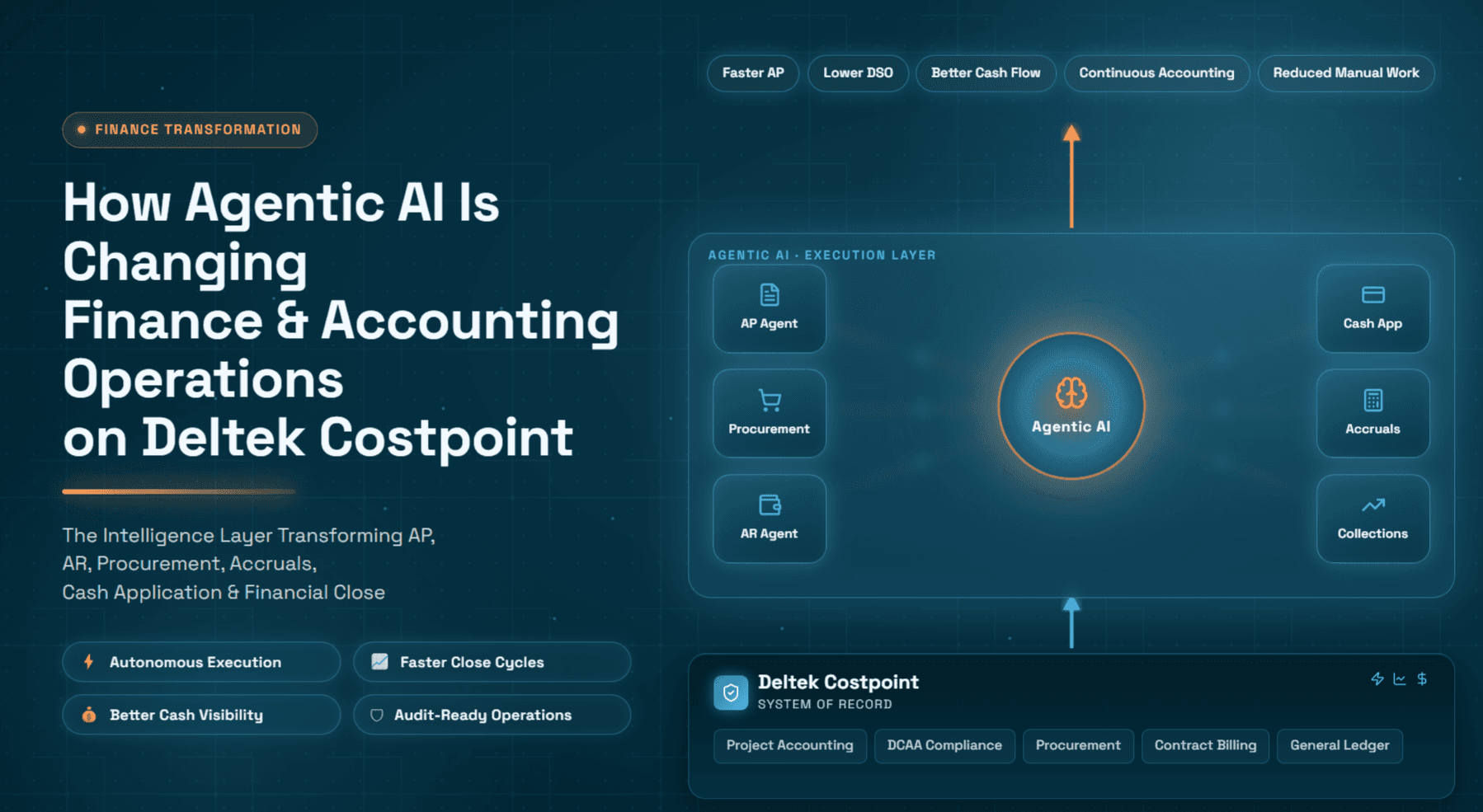
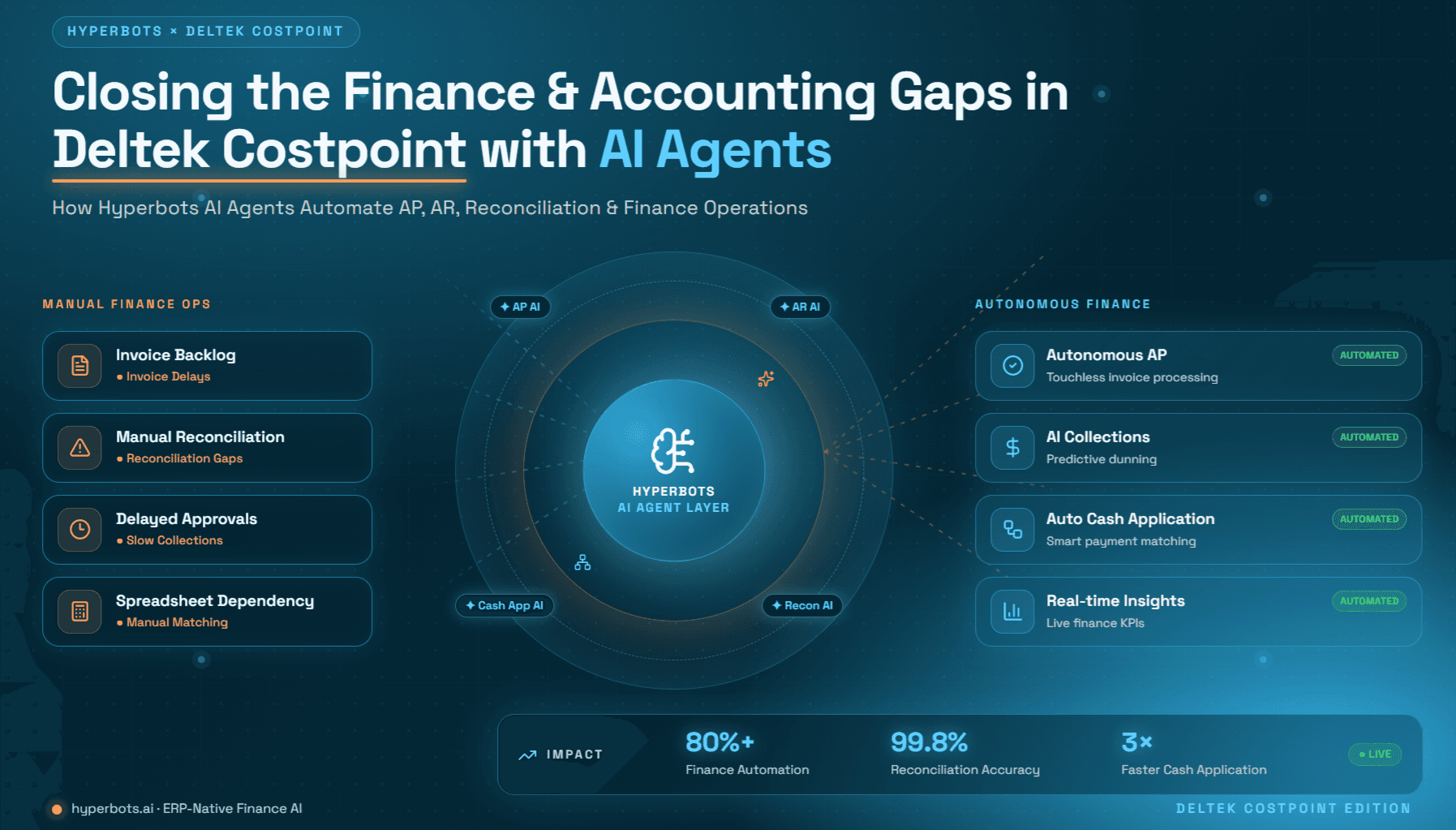
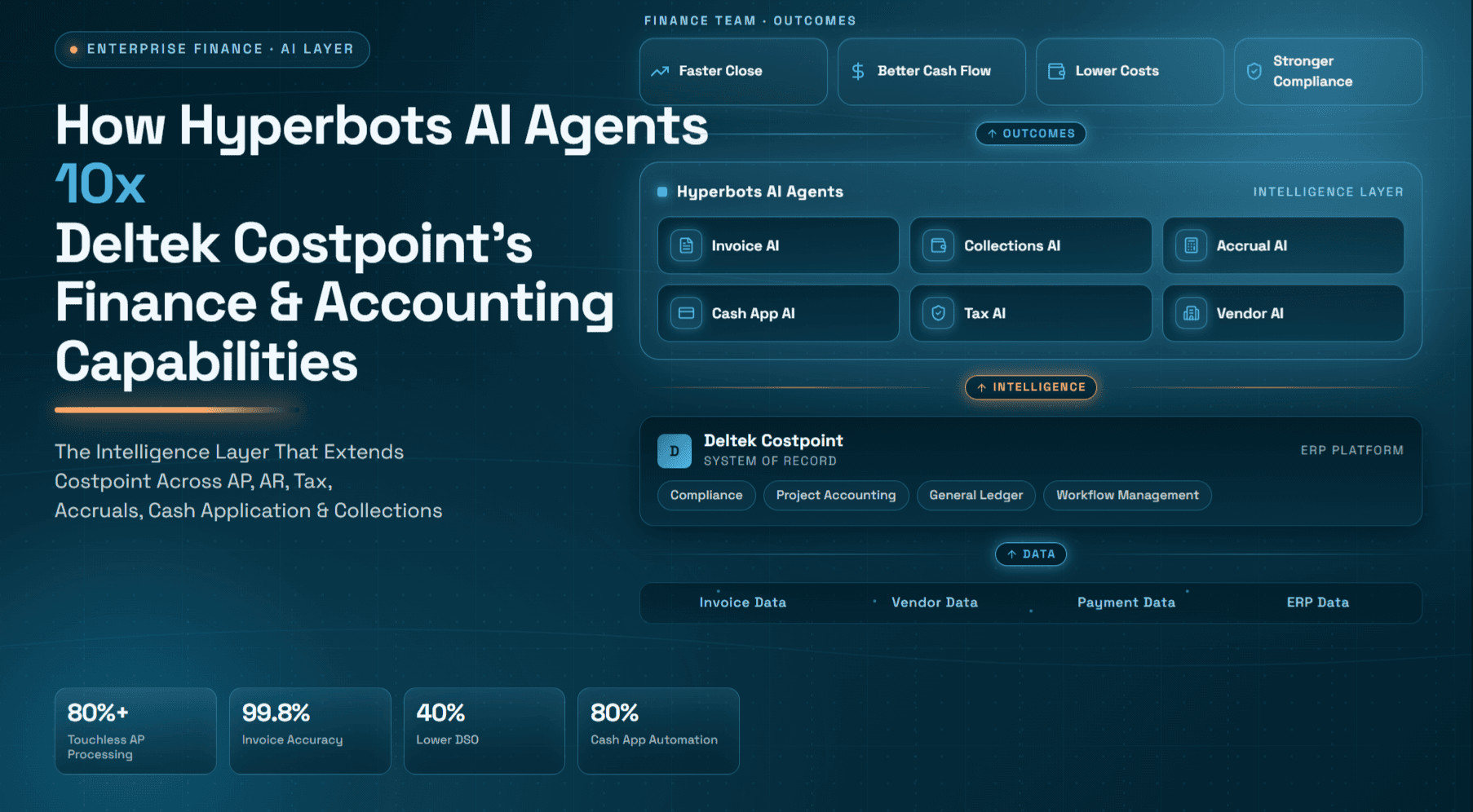
How Hyperbots AI Agents 10x Deltek Costpoint's Finance & Accounting Capabilities
Extend Deltek Costpoint with AI agents that automate finance operations, improve efficiency, and speed up cash flow.
Government contractors have long understood that their financial operating environment is unlike any other. Stringent audit requirements, complex project-based cost structures, multi-contract billing, and the ever-present scrutiny of DCAA compliance create a finance infrastructure demand that few ERP systems can adequately serve.
And Deltek Costpoint has earned its place as the ERP of choice precisely because it was engineered with these realities in mind. Costpoint's project accounting architecture, DCAA audit trail framework, structured procurement workflows, and unified financial data model represent years of deliberate engineering for one of the most demanding operating environments in business.
But the conversation in finance operations is shifting.
The question is no longer whether your ERP can store and process transactions.
It is whether your finance operation can execute intelligently, autonomously, and at scale.
Modern finance organizations are not asking whether to keep Costpoint. They are asking what it looks like to run Costpoint at its full potential with an AI execution layer that handles the operational volume, surfaces real-time intelligence, and frees finance professionals to focus on judgment and strategy.
That is what this post is about.
Why Deltek Costpoint Remains the ERP of Choice for Government Contractors
The strength of Costpoint is not accidental. Deltek built the platform specifically for the operational realities of government contracting, and that specificity is what makes it defensible.
Project Accounting Depth
At the core of Costpoint is a project accounting architecture that handles the complexity of cost-reimbursable contracts, fixed-price contracts, time-and-materials engagements, and mixed-funding structures simultaneously. Cost pools, indirect rate structures, labor distribution, and project-level reporting are natively embedded, not bolted on. For a finance team managing dozens of contracts across multiple agencies, this matters in ways that generic ERP systems simply cannot replicate.
DCAA Compliance as Architecture, Not Add-On
DCAA compliance is not a module in Costpoint, it is embedded in how the system captures and segregates costs. The audit trail architecture, the timekeeping requirements, the labor charging controls, and the cost allocation framework are all designed to withstand a DCAA audit. Finance leaders at government contractors understand the operational peace of mind that provides, particularly in environments where unallowable costs and direct/indirect mischarging can create significant contractual exposure.
Structured Procurement Workflows
Costpoint's procurement module enforces structured workflows, purchase requisition, purchase order issuance, receiving, and invoice matching, within a controlled approval environment. For organizations operating under FAR and DFARS regulations, this structure creates the documentation trail that auditors expect to see.
Unified Financial Visibility
Costpoint's unified data model means that project managers, contracts officers, billing teams, and finance leadership all work from the same underlying financial data. Budget-to-actual variance, unbilled receivables, and project profitability are accessible within a single system, a significant operational advantage compared to environments where ERP and project management systems are fragmented.
The result is a platform that provides strong cost allocation architecture, reduced audit risk, and a reliable foundation for government contractor finance operations. Costpoint is, by any reasonable measure, the right system of record for this environment.
Why Modern Finance Teams Are Layering AI on Top of Costpoint
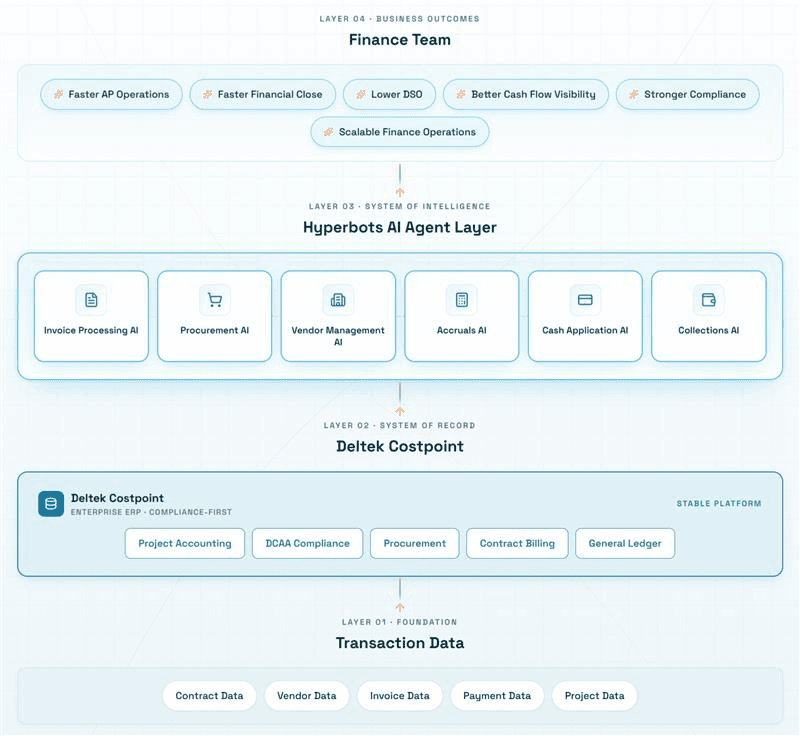
Deltek Costpoint remains one of the strongest ERP platforms for government contractors but finance operations today demand more than structured transaction management.
As organizations grow, finance teams are expected to process larger transaction volumes, manage increasingly complex vendor and customer relationships, accelerate close cycles, improve cash flow visibility, and support faster decision-making, all without proportionally increasing headcount.
This is where the role of AI agents becomes important.
Traditional ERP systems like Costpoint were designed primarily to capture transactions, enforce workflows, and maintain financial records. That foundation remains essential. However, many finance activities surrounding those transactions still rely heavily on manual coordination and operational oversight.
For example:
AP teams still spend time managing invoice exceptions and approval follow-ups
AR teams manually prioritize collections activities and resolve deductions
Accounting teams concentrate reconciliation and accrual work during month-end close
Finance leaders depend on teams to surface anomalies, delays, or operational risks manually
These workflows are operationally intensive because ERP systems are designed around predefined processes and configured rules.
AI agents introduce a different capability layer.
Instead of only executing static workflows, AI agents can continuously analyze patterns, interpret operational context, identify exceptions, and autonomously execute finance tasks across systems.
This changes how finance work gets done inside a Costpoint environment.
Rather than waiting for manual intervention:
AI agents can identify invoice discrepancies automatically
Vendor billing anomalies can be surfaced proactively
Collections activities can be prioritized dynamically based on customer payment behavior
Accrual requirements can be identified continuously throughout the month
Reconciliation workflows can run in the background instead of during compressed close windows
The operational impact is significant because finance teams no longer spend most of their time coordinating transactional workflows manually.
Instead, finance organizations gain:
Faster execution across AP and AR operations
Reduced reconciliation bottlenecks
Improved cash flow visibility
Lower manual workload
Faster financial close cycles
Greater scalability without proportional staffing increases
This is not about replacing ERP systems like Costpoint. It’s about extending them with an intelligence layer capable of learning, reasoning, and executing operational finance workflows autonomously. Costpoint continues to provide the financial control structure government contractors depend on. AI agents enable finance teams to operate on top of that foundation with significantly greater speed, efficiency, and operational intelligence.
Where AI Agents Create the Biggest Operational Impact in Costpoint Environments
As finance organizations modernize operations around Deltek Costpoint, the focus is increasingly shifting from transaction processing to operational execution.
Costpoint already provides the financial structure, compliance controls, and system integrity government contractors depend on. But many finance workflows surrounding the ERP still require substantial manual coordination across AP, AR, procurement, and accounting teams.
This is where AI agents are beginning to reshape finance operations.
Unlike traditional automation tools that rely solely on predefined rules, AI agents can interpret context, recognize patterns, prioritize actions, and execute workflows autonomously across systems. Major ERP and enterprise technology providers are increasingly positioning AI agents as the next operational layer for finance organizations.
AI-Driven Accounts Payable Operations in Costpoint Environments
Accounts payable is often one of the most manually coordinated functions surrounding Costpoint.
Invoices arrive through:
Email attachments
PDFs
Vendor portals
EDI feeds
Scanned documents
Finance teams then validate invoice data, review PO matches, assign accounting codes, resolve discrepancies, and coordinate approvals manually.
AI agents help streamline these workflows by operating continuously in the background.
Modern AI-enhanced AP workflows can:
Extract invoice data automatically
Validate invoices against purchase orders and vendor records
Perform three-way matching
Detect billing anomalies
Route exceptions intelligently
Prioritize approvals dynamically
This allows AP operations inside Costpoint environments to become significantly more exception-driven rather than manually coordinated transaction by transaction.
AI-Powered Procurement and Vendor Coordination
Procurement workflows inside Costpoint often involve multiple stakeholders across purchasing, finance, operations, and vendor management.
Even in highly structured environments, procurement coordination can become operationally fragmented as organizations scale.
AI agents help reduce this friction by automating workflows such as:
Requisition interpretation
Purchase order generation
Vendor communication
Approval orchestration
Status tracking
Exception escalation
Rather than relying on manual follow-ups across emails and spreadsheets, finance and procurement teams gain more continuous visibility into operational status and workflow progression.
This becomes especially valuable in government contracting environments where audit traceability, procurement controls, and documentation consistency are critical.
Continuous Accounting and Faster Financial Close
Month-end close remains one of the most resource-intensive processes for finance teams operating in Costpoint environments.
Accounting teams often spend days:
Reviewing open procurement activity
Identifying accrual requirements
Reconciling balances
Preparing journal entries
Investigating discrepancies
Validating reporting accuracy
AI agents introduce a more continuous accounting model.
Instead of concentrating reconciliation work into a compressed close window, AI-driven finance workflows can:
Monitor transactions continuously
Surface anomalies proactively
Identify accrual requirements earlier
Reconcile balances throughout the month
Assist with journal entry preparation
Research into AI-native ERP operational models suggests that agent-based finance systems can significantly improve workflow execution speed, reduce manual effort, and support more scalable accounting operations.
For finance organizations using Costpoint, this creates the potential for shorter close cycles and improved operational visibility without disrupting existing ERP processes.
Intelligent Contract-to-Cash Operations
On the receivables side, many finance teams using Costpoint still depend heavily on manual collections prioritization, spreadsheet-based tracking, and labor-intensive cash application workflows.
Customer payments frequently arrive with:
Incomplete remittance data
Partial deductions
Non-standard references
Multiple invoices bundled together
AI agents help modernize these workflows by continuously monitoring:
Customer payment behavior
Collection risk patterns
Billing milestones
Deduction trends
Incoming remittance information
This enables more intelligent collections prioritization, faster cash application, improved working capital visibility, and lower unapplied cash balances.
Instead of reacting to AR aging reports after payment delays occur, finance teams gain a more proactive operational view of receivables activity.
The Next Layer of Finance Operations on Top of Costpoint
The broader shift happening across finance organizations is not about replacing ERP systems like Costpoint. It is about extending them with a new operational layer of intelligence powered by agentic AI.
Costpoint continues to provide the financial control framework, project accounting structure, audit readiness, and compliance foundation government contractors rely on every day. What it was not originally designed to do is autonomously interpret unstructured finance data, continuously execute workflows across disconnected systems, resolve operational exceptions through learned patterns, or coordinate finance processes with minimal human intervention.
This is where agentic AI is becoming the next layer of finance operations.
Rather than functioning as static automation scripts or isolated workflow tools, AI agents operate as persistent execution systems on top of the ERP environment. They continuously interact with transaction data, interpret invoice and payment context, identify operational bottlenecks, route approvals intelligently, manage exceptions, monitor collections activity, and synchronize validated outputs back into the ERP while preserving existing controls and governance structures.
For finance organizations running Costpoint, this approach is especially important because ERP disruption is rarely practical. Government contractors often operate within highly interconnected accounting, procurement, compliance, billing, and reporting environments where approval hierarchies, DCAA compliance processes, and audit controls are deeply embedded into day-to-day operations.
As a result, the next generation of finance transformation is increasingly centered on augmentation rather than ERP replacement.
Modern agentic AI platforms integrate directly into existing Costpoint workflows and data structures without requiring finance teams to rebuild their ERP environment. Core financial records, vendor data, project accounting structures, procurement workflows, approvals, and reporting controls continue to remain inside Costpoint as the system of record. The AI layer operates on top of that foundation, extending operational capacity without disrupting the underlying ERP architecture.
This augmentation-based model changes both the speed and economics of finance modernization initiatives. Instead of requiring large-scale ERP reimplementation projects, finance organizations can incrementally modernize targeted workflows across AP, AR, procurement, accounting, and close operations while continuing to operate within the Costpoint environment their teams already trust.
That is the operational shift increasingly shaping the next generation of finance organizations running on Costpoint: not replacing the ERP, but introducing an intelligent agentic execution layer above it. Platforms like Hyperbots are part of this shift, helping finance teams add autonomous operational intelligence on top of established ERP systems like Costpoint while preserving the financial controls and compliance foundations already in place.
How Hyperbots AI Agents Extend Deltek Costpoint’s Finance Operations
For many organizations running Deltek Costpoint, procure-to-pay operations involve far more than invoice entry and PO management.
Finance and procurement teams manage a continuous flow of requisitions, approvals, vendor coordination, invoice validation, accrual processing, tax verification, and payment execution often across multiple entities, contracts, and compliance requirements.
This is where Hyperbots Procure-to-Pay AI Co-Pilots extend Costpoint’s operational capabilities.
Rather than replacing existing procurement and AP workflows inside Costpoint, Hyperbots introduces AI agents that automate operational coordination across the entire procure-to-pay lifecycle while continuing to operate within the ERP’s financial control framework.
Hyperbots Procure-to-Pay Co-pilots
Invoice Processing Co-Pilot
The Invoice Processing Co-Pilot automates invoice capture, extraction, validation, GL coding, PO matching, and ERP posting across complex invoice formats and channels.
AI agents continuously process invoices from emails, PDFs, portals, and EDI feeds while validating line items against purchase orders, vendor records, and receiving data.
Instead of AP teams manually coordinating invoice workflows, exceptions are identified, categorized, and routed intelligently for review.
Organizations using Hyperbots report:
80%+ straight-through invoice processing
99.8% invoice extraction accuracy
Invoice processing times reduced to less than one minute
This allows Costpoint environments to scale AP operations without proportional increases in manual workload.
Procurement Co-Pilot
The Procurement Co-Pilot extends Costpoint’s procurement workflows by automating purchase requisition creation, PO generation, approval routing, and vendor dispatch.
AI agents can:
Extract requisition details from contracts and SOWs
Auto-fill PR fields
Perform budget validation
Recommend GL coding
Detect duplicate requests
Route approvals dynamically
Generate and dispatch purchase orders automatically
Hyperbots reports:
PR creation times reduced to less than 5 minutes
80% reduction in PO creation and dispatch effort
Improved procurement policy compliance across workflows
This significantly reduces procurement coordination overhead while improving operational visibility inside Costpoint.
Vendor Management Co-Pilot
Vendor data quality and onboarding workflows are common operational bottlenecks in large ERP environments.
The Vendor Management Co-Pilot automates vendor onboarding, W-9 verification, duplicate detection, and vendor communication workflows while maintaining structured audit records across interactions.
AI agents help finance teams:
Verify vendor identities automatically
Eliminate duplicate vendor records
Maintain synchronized master data
Provide real-time vendor visibility into invoice and payment status
Organizations using the co-pilot report:
95% reduction in vendor onboarding time
Zero duplicate vendor records
Full audit traceability across onboarding workflows
For Costpoint users managing large supplier ecosystems, this improves operational consistency across procurement and AP operations.
Accruals Co-Pilot
Month-end accrual processing remains one of the most manual accounting workflows in many Costpoint environments.
The Accruals Co-Pilot continuously identifies accrual candidates across:
Goods received but not invoiced
Services performed but not billed
Recurring expenses
Non-PO procurement activity
AI agents automatically prepare accrual entries, synchronize postings into the ERP, and manage intelligent reversals when invoices arrive.
Hyperbots reports:
80% reduction in accrual processing effort
Less than 5% variance between accrued and actual costs
Automated booking and reversal workflows with full audit trails
This helps accounting teams reduce month-end close pressure while improving reporting accuracy.
Payments Co-Pilot
The Payments Co-Pilot extends Costpoint’s payment operations with AI-driven payment timing optimization and payment execution controls.
AI agents continuously analyze:
Vendor payment terms
Early payment discount opportunities
Cash flow priorities
Approval status
Invoice readiness
The system can then recommend and execute optimized payment schedules while preventing duplicate payments and maintaining full reconciliation integrity.
Organizations using the co-pilot report:
Up to 10% reduction in cash outflow through payment optimization
Zero duplicate payments
100% invoice-to-payment validation before release
This gives finance teams greater working capital control without disrupting existing Costpoint payment workflows.
Sales Tax Verification Co-Pilot
Sales and use tax validation remains difficult to manage manually across high invoice volumes and multi-jurisdiction procurement environments.
The Sales Tax Verification Co-Pilot validates invoice tax calculations at the line-item level before posting and payment.
AI agents verify:
Tax applicability
Jurisdictional accuracy
Exemption handling
Tax rate consistency
Origin and destination tax rules
Hyperbots reports:
100% automated invoice tax verification
Less than 0.2% tax discrepancy rates
Full tax audit traceability across invoice workflows
For Costpoint environments operating across multiple entities, states, and compliance requirements, this significantly reduces tax validation risk and manual review effort.
Procure-to-Pay ROI
Metrics | Costpoint alone | With Hyperbots | Operational Impact |
Invoice processing time | 8–12 day invoice cycle times are common in manual AP environments such as Costpoint | Hyperbots processes invoices in <1 minute | 99%+ reduction in invoice processing time |
Straight-through invoice processing | Typical ERP-centric AP teams achieve ~15–25% touchless processing | Hyperbots achieves 80% STP | 3.2×–5.3× higher touchless processing rate |
Invoice extraction accuracy | Traditional OCR systems typically achieve only 85–90% accuracy | Hyperbots delivers 99.8% extraction accuracy | 50×–75× reduction in manual correction requirements |
AP manual workload | AP teams often spend 60–70% of capacity on manual entry and exception handling | Hyperbots automates matching, validation, and GL coding | 4×–5× reduction in manual AP workload |
Early payment discount capture | Most organizations capture <40% of available discounts | Hyperbots captures 100% of all early payment discounts automatically | 2.5×+ improvement in discount capture potential |
Hyperbots Order-to-Cash (O2C) Co-Pilots
Hyperbots Order-to-Cash (O2C) Co-Pilots complement Deltek Costpoint’s strong receivables and project accounting foundation by introducing AI-driven automation into the operational workflows that typically remain manual across cash application, collections, and dispute management.
The Cash Application Co-Pilot enhances Costpoint’s AR infrastructure by automating the reconciliation of incoming payments against open invoices, including complex remittance scenarios such as partial payments, consolidated customer payments, short pays, and non-standard remittance formats. Instead of finance teams manually interpreting remittance data and applying cash line by line, the co-pilot continuously processes and reconciles transactions in real time, accelerating AR close cycles, improving cash visibility, and reducing unapplied cash balances without disrupting Costpoint’s existing accounting controls.
The Collections Co-Pilot builds on Costpoint’s receivables framework by introducing intelligent prioritization and automated engagement workflows into the collections process. Rather than relying solely on aging reports and manual follow-ups, the co-pilot analyzes payment behavior, dispute history, customer responsiveness, and risk indicators to dynamically prioritize collection actions. Standard outreach workflows are automated directly within the collections cycle, while higher-risk or dispute-heavy accounts are escalated intelligently for finance review. This enables organizations to improve collections consistency, shorten dispute resolution cycles, and reduce DSO while continuing to operate within Costpoint’s established financial governance structure.
Order-to-Cash ROI
Metric | Costpoint Alone / ERP-Centric Reality | With Hyperbots | Operational Impact |
Cash application automation | Manual and ERP-centric AR environments don’t automate cash application, with payment matching and reconciliation heavily dependent on human intervention. | Hyperbots achieves 80–90% straight-through cash application using AI-driven remittance extraction, intelligent matching, and autonomous ERP posting | 4×–9× higher cash application automation, enabling faster reconciliation and reduced AR processing costs |
Days Sales Outstanding (DSO) | ERP-centric collections workflows rely on static aging buckets, manual follow-ups, and delayed dispute identification, contributing to elevated DSO | Hyperbots delivers ~40% DSO reduction through AI-driven prioritization and autonomous follow-ups | Up to 1.6× faster cash-conversion cycle |
Cost-to-collect | Traditional collections environments require large amounts of manual outreach, dispute handling, and tracking effort | Hyperbots uses AI-driven prioritization of accounts, automated tailored follow-ups minimizing human intervention | 70% reduction in cost-to-collect |
Reconciliation cost | ERP-centric reconciliation workflows remain labor-intensive due to manual extraction and matching of remittance | Hyperbots delivers 99.8% remittance extraction accuracy with AI-driven autonomous matching and reconciliation workflows | 80% reduction in reconciliation cost |
Unapplied cash levels | Traditional AR environments often maintain unapplied cash balances near 40% due to delayed matching and exception handling | Hyperbots reduces unapplied cash to <10% through AI-driven matching and exception resolution | 75% reduction in unapplied cash |
The Intangible ROI
Beyond the quantifiable metrics, organizations that deploy Hyperbots AI agents alongside Costpoint report qualitative improvements that are harder to measure but equally consequential.
Reduced finance staff burnout. The AP and AR functions in government contractor environments are heavily manual and highly repetitive. Intelligent automation removes the processing work that exhausts experienced staff, allowing them to focus on judgment-intensive activities, vendor relationship management, dispute resolution, and analytical support for operations.
Better audit readiness. Policy-driven AI automation produces consistent, documented decision trails. Every invoice extraction, coding decision, and exception resolution is logged with the reasoning behind it, creating an audit record that is more complete and more defensible than manual processes.
Improved CFO visibility. When AP and AR workflows are automated and data flows to Costpoint in real-time, the CFO and controller gain operating visibility that periodic reporting cannot provide. Cash position, aging dynamics, and accrual status become live data rather than reported data.
Scalable finance operations. Government contractors that win new contracts or expand existing ones face the operational challenge of scaling finance capacity quickly. AI co-pilots provide elastic capacity, absorbing higher invoice volumes and collections workloads without proportionate headcount increases.
You can quantify these outcomes for your specific environment using Hyperbots' suite of ROI calculators.
From ERP to Intelligent Finance Operations
The trajectory of finance operations at government contractors is clear. Costpoint will remain the essential system of record, the compliance architecture, the cost accounting engine, the audit foundation, for the foreseeable future. That is appropriate. It does what it was built to do with a depth of capability that general-purpose ERP systems cannot match in this environment.
What is changing is the expectation of what finance operations should look like above the ERP layer. The finance function that spends its human capital keying invoice data, chasing accrual entries, and manually matching cash payments is not operating strategically. It is operating as a data entry and exception management function, a role that AI agents are well-suited to absorb.
Multi-agent AI collaboration in finance represents a genuine shift in how finance operations are structured. Each co-pilot handles a defined domain such as invoice processing, vendor management, accruals, collections while sharing data and context across workflows. The result is a finance operation that is more consistent, more scalable, and more analytically capable than one that relies on human processing for routine transactions.
For the CFO and controller building the finance organization for the next phase of growth, the question is no longer whether to augment Costpoint with intelligent automation. The question is where to begin, and how to sequence the deployment for maximum operational impact.
If you're exploring ways to make Costpoint workflows more efficient, it can be helpful to see how AI agents fit into real finance operations from invoice processing and cash application to collections and reconciliation.
You can request a personalized walkthrough focused on the workflows your team manages every day, or start a free trial to explore how intelligent automation integrates with your existing Costpoint environment.
Frequently Asked Questions
Q1. What is Deltek Costpoint used for in government contracting?
Deltek Costpoint is an ERP system purpose-built for government contractors and project-based organizations. It handles project accounting, DCAA-compliant timekeeping, contract billing, procurement, and financial reporting within the regulatory framework of federal contracting. Its core strength is managing indirect cost structures, cost pools, and project-level financial data in a format designed to withstand DCAA audit scrutiny.
Q2. Can AI automate accounts payable in a Deltek Costpoint environment?
Yes. AI co-pilots like those provided by Hyperbots integrate directly with Costpoint to automate invoice capture, data extraction, GL coding, 3-way matching, exception handling, and posting. This enables straight-through processing for clean invoices while routing true exceptions to AP staff for resolution, reducing invoice cycle time from days to hours without bypassing Costpoint's financial controls.
Q3. What is the procure-to-pay process in Costpoint?
The procure-to-pay (P2P) process in Costpoint encompasses purchase requisition creation, PO approval and issuance, receiving, invoice processing, and payment. Costpoint enforces structured approval workflows and maintains audit documentation across the process. AI co-pilots extend this by automating the processing-intensive steps such as invoice extraction, matching, coding, and vendor communication while Costpoint continues to serve as the system of record.
Q4. How does AI improve order-to-cash operations for government contractors?
AI improves order-to-cash (O2C) by automating cash application, intelligently prioritizing collections activity, and accelerating dispute resolution. Automated cash application eliminates the manual matching work that delays AR reconciliation and inflates DSO. Collections co-pilots provide systematic outreach based on behavioral scoring rather than manual aging review, producing more consistent follow-through and measurable DSO reduction.
Q5. How does Hyperbots integrate with Deltek Costpoint?
Hyperbots integrates with Costpoint through pre-built connectors that enable bidirectional data synchronization. AI co-pilots read vendor master data, PO records, contract data, and GL structures from Costpoint, execute their processing workflows, and post validated transactions back to Costpoint. The integration is designed to preserve Costpoint as the authoritative system of record while adding autonomous processing capabilities on top of it.
Q6. What is the ROI of adding AI co-pilots to a Costpoint deployment?
ROI from AI co-pilots in a Costpoint environment typically includes: reduction in invoice processing cost per invoice, compressed AP cycle times, increased early payment discount capture, DSO reduction through improved cash application and collections, and reduced month-end close effort from accrual automation. Organizations in comparable finance environments have reported 80%+ reductions in manual AP workload and 15–25% DSO reductions. Hyperbots provides ROI calculators to model the expected impact for specific transaction volumes and staffing profiles.
Q7. What is the difference between an ERP system of record and a system of intelligence?
A system of record, like Costpoint, captures transactions, enforces configured rules, and produces financial reports based on historical data. It does what it is configured to do, consistently and reliably. A system of intelligence, like Hyperbots, learns from patterns in data, reasons about exceptions, makes autonomous decisions within defined parameters, and improves over time. The two are complementary: the ERP provides the data foundation and compliance architecture; the intelligence layer provides the autonomous processing and analytical capability.
Q8. Can Hyperbots AI agents handle accruals in a Costpoint environment?
Yes. The Accruals Co-Pilot automatically discovers accrual candidates, including goods received but not invoiced, services performed without a corresponding invoice, and recurring expenses without active POs, based on Costpoint data. It calculates accrual amounts, books journal entries, and manages reversals in the subsequent period. This transforms month-end accrual management from a multi-day manual process into a largely automated workflow that requires only exception review and controller approval.
Q9. Is AI automation in finance appropriate for DCAA audit environments?
Properly implemented AI automation is well-suited to DCAA audit environments. AI co-pilots generate comprehensive audit trails, logging every extraction decision, coding assignment, exception resolution, and posting action with full context. This level of documentation is often more complete and more consistent than manual processes. Finance leaders evaluating AI automation in a government contracting context should assess the explainability and audit trail capabilities of any platform under consideration to ensure alignment with DCAA documentation standards.