Closing the Finance & Accounting Gaps in Deltek Costpoint with Hyperbots AI Agents
How AI Agents Eliminate Manual Bottlenecks, Improve Financial Accuracy, and Extend the Operational Capabilities of Deltek Costpoint
Government contractors and defense-sector businesses invest heavily in Deltek Costpoint. It handles project accounting, DCAA compliance, and cost tracking with a depth that general-purpose ERPs cannot match. For that specific purpose, it is well-regarded and for good reason.
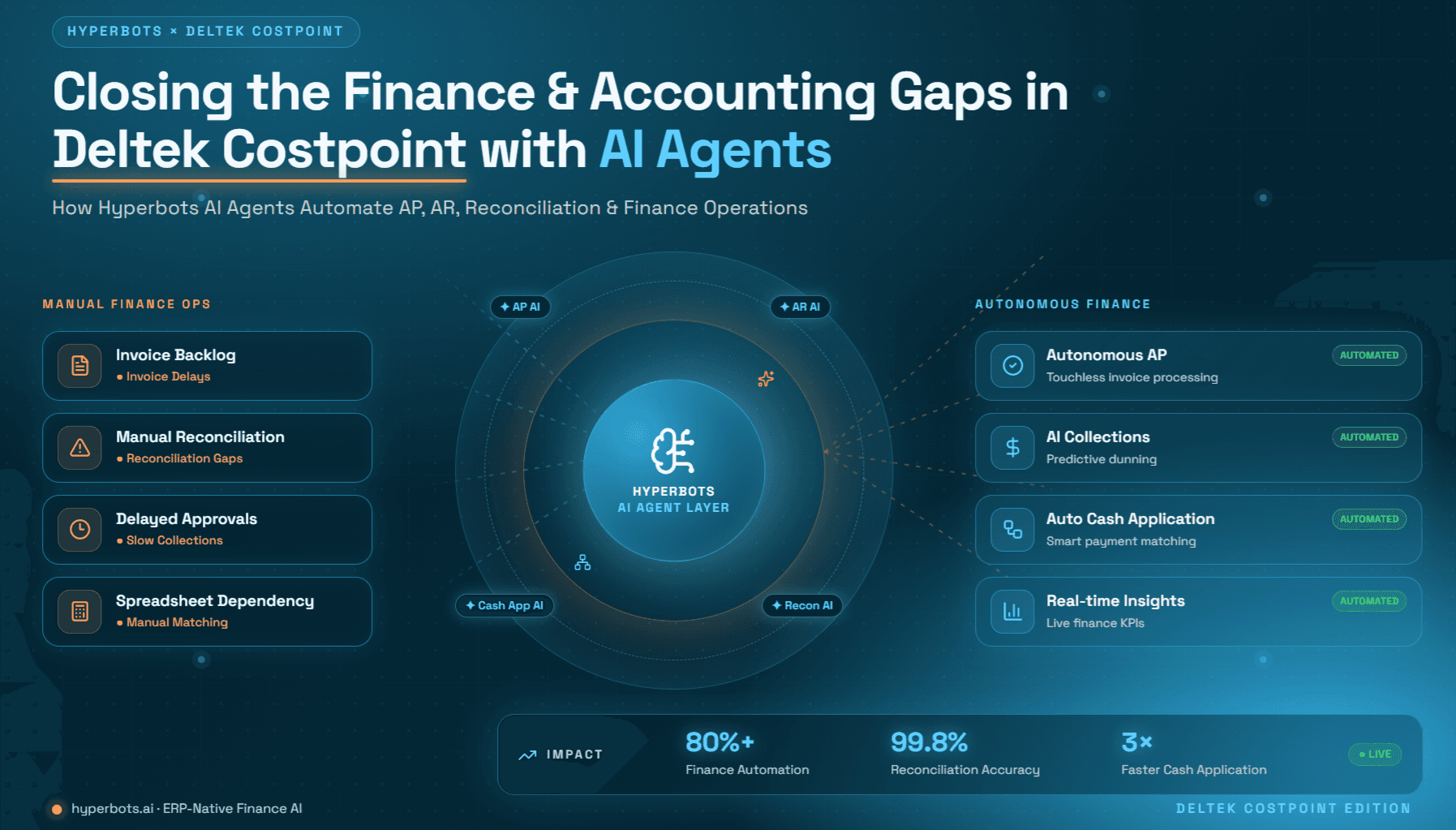
But here is the reality that CFOs and controllers in these environments rarely say out loud: Costpoint was built to record transactions, not to run finance operations intelligently. And the gap between those two things is costing organizations far more than most have bothered to calculate.
Invoice queues pile up. Exception backlogs stretch for days. Month-end accruals still depend on individual judgment calls made under deadline pressure. Vendor disputes drag on through email chains. Early payment discounts expire uncaptured because the AP cycle is simply too slow. And through all of it, the system keeps running, recording faithfully, processing obediently, but never once surfacing a pattern it wasn't explicitly programmed to look for.
This is not a failure of Costpoint. It is an architectural reality of every ERP built on rule-based logic. Understanding the specific gaps that reality creates and what it takes to close them is what this post is about.
Why ERPs Like Costpoint Have Structural Limits
To understand why Costpoint leaves these gaps, it helps to understand how ERPs are architected. They are, at their core, systems of record. They execute workflows defined during implementation, enforce business rules configured by administrators, and record transactions with high fidelity. Accuracy and compliance are their design priorities.
What ERPs are not designed to do is reason. They cannot learn from patterns in the data they record. They cannot handle inputs that fall outside their configured parameters without escalating to a human. They cannot take autonomous action, surface predictive intelligence, or adapt to exceptions in any way that wasn't explicitly anticipated during setup.
This architectural reality is not unique to Costpoint, it is true of SAP, Oracle, NetSuite, and every other major ERP on the market. But for government contractors, who operate in complex, high-compliance, high-volume finance environments, the consequences of these limits are particularly acute. When procure-to-pay processes depend on human intervention at every exception point, the operational cost compounds quickly.
The Finance & Accounting Gaps Costpoint Leaves Open
1. Invoice Processing Is Still Largely Manual
Despite Costpoint's workflow coverage, accounts payable in most Costpoint environments is a high-touch operation. Invoices arrive in multiple formats such as PDF attachments, email submissions, portal uploads, paper scans and each requires human review and data entry before it can move through the system. Even organizations that have layered OCR tools on top of Costpoint find that extraction accuracy on non-standard invoice formats is low enough to require manual correction on a significant share of documents.
The result is predictable: processing backlogs, delayed payments, and AP teams spending the majority of their capacity on data entry rather than financial work. APQC benchmarks place manual invoice processing costs between $12 and $30 per invoice, with most organizations today clustering around $15–$20 depending on complexity, exception rates, and process maturity - a figure that scales brutally in high-volume environments. And critically, for government contractors whose invoice formats vary widely across federal agencies, commercial subcontractors, and international vendors, the variability problem is worse than average.
Costpoint does not solve this. It processes invoices that have already been entered correctly. The work of getting them there remains almost entirely on the finance team. Exploring what future-ready invoice processing actually looks like makes the native Costpoint gap starkly visible.
2. Exception Handling Has No Intelligence Layer
Three-way matching in Costpoint is binary: invoices either match the purchase order and goods receipt or they don't. When they don't, the invoice stops and a human picks it up. There is no mechanism within Costpoint to triage exceptions by complexity, suggest resolutions based on historical patterns, or distinguish between a $12 variance that should be auto-approved within tolerance and a $12,000 discrepancy that signals a genuine problem.
Every exception, regardless of its nature, risk level, or likely resolution, receives the same treatment: manual review. In practice, this means experienced AP professionals spend a disproportionate share of their time on low-complexity issues that have obvious resolutions, while genuinely complex exceptions compete for the same limited queue space. Exception queues accumulate. Payment cycles extend. Vendor relationships deteriorate.
Platforms built specifically for intelligent exception handling in AP workflows consistently demonstrate 60–70% reductions in manual exception resolution time. None of that capability exists within Costpoint's native architecture.
3. There Is No Anomaly Detection
Perhaps the most consequential gap in Costpoint's finance and accounting coverage is the absence of any anomaly detection capability. The system enforces its configured rules reliably, checking for duplicate invoice numbers, validating against approval thresholds, enforcing budget controls. What it cannot do is analyze patterns across the full transaction dataset and surface statistical deviations that fall below the threshold of individual rule triggers.
This matters enormously in practice. Vendor fraud rarely announces itself through obvious rule violations. It exploits the space between rules: slightly altered invoice numbers, payment terms quietly changed in vendor master records, duplicate submissions with just enough variation to pass automated checks, tax codes systematically miscoded to non-taxable categories. These patterns are invisible to a rule-based system. They are exactly what machine learning-driven fraud and anomaly detection in finance is designed to surface.
The Association of Certified Fraud Examiners estimates that organizations lose approximately 5% of revenues to fraud annually, with a median loss per incident exceeding $145,000. For government contractors, where unallowable cost misclassification and billing fraud carry regulatory consequences beyond the direct financial loss, the absence of anomaly detection in Costpoint is a material compliance risk, not just an operational inconvenience.
4. Vendor Communication Is Fragmented and Manual
When an invoice is rejected or placed on hold in Costpoint, notifying the vendor, resolving the dispute, and updating the system record are manual steps that happen outside the ERP typically via email, phone, or a disconnected vendor portal. There is no structured, automated communication layer built into Costpoint's AP workflow.
The operational cost of this fragmentation is significant. Vendors who don't receive timely status updates frequently resubmit invoices, creating duplicate entries that generate more exceptions. Disputes that could be resolved in a single structured interaction stretch across multiple email threads and days of elapsed time. Payment cycles extend not because the finance team is slow, but because the communication infrastructure they're relying on was never designed for the pace modern AP operations require.
A well-implemented vendor management automation approach eliminates this fragmentation entirely. Costpoint does not offer it natively.
5. Real-Time Financial Intelligence Is Absent
Costpoint is a strong system of record. It stores transaction data with precision and supports structured reporting through its built-in analytics tools. But generating meaningful, forward-looking financial intelligence from Costpoint data in real time is not something the platform does well.
Understanding cash flow position based on open commitments, payment cycle performance, or vendor discount capture requires exporting data to external tools, building custom queries, or relying on Finance to manually construct the analysis. The result is a persistent lag between operational reality and financial awareness typically days to weeks depending on the reporting cadence in place.
For decisions that require real-time data like payment timing optimization, working capital management, early payment discount capture, this lag is far from a minor inconvenience. It’s a structural barrier to the kind of AI-driven cash flow optimization that finance organizations operating at peak efficiency have already implemented.
6. Month-End Close Depends Heavily on Human Judgment
Even though Costpoint's integrated project billing and cost allocation modules accelerate close relative to pre-ERP manual processes, month-end close in most Costpoint environments still involves significant unstructured manual work, particularly around accruals.
Identifying unbilled liabilities, discovering services and goods received but not yet invoiced, and making the period-end accrual decisions that drive accurate financial statements require Finance to review open purchase orders, contact project managers, and apply judgment under deadline pressure. In organizations with large project portfolios, this becomes a genuine bottleneck, not because people are working inefficiently, but because the process is inherently human-intensive and Costpoint provides no automation to assist with it.
The accrual automation gap in Costpoint is one of the most direct drivers of close cycle length. Advanced finance automation, including accrual discovery and reconciliation, can reduce close cycles by up to 50%, far beyond what ERP-native capabilities alone can achieve.
7. Tax Compliance Operates on Outdated Assumptions
Costpoint's tax engine validates against tax dictionaries. It knows the rules as they were configured at implementation. What it cannot do is monitor the contextual factors that determine whether those rules still apply: whether a vendor's exemption certificate has expired, whether a shipment destination has moved a transaction into a different tax jurisdiction, or whether a line-item categorization that was correct last year remains correct under current tax law.
The practical consequence is a category of tax liability that accumulates silently. Vendors continue to invoice as tax-exempt against certificates that expired months ago. Domestic invoices get treated as export transactions with zero-tax status. Tax code mismatches on individual line items aggregate into meaningful compliance exposure over time. One analysis found a CFO who identified $200,000 in tax leakage that had been accumulating undetected in exactly this way, invisible to the ERP, visible only when AI-driven validation was applied.
8. GL Coding Is Error-Prone and Inconsistently Applied
GL coding in Costpoint relies heavily on AP staff to manually assign the correct expense account to every non-PO invoice at the point of entry. In environments with hundreds of active cost centers, project codes, and indirect pools, this is a task that demands both institutional knowledge and consistent attention, neither of which scales well under volume pressure.
The consequences of miscoding are not trivial. A misclassified expense that lands in the wrong indirect cost pool can distort burden rates, affect contract billing, and create findings in a DCAA audit. An unallowable cost coded to an allowable pool creates regulatory exposure that may not surface until months later when the incurred cost submission is reviewed. And because Costpoint does not learn from historical coding patterns, the same errors recur with each new AP processor or staff turnover event.
Ensuring accurate GL coding of expenses is foundational to financial reporting integrity, yet Costpoint leaves this entirely to human judgment, with no AI-driven suggestion, no pattern-based learning, and no proactive error flagging before posting.
9. Cash Application in AR Is a Manual Bottleneck
On the receivables side, Costpoint's cash application process is largely manual. When payments arrive, via ACH, check, wire, or customer portal, AR teams must extract remittance information, interpret often incomplete or ambiguous remittance advice, and manually match each payment to the correct open invoices. When remittance data arrives in non-standard formats across email, bank portals, and customer-specific templates, this becomes a time-consuming reconciliation exercise that delays cash posting and keeps invoices in open status longer than necessary.
The downstream effects compound quickly. Unapplied cash accumulates on the books, distorting the true AR picture. Invoices that have effectively been paid remain open in Costpoint, triggering unnecessary collection follow-ups that damage customer relationships. Finance teams spend hours each week on reconciliation work that should be automated, and cash flow forecasts built on the AR aging report are structurally unreliable because the data they draw from is always partially stale.
Costpoint provides no AI-driven matching, no ability to reconstruct missing remittance details from payment context, and no mechanism for reducing the exception rate on ambiguous payments. The AR automation gap, particularly in cash application, is one of the most direct and measurable contributors to elevated DSO in Costpoint environments.
10. Collections Are Reactive, Not Intelligent
Costpoint's receivables aging report is the primary tool most government contractor finance teams rely on to manage collections. It shows which invoices are overdue and by how long. It does not tell you which customers are most likely to pay, which accounts represent the highest cash recovery priority, or which invoices are approaching dispute territory based on behavioral signals in the data.
The result is a collections process that is static and reactive by design. AR teams work down aging buckets sequentially, 30 days, 60 days, 90 days, sending standardized follow-ups based on elapsed time rather than customer-specific intelligence. High-value accounts that show early behavioral signs of payment delay receive the same treatment as low-risk customers who simply haven't processed payment yet. Disputes are identified late, often only when a customer fails to respond rather than when the underlying issue first appears in the data.
This approach is not just inefficient, it is structurally incapable of reducing DSO meaningfully. Real improvement in Days Sales Outstanding requires dynamic prioritization based on customer payment behavior, risk scoring, and real-time signals, precisely the kind of AI-driven collections intelligence that Costpoint's native AR functionality cannot provide.
The Business Impact of These Gaps on P2P and O2C
These gaps do not exist in isolation. They compound across the procure-to-pay cycle and order-to-cash operations in ways that create measurable financial drag.
Despite Net 30 contractual terms, government contractors frequently experience 60–90 day payment cycles in practice, driven by acceptance delays and billing dependencies, turning theoretical payment terms into a working capital constraint which erodes working capital and eliminates the early payment discount window entirely. Early payment discount programs offering 1–2% for 10-day payment represent significant annualized returns; AI's ability to capture missed early payment discounts is directly correlated with invoice processing speed that manual Costpoint workflows cannot reliably deliver.
On the order-to-cash side, the absence of automated cash application and collections intelligence means AR teams are manually matching payments to open invoices, following up on overdue accounts through manual outreach, and managing dispute resolution through disconnected communication channels, all while DSO drifts upward and the cost to collect rises.
Tax leakage accumulates silently. Audit exposure grows with every undocumented exception resolution and every accrual judgment made without a structured audit trail. And through all of it, the finance team is working harder than it should be, on tasks that don't require the expertise they were hired to bring.
How Hyperbots AI Agents Close These Gaps
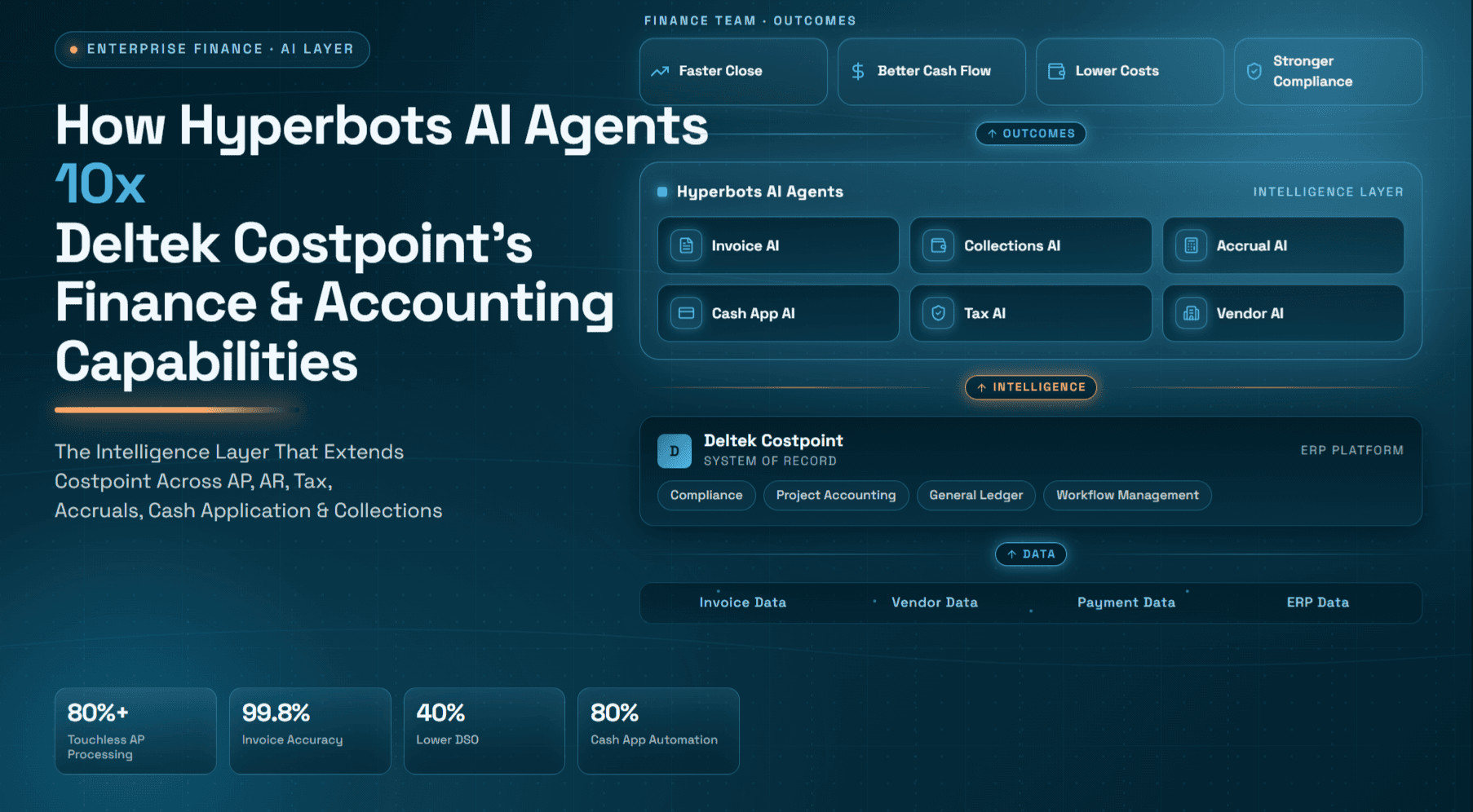
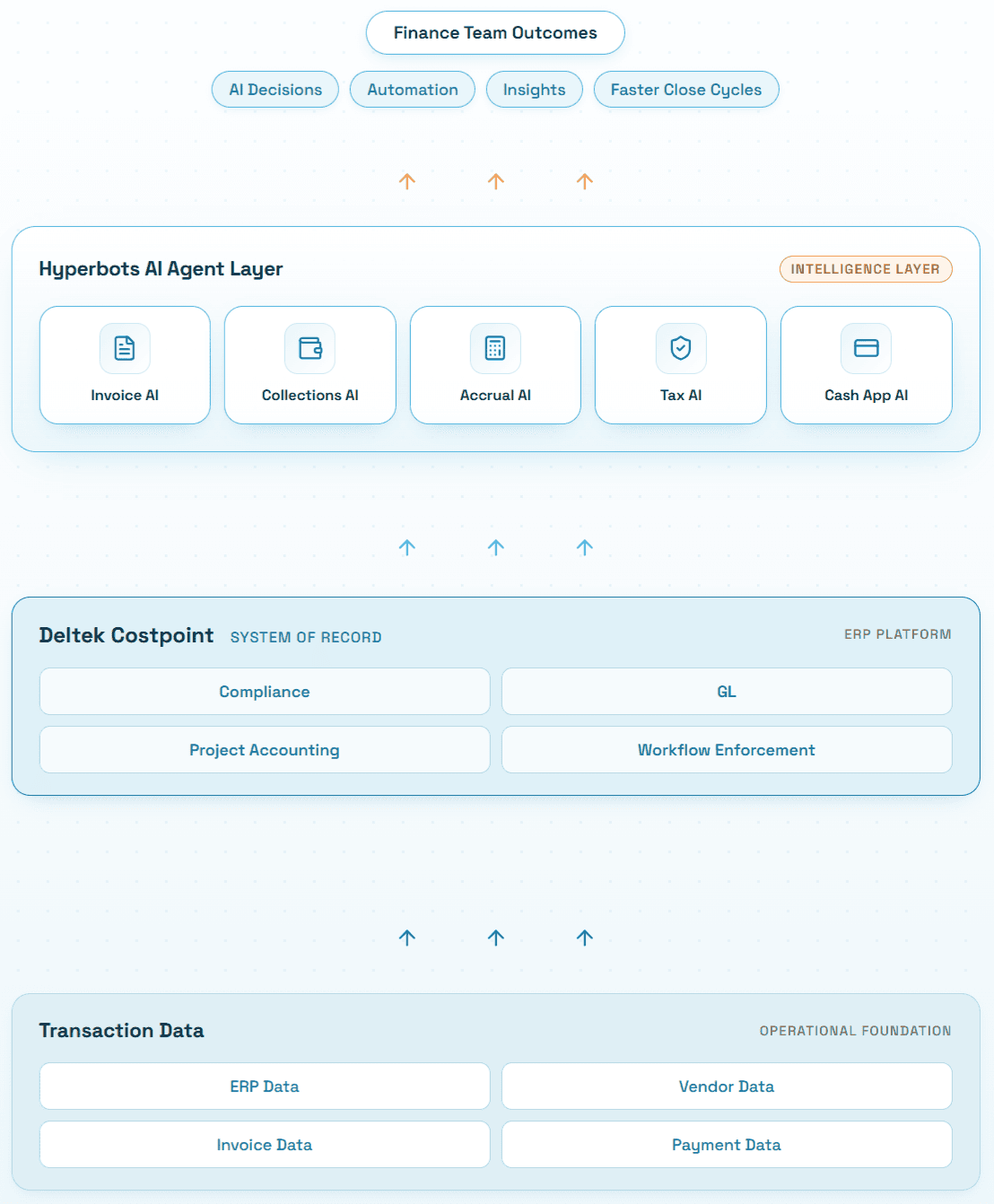
Hyperbots AI agents do not replace Costpoint. They layer intelligence on top of it, operating on Costpoint's data and workflows to add the autonomous processing, pattern recognition, and predictive capability the ERP cannot provide on its own. The relationship is one of augmentation, not displacement, as explored in detail in analyses of how AI complements ERP systems.
The integration is designed for rapid deployment. Pre-trained AI co-pilots built on financial domain data go live in days rather than months, without extended implementation projects, making the path from current-state Costpoint operations to AI-augmented finance measurable in weeks.
Hyperbots Procure-to-Pay Co-Pilots
Hyperbots' Procure-to-Pay software brings a suite of purpose-built AI co-pilots that each address a distinct gap in the Costpoint P2P workflow:
Invoice Processing Co-Pilot automatically captures invoices from email, portals, and files; extracts data at 99.8% accuracy across complex, multi-page, and multi-lingual formats; performs 2-way and 3-way PO matching; and posts clean invoices directly to Costpoint, achieving over 80% straight-through processing with less than one minute of processing time per invoice. GL coding is assigned automatically using vendor history, chart of accounts, and ERP data, with AI reasoning shown for every recommendation.
Procurement Co-Pilot auto-fills purchase requisition fields from contracts and statements of work, runs real-time budget and duplicate checks, routes approvals intelligently, and auto-converts approved PRs into vendor-dispatched POs, reducing PR creation time to under 5 minutes and cutting PO creation and dispatch time by 80% while maintaining 100% policy and budget compliance.
Vendor Management Co-Pilot verifies vendor identities and W-9 documents, eliminates duplicate records, consolidates redundant vendors, and provides a secure portal with real-time PO, invoice, and payment visibility, reducing vendor onboarding time by 95% and maintaining 100% audit traceability across every onboarding action.
Accruals Co-Pilot automatically discovers accruals across goods received, services received but not invoiced, and recurring non-PO expenses, booking them to Costpoint with full GL coding and audit trails, and reversing intelligently when invoices arrive. This delivers less than 5% variance in accrued versus actual costs and an 80% reduction in accrual processing effort.
Payments Co-Pilot recommends optimal payment timing by analyzing terms, cash flow, vendor priorities, and cost of capital, capturing early payment discounts, detecting fraud and duplication, and automating secure payment execution. The result: zero duplicate payments, 10% reduction in cash outflow, and 100% payment-to-invoice matching before any disbursement is released.
Sales Tax Verification Co-Pilot validates tax rates, jurisdictions, and exemptions at the invoice line-item level before posting and payment, achieving 100% automated verification and less than 0.2% tax discrepancy rate across processed invoices, with full tax audit traceability.
Procure-to-Pay ROI :
Metrics | Costpoint alone | With Hyperbots | Operational Impact |
Invoice processing time | 8–12 day invoice cycle times are common in manual AP environments such as Costpoint | Hyperbots processes invoices in <1 minute | 99%+ reduction in invoice processing time |
Straight-through invoice processing | Typical ERP-centric AP teams achieve ~15–25% touchless processing | Hyperbots achieves 80% STP | 3.2×–5.3× higher touchless processing rate |
Invoice extraction accuracy | Traditional OCR systems typically achieve only 85–90% accuracy | Hyperbots delivers 99.8% extraction accuracy | 50×–75× reduction in manual correction requirements |
AP manual workload | AP teams often spend 60–70% of capacity on manual entry and exception handling | Hyperbots automates matching, validation, and GL coding | 4×–5× reduction in manual AP workload |
Early payment discount capture | Most organizations capture <40% of available discounts | Hyperbots captures 100% of all early payment discounts automatically | 2.5×+ improvement in discount capture potential |
Hyperbots Order-to-Cash Co-Pilots
On the receivables side, Hyperbots' AR automation software addresses the collections and cash application gaps that Costpoint's native AR functionality leaves unresolved:
Collections Co-Pilot replaces static aging-bucket-based follow-up with finance-trained AI that dynamically prioritizes accounts and invoices based on customer payment behavior, risk, and value. It automates follow-ups, tracks promises-to-pay, and resolves disputes faster, delivering a near 40% reduction in DSO and a 70% reduction in cost-to-collect. Instead of working down a manual list, AR teams are directed to the highest-impact accounts with full context on each customer's payment history and current risk profile.
Cash Application Co-Pilot automatically extracts remittance data from emails, bank portals, and customer-specific formats; reconstructs missing or ambiguous remittance details; and matches payments to open invoices, even in complex scenarios involving short payments, deductions, and aggregated bulk transactions. It achieves 80% straight-through cash posting and a 10% reduction in unapplied cash, posting results directly back to Costpoint with full audit trails. The manual reconciliation work that currently stretches AR close cycles is effectively eliminated.
Together, these co-pilots give Costpoint environments the intelligence layer across both P2P and O2C that the ERP was never designed to provide.
Order-to-Cash ROI :
Metric | Costpoint Alone / ERP-Centric Reality | With Hyperbots | Operational Impact |
Cash application automation | Manual and ERP-centric AR environments don’t automate cash application, with payment matching and reconciliation heavily dependent on human intervention. | Hyperbots achieves 80–90% straight-through cash application using AI-driven remittance extraction, intelligent matching, and autonomous ERP posting | 4×–9× higher cash application automation, enabling faster reconciliation and reduced AR processing costs |
Days Sales Outstanding (DSO) | ERP-centric collections workflows rely on static aging buckets, manual follow-ups, and delayed dispute identification, contributing to elevated DSO | Hyperbots delivers ~40% DSO reduction through AI-driven prioritization and autonomous follow-ups | Up to 1.6× faster cash-conversion cycle |
Cost-to-collect | Traditional collections environments require large amounts of manual outreach, dispute handling, and tracking effort | Hyperbots uses AI-driven prioritization of accounts, automated tailored follow-ups minimizing human intervention | 70% reduction in cost-to-collect |
Reconciliation cost | ERP-centric reconciliation workflows remain labor-intensive due to manual extraction and matching of remittance | Hyperbots delivers 99.8% remittance extraction accuracy with AI-driven autonomous matching and reconciliation workflows | 80% reduction in reconciliation cost |
Unapplied cash levels | Traditional AR environments often maintain unapplied cash balances near 40% due to delayed matching and exception handling | Hyperbots reduces unapplied cash to <10% through AI-driven matching and exception resolution | 75% reduction in unapplied cash |
Intangible ROI
The returns that don't appear in these tables are no less real.
Finance professionals hired for analytical capability spend the majority of their time in manual Costpoint environments on data entry and exception management. Freeing that capacity doesn't just reduce cost, it changes what the finance function is capable of. Project cost analysis, contract profitability work, strategic cash management, and proactive risk identification are the work finance teams should be doing. AI automation of the transactional layer is what makes that shift possible.
For DCAA-audited contractors specifically, the audit trail quality that AI agents produce, comprehensive, immutable, and covering every autonomous decision, exceeds what manual Costpoint processes reliably generate. The audit preparation burden is significantly reduced, and audit findings driven by documentation gaps become far less likely.
Scalability is the final dimension worth naming. Government contractors winning new contracts face the challenge of scaling finance operations quickly without proportional headcount growth. AI agents scale by design. The Hyperbots ROI calculator suite allows organizations to model these benefits specifically against their transaction profiles before any deployment commitment.
What Modern Finance Teams Need Beyond Costpoint
Costpoint can store transactions, enforce structure, and support compliance. What it cannot do natively is interpret unstructured vendor communication, resolve exceptions intelligently, detect subtle anomalies across workflows, automate judgment-heavy accrual processes, or continuously adapt to changing operational patterns without layers of manual intervention. As invoice volumes grow and finance teams are asked to do more with less, those gaps compound into measurable operational drag.
This is where the distinction between a system of record and a system of intelligence becomes critical. Government contractors are no longer losing time only to manual data entry; they are losing cycle efficiency, discount opportunities, audit readiness, working capital visibility, and strategic finance capacity because too much operational knowledge still lives inside inboxes, spreadsheets, and human judgment.
If you want to see how this intelligence layer operates within a real Costpoint environment, you can request a personalized demo to evaluate it in the context of your workflows, or start a free trial to explore how AI agents handle invoice processing, exceptions, and finance operations in practice.
Frequently Asked Questions (FAQ)
Q1. What is Deltek Costpoint primarily designed for?
Deltek Costpoint is purpose-built for government contractors to manage project accounting, cost tracking, and DCAA compliance. It excels as a system of record, ensuring financial accuracy, audit readiness, and regulatory adherence across complex contract structures.
Q2. Why do finance gaps still exist in Costpoint despite its strong capabilities?
Costpoint operates on rule-based logic, meaning it can only execute predefined workflows. It does not:
Learn from historical patterns
Adapt to new exceptions autonomously
Provide predictive or real-time intelligence
As a result, gaps emerge in areas like invoice processing, exception handling, anomaly detection, and accrual automation.
Q3. What are the biggest procure-to-pay (P2P) challenges in Costpoint environments?
The most common P2P challenges include:
Manual invoice data entry across formats
High exception handling workloads
Delayed approvals and long cycle times
Missed early payment discounts
Fragmented vendor communication
These issues increase cost per invoice and slow down financial operations.
Q4. How do these gaps impact order-to-cash (O2C) processes?
On the O2C side, the lack of automation leads to:
Manual cash application
Slower collections cycles
Higher Days Sales Outstanding (DSO)
Increased dispute resolution time
Limited visibility into receivables
This directly affects cash flow and working capital efficiency.
Q5. Can Costpoint handle fraud detection and anomaly detection?
Not effectively. Costpoint can enforce rules (like duplicate invoice checks), but it cannot:
Detect subtle fraud patterns
Identify statistical anomalies across datasets
Surface unusual vendor or transaction behavior
Advanced anomaly detection requires AI-driven pattern recognition, which is not part of Costpoint’s native design.
Q6. What role do AI agents play in finance automation?
AI agents act as an intelligence layer on top of ERP systems. They:
Automate invoice processing end-to-end
Resolve routine exceptions autonomously
Detect anomalies and fraud signals
Enable real-time financial insights
Improve vendor and customer communication workflows
They complement ERPs rather than replace them.
Q7. How do Hyperbots AI agents integrate with Costpoint?
Hyperbots integrates directly with Costpoint to:
Ingest transaction data
Automate workflows (AP and AR)
Feed processed outputs back into the ERP
This allows organizations to retain Costpoint as the system of record while adding intelligence and automation on top.