How Agentic AI Is Changing Finance & Accounting Operations on Deltek Costpoint
Transform Deltek Costpoint into an autonomous finance platform that reduces manual work, speeds up cash flow, and improves operational efficiency.
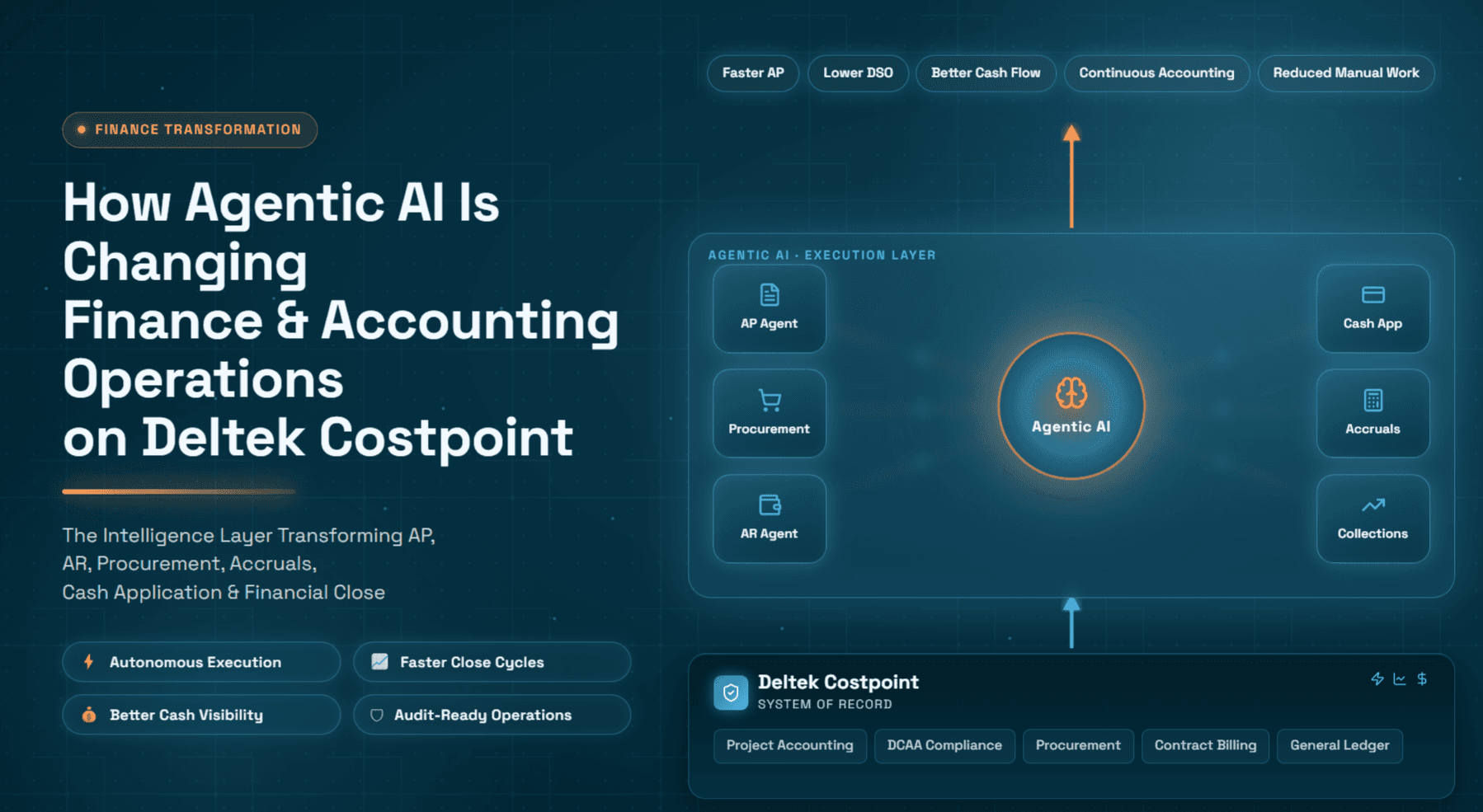
For government contractors and project-based enterprises, Deltek Costpoint has long served as the operational backbone of finance. Its project accounting depth, DCAA compliance architecture, and structured procurement controls make it uniquely suited to the demands of federal contracting, a distinction that general-purpose ERP systems simply cannot match.
But the conversation among finance leaders has shifted considerably over the past two years.
The question is no longer whether Costpoint can handle the complexity of government contractor finance. It can, and it does. The question is what happens above the ERP, in the operational layer where transactions are coordinated, exceptions are managed, cash is applied, and accounting entries are prepared. That layer has historically been staffed by people doing repetitive, judgment-light work at significant cost.
Agentic AI in finance and accounting is changing that.
Unlike traditional automation tools, which execute fixed rules against predictable inputs, AI agents can interpret context, recognize patterns across large transaction datasets, make autonomous operational decisions, and continuously execute finance workflows without waiting for human initiation. In a Costpoint environment specifically, this represents a genuinely new class of capability.
This blog examines where that capability is creating the most meaningful operational change across AP, procurement, vendor management, accounting close, and order-to-cash functions.
What "Agentic AI" Actually Means for Finance Teams
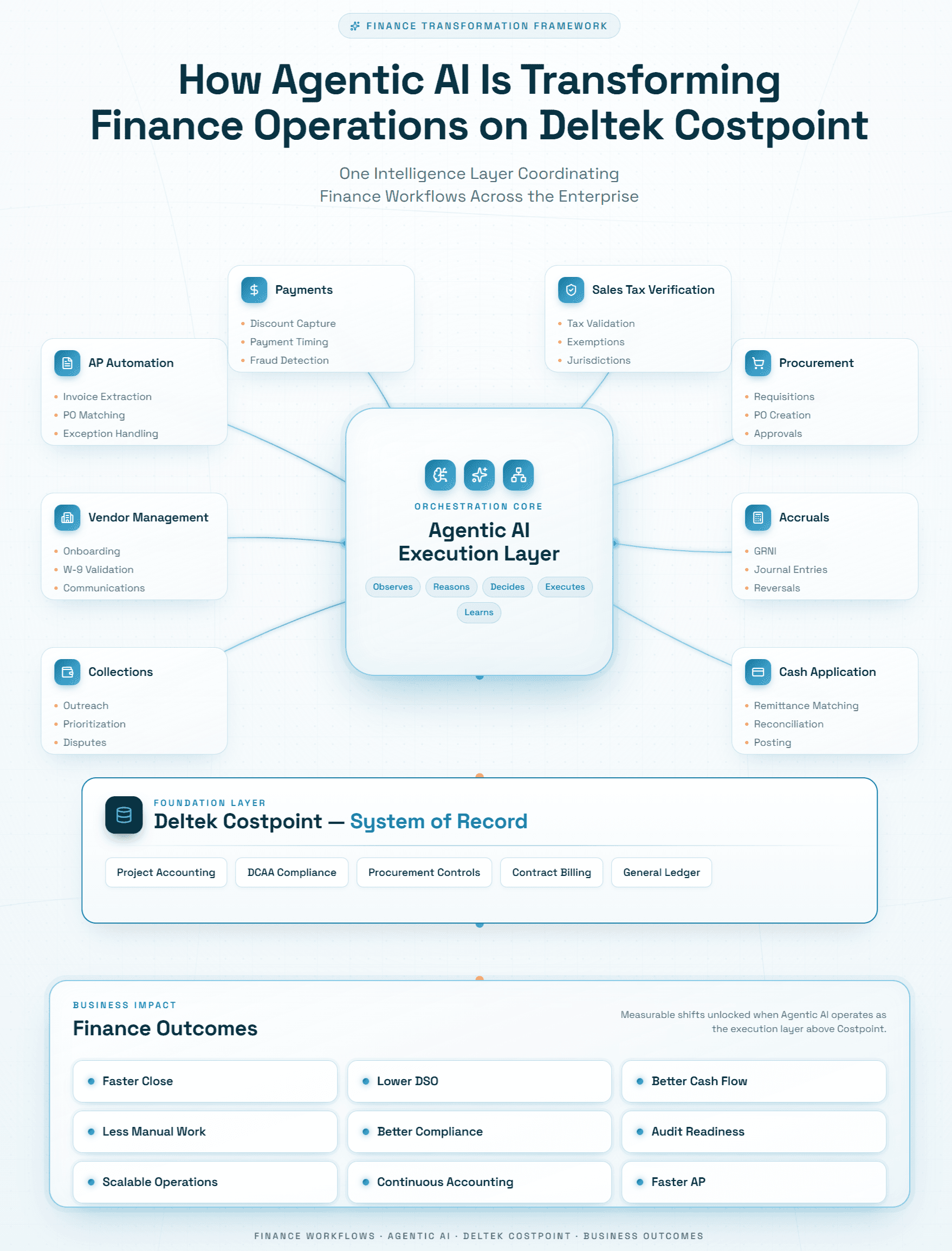
The term carries real definitional weight. An AI agent, in the finance context, is not a workflow trigger or a rule-based routing engine with a modern interface. It is a system that can:
Observe operational state across systems (ERP data, email inboxes, vendor portals, bank files)
Interpret what that state means in context (this invoice has a price variance consistent with a vendor billing error pattern)
Decide what action to take within defined parameters (route for review with context vs. auto-approve within tolerance)
Execute that action and update the system of record
Learn from outcomes and refine future decisions
Applied to Costpoint environments, this means finance workflows that previously required human coordination at every step can now execute continuously in the background with human judgment reserved for genuine exceptions and strategic decisions.
The ERP remains the system of record. AI agents function as the execution and intelligence layer operating on top of it.
AP Automation: From Invoice Queues to Straight-Through Processing
Accounts payable is where the impact of Deltek Costpoint AI automation is most immediately visible. In a traditional Costpoint deployment, invoice processing is a high-touch operation, invoices arrive across email, PDF, portal, and EDI channels; each requires human review, data entry, GL coding, PO matching, and approval routing before it can be posted.
AI-driven invoice processing changes this operational model fundamentally. AI agents continuously monitor incoming invoice channels, extract data across any format or layout, validate against purchase orders and vendor master records, assign GL codes using historical accounting patterns, and post clean invoices directly to Costpoint, all without human initiation.
For government contractors whose invoice populations include federal agencies, commercial subcontractors, international vendors, and service providers, format variability is a significant operational burden. AI-native extraction, which does not rely on invoice templates, handles that variability without requiring configuration changes for each new supplier format.
The practical result: straight-through processing rates consistently above 75–85% in comparable deployments, with invoice cycle times compressing from 7–12 days to 1–3 days. AP teams shift from processing volume to managing the genuine exceptions that require judgment.
What about those exceptions? Rather than routing all exceptions into an undifferentiated queue, AI agents triage them by likely cause, severity, and appropriate resolution path. A minor price variance below tolerance is handled differently than a quantity discrepancy on a cost-reimbursable contract line. Exception handling intelligence of this kind compresses resolution cycles from days to hours and significantly reduces the cognitive load on AP staff.
Procurement Automation: Continuous Workflow Execution
Procurement inside Costpoint is well-structured by design, FAR and DFARS compliance requirements demand it. But the coordination overhead of managing requisitions, approvals, PO generation, and vendor dispatch across multiple contracts and stakeholders remains operationally intensive, particularly as organizations scale.
Agentic AI in procurement addresses the coordination bottleneck without disrupting the financial control architecture. AI agents can extract requisition requirements from contracts and statements of work, auto-fill PR fields, run real-time budget validation, detect duplicates, route approvals dynamically based on amount and category thresholds, and generate and dispatch purchase orders automatically after approval.
For finance leaders, the operational significance is procurement becoming a continuous workflow rather than a series of human-coordinated handoffs. PO creation times that previously took days compress to under an hour. Budget compliance is enforced at the point of requisition rather than discovered as an exception downstream. Audit documentation is generated automatically across the full procurement lifecycle, a meaningful advantage in DCAA-scrutinized environments.
Vendor Management: Eliminating Fragmentation
Vendor communication in most Costpoint deployments flows through email and phone with no structured, auditable communication layer built into native AP workflows. When invoices are rejected, vendors are notified manually. Status inquiries are fielded individually. Dispute resolution extends across disconnected email threads.
AI-powered vendor management introduces structural change here. Automated vendor onboarding, including identity verification, W-9 validation, and duplicate detection, compresses what was a multi-day process to near-instant completion. A self-service vendor portal gives suppliers real-time visibility into PO status, invoice status, and payment timing without requiring AP staff involvement.
More importantly, vendor communications are structured, logged, and auditable. Every interaction generates a record. Dispute resolution has a documented trail. For government contractors operating under FAR documentation requirements, this transforms vendor management from an informal email-based process into a controlled, auditable workflow.
The operational benefit of eliminating vendor inquiry volume from AP staff time is also meaningful, a significant share of AP capacity in manual environments is consumed responding to vendor status requests that AI can address systematically and instantly.
Accruals and Continuous Accounting: Compressing the Close
Month-end accrual management is consistently one of the most burdensome processes in government contractor finance. Identifying goods received but not invoiced, services performed without a corresponding invoice, and recurring expenses without active POs requires systematic review of open commitments under deadline pressure. In organizations with large project portfolios and multiple contracts, this can consume two to three days of controller or senior accountant time every single month.
The problem is architectural: Costpoint records what has been posted, but identifying what should be accrued requires reasoning about what has happened that hasn't been invoiced yet precisely the kind of inference that rule-based ERP processing cannot perform.
AI-driven accrual automation addresses this by monitoring Costpoint data continuously throughout the month. AI agents identify accrual candidates across goods received but not invoiced, services performed but not billed, and recurring non-PO expenses, calculate accrual amounts, prepare journal entries with full GL coding, and post to Costpoint then manage intelligent reversals when the corresponding invoices arrive.
This is the foundation of what is increasingly called continuous accounting, the model where reconciliation, accrual management, and close preparation happen throughout the month rather than concentrated into the final days. Instead of finance teams compressing a week of accounting work into a two-day close sprint, the close itself becomes a review and approval process.
In comparable environments, accrual automation delivers 80% reductions in manual close effort and reduces accrued-versus-actual variance to below 5%. Close cycles that previously required 8–10 days can be compressed to 3–4 days with the reduction driven not by working faster, but by eliminating the manual discovery work entirely.
Sales Tax Verification: The Silent Compliance Gap
For government contractors with commercial revenue streams or mixed-billing environments, sales and use tax compliance on vendor invoices is a meaningful and chronically underaddressed risk area. Costpoint's tax engine validates against configured tax dictionaries; it enforces the rules as they were set up at implementation, but cannot monitor whether exemption certificates have expired, whether shipment destinations have changed jurisdictional exposure, or whether line-item categorizations remain correct under current tax law.
The practical consequence is tax leakage that accumulates silently, vendors invoicing as tax-exempt against expired certificates, misclassified line items generating use tax liability, multi-jurisdiction errors aggregating into audit exposure. One well-documented case identified $200,000 in tax leakage that had been accumulating undetected in exactly this pattern.
AI-driven sales tax verification validates tax applicability, rates, and jurisdictional accuracy at the invoice line-item level before posting and payment, eliminating a compliance risk category that manual AP review cannot systematically address.
Collections and Cash Application: Compressing the O2C Cycle
On the receivables side, most Costpoint environments manage collections through aging report review and manual outreach decisions, a reactive model that is structurally incapable of delivering meaningful DSO improvement.
AI-driven collections replace static aging-bucket prioritization with behavioral intelligence. AI agents analyze customer payment history, dispute patterns, responsiveness signals, and account risk indicators to dynamically prioritize which accounts receive outreach, in what sequence, and with what escalation path. Standard follow-up workflows execute automatically. Accounts showing early behavioral signals of payment delay or dispute risk receive elevated attention before they age into serious problems.
The distinction from rules-based automation is important: a rules-based system sends a reminder at 30 days and an escalation at 60 days for every account regardless of payment behavior. An AI agent recognizes that a specific customer has a pattern of paying on day 42 against Net 30 terms, not because of financial stress, but because of their internal AP processing cycle and optimizes outreach accordingly.
Cash application automation addresses the other major O2C bottleneck. Customer payments arrive with incomplete, ambiguous, or non-standard remittance data, AI agents match payments to open invoices across complex scenarios including partial payments, short pays, and consolidated bulk transactions, and post results directly to Costpoint in real time.
The downstream effects are significant: unapplied cash balances decline, AR aging reflects actual payment status rather than artificially inflated open items, and DSO reductions of 30–40% are achievable in environments where manual cash application has been the primary bottleneck.
Payment Optimization: Working Capital as a Continuous Process
AI-driven payment timing optimization represents a working capital opportunity that manual AP workflows consistently fail to capture. Early payment discount programs offering 1–2% for 10-day payment represent annualized returns of 18–36%, returns that disappear entirely when invoice cycle times run 7–12 days.
AI agents continuously analyze invoice readiness, vendor payment terms, cash flow priorities, and discount windows to recommend and execute optimal payment timing. Early payment discount capture rates increase from 20–35% in manual environments to 70–85% with AI optimization.
Fraud prevention is the other dimension. Duplicate payment detection, anomaly detection in vendor payment terms, and 100% invoice-to-payment validation before disbursement create a payment control layer that manual review cannot reliably replicate at scale.
Audit Readiness and DCAA Considerations
A legitimate concern for government contractors evaluating AI automation is whether AI-generated decisions will meet DCAA documentation standards. The answer, for properly implemented AI systems, is that they typically exceed what manual processes produce.
Every autonomous decision made by an AI agent from invoice extraction, GL code assignment, exception routing, accrual booking to payment recommendation is logged with the reasoning behind it, the data inputs considered, and the outcome generated. This creates an audit trail that is more complete, more consistent, and more defensible than records produced by human-coordinated manual processes, where documentation quality depends on individual staff behavior.
For DCAA audit environments specifically, the combination of comprehensive audit trails, policy-driven automation, and anomaly detection represents a material improvement in audit readiness. Finance leaders evaluating AI automation should assess the explainability and audit trail capabilities of any platform under consideration to ensure alignment with DCAA documentation standards.
Why Agentic AI Augments Costpoint — It Does Not Replace It
This distinction is worth stating clearly because it shapes every implementation decision.
Costpoint's value, its DCAA compliance architecture, project accounting depth, unified financial data model, and structured procurement controls, is genuine and not easily replicated. Government contractors are not evaluating whether to replace Costpoint. They are evaluating what the operational layer above Costpoint should look like.
AI agents are not a parallel finance system. They integrate directly with Costpoint through bidirectional data synchronization, read from Costpoint's transaction and master data, execute intelligent workflows, and write validated outputs back to Costpoint within the existing financial control structure. The ERP remains the authoritative system of record. AI agents provide the execution intelligence that was never part of the ERP's design.
This augmentation model also means deployment timelines are measured in weeks rather than quarters. There is no ERP reimplementation required. Finance organizations can begin automating targeted workflows, invoice processing, accruals, collections, incrementally, while continuing to operate within their existing Costpoint environment.
Exploring Agentic AI for Your Costpoint Environment
The natural next step is seeing how these workflows actually operate, not in a generic demo, but in the context of your specific Costpoint setup, transaction volumes, and finance team structure.
Hyperbots is an agentic AI platform built specifically for finance and accounting operations on top of ERP systems like Costpoint. It covers the full workflow range discussed in this blog invoice processing, procurement, vendor management, accruals, payments, collections, and cash application and integrates directly with Costpoint without requiring a parallel system or ERP replacement.
Hyperbots ease of integration with Deltek Costpoint exists through pre-built ERP connectors, Costpoint’s Web Integration Console (WIC), and API-based synchronization for invoices, vendors, POs, and GL data. It supports both on-premise and cloud deployments, adapts to existing ERP customizations, and is designed to integrate without requiring ERP replacement. Most implementations are positioned to go live within 2-4 weeks rather than requiring long multi-quarter integration projects.
If you want to get a sense of potential impact before committing any time, Hyperbots' ROI calculators let you model expected gains against your own transaction volumes across each workflow area.
And if you'd rather see it in action, you can request a walkthrough focused on the specific workflows your team manages, or try it yourself to explore how it fits your existing processes.
FAQ Section
Q1. What is agentic AI in finance and accounting?
Agentic AI refers to AI systems that can observe operational state, interpret context, make autonomous decisions within defined parameters, and execute actions across systems without requiring manual initiation at each step. In finance, this means AI agents that can process invoices, manage exceptions, book accruals, apply cash, and optimize payments continuously and autonomously, learning from outcomes over time. Unlike traditional automation tools that execute fixed rules, agentic AI reasons about what is happening and acts accordingly.
Q2. How does agentic AI differ from RPA in finance workflows?
Robotic Process Automation (RPA) executes scripted steps against predictable, structured inputs. It works well when every input looks the same and every decision is predetermined. It breaks when inputs vary or exceptions arise which in finance is constant. Agentic AI can handle variability, interpret context, and reason about exceptions rather than simply failing on them. For finance workflows with high invoice format diversity, complex remittance data, or judgment-intensive exception management, AI agents are materially more capable than RPA. The evolution from rule-based automation to AI reasoning is well-documented.
Q3. Can AI agents integrate with Deltek Costpoint without disrupting existing workflows?
Yes. Modern AI finance automation platforms integrate with Costpoint through pre-built bidirectional connectors, reading vendor master data, PO records, GL structures, and contract data from Costpoint, executing their processing workflows, and writing validated outputs back to Costpoint within the existing financial control structure. The integration is augmentation-focused, Costpoint remains the system of record, and existing approval hierarchies, compliance controls, and accounting structures are preserved.
Q4. Is AI automation appropriate for DCAA-audited environments?
Properly implemented AI automation is well-suited to DCAA audit environments. AI agents generate comprehensive, immutable audit trails which include logging every extraction decision, coding assignment, exception resolution, and posting action with full context and reasoning. This level of documentation is typically more complete and more consistent than what manual processes produce, where documentation quality varies by individual and deadline pressure. Finance leaders should evaluate the explainability and audit trail capabilities of any AI platform before deployment.
Q5. How does AI improve month-end close in a Costpoint environment?
Month-end close is significantly compressed when AI agents perform accrual discovery, reconciliation, and journal entry preparation continuously throughout the month rather than during a compressed close window. Instead of controllers spending two to three days identifying open commitments and preparing accrual entries, AI agents monitor transaction data in real time and surface accrual candidates automatically. The close itself becomes a review and approval process rather than a data-intensive reconciliation sprint. Close cycles in comparable environments have been reduced from 8–10 days to 3–4 days using automated accrual workflows.
Q6. What AP bottlenecks does agentic AI specifically address in Costpoint?
The primary AP bottlenecks that AI addresses in Costpoint environments include: manual invoice data entry across diverse formats; exception queues without intelligent triage or prioritization; fragmented vendor communication and status management; slow three-way matching for high invoice volumes; accrual management at month-end; and sales tax verification on vendor invoices. These are structural constraints of rule-based ERP processing, they require an intelligence layer, not a Costpoint configuration change, to resolve.
Q7. How does AI affect collections and DSO in Costpoint environments? AI-driven collections replace static aging-bucket follow-up with behavioral intelligence, dynamically prioritizing accounts based on payment history, dispute patterns, and risk signals rather than elapsed time. Outreach workflows execute automatically for standard scenarios; accounts showing early risk indicators receive elevated attention before they age into serious collection problems. In combination with automated cash application that eliminates the manual matching bottleneck, DSO reductions of 30–40% are achievable in environments where manual processes have been the primary constraint.
Q8. How do AI agents handle invoice exceptions that Costpoint cannot process automatically? When an invoice encounters a mismatch whether it’s price variance, missing PO reference, vendor name discrepancy, an AI agent analyzes the likely cause, checks historical patterns for that vendor and that type of exception, and either resolves it autonomously within configured tolerance parameters or routes it to the appropriate reviewer with context and a recommended resolution. This reasoning-based approach is fundamentally different from Costpoint's binary pass/fail matching, which routes all exceptions to an undifferentiated human queue regardless of complexity or likely resolution path.
Q9. What governance considerations apply to AI automation in finance?
Finance leaders deploying AI agents should evaluate:
Audit trail completeness: every autonomous decision should be logged with reasoning and data inputs
Explainability: finance teams and auditors should be able to understand why any specific decision was made
Human-in-the-loop controls: exceptions above defined thresholds should route for human review
Policy configurability: AI behavior should be configurable to reflect company-specific financial policies and compliance requirements
ERP control preservation: AI agents should operate within, not around, existing Costpoint financial controls. AI governance frameworks for finance provide additional guidance on structured deployment.
Q10. Where should finance organizations begin when deploying AI on top of Costpoint?
Most organizations start with accounts payable, specifically invoice processing and exception handling because the ROI is immediate, measurable, and does not require restructuring existing workflows. Accruals automation is typically the second high-impact deployment, given the consistent close-cycle pressure it relieves. Collections and cash applications follow as O2C priorities. The key principle is incremental deployment: begin with the highest-friction workflow, demonstrate operational impact, then expand. ROI calculators for each workflow area allow organizations to model expected impact against their specific transaction volumes before committing to deployment.