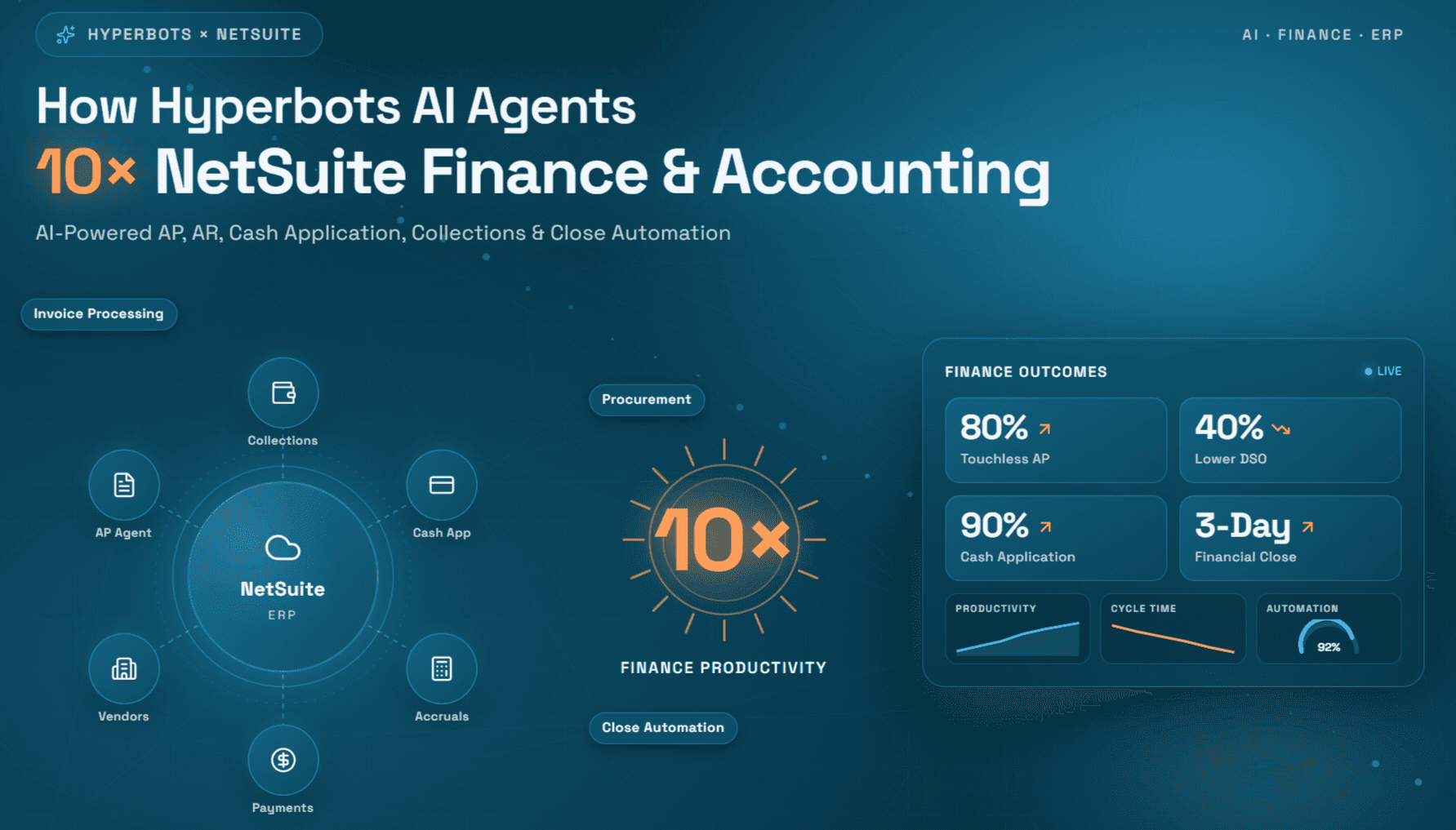
Closing the Finance & Accounting Gaps in NetSuite with Hyperbots AI Agents
Transforming NetSuite from a system of record into an autonomous finance operation.
Oracle NetSuite is one of the most widely deployed cloud ERP platforms in the mid-market and enterprise segments. For CFOs, Controllers, and Finance Transformation leaders, it has become the operational spine of general ledger management, financial consolidation, reporting, and compliance.
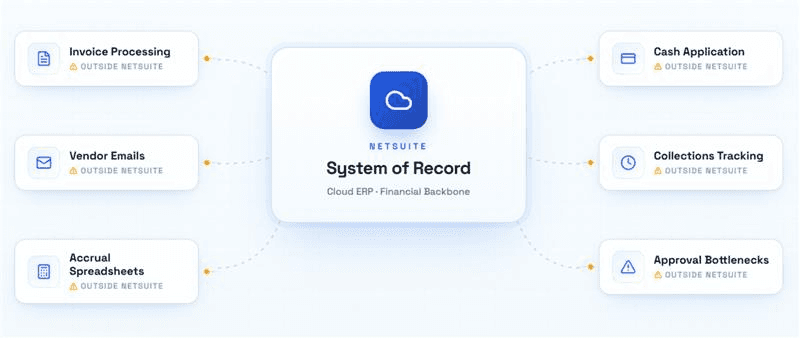
But a pattern has emerged across finance teams using NetSuite: the ERP is doing its job as a system of record, while human teams are doing the rest.
Invoice queues grow. Approval chains stall. Month-end accruals are estimated in spreadsheets. Vendor communication happens via email threads that live outside the system entirely. Collections teams manually track aging reports. Cash application is performed by individuals reconciling remittances line by line. And the organization's finance function, despite running on a modern cloud ERP, still operates at the pace of its slowest manual process.
This blog examines why those gaps exist structurally, how they compound at scale, and how AI agent platforms can close them without disrupting the ERP environment organizations have already invested in.
Why ERP Systems Still Require Manual Finance Operations
ERP platforms such as Oracle NetSuite are fundamentally designed as systems of record. Their primary role is to capture, validate, organize, and report financial transactions after the underlying business activity has already been interpreted and processed by a person or another application. That architecture has made ERP systems indispensable for financial governance and reporting, but it also explains why many finance and accounting workflows remain heavily manual even in mature NetSuite environments.
The distinction matters because modern finance operations are no longer driven by structured transactions alone. They are driven by unstructured operational inputs: vendor emails, PDFs, remittance files, partial receipts, disputed invoices, changing payment terms, tax inconsistencies, and exception-heavy procurement workflows. Traditional ERP systems were not designed to interpret ambiguity or make contextual operational decisions autonomously. Instead, they rely on deterministic workflow logic: predefined rules that execute only when data fits expected patterns.
Industry analysts increasingly describe this limitation as the difference between a “system of record” and a “system of intelligence.” While ERPs excel at storing finalized transactions, they are less effective at handling the operational reasoning required before those transactions can be posted cleanly into the ledger.
This becomes especially visible in Accounts Payable workflows.
Consider a common NetSuite scenario: a vendor invoice arrives with a small variance against the purchase order, a missing goods receipt, or line-item descriptions that do not perfectly match the PO structure. NetSuite’s matching engine can identify the discrepancy, but it typically cannot determine whether the variance is acceptable, whether the invoice should be escalated, or whether the mismatch reflects a legitimate operational change. The transaction is flagged as an exception and routed to a human reviewer.
At low transaction volumes, this dependency on manual intervention may appear manageable. At enterprise scale, it becomes operationally expensive.
According to APQC benchmarking data, top-performing finance organizations process invoices at dramatically lower cost and cycle times than organizations with high manual intervention rates. Yet many ERP-centric AP environments still struggle to achieve straight-through processing rates above 30–50%, meaning a large proportion of invoices require human review somewhere in the workflow.
The consequence is a growing operational backlog:
invoices waiting for approval
exceptions sitting unresolved for days
duplicate payment reviews
vendor email follow-ups
accrual estimates maintained in spreadsheets
cash application delays caused by remittance mismatches
None of these problems necessarily indicate that NetSuite is “broken.” They are structural realities of ERP-centric finance operations.
For example, if a vendor submits a PDF containing multiple invoices, changes banking details mid-cycle, or submits an invoice for services delivered across multiple departments, the ERP does not autonomously reason through the context. It pauses the workflow and waits for human intervention. That pause is intentional design. ERP systems prioritize control, validation, and auditability over autonomous operational execution.
The same pattern appears in Order-to-Cash workflows. Cash application teams often receive remittance advice through emails, bank files, portals, and PDFs with inconsistent formatting. Customers may short-pay invoices, combine multiple invoices into a single payment, or apply deductions without clear explanation. While NetSuite can store the resulting accounting entries, finance analysts frequently still perform the matching, reconciliation, and discrepancy resolution manually.
Research from McKinsey & Company has repeatedly shown that finance teams continue to spend a substantial portion of their time on transactional processing, reconciliation, and exception management rather than strategic analysis. A major reason is that operational finance workflows often remain fragmented across spreadsheets, email threads, PDFs, and disconnected systems outside the ERP environment
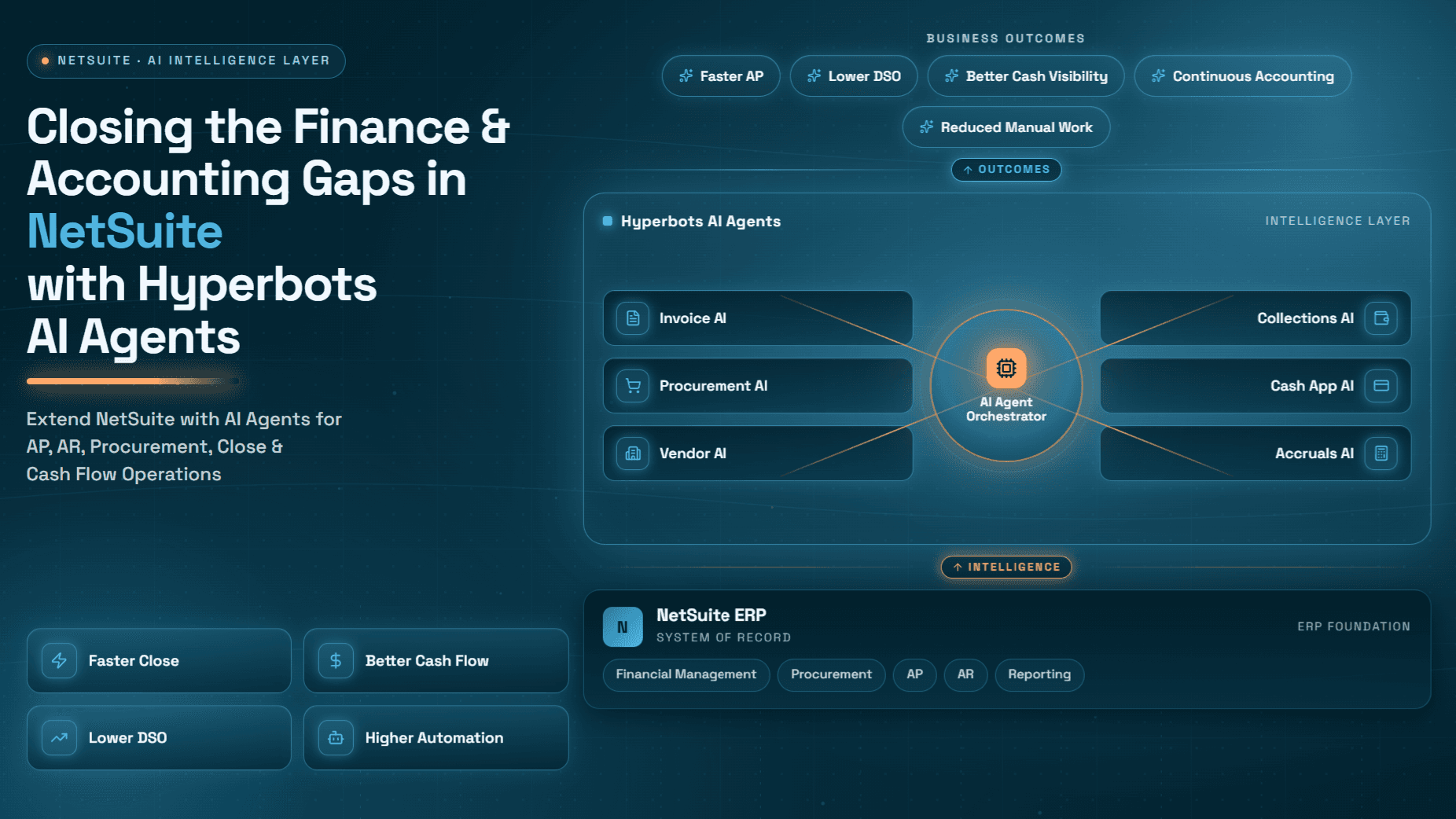
Rather than replacing NetSuite, AI systems operate as an intelligence layer between operational inputs and the ERP itself. They interpret documents, classify exceptions, automate reconciliation tasks, route approvals intelligently, and execute workflows autonomously before posting structured outcomes back into NetSuite.
In other words, the goal is not to eliminate the ERP. It is to reduce the amount of finance work that still happens outside the ERP in spreadsheets, inboxes, and manual coordination loops.
The Difference Between a System of Record and a System of Intelligence
There is a meaningful distinction between a platform that stores what happened and a platform that decides what should happen next.
NetSuite, in its native form, is the former. A finance professional enters data, the system validates it against configured rules, and records it. The intelligence, judgment about vendor reliability, early payment economics, accrual estimates, matching tolerances, lives in the person performing the task, not in the system.
A system of intelligence, by contrast, reads incoming documents autonomously, evaluates them against policy and context, makes or recommends decisions, handles exceptions based on learned patterns, and posts outcomes back to the system of record. It reasons. It adjusts. It escalates only when it genuinely cannot resolve something alone.
The gap between these two models is where most of the operational cost and cycle-time friction in modern finance lives. And it is the gap that AI agents, when purpose-built for finance, are designed to close.
The Bottlenecks Finance Teams Actually Face in NetSuite Environments
Manual Invoice Handling and Intake
In most NetSuite deployments, invoice intake is the first and most persistent source of manual effort. Invoices arrive through vendor emails, portals, EDI feeds, and occasionally post. They vary in format, scanned PDFs, emailed attachments, structured data files, or hybrid documents with narrative line items and handwritten annotations.
NetSuite does not natively resolve this diversity. Without an external automation layer, someone must receive the invoice, extract the relevant data, map it to the correct vendor record, and enter it into the system. Even organizations that have implemented basic OCR tools often find that template-based extraction fails when invoice formats change, which vendors do, routinely.
The downstream impact is a persistent intake queue that grows faster than AP teams can process it, particularly during high-volume periods such as quarter-end.
Approval Bottlenecks and Workflow Stagnation
NetSuite’s workflows are rule-based and linear. They do not adapt to approver availability, escalate intelligently when SLAs are breached, or prioritize invoices that carry early payment discount windows.
In practice, this creates two compounding problems. First, invoices sit in queues waiting for approver action, accumulating aging without any self-correcting mechanism. Second, organizations that have built complex multi-tier approval rules in NetSuite often discover that edge cases, a cost center change, an unrecognized GL code, a split allocation across departments, bypass rules in unexpected ways, generating exceptions that require human triage.
Finance transformation leaders frequently describe approval bottlenecks as one of the highest-friction points in their P2P cycle, and most of that friction persists regardless of ERP sophistication.
Exception-Heavy Accounts Payable Workflows
AP exception management is, for most organizations, a permanent operating model rather than an edge case. PO line mismatches, missing goods receipts, duplicate invoice flags, changed vendor payment terms, and GL coding discrepancies all generate exceptions that require individual human review.
In a NetSuite environment without intelligence layered on top, exception management is essentially a second AP workflow running in parallel with straight-through processing. High-performing AP teams target straight-through processing (STP) rates, the proportion of invoices that process from receipt to posting without human intervention, above 60 to 70 percent. Without AI automation, industry STP rates typically range between 30 and 50 percent, meaning the majority of invoices require manual handling at some stage.
The economics of exception-heavy workflows are well understood: each manually handled invoice costs significantly more to process, takes longer, increases error risk, and creates audit trail gaps.
Vendor Email Dependency and Fragmented Communication
Vendor communication in most NetSuite environments happens outside the ERP entirely. When an invoice is rejected, a team member sends an email. When a PO is issued, it may be sent via email or a portal. When a vendor queries payment status, the AP team responds from an inbox.
This fragmentation has several consequences. Communication history is not captured in NetSuite. Dispute resolution is unstructured and hard to audit. Vendor escalations consume AP team time. And the lack of a structured vendor portal means the finance organization is managing vendor relationships through general-purpose communication tools that were not designed for financial workflows.
Accrual Management Challenges
Month-end accruals represent one of the most operationally intensive challenges in any finance function, and one where ERP tooling has historically been weakest.
Accruals require finance teams to identify what has been received but not yet invoiced, estimate the associated liability, book the accrual entry in the general ledger, and reverse it in the following period. In a NetSuite environment, this process relies on analysts cross-referencing PO commitments, goods receipt records, and open vendor balances, often in combination with spreadsheets, to estimate accrual amounts.
The process is time-consuming, error-prone, and highly dependent on individual judgment. Accrual timing mismatches are among the most common sources of period-end restatements, and accrual discovery, identifying what to accrue in the first place, is a process that has no native automation in most ERP environments.
PO Matching Edge Cases
Three-way matching, reconciling the purchase order, goods receipt, and vendor invoice, is a foundational AP control. NetSuite supports matching configurations, but the matching rules are deterministic and do not accommodate the variability that real-world procurement generates.
Service based invoices frequently arrive without clear quantity references. Blanket POs are consumed across multiple partial invoices over extended periods. Vendor line-item descriptions do not always map cleanly to PO line descriptions. Currency fluctuations on cross-border transactions create tolerance questions. These edge cases, individually minor, collectively constant, generate matching exceptions that require human resolution.
For organizations with high PO volumes or complex vendor relationships, matching exceptions can represent a significant proportion of total AP work.
Duplicate Invoice Risk
Duplicate invoices, the same invoice submitted twice, or a second invoice covering work already billed under a different number, are a persistent risk in AP operations. They arise from vendor billing errors, workflow re-submissions when an email goes unacknowledged, or deliberate fraud.
Native NetSuite duplicate detection operates on exact matches of invoice number and vendor. This captures obvious duplicates, but misses near-duplicates: the same invoice with a different number, or two invoices for similar amounts from the same vendor submitted within days of each other. Identifying these requires cross-referencing across multiple data dimensions simultaneously, which is precisely the type of pattern recognition that deterministic rule engines handle poorly.
Cash Application Delays and Remittance Reconciliation
On the Order-to-Cash side, cash application is one of the most labor-intensive functions in finance. When customers pay invoices, their remittance advice, the document explaining which invoices the payment covers, often arrives in formats that do not align cleanly with open receivables in NetSuite.
Customers pay multiple invoices in a single payment. They apply short pays, deductions, or credits without clear documentation. Remittance arrives via email attachments, portal downloads, or EDI files with variable formatting. Each of these scenarios requires a cash application analyst to match the payment against open invoices, resolve discrepancies, and post the result to the general ledger.
At scale, the volume of manual cash application work creates DSO (days sales outstanding) pressure. Payments that should be applied the day they arrive sit unmatched for days, distorting cash position visibility and aging reports.
Collections Inefficiencies
Collections management in a NetSuite environment typically relies on aging reports, manual outreach, and individual analyst judgment about which accounts to prioritize. Without intelligent automation, collections activity is reactive: accounts age past thresholds before action is taken, follow-up sequences are inconsistently executed, and prioritization is based on simple aging buckets rather than payment behavior, relationship value, or dispute history.
This creates collections leakage, amounts that could be recovered but are not, due to process latency rather than customer intent to default.
Reporting Latency
A CFO or Controller using NetSuite has access to strong reporting and dashboard tools but those reports reflect the data that has been entered into the system. When invoice processing is delayed, accruals are estimated rather than calculated, and cash application is incomplete, the reports are incomplete too. The finance team may not have an accurate picture of AP aging, cash position, or committed liabilities until days after the period closes.
This reporting latency is a structural consequence of human-dependent data entry. It is not a NetSuite reporting failure, it is a data completeness failure caused by the operational gaps described above.
Why Finance Teams Add Layers of Operational Work Outside NetSuite
The operational response to these gaps is well-established: finance teams add people, spreadsheets, and workarounds.
AP teams maintain exception logs in Excel. Accrual estimates are built in shared workbooks with manual inputs from business unit managers. Collections teams build their own tracking sheets outside the ERP. Cash application analysts use intermediate reconciliation tools before posting to NetSuite. Vendor communication is managed in email inboxes and tracked in separate CRM-lite tools.
Each of these workarounds is rational given the tooling available. Each also represents a process fragmentation risk: data that exists outside the ERP is not subject to ERP controls, audit trails, or version management. The more operational work happens outside NetSuite, the more exposure the organization carries at audit time, and the harder it becomes to reconstruct a complete transaction history.
The answer is not to eliminate the ERP or replace it. It is to add a layer of intelligence between the vendors, documents, emails, payments and the ERP, so that more of the work that currently happens in spreadsheets and inboxes happens autonomously, inside a governed workflow, and posts cleanly to NetSuite.
Adding an Intelligence Layer on Top of NetSuite with Agentic AI
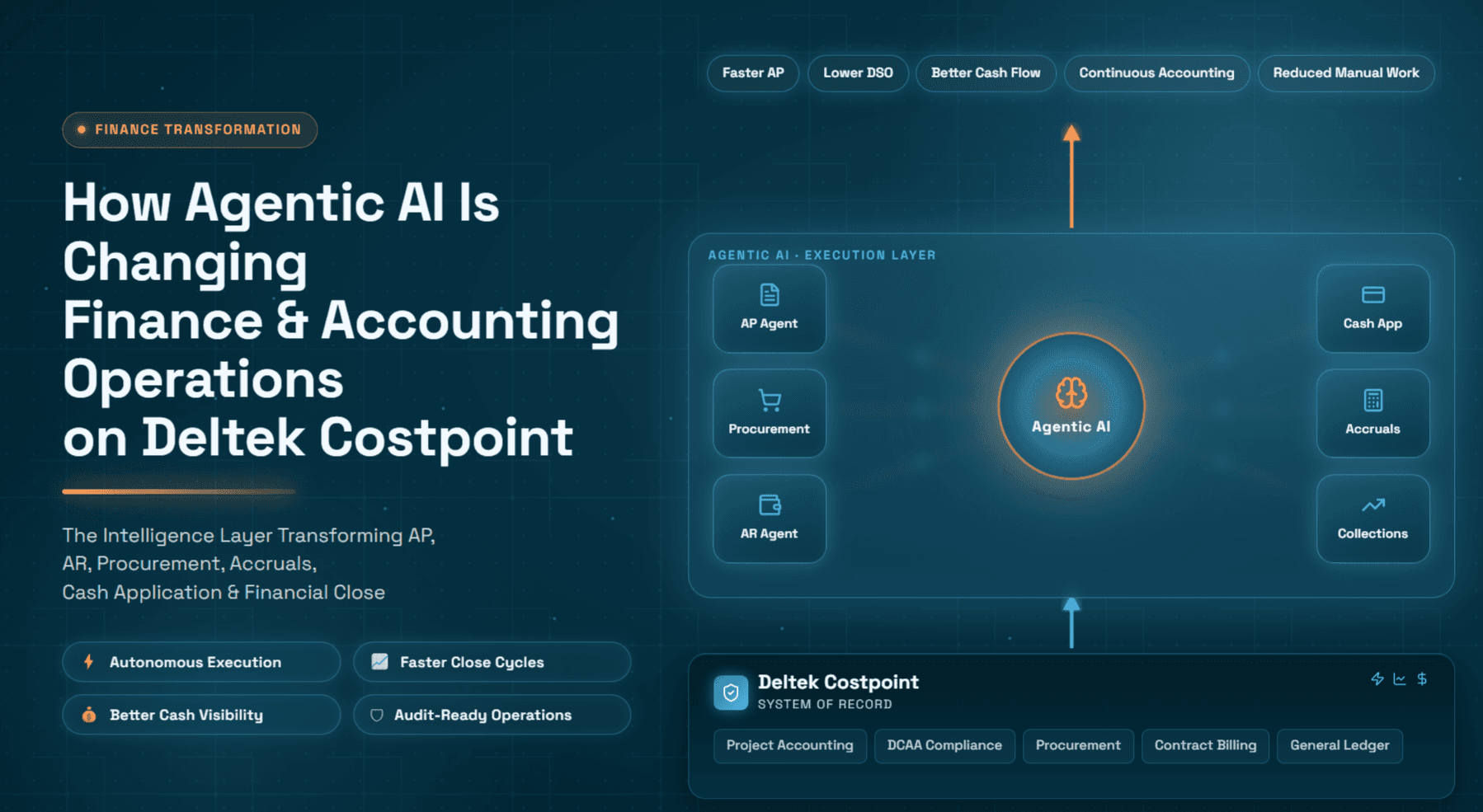
The emergence of agentic AI in finance operations is changing how organizations think about ERP workflows. Instead of treating every exception, approval, reconciliation task, or vendor interaction as a human-dependent process, finance teams are increasingly deploying AI agents that can interpret context, make operational decisions within policy boundaries, and execute workflows autonomously. The broader enterprise software market has increasingly described this transition as a movement from traditional “systems of record” toward “systems of action” or “systems of intelligence.”
This shift matters because many of the operational gaps surrounding NetSuite are not caused by missing data. They are caused by the inability of deterministic workflow systems to reason through ambiguity. ERP platforms are fundamentally designed to capture, validate, and store transactional data rather than autonomously interpret exceptions or operational context.
For example, NetSuite’s native three-way matching framework can validate invoices against purchase orders and receipts, but mismatches typically trigger exception states requiring manual review. In practice, organizations frequently encounter more complex scenarios involving partial receipts, cumulative billing across multiple shipments, service invoices without quantity references, or vendor-specific formatting inconsistencies. Multiple NetSuite implementation specialists and practitioners note that these scenarios often require SuiteScript customization or external automation layers to manage effectively.
This is where agentic AI systems differ from traditional ERP automation.
Rather than following only static “if-this-then-that” rules, finance-focused AI agents can:
Interpret unstructured vendor documents
Analyze historical transaction patterns
Identify probable invoice-to-PO relationships
Classify exceptions by likely cause
Recommend or autonomously execute resolution paths
Escalate only genuinely ambiguous cases to humans
In Procure-to-Pay workflows, this allows organizations to reduce invoice intake bottlenecks, improve straight-through processing rates, accelerate approval routing, and minimize manual exception handling. In Order-to-Cash operations, AI agents are increasingly being used to automate remittance interpretation, cash application, collections outreach, dispute routing, and reconciliation workflows that previously depended on analysts manually interpreting emails, PDFs, and payment files.
Importantly, these AI systems do not replace NetSuite. They operate around it and on top of it. NetSuite continues serving as the governed financial system of record, while AI agents handle much of the operational work that finance teams historically managed through spreadsheets, inboxes, and manual coordination.
This architectural model is becoming increasingly common because it allows organizations to modernize finance operations without replacing their ERP foundation. Instead of rebuilding core financial infrastructure, enterprises are adding an intelligence layer capable of handling the variability, ambiguity, and operational scale that traditional ERP workflows were never originally designed to manage.
How Hyperbots AI Agents Close These Gaps
Hyperbots is an AI co-pilot platform purpose-built for finance and accounting operations. Rather than replacing NetSuite, Hyperbots operates as an intelligence and automation layer that sits between the operational environment and the ERP, handling the judgment-intensive, document-heavy, exception-prone work that ERPs are not designed to perform.
The platform deploys as pre-trained, ready-to-deploy AI co-pilots across the Procure-to-Pay and Order-to-Cash cycles, with deep integration into Oracle NetSuite and other major ERP platforms.
Invoice Processing: From Manual Intake to Autonomous Execution
The Hyperbots Invoice Processing Co-Pilot automates the end-to-end invoice lifecycle from discovery and extraction through validation, matching, GL coding, and ERP posting.
The co-pilot handles invoice discovery across email, portals, and ERP inboxes, ensuring no invoice is missed. AI-native extraction, not template-based OCR, reads invoice data regardless of format or layout, including multi-page and multi-invoice documents. Extraction accuracy reaches 99.8%, eliminating the rework cycle that template failures generate.
Automated duplicate detection operates across multiple dimensions from vendor, amount, date, and invoice number patterns, catching near-duplicates that rule-based systems miss. Three-way matching is configurable by vendor type, spend category, and tolerance threshold, with matching strategy configuration that handles blanket POs, services invoices, and partial deliveries.
AI-driven GL coding assigns correct expense accounts based on historical coding patterns and policy rules, reducing manual GL intervention. Completed invoices are posted directly to NetSuite after approval, with comprehensive audit trails logging every AI and human action.
Organizations that have deployed the Invoice Processing Co-Pilot, including Extreme Reach (XR), a media technology company, have achieved 80% straight-through processing with 99.8% accuracy and zero manual touch-ups, alongside 80% productivity gains in invoice processing operations.
Vendor Management: Structured Communication Inside a Governed Workflow
The Hyperbots Vendor Management Co-Pilot replaces the inbox-and-email operating model with a structured vendor portal. Vendors onboard, submit invoices, receive PO acknowledgments, track payment status, and receive remittance advice through a single governed interface.
Automated vendor identity verification reduces fraud risk during onboarding. Automated acceptance and rejection of invoices eliminates manual communication for routine validation outcomes. Automated remittance communication ensures vendors receive payment details without AP team involvement.
This shifts vendor communication from a reactive, inbox-driven activity to a proactive, system-governed one, reducing AP team time on vendor queries while improving vendor relationship quality.
Accruals: From Spreadsheet Estimates to Automated Discovery and Booking
The Hyperbots Accruals Co-Pilot automates accrual discovery, booking, and reversal across the full range of accrual scenarios.
AI-driven discovery identifies accruals for goods received but not invoiced, services received but not billed, and recurring expenses without a PO. Cut-off date management ensures period-end accuracy. Automated booking posts journal entries directly to NetSuite, and automated reversals execute in the following period without manual intervention.
For finance teams that currently spend significant controller and analyst time on month-end accrual estimation, this represents a structural reduction in period-close effort and a material improvement in accrual accuracy.
Procurement: Compressing the PR-to-PO Cycle
The Hyperbots Procurement Co-Pilot automates the purchase requisition and purchase order lifecycle. The co-pilot extracts PR details from emails and forms, validates them against policy and budget, routes approvals through configurable workflows, and generates and dispatches POs to vendors automatically upon approval.
Budget control automation prevents overspending before PO issuance. Duplicate requisition detection prevents redundant orders. The co-pilot has demonstrated the ability to compress the traditional 3-day PR-to-PO cycle to approximately 4 hours.
Payments: Intelligent Timing and Fraud Prevention
The Hyperbots Payment Co-Pilot adds intelligence to payment decisions that native NetSuite payment runs do not provide. The co-pilot evaluates open payables against cash position and vendor terms, generating early payment recommendations to capture available discounts and late payment recommendations where cash conservation is the priority.
Fraud prevention mechanisms include anomaly detection and duplicate payment checks. Bank statement reconciliation and check reconciliation are automated. Completed payment transactions are posted to the NetSuite general ledger automatically.
For organizations that have historically relied on manual payment runs and reactive discount capture, this capability directly reduces financing cost and working capital pressure.
Collections and Cash Application: Closing the Order-to-Cash Loop
The Hyperbots Collections Co-Pilot automates overdue invoice tracking and follow-up sequences, prioritizing outreach based on payment behavior and account value rather than simple aging thresholds.
The Cash Application Co-Pilot automates the matching of incoming payments to open invoices, processes remittance advice across formats, handles short pays and deductions, and posts matched transactions to NetSuite, reducing the DSO pressure that manual cash application creates.
Sales Tax Verification: Eliminating Tax Leakage
The Hyperbots Sales Tax Verification Co-Pilot validates sales and use tax on every invoice, checking tax rates, category classifications, origin and destination jurisdictions, and economic nexus thresholds against configurable tax dictionaries. Finance teams that have deployed this capability have identified and eliminated material tax leakage, in one documented case, $200,000 in tax exposure that was previously invisible in the AP workflow.
Deployment and Integration
A common concern with AI automation platforms is implementation timeline. Hyperbots addresses this through pre-trained, finance-specific AI models and a faster ERP onboarding architecture that leverages pre-built NetSuite connectors and automated data model mapping. Organizations that have deployed Hyperbots have reported going live within days rather than months, using pre-built models trained on finance-specific data from the outset.
The platform operates on an unlimited-user licensing model, meaning deployment across entire finance and procurement teams does not carry per-seat cost escalation, a meaningful consideration for organizations looking to drive adoption at scale.
Quantifying the Operational Impact
Procure-to-Pay Performance Before and After Hyperbots
Metrics | NetSuite alone | With Hyperbots | Operational Impact |
Invoice processing time | 8–12 day invoice cycle times are common in manual AP environments such as NetSuite | Hyperbots processes invoices in <1 minute | 99%+ reduction in invoice processing time |
Straight-through invoice processing | Typical ERP-centric AP teams achieve ~15–25% touchless processing | Hyperbots achieves 80% STP | 3.2×–5.3× higher touchless processing rate |
Invoice extraction accuracy | Traditional OCR systems typically achieve only 85–90% accuracy | Hyperbots delivers 99.8% extraction accuracy | 50×–75× reduction in manual correction requirements |
AP manual workload | AP teams often spend 60–70% of capacity on manual entry and exception handling | Hyperbots automates matching, validation, and GL coding | 4×–5× reduction in manual AP workload |
Early payment discount capture | Most organizations capture <40% of available discounts | Hyperbots captures 100% of all early payment discounts automatically | 2.5×+ improvement in discount capture potential |
Order-to-cash Performance Before and After Hyperbots
Metric | NetSuite Alone / ERP-Centric Reality | With Hyperbots | Operational Impact |
Cash application automation | Manual and ERP-centric AR environments don’t automate cash application, with payment matching and reconciliation heavily dependent on human intervention. | Hyperbots achieves 80–90% straight-through cash application using AI-driven remittance extraction, intelligent matching, and autonomous ERP posting | 4×–9× higher cash application automation, enabling faster reconciliation and reduced AR processing costs |
Days Sales Outstanding (DSO) | ERP-centric collections workflows rely on static aging buckets, manual follow-ups, and delayed dispute identification, contributing to elevated DSO | Hyperbots delivers ~40% DSO reduction through AI-driven prioritization and autonomous follow-ups | Up to 1.6× faster cash-conversion cycle |
Cost-to-collect | Traditional collections environments require large amounts of manual outreach, dispute handling, and tracking effort | Hyperbots uses AI-driven prioritization of accounts, automated tailored follow-ups minimizing human intervention | 70% reduction in cost-to-collect |
Reconciliation cost | ERP-centric reconciliation workflows remain labor-intensive due to manual extraction and matching of remittance | Hyperbots delivers 99.8% remittance extraction accuracy with AI-driven autonomous matching and reconciliation workflows | 80% reduction in reconciliation cost |
Unapplied cash levels | Traditional AR environments often maintain unapplied cash balances near 40% due to delayed matching and exception handling | Hyperbots reduces unapplied cash to <10% through AI-driven matching and exception resolution | 75% reduction in unapplied cash |
Collectively, these metrics quantify the operational difference between running finance operations solely through a system of record like NetSuite and augmenting that ERP with an AI intelligence layer capable of autonomously interpreting documents, orchestrating workflows, resolving exceptions, and continuously driving process execution across both Procure-to-Pay and Order-to-Cash functions.
Analytical Conclusion: Intelligence Is the Missing Layer
The finance and accounting gaps in Oracle NetSuite are not a critique of the platform. They are a description of what ERP systems were designed to do and what they were not. NetSuite excels as a system of record, a financial consolidation engine, and a reporting platform. It was not designed to autonomously extract meaning from unstructured vendor documents, resolve matching exceptions through learned patterns, estimate accruals through cross-referencing open commitments, or make payment timing decisions based on cash flow modeling.
Those capabilities belong to a different category of technology, one that operates alongside the ERP rather than replacing it, feeding it clean, validated, intelligently processed data while keeping the ERP as the authoritative ledger.
For CFOs and Finance Transformation leaders evaluating where their next point of operational leverage lies, the answer is increasingly clear: it is not inside NetSuite. It is in the intelligence layer that processes the operational world before it reaches NetSuite and in doing so, makes the ERP's records more accurate, more current, and more trustworthy than human-dependent processing has ever been able to achieve at scale.
Organizations looking to evaluate this model in practice can explore a live workflow environment through the Hyperbots Free Trial or request a more tailored walkthrough through the Hyperbots Demo Page based on their existing NetSuite finance processes.
Frequently Asked Questions
Q1: Does adding Hyperbots require replacing or significantly customizing our NetSuite instance?
No. Hyperbots is designed to integrate with NetSuite as a complementary automation layer, not a replacement. It connects through pre-built ERP connectors and reads from and posts to NetSuite's data model without requiring changes to the ERP configuration. Finance teams retain NetSuite as their system of record and general ledger; Hyperbots handles the intelligence and automation work upstream and downstream of ERP entry.
Q2: How long does it take to deploy Hyperbots alongside NetSuite?
Hyperbots is built on pre-trained, finance-specific AI models that are designed to be ready-to-deploy from the outset. The ERP onboarding architecture uses pre-built connectors and automated data mapping, which has enabled organizations to go live within days rather than the months typically associated with ERP-layer implementations.
Q3: What straight-through processing rates can finance teams expect after deploying the Invoice Processing Co-Pilot?
Documented deployments, including the Extreme Reach case, have achieved 80% straight-through processing with 99.8% invoice accuracy. STP rates will vary based on invoice volume, vendor mix, and complexity, but the platform's self-learning AI continues to improve accuracy over time as it learns from feedback.
Q4: How does Hyperbots handle the accruals process, which our team currently manages in spreadsheets?
The Hyperbots Accruals Co-Pilot automates discovery, booking, and reversal across the full range of accrual scenarios, goods received but not invoiced, services received but not billed, and recurring expenses without a PO. It configures company-specific accrual policies and cut-off dates, and posts journal entries directly to NetSuite. This replaces the spreadsheet estimation model with an automated, auditable workflow.
Q5: Can Hyperbots detect duplicate invoices that NetSuite's native duplicate check would miss?
Yes. NetSuite's native duplicate detection matches on exact invoice number and vendor combinations. Hyperbots applies multi-dimensional pattern recognition across vendor, amount, date ranges, and invoice characteristics, identifying near-duplicates, re-submissions, and potential fraud patterns that exact-match rules do not capture.
Q6: How does the Collections Co-Pilot differ from simply running aging reports in NetSuite?
NetSuite aging reports provide a point-in-time view of open receivables and require a team member to review, prioritize, and initiate outreach manually. The Hyperbots Collections Co-Pilot automates follow-up sequences, prioritizes accounts based on payment behavior and relationship value, and tracks resolution, converting a reactive reporting exercise into a proactive, automated collections workflow.
Q7: What licensing model does Hyperbots use, and how does it scale?
Hyperbots offers an unlimited-user licensing model, allowing organizations to deploy AI co-pilots across all relevant finance and procurement users for a single license fee. This avoids the per-seat cost escalation that limits adoption at scale and makes enterprise-wide deployment economically viable.
Q8: Does the platform support multi-entity NetSuite environments?
Yes. Hyperbots' co-pilots, including invoice processing, accruals, procurement, payments, and vendor management, all support multi-entity configurations with separate ledgers, approval rules, tax jurisdictions, and policies per entity.