How Agentic AI Is Changing Finance & Accounting Operations on NetSuite
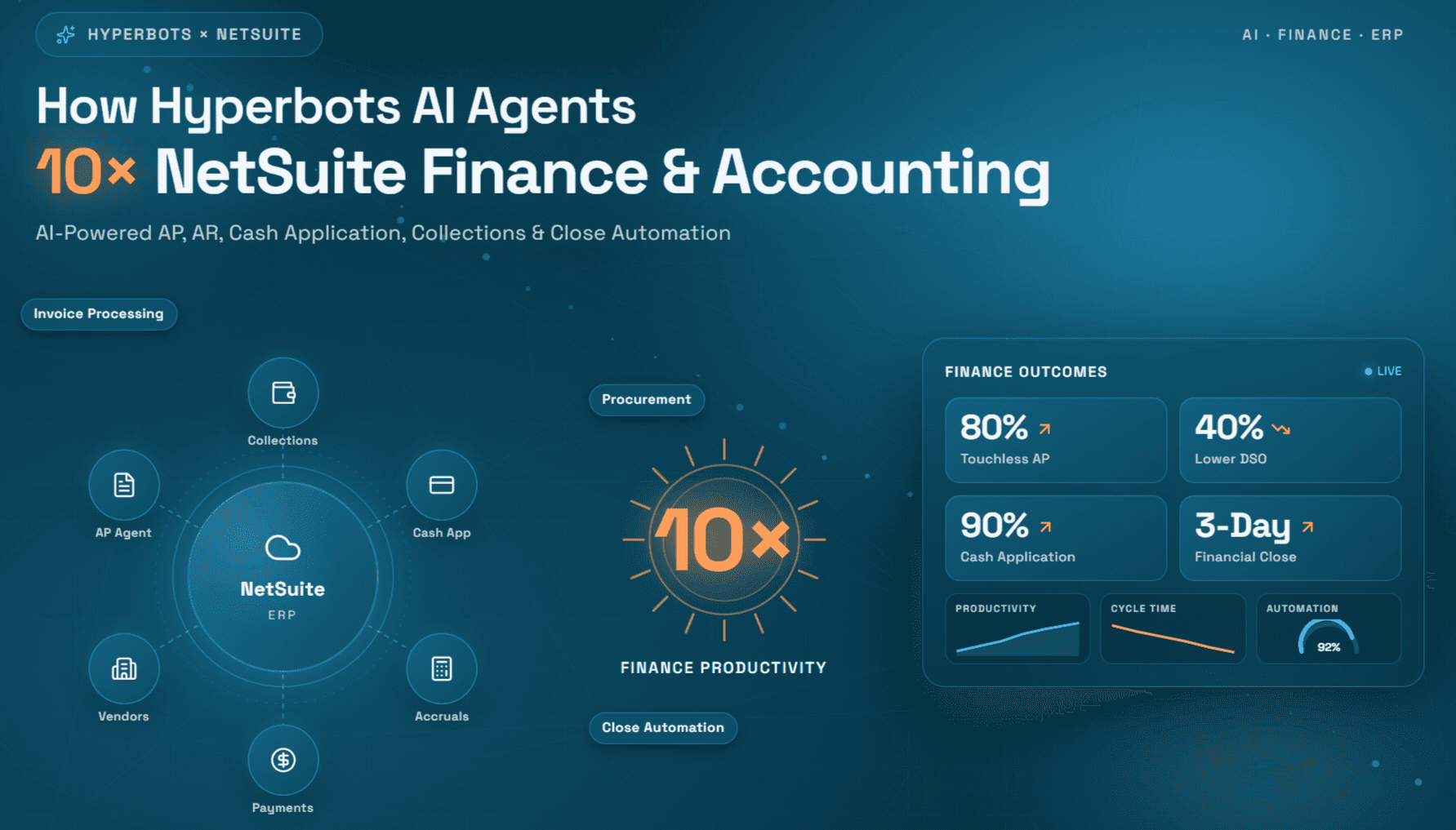
Agentic AI extends NetSuite beyond workflow automation, automating AP, AR, cash application, collections, reconciliations, and financial close to improve productivity and cash flow.
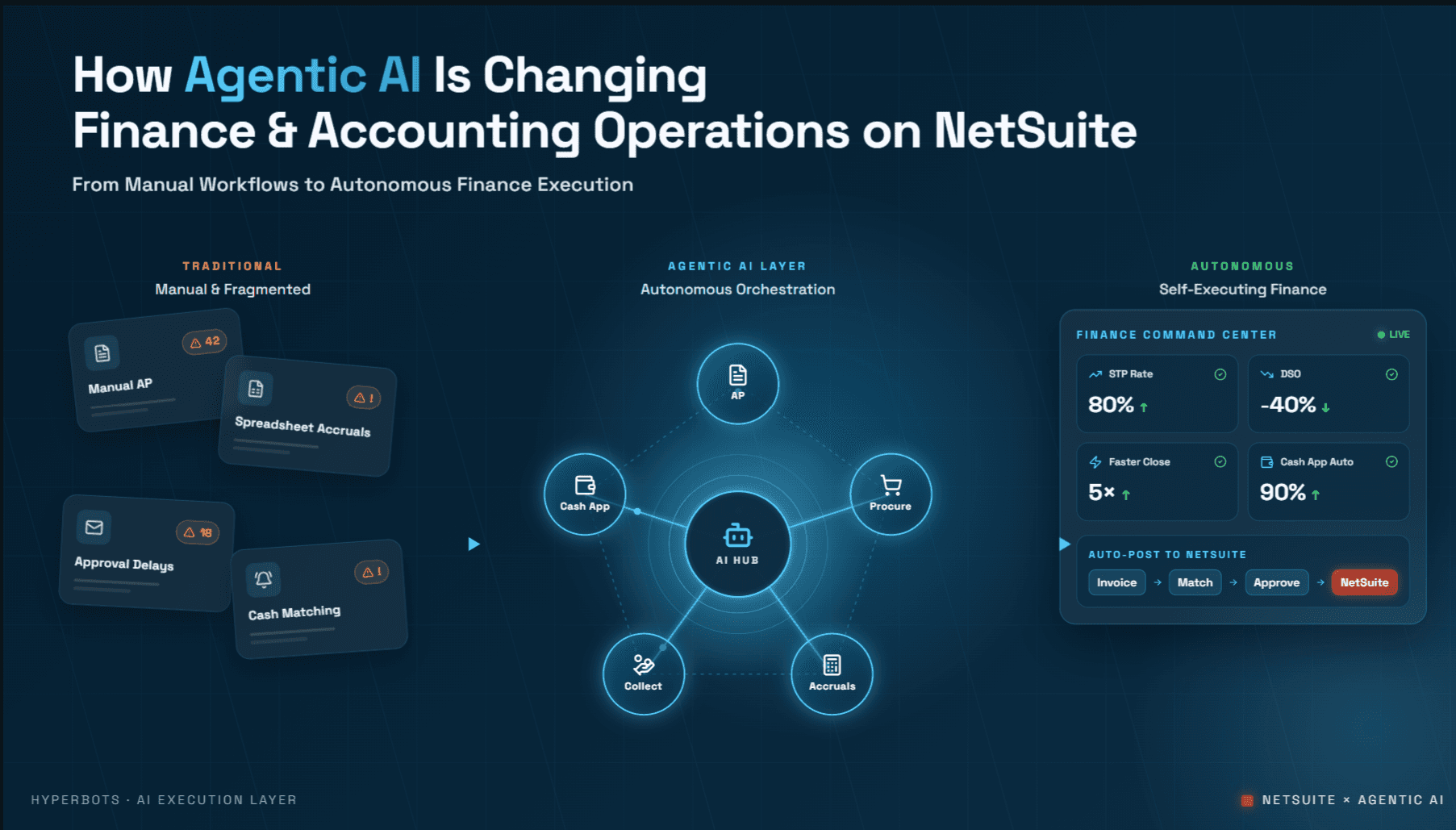
Finance teams have always operated under pressure. Quarter-end closes, reconciliation backlogs, exception queues in accounts payable, chasing down remittances, these aren't new problems. What is new is the widening gap between what finance leaders are being asked to deliver and what their current technology stack can actually support.
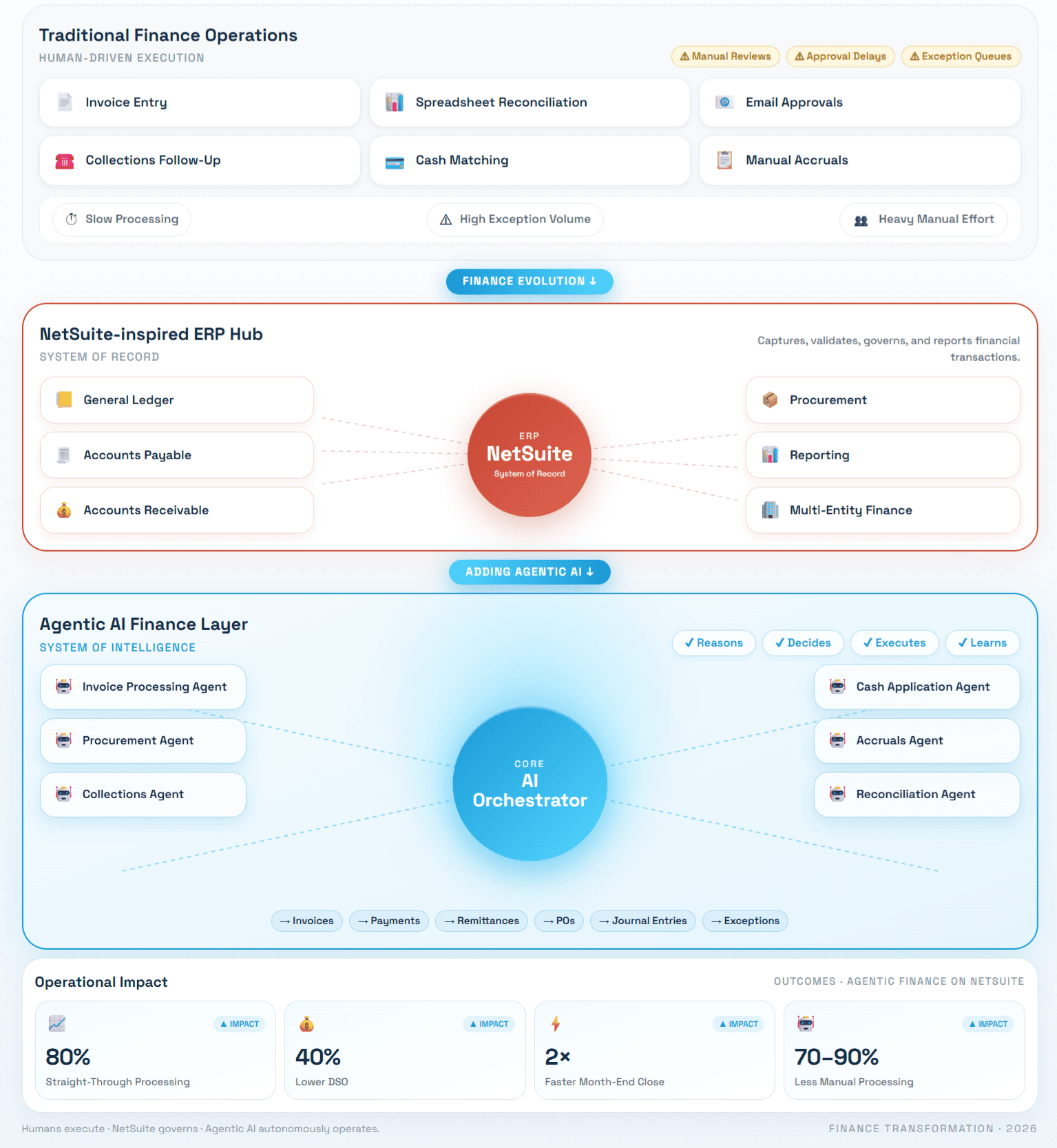
Enterprise ERP systems like Oracle NetSuite have done a tremendous job centralizing financial data and standardizing workflows. But even well-configured ERP environments rely heavily on human judgment for exceptions, unstructured inputs, and cross-system decisions. That gap between what the ERP records and what a skilled accountant actually does, is precisely where agentic AI is beginning to make a measurable difference.
This blog examines what agentic AI actually means in a finance context, where traditional NetSuite automation runs into its limits, and how AI agents are being applied across core finance workflows, from accounts payable and receivable to financial close and FP&A support.
What Is Agentic AI in Finance?
To understand agentic AI, it helps to first clarify what it is not.
Robotic Process Automation (RPA) executes fixed, rule-based sequences. It's reliable when inputs are consistent but brittle when they're not. The minute a vendor changes their invoice format, the bot breaks. Traditional ERP workflow automation is similarly deterministic: it routes a transaction based on predefined thresholds and conditions, but it doesn't reason about context.
Generative AI, in the form most people are familiar with, produces text or data in response to prompts. It's useful for drafting communications, summarizing documents, or answering questions. But it doesn't take action within systems or execute multi-step processes autonomously.
Agentic AI in finance and accounting represents a distinct capability. An AI agent can perceive its environment (invoices, ERP records, emails, contracts), reason about what action is appropriate given its objectives and constraints, take that action within connected systems, and then evaluate whether the outcome was correct,adjusting its approach if not. Critically, it can chain multiple steps together without a human directing each one.
For finance operations, this is significant. Consider an accounts payable scenario: an AI agent doesn't just extract invoice data, it cross-references the PO, checks goods receipt confirmation, validates tax treatment, identifies the correct GL code based on historical patterns, flags a discrepancy in the vendor's bank details, drafts a query to the vendor, and posts the entry after approval. That's not one task, it's eight or nine, executed in sequence with judgment applied at each step.
Finance is particularly well-suited to agentic systems because the work is data-rich, policy-driven, and highly repetitive in structure even when variable in content. There are clear success criteria (is the invoice matched? is the entry correct?), which makes it possible to build agents that operate with a meaningful degree of autonomy while staying within defined governance parameters.
The Limits of Traditional NetSuite Automation
Oracle NetSuite is a capable platform. Its SuiteFlow workflow engine, saved search automation, and approval routing cover a wide range of operational needs. But experienced NetSuite users will recognize where these tools begin to strain.
Rule-based workflows work well when transactions are clean and conform to expectations. When an invoice arrives without a PO reference, when a vendor submits a credit memo in PDF format through email, or when a three-way match fails because the goods receipt was entered with the wrong quantity, these exceptions require human intervention. In most NetSuite environments, that intervention involves someone pulling the invoice from a queue, investigating the issue, communicating with the vendor or internal team, and manually resolving it. That process can take hours or days, and it scales poorly with transaction volume.
The problem is compounded by how finance documents actually arrive. NetSuite is designed to process structured data, but a meaningful portion of AP volume still comes in as PDFs, scanned images, email attachments, or portal downloads from vendor systems. Getting that data into NetSuite accurately with the right header fields, line items, GL codes, and matching references, requires either manual entry or an extraction layer that sits outside the core ERP.
Reconciliation is another persistent friction point. Month-end close in a NetSuite environment often involves accountants manually comparing subledger balances to general ledger accounts, investigating variances, and preparing reconciliation workpapers in Excel. The data exists in NetSuite, but assembling it into a coherent reconciliation view, identifying what requires investigation, and documenting the resolution still demands significant human effort.
None of this is a criticism of NetSuite specifically, these are limitations of the ERP model in general. ERPs record and organize financial transactions; they were not designed to reason about them. That's the opening that agentic AI fills.
How Agentic AI Changes NetSuite Finance Workflows
Accounts Payable
The AP process is the most mature area of agentic AI deployment in finance, for good reason: it's high volume, document-intensive, and full of structured decision points.
Traditional workflow: An invoice arrives by email. AP staff download it, manually key data into NetSuite, attempt a PO match, resolve exceptions by contacting requestors or vendors, route for approval, and post. Exception rates of 20–30% are common in organizations without automation.
With NetSuite AP automation powered by agentic AI: The agent ingests the invoice from any channel such as email, portal, EDI, and extracts header and line-level data with high accuracy, performs a two- or three-way match against the PO and goods receipt in NetSuite, applies intelligent GL coding based on vendor history and line-item descriptions, validates sales tax treatment, and routes for approval only if human review is genuinely required. For matched invoices, the process runs end-to-end without manual intervention.
When exceptions occur, the agent doesn't simply halt. It reasons about the nature of the discrepancy, a quantity variance within tolerance, a price difference outside threshold, a missing PO reference, and takes the appropriate next step, which might mean querying the vendor directly, alerting the requestor, or flagging the invoice for AP manager review with a summary of what it found. Human staff focus on genuine judgment calls rather than routine processing.
The governance dimension matters here. Every agent action is logged, timestamped, and linked to source documentation in a way that supports audit requirements. Approvals remain with humans; the agent handles the preparation and routing.
Accounts Receivable
On the receivable side, agentic AI addresses two of the most time-consuming tasks: cash application and collections management.
Cash application has traditionally been a manual matching exercise. Payments arrive with remittance advice in varying formats, EDI, email attachments, portal downloads, or sometimes no remittance at all. Matching each payment to the correct open invoice in NetSuite, handling partial payments, short pays, and deductions, and resolving mismatches consumes significant AR staff time.
AI-powered cash application agents extract remittance data from any format, match payments to open invoices using multiple signals (invoice number, amount, customer reference, payment history), apply configurable rules for short pays and deductions, and post the entries to NetSuite. When a payment can't be matched automatically, the agent surfaces it with a recommended action rather than simply dumping it in an exception queue.
Collections prioritization benefits equally from an agentic approach. Rather than working through an aging report from oldest to newest, an AI agent can assess each overdue account by considering payment history, customer relationship value, dispute status, and predicted payment probability, producing a prioritized worklist for the collections team. AI collections automation can also handle initial outreach communications autonomously, escalating to human staff only when a customer raises a dispute or the account requires relationship-level attention.
Dispute workflows, which often stall because they span multiple systems and teams, can be managed by agents that track dispute status, route supporting documentation, and push for resolution within defined SLAs.
Financial Close
Month-end close is where many finance teams feel the most acute pressure. It's time-compressed, error-prone, and dependent on a small number of experienced accountants who carry institutional knowledge that isn't easily documented.
AI agents contribute across several close activities. For reconciliations, agents can pull balances from both the subledger and the general ledger in NetSuite, identify variances, cross-reference supporting transactions, and prepare a reconciliation workpaper with exceptions pre-highlighted. Rather than starting from scratch, the accountant reviews and approves a largely completed document.
Accrual estimation is another area where agentic reasoning adds value. Identifying what needs to be accrued such as goods received but not invoiced, services rendered but unbilled, recurring expenses without a current-period invoice, requires scanning open POs, contract schedules, and historical patterns. An AI agent can surface accrual candidates with recommended amounts and supporting rationale, ready for controller review and approval.
Anomaly detection during close is increasingly practical. Agents can flag journal entries that deviate from expected patterns, unusual amounts, atypical account combinations, entries posted at odd times, for human review before the books close. This supports both accuracy and internal controls without adding to the close timeline.
Variance analysis between actual and budget can be assisted by agents that identify the largest drivers of variance, pull the underlying transactions, and provide a narrative summary that the FP&A team can review and refine rather than build from scratch.
Procurement and Spend Controls
Purchase requisition and PO processes in NetSuite can benefit from agents that bring reasoning to what is currently a largely rules-based workflow.
Approval routing based on dollar thresholds and department hierarchies is well-handled by standard NetSuite configuration. What's harder to automate conventionally is spend anomaly detection, identifying when a purchase request is inconsistent with historical patterns for that vendor, category, or department, or when a PO is being created against a vendor whose contracts have lapsed.
AI agents can evaluate each procurement transaction against a broader context: Is this vendor approved? Are the terms consistent with the master agreement? Is this spend category typically bought through preferred suppliers? Does this requisition look like it might be splitting a purchase to stay under an approval threshold? These are judgment calls that rule-based systems handle poorly but that AI agents can surface reliably.
Vendor risk monitoring is an adjacent capability, agents that periodically assess vendor records for compliance flags, certificate expirations, or changes in banking details that might warrant verification before the next payment run.
Why NetSuite Is Well Positioned for Agentic AI
Several characteristics of the NetSuite platform make it a particularly suitable environment for agentic AI deployment.
Centralized, structured data is the foundation. NetSuite's unified data model means that transactions, vendor records, customer data, GL codes, approval hierarchies, and reporting structures all live in one place. AI agents that need to reason across these data sets don't have to reconcile conflicting sources, a significant advantage compared to fragmented multi-system environments.
SuiteCloud and APIs provide well-documented integration surfaces. NetSuite's REST APIs, SuiteScript framework, and SuiteFlow engine allow external AI systems to read data, write back results, and trigger workflow events without requiring deep customization. This makes it practical to deploy agentic AI as a layer on top of NetSuite rather than attempting to replace core functionality.
Workflow orchestration in NetSuite provides a natural handoff point for human oversight. AI agents can prepare, recommend, and route while approvals and exception resolutions remain in the NetSuite workflow where they belong, creating a clear audit trail within the system of record.
Oracle has also been investing in native AI capabilities within NetSuite, including intelligent automation features in areas like invoice processing, cash management, and analytics. AI co-pilots from specialized vendors complement these investments by addressing the depth of automation in specific finance processes where native capabilities are still maturing.
Governance, Controls, and Risks
Any honest assessment of agentic AI in finance must address the risk side of the equation. Finance operations are high-stakes; errors have real consequences.
Hallucination and accuracy risk is a legitimate concern, particularly for AI systems built on general-purpose language models. Finance-specific AI agents mitigate this through structured validation logic, confidence thresholds, and human review gates for decisions above defined risk levels. An agent that is uncertain should surface the transaction for human review, not guess.
Auditability is non-negotiable in a finance context. Every agent decision, what data was used, what logic was applied, what action was taken, must be logged in a way that supports internal and external audit requirements. This isn't optional; it's a baseline requirement for any finance AI deployment.
Segregation of duties doesn't disappear with AI. Agents that prepare journal entries should not also approve them. The segregation framework that governs human roles must be reflected in the AI architecture: preparation, recommendation, and approval remain distinct functions.
Explainability matters for both compliance and adoption. Finance controllers need to understand why an agent took a particular action, which match criteria fired, why a GL code was selected, what triggered an exception flag. Black-box AI has limited utility in a regulated function.
Phased implementation is the practical path forward. Organizations that have seen the most durable results deploy agentic AI in waves, starting with high-volume, well-structured processes like invoice processing, measuring outcomes, building organizational confidence, and then expanding to more complex workflows like accruals and cash application. This approach also allows governance frameworks and human oversight models to mature alongside the technology.
What Finance Teams Should Expect in the Next 3–5 Years
The trajectory of AI in finance operations over the next several years is likely to be one of gradual expansion of agent autonomy within defined boundaries, not a sudden shift to fully autonomous finance.
The near-term picture for most organizations is AI-assisted operations: agents handling the routine and structured portions of finance workflows, with humans engaged at exception points and for final approval. The workload shifts rather than disappears with accountants spending less time on transaction processing and more time on review, analysis, and judgment.
Over a three-to-five year horizon, several developments seem probable. ERP-native AI ecosystems will deepen, with Oracle and others embedding more sophisticated agent capabilities directly into platform functionality. Multi-agent workflows will become more common, where specialized agents for AP, AR, reconciliation, and FP&A coordinate with each other to handle end-to-end finance processes with minimal human orchestration.
Finance roles will evolve toward exception management and supervision, a function that requires understanding what the AI is doing and why, knowing when to override it, and being able to explain decisions to stakeholders and auditors. This demands a different skill set than traditional transaction processing: more analytical, more governance-oriented, and more focused on the quality of AI outputs than on execution.
What won't change is the need for experienced finance professionals who understand the underlying accounting, the regulatory environment, and the business context. AI agents are effective precisely because humans have defined the policies, controls, and objectives they operate within.
Getting Started with Agentic AI for NetSuite Finance
If you're evaluating agentic AI for your NetSuite environment, Hyperbots is one example of a platform purpose-built for this use case. Its AI co-pilots cover accounts payable, accounts receivable, procurement, accruals, and payments, designed to work alongside NetSuite rather than replace it, with pre-trained finance models and built-in governance capabilities.
Request a demo to see how agentic AI workflows operate in a NetSuite context, or start a free trial to evaluate the platform against your own finance data.
Frequently Asked Questions
Q1. What is agentic AI in NetSuite?
Agentic AI in NetSuite refers to AI systems that can perceive financial data within and around the NetSuite environment, reason about what actions are appropriate, and execute multi-step finance tasks such as invoice processing, reconciliation, or collections follow-up—with a degree of autonomy, while maintaining human oversight for approvals and exceptions.
Q2. How is agentic AI different from RPA in finance?
RPA follows fixed, predefined rules and breaks when inputs vary. Agentic AI reasons about context, handles unstructured inputs, manages exceptions without predefined scripts, and improves over time. In practice, RPA automates what's already structured; agentic AI can operate on the messy, variable reality of most finance workflows.
Q3. Can AI agents automate accounts payable in NetSuite?
Yes, and this is one of the most mature deployment areas. AI agents can handle invoice ingestion from any format, data extraction, PO and goods receipt matching, GL coding, sales tax validation, vendor communication for exceptions, and approval routing—reducing manual touch on straight-through transactions significantly.
Q4. Is agentic AI safe for finance operations?
With appropriate governance in place, yes. This means building AI systems with clear audit trails, human approval requirements for high-risk transactions, explainable decision logic, and confidence thresholds that route uncertain cases to human review. The safety of any AI deployment depends substantially on how it's designed and governed, not just the underlying technology.
Q5. Does NetSuite include built-in AI features?
Oracle NetSuite has been adding AI capabilities including intelligent invoice capture, analytics enhancements, and workflow automation features. These native capabilities continue to evolve. Specialized AI co-pilot platforms complement them by providing deeper automation in specific finance processes, particularly in areas like high-volume AP, cash application, and accruals, where native tools are still maturing.
Q6. Will AI replace accountants?
Not in the foreseeable future. Agentic AI handles the structured, repetitive, and rules-based portions of finance work. Accounting judgment, business analysis, audit management, stakeholder communication, and regulatory interpretation all require human expertise. The realistic near-term outcome is that AI handles more of the transaction volume, and accountants focus more of their time on the work that genuinely requires their expertise.
Q7. Which finance workflows benefit most from agentic AI?
Accounts payable, particularly invoice processing and exception handling, is the most mature deployment area. Cash application, collections management, accruals, and reconciliation preparation are close behind. FP&A support through natural-language analysis and scenario modeling is an emerging and growing area. Workflows that are high-volume, data-rich, and involve consistent decision logic tend to benefit most.
Q8. How should finance teams approach implementing agentic AI on NetSuite?
A phased approach is most effective. Start with a well-defined, high-volume workflow like invoice processing where baseline metrics are clear and outcomes are measurable. Establish governance frameworks, audit trails, approval gates, exception handling protocols, before expanding to more complex processes. Involve both finance and IT stakeholders in the design, and treat the first deployment as a learning exercise as much as a production rollout.