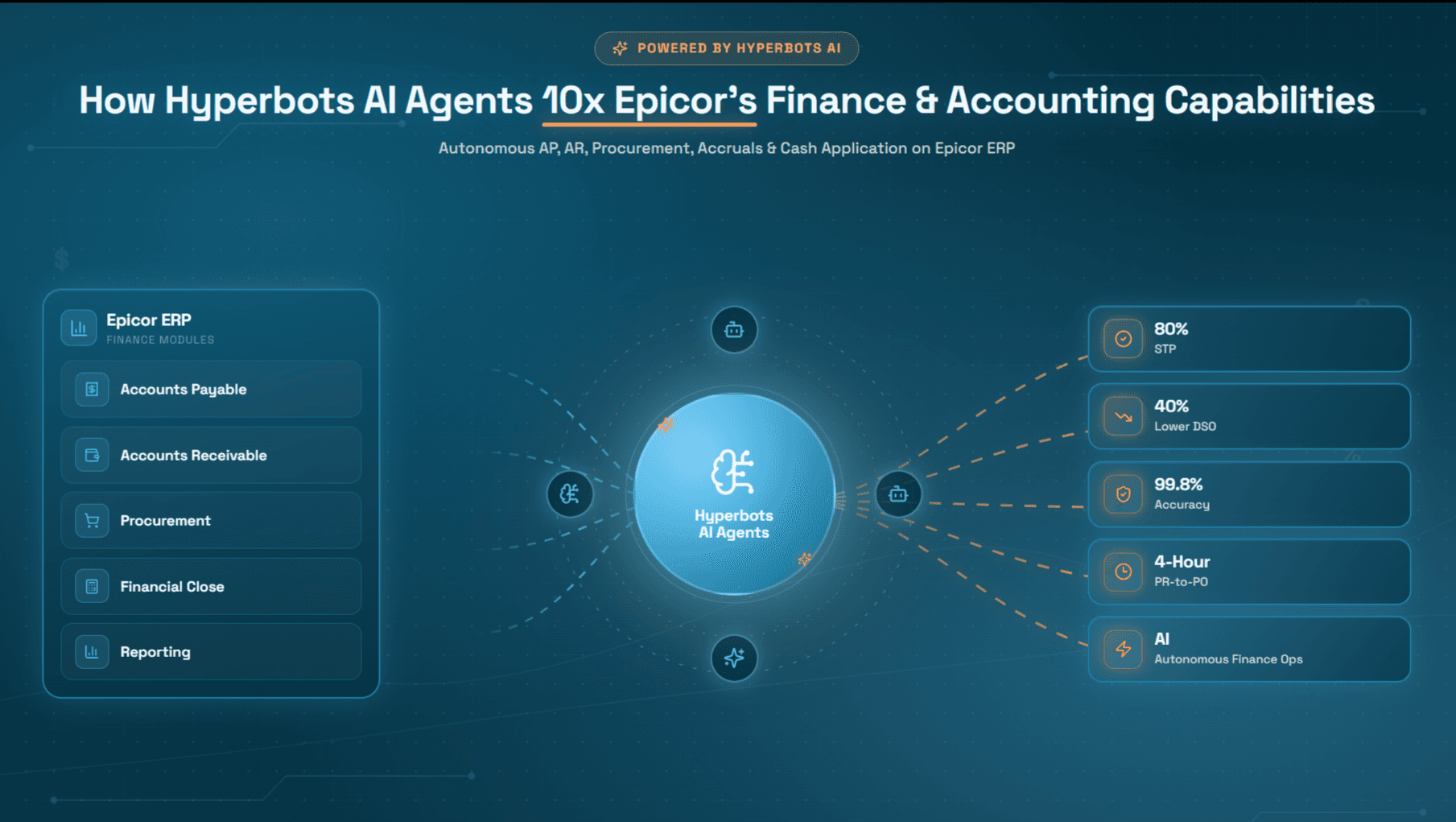
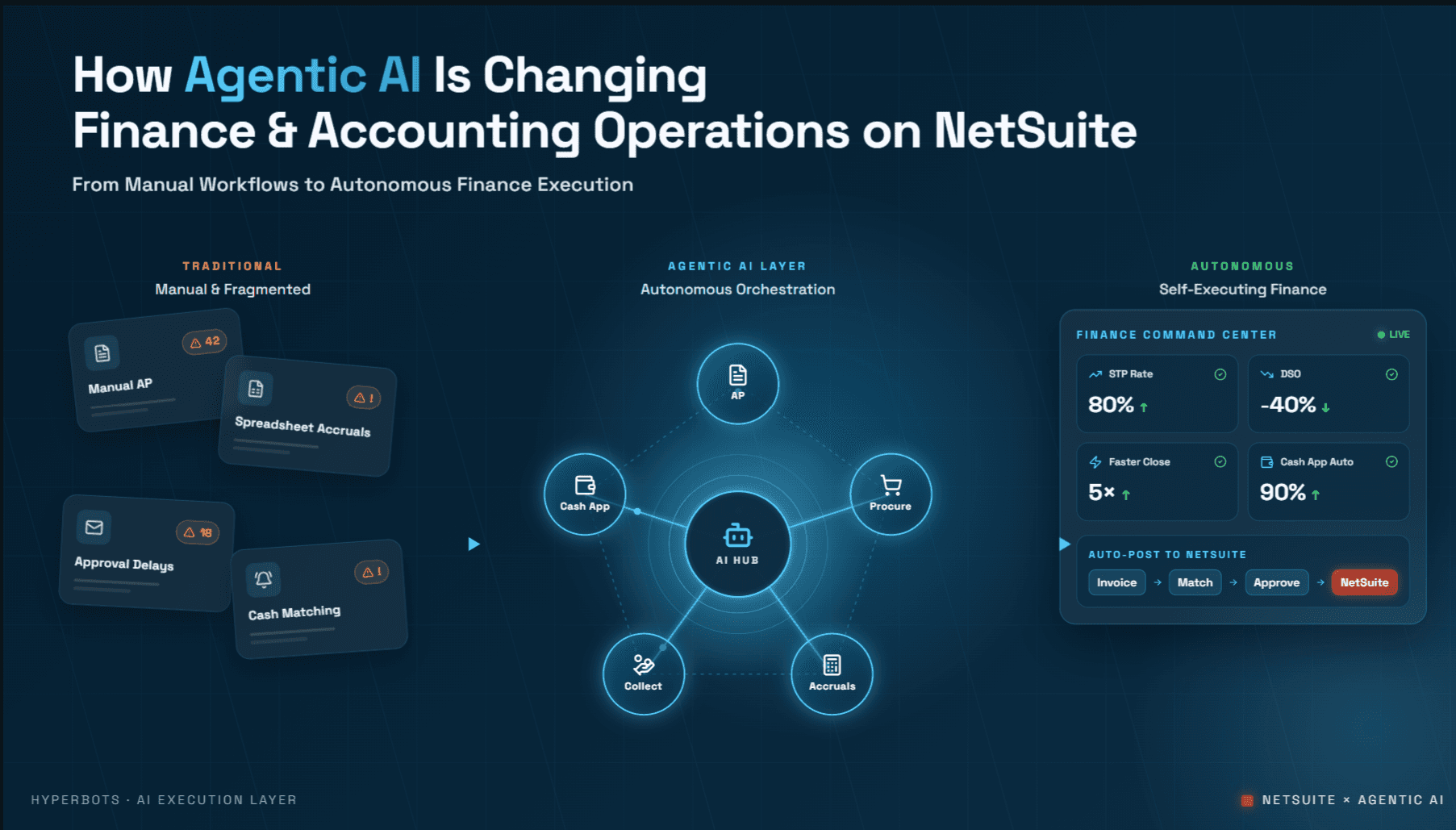
Closing the Finance & Accounting Gaps in Epicor with Hyperbots AI Agents
Hyperbots transforms Epicor with AI-powered automation for invoice processing, cash application, collections, reconciliations, and financial close.
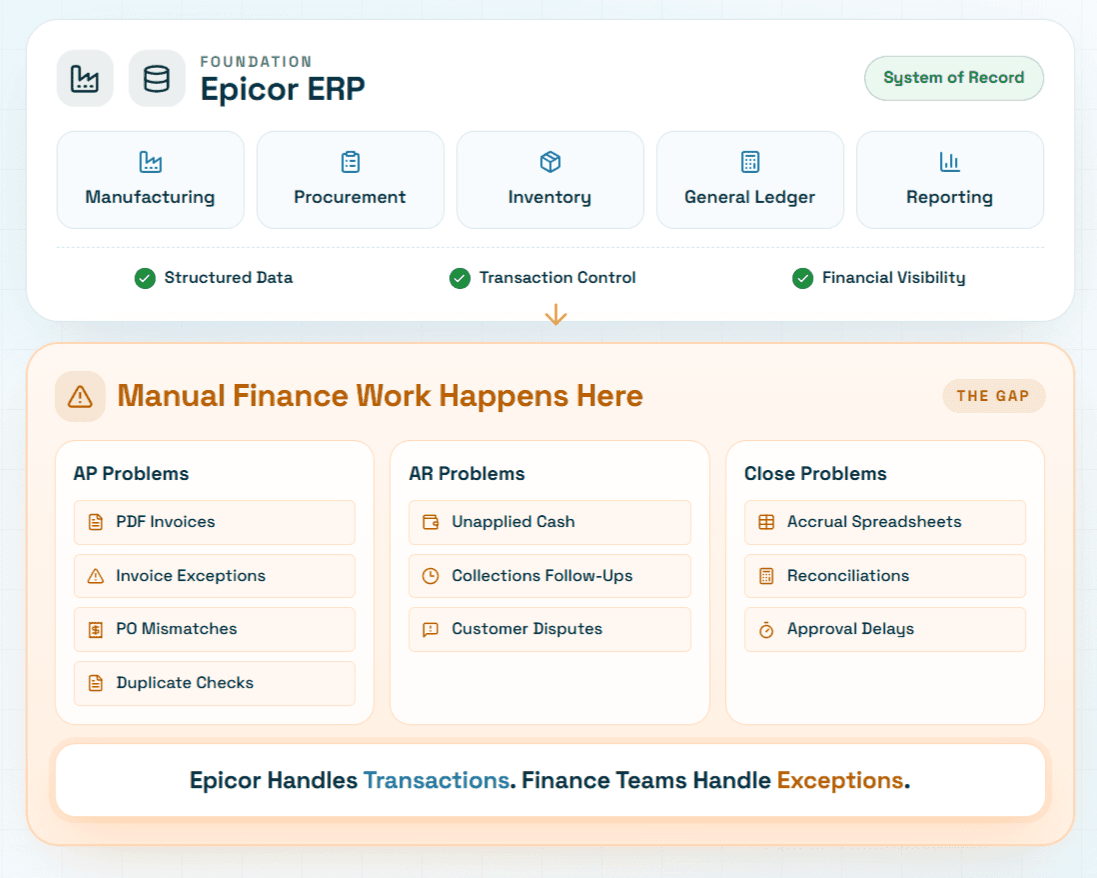
Epicor ERP was architected to solve a specific and important problem: bringing manufacturing and distribution operations onto a unified transactional platform. It does this with reasonable depth through managing bills of material, work orders, inventory, and general ledger in a single system of record. For operations and production teams, that integration has genuine value.
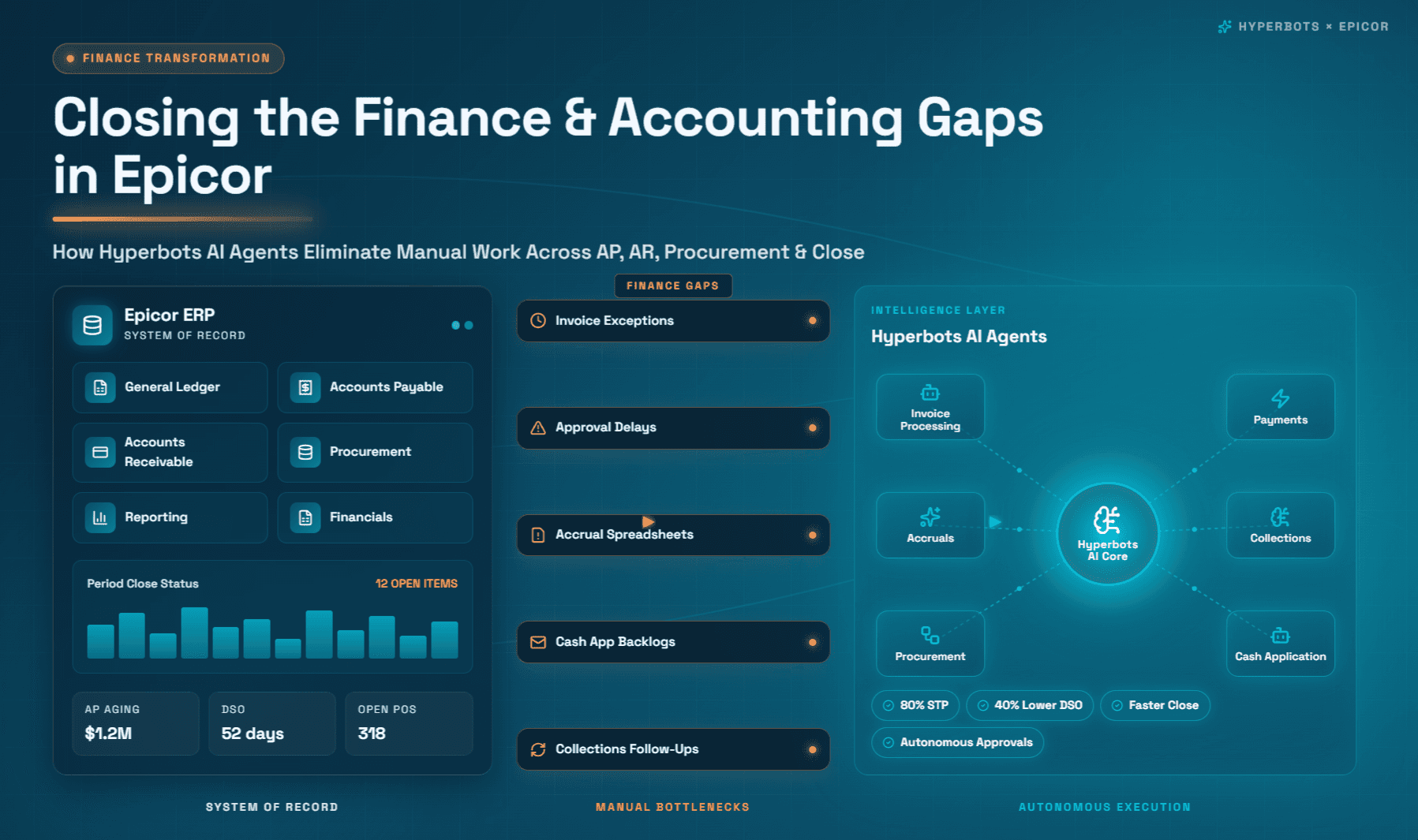
For finance teams, however, a consistent pattern emerges across Epicor environments: the system handles structured transactions well, but struggles at the edges of finance execution where real operational work actually happens. Invoice exceptions, collections follow-ups, remittance parsing, accrual estimation, period-end reconciliation, these are not fringe activities. They constitute a substantial portion of what AP, AR, and accounting teams do each day.
The reason is architectural, not accidental. Traditional ERP systems like Epicor were designed as systems of record and transaction management platforms. They were not conceived as adaptive execution engines capable of reasoning through unstructured data, managing cross-functional exception workflows autonomously, or orchestrating vendor and customer communications dynamically. The result is a persistent gap between what finance teams need and what the ERP natively delivers, a gap that, in most manufacturing finance environments, gets filled by email, spreadsheets, and manual coordination.
This blog examines those gaps in detail: where they occur inside Epicor's procure-to-pay and order-to-cash workflows, why they persist even in well-implemented environments, and what an AI intelligence layer can realistically do to reduce their operational drag.
Procure-to-Pay in Epicor: Where Manual Effort Concentrates
Invoice Ingestion and Extraction
The P2P cycle in Epicor begins cleanly when a purchase requisition flows to a purchase order and an EDI or portal-based invoice lands in the system with complete, matching data. In practice, this scenario represents a minority of invoice volume for most manufacturers.
The majority of vendor invoices arrive as PDFs over email, uploaded through Epicor's vendor portal, or submitted via fax by smaller suppliers. Epicor’s core ERP platform historically relied on structured workflows and external OCR tooling, though Epicor now offers adjacent products such as AP Assist and AR Assist to address invoice and remittance extraction. These capabilities are not uniformly deployed across the installed base and still rely on exception handling workflows. Furthermore, OCR alone, without contextual understanding, struggles with vendor-specific invoice formats, multi-page documents, inconsistent field placement, and the kind of ambiguous line-item descriptions common in manufacturing supply chains.
The result: AP staff in Epicor environments frequently spend a meaningful portion of their day manually keying or correcting invoice data, a high-touch activity with no strategic value and significant error risk.
PO Matching Exceptions and Approval Bottlenecks
Three-way matching, reconciling the invoice against the PO and the goods receipt, is where Epicor's rules-based automation most commonly breaks down. Tolerance mismatches, quantity discrepancies between receipt and invoice, unit-of-measure variations, and line-item descriptions that do not match verbatim are all common exception triggers in manufacturing procurement.
When a match exception occurs in Epicor, the system routes the invoice to an approval queue. What happens next typically leaves the ERP entirely. Approvers receive email notifications, consult separate documentation, exchange messages with buyers or receiving teams, and eventually resolve the discrepancy often without a clean audit trail returning to the ERP. In high-volume environments, these exceptions accumulate faster than they are resolved, creating AP aging backlogs that distort cash flow visibility.
The deeper issue is that Epicor's matching logic is deterministic and static. It cannot learn from historical resolution patterns. It cannot recognize that Vendor X consistently submits invoices with slightly different unit pricing due to a freight surcharge that has been informally accepted. It cannot distinguish between a discrepancy that requires escalation and one that can be resolved by reference to a standing agreement. Every exception is treated as equally unresolved until a human intervenes.
Duplicate Invoice Risk and Accrual Visibility
Duplicate invoice exposure is a persistent risk in Epicor AP environments, particularly when invoices arrive through multiple channels, email, portal, and paper scanning, or when a vendor resubmits after a delayed response. Epicor's native duplicate detection relies on exact or near-exact field matches. Invoices with slight variations in invoice number format, date expression, or vendor reference can pass through without triggering a duplicate flag.
On the accrual side, Epicor environments typically require significant manual effort at period-end to identify goods received but not yet invoiced, services delivered without a corresponding PO, or recurring expenses not yet reflected in AP. Finance teams performing these estimates often rely on open PO reports, receiving logs, and direct outreach to operations, a time-intensive process that introduces estimation variance and increases close cycle duration.
Accounts Payable Operations: The Exception Layer Is the Problem
Touch-Heavy Processing and Workflow Rigidity
A common benchmark in enterprise AP operations is cost-per-invoice. In manually intensive Epicor environments, that cost is elevated not because Epicor's workflow engine is poorly designed, but because a substantial proportion of invoices require human interaction at one or more stages. GL coding, approval routing, vendor communication, and exception resolution all add touches.
Epicor's workflow engine is rule-based: routing decisions are made on predefined criteria such as invoice amount, cost center, or vendor classification. This works well for standard invoices that fit the expected pattern. It breaks down when invoices present combinations of attributes the rules were not designed to handle, a situation that is routine rather than exceptional in manufacturing environments with diverse vendor bases and complex procurement categories.
Contextual reasoning, understanding that an invoice from a logistics provider might be coded to distribution rather than operations based on the PO description and historical pattern, requires adaptive intelligence that static rule sets cannot provide.
GL Coding and Audit Trail Fragmentation
Manual GL coding in Epicor is a significant source of both labor cost and financial reporting risk. AP staff must interpret invoice descriptions, cross-reference PO categories, and apply the correct account codes, a judgment-intensive task that is prone to inconsistency when volume is high or when staff turnover disrupts institutional knowledge.
Epicor maintains a transaction audit trail, but the audit record frequently captures only the outcome, the invoice posted with a specific GL code, without documenting the reasoning behind that coding decision. When auditors or controllers need to review coding accuracy, they must reconstruct the logic from contextual clues rather than reading a documented decision chain.
Order-to-Cash in Epicor: Fragmentation Across the Revenue Cycle
Cash Application Delays and Remittance Parsing
Cash application is one of the most operationally demanding processes in Epicor's O2C workflow. The challenge is not Epicor's posting mechanics, which function reliably for clean, one-to-one payment matches. The challenge is remittance interpretation.
Customers submit remittance advice in widely varying formats: email attachments, portal uploads, ACH payment descriptions, PDF check stubs, and spreadsheet extracts. Each format requires different parsing logic to extract the invoice references, payment amounts, and any deductions or short-pays. Epicor has no native remittance interpretation engine. AR staff must manually review incoming remittance data, identify the corresponding open invoices, and create the application records in the system.
In high-volume AR environments, distribution companies process hundreds or thousands of transactions daily with unapplied cash balances accumulating during periods of staff absence or volume spikes. Unapplied cash distorts AR aging reports, reduces visibility into actual outstanding balances, and creates friction in collections follow-up.
Collections Workflow and DSO Management
Epicor's standard AR aging and collections functionality provides statement generation and dunning letter capabilities. What it does not provide is intelligent collections prioritization: the ability to dynamically rank outstanding balances by collectability, customer payment behavior, relationship sensitivity, and business risk.
In practice, collections teams in Epicor environments work from static aging reports, often exported to Excel, and prioritize follow-up based on balance size and days outstanding. This approach misses important signals. A large balance from a consistently reliable customer who is simply running behind is a different risk profile than a smaller balance from a customer who has disputed every invoice for six months. Epicor does not reason across these dimensions autonomously.
Follow-up communication is equally fragmented. Collectors send emails from personal inboxes, track responses in spreadsheet notes, and coordinate with sales or account management through informal channels. The result is inconsistent follow-up cadences, missed escalation triggers, and limited institutional memory about each customer relationship.
Deduction Handling and Dispute Management
Deductions which are customer short-payments with an implied or explicit claim for a credit, are among the most labor-intensive activities in O2C. In manufacturing and distribution environments, deduction volumes can be substantial, driven by pricing disputes, promotional allowances, freight claims, and quality deductions.
Epicor does not have a dedicated deduction management module in most configurations. Deductions are typically handled through manual workflows: the AR team identifies a short-pay, creates a deduction record in a spreadsheet or ancillary system, routes a claim form to the relevant internal team, and awaits resolution before clearing the AR balance. This process can take days or weeks per item, and deduction aging is difficult to track systematically within Epicor's native AR module.
Accounts Receivable: Operational Gaps That Compress Working Capital
Aging Follow-Up Inefficiencies
The operational reality in many Epicor AR environments is that follow-up on overdue balances is reactive and inconsistent. High-volume periods, staff bandwidth constraints, and the absence of automated prioritization mean that some overdue balances receive timely attention while others are overlooked until they age significantly.
Epicor can generate aging reports and send scheduled statements, but it cannot autonomously adjust follow-up intensity based on real-time payment behavior, initiate multi-channel outreach, or escalate strategically based on customer relationship context. These capabilities require a layer of intelligence that the ERP was not designed to provide.
The downstream consequence is measurable: DSO in manually managed Epicor AR environments tends to be higher than in comparable organizations using intelligent collections automation. Even modest improvements in follow-up consistency and prioritization, reaching customers earlier in the overdue cycle with the right message, can reduce DSO and improve cash flow visibility materially.
Reconciliation and Dispute Resolution
Customer account reconciliation in Epicor typically requires AR staff to compile statements, cross-reference payment histories, identify unapplied credits, and resolve discrepancies through direct customer communication. When disputes arise, a common occurrence in manufacturing environments with complex pricing structures, the resolution workflow often moves outside Epicor entirely, coordinated through email and shared documents.
The absence of a structured, ERP-integrated dispute resolution workflow means that dispute status is difficult to track systematically, resolution timelines are hard to enforce, and the institutional knowledge accumulated through customer dispute history is rarely captured in a format that informs future collections strategy.
Financial Close and Reconciliation: The Month-End Bottleneck
Manual Reconciliations and Spreadsheet Dependence
Month-end close in Epicor environments is commonly an extended, labor-intensive process. Reconciliations between subsidiary ledgers and the GL, between bank statements and AP/AR records, and between accrual estimates and actual invoices received all require significant manual effort. Many of these reconciliations are performed in spreadsheets, with data extracted from Epicor and manipulated outside the system.
Spreadsheet-based reconciliation introduces version control risks, formula errors, and audit trail gaps. When reconciliation exceptions are identified, the resolution process requires coordination across finance team members who may be working simultaneously on multiple period-end tasks, creating the approval and sign-off bottlenecks that extend close cycles.
Accrual Estimation and Anomaly Detection
Estimating accruals at period-end, particularly for services rendered without a corresponding invoice, or for goods in transit at the cutoff date, requires judgment that Epicor cannot provide autonomously. Finance teams must identify accrual candidates through manual review of open POs, goods receipt records, and direct inquiry to operations and procurement teams.
Similarly, Epicor does not have native anomaly detection capabilities that would alert controllers to unusual patterns in posting activity, unexpected vendor charges, or GL coding inconsistencies. These anomalies are typically discovered during close review, adding to the exception handling workload when the timeline pressure is highest.
Why These Gaps Persist: An Architectural Reality
The operational gaps described above are not configuration failures. They persist in well-implemented Epicor environments because they reflect a fundamental architectural reality: ERP systems are optimized for structured, deterministic transaction processing. Finance operations, particularly in manufacturing and distribution environments, generate large volumes of unstructured data, PDF invoices, email communications, freeform remittance notes, verbal agreement records, that fall outside the ERP's data model.
Rules-based automation, which is what Epicor's workflow engine provides, works reliably within defined parameters and breaks predictably outside them. Automation often breaks at the exception layer and in finance operations, exceptions are not edge cases. They are a routine feature of working with diverse vendor and customer bases, complex procurement categories, and the inherent variability of real-world transactional data.
Addressing these gaps requires a different architectural approach: not replacing the ERP, but augmenting it with a layer of adaptive intelligence that can interpret unstructured data, reason through exception scenarios, orchestrate multi-channel communications, and learn from historical patterns to improve accuracy over time.
Finance Workflow | Epicor Native Capability | Operational Limitation | Hyperbots AI Augmentation |
Invoice Processing | Rules-based workflow + OCR tools | Manual correction for non-standard invoices | AI-native extraction and contextual validation |
3-Way Matching | Deterministic PO matching | Frequent exception queues for tolerances and freight variances | Adaptive tolerance-based exception handling |
Cash Application | Standard payment posting | Manual remittance interpretation | AI remittance parsing and autonomous matching |
Collections | Static aging reports | No dynamic prioritization or outreach orchestration | AI-driven collections prioritization and follow-up |
GRNI Accruals | Manual reporting workflows | Spreadsheet-heavy period-end estimation | Automated accrual candidate identification |
Reconciliation | Spreadsheet-driven | Audit trail fragmentation and manual tie-outs | AI-assisted reconciliation workflows |
How Hyperbots AI Agents Address the Epicor Finance Gap
Hyperbots is designed to function as an AI intelligence layer that augments Epicor rather than replacing it. The integration preserves Epicor as the system of record while deploying purpose-built AI co-pilots across the specific workflow areas where ERP-native automation has documented limitations.
AP and Procurement Co-Pilots
The Invoice Processing Co-Pilot addresses the extraction and matching gaps that drive manual effort in Epicor AP operations. Rather than template-based OCR, Hyperbots uses AI-native extraction that can interpret unformatted PDFs, multi-page documents, and invoices with non-standard layouts without predefined templates. Finance teams may experience meaningful reductions in manual keying effort as straight-through processing rates increase for invoices that previously required human intervention at the data capture stage.
For PO matching, Hyperbots' configurable matching strategies allow tolerance rules to be set at the vendor, category, or PO level, enabling the system to resolve routine discrepancies autonomously rather than routing every variance to an approval queue. Exception handling effort can decline significantly when the system can distinguish between a discrepancy that requires human judgment and one that falls within a pre-approved tolerance.
The Procurement Co-Pilot extends this intelligence to the upstream P2P cycle, automating PR creation, validation, and PO generation with AI-assisted GL coding that learns from historical patterns. Organizations often reduce the manual effort associated with procurement cycle time when requisition-to-PO workflows are automated end-to-end.
The Accruals Co-Pilot automates the identification of accrual candidates at period-end, including goods received but not invoiced, services rendered without a PO, and recurring expenses and books the corresponding journal entries directly into Epicor after a configurable review step. Many teams experience faster month-end close cycles when accrual estimation moves from a manual, multi-day process to an automated workflow with human oversight at the exception layer.
Procure-to-Pay ROI
Metrics | Epicor alone | With Hyperbots | Operational Impact |
Invoice processing time | 8–12 day invoice cycle times are common in manual AP environments such as Epicor | Hyperbots processes invoices in <1 minute | 99%+ reduction in invoice processing time |
Straight-through invoice processing | Typical ERP-centric AP teams achieve ~15–25% touchless processing | Hyperbots achieves 80% STP | 3.2×–5.3× higher touchless processing rate |
Invoice extraction accuracy | Traditional OCR systems typically achieve only 85–90% accuracy | Hyperbots delivers 99.8% extraction accuracy | 50×–75× reduction in manual correction requirements |
AP manual workload | AP teams often spend 60–70% of capacity on manual entry and exception handling | Hyperbots automates matching, validation, and GL coding | 4×–5× reduction in manual AP workload |
Early payment discount capture | Most organizations capture <40% of available discounts | Hyperbots captures 100% of all early payment discounts automatically | 2.5×+ improvement in discount capture potential |
AR and Collections Co-Pilots
On the order-to-cash side, Hyperbots' Cash Application Co-Pilot addresses the remittance parsing challenge that drives unapplied cash accumulation in Epicor environments. The co-pilot interprets incoming remittance data across formats, email attachments, ACH descriptions, PDF stubs and applies payments to open invoices autonomously, with human review triggered only for genuinely ambiguous cases. Finance teams may improve cash application turnaround times and reduce unapplied cash balances as a result.
The Collections Co-Pilot introduces intelligent prioritization to the AR follow-up process. Rather than working from a static aging report, collections teams receive dynamically ranked worklists that factor in payment behavior, balance size, customer relationship context, and dispute history. Automated outreach cadences, escalating appropriately based on customer response, replace ad-hoc email follow-up, improving consistency without increasing headcount.
These capabilities are not positioned as a fully autonomous finance department. They are realistic, operationally grounded augmentations to an ERP environment where specific, well-documented gaps in native automation create friction and cost. The ROI calculators available from Hyperbots allow finance leaders to estimate the impact in their specific operating environment before committing to deployment.
Order-to-Cash ROI
Metric | Epicor Alone / ERP-Centric Reality | With Hyperbots | Operational Impact |
Cash application automation | Manual and ERP-centric AR environments don’t automate cash application, with payment matching and reconciliation heavily dependent on human intervention. | Hyperbots achieves 80–90% straight-through cash application using AI-driven remittance extraction, intelligent matching, and autonomous ERP posting | 4×–9× higher cash application automation, enabling faster reconciliation and reduced AR processing costs |
Days Sales Outstanding (DSO) | ERP-centric collections workflows rely on static aging buckets, manual follow-ups, and delayed dispute identification, contributing to elevated DSO | Hyperbots delivers ~40% DSO reduction through AI-driven prioritization and autonomous follow-ups | Up to 1.6× faster cash-conversion cycle |
Cost-to-collect | Traditional collections environments require large amounts of manual outreach, dispute handling, and tracking effort | Hyperbots uses AI-driven prioritization of accounts, automated tailored follow-ups minimizing human intervention | 70% reduction in cost-to-collect |
Reconciliation cost | ERP-centric reconciliation workflows remain labor-intensive due to manual extraction and matching of remittance | Hyperbots delivers 99.8% remittance extraction accuracy with AI-driven autonomous matching and reconciliation workflows | 80% reduction in reconciliation cost |
Unapplied cash levels | Traditional AR environments often maintain unapplied cash balances near 40% due to delayed matching and exception handling | Hyperbots reduces unapplied cash to <10% through AI-driven matching and exception resolution | 75% reduction in unapplied cash |
Practical Workflow Examples for Epicor Manufacturing Environments
Invoice-to-Post Automation: A Tier 2 auto parts manufacturer receives 4,000 vendor invoices monthly, 60% as emailed PDFs. Hyperbots extracts, validates, and matches invoices against Epicor POs autonomously, routing only genuine exceptions—roughly 20% of volume—to AP staff for review. Total manual processing touches decline, and average invoice cycle time shortens.
PO Exception Resolution: A distributor's invoice for a blanket PO arrives with a unit price 1.8% above the PO rate. Hyperbots recognizes the variance falls within a configured tolerance band for this vendor category, auto-approves, and posts to Epicor without generating an approval queue item that a human must clear.
Remittance Interpretation: A retail customer submits payment via ACH with a reference file listing 47 invoice numbers, 3 deductions, and 2 credits. Hyperbots parses the remittance file, matches 44 invoices automatically, flags the 3 deductions for AR review, and applies the 2 credits, posting the clean portion to Epicor the same day.
Collections Prioritization: Rather than reviewing a flat aging export, the collections team reviews a dynamically ranked worklist. Accounts with deteriorating payment trends and no recent communication appear at the top. Accounts that are technically overdue but historically reliable with a current payment in transit appear lower. Follow-up effort concentrates where it has the most impact on DSO.
Accrual Discovery: At period-end, Hyperbots scans open Epicor POs, goods receipt records, and service contract data to identify unbilled liabilities. It proposes accrual entries with supporting documentation for controller review, compressing what was a two-day manual process into a review-and-approve workflow.
Frequently Asked Questions (FAQ)
Q1. What are the main AP automation gaps in Epicor ERP?
Epicor's AP module handles standard invoice matching and payment workflows reliably, but lacks native AI-based invoice extraction, adaptive exception handling, and autonomous GL coding. Manual intervention is typically required for non-standard invoice formats, matching discrepancies, and vendor communication, activities that represent significant operational cost in high-volume AP environments.
Q2. Can Epicor handle automated invoice processing without add-on tools?
Epicor supports basic workflow automation and some EDI-based invoice ingestion. However, it does not include AI-native invoice extraction capable of interpreting unformatted PDFs without predefined templates, nor does it provide contextual matching logic that can resolve tolerance-based discrepancies autonomously. Add-on AI layers are typically required to achieve meaningful straight-through processing rates.
Q3. What is the procure-to-pay workflow limitation in Epicor?
The primary P2P limitation in Epicor environments is the concentration of manual effort at exception points, matching discrepancies, approval bottlenecks, GL coding decisions, and vendor communication. Rules-based automation handles the standard path; anything outside the predefined parameters requires human handling. This exception layer is where most P2P cycle time and cost accumulates.
Q4. How do AI agents improve accounts receivable in Epicor?
AI agents address specific AR gaps: cash application automation reduces unapplied cash by interpreting remittance data across formats; collections intelligence improves follow-up consistency through dynamic prioritization and automated outreach; and dispute management support provides structured workflows for tracking and resolving customer deductions within or alongside the ERP.
Q5. What is cash application automation and why does Epicor need it?
Cash application is the process of matching incoming customer payments to open AR invoices. Epicor handles clean, one-to-one matches well but does not have the remittance parsing intelligence needed to interpret diverse payment reference formats automatically. Without AI-augmented cash application, unapplied cash balances accumulate, AR aging reports become unreliable, and collections follow-up operates on incomplete information.
Q6. Can Hyperbots integrate with Epicor ERP?
Yes. Hyperbots provides pre-built integration with Epicor ERP, connecting its AI co-pilots to Epicor's AP, AR, procurement, and GL modules. The integration preserves Epicor as the system of record while deploying AI intelligence across specific workflow gaps.
Q7. How long does it take to deploy Hyperbots on Epicor?
Hyperbots is designed as a ready-to-deploy, pre-trained platform for finance automation, with implementation timelines measured in days to weeks rather than months. Pre-trained models reduce the data preparation burden typically associated with AI deployments in finance.
Q8. What is the ROI of AP and AR automation for Epicor users?
ROI varies by organization size, invoice volume, and baseline process maturity. Organizations often reduce manual processing touchpoints, finance teams may improve processing efficiency and cycle time, and exception handling effort can decline significantly as straight-through processing rates increase. Hyperbots provides process-specific ROI calculators to support business case development.