How Agentic AI Is Changing Finance & Accounting Operations on Epicor ERP
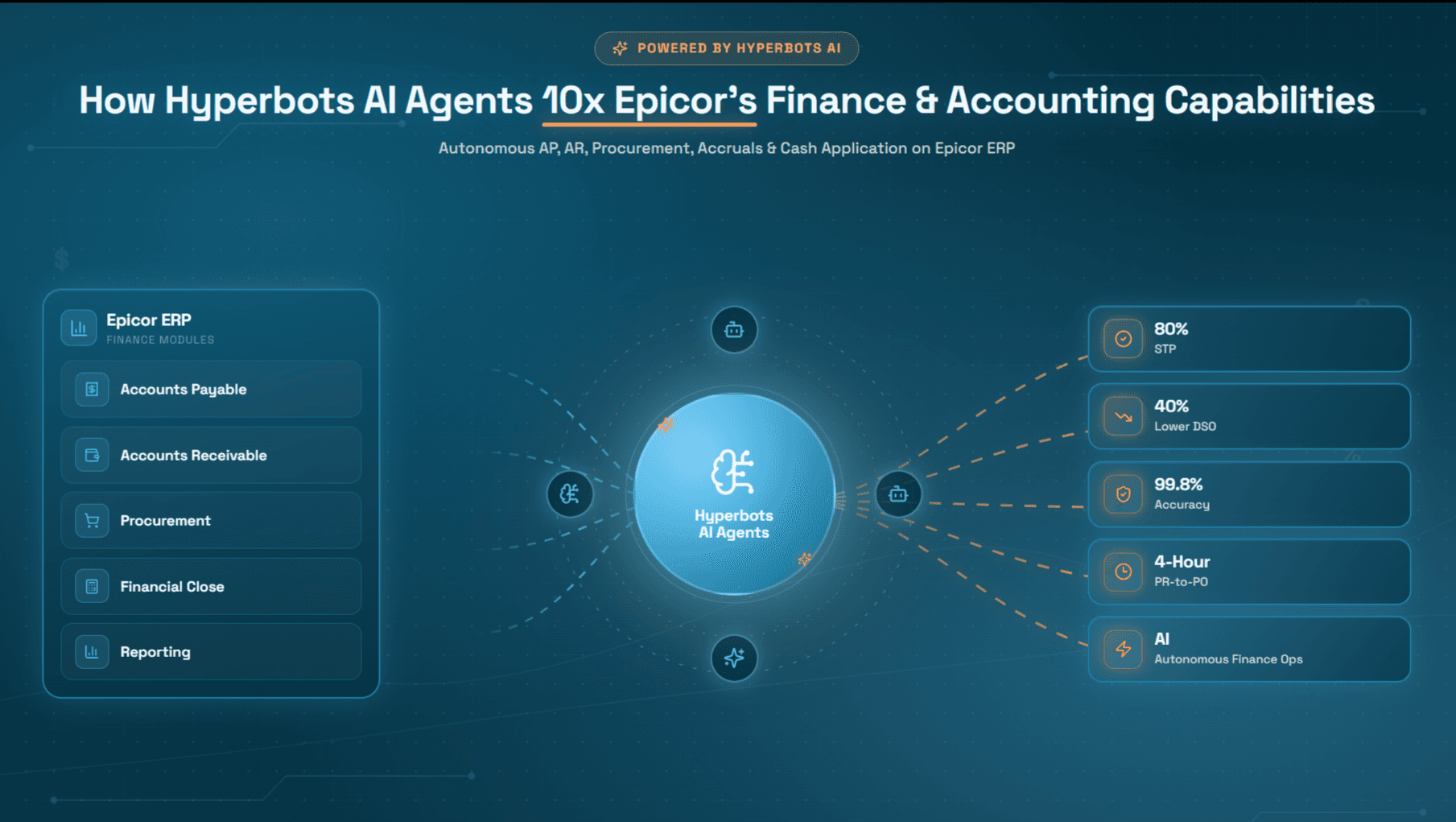
Agentic AI extends Epicor ERP beyond workflow automation, enabling autonomous AP, AR, cash application, collections, reconciliations, and financial close.
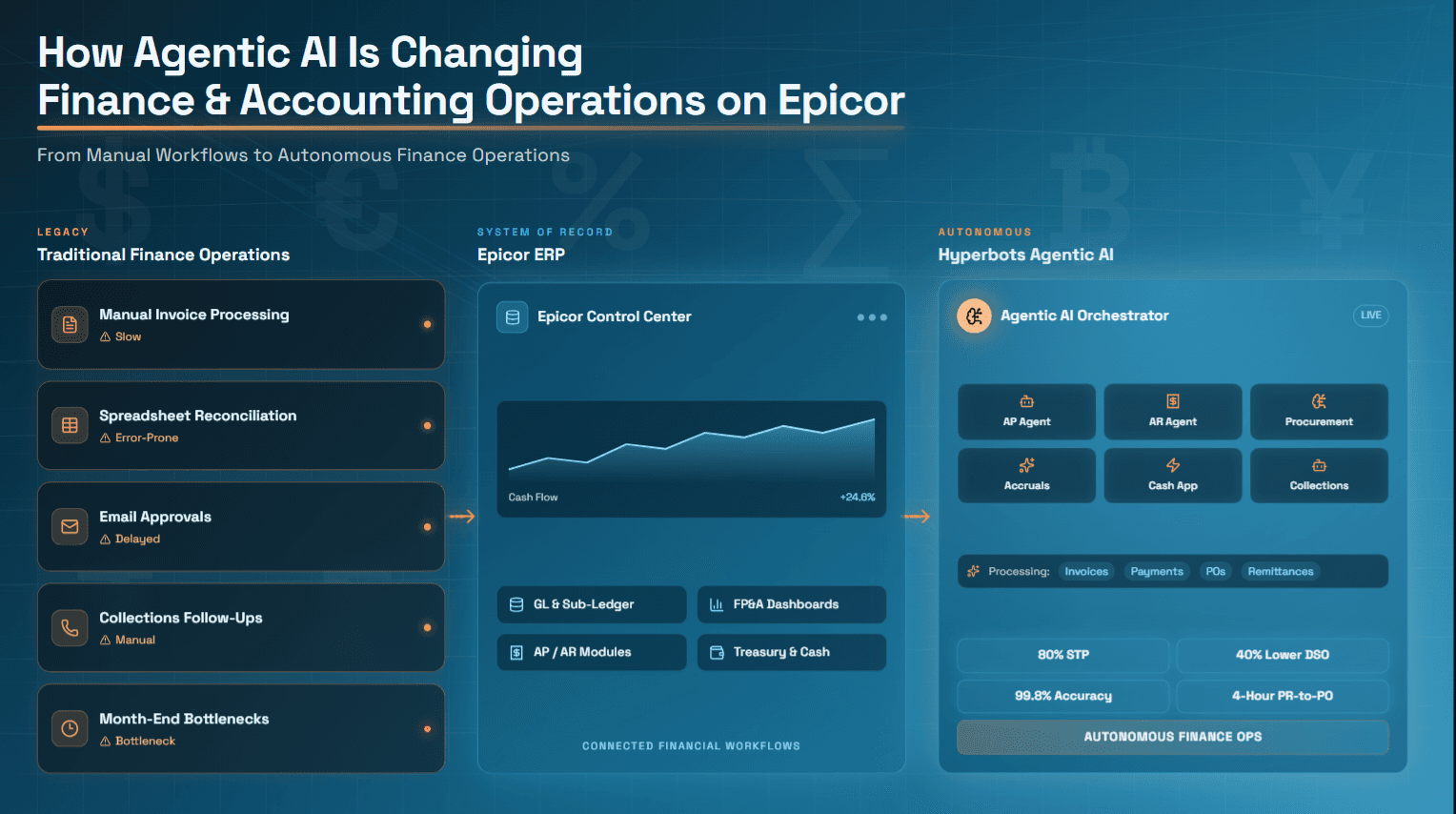
Finance and accounting teams at manufacturing and distribution companies have never faced greater operational pressure. Transaction volumes are rising, customer payment expectations are intensifying, and CFOs are being asked to close the books faster, improve working capital visibility, and do more with leaner teams. For the thousands of organizations running Epicor ERP, the platform remains an indispensable system of recordBut a growing body of evidence suggests that ERP-native automation alone is reaching its limits.
Enter agentic AI: a new class of artificial intelligence that does not merely assist humans but autonomously plans, executes, and iterates on complex multi-step finance workflows. This is not robotic process automation dressed in a new language. Agentic AI systems reason through ambiguity, handle exceptions, communicate with counterparties, and adapt their behavior based on context, capabilities that fundamentally change what is possible in accounts payable, accounts receivable, collections, cash application, and financial close.
This blog examines how agentic AI extends the value of Epicor ERP for finance teams, why ERP-native automation hits a ceiling in high-complexity environments, and how the next generation of finance operations will be built on a layered architecture where Epicor provides the data foundation and AI agents provide the execution layer.
The Evolution of Finance Operations on Epicor
Epicor Kinetic, Epicor's cloud-first ERP platform built specifically for discrete manufacturers and distributors, has long been a preferred foundation for mid-market and enterprise finance teams in industrial sectors. Its financial management suite covers general ledger, accounts payable and receivable, fixed assets, cash management, multi-entity consolidation, and multi-currency operations. For organizations with complex manufacturing cost structures, intercompany transactions, and multi-site procurement, Epicor's operational depth is a genuine competitive advantage.
Within Epicor's financial ecosystem, several purpose-built tools extend core capabilities. Epicor ECM with AP Automation handles intelligent document capture and content management for the procure-to-pay process. Epicor Cash Collect automates invoicing, payment reminders, and collections workflows within the order-to-cash cycle. Epicor Prism, the platform's generative AI layer, enables natural language querying of ERP data, allowing finance users to ask questions like "How many invoices are past due for more than 15 days?" and receive instant answers. Epicor Grow AI, the platform's machine learning layer, analyzes structured ERP data to spot patterns, predict behavior, and surface real-time guidance directly within the Epicor environment.
The result is an ERP platform that has made meaningful progress toward intelligent finance automation. Yet as finance teams scale their operations, processing thousands of invoices monthly, managing aging AR portfolios across hundreds of customers, and closing consolidated multi-entity financials under tightening deadlines, a structural constraint begins to emerge.
Why Traditional ERP Automation Hits a Ceiling
The challenge is not that Epicor lacks automation capability. The challenge is that ERP automation is architected around structured, predictable workflows and finance operations are rarely that clean.
Invoice processing and exception management illustrate the problem well. Epicor ECM AP Automation handles standard invoice capture and three-way matching effectively. But invoice exception rates across the industry have climbed to 23.2 percent, with exceptions consuming up to 24 percent of each AP processor's day (Ardent Partners, 2024). When a vendor invoice arrives with a quantity discrepancy, a missing purchase order reference, or an unexpected freight charge, the ERP flags it and then waits for a human to investigate, communicate with the vendor, obtain approval, and re-enter the corrected data. The system of record has done its job. But the work of resolution remains entirely manual.
Cash application presents a similar structural limitation. Incoming payments arrive via ACH, wire, check, and virtual card, often with partial or missing remittance information. Accurately matching these payments to open AR invoices requires cross-referencing customer accounts, resolving short pays, and interpreting unstructured remittance data. When remittance details are absent or ambiguous, the matching process defaults to human review. Payments that take three to five days to apply inflate reported DSO and distort working capital metrics, creating a picture of the business that is already days stale by the time finance leaders see it.
Collections prioritization compounds the problem. Epicor Cash Collect provides aging reports and automated payment reminders, valuable capabilities that reduce the manual effort of routine follow-up. But prioritizing which accounts to pursue, with what message, at what escalation level, and through which communication channel requires judgment informed by payment history, relationship context, invoice dispute status, and customer financial health. Rules-based systems can approximate this judgment for straightforward cases, but the accounts that most need active management are precisely the ones that fall outside standard patterns.
Financial close and reconciliation remain labor-intensive even in well-configured Epicor environments. Month-end accruals require finance teams to identify unbilled liabilities, estimate accrual amounts, book journal entries, and reverse them in the following period, a process that depends on staff availability and institutional knowledge rather than system intelligence. Bank reconciliation, intercompany eliminations, and GL account reconciliations similarly demand significant human effort to complete within close windows that continue to compress.
The underlying pattern is consistent: ERP systems excel at processing structured transactions and enforcing workflow rules. They do not autonomously reason through ambiguity, communicate with external parties, or adapt their approach based on contextual signals. That gap between the transaction system and the judgment required to manage exceptions, is where finance teams lose the most time.
According to McKinsey’s 2024 CFO Pulse survey, 98 percent of finance leaders reported investing in digitization and automation. Yet the largest group of respondents said that only 25 percent or less of their finance processes were currently digitized or automated. The limitation is no longer technology availability alone, it is the reality that many finance workflows still depend on judgment, context, exception handling, and decision-making that traditional rule-based automation struggles to replicate.
What Makes Agentic AI Different
To understand why agentic AI represents a genuine step change not an incremental improvement, it helps to distinguish it from the automation approaches it supersedes.
Traditional automation (including RPA) executes predefined rules against structured data. It is fast and accurate within its defined boundaries, but brittle when conditions change or exceptions arise. A rule that handles a standard three-way match cannot reason about a partial delivery, a price variance within tolerance, or a vendor communication requesting clarification.
AI copilots (including Epicor Prism in its current form) augment human decision-making by surfacing information, answering questions, and generating recommendations. The human reviews the recommendation and decides whether to act. This is valuable, but the bottleneck, human review and execution, remains.
AI agents take action autonomously within defined parameters. They can execute a single workflow step, coding an invoice to the correct GL account, sending a collections email, flagging a duplicate payment without waiting for human instruction.
Agentic AI coordinates networks of AI agents that work collaboratively to complete end-to-end processes. An agentic finance system does not just identify that an invoice has a price discrepancy; it investigates the root cause against the purchase order, generates a vendor communication requesting a corrected invoice, routes an exception to the appropriate approver with context and a recommended resolution, and updates the ERP when the issue is resolved, all autonomously, with a complete audit trail.
The distinguishing characteristics of agentic AI in finance are threefold. First, contextual reasoning: the system interprets ambiguous situations using historical patterns, policy rules, and relational data rather than requiring exact-match conditions. Second, multi-step orchestration: rather than automating individual tasks, it completes complex workflows that span systems, communications, and decision points. Third, continuous learning: agentic systems improve their accuracy and coverage over time as they process more transactions and receive feedback on their decisions.
For Epicor customers, this distinction is consequential. The ERP already holds the data structures, transaction history, vendor master, customer master, and workflow logic that agentic AI needs to operate. The question is not whether to replace Epicor, it is how to extend it with an execution layer capable of acting on the information it contains.
How Agentic AI Transforms Procure-to-Pay on Epicor
The procure-to-pay cycle, from purchase requisition through invoice payment, is one of the most transaction-intensive processes in manufacturing finance. For a mid-market manufacturer running Epicor, the P2P cycle might involve thousands of vendor invoices monthly, dozens of buyers managing purchase orders across multiple sites, and an AP team responsible for validation, matching, coding, approval routing, and payment execution.
Agentic AI for procure-to-pay operates across each stage of this workflow in ways that Epicor's native automation does not.
Invoice capture and extraction: Invoices arrive in every format, PDF email attachments, EDI, vendor portals, scanned documents. Agentic AI extracts header and line-item data with high accuracy from any format, without template dependency, and cross-validates extracted data against Epicor's PO and vendor master records before passing it downstream.
Validation and coding assistance: Rather than simply flagging a mismatch and waiting, an AI agent investigates the discrepancy, checking whether it falls within configured tolerance, whether a prior invoice from the same vendor had a similar pattern, and what GL coding the vendor's previous invoices used. It applies contextual GL coding based on historical patterns and policy rules, then routes only genuine exceptions to human reviewers with full context attached.
Approval routing and exception resolution: Approval bottlenecks are among the most common sources of P2P cycle time inflation. An AI agent monitors approval queues, sends contextual reminders with due date and discount deadline information, escalates stalled approvals based on SLA rules, and adjusts routing logic when approvers are unavailable without manual intervention.
Vendor communication: When an invoice requires correction, an AI agent drafts and sends a vendor communication through the appropriate channel, tracks the response, and updates the workflow when a corrected invoice is received. This eliminates the back-and-forth email chains that consume AP team time and delay payment processing.
The practical outcome is a P2P cycle that requires human attention only for genuine judgment calls, policy exceptions, strategic vendor disputes, significant PO variances, rather than for routine processing, standard exceptions, and approval follow-up.
How Agentic AI Transforms Order-to-Cash on Epicor
The order-to-cash cycle is where revenue becomes cash and where delays, errors, and inefficiencies directly damage working capital. For Epicor customers, the O2C cycle connects Epicor's order management and AR modules to collections and cash application workflows where the data complexity is highest.
Cash application is the process where agentic AI delivers some of its most measurable value. Incoming payments arrive with varying levels of remittance detail. An AI cash application agent interprets unstructured remittance data, matches payments to open invoices using multiple signals, customer name, invoice number, payment amount, historical matching patterns and applies them to Epicor's AR ledger with high straight-through processing rates. Short pays and partial payments are flagged with context, and the system generates deductions tracking and dispute documentation automatically. Organizations implementing AI-enabled accounts receivable and cash-application workflows frequently report measurable DSO reductions, with many enterprises achieving improvements equivalent to several days of accelerated cash collection. Because DSO directly affects working capital availability, even small reductions can unlock substantial liquidity for manufacturers operating with large AR balances.
Collections prioritization and outreach: Rather than working an AR aging report sequentially, an AI collections agent scores open receivables by payment risk, customer relationship value, invoice dispute probability, and days overdue. It generates personalized outreach communications, adjusts escalation timing based on customer response patterns, and routes high-value or complex accounts to senior collectors with full context and recommended approach. According to APQC’s 2024 Financial Management Priorities research, cash flow management remains one of the finance function’s most important focus areas. APQC also found growing concern around late customer payments, highlighting the increasing importance of collections effectiveness, receivables visibility, and proactive cash-flow management. These are precisely the areas where AI-driven prioritization and autonomous collections workflows can create significant operational leverage.
Dispute management: Invoice disputes are a leading driver of extended DSO. An AI agent can identify the likely root cause of a dispute, pricing discrepancy, delivery issue, quantity variance, gather supporting documentation from Epicor, draft a resolution response, and route the case to the appropriate internal owner. This compresses dispute resolution cycles from days to hours and preserves customer relationships that manual collections friction tends to erode.
Customer risk monitoring: An agentic AR system monitors customer payment behavior in real time, flags accounts whose payment patterns are deteriorating, and alerts credit managers before exposures become problematic. Integrated with Epicor's customer and order data, this gives finance teams proactive visibility rather than reactive exposure management.
The combined effect on DSO and working capital is material. Organizations deploying AI-driven accounts receivable and cash-application automation frequently report substantial reductions in manual finance workload, with many enterprises automating 80–90% of cash application activity and achieving DSO improvements ranging from 15% to 40%. By automatically matching payments, prioritizing collections activity, and reducing reconciliation effort, AI agents free finance teams from repetitive execution work and allow them to focus on customer relationships, credit strategy, dispute resolution, and working-capital optimization.
From Systems of Record to Systems of Action
There is a useful architectural distinction that explains why ERP and agentic AI are complementary rather than competitive: the difference between a system of record and a system of action.
Epicor is, at its core, a system of record. It stores transactions, enforces data integrity, maintains audit trails, and provides the structured information that finance operations depend on. It executes workflows that are fully defined and deterministic. This is exactly what an ERP should do, and Epicor does it well for manufacturing and distribution environments that require deep operational integration between finance, procurement, inventory, and production.
Agentic AI is a system of action. It reads the state of the system of record, reasons about what should happen next, executes the appropriate action, handles the exceptions, communicates with counterparties, and writes the result back to the system of record. It operates in the space between structured transactions, the judgment calls, the communications, the exception handling, the prioritization, that rule-based systems cannot reach.
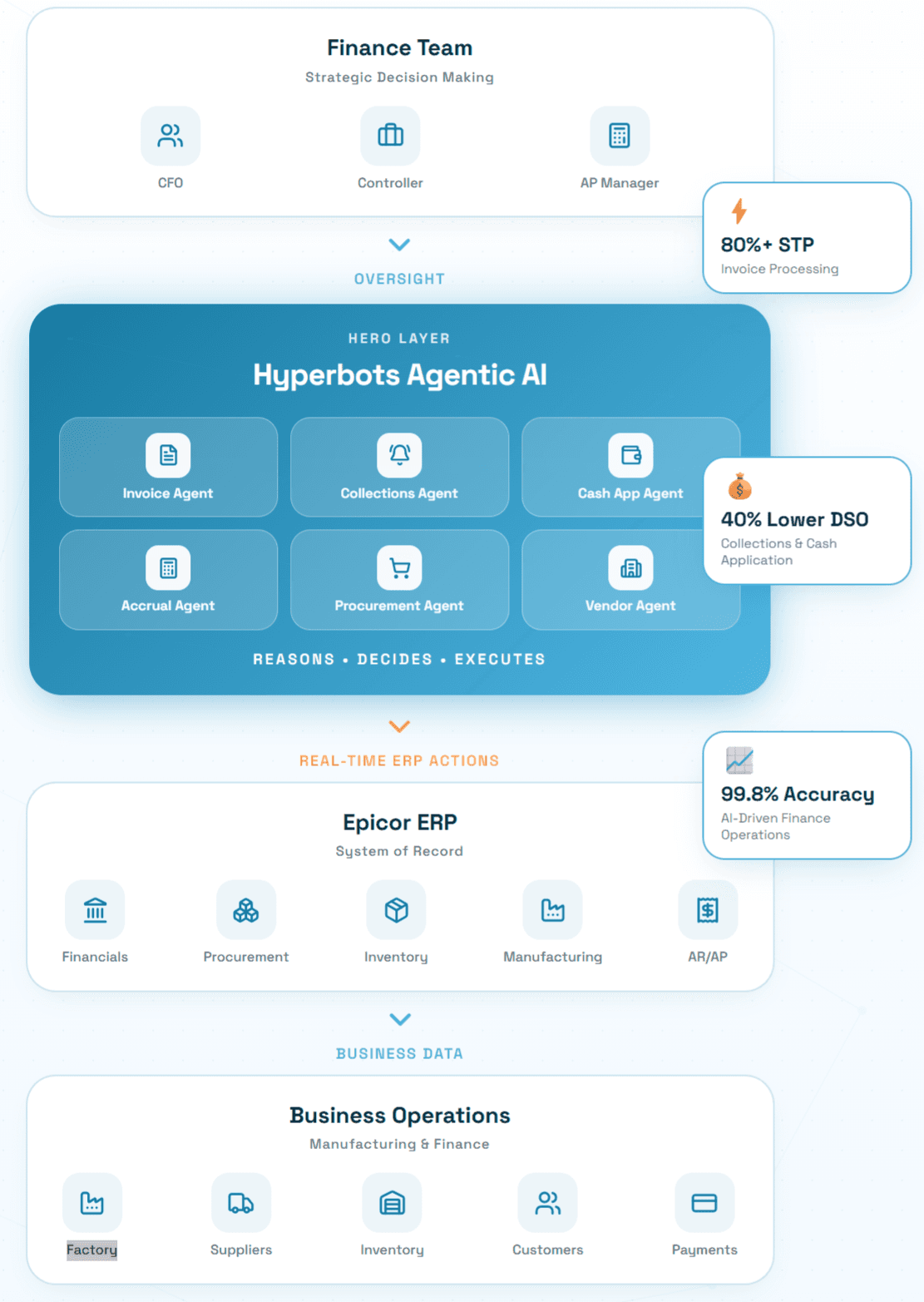
The architecture that is emerging at forward-looking Epicor customer organizations looks like this:
Finance Team
↓ (strategic oversight, exception judgment)
Agentic AI Layer
↓ (execution, reasoning, communication)
Epicor ERP
↓ (transactions, data, workflow rules)
Business Data
In this model, finance professionals are not removed from the picture—they are elevated within it. Routine processing, standard exceptions, and rule-based approvals are handled by AI agents. Complex judgment calls, relationship-sensitive communications, and strategic decisions are escalated to humans with full context and recommended actions. The finance function becomes a supervisory and strategic capability rather than a transaction-processing function.
This is not a distant future state. According to a 2025 UiPath Agentic AI Report, 72 percent of finance leaders cite operational efficiency and productivity as the primary benefit they are pursuing with agentic AI. A 2024 survey by KPMG projects that the share of finance leaders investing in AI will grow from 38 percent to 95 percent within three years.
Why Epicor Customers Are Well Positioned for Agentic AI
The transition to agentic finance operations is not equally easy for all ERP environments. Epicor customers, particularly those who have invested in Kinetic cloud deployments, are in a structurally advantaged position for several reasons.
ERP data maturity: Epicor's deep operational data model, connecting procurement, production, inventory, and finance in a single platform, gives AI agents richer context than they would have working with a finance-only system. An AI agent resolving a vendor invoice discrepancy can reference the original PO, goods receipt, production order, and vendor master in a single pass. This contextual depth improves both the accuracy and the speed of agentic decision-making.
Existing workflow infrastructure: Epicor's configurable workflow and approval routing capabilities provide a structured process foundation that agentic AI can extend rather than replace. AI agents can operate within Epicor's approval hierarchy, escalation rules, and policy configurations, augmenting the existing framework rather than requiring a full process redesign.
Cloud adoption trajectory: Epicor's migration of its installed base toward Kinetic cloud deployments creates the API accessibility and integration surface that agentic AI platforms require. Cloud ERP deployments offer real-time data access, modern authentication standards, and webhook-based event triggers that enable AI agents to monitor and act on ERP state changes continuously.
Epicor's own AI investments: Epicor's Prism AI and Grow AI initiatives signal the platform's direction toward embedded intelligence. Epicor ECM's integration with Prism delivers AI-driven document understanding and verified responses. Epicor's Automation Studio, powered by Workato, enables workflow automation and application integration. These native investments establish an AI-compatible infrastructure that external agentic platforms can build upon.
The practical implication is that Epicor customers do not need to rebuild their finance technology stack to benefit from agentic AI. They need to add an intelligent execution layer that reads from Epicor, acts on Epicor's behalf, and writes back to Epicor, extending the platform's value without disrupting the operational foundation it provides.
How Hyperbots Extends Epicor with Agentic Finance Operations
For Epicor customers looking to move beyond traditional workflow automation, Hyperbots represents the type of Agentic AI layer that is increasingly being adopted across modern finance organizations. Rather than replacing Epicor, Hyperbots operates alongside the ERP, using Epicor's financial, procurement, and customer data as the system of record while AI agents execute workflows, manage exceptions, coordinate communications, and support finance decision-making.
This approach reflects the broader shift from systems of record to systems of action. Epicor continues to provide the operational foundation for finance processes, while Hyperbots adds an intelligence and execution layer capable of handling the judgment-intensive work that often slows procure-to-pay and order-to-cash operations.
By combining Epicor's transaction management capabilities with Agentic AI, organizations can reduce manual intervention, accelerate process execution, improve visibility into financial operations, and allow finance teams to focus more on analysis, strategy, and business outcomes rather than administrative tasks.
For Epicor customers in manufacturing specifically, Hyperbots' manufacturing industry configuration addresses the specific complexities of multi-site procurement, production-linked AP, and high-volume vendor invoice environments that general-purpose AP automation platforms handle poorly.
The Future of Finance on Epicor Is Agentic
Epicor ERP provides manufacturing and distribution finance teams with a robust, operationally integrated system of record. Its Kinetic platform, financial management suite, ECM AP Automation, Cash Collect, and emerging AI capabilities through Prism and Grow AI represent a serious and improving foundation for finance operations.
But the ceiling of ERP-native automation is real. Invoice exceptions, cash application complexity, collections prioritization, and financial close effort all require reasoning, communication, and adaptive judgment that rule-based systems cannot provide at scale. Agentic AI, systems that autonomously plan, execute, and iterate on complex multi-step workflows, addresses precisely this gap.
The finance organizations that will define the next decade are building on Epicor's data foundation and extending it with an agentic execution layer: one that handles exceptions without human intervention, communicates with vendors and customers contextually, closes books faster, and improves continuously. That architecture: Finance Team → Agentic AI → Epicor ERP → Business Data is available today, and the competitive implications for organizations that adopt it early are significant.
For Epicor customers looking to reduce manual finance work, accelerate cash flow, improve invoice processing, and increase operational visibility without replacing their ERP, the next step is understanding what agentic finance automation can deliver in their specific environment.
Request a personalized demo of Hyperbots to see how AI agents integrate with Epicor to automate accounts payable, accounts receivable, cash application, collections, and financial close processes. You can also start with a free trial to evaluate the impact on your finance operations, workflows, and working capital performance before committing to a broader rollout.
Frequently Asked Questions
Q1: What is agentic AI for Epicor ERP? Agentic AI for Epicor ERP refers to AI systems that autonomously execute multi-step finance workflows, invoice processing, cash application, collections, accruals, and more by reading data from Epicor, reasoning through exceptions and decisions, communicating with vendors and customers, and writing results back to the ERP. Unlike basic automation, agentic AI handles ambiguity and exceptions without requiring human intervention at every step.
Q2: Does agentic AI replace Epicor ERP? No. Agentic AI extends Epicor ERP rather than replacing it. Epicor remains the system of record for all financial transactions, vendor and customer master data, workflow rules, and audit trails. Agentic AI adds an execution layer that acts on the information Epicor holds—handling the judgment calls, communications, and exception management that rule-based ERP automation cannot reach autonomously.
Q3: What Epicor finance processes benefit most from agentic AI? The highest-impact areas are accounts payable (invoice processing and exception management), cash application (matching payments to AR invoices), collections (prioritization and customer outreach), accruals (discovery and booking), and financial close (reconciliation and journal entry automation). These are the processes where manual exception handling and human judgment are most concentrated.
Q4: How does Epicor's own AI—Prism and Grow AI—differ from agentic AI platforms? Epicor Prism and Grow AI are embedded intelligence capabilities within the Epicor platform. Prism uses generative AI for natural language querying and document understanding. Grow AI uses machine learning for predictive analytics on structured ERP data. Agentic AI platforms like Hyperbots complement these capabilities by adding autonomous execution—not just insights and recommendations, but end-to-end workflow completion, vendor communication, and exception resolution without waiting for human action.
Q5: What is the typical ROI of agentic AI for Epicor AP automation? Organizations deploying agentic AI on AP processes typically report 70 to 90 percent reductions in manual invoice processing effort, straight-through processing rates of 80 percent or higher, and invoice accuracy exceeding 99 percent. These improvements translate to significant cost reductions per invoice processed and recovery of finance staff time for higher-value work.
Q6: How does agentic AI improve Days Sales Outstanding (DSO) for Epicor customers? Agentic AI reduces DSO through two primary mechanisms: faster cash application (payments matched to invoices in hours rather than days) and smarter collections prioritization (AI-driven outreach targeting high-risk accounts with contextual communications). Organizations implementing AI-driven AR automation have reported DSO reductions of 30 to 35 days and 50 percent reductions in 90-day aged accounts.
Q7: How does Hyperbots integrate with Epicor ERP? Hyperbots integrates with Epicor through pre-built connectors that handle data model mapping, real-time synchronization, and bi-directional ERP write-back. The platform supports Epicor Kinetic and Epicor financial module configurations, enabling rapid onboarding without lengthy custom integration projects. All AI decisions and actions are logged with complete audit trails that sync with Epicor's compliance records.
Q8: Is agentic AI suitable for mid-market manufacturers using Epicor? Yes. Mid-market manufacturers are often the most underserved by traditional AP and AR automation tools, which are either too limited for complex manufacturing workflows or too expensive to deploy broadly. Agentic AI platforms with manufacturing-specific configurations and unlimited-user licensing models are well-suited to mid-market Epicor environments where transaction complexity is high but finance team headcount is constrained.