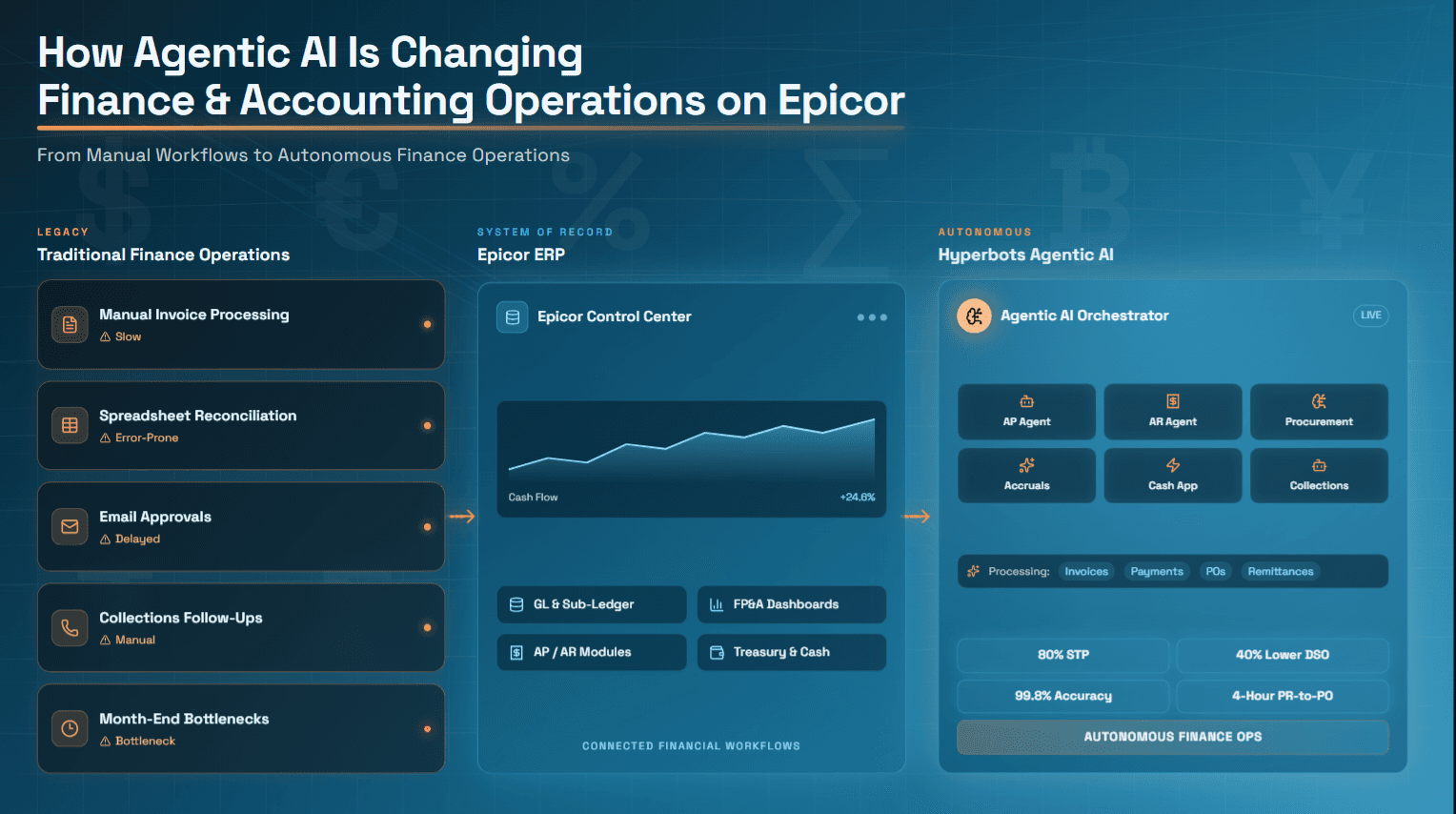
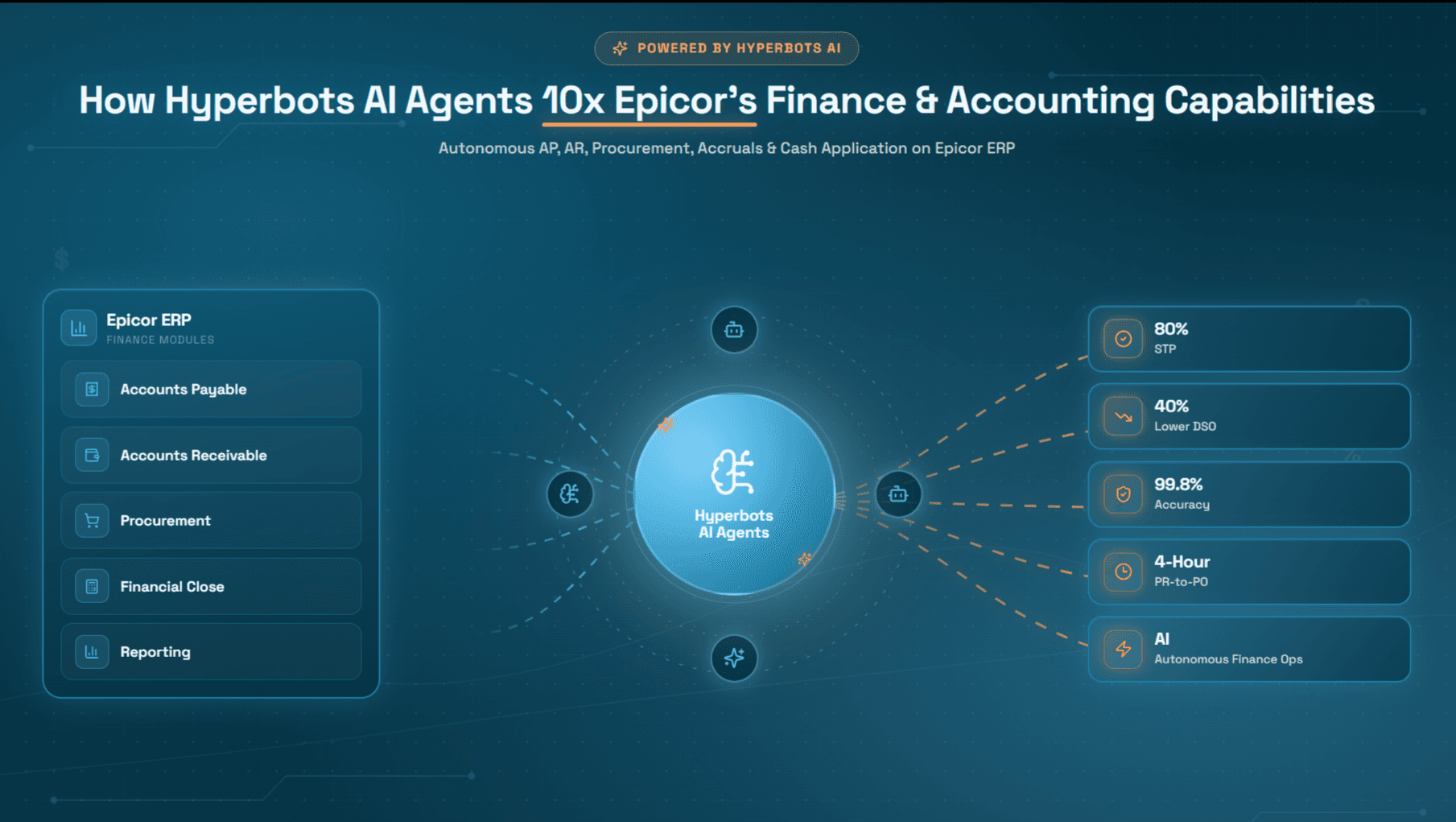
How Hyperbots AI Agents 10x Epicor's Finance & Accounting Capabilities
Hyperbots extends Epicor with AI finance agents that automate AP, AR, cash application, collections, reconciliations, and financial close for faster, more accurate finance operations.
Enterprise finance operations have never been more demanding. As transaction volumes rise, vendor ecosystems grow more complex, and CFOs face pressure to do more with leaner teams, the question is no longer whether to automate, it's how deeply and intelligently to do so.
Epicor ERP has long been a trusted platform for mid-market and enterprise organizations, particularly in manufacturing, distribution, and project-based industries. It delivers financial visibility, workflow standardization, and audit-ready controls that remain central to sound finance operations. The question finance leaders are increasingly asking is not whether Epicor is enough, it is, but whether their teams are fully leveraging what the platform enables.
That's where agentic AI enters the picture. Rather than replacing ERP systems, forward-looking organizations are layering AI execution on top of their existing ERP investments. This architectural shift with ERP as system of record and AI as operational execution layer, is becoming the defining pattern of modern finance transformation.
This blog explores why Epicor remains a strong ERP foundation and how AI co-pilots from Hyperbots extend Epicor's capabilities across accounts payable, procurement, and accounts receivable.
Why Epicor Remains a Strong ERP Foundation for Finance Operations
Not all ERP systems become deeply embedded inside manufacturing and distribution businesses. Many are implemented primarily as accounting platforms with operational functionality added later.
Epicor evolved differently.
For decades, Epicor has been heavily adopted by organizations where finance operations are inseparable from production activity, procurement coordination, inventory movement, and shop-floor execution. That includes industries such as:
Industrial manufacturing
Automotive supply
Electronics manufacturing
Metal fabrication
Aerospace subcontracting
Building materials distribution
Industrial equipment manufacturing
Engineer-to-order production
In these environments, finance teams are not simply managing invoices and closing books. They are constantly trying to answer operationally complex questions:
Which production lines are eroding margins?
How much scrap is impacting profitability?
Which customers generate the highest hidden servicing costs?
How do inventory fluctuations affect working capital?
Which jobs are consuming more labor than estimated?
Where are procurement delays affecting cash flow?
These businesses require an ERP system that understands operational economics, not just financial reporting.
That is where Epicor has historically differentiated itself.
Epicor Was Built for Operationally Complex Finance Environments
One of the biggest reasons manufacturing and distribution companies continue investing in Epicor is that the platform was designed around industries where operational activity directly drives financial outcomes.
In many ERP environments, finance teams still operate with delayed visibility:
Production data sits in one system
Inventory lives in another
Procurement workflows are fragmented
Cost accounting requires spreadsheet consolidation
Epicor reduces that fragmentation by connecting operational workflows directly into the financial layer.
Material consumption, labor reporting, procurement activity, inventory movement, production output, and shipping transactions all feed financial visibility continuously.
That matters enormously for industrial organizations because profitability is often determined operationally long before it appears on a financial statement.
For example, a CNC machining company may experience:
Rising scrap rates
Increased setup times
Material inflation
Production reruns
Unexpected labor overruns
Without operational-financial integration, finance teams may not fully understand the impact until month-end close.
Epicor helps surface those cost drivers much earlier because production activity and accounting activity are tied together inside the same ERP environment.
This is one of the core reasons Epicor remains especially respected among manufacturing controllers and operational CFOs.
Deep Manufacturing Cost Accounting Is One of Epicor’s Biggest Strengths
Industrial organizations care deeply about:
Labor absorption
Work-in-progress valuation
Production overhead allocation
Routing efficiency
Material variance
Scrap impact
Machine-hour costing
Standard vs actual costing
These are not secondary accounting considerations. They directly determine margin performance.
Epicor’s manufacturing architecture was built around these realities.
A precision manufacturer running high-mix, low-volume production can use Epicor to track:
Actual labor consumed per operation
Material usage against expected standards
Overhead absorption by routing step
Scrap variance by production run
Profitability by job, customer, or part
This level of cost visibility allows finance leaders to identify margin leakage operationally instead of discovering it weeks later in summarized reporting.
That operational depth is difficult to replicate in generic finance-first ERP environments.
Epicor Excels in Engineer-to-Order and Project Manufacturing Finance
Engineer-to-order (ETO) businesses operate with some of the most financially complex manufacturing environments in the market.
Examples include:
Industrial machinery manufacturers
Aerospace suppliers
Heavy equipment producers
Custom fabrication firms
Industrial systems integrators
These organizations deal with:
Long production cycles
Constant engineering revisions
Dynamic bills of materials
Project-based procurement
Milestone billing
Complex revenue recognition
High customization requirements
Traditional accounting systems often struggle in these environments because costs evolve continuously throughout the project lifecycle.
Epicor’s project manufacturing structure helps finance teams connect:
Procurement
Labor consumption
Engineering changes
Inventory usage
Manufacturing execution
Project accounting
inside a single operational framework.
This gives finance organizations far better visibility into true project profitability while work is still underway.
That distinction is important.
Many manufacturers do not discover margin erosion until after a project closes, when labor overruns, engineering revisions, and procurement changes have already accumulated.
Epicor helps surface those financial impacts much earlier, allowing finance and operations teams to respond before profitability deteriorates further.
Epicor’s Distribution Heritage Creates Stronger Inventory Financial Visibility
Epicor is also widely used in distribution-heavy businesses where inventory management and financial management are deeply interconnected.
In these organizations, inventory is often:
The largest balance-sheet asset
The biggest working capital driver
One of the primary determinants of cash flow health
Finance leaders in distribution environments need much more than static inventory valuation.
They need visibility into:
Inventory turns
Slow-moving stock
Procurement timing
Freight cost allocation
Vendor rebate impacts
Margin compression
Landed cost variability
Epicor’s distribution-focused architecture tightly integrates operational inventory movement with financial reporting.
This allows finance teams to analyze:
Margin performance by SKU
Supplier-driven cost changes
Carrying cost exposure
Inventory-driven cash flow risk
in ways that many generic accounting systems struggle to support effectively.
That capability is especially valuable for:
Industrial distributors
Building materials suppliers
Electronics distributors
Automotive parts distributors
where small operational inefficiencies can materially impact EBITDA and working capital performance.
Epicor Gives Finance Teams Job-Level Profitability Visibility
One reason many industrial organizations remain loyal to Epicor for years is its ability to expose operational profitability at a granular level.
Many ERP systems are good at reporting financial outcomes after the fact.
Epicor is stronger at helping finance teams understand why profitability changes operationally.
Finance leaders can analyze profitability across:
Jobs
Production runs
Customers
Manufacturing cells
Product lines
Projects
Routing structures
This creates significantly better operational decision-making.
For example, a fabrication company may discover:
Certain customers consistently create expensive engineering revisions
Some production lines generate excessive scrap
Specific product categories consume disproportionate labor hours
Certain routing paths create recurring bottlenecks
These insights are operationally actionable, not just financially informative.
That is an important distinction because modern CFOs increasingly participate directly in operational optimization, not just accounting oversight.
Epicor supports that shift particularly well.
Epicor Connects Finance More Closely to the Shop Floor
One of Epicor’s most underrated strengths is how tightly it connects finance visibility with shop-floor activity.
In many organizations, there is still a major disconnect between:
Operations ↔ Finance
Production teams manage:
Machine utilization
Downtime
Scrap
Labor reporting
Production output
while finance teams only see summarized cost outcomes later.
Epicor helps bridge that gap.
Because production transactions feed directly into costing and accounting structures, finance teams gain much stronger real-time visibility into operational performance.
For industrial businesses operating on tight margins, this matters tremendously.
A small increase in:
Scrap
Setup inefficiency
Labor overruns
Material waste
can materially affect profitability at scale.
Epicor helps finance teams identify those issues earlier and participate more actively in operational improvement initiatives.
Epicor’s Industry Specialization Is Its Real Competitive Advantage
This is ultimately what separates Epicor from many broader ERP competitors.
Organizations typically choose:
SAP for global enterprise standardization
Oracle for broad enterprise architecture
NetSuite for cloud-centric financial management
Microsoft Dynamics for Microsoft ecosystem alignment
Organizations choose Epicor because they need:
Manufacturing-aware finance operations
Production-centric costing
Inventory-intensive accounting
Shop-floor operational visibility
Industry-specific workflow depth
That specialization makes Epicor particularly strong for industrial organizations whose financial performance is driven heavily by operational execution.
Epicor is not simply an accounting system with manufacturing modules attached.
For many companies, it functions as the operational-financial backbone of the business.
How Finance Operations Are Evolving Beyond Traditional ERP Workflows
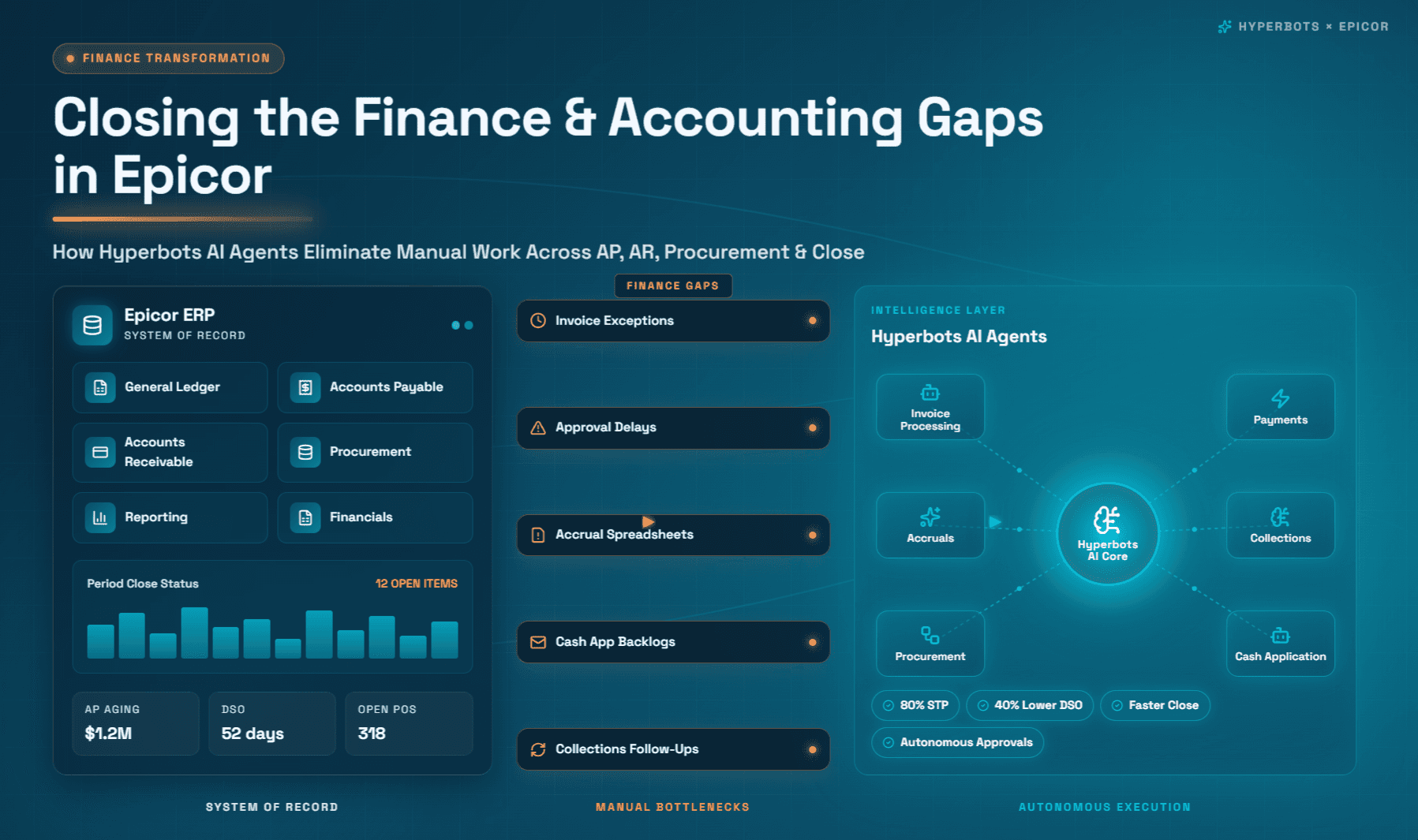
Even the most capable ERP system has boundaries defined by its architecture. ERP platforms are designed to record, validate, and report, not to autonomously act, communicate, or adapt in real time. As finance operations grow more complex, teams increasingly encounter operational gaps that are not ERP shortcomings, they are the natural limits of what any transactional system was built to do.
Rising Transaction Complexity
Organizations commonly experience steady growth in invoice volumes, vendor counts, and payment complexity over time. What a finance team of ten could manage manually a few years ago may now require significantly more coordination. ERP systems process what they receive; they don't reach out to vendors, resolve discrepancies proactively, or prioritize workloads dynamically.
Shared Inbox Overload
AP and AR teams in ERP environments often work through shared email inboxes to handle vendor inquiries, invoice submissions, remittance confirmations, and collections follow-ups. This communication layer sits almost entirely outside the ERP, creating a manual coordination burden that grows with transaction volume.
Exception-Heavy Workflows
Three-way matching, while powerful, surfaces exceptions regularly such as price variances, quantity mismatches, missing purchase orders, and duplicate submissions. ERP environments often require manual intervention to investigate and resolve each exception, creating bottlenecks during month-end close and high-volume periods.
Increasing Need for Operational Responsiveness
Finance leaders increasingly look for ways to make their operations more responsive, faster invoice cycle times, proactive collections outreach, and real-time cash application without proportionally growing headcount. These goals are achievable, but they require an execution layer that can act on ERP data, not just store it.
These dynamics are operational evolution challenges. They don't reflect any limitation of Epicor as a platform; they reflect the reality that modern finance operations require capabilities that extend beyond what any ERP was designed to provide natively.
The Rise of Agentic AI in ERP Finance Environments
The term "agentic AI" describes AI systems that don't just answer questions or generate outputs, they take actions, make decisions, and complete tasks autonomously within defined parameters. In finance, this means AI that can process an invoice end-to-end, follow up with a vendor, post a journal entry, and escalate an exception for human review, all without waiting for a human to initiate each step.
This is meaningfully different from earlier generations of finance automation:
Rule-based automation (RPA) executes fixed scripts. It breaks when inputs vary.
Intelligent document processing captures and extracts data but stops at the ERP door.
Agentic AI understands context, applies policy, communicates with stakeholders, and handles exceptions with reasoning rather than rigid rules.
For Epicor users, agentic AI functions as an orchestration layer that sits above the ERP and interacts with it bidirectionally. It reads transactional data from Epicor, applies operational intelligence, executes actions, and writes results back into the system, keeping ERP as the authoritative system of record while dramatically expanding what the finance team can accomplish.
Human-in-the-loop design ensures that exceptions, policy decisions, and high-stakes approvals surface to the right person at the right time. The AI handles execution volume; humans handle judgment. This division of labor is what makes agentic AI practical for finance organizations that cannot afford errors in a compliance-sensitive environment.
Finance leaders increasingly recognize this ERP plus agentic AI architecture as the natural next stage of operational maturity. It doesn't require a platform replacement. It requires a thoughtful execution layer built on top of the ERP investment already made.
How Hyperbots Extends Epicor’s Finance & Accounting Capabilities
The value of Hyperbots becomes much clearer when viewed through the lens of what Epicor already does exceptionally well.
Epicor is an operationally deep ERP system used heavily by manufacturers, distributors, project-based producers, and industrial organizations where finance operations are tightly connected to procurement, inventory, production, and supply chain execution.
That operational depth creates enormous opportunities for AI automation.
Because Epicor already centralizes:
Procurement workflows
Inventory transactions
Supplier records
Production data
Cost accounting structures
Approval hierarchies
Financial controls
Customer transactions
Hyperbots can operate with significantly more operational context than generic automation platforms.
Rather than replacing Epicor, Hyperbots extends the ERP into an active execution layer that continuously processes transactions, resolves operational bottlenecks, communicates with stakeholders, and orchestrates finance workflows autonomously.
This is especially important in manufacturing and distribution environments where finance teams are often overwhelmed by:
High invoice volumes
Procurement complexity
Shared inbox overload
Exception-heavy workflows
Cash application delays
Dispute resolution bottlenecks
Inventory-driven reconciliation challenges
Hyperbots addresses these operational gaps while preserving Epicor as the financial system of record.
AP / P2P Co-Pilots: Extending Epicor’s Manufacturing and Procurement Strengths
One of Epicor’s greatest strengths is its deep procure-to-pay and manufacturing integration.
In industrial environments, procurement is rarely isolated from operations. Purchase orders are often tied directly to:
Production schedules
Material requirements planning (MRP)
Inventory replenishment
Supplier lead times
Project manufacturing timelines
Engineering changes
Epicor already manages these operational relationships extremely well.
Hyperbots extends this foundation by automating the execution work that finance and procurement teams still handle manually around the ERP.
The invoice processing co-pilot handles the end-to-end AP workflow:
Invoice ingestion across email, EDI, portals, and PDFs
AI-driven extraction and classification
PO and goods receipt validation inside Epicor
GL coding recommendations
Approval routing
Vendor communication
ERP posting orchestration
Because Epicor already contains the operational procurement context, Hyperbots can perform highly accurate three-way matching against:
Purchase orders
Goods receipts
Vendor invoices
Inventory transactions
This becomes especially powerful in manufacturing environments where invoice exceptions are often tied to operational realities such as:
Partial receipts
Material substitutions
Freight variances
Quantity tolerances
Supplier shortages
Production-driven PO modifications
Rather than forcing AP teams to manually investigate every discrepancy, Hyperbots surfaces exceptions contextually:
What mismatched
Why it mismatched
Operational history tied to the transaction
Recommended resolution paths
This dramatically reduces the manual coordination burden that typically sits outside the ERP in shared inboxes and spreadsheet trackers.
Hyperbots also enhances one of Epicor’s biggest strengths: manufacturing-aware procurement workflows.
Its procurement co-pilot automates:
Purchase requisition creation
Policy validation
Budget checks
Vendor selection workflows
PO generation
Vendor dispatch communication
while remaining synchronized with Epicor’s approval controls, inventory structures, and financial governance.
For manufacturers running lean procurement operations, this significantly compresses procurement cycle times without compromising ERP controls.
AR / O2C Co-Pilots: Extending Epicor’s Financial Visibility Into Cash Flow Execution
Epicor provides strong receivables tracking and financial visibility. Hyperbots extends that capability into operational cash flow execution.
This distinction matters because many finance organizations still manage collections and cash application through highly manual workflows that exist outside the ERP:
Shared AR inboxes
Remittance parsing
Spreadsheet-based collections tracking
Manual deduction resolution
Customer follow-up coordination
Hyperbots automates these workflows directly against Epicor’s receivables environment.
The cash application co-pilot uses AI to:
Process remittance advice
Match incoming payments to open invoices
Handle short-pays and deductions
Identify unapplied cash
Resolve multi-invoice remittances
Post matched transactions back into Epicor
This is particularly valuable for distribution and manufacturing companies where customer payment behavior is often operationally complex:
Consolidated payments
Freight deductions
Pricing disputes
Short shipments
Partial invoice settlements
Multi-entity remittances
Because Epicor already contains the customer, invoice, and transaction history, Hyperbots can apply significantly more contextual intelligence during matching and exception resolution.
This dramatically reduces manual cash posting effort while improving posting speed and accuracy.
The collections co-pilot extends Epicor’s receivables visibility into proactive collections orchestration.
It autonomously:
Generates collections outreach
Personalizes follow-up communication
Tracks customer responses
Escalates delinquent accounts
Maintains dispute workflows
Documents collections activity
Prioritizes outreach based on risk and aging
For finance organizations managing large industrial customer bases, collections consistency is often difficult to maintain manually because AR teams spend disproportionate time on administrative follow-up coordination.
Hyperbots automates the cadence and documentation layer while allowing AR professionals to focus on:
Strategic accounts
Customer relationships
Dispute resolution
High-risk collections situations
The result is a collections process that is more systematic, scalable, and operationally responsive.
Operational ROI Epicor Users Can Realistically Expect
The following table reflects realistic operational improvements based on the types of workflows Hyperbots automates in ERP environments. These are representative ranges grounded in how AI automation typically performs across finance operations, not guarantees.
Finance Process | Epicor Alone | With AI Co-Pilots |
Invoice processing time | 5–12 days end-to-end | <1 min for STP invoices |
Manual cash posting effort | High (per remittance) | Substantially reduced via automated matching |
AP team email workload | 30–50% of working hours | Significant reduction in routine vendor inquiries |
Exception resolution time | 2–5 days average | Same-day for structured exceptions |
Collections follow-up consistency | Variable, dependent on staff | Systematic, policy-driven cadence |
Straight-through processing rate | 20–40% typical | 70–80%+ with AI matching and validation |
Reconciliation effort (month-end) | Significant manual effort | Reduced through automated matching and audit trails |
Finance teams using Hyperbots on Epicor can expect productivity gains that scale with transaction volume, the higher the volume, the more pronounced the efficiency improvement relative to manual operations.
For a more precise estimate of potential ROI for your environment, Hyperbots provides interactive ROI calculators covering invoice processing, procurement, collections, and cash application.
Why ERP + Agentic AI Is Becoming the Future of Finance Operations
The enterprise software landscape is converging on a clear architectural pattern: ERP as the financial system of record, AI as the operational execution layer that acts on that record continuously and intelligently.
This isn't a prediction, it's already visible in how finance leaders are discussing automation strategy at CFO roundtables and industry events. The question has shifted from "should we automate?" to "how do we orchestrate AI across our existing ERP environment effectively?"
For Epicor users specifically, this pattern is well-supported. Epicor provides the data structures, approval controls, and financial governance that agentic AI needs to operate reliably. AI co-pilots read from and write back to Epicor, keeping it authoritative, while executing the operational work that previously required manual coordination.
The result is a finance function that operates with greater throughput, fewer errors, and more consistent policy application than a purely manual or RPA-based model allows. Finance teams gain leverage: the same team can handle higher transaction volumes, close faster, and respond to exceptions more quickly without a proportional increase in headcount.
This is what AI-enhanced ERP workflows look like in practice. Not a platform migration, not a wholesale replacement of existing systems but a purposeful extension of what finance teams can accomplish within the ERP environment they already operate.
Conclusion
Epicor is a capable, operationally mature ERP platform. Organizations running Epicor have strong financial data infrastructure, standardized workflows, and audit-ready controls. That investment is worth protecting and worth building on.
Agentic AI represents the natural next layer of operational maturity for Epicor environments. By adding AI execution on top of Epicor's financial foundation, finance teams can process more invoices, apply cash faster, run more consistent collections, and close more quickly—without replacing or circumventing the ERP.
Hyperbots functions as that execution layer: pre-trained, ERP-integrated, and designed to amplify what Epicor already does well. The combination of Epicor's financial control and Hyperbots' operational AI creates a finance function that is both well-governed and highly productive.
Ready to see how Hyperbots extends Epicor's capabilities for your team? Request a personalized demo or start a free trial to explore the co-pilots in your own finance environment.
Frequently Asked Questions
Q1. What is agentic AI in finance?
Agentic AI refers to AI systems that autonomously execute multi-step finance workflows such as processing invoices, posting cash, or managing collections outreach without requiring human initiation at each step. Unlike simple automation, agentic AI applies contextual reasoning, handles exceptions, and communicates with vendors or customers within defined policy parameters.
Q2. Can AI agents integrate with Epicor ERP?
Yes. Hyperbots AI co-pilots are natively integrated with Epicor ERP, using pre-built connectors that synchronize invoice data, purchase orders, GL codes, and payment records bidirectionally. ERP remains the system of record; AI co-pilots read from and write back to it.
Q3. How does AI improve AP workflows in Epicor?
AI co-pilots extend Epicor's AP capabilities by automating invoice capture, extraction, three-way matching, exception handling, vendor communication, and GL posting. The result is faster cycle times, higher straight-through processing rates, and reduced manual workload for AP teams all while maintaining Epicor's approval governance and audit trails.
Q4. Can AI automate cash application processes?
Yes. AI-driven cash application automates the matching of incoming payments to open invoices, processes remittance advice across formats, identifies short pays and deductions, and posts matched items directly to the ERP. This eliminates much of the manual effort involved in daily cash posting.
Q5. Does AI replace finance teams?
No. Agentic AI is designed to augment finance teams, not replace them. AI handles routine, high-volume, repetitive tasks, invoice processing, payment posting, collections follow-up, while surfacing exceptions, judgment calls, and relationship-sensitive issues to human reviewers. Finance professionals shift toward higher-value analysis, vendor strategy, and exception resolution.
Q6. Why are companies adding AI layers to ERP systems?
ERP systems excel at recording, validating, and reporting financial transactions. They are not designed to autonomously act, communicate, or adapt in real time. As transaction complexity and volume grow, finance teams add AI layers to extend operational execution handling the volume and coordination work that sits between what the ERP records and what the business actually needs to operate efficiently.