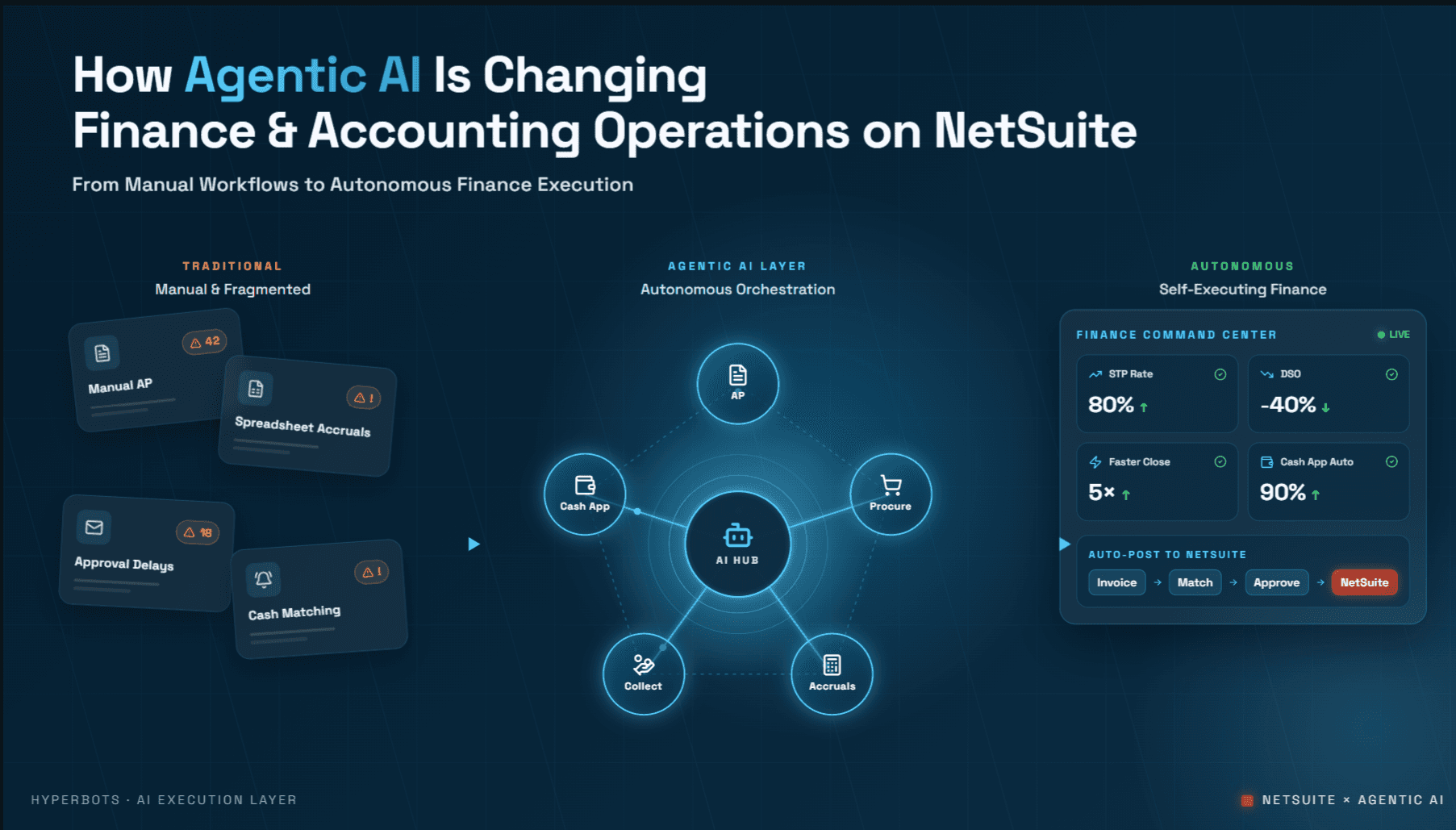
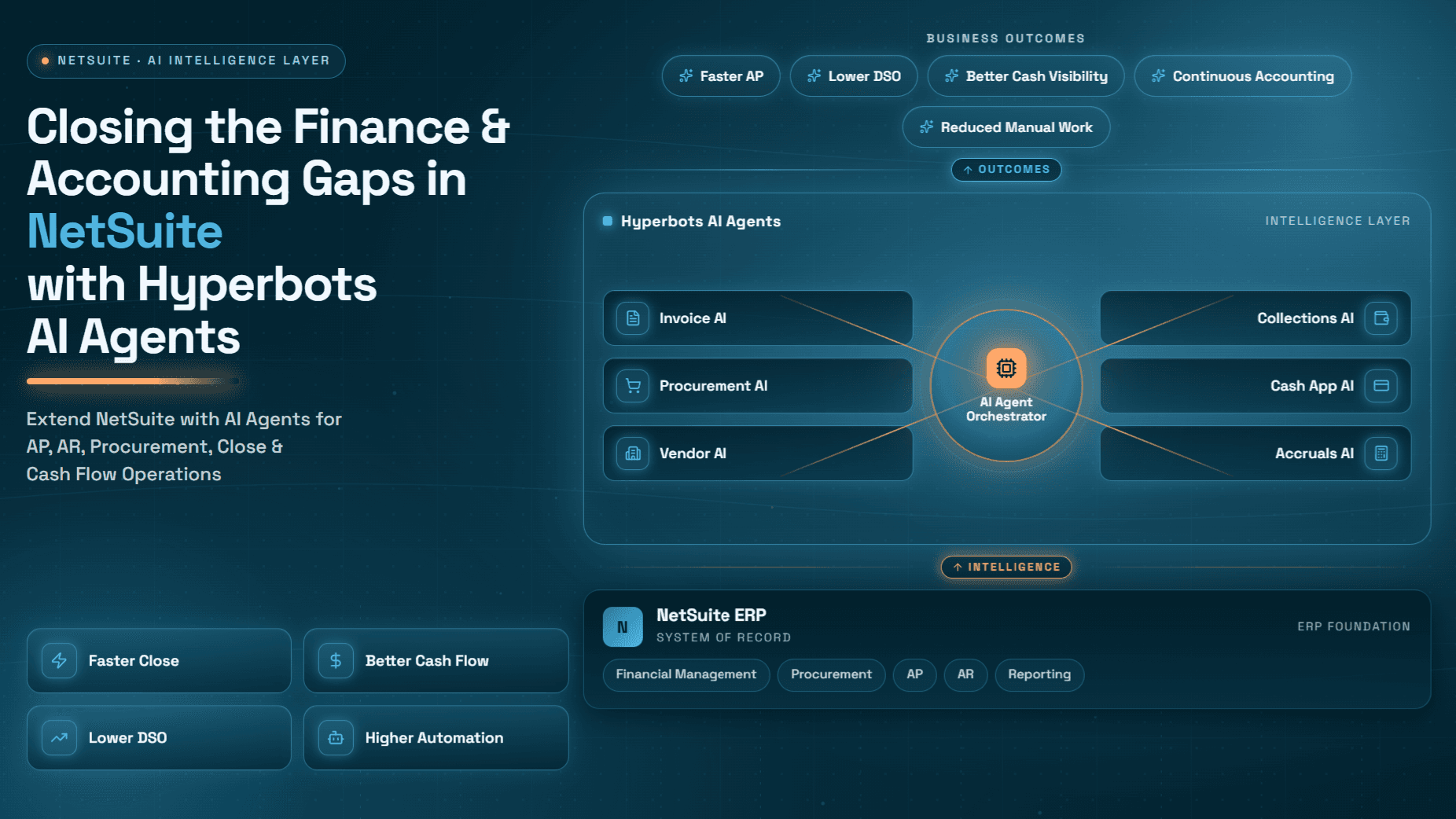
How Hyperbots AI Agents 10x Netsuite's Finance & Accounting Capabilities
Combine NetSuite with Hyperbots AI agents to automate finance operations, accelerate cash flow, and scale efficiently.
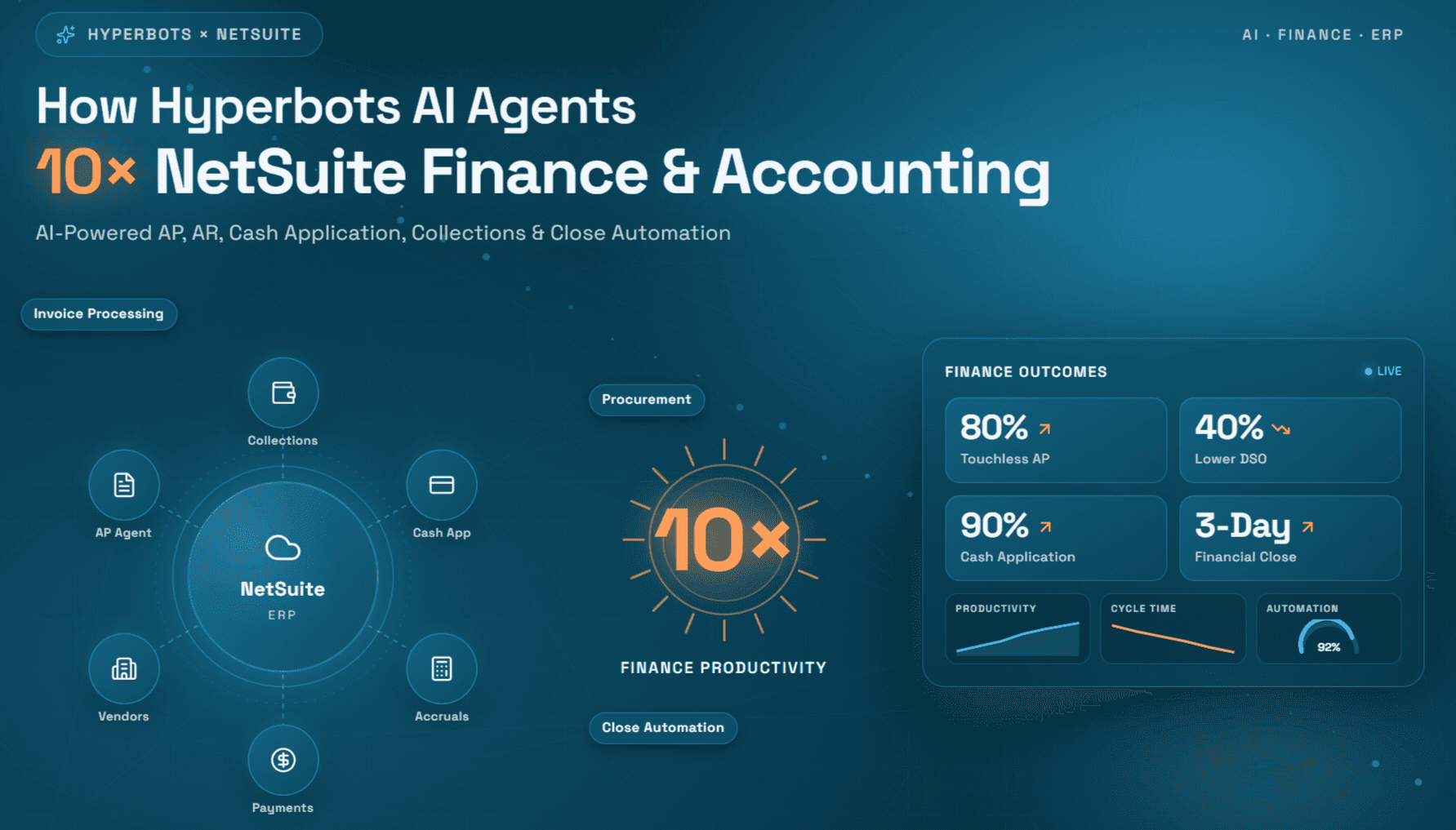
Oracle NetSuite is one of the most capable cloud ERP platforms available to mid-market and enterprise finance teams. Its financial management modules, reporting engine, approval workflows, and multi-entity support give finance leaders a reliable system of record. Yet for all its configurability, NetSuite, like any ERP, is only as effective as the operational processes running on top of it.
For many finance teams, a familiar pattern emerges after go-live: NetSuite handles the structure, but humans handle the execution. Invoice volumes arrive faster than they can be processed. Accruals are calculated manually each month-end. Purchase requisitions sit in email chains waiting for approval. Collections follow-up depends on whoever has bandwidth that day.
This execution gap is not a failure of NetSuite. It is a structural challenge inherent to how ERP platforms are designed as systems of record and control, not autonomous execution engines. Closing that gap requires a different kind of technology: one that operates alongside the ERP, processes transactional volume at scale, and hands off to humans only when genuine judgment is required.
Why NetSuite Became the ERP of Choice for Scaling Finance Teams
One reason Oracle NetSuite continues to dominate the mid-market and upper mid-market ERP landscape is that it solved a structural problem many growing organizations struggled with for years: financial fragmentation.
Before cloud-native ERP systems became mainstream, finance teams often operated across disconnected accounting software, procurement systems, spreadsheets, bank portals, reporting tools, and manually maintained consolidation workbooks. As companies expanded into new entities, geographies, or product lines, the operational complexity increased faster than the finance infrastructure supporting it. Reporting cycles slowed, intercompany reconciliation became cumbersome, and visibility across the organization deteriorated.
NetSuite’s architecture addressed that problem directly by bringing operational and financial workflows into a unified cloud environment. Instead of treating accounting as a downstream reporting function, NetSuite connected procurement, inventory, billing, revenue recognition, order management, and financial reporting into the same transactional ecosystem. That design significantly reduced the reconciliation overhead that traditionally consumed finance teams operating in high-growth environments.
For CFOs and controllers, this unified model creates operational consistency at scale. Subsidiaries follow the same financial structure. Approval policies operate through centralized workflows. Procurement and payment activities become traceable from initiation through settlement. Financial data updates in real time rather than moving through delayed batch processes or spreadsheet transfers. As organizations expand internationally or acquire additional business units, that standardization becomes increasingly valuable.
NetSuite OneWorld strengthened this advantage further by giving multinational organizations native support for:
Multi-entity consolidation
Multi-currency accounting
Tax management
Intercompany eliminations
Regional compliance requirements
Localized reporting structures
Instead of maintaining separate ERP systems for different regions and consolidating them manually at month-end, finance leaders could operate from a centralized financial platform while still preserving local operational flexibility.
Equally important is NetSuite’s role in governance and financial control. Modern finance organizations are no longer evaluated purely on reporting accuracy. They are also expected to demonstrate auditability, approval discipline, policy enforcement, and operational transparency across increasingly complex transaction environments.
NetSuite’s workflow infrastructure helps finance teams operationalize those controls directly inside day-to-day execution. Through SuiteFlow and role-based permissions, organizations can establish:
Multi-level approval hierarchies
Segregation-of-duty controls
Conditional routing logic
Threshold-based escalations
Audit trails for every transaction state change
Policy-aligned procurement workflows
That level of embedded governance is especially important for organizations navigating SOX compliance, external audits, private equity reporting requirements, or IPO preparation. In many cases, NetSuite is not simply an accounting platform; it becomes the operational control framework around which the finance organization is structured.
The platform also provides strong analytical visibility. Saved searches, KPI dashboards, SuiteAnalytics, and role-based reporting give finance leaders immediate access to operational and financial performance data without relying entirely on external BI infrastructure. Controllers can monitor close progress in real time. Procurement leaders can analyze spend patterns across vendors. AR teams can evaluate aging exposure dynamically. Executives can assess profitability across subsidiaries, departments, or product lines from the same environment.
This combination of operational integration, governance, and visibility is why NetSuite is frequently adopted during periods of organizational scaling. The ERP does not simply record financial outcomes; it creates process standardization across the business itself.
That distinction matters because modern finance complexity is increasingly operational rather than purely accounting-related. Transaction volumes grow faster than headcount. Approval chains become harder to coordinate manually. Vendor ecosystems expand. Revenue operations become multi-channel and geographically distributed. Finance teams require systems capable of maintaining consistency across that complexity without sacrificing speed or control.
NetSuite solves a substantial portion of that challenge exceptionally well.
What NetSuite Does Well and Why That Matters
NetSuite performs exceptionally well as a controls-oriented financial system. Its workflow and approval infrastructure enables finance teams to configure approval routing, delegation hierarchies, segregation-of-duty controls, and audit trails directly inside operational workflows. Through SuiteFlow and related approval frameworks, organizations can build multi-level approval processes for purchase orders, journal entries, vendor bills, reimbursements, and procurement activities without extensive custom development.
That level of governance is one reason NetSuite remains widely adopted among scaling and enterprise finance teams. The platform supports compliance-oriented financial operations through:
Role-based permissions
Approval state management
Transaction audit histories
Revenue recognition controls
Multi-book accounting support
GAAP and IFRS alignment
Documented workflow activity
These capabilities make NetSuite particularly valuable for organizations navigating SOX compliance, external audits, or increasingly complex financial structures.
Another major strength is operational integration. Procurement, inventory, billing, accounting, and cash management workflows are interconnected rather than isolated. When a transaction changes in one part of the business, downstream financial data updates automatically. Purchase orders affect commitments, inventory affects cost accounting, billing affects receivables, and payments affect cash forecasting within the same environment. This integrated operating model significantly reduces reconciliation overhead compared to fragmented finance stacks.
NetSuite’s native automation capabilities are also more sophisticated than many organizations initially realize. SuiteFlow enables configurable no-code workflow automation for approvals, notifications, field updates, escalations, and transaction routing. Finance teams can automate significant portions of operational coordination without relying entirely on developers or external tooling.
Importantly, none of this should be minimized when discussing modern finance AI platforms.
For companies that have invested in a well-configured NetSuite environment, the ERP genuinely functions as the backbone of financial operations. It provides financial integrity, transaction governance, reporting consistency, and operational standardization at scale. The goal is not to replace that foundation.
The more relevant question emerging for finance leaders today is different:
What handles the extremely high-volume, repetitive, judgment-heavy execution work that ERP systems were never originally designed to automate completely?
Because even in highly mature NetSuite environments, finance teams still encounter operational friction in areas such as:
Invoice ingestion and exception handling
Manual GL coding reviews
Three-way match discrepancies
Vendor communication
Collections follow-ups
Cash application reconciliation
Accrual estimation
Approval chasing
Spreadsheet-driven close activities
Email-based coordination
Industry practitioners and NetSuite users frequently describe these gaps as the remaining “manual layer” surrounding otherwise modern ERP systems.
That distinction matters because it reframes the role of AI in finance operations. The opportunity is not replacing NetSuite’s system-of-record capabilities. The opportunity is extending NetSuite with intelligent execution systems that can absorb repetitive operational workload while preserving governance, auditability, and ERP integrity.
That is the context in which AI agent platforms like Hyperbots become strategically relevant.
Why NetSuite Creates the Conditions for Successful AI Finance Automation
One of the more overlooked realities in finance transformation is that AI automation works best in organizations that already have a mature ERP foundation. In practice, many AI initiatives fail not because the models are weak, but because the underlying finance environment lacks standardized workflows, clean master data, approval governance, and transactional consistency.
This is precisely where NetSuite becomes strategically important.
Organizations running NetSuite have already solved many of the structural problems that make intelligent finance automation difficult in fragmented environments. Vendor records are centralized. Approval hierarchies are defined. Financial dimensions are standardized. Procurement, AP, AR, billing, and accounting workflows operate within the same transactional ecosystem. Audit trails exist at the transaction level. Finance policies are embedded directly into operational workflows rather than enforced manually through spreadsheets and email coordination.
That operational consistency matters because AI systems depend heavily on structured context.
For example:
AI-driven invoice coding becomes more reliable when historical GL behavior is standardized inside the ERP.
Automated approval routing works more effectively when authority structures already exist through SuiteFlow.
Intelligent accrual estimation becomes more accurate when purchasing, receipts, vendor activity, and historical spend patterns are centralized within the same financial environment.
Cash application automation performs better when customer records, remittance history, and AR workflows are already normalized across the organization.
In other words, NetSuite provides the operational infrastructure that allows AI systems to function safely and predictably at scale.
This is one reason finance leaders increasingly view AI augmentation as a second-stage optimization rather than a standalone transformation initiative. The ERP establishes governance, financial integrity, and process standardization first. AI then extends execution capacity on top of that foundation by reducing manual workload, accelerating throughput, and improving operational responsiveness.
Without a mature ERP environment, AI automation often creates additional fragmentation because workflows, controls, and data structures remain inconsistent. In mature NetSuite environments, however, AI can operate within an already-governed financial framework. Approval thresholds remain intact. Auditability is preserved. Human oversight continues where exceptions occur. The result is not uncontrolled automation, but scalable execution operating inside existing finance controls.
That distinction is important because it reframes AI adoption from an ERP replacement discussion into a finance maturity discussion. For many organizations, the reason AI augmentation becomes practical is precisely because NetSuite already standardized the underlying operating environment.
The Manual Work That Persists Inside Modern ERP Environments
Accounts Payable: Volume, Variance, and the STP Problem
Straight-through processing (STP), which is the ability to receive an invoice, validate it, match it to a PO, and post it to the ledger without human intervention, is the benchmark by which AP automation is measured. In practice, even well-configured NetSuite environments with OCR-based capture tools struggle to achieve STP rates above 40–50% of invoice volume. The rest require some form of manual touch: a coding correction, a matching exception, a missing PO reference, or a tax discrepancy.
The reasons are structural. Invoice formats vary by vendor. Three-way matching fails when goods receipts are delayed or quantities differ by tolerance margins. GL coding requires judgment that rule-based systems handle poorly for non-PO invoices. Each exception creates a queue that AP staff must work through manually, and those queues grow with transaction volume.
The constraints on straight-through processing are well-documented: format variability, data quality gaps, policy complexity, and the sheer diversity of vendor invoice structures all contribute to STP failure rates that no rule-based system can fully address.
Accruals: The Month-End Bottleneck That Never Disappears
Accruals represent one of the most labor-intensive and error-prone processes in any finance close cycle. Finance teams must identify goods and services received but not yet invoiced, estimate amounts for recurring obligations, book reversing journal entries, and reconcile actuals when invoices eventually arrive.
In NetSuite, accruals are a manual or semi-manual process. Controllers and accounting staff must query open POs, review service agreements, assess unbilled vendor activity, and make judgment calls about what to accrue. Month-end accrual cycles routinely extend the close by two to four days. Variances between accrued and actual amounts affect period reporting accuracy. With high invoice volumes or complex vendor contracts, the margin for error compounds.
Procurement: The Gap Between Requisition and Execution
Purchase requisition workflows in NetSuite provide structure, but the actual creation, routing, and approval of PRs and POs still involves significant manual effort. Requestors must populate requisition fields manually. Approvers receive notifications but must navigate to the ERP to review. Budget validation often happens post-facto. The cycle from identified need to issued purchase order which should take under an hour in an optimized environment, commonly runs three to five business days in practice.
The impact is measurable: procurement delays hold up project execution, create maverick spend as requestors bypass the process, and result in invoices arriving without corresponding POs, further degrading AP STP rates. Purchase order automation that operates within the ERP's control framework, rather than outside it, is increasingly seen as the practical solution.
Cash Application: Where AR Throughput Breaks Down
On the revenue side, cash application, matching incoming payments to open customer invoices, is a process that scales poorly without automation. Remittance advice arrives in multiple formats: EDI, email attachments, portal downloads, and bank statements. Payment amounts frequently differ from invoice totals due to short pays, promotional deductions, or disputed charges. Each exception requires a human to investigate, communicate with the customer, and apply the payment correctly.
Manual cash application creates delays in Days Sales Outstanding (DSO), distorts AR aging reports, and consumes staff time that could be directed toward higher-value collections activity. In high-transaction environments, the backlog of unapplied cash can become a significant reporting problem.
Collections: Structured Follow-Up at Scale
Collections operations depend on consistent, timely outreach to customers with overdue balances. In practice, collections teams manage this through a combination of AR aging reports, email, and phone calls, a process that is labor-intensive, inconsistently executed, and difficult to scale. NetSuite provides aging data and dunning letter templates, but the execution of follow-up sequences, escalation logic, and dispute resolution still falls to staff.
The result is that collections efficiency correlates directly with headcount rather than with process design, a relationship that becomes problematic as transaction volumes grow or AR teams experience turnover.
AI Agents in Finance: What the Architecture Actually Looks Like
The emergence of AI agents in enterprise finance is distinct from earlier waves of automation. Rules-based RPA systems automate repeatable sequences but fail when data structures or process flows vary. Template-based OCR extracts invoice data but breaks on non-standard formats. Workflow automation tools route approvals but do not make decisions.
AI agents operate differently. They are trained on finance-domain data such as invoice formats, GL coding patterns, matching logic, payment terms, accrual calculations and can apply judgment to scenarios that fall outside predefined rules. They can recognize that a vendor invoice with a 2% quantity variance against a PO should auto-approve under tolerance policy, while a 15% variance should route for review. They can identify which open service contracts have received goods not yet invoiced. They can apply incoming payments against open invoices even when remittance detail is incomplete.
The key architectural principle is that AI agents do not operate as standalone systems. They connect to the ERP, reading transactional data, executing within its workflow framework, and writing results back to the ledger. How AI complements ERP systems is a question of integration depth and domain specificity, not generic automation. NetSuite remains the system of record; AI handles the execution throughput.
Multi-agent collaboration, where specialized agents handle invoice extraction, GL coding, matching, and posting as coordinated tasks, is also emerging as a practical architecture for finance and accounting operations. This mirrors how high-performing finance teams organize human specialists: each focused on a specific function, with handoffs governed by clear rules.
How Hyperbots Extends NetSuite's Finance & Accounting Capabilities
Hyperbots is an AI co-pilot platform purpose-built for finance and accounting operations. It integrates directly with Oracle NetSuite and operates as an intelligent execution layer on top of the ERP, handling transactional volume, processing exceptions, and passing results back to NetSuite in real time. The platform does not replace NetSuite's workflow engine, reporting, or financial controls. It augments the execution capacity of the finance team running on top of it.
P2P Co-Pilots
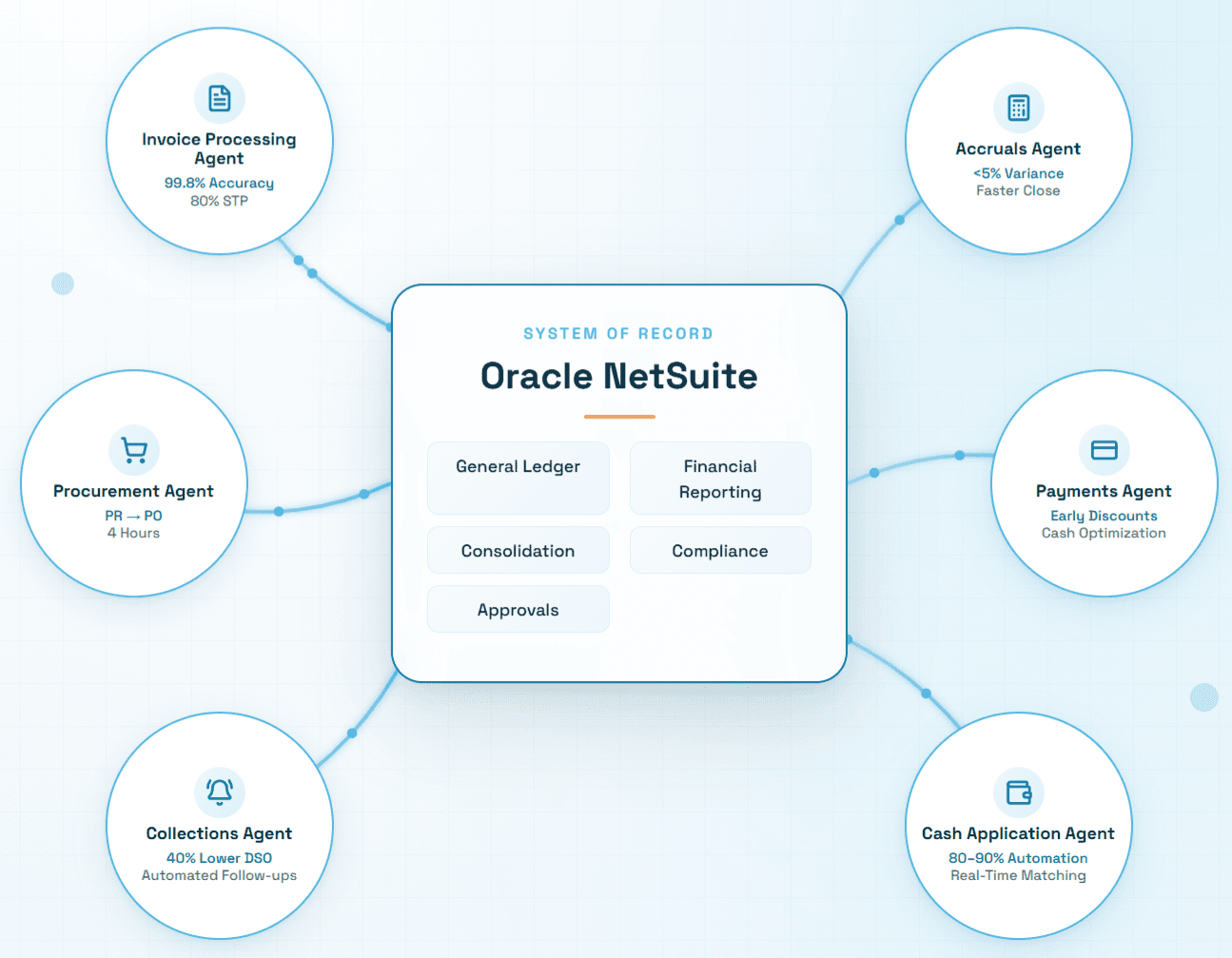
Invoice Processing Co-Pilot
The Invoice Processing Co-Pilot handles end-to-end invoice intake, extraction, validation, matching, GL coding, and posting, directly into NetSuite. It achieves 99.8% invoice extraction accuracy and processes invoices in under one minute, compared to the industry average of several days for manual workflows. For PO-backed invoices, it executes two-way and three-way matching autonomously, with configurable tolerance rules. Invoices that fall within policy parameters post straight-through; exceptions are flagged and routed with full context. Straight-through processing rates of 80% have been validated in production environments, including a documented case with Extreme Reach achieving 80% STP and 99.8% accuracy with zero manual touch-ups.
Accruals Co-Pilot
The Accruals Co-Pilot automates the identification of unbilled liabilities, goods received not invoiced, services consumed but not yet billed, recurring obligations without POs and generates accrual journal entries for posting in NetSuite. Reversals are automated in the following period. The co-pilot maintains accrual variance below 5% and eliminates the manual spreadsheet-driven accrual process that extends month-end close for most finance teams. Details on how agentic AI transforms accruals are available for finance teams assessing this capability.
Procurement Co-Pilot
The Procurement Co-Pilot automates PR creation, validation, PO generation, and vendor dispatch. It extracts requisition details from email and documents, populates PR fields from historical data and policy rules, validates against budget, and routes for approval. PR-to-PO cycles that typically take three or more days can be completed in approximately four hours, with PR creation taking as little as five minutes. POs are dispatched to vendors and confirmed through a vendor portal that synchronizes back to NetSuite.
Payments Co-Pilot
The Payments Co-Pilot automates payment recommendations, approval routing, and disbursement execution across ACH, check, and card. It identifies early payment discount opportunities and flags them for capture, while also modeling late payment strategies when cash conservation is the priority. Bank statement reconciliation and GL posting back to NetSuite are automated. Finance teams using the Payments Co-Pilot report approximately 10% reduction in cash outflow through optimized payment timing and discount capture.
Sales Tax Verification Co-Pilot
The Sales Tax Verification Co-Pilot validates tax applicability, rates, and jurisdiction compliance on each invoice line item before posting. It cross-references origin and destination addresses, applies tax category classification using integrated tax dictionaries, and flags mismatches for review. For organizations with multi-state purchasing activity, this co-pilot has been documented to identify substantial tax leakage, in one case, $200,000 in recovered tax exposure for a single CFO's organization.
Vendor Management Co-Pilot
The Vendor Management Co-Pilot automates vendor onboarding, identity verification, document collection, and ongoing communication. New vendors are onboarded through a self-service portal that collects required data, validates banking details, and syncs the vendor record to NetSuite. Remittance advice, PO acknowledgments, and invoice acceptance notifications are automated, reducing the back-and-forth that typically consumes AP staff time.
Procure-to-Pay ROI
Metrics | NetSuite alone | With Hyperbots | Operational Impact |
Invoice processing time | 8–12 day invoice cycle times are common in manual AP environments such as NetSuite | Hyperbots processes invoices in <1 minute | 99%+ reduction in invoice processing time |
Straight-through invoice processing | Typical ERP-centric AP teams achieve ~15–25% touchless processing | Hyperbots achieves 80% STP | 3.2×–5.3× higher touchless processing rate |
Invoice extraction accuracy | Traditional OCR systems typically achieve only 85–90% accuracy | Hyperbots delivers 99.8% extraction accuracy | 50×–75× reduction in manual correction requirements |
AP manual workload | AP teams often spend 60–70% of capacity on manual entry and exception handling | Hyperbots automates matching, validation, and GL coding | 4×–5× reduction in manual AP workload |
Early payment discount capture | Most organizations capture <40% of available discounts | Hyperbots captures 100% of all early payment discounts automatically | 2.5×+ improvement in discount capture potential |
O2C Co-Pilots
Collections Co-Pilot
The Collections Co-Pilot manages structured follow-up sequences for overdue customer balances, automated reminders, escalation logic, dispute flagging, and payment arrangement tracking. It operates from NetSuite AR aging data and executes outreach workflows consistently across the full customer portfolio, not just the accounts that happen to be on a collector's list that week. Finance teams using AR automation report up to 40% reduction in DSO and 70% reduction in collection costs at scale.
Cash Application Co-Pilot
The Cash Application Co-Pilot matches incoming payments, including those with incomplete or non-standard remittance detail, to open customer invoices in NetSuite. Short pays, deductions, and partial payments are handled with configurable resolution logic. Reconciliation costs have been reduced by 80% in documented implementations, with real-time ERP synchronization ensuring AR balances reflect current cash positions.
Order-to-Cash ROI
Metric | NetSuite Alone / ERP-Centric Reality | With Hyperbots | Operational Impact |
Cash application automation | Manual and ERP-centric AR environments don’t automate cash application, with payment matching and reconciliation heavily dependent on human intervention. | Hyperbots achieves 80–90% straight-through cash application using AI-driven remittance extraction, intelligent matching, and autonomous ERP posting | 4×–9× higher cash application automation, enabling faster reconciliation and reduced AR processing costs |
Days Sales Outstanding (DSO) | ERP-centric collections workflows rely on static aging buckets, manual follow-ups, and delayed dispute identification, contributing to elevated DSO | Hyperbots delivers ~40% DSO reduction through AI-driven prioritization and autonomous follow-ups | Up to 1.6× faster cash-conversion cycle |
Cost-to-collect | Traditional collections environments require large amounts of manual outreach, dispute handling, and tracking effort | Hyperbots uses AI-driven prioritization of accounts, automated tailored follow-ups minimizing human intervention | 70% reduction in cost-to-collect |
Reconciliation cost | ERP-centric reconciliation workflows remain labor-intensive due to manual extraction and matching of remittance | Hyperbots delivers 99.8% remittance extraction accuracy with AI-driven autonomous matching and reconciliation workflows | 80% reduction in reconciliation cost |
Unapplied cash levels | Traditional AR environments often maintain unapplied cash balances near 40% due to delayed matching and exception handling | Hyperbots reduces unapplied cash to <10% through AI-driven matching and exception resolution | 75% reduction in unapplied cash |
Positioning: What Changes and What Stays the Same
A common concern among finance leaders evaluating AI augmentation is how it interacts with existing ERP governance. The answer in Hyperbots' architecture is straightforward: NetSuite's chart of accounts, approval thresholds, workflow rules, and financial controls remain unchanged. The AI co-pilots operate within those parameters, not around them.
Human oversight is preserved through configurable exception thresholds. Transactions within policy process autonomously; those outside tolerance route to the appropriate reviewer with full context and a documented audit trail. Finance teams scale throughput, processing more invoices, closing faster, collecting more consistently, without proportional headcount growth, and without surrendering control to a black box.
For finance leaders considering where to start, AP automation typically delivers the fastest measurable return: invoice processing cost reduction, STP rate improvement, and working capital impact from earlier payment visibility are all quantifiable within the first quarter of deployment.
A Practical Next Step
For finance leaders running NetSuite who want to assess where AI augmentation would have the most impact on their specific workflows, Hyperbots offers both a free trial and a personalized demonstration with finance operations specialists. The conversation is typically diagnostic: where is manual effort concentrated, what are the current STP and DSO benchmarks, and what would a 30-day improvement look like? No commitment is required, and the starting point is operational data rather than a sales deck.
NetSuite is a strong foundation. The question is how much execution capacity your team is leaving on the table and whether intelligent augmentation is the right way to close that gap.
Frequently Asked Questions
1. Does Hyperbots replace NetSuite or work alongside it?
Hyperbots works alongside NetSuite as an intelligent execution layer. NetSuite remains the system of record for all financial data, controls, and reporting. Hyperbots handles transactional processing, invoices, accruals, procurement, payments, collections, and cash application, and posts results back to NetSuite in real time.
2. What NetSuite processes benefit most from AI automation?
The highest-impact areas are invoice processing (STP rate and speed), accruals (month-end close time and accuracy), procurement (PR-to-PO cycle time), and AR collections (DSO and collection cost). Cash application and payments optimization also deliver measurable returns, particularly for organizations with high transaction volumes or significant early payment discount opportunities.
3. How does AI handle exceptions in AP workflows?
AI agents evaluate each invoice against configured policy parameters such as matching tolerances, GL coding rules, approval thresholds, tax validation logic. Invoices within policy post straight-through. Exceptions are flagged with full context (what failed, why, and what action is needed) and routed to the appropriate reviewer in NetSuite. The exception handling approach is designed to minimize manual reviews, not eliminate human judgment on genuinely ambiguous cases.
4. What accuracy benchmarks are realistic for AI invoice processing?
Production implementations have validated 99.8% invoice extraction accuracy and 80% straight-through processing rates. These figures depend on data quality, vendor invoice diversity, and the completeness of policy configuration. Finance teams should expect initial STP rates to improve over time as the AI learns from exceptions and feedback.
5. How quickly can AI co-pilots be deployed on top of an existing NetSuite instance?
Pre-trained AI models purpose-built for finance workflows enable faster deployment than custom-built automation. Hyperbots' co-pilots use pre-built NetSuite connectors and data model mapping, with implementations that go live in days rather than months. Initial configuration covers GL coding patterns, matching tolerance rules, approval thresholds, and accrual policies.
6. Is AI in finance appropriate for mid-market companies, or only enterprise?
AI augmentation for finance operations is particularly well-suited to mid-market companies running NetSuite, where finance teams often lack the headcount to manage transaction volume growth without automation. The operational leverage, processing more transactions per FTE, closing faster, reducing DSO, is proportionally higher for teams that cannot hire their way out of volume challenges.