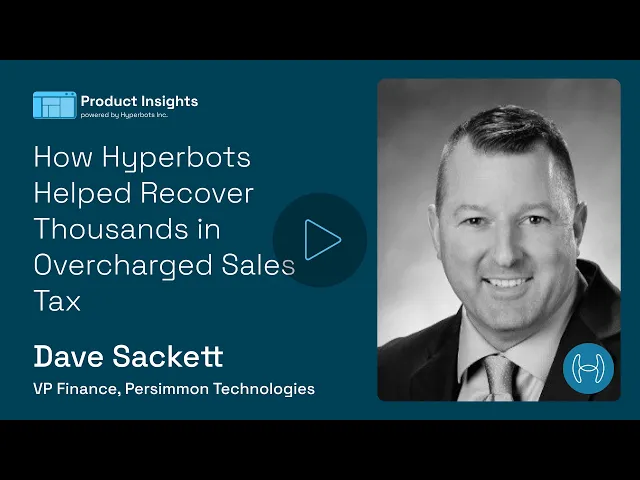
How Hyperbots Helped Recover Thousands in Overcharged Sales Tax
A CFO Insight conversation on how Hyperbots' AI sales tax co-pilot validates tax, manages compliance across multiple ERPs, and prevents costly errors before invoices are posted.
In this CFO Insight conversation, Brad Boehmke sits down with Dave Sackett to dig into the functional capabilities of Hyperbots' sales tax verification co-pilot. They cover why a dedicated tax co-pilot was worth bringing in, how it extracts and validates tax data, how it handles multiple ERPs and currencies, and what kind of results it has delivered in practice.
Why bring in a dedicated sales tax co-pilot at all?
Brad: Why did you bring in a dedicated sales tax co-pilot on your side?
Dave: Because vendor invoices were coming in with wrong rates. AP could only spot a handful of them as they came by. With Hyperbots, we've got automation to check every single line on the voucher that posts, so we catch errors up front instead of months later during an audit.
How does it extract the tax-relevant data?
Brad: And how does it extract the tax-relevant data?
Dave: It uses vision language models that pull in the quantities, prices, ship-from and ship-to addresses, and zip codes with 99.8% accuracy. A lot of OCR tools hit the low 80s percent and miss header overrides, which forces a human review. With Hyperbots, we don't need that.
Brad: That's definitely a big difference.
Dave: Agreed.
How does address validation work?
Brad: Validating addresses can be tricky. What's different in this case?
Dave: The co-pilot uses the USPS and Canada Post APIs to correct typos and append county and district codes. No valid address means no tax calculation. A lot of legacy engines just use the five-digit zip code and hope for the best.
How are items classified into tax categories?
Brad: And how are items classified into tax categories?
Dave: Each agent's AI classifier is trained on millions of SKU taglines across software, clothing, food, you name it, even when the ERP item master is blank. Some tools require you to maintain giant tax code tables manually. Hyperbots doesn't need that.
Where does Hyperbots get its tax rules from?
Brad: So where does Hyperbots get the actual tax rules?
Dave: From the jurisdiction dictionary. It refreshes nightly across more than 4,000 US jurisdictions plus EU VAT and Canadian GST and HST. All of those feeds plug straight into the co-pilot.
Brad: That's super helpful. Staying up to date is necessary.
Can it catch mismatches between what you owe and what you're charged?
Brad: Can it spot mismatches between what we should pay and what the vendor is charging?
Dave: Yes, and that's one of the great benefits of Hyperbots. If you're overcharged, it triggers a vendor credit memo request. If you're undercharged, it auto-books use tax. If an exempt item gets taxed, it flags it for certificate checks. It looks at all these data fields to confirm whether things are correct, and if not, it alerts you. Our prior AP tool only handled overcharges and ignored underpayments.
How does Hyperbots monitor economic nexus thresholds?
Brad: Economic nexus thresholds are constantly changing. How are they monitored?
Dave: The co-pilot tracks a rolling 12-month sales and transaction count per state. As soon as we cross a threshold, it alerts us and starts applying collection logic automatically. A lot of systems leave nexus tracking to a spreadsheet, but because the co-pilot works off live data tables, it can reference them in real time.
How do you prove higher compliance?
Brad: This tends to be a tricky one. How do you prove higher compliance?
Dave: You look at the error rates on sampled invoices. For example, going from an 18% error rate down to under 1%, and not receiving a single penalty invoice since going live.
What notifications do users get about tax issues?
Brad: Staying on top of things is key to productivity. What kind of notifications do users get about tax?
Dave: Real-time alerts, and they come through in plain English, so you can actually understand them. For example: "Invoice 987 was overcharged 0.75%, credit memo requested." AP clicks in, sees the details, done. It's no more end-of-day data dumps that people have to dig through after their work is finished. It happens in real time.
Are audit trails visible at the line level?
Brad: Talk about audit trails. Are inline-level checks visible?
Dave: Yes, every verdict stores the rule ID, the rate source, the timestamp, and any user override in a hash-chain ledger. Auditors can query over 800 invoices and reconcile them in a single afternoon.
What happens when an exemption certificate is missing or expired?
Brad: What happens when an exemption certificate is missing or expired?
Dave: The co-pilot flags the invoice, pauses posting, and emails the vendor to secure a link to upload a new certificate. Some tools let the invoice through and hope someone cleans it up later. We don't want that.
Can the system learn from manual overrides?
Brad: And can the system learn from overrides?
Dave: Absolutely. Any manual adjustment retrains the model overnight, so the same error doesn't show up again. Older rule-based engines stay static until IT manually edits a table. The difference with Hyperbots is that it actually learns from that experience.
Can one co-pilot cover multiple ERPs?
Brad: For example, what if I say that we operate across three ERPs, which is the norm for a lot of companies. Does one co-pilot cover them all?
Dave: Yes, everything can be connected and linked. Entity configs activate the right connector, so AP sees one tax exemption queue even though invoices are posting to SAP, NetSuite, Sage, or Epicor. It doesn't matter. Hyperbots still treats it all as one database.
How is single sign-on handled across ERPs?
Brad: Part of that is single sign-on. How is that handled across ERPs?
Dave: One Azure AD login, and Hyperbots swaps invisible tokens per ERP behind the scenes. Tax analysts never have to juggle passwords, so you still get the benefit of single sign-on even with multiple ERPs in play.
How does it handle international invoices and VAT?
Brad: What about international invoices? VAT reverse charge, GST, that kind of thing?
Dave: The individual accountant doesn't need to be a tax expert, because the dictionary includes EU and Canadian tax rules. The co-pilot flags reverse charge cases and populates the correct self-assessment lines automatically. Some tools force you into a separate VAT module to process it. With Hyperbots, you pull in US, EU, and Canadian rules, and it doesn't matter which one you're working with.
How does the co-pilot post adjustments back to the ERP?
Brad: How does the co-pilot post adjustments back to the ERP?
Dave: It writes the corrected voucher, adds the use tax line, then reads the record back to confirm it posted. If the ERP rejects the post, the item drops into an exceptions queue with the exact error message attached.
Are there any pitfalls with multi-currency invoices?
Brad: And multi-currency invoices, any pitfalls there?
Dave: Hyperbots converts tax into functional and transactional currency using the ERP's FX table, so there are no revaluation surprises at month end. It's all handled in real time.
What's a real win you've seen from this?
Brad: This is more open-ended, but describe a real win you've seen.
Dave: A vendor charged us 8.25% on software delivered to Dallas. The correct rate was 7.5%. The co-pilot flagged it, auto-requested a credit memo, and we recovered $5,700 that same week.
Brad: That's fantastic. Anytime you're getting money back, especially in the thousands, it's a nice feeling.
Dave: For sure. It pays for itself.
How quickly did Hyperbots' pre-trained models deliver value?
Brad: Last couple of questions. How quickly did Hyperbots' pre-trained models start delivering value?
Dave: Day one. They're already trained on millions of invoices and tax outcomes, so false flags were under 1% right away. A lot of machine learning tools take weeks of feeding data before they're useful.
Brad: There's usually a learning curve on both sides with new technology, so being that sharp right out of the box is huge. You see the value immediately.
Dave: Exactly, and it gives the team confidence that it works.
Why does Hyperbots beat typical tax engines?
Brad: Last question. If you could sum up why Hyperbots beats typical tax engines, what would you say?
Dave: A lot of competing systems do a batch check after posting. Hyperbots extracts, validates, decides, books, and learns live, line by line. That's why we're seeing 99.8% accuracy, close to zero penalties, instant credit recoveries, and an audit trail that auditors consider bulletproof.
Brad: That's awesome. Great discussion, Dave. Looking forward to the next one. It was great to dive into the functional capabilities of sales tax verification and that specific co-pilot from within Hyperbots. Thanks again, and really appreciate the time.