
Government Contract Management Software: The Complete 2026 Guide
Everything you need to know about government contract management software.
Government contracting runs on paperwork, deadlines, and dollar ceilings that don't bend. A missed modification, an unbilled ceiling breach, or a funding lapse doesn't just create an internal headache, it can trigger a stop-work order, an audit finding, or a lost recompete. That's why "contract management software" means something different in the public sector than it does anywhere else in B2B software.
This guide breaks down what government contract management software actually is, how federal and local government requirements diverge, what to track once a contract is awarded, and critically, why the finance side of contract management is where most GovCon organizations still struggle, even after they've bought a CLM system.
What Government Contract Management Software Is
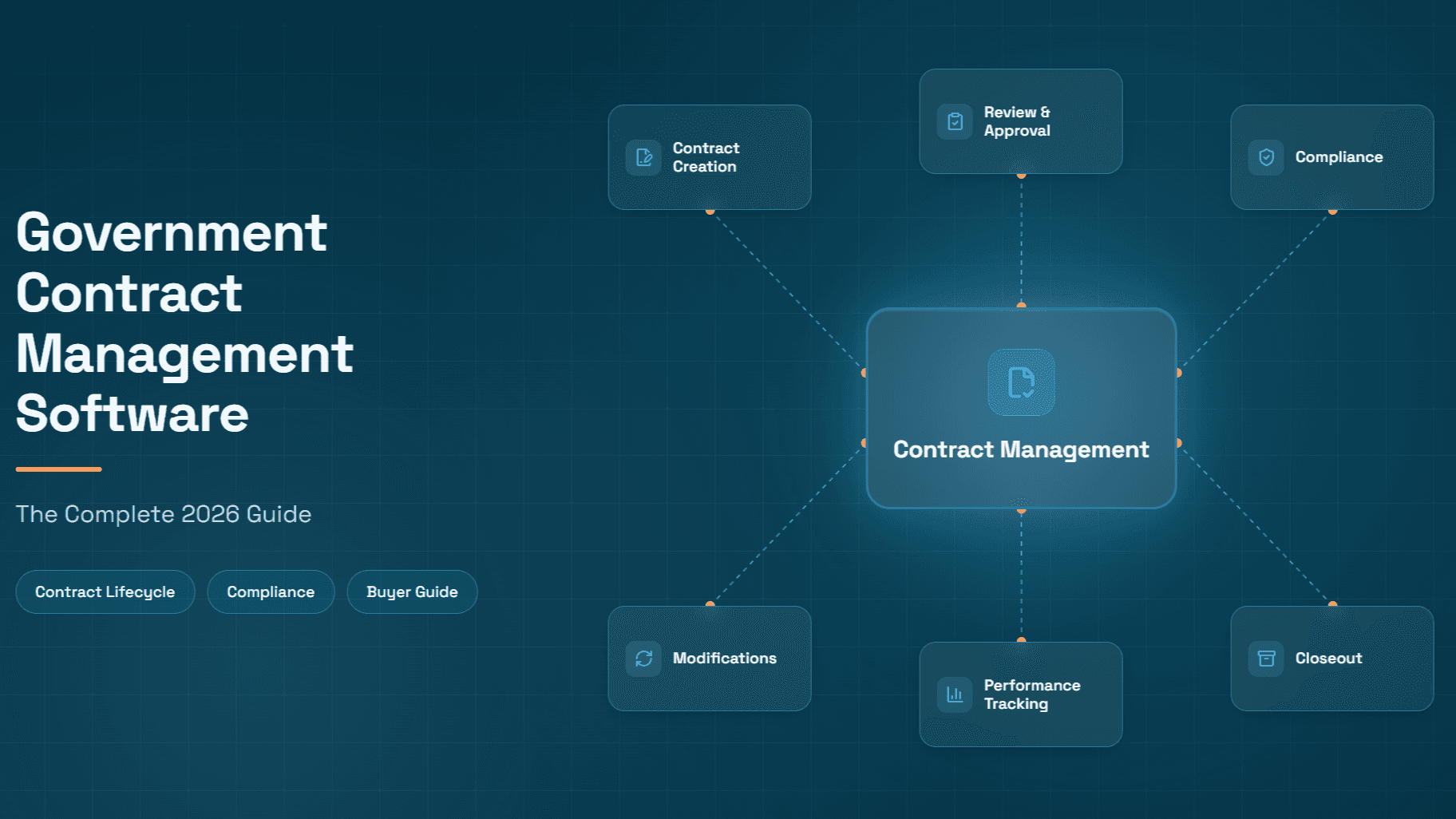
Government contract management software is any platform purpose-built to manage the lifecycle of a contract with a public sector buyer, from solicitation and proposal through award, execution, modification, and closeout. Unlike commercial contract management, which is largely about negotiating terms and storing signed PDFs, government contract management software has to account for a regulatory layer that commercial deals never touch.
The complete government contract lifecycle typically includes:
Opportunity identification and capture planning
Proposal development and pricing
Contract award and acceptance
Contract administration (obligations, deliverables, reporting)
Modifications and change orders
Invoicing and funding tracking against ceilings
Closeout, final invoicing, and records retention
Why government contracting differs from commercial contracting
A commercial contract is a negotiated agreement between two private parties. A federal contract is a negotiated agreement layered on top of a body of federal law and regulation, principally the Federal Acquisition Regulation (FAR) and, for defense work, the Defense Federal Acquisition Regulation Supplement (DFARS). Contract type selection (firm-fixed-price, cost-reimbursement, time-and-materials, or an incentive structure) is itself a regulated decision, and it determines everything downstream: how the contractor gets paid, what the contractor has to document, and how much financial risk the contractor carries. Notably, an April 2026 executive order directed federal agencies to default to fixed-price contracting wherever legally possible, pushing agencies to justify the continued use of cost-reimbursement and time-and-materials vehicles rather than treating them as a default option.
This regulatory overlay is why the phrase "government contract management solutions" usually refers not to one tool, but to a stack: a system of record for the contract itself, plus the compliance, proposal, and financial tooling wrapped around it. Vendors and industry commentators often shorten this entire category to GovCon software, a catch-all term covering CLM, proposal automation, compliance tracking, and the finance systems that keep contracts solvent.
Types of Government Contracting Software
No single platform owns the full government contract lifecycle. Most GovCon organizations run several purpose-built systems side by side. Understanding the boundaries between categories helps avoid buying redundant tools or worse, leaving a gap that nobody owns.
Software Category | Primary Purpose | Typical Users | Common Limitations |
Contract Lifecycle Management (CLM) | Document repository, obligation tracking, modification history, clause libraries | Contracts administrators, legal | Strong on documents and dates; weak on real-time financial data (billing, ceilings, indirect rates) |
Proposal & Capture Software | Opportunity tracking, proposal drafting, pricing volumes, teaming | Business development, capture managers | Stops at award; doesn't manage post-award administration |
Compliance Software | FAR/DFARS clause tracking, CMMC/NIST posture, small-business reporting | Compliance officers, security teams | Often siloed from contract and finance systems, creating duplicate data entry |
ERP (Enterprise Resource Planning) | General ledger, project accounting, indirect rate pools, payroll | Finance, accounting | Government-specific logic (ceilings, CLIN-level billing) often requires costly customization |
Project Management | Task tracking, resource allocation, milestone reporting | Program/project managers | Rarely connects budget-to-actual data back to the contract funding source |
Financial Automation for Government Contractors | Invoice/PO matching against contract terms, funding and ceiling tracking, billing accuracy | Controllers, AP/AR teams, CFOs | Newest category; many finance teams still run this manually in spreadsheets |
Contract management software for government contractors is rarely a single purchase decision, it's an integration decision. The organizations that struggle most are usually the ones that bought a strong CLM platform and assumed it would also solve billing accuracy, funding availability checks, and revenue recognition. It won't; that's a different job, done by a different layer of software, covered later in this guide.
Federal vs Local Government Contract Management
Federal and local (state, county, and municipal) contracting share a common goal, spending public money accountably, but the mechanics diverge enough that a system configured for one often needs real adjustment for the other.
Dimension | Federal Government | Local Government |
Governing rules | FAR (Title 48 CFR), plus agency supplements like DFARS for defense work | State procurement codes and local ordinances; federal Uniform Guidance (2 CFR 200) applies only when federal pass-through funds are involved |
Funding source | Congressional appropriations, obligated by fiscal year | State/local budgets, bonds, grants, and in some cases federal pass-through funds |
Contract types | Firm-fixed-price, cost-reimbursement (CPFF, CPIF, CPAF), time-and-materials, IDIQ | Typically fixed-price or unit-price; cost-reimbursement structures are far less common |
Competitive thresholds | Micro-purchase threshold of $15,000 and simplified acquisition threshold of $350,000 for awards made on or after October 1, 2025, above which full and open competition applies | Set by state statute or local ordinance; formal competitive bidding is commonly required somewhere between $35,000 and $100,000, varying widely by jurisdiction |
Reporting & compliance | SAM.gov registration, FPDS reporting, CMMC/NIST 800-171 for defense-adjacent work, DCAA-compliant accounting for cost-type contracts | Local vendor registration, public records law, prevailing wage and local-preference requirements where applicable |
Approval workflows | Contracting officer authority, formal acquisition planning above certain dollar thresholds | Governing board or council approval, often required above locally set spending limits |
What this means for software selection: a platform built primarily for federal defense contractors, with FAR/DFARS clause libraries and DCAA-ready cost tracking baked in, will typically be over-engineered for a municipal vendor managing fixed-price public works contracts, and under-equipped for the specific things municipal buyers care about, like prevailing-wage compliance and public-records retention. Organizations that sell into both federal government contract management software and contract management software for local government audiences usually need configurable rule sets rather than a one-size-fits-all workflow.
For contractors chasing both markets, System for Award Management (SAM.gov) registration remains the gatekeeping step for any federal work: a business needs an active SAM registration and Unique Entity ID (UEI) before it can receive a federal contract award, and that registration must be renewed every 365 days to stay active.
Government Contract Tracking Software
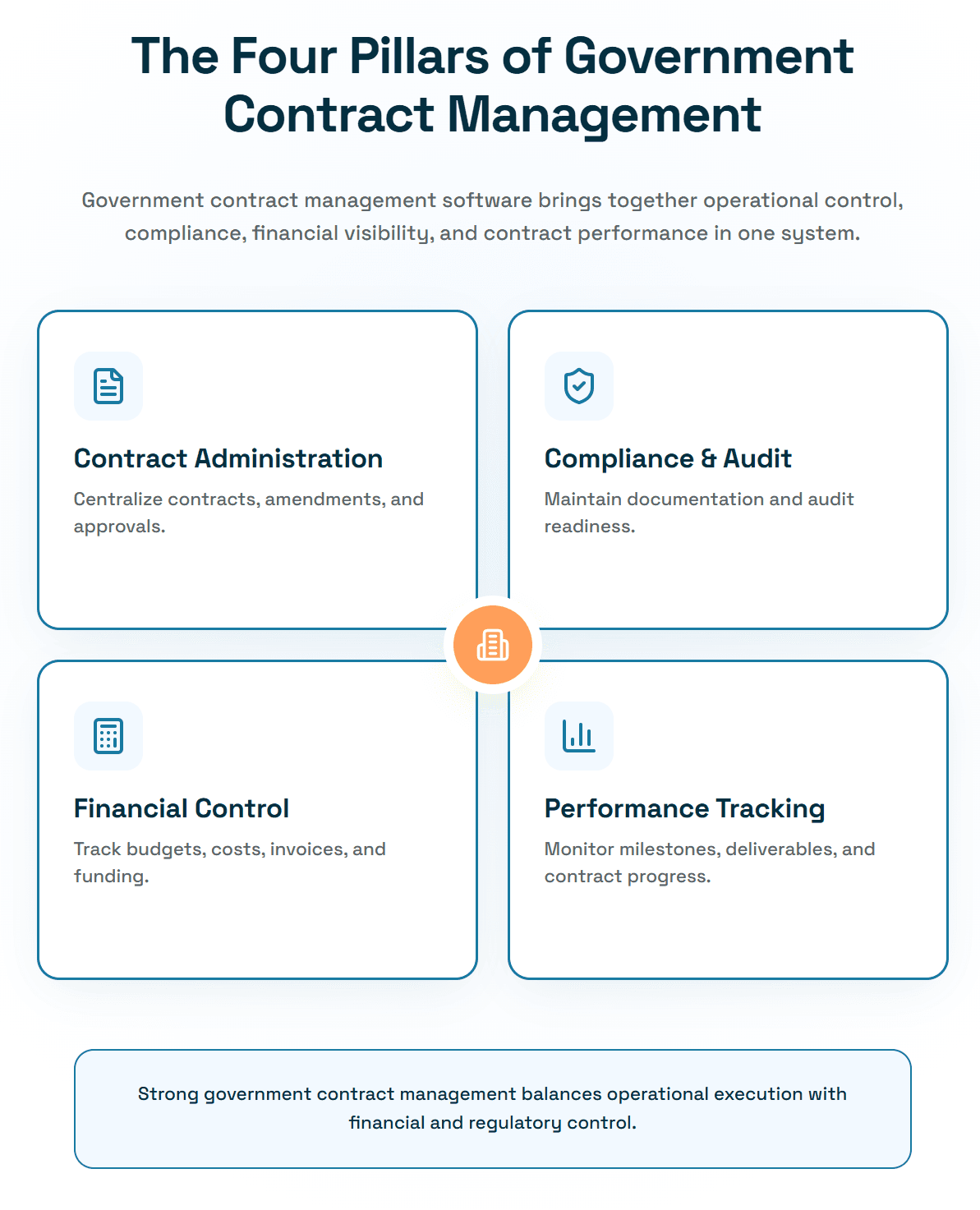
Once a contract is awarded, the operational risk shifts from "will we win this" to "will we execute this without a compliance or funding failure." Government contract tracking software exists to keep that risk visible. At minimum, it should track:
Obligations: what the government has legally committed to pay
Funding: incrementally funded contracts often start with only partial obligated value; tracking the gap between funded and total contract value prevents accidental overbilling
Modifications: changes to scope, price, or period of performance, each of which needs its own audit trail
Ceilings: the not-to-exceed value the contractor cannot bill past without contracting officer approval
CLINs (Contract Line Item Numbers): the sub-units of a contract that are often billed, funded, and reported separately
Task orders: individual orders issued under an IDIQ or GWAC vehicle, each with its own funding and deliverables
Invoicing: matched to contract terms, CLIN structure, and funding availability
Deliverables: technical and administrative deliverables tied to contract milestones
Renewals and option periods: tracked well ahead of expiration to avoid a lapse in coverage
Audit readiness: documentation trails sufficient to survive a DCAA or Inspector General review
Before any of this tracking begins, a contract has to be won which is where government contract bids software comes in. Bid and proposal platforms handle opportunity identification, capture planning, and proposal pricing; they hand off to contract tracking systems the moment an award is made. The two categories rarely overlap, and organizations shouldn't expect one to substitute for the other.
The Financial Side of Government Contract Management
Here's the gap that's easy to miss when evaluating government contract management solutions: most CLM platforms are built to manage documents, not dollars. They're excellent at storing the signed contract, logging every modification, and reminding someone that an option period is coming up. What they typically don't do well is the day-to-day financial discipline that keeps a government contract profitable and compliant.
That work still falls to the finance team, and it includes:
Billing against the correct CLIN, at the correct rate, within the correct period of performance
Invoice validation: confirming that what's being billed actually matches what the contract authorizes
PO matching: reconciling purchase orders against contract terms and vendor invoices
Funding availability checks: verifying that a task order or CLIN has enough obligated funding before work proceeds or an invoice goes out
Contract ceiling tracking: catching a potential overrun before it becomes an unauthorized commitment
Indirect rate application: applying provisional, and later final, indirect rates correctly across cost-type contracts
Modification tracking on the financial side: making sure a scope or price modification is reflected in billing before the next invoice goes out
Revenue accuracy: recognizing revenue in a way that ties back to actual contract performance, not just cash received
This is the layer where Hyperbots fits into the government contracting technology stack, not as a replacement for a CLM system, but as the finance automation layer sitting underneath it. Hyperbots' AI co-pilots for invoice processing and procurement are built to handle exactly the kind of structured matching that government billing requires: validating invoices and purchase orders against contract terms, applying 3-way matching logic between invoice, PO, and receipt, and routing exceptions before they become compliance issues rather than after.
For contractors managing multiple contract vehicles with different CLIN structures, this kind of automation reduces the manual reconciliation work that otherwise falls on a controller at month-end, checking that every invoice line maps to an authorized CLIN, that funding hasn't been exceeded, and that GL coding is consistent across contracts. Hyperbots' procurement co-pilot also applies budget and policy validation before a purchase order is issued, which matters in a contracting environment where an unauthorized commitment against a fixed-ceiling contract is a real compliance risk, not just a bookkeeping error.
The goal here isn't to replace document-centric CLM tools or proposal software, it's to close the gap between "the contract says X" and "the invoice, PO, and GL entry actually reflect X." That gap is where audit findings, unbilled revenue, and margin leakage tend to live on government contracts. For contractors who also sell goods across state lines, sales tax verification adds another layer of compliance automation, since multi-state government work often means navigating inconsistent state and local tax treatment on the same contract.
Comparison: CLM, ERP, Proposal Software, and Financial Automation
Category | Strengths | Limitations | Best Fit |
CLM platforms | Strong document control, modification history, clause libraries, renewal alerts | Limited real-time connection to billing, funding, and GL data | Organizations needing a system of record for contract documents and obligations |
ERP systems | General ledger, project accounting, payroll, core financial reporting | Government-specific logic (CLIN billing, ceiling tracking) often needs custom configuration or add-ons | Organizations that need a financial backbone across the whole business, not just government contracts |
Proposal & capture software | Opportunity pipeline, proposal drafting, pricing volumes | Ends at award; no post-award administration | Business development and capture teams pursuing new work |
Financial automation (AP/procurement/AR co-pilots) | Invoice/PO matching against contract terms, funding checks, GL coding accuracy, audit trails | Doesn't replace document-centric CLM or proposal tools | Finance teams that need contract-to-cash accuracy layered on top of existing CLM/ERP systems |
No category here is inherently better than another, they solve different problems. The organizations with the fewest audit findings and the cleanest revenue recognition are usually the ones that treat these as complementary layers rather than trying to force one platform to do all four jobs.
Automate the Financial Side of Your Government Contracts
CLM and ERP systems can tell you what a contract says. They're less reliable at telling you, in real time, whether your last invoice matched the CLIN it was billed against, or whether a purchase order pushed you past a funding ceiling. That's the layer Hyperbots was built for – AI co-pilots that sit on top of your existing ERP and contract systems to automate invoice and PO matching, funding checks, and GL coding accuracy for contract-to-cash workflows. If your team is still reconciling contract terms against invoices by hand, see how Hyperbots' finance automation co-pilots fit into a GovCon technology stack.
Frequently Asked Questions
Q1. What is government contract management software?
Government contract management software is a category of tools used to track a public-sector contract from award through closeout, covering obligations, modifications, deliverables, and compliance documentation. It differs from commercial contract management because it has to account for regulatory frameworks like the FAR and DFARS, funding ceilings, and public reporting requirements that don't apply to private contracts.
Q2. What's the difference between government contracting software and general contract management software?
General contract management software focuses on negotiation, e-signature, and clause storage for commercial agreements. Government contracting software adds regulatory-specific tracking such as contract type (fixed-price vs. cost-reimbursement), CLIN-level funding, incremental obligations, and compliance reporting to systems like SAM.gov that commercial CLM tools typically don't need to handle.
Q3. Is there a single software that manages the entire government contract lifecycle?
No single platform reliably covers proposal, contract administration, and financial execution end to end. Most GovCon organizations run a CLM or ERP system as the system of record for the contract itself, paired with dedicated proposal software pre-award and financial automation tools post-award to manage billing, funding checks, and invoice accuracy.
Q4. What is federal contract management software, specifically?
Federal contract management software is built around FAR and DFARS compliance, tracking contract type, incremental funding, CLIN structures, and reporting obligations to systems like SAM.gov and FPDS. It often needs to support DCAA-compliant cost accounting for organizations holding cost-reimbursement contracts.
Q5. How is contract management software for local government different from federal tools?
Local government contract management centers on state and municipal procurement codes rather than the FAR. Thresholds for competitive bidding are typically lower and set by state statute, cost-reimbursement contract types are far less common, and compliance concerns shift toward public records law, prevailing wage rules, and local vendor preferences rather than DCAA audits or CMMC certification.
Q6. What is government contract tracking software used for?
It's used to monitor obligations, funding ceilings, CLINs, task orders, modifications, deliverables, and renewal dates throughout contract execution, giving contracts and finance teams visibility into risk areas like an approaching ceiling breach or an expiring option period before they become a problem.
Q7. Do I need separate software for government contract bids versus contract management?
Generally, yes. Bid and proposal software (sometimes called "government contract bids software") manages the pre-award capture and pricing process, while contract management and tracking tools take over once an award is made. The two rarely live on the same platform, since the workflows and users are largely different.
Q8. Why do finance teams still struggle with government contracts even after buying a CLM system?
Because most CLM systems manage documents and dates, not financial transactions. Billing accuracy, PO-to-contract matching, funding availability checks, and indirect rate application are finance-specific workflows that a document-centric CLM platform typically wasn't built to handle, which is why many organizations add a dedicated finance automation layer on top.
Q9. What should I look for in contract management software for government contractors?
Look for CLIN-level tracking, configurable rules for both fixed-price and cost-reimbursement contract types, funding and ceiling visibility, audit-ready documentation, and critically, a clear connection (via integration or a dedicated automation layer) between the contract terms and your actual billing, PO matching, and GL coding process.
Q10. How is CMMC affecting government contract management for defense contractors?
CMMC 2.0 became enforceable in DoD contracts starting November 10, 2025, with Level 2 third-party certification requirements phasing in through November 2026. Defense contractors handling controlled unclassified information increasingly need to track their CMMC status and NIST SP 800-171 control posture alongside standard contract administration, adding another compliance layer that contract management systems need to account for.
