CRM for Government Contractors: The 2026 Comparison Guide
Compare the top CRM platforms for government contractors.

What Is a CRM for Government Contractors?
A CRM for government contractors is a system of record for the business development lifecycle that precedes a federal award: identifying opportunities, qualifying them, managing the capture process, coordinating proposal development, and tracking relationships with government agencies, prime contractors, and teaming partners. Unlike a commercial CRM, which is optimized around leads, deals, and a sales funnel measured in weeks, a GovCon CRM is built around opportunities that can sit in a pipeline for years and involve dozens of internal and external stakeholders before a proposal is even submitted.
The core purpose is to give business development and capture teams a single, accurate picture of the federal pipeline so that a limited bid-and-proposal budget gets spent on opportunities the company can actually win.
Core capabilities of a GovCon CRM
Capability | What it does | Why it matters for GovCon |
Capture management | Structures the pre-RFP pursuit process with Go/No-Go gates, PWIN scoring, and capture plans | Determines competitive positioning long before a solicitation drops |
Opportunity/pipeline tracking | Tracks each pursuit through custom stages tied to procurement milestones | Federal sales cycles run 12+ months and need long-horizon visibility |
Business development | Manages agency relationships, contacts, and call plans | Federal buying decisions are relationship- and trust-driven |
Proposal collaboration | Coordinates color-team reviews, compliance matrices, and content reuse | Late or non-compliant proposals are automatically disqualified |
Teaming partner management | Tracks subcontractors, JV partners, and their certifications | Many awards require formal teaming and small-business participation |
Federal agency relationship management | Maintains contact history across contracting officers and program offices | Agency staff turnover requires institutional memory the CRM must preserve |
Compliance and audit support | Tracks SAM.gov registration, OCI reviews, and documentation history | Non-compliance can disqualify a bid or trigger audit findings |
Market intelligence integration | Pulls solicitation and forecast data from SAM.gov, GovWin IQ, or GovTribe | Early opportunity identification is a major driver of win rate |
Best CRMs for Government Contractors Compared
The market includes purpose-built GovCon platforms, GovCon-specific overlays on commercial CRMs, and newer AI-native capture-to-proposal tools. Five platforms come up most often in contractor evaluations: Unanet CRM, Salesforce Government Cloud, GovDash, Creatio, and TechnoMile.
Platform | Best for | Proposal management | Capture management | ERP integration | Compliance support | Implementation complexity | Ideal company size |
Unanet CRM | Firms wanting CRM tightly linked to project-based ERP | Proposal auto-generation using resumes, past performance, and templates | Configurable Go/No-Go gates modeled on the Shipley Method | Native, single-database integration with Unanet ERP | Built-in DCAA-oriented controls when paired with Unanet ERP | Moderate | Small to mid-market |
Salesforce Government Cloud | Large or defense-focused contractors needing the highest security tier | Available via AppExchange add-ons (e.g., TechnoMile) rather than natively | Configurable via custom objects and flows, or GovCon overlays | Broad, but usually via middleware or custom integration | FedRAMP High, DoD IL4/IL5, and CMMC Level 2/3 alignment on Government Cloud Plus | High | Mid-market to large enterprise |
GovDash | Firms wanting capture, proposal drafting, and contract tracking in one AI-native system | Native AI-assisted drafting, automated compliance matrix generation from RFP shredding | Structured capture pipeline with gate reviews feeding directly into proposal workflows | Via SharePoint sync and Word/Excel integration rather than deep ERP connectors | Built for FAR/DFARS-aware workflows; hosted on GovCloud infrastructure | Moderate | Small to mid-market, high-bid-volume teams |
Creatio | Contractors wanting a highly configurable, no-code CRM they can adapt themselves | Configurable via no-code workflow builder; not GovCon-specific out of the box | Must be custom-configured; not pre-built for Shipley-style gates | Open API-based integration; requires configuration work | General enterprise security controls; not GovCon-specific by default | Moderate to high (configuration-driven) | Mid-market to enterprise, especially those already using Creatio elsewhere |
TechnoMile | Contractors wanting deep GovCon-specific BD, capture, and contract lifecycle tooling on Salesforce | Strong proposal and B&P budget tracking, plus a companion CLM suite | Purpose-built capture workflows, including OCI and TINA sweep tracking | Built on Salesforce; integrates with ERP systems including Deltek | Strong; explicitly built around FAR/DFARS-driven pre- and post-award compliance | High (Salesforce-based implementation) | Mid-market to large enterprise, including aerospace & defense |
Unanet CRM
Overview: Unanet CRM grew out of its 2021 acquisition of Cosential and is sold as a purpose-built companion to Unanet's project-based ERP. It's aimed squarely at GovCon and architecture/engineering/construction firms that want business development data to flow directly into project accounting once an opportunity converts to an award.
Strengths: Unanet CRM supports configurable Go/No-Go forms and PWIN scoring modeled on methodologies such as Shipley, plus drag-and-drop pipeline dashboards and auto-generated proposals that pull in resumes, winning content from previous bids, and past estimates. Because CRM and ERP share a data model, capture teams and project accountants work from the same opportunity, contract, and contact records rather than reconciling two systems.
Weaknesses: The tight ERP coupling is also a limitation for firms that don't run Unanet ERP as the CRM's biggest advantages diminish outside that ecosystem. According to industry benchmarking, a large share of GovCon firms still track pipelines in Excel or use no CRM at all, reflecting how much adoption friction remains in this category even with purpose-built tools.
Best fit: Small to mid-market GovCon and AEC firms already using, or planning to adopt, Unanet ERP for project accounting and DCAA-compliant timekeeping.
When it may not be the right choice: Enterprise contractors already standardized on Salesforce, or firms that need FedRAMP High-level security certifications for CRM data, may find Unanet's compliance posture less rigorous than Salesforce Government Cloud's.
Salesforce Government Cloud
Overview: Salesforce Government Cloud is a dedicated, security-hardened deployment of the Salesforce platform built for U.S. public sector organizations and their contractors. It is not a GovCon-specific CRM on its own, it's the compliant infrastructure layer that GovCon-focused apps (including TechnoMile's Growth Suite) are frequently built on top of.
Strengths: Government Cloud Plus is designed to help organizations meet authorizations such as IRS 1075, FedRAMP High, DoD Impact Levels, and Top Secret, and runs on AWS GovCloud (US), the FedRAMP-authorized cloud built to adhere to the government's most stringent security and compliance requirements. For contractors managing Controlled Unclassified Information (CUI) or working toward CMMC Level 2/3 certification, this is the highest compliance ceiling among mainstream CRM platforms. It also supports pre-built solutions, point-and-click app-building tools, and a regular cadence of platform innovation.
Weaknesses: Out of the box, Salesforce Government Cloud is a general-purpose CRM platform, not a GovCon capture tool, federal-specific workflows like Shipley-style gate reviews or compliance matrices require add-on apps (such as TechnoMile) or custom development. Compliance overhead and configuration complexity typically translate into a longer, costlier implementation than purpose-built alternatives, and government and defense contractor pricing often runs 15-30% higher than commercial equivalents once compliance-related overhead is included.
Best fit: Large or defense-focused contractors that need the highest available FedRAMP/DoD compliance tier and have the budget and internal Salesforce expertise to configure GovCon-specific workflows on top of the platform.
When it may not be the right choice: Small businesses without dedicated Salesforce administrators, or firms that want GovCon capture workflows available immediately without custom configuration.
GovDash
Overview: GovDash is a newer, AI-native platform that positions itself as a unified system spanning business development, capture, proposal writing, pricing, and post-award contract management, built specifically to replace the fragmented stack of spreadsheets, SharePoint, and point tools many GovCon teams currently use.
Strengths: GovDash's proposal engine is built to parse solicitations and generate compliance matrices automatically; its shredding engine is described as parsing over 95% of solicitation content to build compliance matrices and annotated outlines, identifying requirements hidden outside Sections L and M. It also links past-performance and delivery data back into the capture process, so CPARS management organizes documentation to support strong performance evaluations while past performance data feeds directly into the capture workflow to validate future bid decisions. This closes a loop that many CRM-only or proposal-only tools leave open.
Weaknesses: As a comparatively young platform, GovDash has a narrower integration footprint than Salesforce or Unanet, and it isn't built as a general-purpose ERP-integrated CRM, reviewers note that teams with existing SharePoint workflows may find the platform works best when content is migrated into GovDash's own library rather than natively syncing with existing document structures. It also doesn't offer native project accounting or DCAA-compliant timekeeping, so it needs to sit alongside an ERP rather than replace one.
Best fit: Mid-market and high-bid-volume contractors that want a modern, AI-assisted capture-to-proposal workflow and are willing to consolidate proposal content into a new system of record.
When it may not be the right choice: Contractors that need deep, native ERP/accounting integration in the same platform, or organizations with heavy existing investment in SharePoint-based proposal libraries that don't want to migrate content.
Creatio
Overview: Creatio is a no-code CRM and business process automation platform used broadly across industries, including a public-sector product line. It is not GovCon-specific in the way Unanet, GovDash, or TechnoMile are, but its configurability lets contractors build federal-specific workflows without custom development.
Strengths: Creatio's no-code workflow designer means capture teams can configure opportunity stages, approval gates, and compliance tracking without engineering resources, and pricing starts at $40 per user per month with no additional fees for its built-in AI capabilities, a materially lower entry point than enterprise Salesforce or TechnoMile deployments. Creatio also notes that CRM software for government contractors can automatically track contract expiration dates and upcoming procurement opportunities to help business development teams align outreach in advance, a capability contractors can build on Creatio's workflow engine.
Weaknesses: Because it isn't purpose-built for GovCon, contractors have to invest configuration time to replicate Shipley-style capture gates, compliance matrices, and federal market-intelligence integrations that come pre-built in Unanet, GovDash, or TechnoMile. There's also no out-of-the-box connector to SAM.gov or GovWin IQ comparable to TechnoMile's native integrations.
Best fit: Mid-market contractors that want a lower-cost, highly configurable CRM and have (or are willing to build) the internal capacity to tailor it to federal capture workflows.
When it may not be the right choice: Firms that want GovCon-specific capture and compliance functionality available on day one without a configuration project.
TechnoMile
Overview: TechnoMile is a GovCon- and aerospace/defense-focused CRM and contract lifecycle management suite built on the Salesforce platform. Its Growth CRM product is explicitly designed around the federal business development lifecycle, and the company also offers a companion Contracts Suite for post-award contract lifecycle management.
Strengths: TechnoMile is one of the few platforms built specifically to track pre-award compliance activities alongside the pipeline: it helps contractors maintain a secure and compliant environment for storing and managing sensitive government contracting data, and manage and document pre-award compliance processes such as Organizational Conflict of Interest (OCI) and Truth in Negotiations Act (TINA) sweeps. Because it's Salesforce-native, it inherits Salesforce's security and compliance posture while adding GovCon-specific data models. It also integrates a SAM.gov connector that lets teams search solicitations and pull details and documents directly onto opportunity records without manual data entry, plus contact intelligence from its GovSearch database.
Weaknesses: As a Salesforce-based product, TechnoMile inherits Salesforce implementation complexity and licensing costs, and B&P cost tracking that integrates with ERP systems requires additional configuration. It is also a narrower, GovCon-only vendor compared to Salesforce or Creatio's broader platform ecosystems.
Best fit: Mid-market to large GovCon, aerospace, and defense contractors that want purpose-built pre-award compliance tracking (OCI, TINA) alongside capture and proposal management, particularly those already using or open to Salesforce infrastructure.
When it may not be the right choice: Very small contractors without the budget for a Salesforce-based implementation, or firms that want capture, proposal, and contract management fully unified in a single non-Salesforce system.
CRM vs. ERP vs. Finance Automation
Contractors frequently conflate CRM and ERP, or assume one platform should handle everything from lead tracking to bank reconciliation. In practice, each system solves a different problem, and understanding the boundary matters when architecting a GovCon technology stack.
System | Core question it answers | Primary users | Typical data owned |
CRM | Which opportunities should we pursue, and how do we win them? | Business development, capture, proposal teams | Opportunities, contacts, capture plans, proposal content |
ERP | How do we deliver the contract compliantly and account for the cost? | Program managers, project accountants, contracts | Projects, timekeeping, indirect rates, billing, budgets |
Finance automation | How do we process the transactions the awarded contract generates fast and accurately? | AP, AR, procurement, controllers | Vendor invoices, purchase orders, cash application, reconciliations |
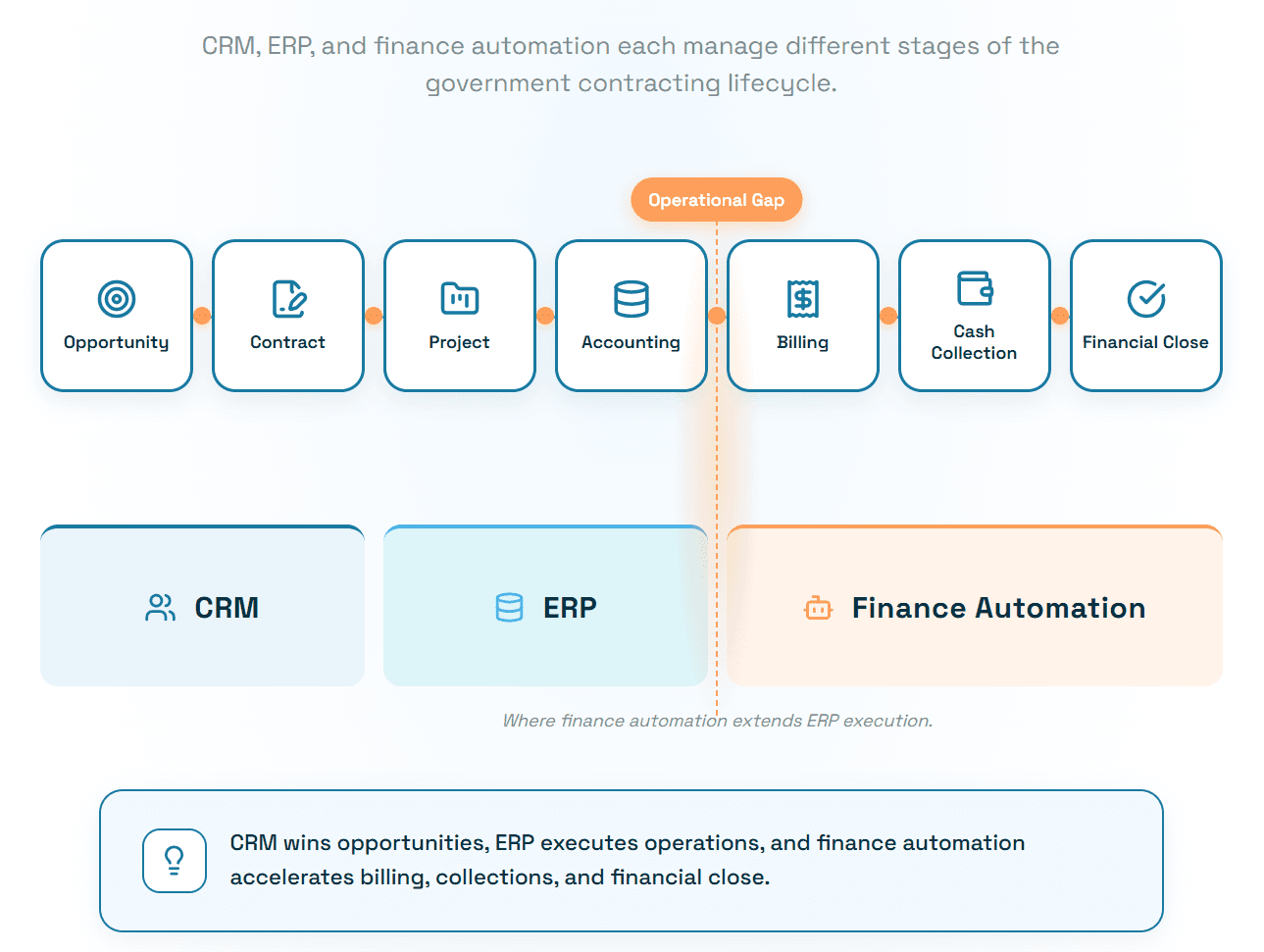
Work on a government contract flows in a predictable sequence:
Opportunity → Contract → Project → Accounting → Billing → Cash Collection → Financial Close
CRM owns the far left of that chain which is everything before award. ERP owns project setup, cost accounting, and DCAA-compliant timekeeping once the contract is signed. But between "the contract is signed" and "the books are closed," a large volume of transactional finance work has to happen: vendor invoices need to be captured and matched against purchase orders, accruals need to be booked at period end, payments need to be issued and reconciled, and for contractors managing multiple state and local subcontracts, sales and use tax needs to be verified line by line. Most ERPs handle the accounting structure for this work but still rely heavily on manual effort to execute it, which is where finance automation platforms come in.
Closing the Capture-to-Cash Gap with AI
Winning the contract is the CRM's job. Getting paid accurately and on time and paying vendors, subcontractors, and suppliers correctly along the way is a finance operations problem that starts the moment the award is signed and continues for the life of the contract.
For government contractors, that work carries extra weight because of DCAA scrutiny. Every invoice, GL code, and accrual has to be defensible in an audit. Manual AP processing under those conditions is slow and error-prone: invoices arrive in inconsistent formats, purchase order matching has to account for cost-reimbursable and T&M contract structures that don't fit standard 3-way matching logic, and month-end accruals for unbilled subcontractor costs are often built in spreadsheets that don't leave a clean audit trail.
Typical friction points in the post-award finance function include:
Vendor invoice processing: extracting and validating invoice data across inconsistent formats and matching it against purchase orders and contract terms
Accounts payable (AP): routing approvals, applying GL codes correctly across multiple contracts and cost centers, and avoiding duplicate or unauthorized payments
Cash application: matching incoming government and prime-contractor payments to open invoices, especially where remittance data is incomplete
Collections: following up on aging receivables from government and commercial customers without damaging the relationship
Reconciliations: tying out bank statements, subledgers, and accruals against the ERP of record
Financial close: closing the books on time each period despite the volume and complexity of contract-level accounting
This is where AI-powered finance automation platforms complement rather than compete with the CRM and ERP layer. Hyperbots is one such platform: it is not a CRM and does not manage capture, proposals, or agency relationships. Instead, it deploys AI co-pilots that sit downstream of the CRM and alongside the ERP to automate the transactional finance work such as invoice processing, accounts payable, procurement, accruals, payments, sales tax verification, vendor management, collections, and cash application that begins once a pursuit becomes a signed contract. For contractors running Deltek Costpoint, SAP, NetSuite, Microsoft Dynamics, or other GovCon-common ERPs, this kind of automation layer can reduce the manual effort and audit risk that builds up as contract volume grows without requiring a change to the CRM or ERP the BD and program teams already rely on.
Connect Your CRM and ERP with AI Finance Automation
If your CRM and ERP are already doing their jobs, tracking opportunities and managing project accounting, the next question is what's happening to the finance work in between. For GovCon finance teams evaluating how to reduce manual AP effort, tighten DCAA audit readiness, and close the books faster without adding headcount, it's worth understanding how AI co-pilots for invoice processing, accruals, and payments fit alongside your existing systems. Explore Hyperbots' AP automation for government contractors or see how Hyperbots integrates with Deltek Costpoint.
Frequently Asked Questions
Q1. What is the best CRM for government contractors?
There's no single best CRM for every contractor as the right choice depends on company size, existing ERP, and compliance requirements. Unanet CRM suits firms wanting tight integration with project-based ERP; Salesforce Government Cloud suits large or defense contractors needing the highest FedRAMP/DoD compliance tier; GovDash suits high-bid-volume teams wanting AI-assisted capture-to-proposal workflows; Creatio suits contractors wanting a lower-cost, configurable no-code CRM; and TechnoMile suits mid-market to enterprise GovCon and aerospace/defense firms wanting purpose-built pre-award compliance tracking on Salesforce.
Q2. Does Salesforce work for GovCon?
Yes, but typically not out of the box. Salesforce Government Cloud provides the compliance infrastructure, FedRAMP High, DoD Impact Levels, and CMMC alignment, that federal work requires, but GovCon-specific capture workflows, compliance matrices, and OCI/TINA tracking usually come from an add-on like TechnoMile's Growth Suite built on top of the platform.
Q3. What CRM integrates with Deltek Costpoint?
Deltek offers its own CRM and proposal management products (including Vantagepoint CRM) designed to integrate natively with Costpoint. Third-party CRMs, including TechnoMile and Salesforce-based tools, also integrate with Costpoint via API or middleware, and downstream finance automation platforms such as Hyperbots connect directly to Costpoint to automate the AP, procurement, and accruals work that follows contract award.
Q4. CRM vs. ERP for contractors, what's the difference?
A CRM manages the pre-award business development lifecycle: opportunities, capture plans, proposals, and agency relationships. An ERP manages post-award execution: project accounting, DCAA-compliant timekeeping, indirect rate management, and billing. They serve different teams and different stages of the contract lifecycle, and most GovCon technology stacks require both.
Q5. What is capture management?
Capture management is the structured pre-proposal process of identifying, qualifying, and positioning for a government contract opportunity before an RFP is released, including competitive analysis, teaming decisions, and Go/No-Go gate reviews. A well-run capture process determines competitive position well before a proposal is written.
Q6. Does Hyperbots replace CRM software?
No. Hyperbots is an AI-powered finance automation platform, not a CRM. It does not manage opportunities, capture processes, or proposals. It complements existing CRM and ERP systems by automating the finance work that begins after a contract is won, including invoice processing, accounts payable, accruals, payments, sales tax verification, vendor management, and collections.
Q7. How long does it take to implement a GovCon CRM?
Implementation timelines vary widely by platform and scope. Purpose-built GovCon CRMs like Unanet or GovDash can often reach productive use within weeks for core capture workflows, while Salesforce-based deployments (including Salesforce Government Cloud and TechnoMile) typically require a longer configuration and compliance-validation process, especially when FedRAMP High or CMMC alignment is required.
Q8. Do small businesses need a specialized GovCon CRM, or can they use a generic CRM?
Small contractors pursuing a handful of opportunities a year sometimes start with spreadsheets or a generic CRM like HubSpot. As pipeline volume and compliance requirements grow, particularly once a company is tracking multiple set-aside certifications, teaming partners, or contract vehicles, a purpose-built GovCon CRM typically pays for itself in reduced administrative overhead and improved win-rate tracking.
Q9. What role does AI play in GovCon CRM and capture management?
AI is increasingly used for opportunity scoring, automated RFP parsing and compliance matrix generation, and drafting proposal content grounded in a contractor's past performance data. Platforms like GovDash and TechnoMile have built AI directly into capture and proposal workflows, while AI finance automation platforms like Hyperbots apply similar techniques to the post-award transactional finance work.
Q10. Can I use both a CRM and an ERP's built-in CRM module?
Many contractors do, especially during a transition. However, running a business development CRM and an ERP's native CRM module in parallel typically creates duplicate data entry and reconciliation overhead. Most contractors standardize on a single CRM system of record either a purpose-built GovCon CRM tightly integrated with their ERP (like Unanet) or a separate CRM that syncs with ERP data via API.