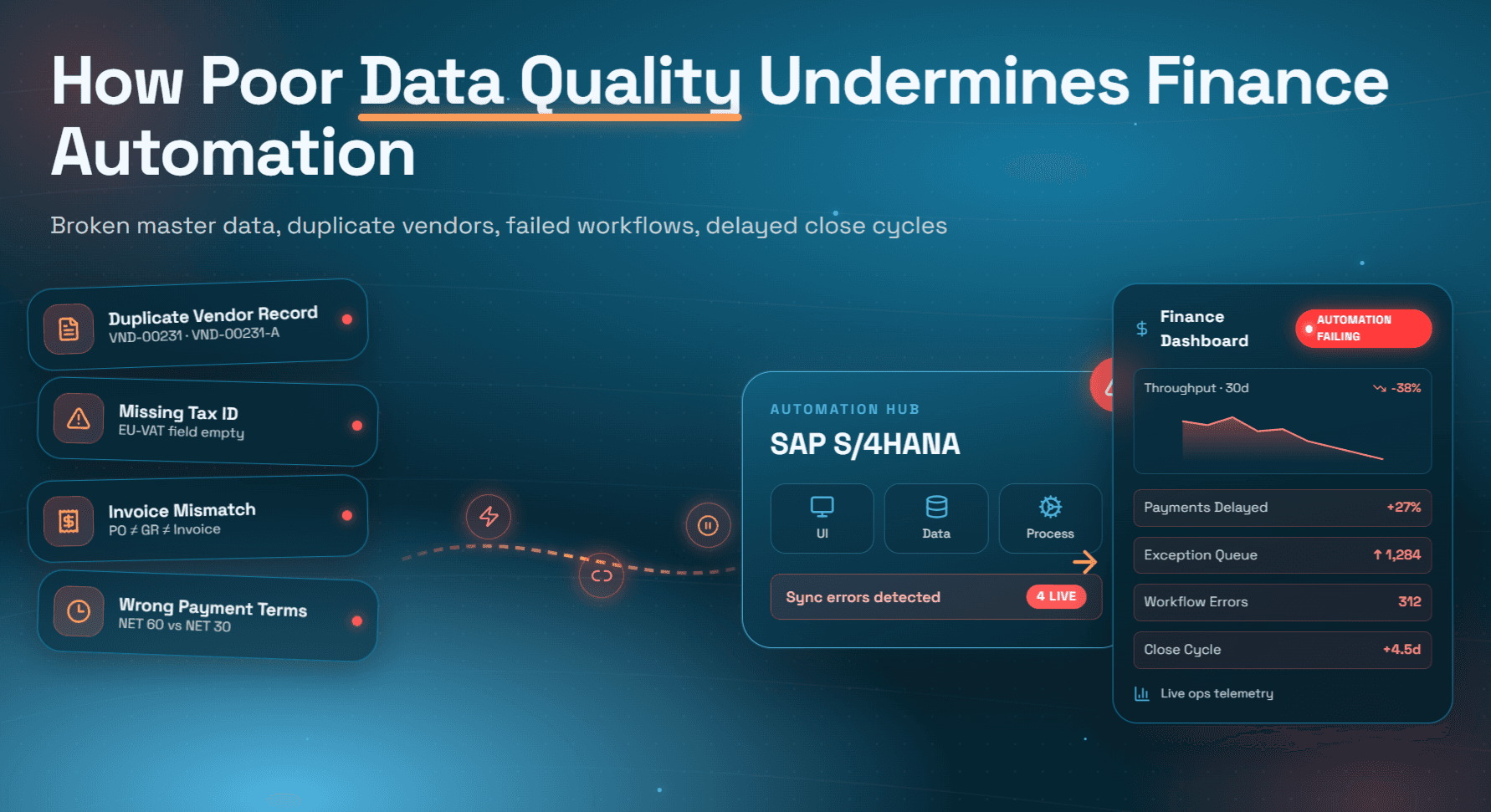
How Poor Data Quality Undermines Finance Automation on SAP S/4HANA
Learn how poor data quality disrupts finance automation on SAP S/4HANA and why clean master data is critical for efficiency, accuracy, and ROI.
Why Data Quality Is the Foundation of SAP S/4HANA Automation
SAP S/4HANA is among the most powerful enterprise resource planning platforms available, built for real-time analytics, intelligent automation, and universal journal-based accounting. But all of this capability rests on one critical assumption: that the data flowing into it is clean, consistent, and complete.
When that assumption fails, the consequences are neither minor nor isolated. A single vendor record with a mismatched tax ID ripples into failed 3-way matches, blocked invoices, inaccurate GL postings, and ultimately, unreliable financial statements. Data accuracy is not a backend concern for IT teams, it is the operational backbone of every finance process SAP S/4HANA is designed to automate.
According to Gartner, poor data quality costs organizations an average of $12.9 million annually. In SAP environments, where Accounts Payable, Procurement, Treasury, and the Universal Journal are tightly interconnected, the operational impact of poor data quality can be magnified. A missing PO field can cascade into blocked payments, missed discounts, and audit exceptions.
This blog examines the specific ways in which poor data quality undermines finance automation on SAP S/4HANA, focusing on three dimensions where failure is most costly: posting errors, reconciliation issues, and degraded data accuracy across the procure-to-pay and order-to-cash cycles.
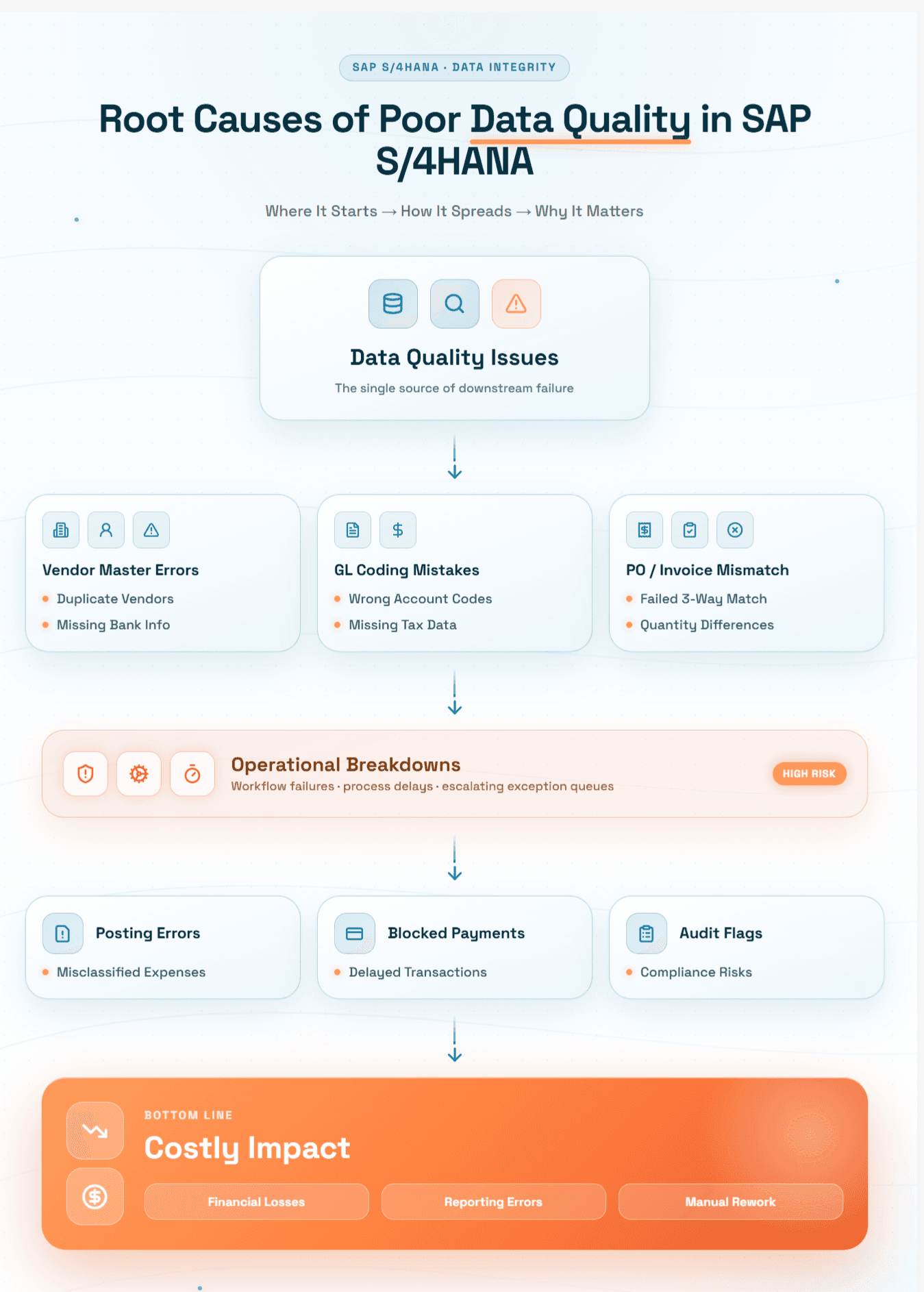
Root Causes of Poor Data Quality in SAP S/4HANA
Before addressing the downstream symptoms, it is essential to understand where data quality problems originate. In most SAP S/4HANA environments, failures trace back to a small set of chronic, structural issues.
Root Cause | Where It Originates | Downstream Impact | Severity |
Duplicate vendor records | Vendor master / migration | Duplicate payments, audit flags | Critical |
Incorrect GL account codes | Manual invoice coding | Posting errors, misclassified expenses | Critical |
Missing or incorrect tax data | Invoice entry / vendor setup | Sales tax errors, compliance risk | Critical |
Inconsistent payment terms | Vendor master / PO creation | Missed discounts, reconciliation issues | High |
Unmatched PO/GR/Invoice data | Procurement / receiving | Blocked invoices, 3-way match failure | Critical |
Incomplete vendor bank details | Vendor onboarding | Failed payments, vendor disputes | High |
Legacy data migration errors | S/4HANA go-live migration | Corrupted opening balances, accrual errors | Critical |
Unstructured invoice formats | Supplier invoices (email/PDF) | Extraction errors, manual rework | High |
Each of these root causes is addressable but most organizations address them reactively, after the damage to reporting, compliance, and cash flow is already done. The more effective approach requires understanding how these issues manifest as specific failure modes inside SAP S/4HANA's automation engine.
Understanding the structure of GL coding in SAP and how Chart of Accounts misalignment compounds data quality failures is an important first step for any finance leader undertaking S/4HANA automation.
How Posting Errors Cascade Through Finance Workflows
Posting errors in SAP S/4HANA are not simply inconvenient, they are systemic risk events. Because S/4HANA uses the Universal Journal (table ACDOCA) as a single source of truth for all financial postings, an incorrect entry in one module propagates immediately into every downstream report, balance, and reconciliation run that depends on it.
The Anatomy of a Posting Error in SAP
A posting error typically begins with an upstream data quality failure, an invoice coded to the wrong cost center, a PO referencing an outdated material number, or a tax line miscalculated due to an incorrect jurisdiction in the vendor master. When SAP attempts to process these transactions automatically, it either blocks them for manual review or, more dangerously, posts them incorrectly without triggering an exception.
The second scenario, a silent posting error, is the most damaging. Finance teams discover these errors only during period-end close, when reconciliation reveals that trial balances do not tie, intercompany accounts are out of sync, or accrued expenses are booked against the wrong entity.
Common Posting Error Scenarios
Error Type | Trigger Condition | SAP Module Affected | Recovery Cost (avg.) |
Wrong GL account posting | Incorrect manual coding on invoice | FI-AP, Controlling | 2–4 hrs per correction |
Duplicate invoice posting | No duplicate check on vendor/amount | FI-AP | Payment recovery + audit |
Tax code mismatch | Incorrect vendor tax classification | FI-AP, Tax | Compliance penalty risk |
Currency conversion error | Stale exchange rate in vendor record | FI-AP, Treasury | FX exposure, restatement |
Cost center mis-allocation | Outdated cost center hierarchy | CO, FI | Manual reallocation + re-close |
Accrual reversal failure | Accrual not linked to original entry | FI-GL | Overstated liabilities |
Understanding debit and credit posting conventions in SAP S/4HANA versus other ERPs is critical when designing data validation rules for cross-system environments. Differences in how SAP handles journal entries compared to platforms like NetSuite or QuickBooks mean that migrated data is especially prone to posting errors if mappings are not validated at the field level.
The downstream impact of GL coding errors on financial reporting and audits is well-documented: misclassified expenses inflate certain line items, distort cost center reporting, and create discrepancies that external auditors flag as material weaknesses. For public companies, this creates Sarbanes-Oxley risk. For all organizations, it creates a credibility gap in management reporting.
Reconciliation Issues: The Silent Month-End Crisis
If posting errors are the acute disease, reconciliation issues are its chronic, debilitating symptom. Month-end close on SAP S/4HANA can take anywhere from 5 to 15 business days in organizations with significant data quality problems, a timeline that renders financial statements outdated the moment they are produced.
Why Reconciliation Breaks Down
Reconciliation in SAP S/4HANA requires that data across multiple sub-ledgers like Accounts Payable, Accounts Receivable, Fixed Assets, Inventory, ties perfectly to the General Ledger. When vendor master data is inconsistent, when invoices are posted to wrong accounts, or when accruals are not properly reversed, these sub-ledger-to-GL reconciliations break down, requiring manual investigation and correction before books can be closed.
The most common reconciliation failures in SAP environments include AP-to-GL mismatches caused by incomplete period-end postings, intercompany account imbalances arising from timing differences or data entry errors, bank statement line items that cannot be matched to cleared payments, and accrued liabilities that were not reversed in the correct period.
Reconciliation Type | Common Break Reason | Average Resolution Time | Risk if Unresolved |
AP sub-ledger to GL | Unposted invoices, wrong period | 4–8 hours | Understated liabilities |
Bank statement reconciliation | Unmatched cleared items, stale data | 2–6 hours | Cash position errors |
Intercompany balancing | Timing differences, FX rate mismatch | 1–3 days | Consolidated P&L distortion |
Accruals reconciliation | Missing reversals, wrong GL codes | 3–6 hours | Overstated period expenses |
AR to GL | Unapplied cash, credit note timing | 2–5 hours | Overstated receivables |
Inventory to COGS | GR/IR account anomalies | 4–10 hours | Margin misstatement |
The GR/IR (Goods Receipt / Invoice Receipt) clearing account is one of the most frequently cited sources of reconciliation issues in SAP S/4HANA. When purchase orders, goods receipts, and vendor invoices do not match in quantity, price, or timing, the GR/IR account accumulates uncleared balances that must be manually investigated and resolved. Without high data accuracy in procurement and receiving data, this account becomes a graveyard of unresolved transactions.
Organizations can significantly reduce reconciliation burden by understanding best practices for GL posting and building data validation checks before transactions are entered rather than after they fail reconciliation.
Furthermore, the complexity of accruals in accounts payable is a major contributor to period-end reconciliation issues on S/4HANA. Accruals that are not properly timed, coded, or reversed create permanent mismatches that are extremely time-consuming to trace and correct.
Impact on Straight-Through Processing and Automation Rates
One of the most quantifiable consequences of poor data quality in SAP S/4HANA is its direct suppression of straight-through processing (STP) rates. STP, the percentage of transactions processed end-to-end without human intervention, is the primary KPI for finance automation maturity.
Industry benchmarks suggest that best-in-class finance operations target STP rates of 70–85% for invoice processing. Most organizations with unaddressed data quality problems achieve 20–40%. The gap represents tens of thousands of hours of manual intervention annually, and the root cause is almost always data, not the automation platform itself.
Data Quality Level | Typical STP Rate | Manual Exceptions per 1,000 Invoices | Avg. Processing Cost per Invoice |
Poor – ad hoc, no standards | 15–30% | 700–850 | $12–$18 |
Moderate – partial governance | 30–55% | 450–700 | $7–$12 |
Good – structured governance | 55–75% | 250–450 | $3–$7 |
Excellent – AI-validated, continuous | 80–99% | 10–250 | $0.50–$3 |
The relationship between data quality and STP is exponential. Moving from 30% to 60% STP requires significant data remediation. Moving from 60% to 80%+ requires intelligent, AI-driven data validation that catches errors before they enter SAP, not after.
Understanding the constraints that prevent high straight-through processing, including data variability, format inconsistency, and policy exceptions, is essential for any S/4HANA automation program aiming for best-in-class performance.
Vendor Master Data: The Hidden Multiplier of Every Error
In SAP S/4HANA, the vendor master record is referenced in virtually every procure-to-pay transaction. It determines payment terms, banking information, tax treatment, reconciliation accounts, and currency. A vendor master that contains incorrect or incomplete data does not just affect one transaction, it multiplies errors across every invoice, payment, and accrual associated with that vendor.
Most Dangerous Vendor Master Errors in SAP
Duplicate vendor records are the most prevalent and costly vendor master quality problem. In organizations with decentralized procurement or frequent ERP migrations, it is common to find the same vendor registered under 3–10 different vendor numbers with different payment terms, different bank accounts, and different reconciliation account assignments. This creates the risk of duplicate payments, inconsistent cash flow forecasting, and inaccurate vendor spend reporting.
Incorrect payment terms in vendor master records are another major source of both reconciliation issues and missed early payment discounts. If the vendor master says Net 45 but the contract says 2/10 Net 30, the automated payment run will consistently miss the discount window, resulting in measurable cash leakage.
The identification of anomalies in vendor payment terms is a capability that most organizations lack at scale and yet it is one of the highest-value data quality interventions available. Similarly, understanding the challenges inherent in vendor onboarding helps explain why master data quality problems accumulate so predictably over time.
Incorrect bank details in vendor master records carry the most severe risk: misdirected payments. In an era of vendor impersonation fraud and Business Email Compromise, detecting and preventing fraud through AI-based validation has become a financial controls imperative, not just a data quality initiative.
GL Coding and Chart of Accounts Misalignment in SAP
The Chart of Accounts (CoA) in SAP S/4HANA is the scaffolding upon which all financial reporting is built. When the CoA is poorly designed with redundant accounts, inconsistent naming conventions, or accounts that span multiple conceptual categories, the data accuracy of every financial statement produced by SAP is compromised before a single transaction is entered.
Manual GL coding of invoices is consistently identified as one of the top three sources of posting errors in AP automation programs. When AP clerks must manually assign GL accounts to hundreds of invoices daily, coding inconsistency is inevitable. The same vendor's invoice might be coded to "Office Supplies - 6200" one month and "Administrative Expenses - 6400" the next, making trend analysis and budget variance reporting meaningless.
Understanding the best and worst practices in Chart of Accounts design is foundational to reducing GL posting errors in SAP. Similarly, recognizing how redundant and duplicate GL codes accumulate and the financial reporting distortions they cause helps finance leaders prioritize data governance investments.
The discipline of ensuring accurate GL coding of expenses requires either a significant training investment in manual processes, or far more effectively, an AI-driven coding engine that learns from historical coding patterns and applies policy rules at the point of invoice entry, before the transaction reaches SAP's posting layer.
Fixing Data Quality: A Structured Approach for SAP S/4HANA
Addressing data quality on SAP S/4HANA requires a structured, layered approach that operates at three levels: prevention (stopping bad data from entering SAP), detection (identifying errors as early as possible in the transaction lifecycle), and correction (automated remediation at scale rather than manual rework).
Layer | Approach | Key Actions | Expected Outcome |
Prevention | Data validation at entry point | AI extraction, field validation, policy checks before SAP posting | Reduced posting errors by 70–90% |
Detection | Continuous transaction monitoring | Anomaly detection, duplicate checks, 3-way match validation | Exception identification before period close |
Correction | Automated remediation workflows | Self-correcting AI, exception routing, vendor communication | 60–80% reduction in manual correction effort |
Governance | Master data management standards | Vendor master cleansing, CoA rationalization, audit trails | Sustained improvement in STP rates |
The AI-driven approach to 3-way matching represents a significant evolution from SAP's native matching capabilities, particularly for high-volume, high-variability invoice environments where line-item tolerances, partial deliveries, and service invoices make deterministic rules insufficient.
Equally important is the selection of the right matching strategy for different invoice types, 2-way, 3-way, and 4-way matching each have optimal use cases that, when misapplied, generate unnecessary exceptions and inflate reconciliation workload.
Finally, building a strategic AI roadmap for finance and accounting ensures that data quality improvements are not one-time events but continuous, self-reinforcing programs that compound over time.
How Hyperbots AI Co-pilots Eliminate Data Quality Problems at the Source
Hyperbots is the most comprehensive AI Co-pilot suite for Finance and Accounting, purpose-built to solve the exact data quality, posting error, and reconciliation challenges that undermine SAP S/4HANA automation. Hyperbots AI Co-pilots reduce operations costs by 80% while achieving 99.8% data accuracy across P2P and O2C workflows.
Unlike rule-based automation tools that fail when data deviates from expected patterns, Hyperbots AI Co-pilots are built on an AI-native, self-learning architecture that understands the context of every transaction. They validate, enrich, and correct data before it enters SAP S/4HANA, eliminating the root causes of posting errors and reconciliation issues rather than managing their aftermath.
Hyperbots integrates natively with SAP S/4HANA as well as SAP Business One, and delivers pre-trained AI models that go live in days, not months. The platform requires no template configuration and achieves high accuracy immediately, even on non-standard invoice formats, complex PO structures, and multi-entity environments.
P2P Co-pilots: Solving Data Quality Across the Procure-to-Pay Cycle
Achieves 99.8% extraction accuracy on any invoice format, structured, unstructured, multi-page, and multi-invoice documents. It eliminates manual GL coding by applying AI-driven coding that learns from historical patterns, preventing posting errors before they reach SAP. Organizations using this Co-pilot see 80%+ straight-through processing rates, eliminating the manual exception queue that causes reconciliation backlogs at month-end.
Solves the vendor master data problem at its source. The Co-pilot automates vendor onboarding with identity verification, validates bank details for fraud prevention, detects duplicate vendor records, and maintains a continuously clean vendor master. Finance teams that previously spent days resolving vendor data discrepancies, the root of countless posting errors, find their vendor-related exceptions reduced by over 70%. Clean vendor data means payment terms are honored, discounts are captured, and reconciliation ties cleanly every period.
Compresses the PR-to-PO cycle from 3 days to 4 hours by automating field extraction, policy validation, budget control, and PO creation. By ensuring that PO data is accurate and complete at creation, including correct GL coding, cost centers, and vendor references, this Co-pilot prevents the downstream 3-way match failures and GR/IR reconciliation issues that plague manual procurement processes. The result is a clean, auditable data trail from requisition to payment that SAP S/4HANA can process without intervention.
Eliminates a significant and often overlooked source of posting errors: incorrect sales and use tax on vendor invoices. The Co-pilot validates tax rates, classifications, and jurisdictions on every invoice line item before posting to SAP, catching overcharges, undercharges, and misclassifications automatically. One CFO using this Co-pilot identified and eliminated $200,000 in annual tax leakage and simultaneously eliminated the compliance risk of posting incorrect tax amounts into SAP's tax reporting module.
Transforms the payment run from a high-risk, manual process into an intelligent, policy-driven workflow. It provides AI-powered early payment recommendations to capture discounts, validates payment data against vendor master records to prevent misdirected payments, automates bank statement reconciliation to eliminate period-end cash position surprises, and posts payment GL entries directly into SAP. The result is a payment process where reconciliation issues caused by unmatched cleared items become largely historical.
Addresses one of the most persistent sources of month-end reconciliation issues: incomplete, incorrectly coded, or unreversed accruals. The Accruals Co-pilot automatically discovers accrual candidates across goods received not invoiced, services received not billed, recurring expenses, and pending invoices. It books journal entries into SAP with accurate GL coding and automated reversals in the subsequent period, ensuring that accrual reconciliation no longer consumes days of analyst time at every period close.
O2C Co-pilots: Solving Data Quality in Order-to-Cash
In the order-to-cash cycle, AR aging data is only actionable if the underlying transaction data, invoice dates, payment terms, customer account classifications, is accurate. The Collections Co-pilot brings AI-driven intelligence to receivables management, automatically prioritizing overdue accounts, generating collection communications, and tracking promise-to-pay commitments. The benefit is twofold: days sales outstanding (DSO) is reduced, and the AR data that feeds into reconciliation is maintained with far greater accuracy.
Unapplied cash is one of the most common causes of AR-to-GL reconciliation issues in SAP S/4HANA. The Cash Application Co-pilot automatically matches incoming payments to open invoices, across remittance formats, partial payments, and multi-invoice settlements and thus eliminating the backlog of unmatched cash that distorts AR aging and delays period-close. By keeping the AR subledger clean in real time, it ensures that AR reconciliations tie without manual intervention.
Hyperbots Platform Capabilities: Transformational Impact
The individual Co-pilots are powered by a unified AI platform that delivers capabilities unavailable in conventional ERP add-ons or rule-based automation tools.
Purpose-built for finance, not retrofitted from generic ML. Every model is trained on finance-specific data patterns.
Pre-trained on finance documents. Go live in days, not months. No template configuration required.
Accuracy compounds over time through continuous feedback loops, the system gets smarter with every transaction.
Internal approval rules, GL coding logic, and payment policies are configured into the AI, not hard-coded.
Exceptions are routed intelligently to the right human, with full context, rather than dumped into a manual queue.
Finance automation that never sleeps — invoices processed, accruals booked, and payments validated around the clock.
One license, infinite users. Deploy AI Co-pilots across the entire finance organization with no per-seat cost barrier.
Pre-configured for the compliance, procurement, and reporting norms of specific sectors, not generic automation.
For organizations running SAP alongside other ERPs, Hyperbots' broad integration library ensures that data quality improvements are not siloed. The platform's multi-agent collaboration framework means that Co-pilots share data and context, so the Vendor Management Co-pilot's clean vendor master directly improves the Invoice Processing Co-pilot's matching accuracy, which in turn reduces the Accruals Co-pilot's reconciliation burden. The entire P2P cycle becomes a self-reinforcing loop of increasing data accuracy.
Organizations can also use Hyperbots' ROI calculators to quantify the specific financial impact of each Co-pilot deployment before committing to full rollout.
Hyperbots-Led ROI Improvements in P2P and O2C
Area | Tangible ROI | Intangible ROI |
Invoice Processing (P2P) | 80% cost reduction; 99.8% accuracy; 80% STP rate | Auditor confidence; reduced restatement risk; team morale |
Procurement (P2P) | 3-day cycle → 4 hours; budget overruns prevented at PO creation | Stakeholder trust in procurement data; better vendor negotiations |
Vendor Management (P2P) | Fraud prevention; duplicate payment elimination; discount capture | Stronger supplier relationships; faster onboarding for new vendors |
Payments (P2P) | Early payment discounts captured; misdirected payments eliminated | Improved cash flow visibility; vendor relationship stability |
Accruals (P2P) | Days saved in month-end close; accurate period expense reporting | CFO confidence in close data; reduced auditor adjustment risk |
Collections (O2C) | DSO reduction; improved cash conversion cycle | Customer relationship management; data-driven escalation |
Cash Application (O2C) | Unapplied cash eliminated; AR-to-GL reconciliation automated | Real-time cash position accuracy; faster customer dispute resolution |
The framework for measuring ROI on AI-led finance automation developed by Hyperbots goes beyond cost-per-invoice metrics to capture the full value of data quality improvements including reduced audit costs, faster close cycles, better working capital management, and improved regulatory compliance posture.
Finance leaders can explore the transformational impact of pre-trained AI Co-pilots and understand why the speed-to-value advantage is itself a significant ROI driver in SAP S/4HANA environments where business conditions change faster than traditional implementation timelines allow.
Industry-Specific Impact: Hyperbots Across Sectors
Data quality challenges in SAP S/4HANA manifest differently across industries and Hyperbots' industry-specific configurations ensure that AI Co-pilots are tuned to the specific compliance, procurement, and reporting norms of each sector.
Industry | Key Data Quality Challenge in SAP | Hyperbots Impact |
Manufacturing | GR/IR mismatches, complex 3-way matching at scale, multi-plant PO data | AI-powered matching reduces blocked invoices by 70%+; real-time GL accuracy |
Retail | High invoice volumes, vendor proliferation, SKU-level cost reconciliation | 80%+ STP; automated vendor data cleansing; cost-center accuracy at scale |
Professional Services | Service POs without GRs, project-code accuracy, time & material matching | AI service invoice matching; project GL coding accuracy; accrual automation |
Healthcare | Regulatory compliance in AP, complex vendor credentialing, tax-exempt tracking | Automated tax verification; vendor identity checks; compliant audit trails |
Wholesale & Distribution | Multi-location inventory reconciliation, blanket PO management, volume pricing | Blanket PO matching automation; multi-entity reconciliation support |
Data Quality Is the Real Automation Strategy
SAP S/4HANA can deliver faster closes, real-time visibility, stronger controls, and highly automated finance operations but only when the data entering the system is accurate, complete, and trusted. Without that foundation, even the most advanced ERP becomes a platform for accelerating errors: blocked invoices, failed reconciliations, duplicate payments, misstated reports, and rising manual workload.
The evidence is clear throughout the procure-to-pay and order-to-cash cycles. Poor vendor master data weakens payments and onboarding. Weak GL coding discipline distorts reporting. Inconsistent PO, invoice, and receipt data breaks 3-way matching. Incorrect accruals delay close cycles. What appears to be an SAP performance issue is often a data quality issue in disguise.
That is why leading finance organizations are shifting their focus from reactive clean-up to proactive prevention. Instead of fixing errors after posting, they are deploying AI to validate, enrich, and correct data before it reaches SAP S/4HANA. The result is higher straight-through processing, faster reconciliations, cleaner closes, lower operating costs, and greater confidence in every number reported.
Hyperbots was built for exactly this challenge. Its AI Co-pilots do not just automate tasks, they improve the quality of every transaction flowing through finance. From invoice processing and vendor management to payments, accruals, collections, and cash application, Hyperbots helps SAP S/4HANA perform the way it was designed to.
Ready to Eliminate Data Quality Problems from Your SAP Finance Processes?
Hyperbots AI Co-pilots go live in days, achieve 99.8% accuracy, and reduce operations costs by 80%. Stop managing the symptoms of poor data quality, eliminate the root causes. Book a demo with Hyperbots or start your free trial and see how Hyperbots improves your current operations.
Frequently Asked Questions
Q1. What are the most common data quality problems that cause posting errors in SAP S/4HANA?
The most frequent sources of posting errors in SAP S/4HANA are incorrect GL account coding on invoices, duplicate vendor records generating duplicate payments, tax code mismatches in vendor master data, currency discrepancies from stale exchange rates, and cost center mis-allocations caused by outdated organizational hierarchies. Each of these originates upstream of SAP's posting layer, which is why prevention, through AI-driven data validation before entry, is far more effective than post-posting correction.
Q2. How does poor data accuracy affect month-end close on SAP S/4HANA?
Poor data accuracy extends month-end close cycles significantly, often by 5–10 additional business days, because sub-ledger-to-GL reconciliations fail when transaction data is inconsistent. The AP sub-ledger may not tie to the GL due to unposted invoices or wrong-period postings. Accruals may be missing or uncoded. Bank reconciliations may show unmatched cleared items. Each of these requires manual investigation and correction before books can be closed, creating the "silent month-end crisis" that many finance teams accept as normal but should not.
Q3. Can AI improve data accuracy in SAP S/4HANA without replacing the ERP?
Yes and this is precisely the model Hyperbots uses. AI Co-pilots act as an intelligent layer between upstream data sources (invoices, vendor communications, procurement requests) and SAP S/4HANA. They validate, enrich, and correct data before it enters the ERP, eliminating the root causes of posting errors and reconciliation issues without requiring changes to SAP configuration or custom ABAP development. SAP S/4HANA remains the system of record; Hyperbots ensures that what is posted into it is accurate from the start.
Q4. What is a realistic straight-through processing rate for invoice processing on SAP S/4HANA
Without AI augmentation, most SAP S/4HANA environments achieve 20–45% STP for invoice processing. With AI Co-pilots that address data quality at the source, accurate extraction, intelligent GL coding, automated 3-way matching, and tax verification, organizations routinely achieve 80%+ STP. Hyperbots customers have achieved exactly 80% STP with 99.8% accuracy in production environments, as demonstrated by the Extreme Reach case study.
Q5. How do reconciliation issues in SAP S/4HANA affect audit readiness?
Persistent reconciliation issues are among the top findings in both internal and external audits of SAP environments. They indicate weak internal controls over financial reporting and can constitute material weaknesses under Sarbanes-Oxley for public companies. Unresolved GR/IR balances, unexplained intercompany differences, and inconsistent accrual practices are specifically noted by auditors as indicators of data quality gaps. AI-driven automation that eliminates these issues at the source dramatically improves audit readiness and reduces the time auditors spend in the AP and GL cycles.
Q6. How do reconciliation issues in SAP S/4HANA affect audit readiness?
Hyperbots' pre-trained AI models are designed for rapid deployment. Unlike traditional automation implementations that require months of configuration, template training, and testing, Hyperbots Co-pilots go live within days, leveraging pre-built SAP integrations and finance-specific AI models that require no template setup. This speed-to-value advantage is itself a significant ROI driver, since it means data quality improvements begin delivering results almost immediately after the decision to deploy.
Q7. How quickly can Hyperbots AI co-pilots be deployed on a SAP S/4HANA environment?
Yes. Hyperbots AI Co-pilots integrate with both SAP S/4HANA and SAP Business One. For SAP Business One environments, Hyperbots delivers 80% efficiency improvement and 98.8% invoice processing accuracy, bringing enterprise-grade AI automation to mid-market SAP customers who have historically lacked access to intelligent finance automation at this level of capability.