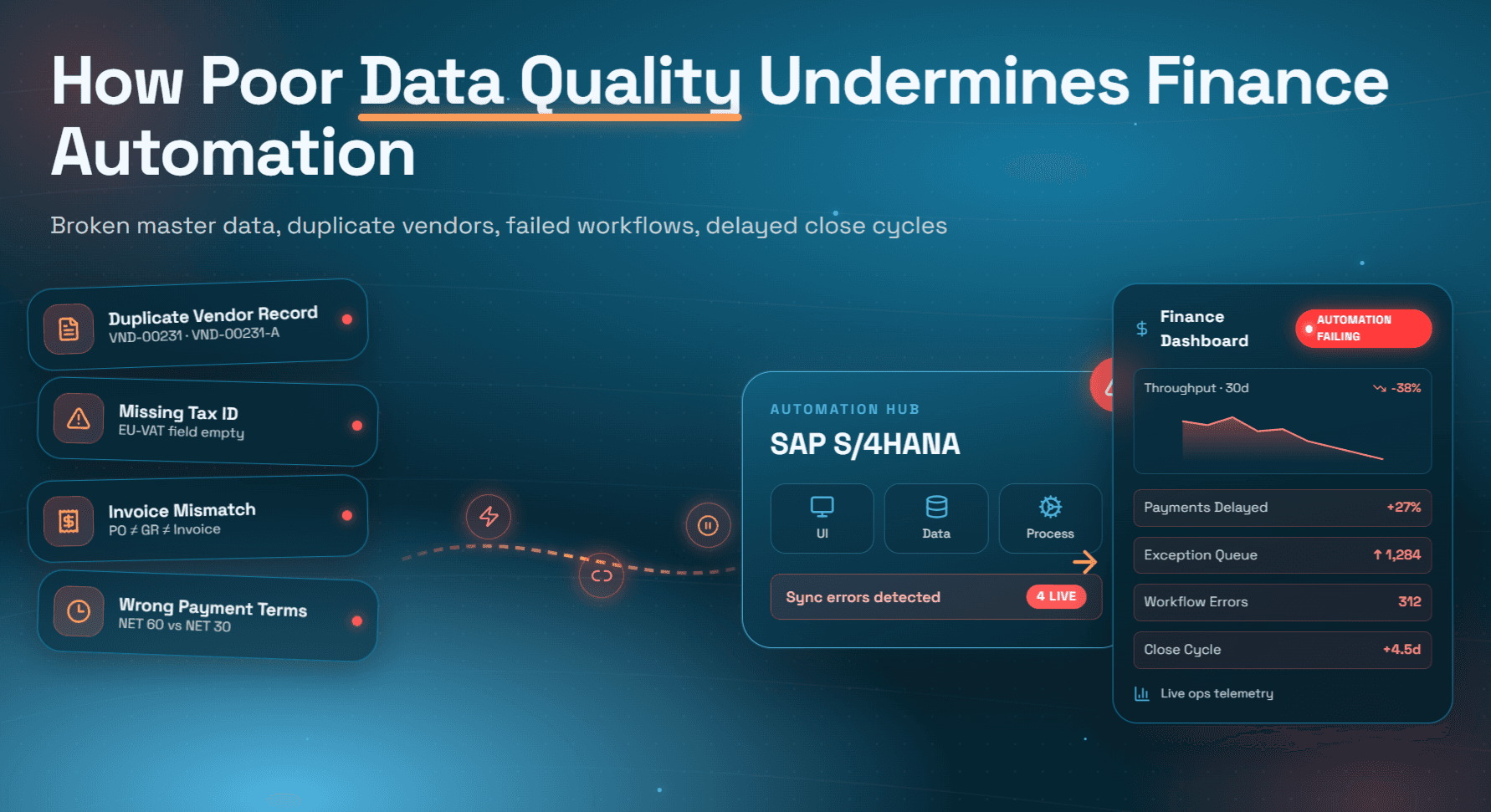

Business Partner in SAP S/4HANA: What Changed and Why Finance Teams Struggle
Why SAP’s unified Business Partner model creates efficiency potential—and operational friction
The introduction of the Business Partner as the central data object in SAP S/4HANA was one of the most consequential architectural shifts in ERP history. For finance teams in the middle of or anticipating a migration, the impact runs far deeper than a change in transaction codes. This guide unpacks what the business partner model really means, why the vendor-customer merge creates real operational strain, who owns the data and why that question is harder than it sounds, and what modern AI-driven automation can do to relieve the pressure.
What is the business partner model in SAP S/4HANA?
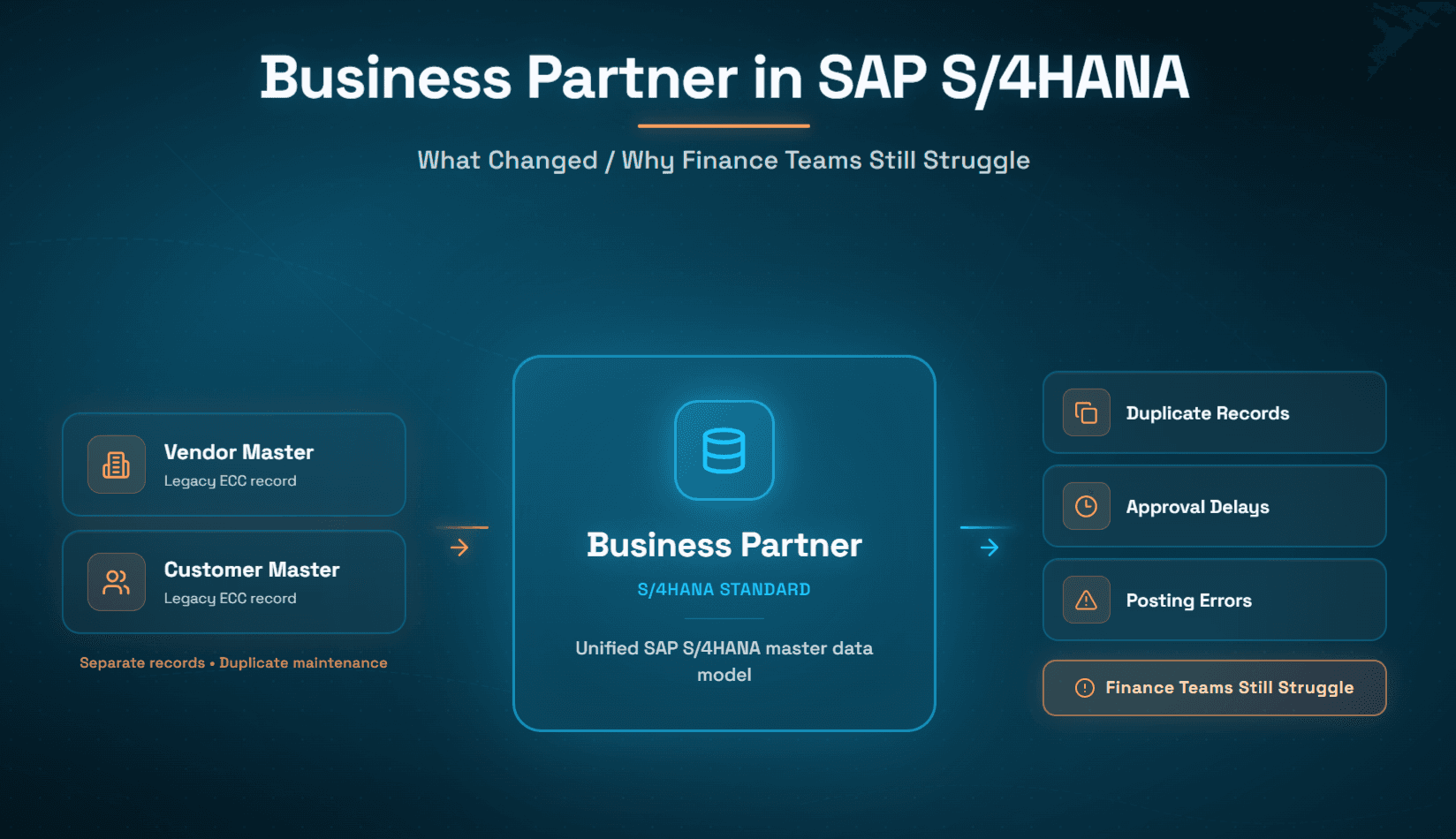
In SAP ECC, the system maintained separate master data objects for vendors (managed in the FI-LO vendor master), customers (managed via the FI-SD customer master), and sometimes employees or other third-party entities. These objects could exist independently of each other, even when the underlying real-world entity, say, a supplier who also buys from your company was identical. The result was data duplication, maintenance overhead, and consistency gaps that plagued reconciliation and audit processes for decades.
SAP S/4HANA replaces this fragmented approach with a single, unified object: the Business Partner (BP). The business partner is not simply a renamed vendor or customer. It is a new data architecture built around the concept that any entity you transact with like a supplier, customer, bank, employee, or internal cost center, should be represented once in the system and then assigned roles that govern how that entity behaves within specific process contexts.
When a business partner is created, it is assigned a BP role. The most relevant roles for finance teams are:
FLVN00 / FLVN01 – the vendor roles, which activate the Financial Accounting attributes of what was formerly the vendor master
FLCU00 / FLCU01 – the customer roles, which activate AR-relevant fields
000000 – the general business partner role, which holds core identity data such as address, bank details, and tax numbers
The critical architectural distinction is that all transactional identities such as name, address, VAT registration, bank account, live at the general BP level. Process-specific configuration like payment terms, reconciliation account, dunning procedure, purchasing organization assignment, lives at the role level. This means that when the same entity is both a supplier and a customer, those two operational identities now share a single set of master identity data, and any change to the core identity propagates automatically. This is the business partner model.
For further context on how ERP structures vary across platforms and what this means for GL coding and financial reporting, see Hyperbots' guide on differences in Chart of Accounts across ERPs and the comprehensive SAP Chart of Accounts and GL coding reference.
What specifically changed from ECC to S/4HANA?
The shift from ECC to S/4HANA around the business partner model is not cosmetic. There are seven structural changes that finance and procurement teams must understand before going live.
1. Transaction code retirement
The beloved transaction codes FK01, FK02, FK03 (vendor create, change, display) and XD01, XD02, XD03 (customer create, change, display) are no longer the primary entry points for master data maintenance. The new transaction is BP, a single screen that surfaces general data and role-specific tabs. Organizations that have invested in custom workflows, approvals, or user training around the old T-codes must redesign those processes entirely.
2. The HANA data model restructuring
In ECC, vendor and customer data was stored in tables LFA1, LFB1, LFB5 (vendor) and KNA1, KNB1, KNB5 (customer). In S/4HANA, these tables are retained for compatibility but the source-of-truth tables are now BUT000 (BP general data), BUT020 (addresses), BUT100 (roles), and the finance-specific extension tables. Any custom ABAP, reports, or interfaces that read directly from LFA1 or KNA1 will still function technically but may return incomplete or stale data if they bypass the BP layer.
3. Mandatory BP number synchronization
S/4HANA enforces a 1:1 relationship between a BP number and the corresponding vendor or customer account group number. This synchronization, often called the "central mapping," must be maintained consistently. During migration, organizations that did not enforce number range discipline in ECC often discover thousands of vendor records where the vendor number and the BP number are mismatched, causing downstream posting errors and reconciliation failures.
4. Consolidation of bank details
Bank account data moves from vendor-level storage to BP-level storage, becoming shared across all roles. This has profound implications for payment fraud prevention: a change to a supplier's bank details in ECC was a vendor-scoped event. In S/4HANA, the same change affects every role assigned to that BP, including any customer role. Finance teams need revised controls and approval hierarchies for bank detail changes. See Hyperbots' perspective on managing variations in payment instructions for practical guidance.
5. Tax and compliance data at the BP level
VAT registration numbers, tax classification codes, and withholding tax configurations now reside at the BP level rather than being duplicated across vendor and customer records. While this reduces redundancy, it also means that any error in tax data has a wider blast radius. An incorrect tax number on a vendor record in ECC affected AP transactions only; the same error on a BP record in S/4HANA may affect AR transactions and financial reporting simultaneously.
6. Address management changes
Address structures in S/4HANA are managed via the Business Address Services (BAS) layer, which is shared across all SAP applications. Addresses are assigned at the BP level and can optionally be differentiated at the role level using "usage" assignments. This architecture resolves the ECC problem of duplicate addresses but introduces complexity when a supplier has different remittance addresses for different company codes. Understanding why addresses in invoices and POs matter becomes even more critical in this unified data environment.
7. Relationship framework
S/4HANA introduces a relationship management capability within the BP framework that allows you to formally model connections between business partners for example, a parent company and its subsidiaries, or a freight carrier and the logistics coordinator it uses. This capability, while underutilised by most organizations at go-live, becomes important in multi-entity procurement environments and when implementing multi-agent collaboration in finance.
The vendor-customer merge: opportunity or operational nightmare?
The vendor-customer merge is arguably the most discussed and most misunderstood aspect of the S/4HANA business partner model. The concept is straightforward: if the same legal entity is both a supplier you pay and a customer from whom you collect receivables, those two records should be linked, or ideally, merged under a single Business Partner.
In theory, this resolves longstanding frustrations: treasury teams can net open payables against receivables, improving cash flow visibility; master data teams maintain one record instead of two; credit management can see a 360-degree picture of the relationship. In practice, the vendor-customer merge is one of the leading causes of go-live delays, post-migration data quality incidents, and finance team burnout.
Why the merge is technically complex
The merge is not an automated database join. It requires an active decision: which BP number becomes the "golden record" and which is absorbed? The absorbed record's number ranges, purchasing organization assignments, company code settings, and open items must all be reviewed and reconciled. In organizations with hundreds of intercompany trading partners or subsidiaries that are simultaneously customers and vendors, this reconciliation exercise can run into months of manual analysis.
The complexity deepens when:
The vendor was created in one company code with one set of payment terms, and the customer was created in a different company code with different credit limits
Open purchase orders reference the old vendor number, while open sales orders reference the old customer number, and both need to be mapped to the new unified BP without breaking existing document chains
Custom partner determination procedures in SD reference the old customer number directly
The clearing account for vendor-customer netting was configured differently across SAP instances in a multi-system landscape
Operational impacts post-merge
Even after a successful merge, finance teams encounter ongoing operational friction. Approval workflows that were designed for either a vendor or a customer change request now receive a combined BP change request that touches both AP and AR data. Processors who are authorised to approve vendor bank detail changes may not have, and should not have, the authority to modify customer credit limits, yet both fields now live on the same record. Designing authorization objects and approval routing for this new reality requires significant rethinking of segregation of duties.
Payment processing is another area of persistent difficulty. Net payment runs that offset vendor payables against customer receivables require specific configuration in F110 (the automatic payment run) and, in S/4HANA, in the new Fiori-based payment apps. Many finance teams discover that their bank connectors, house banks, and payment medium programs were not designed to handle netted payments and require re-configuration or replacement. See Hyperbots' detailed analysis of rationalizing payment terms across vendors and understanding variations in payment terms for the downstream payment implications.
Key insight: organizations that treat the vendor-customer merge as purely a technical migration task, rather than a cross-functional process redesign, experience three times the number of post-go-live incidents in AP and AR. The merge is a business decision, not just a data decision.
When not to merge
Not every entity that appears in both vendor and customer master data should be merged. Merging is appropriate when the legal entity is genuinely the same, the relationship is ongoing, and netting provides a demonstrable treasury benefit. It is often inappropriate when the "overlap" is coincidental (e.g., a company that bought something from you once three years ago now provides a service), when the relationship is in dispute, or when different subsidiaries of a conglomerate are independently transacting and have distinct credit profiles that must remain separate. Establishing clear governance criteria before beginning the vendor-customer merge exercise prevents costly reversals later.
Data ownership in the business partner model – who is responsible?
Data ownership is the most under-examined dimension of the S/4HANA business partner model transition, and it is the one that creates the most persistent operational problems after go-live. In the ECC world, the answer to "who owns vendor master data?" was usually "the accounts payable team" or "procurement." The answer to "who owns customer master data?" was "accounts receivable" or "sales." These were clean boundaries, reflected in system authorizations and organizational structures.
The business partner model eliminates those boundaries. A single record now contains fields that are operationally relevant to AP, AR, procurement, sales, treasury, tax, compliance, and IT. No single function can claim full ownership, yet someone must be accountable for data accuracy. The resulting ambiguity manifests in several ways.
The authorization design challenge
SAP S/4HANA provides a granular authorization object framework for BP maintenance, allowing you to restrict access to specific BP roles, specific fields, and specific company codes. However, designing these authorizations correctly requires a detailed understanding of which teams touch which fields and under what circumstances. Most organizations go live with overly permissive "everyone can change everything" authorizations because the correct design takes months of analysis they do not have time for during implementation. The result is a lack of genuine data ownership accountability and a fertile environment for both accidental and deliberate data corruption.
The workflow approval gap
ECC had fairly well-established patterns for vendor master change workflows typically built on workflow tasks TS20000022 or custom BAdI-based approvals. S/4HANA introduces Fiori-based BP change requests, which are architecturally different and require a new workflow design. Many organizations migrate to S/4HANA without a functioning BP change workflow in place, meaning that all changes go directly to the database without any approval gate. This is a material internal controls weakness that external auditors increasingly flag. Connecting this to how CFOs can enhance auditability in the age of AI is now a strategic imperative.
Data ownership in multi-entity organizations
In organizations that operate multiple SAP systems or that have completed an S/4HANA migration but retained subsidiary ECC instances, data ownership becomes even more complex. A supplier that operates across geographies may have different BP records in different SAP landscapes. Changes made in one landscape do not automatically propagate to others. Maintaining consistency requires either a Master Data Governance (MDG) implementation, a third-party data hub, or manual synchronization processes, each carrying its own cost and risk.
The question of data ownership is not purely technical. It intersects with the decentralization versus centralization of procurement decisions that organizations have been wrestling with for years. Centralized procurement teams argue for central ownership of supplier master data. Regional finance teams argue that they understand their local regulatory requirements and vendor relationships better. Without an explicit governance decision, both groups will modify the same BP records, often in conflicting ways.
BP data domain | Primary owner (recommended) | Secondary reviewer | Key risk if unowned |
Legal name and address | Master Data Governance team | Compliance / Tax | Incorrect tax reporting, payment failures |
Bank account details | Treasury / AP | Fraud risk / Internal Audit | Payment fraud, duplicate payments |
Payment terms (vendor role) | Procurement | AP / Treasury | Missed early payment discounts, cash flow errors |
Credit limit (customer role) | Credit Management / AR | Sales | Over-exposure, bad debt |
Tax classification | Tax team | AP / AR | Sales tax under/overcharge, audit penalties |
Purchasing org assignment | Procurement | IT / Finance | PO creation failures, approval bypass |
Why finance teams struggle during and after migration
Every SAP migration project carries risk. The business partner model transition carries an unusually concentrated set of risks in the finance domain specifically, for reasons that go beyond the technical challenges described above.
Data quality debt inherited from ECC
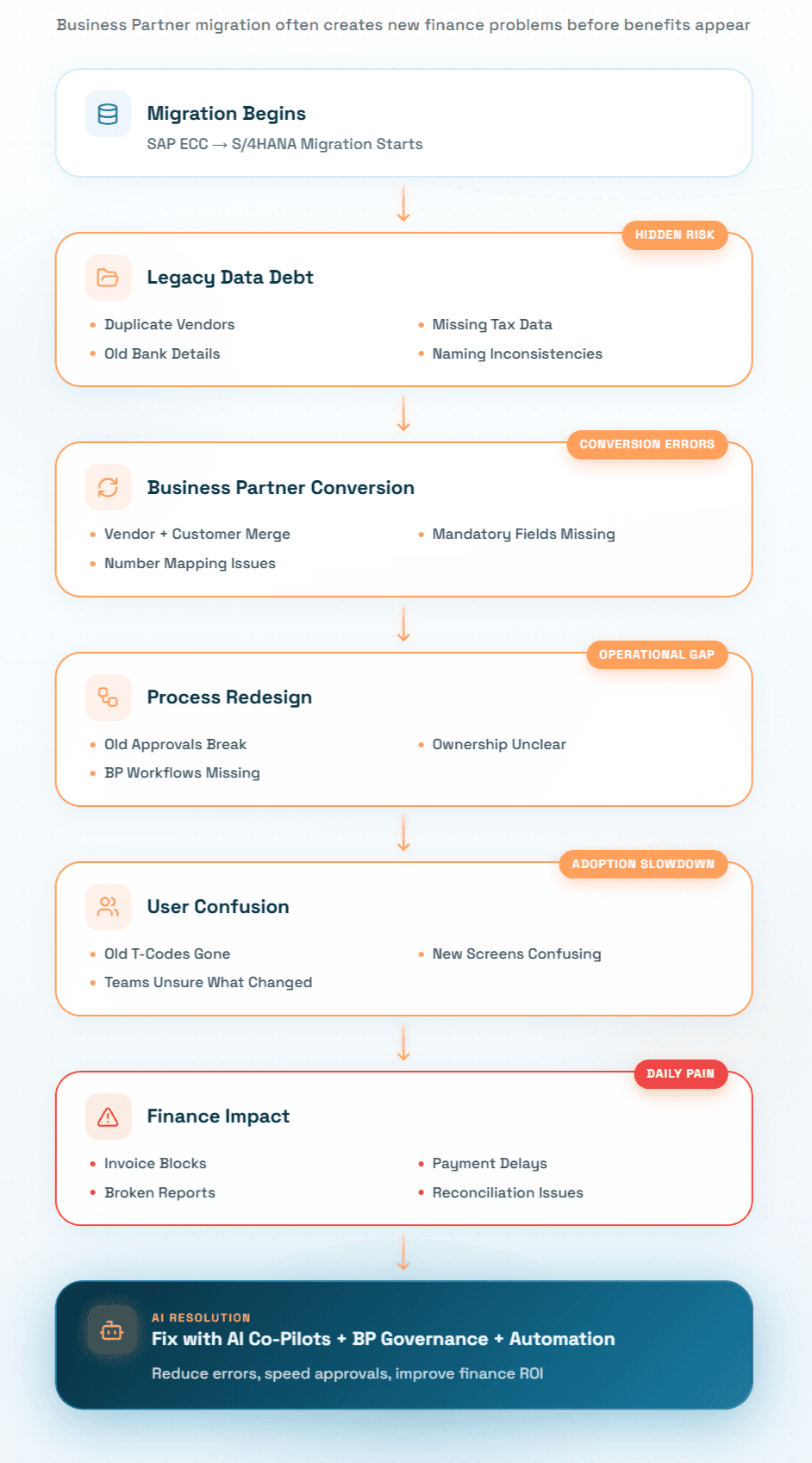
Most large organizations have been running SAP ECC for ten to twenty years. Over that period, vendor and customer master data has accumulated thousands of inactive records, duplicate entries, inconsistent naming conventions, outdated bank details, and missing tax information. Migration to S/4HANA forces a reckoning with this debt. The BP creation process requires mandatory fields that the ECC migration tool will fail on if the source data is incomplete.
A typical mid-market organization discovers during pre-migration data quality assessment that 15–30% of active vendor records have at least one critical data deficiency that would prevent clean BP creation. Remediation, contacting vendors, updating records, deduplicating, is a manual, time-consuming exercise that the implementation timeline rarely accounts for adequately. See the Hyperbots analysis of vendor onboarding challenges and the advantages of AI for a detailed breakdown of where the friction concentrates.
Process redesign scope underestimated
Finance teams frequently discover post-go-live that processes they assumed would work as before now require rethinking. The purchase order creation process, invoice matching, payment scheduling, and accrual booking all interact with vendor or customer master data in ways that the business partner model changes. Assuming these processes are "just SAP configuration changes" leads to scope creep, delayed stabilisation, and user frustration.
Training and change management underinvestment
The cognitive shift required to move from thinking in terms of "vendor 1001234" to thinking in terms of "Business Partner 1001234 with vendor role in company code 1000" is not trivial for AP clerks, buyers, and AR processors who have worked with the old transaction codes for years. Training programmes that focus only on the new Fiori UI without addressing the underlying conceptual change produce users who follow the new steps mechanically but do not understand why, meaning that when an exception or error occurs, they have no mental model to diagnose or resolve it.
Reporting and analytics disruption
Finance teams that have invested in custom reports, Power BI dashboards, or SAP Business Objects universes built on ECC vendor and customer tables face a painful rebuild. The S/4HANA data model exposes the same information through different table structures and CDS views. Universal Journal (ACDOCA) replaces many of the line-item tables, and the BP tables replace LFA1/KNA1 as the source for master data attributes. Reports that were built on ECC structures and not rebuilt for S/4HANA produce incorrect results silently, sometimes for months before the discrepancy is caught.
Warning: A common post-migration failure mode is "shadow ECC", teams maintaining parallel spreadsheet-based vendor registers because they do not trust the BP data quality in S/4HANA. This creates the very data ownership vacuum that the business partner model was designed to eliminate.
Ongoing duplicate BP creation
Without adequate duplicate-check configuration and governance, new BP records continue to be created for entities that already have a BP record. Buyers create new vendor BPs because they cannot find the existing one. AP teams create new BPs because the existing one lacks the company code extension they need. Over time, the BP master data degrades back toward the fragmented state that the migration was meant to resolve. Implementing robust GL posting best practices and AI-based anomaly detection in matching can surface these issues before they compound.
Impact on accounts payable, procurement, and accruals
The business partner model does not affect all finance functions equally. AP, procurement, and accruals feel the impact most acutely, and understanding the specific pain points in each area is essential for planning mitigation strategies.
Accounts payable
For AP, the most significant change is in invoice processing. Every invoice that arrives references a vendor, which in S/4HANA is a BP with a vendor role. If the BP record is incomplete like missing a reconciliation account assignment, lacking a company code extension, or having an inactive bank detail, the invoice cannot be posted or paid. In high-volume AP environments, even a 2% rate of BP data deficiencies generates hundreds of blocked invoices per month.
The three-way matching process in which invoices are reconciled against the purchase orders and good receipt notes, depends entirely on the BP vendor role being correctly configured with the purchasing organization and company code assignments. Any mismatch causes matching exceptions that require manual resolution. The challenges of solving 3-way matching with AI are compounded when the underlying BP data is inconsistent. Effective matching strategies for invoices, POs, and GRNs become even more important in this context.
Procurement
Procurement teams interact with the BP through the purchase requisition and purchase order lifecycle. The purchase requisition to purchase order handoff requires the vendor BP to have a valid purchasing organization assignment and at least one active purchasing info record or contract. In post-migration environments where BP quality is uneven, buyers encounter frequent "vendor not found" or "purchasing data incomplete" errors that interrupt the PO creation process.
The PR to PO cycle time, already a persistent pain point in many organizations, deteriorates sharply when BP data quality is poor, because every exception requires a manual lookup, a BP change request, and an approval cycle before the PO can be issued.
Accruals
Month-end accruals depend on accurate knowledge of what has been received but not yet invoiced (GRIR accruals), what services have been performed but not yet billed, and what recurring expenses are expected. All three accrual types reference BP data. GRIR accruals require correctly matched PO and GRN records with valid vendor BP assignments. Service accruals require the service provider's BP record to have the relevant company code extension active. Recurring expense accruals depend on the vendor's payment terms and billing history being accurately maintained in the BP record. The complexity of navigating accruals in accounts payable is therefore directly connected to the health of the BP master data.
Best practices for managing the business partner model effectively
Organizations that navigate the business partner model successfully share a common set of practices. None of them are particularly new concepts, but the S/4HANA business partner model makes the cost of not following them measurably higher.
Establish a master data governance structure before go-live
Create explicit data ownership assignments, not just documentation, but system authorizations that enforce ownership. Define which team approves which type of BP change and build the workflow accordingly. Without this, data governance is aspirational rather than operational.
Implement a BP duplicate check strategy
SAP's standard duplicate check uses address matching and can be configured with fuzzy logic. Supplement it with a programmatic pre-check against tax number, DUNS number, or bank account to catch duplicates that address-based checks miss. Run regular duplicate analyses as a BAU activity, not just a migration task.
Define vendor-customer merge governance criteria
Publish clear criteria for when a vendor-customer merge is appropriate and mandatory versus optional. Build a lightweight triage process for new BP requests that checks whether an existing BP with a different role already exists for the same legal entity. This prevents the duplicate creation problem from re-establishing itself post-migration.
Treat bank detail changes as high-risk events
Given the broader impact of bank detail changes under the business partner model, implement a multi-step verification process: the change request should require supplier confirmation via a separate communication channel (not email alone), a two-person approval in SAP, and a temporary payment hold on the affected BP until the change is validated. Connect this to your fraud prevention controls. For detailed guidance, see detecting and preventing fraud and anomalies in finance with agentic AI.
Maintain a BP quality scorecard
Report on BP data completeness and accuracy as a regular finance KPI. Track: percentage of active BPs with complete company code extensions, percentage with validated bank details, percentage with current tax registrations, and age of last review. Make this visible to the CFO as part of the data governance reporting cadence. Explore how AI automation improves audit ease by keeping this data current and auditable at all times.
Automate what can be automated
Significant portions of the BP maintenance lifecycle, vendor onboarding, change request routing, duplicate detection, tax verification, can and should be automated. Manual processes at high volume are the primary source of data quality degradation. Automation not only speeds these processes but makes them more consistent and auditable. This is where AI-native platforms like Hyperbots, built to complement SAP S/4HANA, provide compounding value. For context on how pre-trained AI co-pilots accelerate finance transformation, see how pre-trained AI co-pilots transformed finance in days, not months.
How Hyperbots AI co-pilots eliminate the ongoing struggle
The SAP S/4HANA business partner model creates a new operating reality for finance teams. The processes that interact with BP data, invoice processing, procurement, payments, accruals, vendor management, and tax compliance, all become more interdependent and more sensitive to data quality than they were in ECC. Managing this at scale and at the speed modern finance operations require is beyond the capacity of manual processes and rule-based automation.
Hyperbots is purpose-built for this challenge. Its suite of AI co-pilots operates as a layer of agentic intelligence on top of SAP S/4HANA and other ERP systems, automating the high-volume, judgment-intensive tasks that drain finance teams and doing so with a level of accuracy that removes the cost of rework. Here is how each co-pilot addresses the post-S/4HANA struggle directly.
Delivers 99.8% extraction accuracy on all invoice formats, structured or unstructured, without template dependency. Automatically maps invoices to the correct BP vendor role in S/4HANA, validates against PO and GRN data, performs 2-way, 3-way and 4-way matching, assigns GL codes, and posts directly to ERP. Straight-through processing rates of 80%+ which means that 4 out of 5 invoices flow from receipt to posted status with zero human touch, eliminating the manual exception volume that BP data gaps generate. Finance teams stop chasing blocked invoices and start managing by exception at a strategic level.
Automates the full BP vendor onboarding lifecycle: document collection, identity verification, duplicate detection, W-9 forms for tax registration validation, bank detail verification, and ERP synchronization. Every change request is routed through a configurable approval workflow with full audit trails. Bank detail changes trigger an elevated verification protocol automatically. The result is a vendor master data quality that degrades at a fraction of the manual-process rate, directly addressing the data ownership gap that the S/4HANA migration creates. Organizations using this co-pilot report 70%+ reduction in vendor onboarding cycle time and near-elimination of duplicate BP records.
Compresses the PR-to-PO cycle from a multi-day manual process to as little as 4 hours. The co-pilot extracts requisition data from emails, forms, and documents; validates against BP vendor records, budgets, and policy rules; routes for approval; and generates and dispatches the purchase order, all autonomously. When BP data is incomplete, the co-pilot surfaces the gap with a specific remediation recommendation rather than silently blocking the PO. Procurement teams gain visibility into the entire pipeline, not just the exceptions that land in their inbox.
Transforms payment execution from a scheduled batch activity into a continuous, optimised process. The co-pilot analyses the full AP ledger, identifies early payment discount opportunities, flags vendors where strategic late payment conserves cash, validates bank details against the BP master before every disbursement, and routes payment batches for approval. Remittance advice is generated and dispatched automatically. Fraud detection algorithms monitor for anomalous bank detail changes, the primary risk vector in a post-merger BP environment. organizations capture 40–60% more early payment discounts and reduce payment fraud incidents significantly.
Automates the full accrual cycle: discovering unbilled liabilities from GRIRs, services received but not invoiced, and recurring commitments; calculating accrual amounts; creating journal entries; posting to S/4HANA; and reversing automatically in the following period. The co-pilot handles the BP data validation inherent in accrual discovery, ensuring that each accrual references a valid, active vendor BP with the correct company code assignment. Month-end close time reduces by 60–70% in organizations that deploy this co-pilot, with zero manual journal entry preparation for standard accruals.
Validates sales and use tax on every invoice at line-item level. Extracts and validates origin and destination addresses which is critical in a unified BP model where address data is shared. This co-pilot classifies line items against tax dictionaries, checks nexus thresholds, and reports mismatches before posting. This directly addresses the wider blast radius of tax errors on BP-level address data. organizations avoid the compliance exposure that comes from tax errors propagating across both AP and AR transactions on merged vendor-customer BPs.
Order-to-cash – Collections and Cash Application co-pilots
The vendor-customer merge creates a unified BP that also carries customer role data. Hyperbots extends its AI intelligence to the order-to-cash side with two additional co-pilots.
The Collections Co-pilot automates accounts receivable collections outreach, prioritizing open balances, generating personalised dunning communications, tracking responses, and escalating based on configurable rules. In organizations where the same BP is both a vendor and a customer, the co-pilot's intelligence includes the payables balance with that BP, enabling the treasury to make netting-informed decisions before escalating collections. DSO (Days Sales Outstanding) reductions of 40–50% are achievable with consistent deployment.
The Cash Application Co-pilot automates the matching of incoming payments to open invoices, handling remittance advice in any format, resolving short payments, deductions, and partial payments autonomously. In a post-S/4HANA environment where customer BP data is actively maintained and accurate, the co-pilot's matching accuracy reaches 99%, eliminating the suspense account backlogs that manual cash application generates.
ROI and transformation metrics – what Hyperbots delivers
The value of Hyperbots' AI co-pilots is measurable across both P2P and O2C dimensions. organizations that have deployed the full suite of co-pilots alongside SAP S/4HANA report the following performance benchmarks:
80% Reduction in manual operations cost across P2P
99.8% Invoice extraction accuracy, template agnostic so no templates are needed
80%+ Straight-through processing rate for invoices
4 hrs PR-to-PO cycle time (down from 3 days)
70% Faster vendor onboarding and BP enrichment
$200K Tax leakage eliminated at a single CFO deployment
10% reduction in cash flow
5 min PR creation
Less than 5% variance in accrued s actual costs
70% Cost reduction in Collections.
40% reduction in DSO.
80% reducion in reconcilliations cost
Unapplied cash is reduced to less than 10%
Beyond the headline numbers, the intangible ROI of deploying Hyperbots alongside S/4HANA is substantial. Finance teams report significantly higher confidence in the accuracy of BP master data because every co-pilot action that touches vendor data is logged, validated, and auditable. CFOs gain explainable AI, every posting decision, GL code assignment, and payment recommendation comes with a documented rationale, which transforms the audit preparation process. Controllers report faster month-end closes, fewer audit queries on AP accruals, and improved compliance with sales and use tax obligations.
Hyperbots' unlimited-user licensing model means that the per-transaction cost of deploying AI intelligence does not increase as transaction volumes grow, a material advantage in high-growth or high-volume manufacturing and retail environments. See the full analysis of unlimited access and ROI for the financial modelling detail.
Explore Hyperbots' ROI calculators to quantify the value for your specific environment: invoice processing ROI calculator, procurement ROI calculator, and payments ROI calculator.
For organizations evaluating the broader AI finance automation landscape, see ROI on AI-led automation in finance and building a business case for AI-driven AP automation.
See how Hyperbots integrates with SAP S/4HANA to automate your entire P2P and O2C process with 99.8% accuracy from day one.
Industry-specific considerations for the business partner model
The challenges of the S/4HANA business partner model are universal, but the specific pain points and the value of AI-driven resolution differ by industry. Hyperbots serves a range of industries with configurations tailored to sector-specific compliance and process requirements.
In manufacturing, the BP model intersects with MRP-driven procurement, where the system automatically generates purchase requisitions based on material requirements planning runs. Each auto-generated PR references a source list that ties back to a vendor BP. If the BP's purchasing organization assignment is incorrect or the info record is outdated, the MRP-generated PO fails, disrupting production schedules, not just payment cycles. Hyperbots' manufacturing-specific deployment addresses these PO-heavy, high-frequency AP workflows with pre-configured matching tolerances and MRP-aware exception handling. See also how Hyperbots outperforms alternatives in manufacturing invoice automation.
In retail, the volume of supplier BPs, often numbering in the thousands for large retailers with diversified supply chains, makes manual data governance impossible. Seasonal supplier onboarding, promotional pricing agreements, and returns processing all depend on BP data accuracy. The vendor-customer merge is particularly complex in retail because many wholesale suppliers are simultaneously customers for surplus goods or consignment returns. Hyperbots' retail ERP automation capabilities are designed for this high-volume, multi-relationship environment.
In professional services, the BP model's customer-vendor merge question arises acutely for subcontractors who are also clients. Time-and-material billing, milestone invoices, and retainer structures all create BP data management challenges that differ structurally from product-based procurement. The professional services ERP guide provides additional context on how AI automation adapts to these service-centric billing models.
Frequently asked questions about the SAP S/4HANA business partner model
Q1. What is the business partner model in SAP S/4HANA?
The business partner model is the unified data architecture in SAP S/4HANA where all external parties such as suppliers, customers, banks, and others, are represented as a single Business Partner object. Each BP is assigned roles (such as vendor or customer) that activate the relevant process-specific data fields. It replaces the separate vendor master (LFA1) and customer master (KNA1) structures used in SAP ECC, eliminating data duplication and enabling a 360-degree view of any transacting entity.
Q2. Is the vendor-customer merge mandatory in S/4HANA?
No, the merge is not technically mandatory, but SAP's architecture strongly encourages it for entities that are genuinely both suppliers and customers. Running separate unlinked BPs for the same legal entity creates data inconsistency risks and prevents treasury benefits like payment netting. However, the merge should only be executed where a clear business case exists and where governance processes are in place to manage the combined record.
Q3. Who should own business partner master data?
Data ownership in the business partner model is inherently cross-functional because a single BP record contains fields relevant to AP, AR, procurement, tax, treasury, and compliance. Best practice is to designate a Master Data Governance team as the owner of core identity fields (name, address, tax registration) and to assign ownership of role-specific fields to the relevant operational teams, AP for payment terms, credit management for credit limits, procurement for purchasing organization assignments. System authorizations should enforce these ownership boundaries.
Q4. How does a poorly maintained BP master affect invoice processing?
BP data deficiencies directly block invoice processing. A vendor BP missing a company code extension cannot be used for invoice posting. A BP with an inactive or unvalidated bank detail prevents payment execution. Missing purchasing organization assignments break the 3-way match by preventing PO linkage. In high-volume AP environments, even a small percentage of deficient BP records generates a disproportionate volume of manual exceptions and payment delays.
Q5. Can AI automation resolve the data quality problems created by the business partner model migration?
AI co-pilots like those from Hyperbots can both prevent ongoing BP data degradation and resolve the downstream consequences of existing data quality issues. For prevention: automated vendor onboarding with identity verification, duplicate detection, and bank validation keeps BP records clean. For resolution: intelligent invoice processing can flag BP data gaps with specific remediation recommendations rather than silently blocking transactions, reducing the time-to-resolution for exceptions from days to hours.
Q6. How does Hyperbots integrate with SAP S/4HANA?
Hyperbots integrates with SAP S/4HANA through pre-built ERP connectors that use standard SAP APIs and BAPIs to read and write data. The integration covers BP master data, purchase orders, goods receipts, invoice documents, GL accounts, and payment transactions. The ERP onboarding process is designed for rapid deployment, typically achieving go-live within days rather than months. Hyperbots also integrates with a wide range of other ERP platforms including NetSuite, Microsoft Dynamics, QuickBooks, SAP Business One, and Sage 300. See the full integrations page for details.
Q7. What is the difference between a business partner model and the old vendor/customer master approach?
In the old ECC approach, vendors and customers were entirely separate data objects with no formal link, even when they represented the same real-world entity. The business partner model creates one object per entity and uses roles to govern how that entity participates in different business processes. The key benefits are elimination of data duplication, a single source of truth for identity data (name, address, tax number, bank details), and the ability to formally model combined vendor-customer relationships for netting and reconciliation.
Q8. How can finance teams reduce the manual workload caused by BP exceptions?
The most effective approach combines three elements: proactive BP data governance to prevent deficiencies from arising, intelligent automation to handle high-volume routine transactions without human involvement, and AI-driven exception management that triages and routes issues with specific recommended actions rather than generic error codes. Hyperbots' co-pilots address all three layers simultaneously, enabling finance teams to shift from reactive exception processing to strategic oversight.