The Hidden Costs of Manual Procurement: Why Automation Delivers Measurable ROI
How manual procurement drives hidden costs and how automation reduces errors, delays, and operational overhead
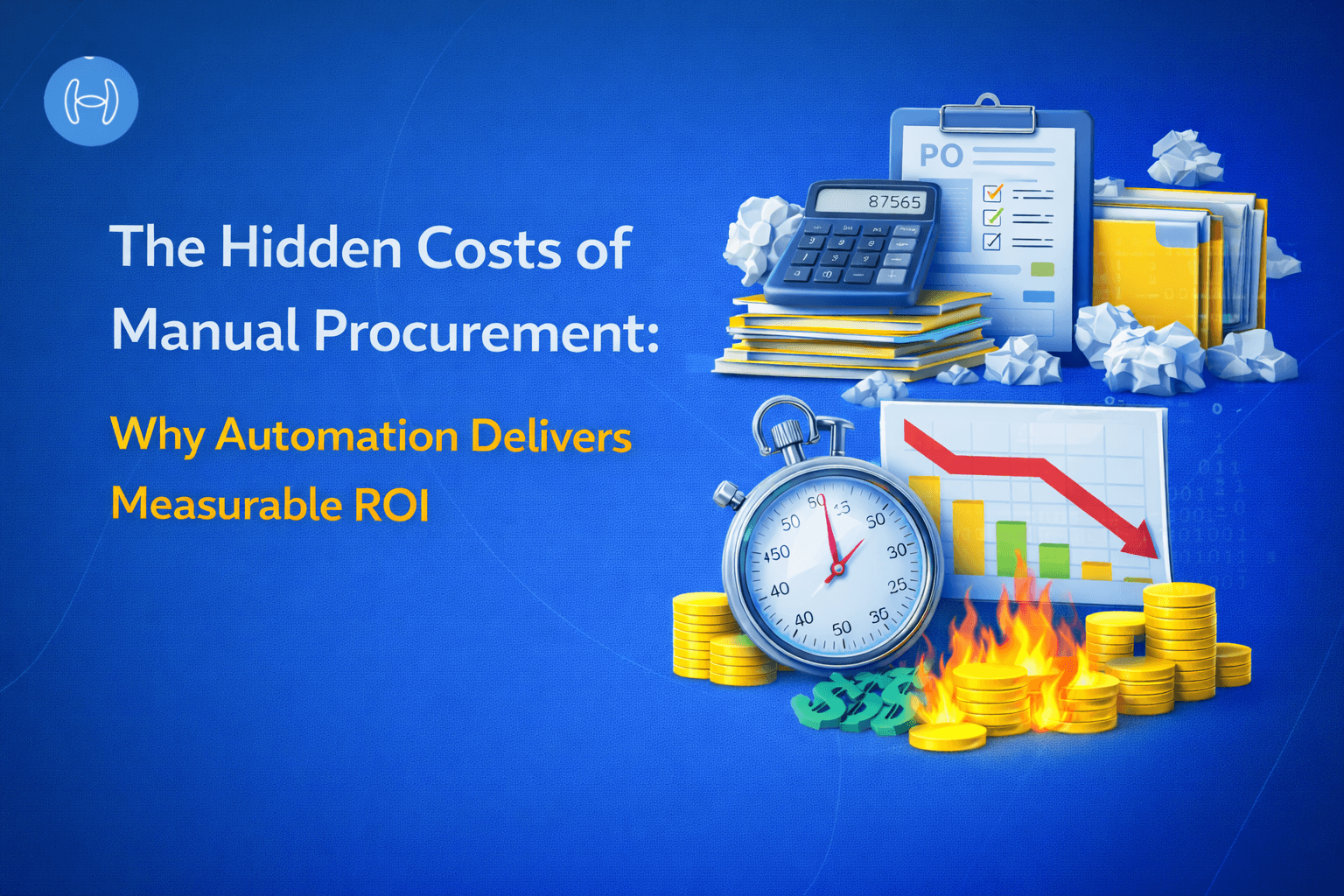
When a CFO looks at the cost of procurement, the visible line items are straightforward: staff salaries, ERP licensing, supplier contracts. What rarely appears on any report is the cost of the process itself: the hours spent creating purchase orders manually, the payment delays caused by approval bottlenecks, the overpayments that slip through because invoice matching is done by hand, the compliance penalties that accumulate when vendor documentation is not maintained.
These are not small numbers. They are also not inevitable. They exist specifically because manual procurement processes carry costs that are real but difficult to see, and therefore difficult to justify fixing.
This blog breaks down where those hidden costs live, what drives them, and how automation converts each one into measurable ROI. If you want to understand what specific metrics and KPIs tell you whether automation is paying off, the guide on measuring ROI in procurement automation covers the full framework for tracking value once automation is in place.
What Manual Procurement Actually Costs
Manual procurement is any step in the procure-to-pay process that requires a person to read, enter, route, chase, or verify information that a system could handle automatically.
In most mid-market organisations, that covers a significant proportion of the process: purchase requisitions completed in spreadsheets or email, purchase orders created by hand in the ERP, invoice data keyed from PDFs, approval chains managed through email threads, vendor compliance documents tracked in shared folders, and payment decisions made without real-time visibility into cash position or early payment discount windows.
None of these steps are wrong in isolation. They are just expensive, and the expense compounds as transaction volume grows.
Cost 1: The Per-Transaction Cost of Creating a Purchase Order
Every purchase order a business raises has a cost to create. That cost is not just the time to fill in the PO form. It includes finding the right vendor record, validating the price against the contract, identifying the correct GL code, routing the requisition for pre-approval, creating the PO, dispatching it to the vendor, and confirming receipt.
For a single PO, done carefully, this can take 20 to 30 minutes of staff time. Across an organisation processing hundreds of POs a week, the cumulative hours are substantial. Add the cost of errors, a wrong vendor code, an incorrect price, a PO raised against the wrong cost centre, each requiring correction and re-routing, and the per-transaction cost climbs further.
The guide on what it costs to process a purchase order provides industry benchmarks for manual PO processing and shows how they compare against automated processing. The gap is consistently wider than most finance teams assume before they measure it.
Cost 2: Approval Delays and Their Downstream Consequences
Procurement approval chains exist for good reasons: they enforce financial controls, distribute authority appropriately, and create an audit record of commitments. When they work well, they are fast and invisible.
When managed manually, approval chains become a consistent source of cost and friction. An approver is in meetings. An email gets buried. A PO sits in a queue for three days waiting for a signature that takes 30 seconds to give.
The downstream consequences are rarely measured but consistently real. Suppliers receive orders later. Early payment discount windows close because the invoice arrives after payment has already been delayed. Rush orders raised to compensate often carry premium pricing. And the finance team spends time chasing approvals that a system should handle automatically. The guide on how manual and automated purchase order processes compare quantifies exactly what these delays cost and what structured routing delivers instead.
Cost 3: Invoice Errors and the Work of Fixing Them
Every incorrectly processed invoice has a cost that goes beyond the error itself. An invoice posted with the wrong GL code distorts financial reporting. One matched against the wrong PO creates a reconciliation problem that surfaces at month-end. One paid twice because duplicate detection was not in place requires vendor communication, a credit note, and a bank reconciliation adjustment.
In manual environments, errors are not exceptions. They are a predictable product of high-volume, repetitive work. The cost of each error is also compounding. A mismatched three-way match requires someone to trace the original PO, pull the goods receipt, and determine whether the discrepancy is genuine. None of this is value-added work, and all of it consumes finance team capacity.
Cost 4: Supplier Communication Overhead
Every manual touchpoint in procurement creates a corresponding vendor communication need. A delayed PO prompts a supplier query about the order status. An invoice discrepancy requires back-and-forth to establish where the error sits. A late payment generates a chasing call from the vendor's AR team.
In large vendor bases, this communication overhead is substantial. Finance teams spend hours each week on payment queries and invoice disputes that a connected system would resolve automatically. The cost is not just time. Suppliers consistently paid late adjust their behaviour over time: building later payment into pricing assumptions, deprioritising the relationship, becoming less flexible on urgent orders. The hidden cost of poor supplier communication shows up in commercial terms, not in any single transaction.
The guide on accounts payable automation benefits covers how removing these friction points from the AP process translates directly into recovered supplier relationship value and finance team capacity.
Cost 5: Compliance Risk and What It Costs When It Materialises
Manual procurement creates compliance gaps that are invisible until they are not. A vendor whose insurance certificate lapsed three months ago and nobody noticed. A purchase committed without proper approval authority. An invoice paid to a vendor who should have been screened against an exclusion list.
None of these appear in operating costs until something goes wrong. When they do, the cost is not just the direct financial penalty. It is the audit finding that requires a management response, the insurance claim that cannot be honoured, the regulatory inquiry that requires legal involvement.
The compliance cost of manual procurement is a probability cost. For any individual lapse, the consequence may be unlikely. Across an active vendor base managed without systematic controls, the aggregate probability of a costly compliance failure is considerably higher than it appears.
What the Total Looks Like
These five cost categories do not operate in isolation. An approval delay creates a late payment, which closes a discount window and damages a supplier relationship. An invoice error creates a reconciliation problem that extends the month-end close. A compliance gap in vendor documentation becomes an audit finding that requires remediation resources.
The total cost of manual procurement is therefore the sum of individual categories plus their interaction effects, plus the opportunity cost of finance team time consumed by process management rather than financial analysis.
Cost Category | Direct Cost | Hidden Multiplier |
Manual PO creation | Staff time per transaction | Errors requiring correction and re-routing |
Approval delays | Lost early payment discounts | Rush order premiums, supplier relationship erosion |
Invoice errors | Correction and reconciliation time | Mispostings distorting financial reporting |
Supplier communication overhead | Finance team hours on queries | Commercial term erosion in vendor negotiations |
Compliance failures | Penalty and remediation costs | Audit findings, insurance gaps, regulatory exposure |
How Automation Addresses Each Cost
Automation does not replace procurement judgment. What it does is eliminate the manual work that consumes time without adding value, and make the work that remains faster and more accurate.
Cost Category | Manual Process | With Automation |
PO creation | 20 to 30 minutes per PO, manual field entry, manual dispatch | Auto-filled from contracts, PR to PO in minutes, dispatched automatically |
Approval routing | Email-based, no visibility, delays common | System-driven routing by threshold, business unit, and cost centre |
Invoice matching | Manual three-way match, high error rate, exceptions unresolved | Automated matching, exceptions flagged with context, high straight-through rate |
Supplier communication | Manual status updates, reactive query handling | Real-time vendor portal access, automated remittances and notifications |
Compliance tracking | Spreadsheet-based, reactive when gaps appear | Continuous monitoring, proactive flagging before lapses create exposure |
The ROI from each of these improvements is measurable. Faster PO creation reduces procurement cycle time. System-driven approval routing captures early payment discounts that email approvals miss. Automated invoice matching reduces error correction costs and reconciliation hours. Vendor portals reduce supplier query volume. Continuous compliance monitoring eliminates reactive remediation costs.
How Hyperbots Procurement Co-Pilot Eliminates These Costs
Hyperbots is an AI-native procurement automation platform that sits on top of the ERP and handles the manual work that most procurement teams still do by hand.
The Procurement Co-Pilot automatically generates purchase requisitions by extracting and pre-filling fields from contracts and statements of work. What takes 20 to 30 minutes manually takes under 5 minutes. GL codes are recommended from historical data and human feedback, removing one of the most common sources of coding error. Real-time budget checks run against live ERP data during PR creation, so requesters and approvers can see available budget before a commitment is made, not after the invoice arrives.
Once a requisition is approved, the Co-Pilot converts it into a purchase order automatically using custom or predefined templates and dispatches it directly to the vendor. PO creation and dispatch time is reduced by 80%. A duplicate PR detection layer identifies when a new request shares characteristics with an existing open requisition, stopping duplicate commitments at the source.
Approval workflows are fully configurable by business unit, category, and cost centre. Instead of managing approvals through email with no visibility, approvers receive system-driven notifications and act within a structured workflow. Every action taken by the AI or by a human is recorded in a comprehensive audit trail with timestamps, making procurement fully auditable without any manual documentation effort.
For supplier communication, the vendor portal gives suppliers real-time visibility into PO status, history, and payment information. The volume of inbound supplier queries drops because the information is already available to them without a finance team member providing it.
The Co-Pilot integrates with Oracle NetSuite, SAP S/4HANA, SAP ECC, SAP B1, Microsoft Business Central, Sage Intacct, and Sage 300 through pre-built native connectors. It is pre-trained on financial documents and ready to deploy from day one without custom development. Go-live is within one month. ROI is typically reached within six months.
Conclusion
The ROI case for procurement automation is not primarily about the cost of the software. It is about the cost of not automating, distributed across PO creation time, approval delays, invoice errors, supplier communication overhead, and compliance exposure. Most of these costs are invisible in standard financial reporting, which is exactly why they persist.
Once they are measured, the case for automation becomes clear. The question shifts from whether to automate to which costs to address first and how quickly the investment pays back.