How to Issue a Purchase Order: Steps and Best Practices for Procurement Excellence
Learn purchase order issuance with best practices, compliance, and AI automation to streamline workflows and cut costs.
Executive Summary
Issuing purchase orders effectively is a core competency for modern procurement, driving efficiency and cost control. This guide provides finance leaders with step-by-step methodologies, compliance frameworks, and automation strategies that transform PO processes into strategic advantages. Systematic approaches deliver faster processing, fewer errors, and stronger vendor relationships.
With AI co-pilots, organizations can automate routine tasks, ensure compliance, and cut costs. Covering stakeholder touchpoints, approvals, and compliance checkpoints, this article equips CFOs, Controllers, and Procurement leaders with actionable insights to standardize workflows and achieve operational excellence through intelligent automation.
Understanding the Purchase Order Issuance Fundamentals
The process to issue PO documents begins with understanding the strategic importance of purchase orders within broader procurement ecosystems. Purchase order issuance represents more than administrative documentation - it establishes legal relationships, controls organizational spending, and ensures compliance with regulatory requirements while managing vendor expectations.
Effective purchase order issuance requires coordination across multiple organizational functions, including procurement, finance, legal, and operations departments. Each stakeholder contributes essential elements that ensure purchase orders serve both immediate transactional needs and long-term strategic objectives.
Strategic Importance of Purchase Order Issuance:
Modern organizations recognize that systematic approaches to raising a purchase order deliver measurable business value beyond basic transaction processing. Purchase orders serve as control mechanisms that prevent unauthorized spending, ensure budget compliance, and provide audit trails for financial reporting and regulatory compliance purposes.
Legal and Compliance Considerations:
Purchase orders create legally binding obligations between organizations and vendors, requiring careful attention to terms, conditions, and approval authorities. Organizations must ensure that individuals issuing purchase orders possess appropriate delegation of authority and understand the legal implications of their actions.
Financial Control Framework:
The purchase order issuance process provides critical financial controls by validating budget availability, ensuring appropriate account coding, and maintaining spending visibility for management reporting purposes. These controls become increasingly important as organizations scale and procurement activities become more complex.
Vendor Relationship Management:
Consistent, professional purchase order issuance practices contribute to positive vendor relationships by providing clear expectations, facilitating communication, and demonstrating organizational competence and reliability.
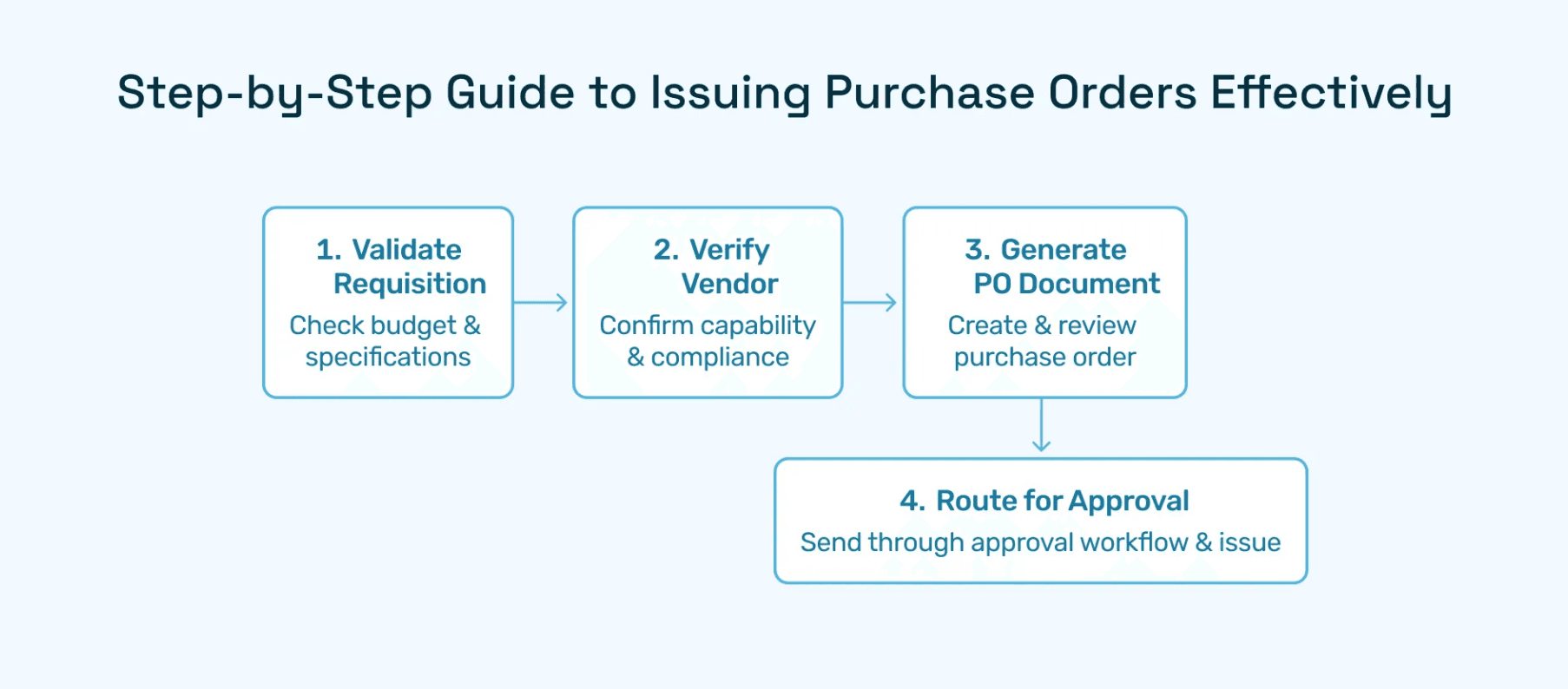
Step-by-Step Guide to Issuing Purchase Orders Effectively
The systematic approach to issuing purchase order documents involves multiple sequential steps that ensure accuracy, compliance, and efficiency while minimizing processing time and potential errors.
Step 1: Purchase Requisition Validation and Processing
The PO creation process begins with thorough validation of underlying purchase requisitions to ensure accuracy, completeness, and organizational authorization. This validation includes verifying budget availability, confirming vendor selection rationale, and validating technical specifications or service requirements.
Key Validation Elements:
Budget code verification and availability confirmation
Vendor master data validation and performance history review
Technical specification accuracy and completeness assessment
Delivery schedule feasibility and business requirement alignment
Compliance with organizational procurement policies and procedures
Step 2: Vendor Selection and Master Data Verification
Effective purchase order issuance requires comprehensive vendor qualification and master data accuracy. Organizations must verify vendor capability, financial stability, and compliance with organizational requirements before committing to purchase obligations.
Vendor Verification Components:
Financial stability assessment and creditworthiness evaluation
Capability confirmation for requested goods or services
Compliance verification with organizational vendor requirements
Insurance coverage validation and risk assessment completion
Contract terms and pricing agreement confirmation
Step 3: Purchase Order Document Generation and Review
The technical process of generating purchase order documents requires attention to detail and adherence to organizational standards. Modern systems automate much of this process while maintaining human oversight for critical decisions and exception handling.
Document Generation Requirements:
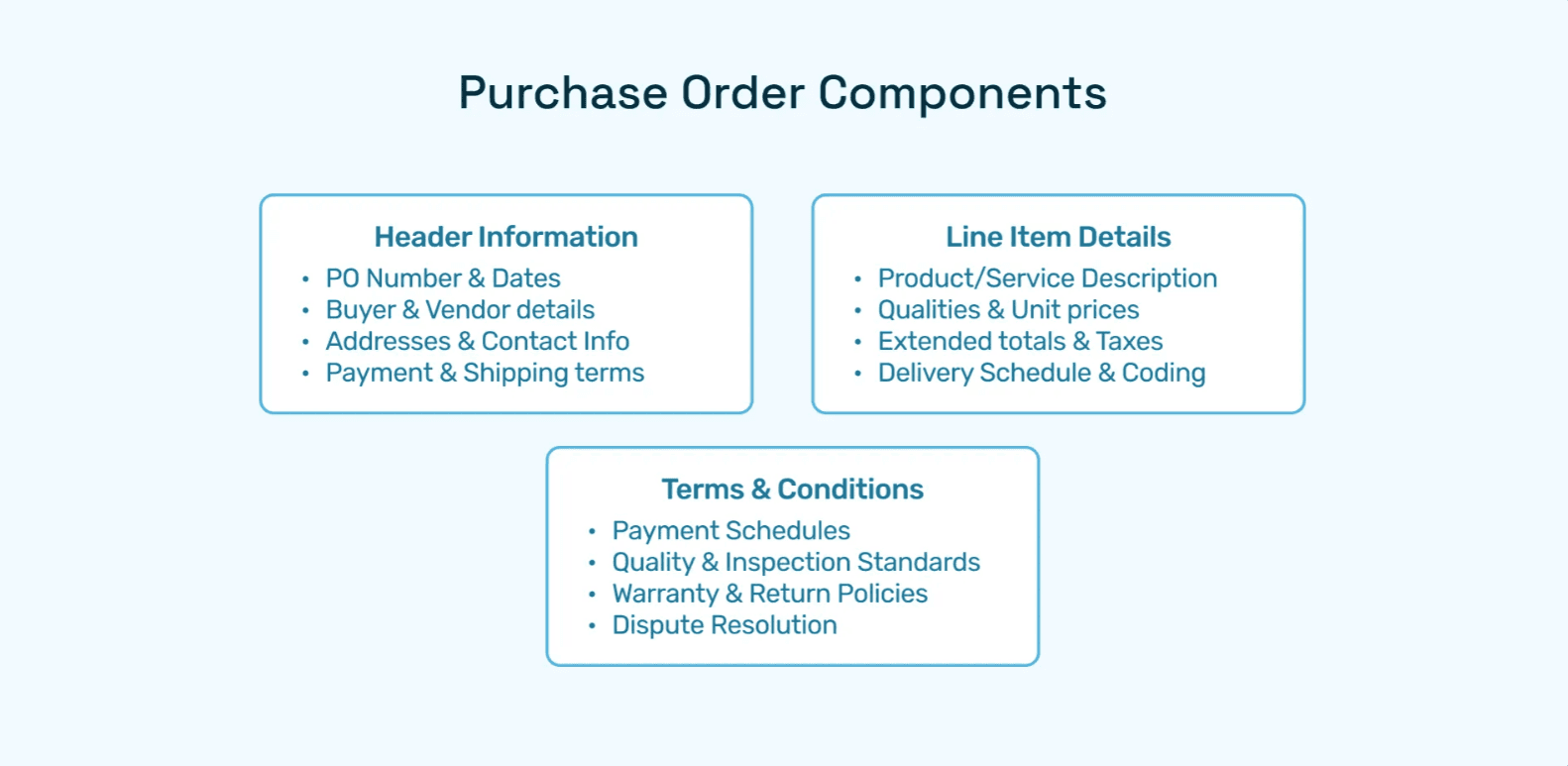
Accurate transfer of requisition information to the purchase order format
Automatic population of vendor master data and contact information
Application of appropriate terms, conditions, and payment schedules
Generation of unique purchase order numbers and tracking references
Integration with enterprise resource planning systems for data consistency
Step 4: Approval Workflow Management and Routing
Purchase order approval workflows ensure appropriate organizational oversight while maintaining processing efficiency. These workflows must balance control requirements with operational speed to prevent unnecessary delays while ensuring compliance with delegation authorities.
Approval Workflow Considerations:
Dollar threshold-based routing to appropriate approval levels
Department-specific approval requirements and specialized expertise
Emergency or expedited processing procedures for critical purchases
Exception handling for unusual circumstances or policy deviations
Audit trail maintenance for compliance and reporting purposes
Advanced Strategies for Purchase Order Process Optimization
Streamlining the PO Creation Process Through Standardization
Organizations achieving excellence in PO creation process management implement comprehensive standardization programs that reduce variability, eliminate redundant activities, and ensure consistent outcomes across all procurement activities.
Template Standardization Framework:
Standardized templates provide the foundation for efficient purchase order creation by pre-populating common fields, ensuring consistent formatting, and reducing manual data entry requirements. These templates adapt to different purchase categories while maintaining organizational consistency and compliance requirements.
Template Design Principles:
Category-specific field requirements with mandatory data validation
Automated population of vendor master data and pricing information
Integration with budget systems for real-time availability confirmation
Built-in compliance checking for organizational policies and procedures
Flexible customization options for unique circumstances or requirements
Workflow Automation Opportunities:
Modern organizations leverage technology to automate routine aspects of purchase order issuance while maintaining human oversight for strategic decisions and exception handling. This automation reduces processing time, eliminates manual errors, and ensures consistent application of organizational policies.
Automation Implementation Areas:
Automatic routing based on purchase amount and category classifications
Real-time budget validation and general ledger coding recommendations
Vendor performance scoring and selection optimization algorithms
Contract term application and compliance verification processes
Document generation and distribution through preferred communication channels
Integration Excellence Across Enterprise Systems
Successful purchase order issuance depends on seamless integration across enterprise systems, including ERP platforms, procurement systems, budget management tools, and vendor communication portals.
ERP Integration Requirements:
Enterprise resource planning integration ensures data consistency, eliminates duplicate data entry, and provides real-time visibility into procurement activities for management reporting and decision-making purposes.
Critical Integration Points:
Vendor master data synchronization and real-time updates
Chart of accounts integration for accurate general ledger coding
Budget system connectivity for real-time availability checking
Inventory management integration for stock level considerations
Accounts payable system preparation for efficient invoice processing
Hyperbots Platform: Transforming Purchase Order Issuance Through AI
Transformative AI-Powered Purchase Order Automation
Hyperbots delivers the most comprehensive AI co-pilot suite specifically designed for purchase order automation, transforming traditional manual processes into intelligent, automated workflows that achieve operational cost reductions of up to 80% while maintaining superior accuracy and compliance standards.
Core Automation Capabilities for PO Issuance:
Intelligent Field Extraction and Auto-Population: The AI co-pilot automatically extracts relevant information from purchase requisitions, vendor communications, and historical data to populate purchase order fields with validated information, eliminating manual data entry and reducing processing time from hours to minutes.
Advanced Validation and Compliance Checking: Machine learning algorithms continuously monitor purchase orders for policy violations, duplicate submissions, and potential anomalies, ensuring compliance before routing for approval while preventing costly errors and rework cycles.
Smart Routing and Approval Management: The system intelligently routes purchase orders through appropriate approval workflows based on dollar amounts, categories, and organizational hierarchy while providing real-time status visibility and automated escalation for delayed approvals.
Automated Vendor Communication and Dispatch: Once approved, the system automatically generates properly formatted purchase orders and delivers them to vendors through their preferred communication channels, including email, EDI, or supplier portal integration with delivery confirmation tracking.
Hyperbots Differentiation in Purchase Order Automation
While traditional procurement solutions focus on basic workflow automation, Hyperbots delivers true artificial intelligence that learns from organizational patterns and continuously improves processing accuracy and efficiency through adaptive machine learning algorithms.
Key Competitive Differentiators:
Contextual Intelligence and Decision Making: Unlike rule-based systems, Hyperbots analyzes historical patterns, vendor performance metrics, market conditions, and organizational preferences to provide intelligent recommendations for vendor selection, pricing optimization, and delivery scheduling decisions.
End-to-End Process Orchestration: Hyperbots provides comprehensive automation across the entire procure-to-pay lifecycle, ensuring seamless handoffs between purchase order creation, receipt confirmation, invoice processing, and payment execution without manual intervention or data re-entry.
Continuous Learning Architecture: The platform's machine learning models continuously improve accuracy and efficiency by learning from user interactions, approval patterns, outcome data, and external market intelligence, delivering increasingly sophisticated automation capabilities over time.
Enterprise-Grade Integration Excellence: Hyperbots seamlessly integrates with leading ERP systems including SAP, Oracle, NetSuite, and Microsoft Dynamics, providing real-time bidirectional data exchange while accommodating custom field requirements and organization-specific configurations without technical complexity.
Best Practices for Purchase Order Issuance Excellence
Developing Organizational Competency in PO Management
Success in raising a purchase order requires more than technological solutions—it demands organizational commitment to process excellence, continuous improvement, and stakeholder engagement across multiple business functions.
Change Management and Training Framework:
Effective implementation of improved purchase order issuance processes requires comprehensive change management that addresses technical training, process standardization, and cultural adaptation to new workflows and technologies.
Key Training Components:
Technical system training for all stakeholders involved in purchase order processing
Process standardization education to ensure consistent application of procedures
Compliance training focused on legal, regulatory, and organizational requirements
Vendor communication best practices for relationship management effectiveness
Exception handling procedures for unusual circumstances or system limitations
Performance Monitoring and Continuous Improvement:
Organizations achieving sustained excellence implement comprehensive performance monitoring systems that track key metrics, identify improvement opportunities, and drive continuous optimization of purchase order issuance processes.
Critical Performance Indicators:
Average processing time from requisition to purchase order dispatch
Error rates and rework frequency with root cause analysis
Approval cycle times and bottleneck identification across organizational levels
Vendor satisfaction scores and relationship quality measurements
Compliance metrics and audit readiness assessments
Risk Management and Compliance Assurance
Modern purchase order issuance must address increasing regulatory requirements, cybersecurity concerns, and operational risk factors that could impact organizational performance or compliance status.
Regulatory Compliance Framework:
Organizations must ensure that purchase order issuance processes comply with applicable regulations including Sarbanes-Oxley requirements, industry-specific regulations, and international trade compliance where applicable.
Compliance Considerations:
Segregation of duties requirements and approval authority delegation
Documentation standards and audit trail maintenance procedures
Data privacy and cybersecurity protections for vendor information
International trade compliance for cross-border procurement activities
Financial reporting accuracy and internal control effectiveness
Cybersecurity and Data Protection:
Purchase order systems contain sensitive vendor information, pricing data, and strategic procurement intelligence that require robust cybersecurity protections and data governance frameworks.
Security Requirements:
Access controls and user authentication for system users
Data encryption for sensitive vendor and pricing information
Backup and disaster recovery procedures for business continuity
Vendor data protection and privacy compliance measures
Regular security assessments and vulnerability management programs
Future-Ready Purchase Order Issuance Strategies
Emerging Technologies and Innovation Opportunities
The future of purchase order issuance involves the integration of emerging technologies, including artificial intelligence, blockchain, Internet of Things sensors, and advanced analytics that will further transform procurement operations and create new competitive advantages.
Artificial Intelligence and Machine Learning Evolution:
Next-generation AI capabilities will provide even more sophisticated automation, predictive analytics, and decision support that anticipates procurement needs, optimizes vendor selection, and prevents supply chain disruptions before they occur.
AI Innovation Areas:
Predictive demand forecasting and automatic purchase order generation
Dynamic pricing optimization based on market intelligence and vendor performance
Supply chain risk assessment and mitigation strategy recommendations
Natural language processing for contract term extraction and analysis
Advanced anomaly detection for fraud prevention and compliance assurance
Blockchain and Distributed Ledger Applications:
Blockchain technology offers opportunities for enhanced transparency, traceability, and trust in purchase order transactions while reducing disputes and improving vendor relationship management through immutable transaction records.
Blockchain Implementation Opportunities:
Immutable purchase order records and audit trails for enhanced compliance
Smart contract execution for automatic milestone-based payments
Vendor verification and reputation scoring through distributed networks
Supply chain traceability and sustainability verification processes
Reduced transaction costs through the elimination of intermediary processing
Integration with Broader Digital Transformation Initiatives
Purchase order issuance optimization should align with broader organizational digital transformation strategies to maximize synergies, reduce implementation costs, and accelerate time-to-value for automation investments.
Digital Ecosystem Integration:
Modern organizations recognize that purchase order automation delivers maximum value when integrated with broader digital initiatives, including enterprise resource planning modernization, data analytics programs, and customer experience enhancement projects.
Integration Strategy Considerations:
Alignment with enterprise architecture and technology roadmaps
Data governance and master data management integration requirements
User experience consistency across related business applications
Change management coordination to minimize organizational disruption
Investment optimization through shared infrastructure and capabilities
Optimizing Your Purchase Order Operations for Peak Performance
The journey to master how to issue PO documents effectively extends far beyond basic transactional processing - it represents a strategic opportunity to transform procurement operations, enhance vendor relationships, and deliver measurable business value through operational excellence and intelligent automation.
Organizations that embrace systematic approaches to issuing purchase order documents while leveraging advanced AI capabilities position themselves for sustained competitive advantage. The PO creation process becomes a differentiator when optimized through comprehensive automation, standardization, and continuous improvement methodologies that adapt to evolving business requirements.
Modern procurement demands solutions that balance efficiency with control, speed with accuracy, and innovation with compliance. Hyperbots leads this transformation by delivering AI co-pilots that eliminate manual inefficiencies while ensuring organizational governance and vendor relationship excellence.
Ready to transform your purchase order issuance operations? Discover how Hyperbots can transform your purchase order processes through intelligent automation that delivers cost reduction and error elimination. Experience our AI-powered procurement platform through a personalized demonstration that showcases real-world scenarios and measurable results. Join finance leaders who have already transformed their operations with the future of procurement automation.
Frequently Asked Questions (FAQs)
1. What are the essential steps to issue a purchase order effectively?
A: Requisition validation, vendor verification, document generation, approval routing, compliance checking, and automated dispatch via AI.
2. What information is required when raising a purchase order?
A: Vendor details, item descriptions, quantities, prices, delivery dates, budget codes, approvals, compliance certifications.
3. How does AI improve the issuing of purchase order process?
A: AI delivers error reduction, cost savings, automated extraction, intelligent routing, and compliance.
4. What are common mistakes when issuing purchase orders?
A: Incomplete vendor information, budget errors, missing approvals, delivery conflicts, and compliance oversights; AI prevents.
5. How do you ensure compliance when issuing purchase orders?
A: Proper approvals, complete documentation, policy adherence, audit trails, and regulatory checking through AI automation.