What is a Standard Purchase Order? Examples and Templates to Streamline Your Procurement Process
Simplify purchase orders with templates, real-world examples, and AI automation for faster, cost-efficient procurement.
Executive Summary
A standard purchase order serves as the cornerstone of efficient procurement operations, providing a structured framework for vendor transactions while ensuring compliance, cost control, and operational transparency. This comprehensive guide examines the essential components of standard purchase orders, offers practical examples and templates, and demonstrates how AI-powered automation can enhance your procurement processes.
Standard purchase orders eliminate procurement ambiguity by establishing clear expectations between buyers and suppliers. Organizations implementing standardized PO processes typically achieve faster processing times and reduce procurement errors. Modern AI co-pilots are transforming this space, with leading solutions delivering operational cost reductions of while maintaining strict compliance standards.
What Defines a Standard Purchase Order?
A standard purchase order represents a legally binding commercial document that formally authorizes a vendor to deliver goods or services at specified terms, quantities, and prices. Unlike ad-hoc procurement requests, standard purchase orders follow established formats and approval workflows that ensure consistency, accountability, and regulatory compliance across all organizational purchases.
The standardization aspect encompasses three critical dimensions: document structure, approval processes, and data requirements. Organizations implementing standard purchase order protocols typically experience 5 minutes reduction in PR creation time while achieving superior vendor relationship management and cost control outcomes.
Key characteristics that distinguish standard purchase orders include:
Structured Data Fields: Every standard purchase order contains mandatory fields such as PO number, vendor information, line items with descriptions and quantities, delivery dates, payment terms, and authorized approver signatures. This consistency enables automated processing and reduces manual intervention requirements.
Predetermined Approval Workflows: Standard purchase orders follow established routing protocols based on purchase amount thresholds, department requirements, and budget classifications. These flexible workflows ensure appropriate oversight while maintaining processing efficiency.
Legal and Compliance Framework: Standard formats incorporate necessary legal language, terms and conditions, and regulatory requirements specific to industry and geographic considerations.
Core Components of Standard Purchase Order Format
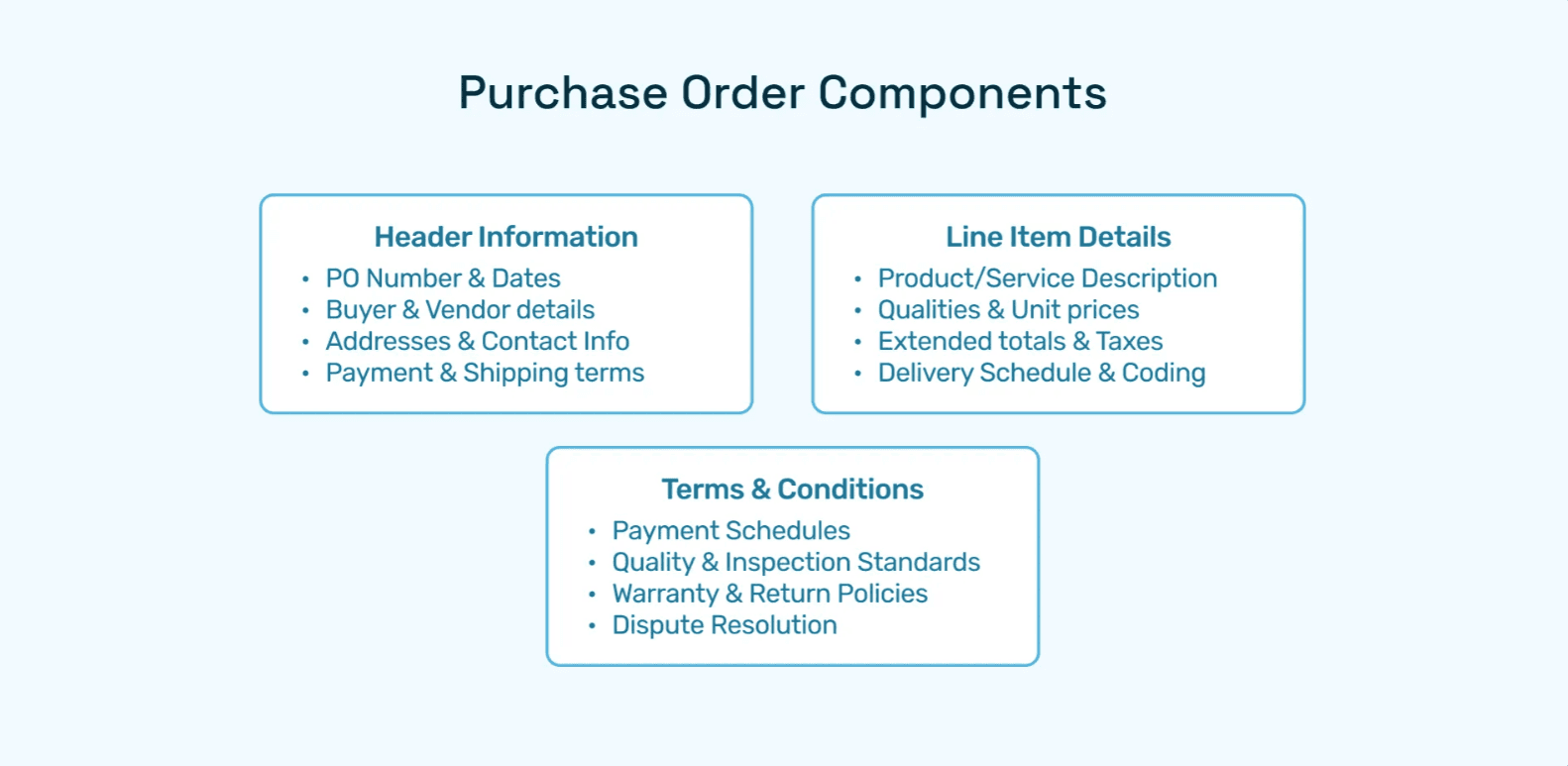
The PO format standard encompasses essential elements that transform informal purchase requests into legally binding commercial instruments. Understanding these components enables organizations to design templates that balance operational efficiency with comprehensive documentation requirements.
Header Information Section:
Purchase order number (unique identifier for tracking and reference)
Issue date and required delivery date
Buyer organization details, including billing and shipping addresses
Vendor information with remit-to addresses and contact details
Payment terms, shipping instructions, and special handling requirements
Line Item Details:
Product or service descriptions with specific part numbers or SKUs
Quantities ordered with unit of measure specifications
Unit prices and extended totals with applicable tax calculations
Delivery schedules and milestone requirements for complex orders
Account coding and budget allocation references
Terms and Conditions:
Payment schedules and early payment discount opportunities
Quality standards, inspection requirements, and acceptance criteria
Warranty provisions and return/exchange policies
Force majeure clauses and dispute resolution procedures
Modern AI-powered procurement systems can automatically populate these fields by extracting information from purchase requisitions, validating against vendor master data, and ensuring compliance with organizational policies.
Standard Purchase Order Examples Across Different Industries
Manufacturing Sector Standard PO Example
Manufacturing organizations require standard PO examples that accommodate complex material requirements, quality specifications, and delivery scheduling constraints. A typical manufacturing standard purchase order includes detailed technical specifications, quality certifications, and inspection protocols.
Example Scenario: A automotive parts manufacturer ordering raw materials demonstrates how standard purchase orders manage multi-line item complexity while maintaining supplier accountability.
PO Number: MFG-2024-15847
Vendor: Premium Steel Solutions Inc.
Delivery Required: March 15, 2024
Terms: Net 30 with 2% early payment discount
Line items include specific steel grades with tolerances, delivery staging requirements, and quality certification mandates. The standard format ensures all stakeholders understand expectations while providing legal protection for both parties.
Professional Services Standard Purchase Order
Service-based standard purchase orders require different structural elements compared to goods procurement, emphasizing deliverable definitions, milestone payments, and intellectual property considerations.
Consulting Services Example:
PO Number: SVC-2024-09234
Vendor: Strategic Advisory Partners LLC
Project Duration: 90 days from contract execution
Payment Structure: 50% upon contract signing, 50% upon deliverable acceptance
The standard format includes detailed scope of work descriptions, performance metrics, and change order procedures that prevent scope creep while ensuring service quality.
Technology Procurement Standard Purchase Order
Technology purchases demand specialized standard purchase order formats that address software licensing, implementation services, and ongoing support requirements.
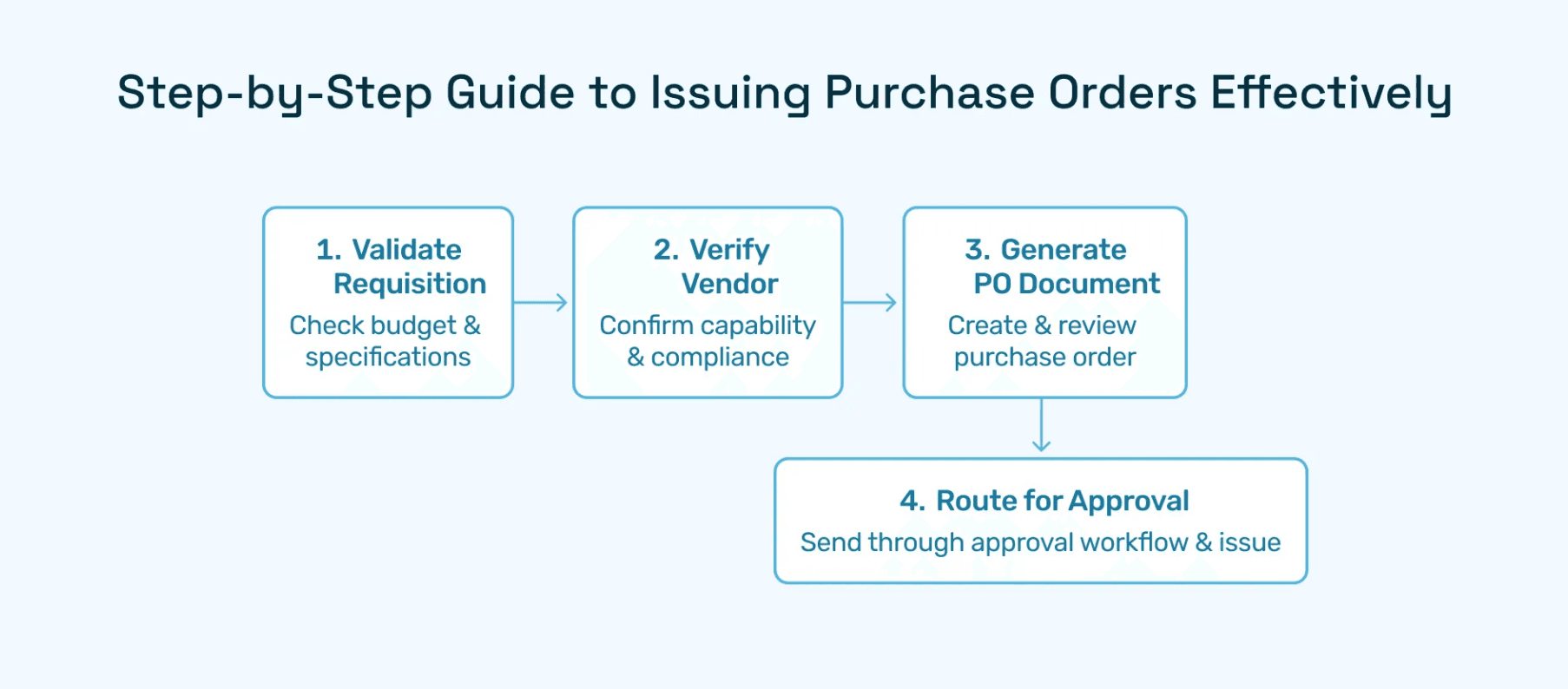
These examples demonstrate how PO template standard approaches adapt to industry-specific requirements while maintaining consistent organizational compliance and approval workflows.
Essential Standard Purchase Order Templates for Different Business Needs
Basic Goods Purchase Order Template
The fundamental PO template standard for physical goods procurement includes essential fields that accommodate most standard business requirements while remaining simple enough for efficient processing.
Template Structure:
Company letterhead and contact information
Sequential PO numbering system with date references
Vendor selection fields with master data validation
Product description templates with standardized naming conventions
Quantity and pricing calculation fields with tax handling
Delivery instruction templates with shipping preferences
Approval signature blocks with delegation authorities
This template serves as the foundation for 70-80% of routine procurement activities while providing flexibility for customization based on specific organizational requirements.
Services Purchase Order Template
Service procurement requires specialized templates that address unique considerations such as deliverable acceptance criteria, milestone-based payments, and intellectual property provisions.
Key Template Elements:
Detailed scope of work description fields
Performance milestone definitions with measurable criteria
Payment schedule templates tied to deliverable completion
Service level agreement parameters and penalty provisions
Confidentiality and intellectual property protection clauses
Capital Equipment Purchase Order Template
High-value capital purchases demand comprehensive templates that address installation requirements, warranty provisions, and asset management considerations.
Specialized Template Features:
Technical specification attachment capabilities
Installation and commissioning requirement fields
Warranty and maintenance agreement provisions
Asset tagging and depreciation schedule references
Insurance and risk allocation clauses
These templates integrate with enterprise resource planning systems to ensure proper asset capitalization and ongoing lifecycle management.
Transformational Impact of AI-Powered Purchase Order Automation
Hyperbots Platform: Transforming Standard Purchase Order Processing
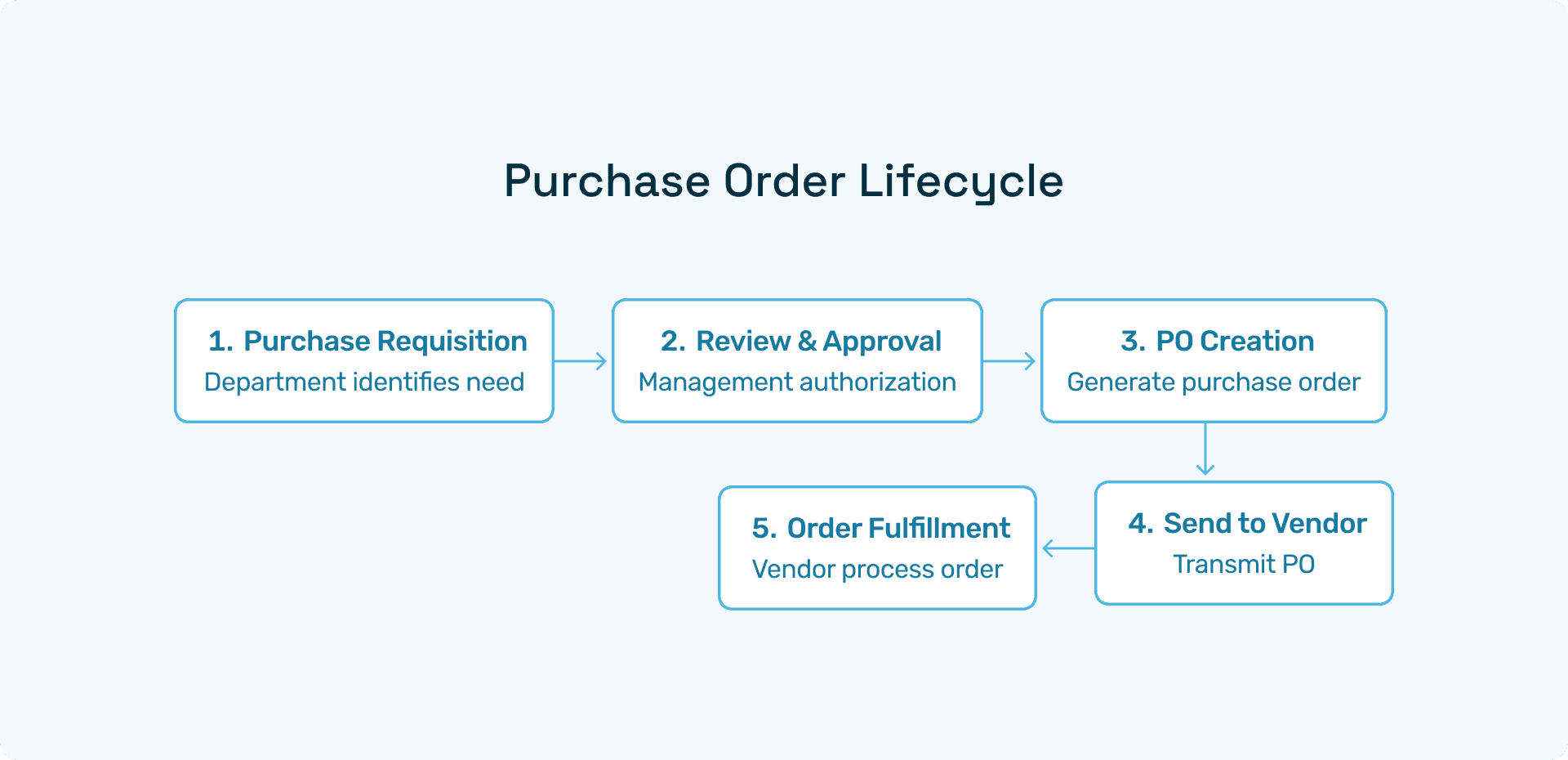
Hyperbots delivers the most comprehensive AI co-pilot suite specifically designed for purchase order automation, achieving operational cost reductions of up to 80% while maintaining superior accuracy and compliance standards. The platform's procurement co-pilot transforms traditional manual processes into intelligent, automated workflows that eliminate bottlenecks and reduce human error.
Core Automation Capabilities:
Automated Field Extraction and PR Autofill: The AI co-pilot intelligently extracts relevant information from purchase requisitions, automatically populating standard purchase order templates with validated data from vendor master files, pricing agreements, and organizational policies.
Validation, duplication & Anomaly Detection: Machine learning algorithms continuously monitor purchase orders for inconsistencies, duplicate submissions, and policy violations, ensuring compliance before routing for approval.
Budget controls & GL coding Recommendations: The system automatically validates purchases against approved budgets while recommending appropriate general ledger coding based on historical patterns and organizational chart of accounts structures.
Configurable workflows: Organizations can customize approval routing, form templates, and business rules without technical intervention, adapting to changing business requirements while maintaining process integrity.
Automated PO Creation & Dispatch: Once approved, the system automatically generates properly formatted purchase orders and delivers them to vendors through preferred communication channels, including email, EDI, or supplier portal integration.
Hyperbots Differentiation in the Procurement Automation Market
While traditional procure-to-pay solutions focus on basic workflow automation, Hyperbots delivers true artificial intelligence that learns from organizational patterns and continuously improves processing accuracy and efficiency.
Key Differentiators:
End-to-End Process Intelligence: Unlike point solutions that address individual process steps, Hyperbots provides comprehensive automation across the entire procure-to-pay lifecycle, including purchase requisition management, purchase order processing, receipt confirmation, invoice processing, and payment execution.
Contextual Decision Making: The AI co-pilot analyzes historical data, vendor performance metrics, and market conditions to provide intelligent recommendations for vendor selection, pricing optimization, and delivery scheduling.
Exceptional Integration Capabilities: Hyperbots seamlessly integrates with leading ERP systems, including SAP, Oracle NetSuite, and Microsoft Dynamics, providing real-time read-write access to master data while accommodating custom field requirements and organizational-specific configurations.
Continuous Learning Architecture: The platform's machine learning models continuously improve accuracy and efficiency by learning from user interactions, approval patterns, and outcome data, delivering increasingly sophisticated automation capabilities over time.
Business Impact and Strategic Value Creation
Beyond direct cost savings, Hyperbots purchase order automation delivers strategic value through improved vendor relationships, enhanced data analytics capabilities, and increased organizational agility.
Strategic Value Areas:
Enhanced Vendor Relationships: Consistent, accurate, and timely purchase order processing improves supplier satisfaction and enables better negotiation outcomes. Organizations typically achieve price improvements through enhanced vendor partnerships.
Data-Driven Decision Making: Automated data capture and analytics provide unprecedented visibility into spending patterns, vendor performance, and procurement trends, enabling more strategic sourcing decisions and budget planning.
Scalability and Growth Support: Automated processes scale seamlessly with business growth, eliminating the need for proportional increases in procurement staff while maintaining processing quality and compliance standards.
Risk Mitigation: Consistent application of organizational policies and regulatory requirements reduces legal and financial risks associated with non-compliant procurement activities.
Implementation Best Practices for Standard Purchase Order Systems
Designing Effective Standard Purchase Order Templates
Successful implementation of standard purchase order systems requires careful template design that balances comprehensive documentation with user efficiency. Organizations should conduct a thorough analysis of existing procurement patterns to identify common requirements and standardization opportunities.
Template Development Framework:
Requirements Analysis: Document existing purchase order variations, approval workflows, and stakeholder needs to identify core template requirements and customization needs.
Stakeholder Engagement: Involve procurement teams, finance personnel, legal departments, and key vendors in template design to ensure comprehensive coverage of operational and compliance requirements.
Iterative Testing: Implement templates in pilot programs with representative transaction types to validate functionality and identify improvement opportunities before full deployment.
Change Management: Provide comprehensive training and support to ensure user adoption while maintaining open feedback channels for continuous improvement.
Integration and Change Management Strategies
Successful purchase order automation requires strategic integration planning and comprehensive change management to ensure user adoption and system effectiveness.
Integration Considerations:
ERP System Connectivity: Ensure seamless data exchange between purchase order systems and existing enterprise resource planning platforms, including master data synchronization and real-time transaction posting.
Vendor Communication Channels: Establish preferred communication methods with key suppliers, including electronic data interchange capabilities and supplier portal access for order status visibility.
Approval Workflow Mapping: Document existing approval authorities and routing requirements to ensure automated workflows replicate organizational governance while improving efficiency.
Performance Monitoring: Implement comprehensive analytics and reporting capabilities to track system performance, user adoption, and business impact metrics.
Advanced Features and Future-Ready Capabilities
AI-Powered Predictive Analytics and Optimization
Hyperbots purchase order automation extends beyond traditional workflow automation to deliver predictive insights and optimization recommendations that drive strategic procurement decisions.
Advanced Analytical Capabilities:
Demand Forecasting: Machine learning algorithms analyze historical purchase patterns, seasonal variations, and business growth trends to predict future procurement requirements and optimize inventory management.
Vendor Performance Analytics: Comprehensive tracking of delivery performance, quality metrics, and pricing trends enables data-driven vendor selection and relationship management strategies.
Spend Analysis and Optimization: Automated categorization and analysis of procurement spending identifies consolidation opportunities, negotiation leverage points, and cost reduction strategies.
Risk Assessment and Mitigation: Continuous monitoring of vendor financial health, geopolitical factors, and supply chain disruptions provides early warning systems for procurement risk management.
Integration Excellence Across Enterprise Systems
Hyperbots delivers unparalleled integration capabilities that ensure seamless connectivity across complex enterprise technology ecosystems while maintaining data integrity and process efficiency.
Comprehensive Integration Framework:
Real-Time Data Synchronization: Bidirectional integration with leading ERP systems ensures instant updates of vendor master data, pricing agreements, and transaction statuses across all platforms.
Custom Field Accommodation: Configuration-driven integration framework adapts to organization-specific ERP customizations and data requirements without requiring technical modifications.
Exception Handling and Recovery: Sophisticated error handling protocols ensure data integrity through read-back verification, optimal retry strategies, and comprehensive exception reporting for user resolution.
Multi-Environment Support: Seamless integration across on-premise, cloud, and hybrid ERP deployments with enterprise-grade security and compliance standards.
Transform Your Purchase Order Operations with Intelligent Automation
Standard purchase orders represent far more than administrative documents; they serve as the foundation for efficient, compliant, and cost-effective procurement operations. Organizations that embrace standardization and AI-powered automation position themselves for sustained competitive advantage through reduced costs, improved vendor relationships, and enhanced operational agility.
The evolution from manual purchase order processing to intelligent automation represents a fundamental shift in procurement operations. Hyperbots leads this transformation with comprehensive AI co-pilots that deliver measurable results: perational cost reduction upto 80%, error elimination, and cycle time improvement.
Ready to transform your procurement processes? Discover how Hyperbots can transform your standard purchase order operations through intelligent automation. Schedule a personalized demo to see firsthand how our AI co-pilots eliminate manual inefficiencies while ensuring compliance and cost control. Experience the future of procurement automation designed by CFOs for finance professionals who demand excellence.
Frequently Asked Questions (FAQs)
1. What are the essential components of a standard purchase order?
A: Unique PO number, vendor details, line items, quantities, prices, delivery dates, payment terms, approvals.
2. How do standard purchase order templates accommodate different industries?
A: Core frameworks allow customization for industry-specific quality certifications, regulatory compliance, specialized terms, conditions.
3. What integration capabilities are required for effective purchase order automation?
A: Seamless ERP integration, vendor communication channels, approval workflows, and real-time data synchronization across enterprise systems.
4. How do automated purchase orders ensure compliance and audit readiness?
A: Complete audit trails, automatic policy enforcement, and detailed reporting reduce compliance costs effectively.