Purchase Order Creation Process: Data, Approvals, and Issuance
A practical guide for CFOs, Controllers, and Procurement Leaders to streamline the purchase order creation process while boosting compliance and efficiency.
Executive Summary
The purchase order creation process is a cornerstone of enterprise procurement, ensuring that organizations maintain control, compliance, and cost visibility across purchasing activities. Yet, in many mid-sized and large enterprises, this process is often bogged down by manual data entry, fragmented workflows, and approval bottlenecks.
This blog provides an in-depth look at the steps, roles, and data flows that define the purchase order creation process. We break down how finance and procurement leaders can optimize data collection, approval routing, and issuance to suppliers. More importantly, we’ll demonstrate how modern platforms like Hyperbots Procurement Co-pilot can transform the PO creation journey, from automated field extraction and anomaly detection to real-time budget controls and audit-ready workflows. With Hyperbots, enterprises can cut costs, reduce approval cycle times, and ensure that the process of purchase order creation delivers both agility and compliance.
Why the Purchase Order Creation Process Matters
Every organization that buys goods or services must ensure purchases are authorized, budgeted, and compliant. That’s where the purchase order creation process comes in.
At its core, a purchase order (PO) is a formal, legally binding document issued by a buyer to a vendor, specifying products, quantities, delivery timelines, and agreed pricing. However, the process of creating a purchase order is more than just drafting paperwork; it’s about managing data accuracy, approval controls, and auditability across departments.
For finance leaders, the PO purchase order process plays a vital role in ensuring cost visibility before commitments are made, enforcing approval workflows that align procurement with budget holders, managing risks by preventing fraud, duplication, or unauthorized spend, and enabling audit readiness through structured documentation. Yet, despite its strategic importance, many enterprises continue to rely on outdated, manual methods to process purchase orders, resulting in frequent errors, costly delays, and heightened compliance risks.
That’s why platforms like Hyperbots are reinventing this workflow, embedding AI-driven automation directly into every stage of the purchase order creation process.
Understanding the Purchase Order Creation Process
What Is the Purchase Order Creation Process?
The purchase order creation process is the structured workflow that organizations use to transform a purchase requisition into a formal purchase order (PO). At its core, it ensures that requests for goods or services are properly documented, validated, approved, and issued in a way that aligns with financial controls, procurement policies, and compliance requirements. Far from being just an administrative formality, this process establishes a legally binding agreement between the buyer and supplier, providing clarity on pricing, quantities, timelines, and terms.
A typical purchase order creation process involves several critical stages:
Gathering purchase requisition data: Employees or departments submit requests for goods or services, including item descriptions, quantities, required delivery dates, budget codes, and justifications.
Validating accuracy and budget compliance: The requisition is reviewed against allocated budgets, cost centers, and vendor catalogs to ensure accuracy and financial control.
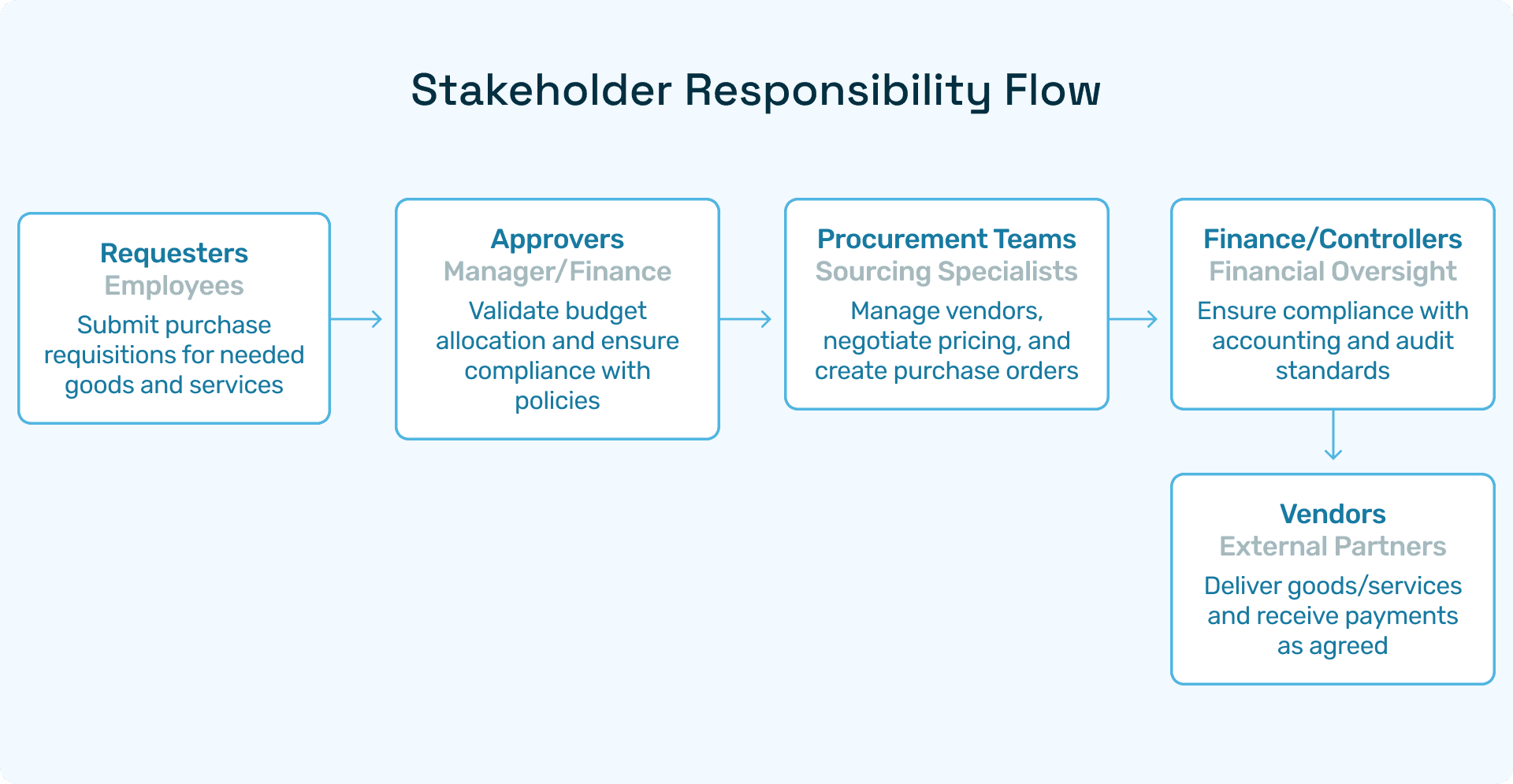
Approval routing across stakeholders: Depending on organizational policy, requisitions may require one or multiple levels of approval from managers, finance leaders, or compliance officers.
Issuance of the PO to suppliers: Once approved, the requisition is converted into a formal PO, which is then sent to the vendor through email, EDI, or procurement portals.
Closing and record-keeping for audits: After fulfillment and payment, the PO is closed, archived, and retained as part of the company’s audit and compliance trail.
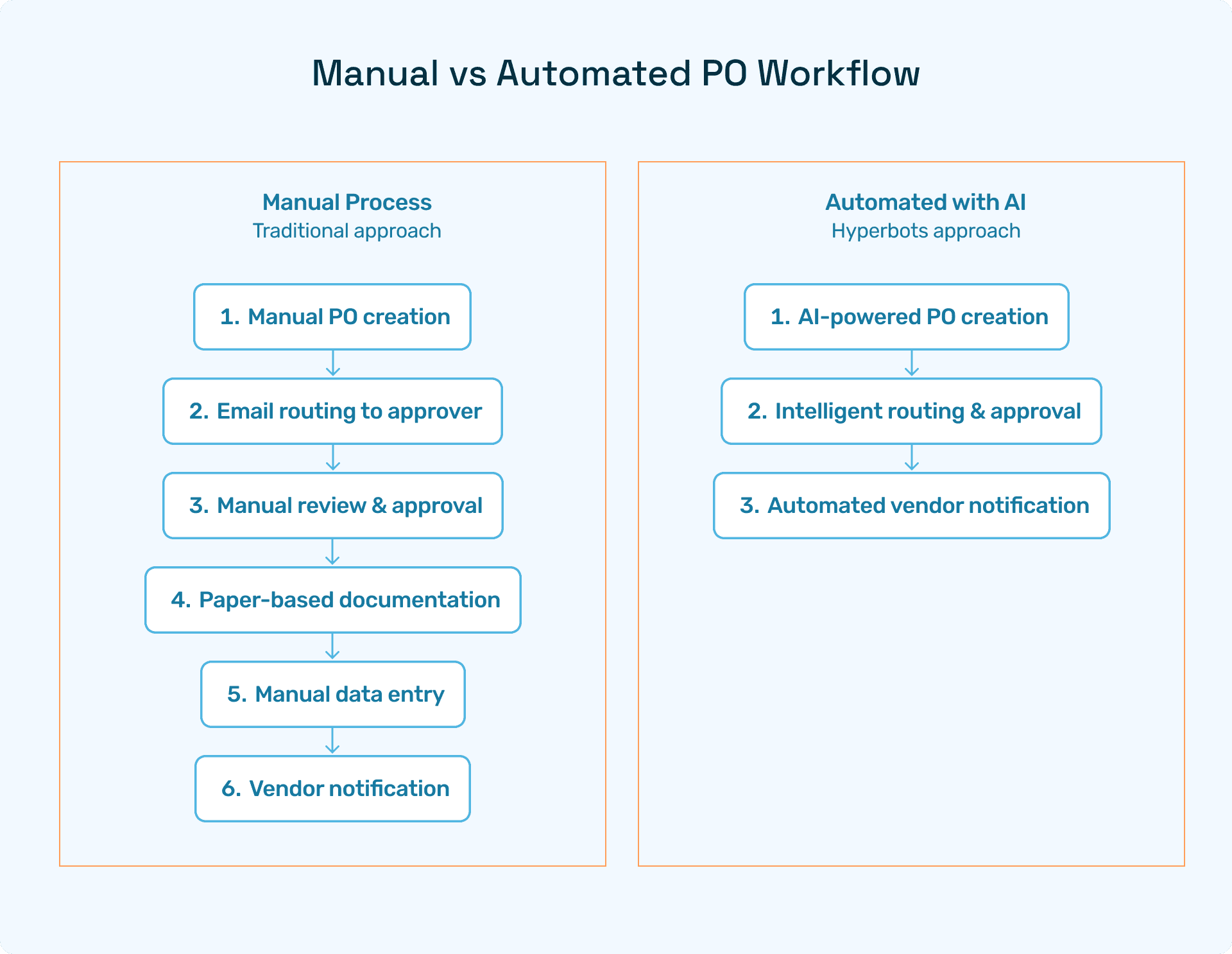
While the PO purchase order process often appears linear on paper, the reality is more complex. In organizations with modern, AI-driven procurement systems, the journey is streamlined with automation that reduces bottlenecks, minimizes human error, and accelerates cycle times. In contrast, enterprises still relying on manual spreadsheets, paper-based forms, or disconnected ERP modules often face delays, inaccuracies, and compliance risks. The degree of automation and integration in this workflow ultimately defines whether the process becomes a strategic advantage or a cost and compliance liability.
Step 1 — Data Collection and Validation
Before a purchase order (PO) can be created and issued, organizations must begin with the accurate collection of requisition data. This foundational step ensures that all downstream stages, from approvals to payment, are built on reliable, consistent, and compliant information. At this stage, data accuracy directly impacts not only cycle times but also budget adherence, supplier relationships, and audit readiness.
The requisition data typically includes:
Item or service description — What is being requested, captured in a standardized format.
Quantity and unit of measure — Ensuring clarity on the scope of purchase.
Unit price and total cost — Accurate pricing information aligned with vendor agreements.
Vendor details — Supplier name, contact information, and vendor codes.
Delivery terms — Timelines, shipping conditions, and any special instructions.
Cost center or GL code — Mapping the spend to the appropriate budget or account.
Challenges in Manual Data Collection
In a traditional environment, most requisition data is entered manually into forms or ERP systems. This introduces several recurring challenges, such as:
Duplicate or incomplete entries that require rework or cause delays.
Incorrect GL coding that misaligns purchases with budgets or reporting requirements.
Manual re-keying across multiple systems creates inconsistencies between requisition, procurement, and finance records.
Lack of validation against existing budgets, leading to overspending or missed savings opportunities.
These inefficiencies not only increase cycle times but also heighten the risk of compliance failures, strained vendor relationships, and poor financial visibility.
Hyperbots Advantage
Hyperbots’ Procurement Co-pilot transforms this critical stage by embedding AI-driven automation directly into the requisition data collection process. Key advantages include:
Automated field extraction — AI reads and extracts data from requisition documents, contracts, or emails, minimizing manual entry.
Auto-fill capabilities — The system leverages historical purchase data to pre-populate vendor, pricing, and delivery details with high accuracy.
Anomaly and duplicate detection — Intelligent algorithms flag errors, missing information, or duplicate requests before they move forward in the workflow.
Real-time budget control and GL-coding recommendations — AI checks requests against budget limits and suggests accurate coding, ensuring compliance with financial policies.
By embedding intelligence at the very beginning of the purchase order creation process, Hyperbots enables organizations to establish a strong foundation for error-free, policy-compliant, and audit-ready purchasing. This reduces friction in later steps such as approvals, issuance, and invoice matching, accelerating the entire PO cycle.
Step 2 — Routing and Approvals
Once requisition data is validated, it progresses to the approval phase of the purchase order creation process. This step is essential to ensure that purchases are legitimate, budget-aligned, and compliant with both internal policies and external regulations. Approvals are not just procedural; they act as a safeguard, ensuring every commitment of organizational funds has been justified and validated by the right stakeholders.
In most enterprises, the approval chain varies depending on purchase size, category, and urgency. Typically, this process includes:
Department managers are verifying the operational need for the purchase.
Finance controllers ensure alignment with allocated budgets and financial policies.
Procurement leads confirming supplier terms, pricing, and compliance with contractual obligations.
Manual Approval Challenges
When handled manually, the approval process often introduces delays and inefficiencies:
Emails or spreadsheets create bottlenecks where approvals are lost in inboxes or overlooked.
Approvals stall when managers are unavailable, delaying the entire purchase order cycle.
Lack of visibility into approval status forces requisitioners to follow up repeatedly, wasting time and resources.
Inconsistent enforcement of policies increases the risk of unauthorized or non-compliant spending.
These bottlenecks frustrate employees, extend cycle times, and compromise the ability of procurement teams to manage spend effectively.
Hyperbots Advantage
Hyperbots’ Approval Workflow Engine eliminates these pain points by embedding AI-driven routing intelligence into the approval process:
Configurable workflows adapt to organizational hierarchies and approval thresholds.
Automated routing ensures requisitions reach the right stakeholders at the right time.
Escalation alerts notify managers and executives about pending approvals, minimizing delays
Mobile-friendly approvals allow decision-makers to review and approve requisitions on the go, significantly cutting cycle times.
Complete visibility dashboards provide procurement teams and CFOs with real-time status updates and analytics.
By automating and optimizing this stage of the PO purchase order process, Hyperbots transforms approvals from a bottleneck into a streamlined, accountable workflow that accelerates business outcomes.
Step 3 — Issuance of Purchase Orders
Once approvals are secured, the next stage is the issuance of the official purchase order. At this point, the requisition evolves into a legally binding document — the purchase order (PO) — which outlines the exact details of the transaction and serves as the cornerstone of accountability between buyer and supplier.
The issuance process typically involves generating the PO in a standardized format, communicating it to the supplier, and ensuring a record is logged for tracking and audit.
Typical Manual Issuance Issues
In many organizations, this step is still handled manually within ERP or email systems, leading to recurring issues such as:
Errors in formatting or missing information that result in supplier disputes or fulfillment delays.
Delays in dispatching POs, especially when staff must manually prepare and email documents.
Lack of centralized tracking leaves procurement teams unsure of which POs have been sent or acknowledged.
Inefficient version control, where updated terms or quantities are not reflected consistently across records.
These inefficiencies can damage supplier relationships, delay procurement cycles, and create significant audit risks.
Hyperbots Advantage
With Hyperbots AI-driven PO Issuance, organizations can ensure accuracy, speed, and compliance at scale:
POs are auto-created directly from approved requisitions, reducing human intervention and error.
Standardized templates guarantee compliance with internal policies, legal requirements, and supplier standards.
Automated dispatch delivers POs via email, EDI, or supplier portals without manual steps.
Comprehensive audit trails track every issuance, modification, and acknowledgment for full transparency.
Real-time confirmation tracking ensures suppliers have received and acknowledged the PO, reducing disputes.
This level of automation shortens cycle times, improves supplier collaboration, and ensures every issued purchase order is audit-ready by design.
Hyperbots Platform Capabilities: Transforming PO Automation
The Hyperbots Procurement Co-pilot is not just another software tool; it’s a strategic automation partner for finance and procurement teams. By embedding AI intelligence at every stage, Hyperbots transforms the process of purchase order creation from a manual, error-prone task into a seamless, compliant workflow.
Here’s how Hyperbots powers each stage of the purchase order lifecycle:
Automated field extraction & PR autofill
Manual re-keying is eliminated. Hyperbots uses advanced field recognition to pull data directly from requisition documents, ensuring accuracy and speed.Validation, duplication & anomaly detection
Every requisition is scanned for inconsistencies, duplication, or budget conflicts. Issues are flagged automatically before entering approval workflows, preventing costly errors.Budget controls & GL coding recommendations
Hyperbots applies financial intelligence to recommend the correct general ledger (GL) codes and validate budget alignment, ensuring transactions meet accounting and compliance standards.Configurable workflows
Approvals are not one-size-fits-all. Hyperbots’ workflows adapt seamlessly to enterprise structures, hierarchies, and compliance requirements, giving organizations control without rigidity.Automated PO creation & dispatch
Approved requisitions are converted into standardized POs instantly. Dispatch occurs via email, EDI, or supplier portals — no manual intervention needed.PO closing & reconciliation
Hyperbots ensures full lifecycle visibility. From issuance to closure, every event is logged, enabling audit readiness and financial transparency.
Supporting Co-pilots
Hyperbots’ ecosystem extends far beyond PO creation. Supporting AI Co-pilots deliver automation across the broader procure-to-pay lifecycle:
Invoice Processing Co-pilot: Captures, validates, and matches invoices to POs.
Vendor Management Co-pilot: Streamlines onboarding, compliance checks, and collaboration.
Accruals & Payments Co-pilot: Automate accounting entries and payment cycles.
Sales Tax Verification Co-pilot: Validates compliance with tax laws, reducing risks of penalties.
Together, these AI agents ensure that organizations don’t just digitize tasks — they transform procurement into a strategic value driver.
ROI of Hyperbots-Led Purchase Order Automation
One of the first questions CFOs and Controllers ask is: What’s the tangible return of automating the purchase order creation process? Unlike generic workflow tools, Hyperbots delivers measurable ROI across direct costs, efficiency, and compliance. Based on enterprise-scale deployments across multiple industries, the results are both immediate and long-lasting.
1. Direct Cost Reductions
Fewer manual hours spent on PO creation: By eliminating data entry, re-keying, and form-filling, finance and procurement teams reclaim significant capacity for higher-value work.
Reduction in error-related rework costs: Mistakes such as incorrect GL coding or duplicate orders often require multiple cycles of correction. Hyperbots prevent these errors upfront.
Lower audit-preparation expenses: Audit readiness is built into the system, reducing the man-hours and consulting costs typically associated with annual compliance reporting.
2. Efficiency Gains
Faster PO cycle times: What previously took days or weeks — routing requisitions, securing approvals, and issuing POs — now happens in hours.
Approval delays eliminated with mobile-first workflows: Managers and finance controllers can review and approve POs on-the-go, ensuring the process never stalls.
Automated vendor dispatch: Suppliers receive standardized, accurate POs immediately, reducing fulfillment delays and strengthening supplier relationships.
3. Risk & Compliance Benefits
Real-time budget control: Every requisition is validated against cost centers and budgets before approval, preventing overspending.
Audit-ready documentation: Every step of the PO lifecycle is logged, creating a searchable compliance trail that regulators and auditors trust.
Fraud detection through anomaly alerts: Hyperbots flags suspicious transactions, duplicate requests, or deviations from vendor terms, protecting organizations from costly fraud.
Taken together, these outcomes create a triple-layered ROI: reduced operating costs, faster cycle times, and improved governance. For CFOs and Controllers, this translates into both immediate savings and long-term strategic value.
The Future of the Purchase Order Creation Process
The future of purchase order creation is not about digitizing paperwork; it’s about intelligent decision-making at speed. Leading research from Gartner and Deloitte confirms that procurement is rapidly shifting from tactical transaction handling to strategic enablement. In this new landscape, automation and AI are not optional; they are the foundation of competitiveness.
With Hyperbots, the PO purchase order process evolves into a strategic advantage:
CFOs gain real-time spend visibility: Every PO created and approved provides instant insight into financial commitments before funds are spent. This proactive visibility improves forecasting and capital allocation.
Controllers ensure audit readiness by design: With standardized, searchable audit trails, financial teams are always “audit-ready” — no more scrambling during year-end reviews.
Procurement leaders focus on partnerships, not paperwork: By eliminating bottlenecks in requisition and approval cycles, leaders can redirect bandwidth toward supplier strategy, negotiation, and value creation.
Ultimately, the process to purchase orders will become less about administrative approvals and more about enabling organizations to make smarter, faster, and more compliant purchasing decisions. Hyperbots is already leading this shift by embedding AI across every stage of the lifecycle.
Taking the Next Step in Purchase Order Automation
The purchase order creation process is no longer a back-office formality — it’s a strategic driver of compliance, savings, and efficiency.
By adopting the Hyperbots Procurement Co-pilot, finance leaders can:
Streamline requisition-to-PO workflows.
Improve compliance without adding manual burden.
Achieve measurable ROI and future-proof their operations.
👉 If your team is ready to see how automation can transform your PO workflows, schedule a demo today.
FAQs About the Purchase Order Creation Process
Q1: What is the purchase order creation process?
A: It’s the workflow organizations use to transform a requisition into a formal PO, including data collection, approvals, and issuance.
Q2: How does automation improve the process of purchase orders?
A: Automation reduces errors, speeds up approvals, ensures compliance, and provides real-time visibility across the PO lifecycle.
Q3: What roles are involved in the PO purchase order process?
A: Typically, requisitioners, department managers, finance controllers, and procurement leads. In automated systems, AI co-pilots assist each role.
Q4: How does Hyperbots compare to traditional P2P platforms?
A: While legacy platforms digitize forms, Hyperbots automates end-to-end workflows, delivering up to 80% cost savings and full auditability.
Q5: Can Hyperbots integrate with ERP systems?
A: Yes. Hyperbots integrates seamlessly with ERP and finance platforms, ensuring smooth data flow across the organization.