Purchase Order Tracking Systems: Real-Time Status, Alerts, and SLAs
Stay ahead with Hyperbots’ AI-driven PO tracking, delivering speed, compliance, and strategic control for leaders.
Executive Summary
Modern procurement teams need more than just purchase order creation tools. They need a purchase order tracking system that ensures visibility, compliance, and accountability across the procurement lifecycle. Without real-time tracking, organizations face missed service-level agreements (SLAs), delayed vendor deliveries, and poor spend governance.
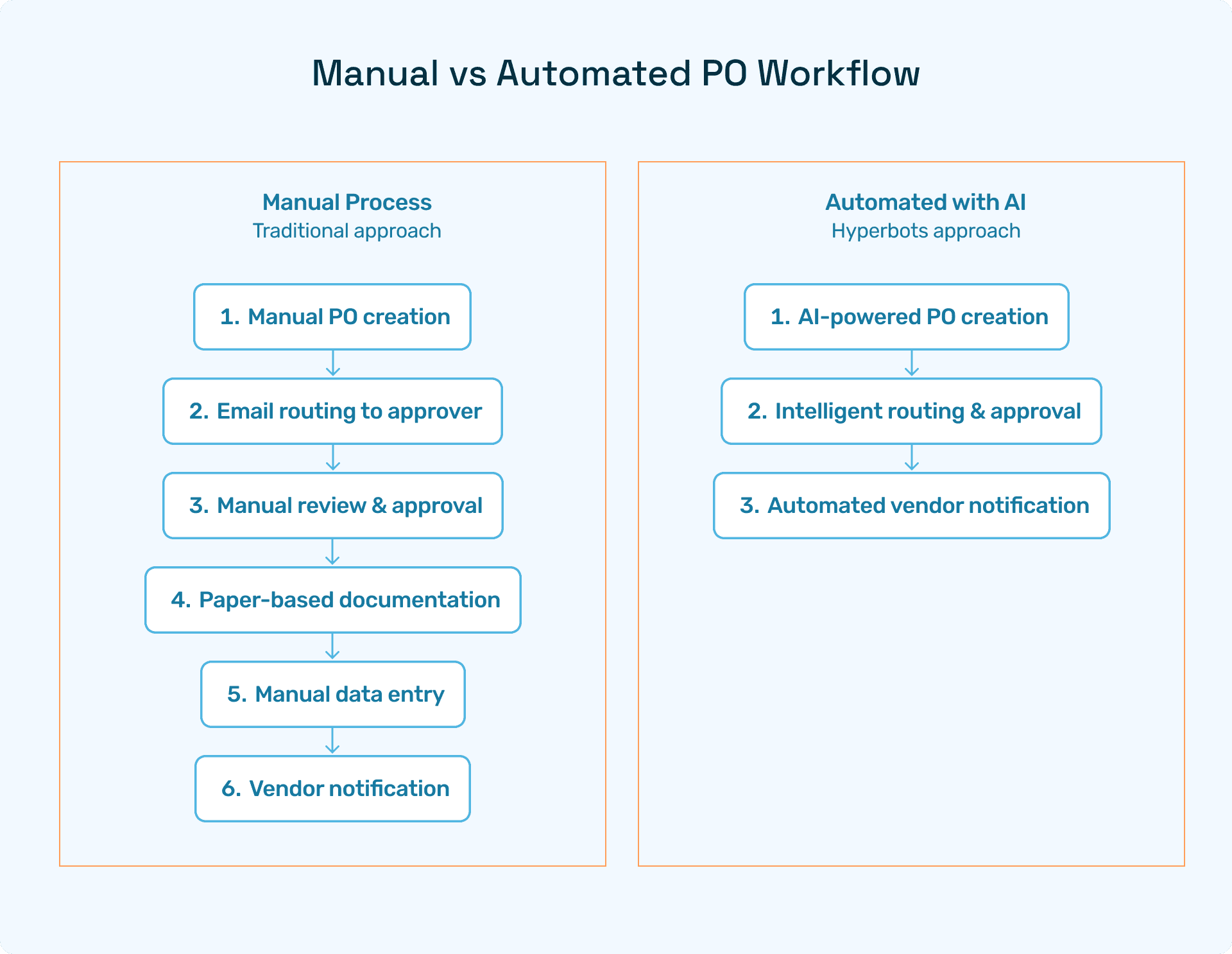
This blog explores how traditional tracking systems fall short, how AI-powered purchase order tracking systems (including generative AI purchase order tracking systems) transform monitoring, and why Hyperbots offers the most advanced platform for CFOs, procurement heads, and vendor managers. With its suite of AI Co-pilots, Hyperbots reduces operational costs by 80%, enforces SLA adherence, and provides predictive insights that no other provider delivers.
What Is a Purchase Order Tracking System?
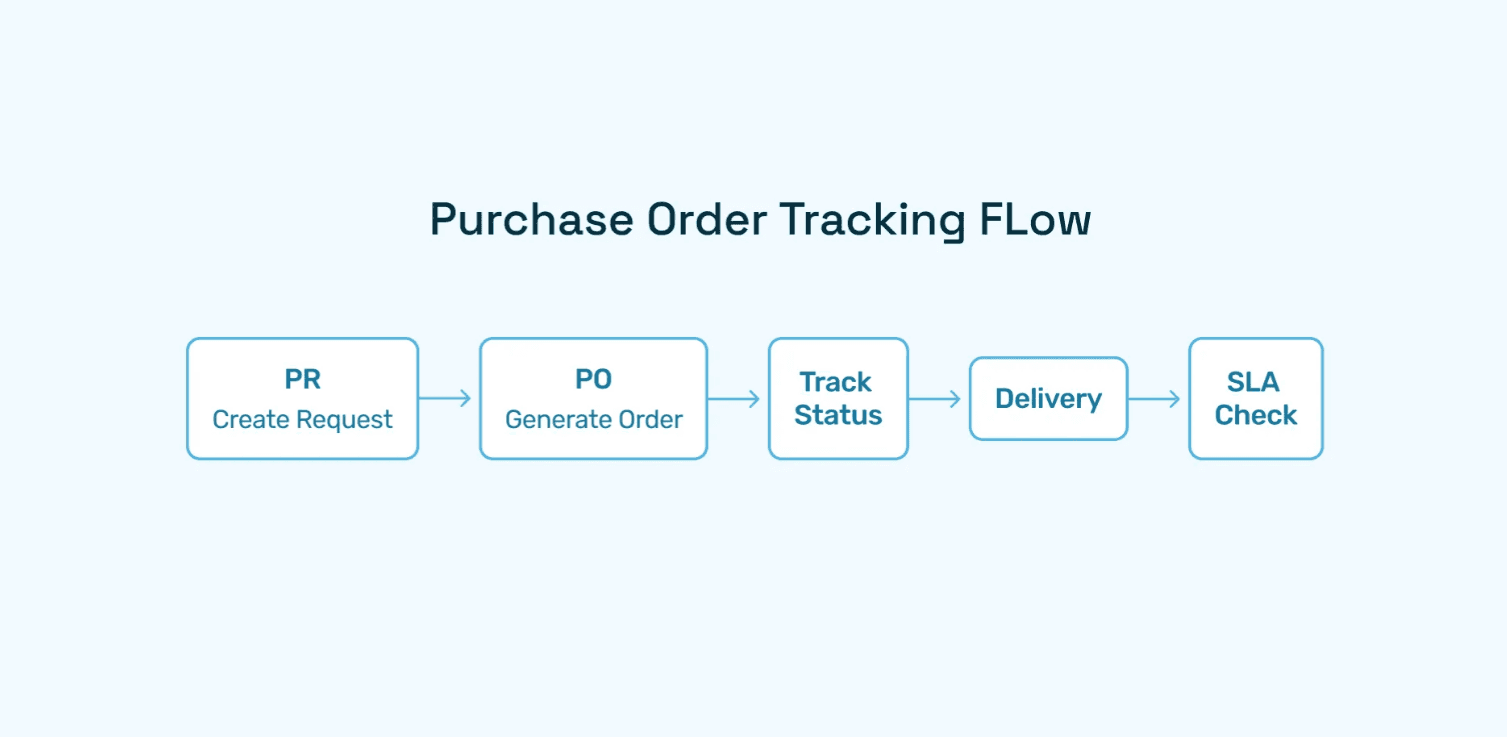
A purchase order tracking system enables organizations to monitor purchase orders from creation through approval, dispatch, fulfillment, and closure. Its primary role is to provide status visibility, knowing where each order stands at any given time.
Core Features of a Purchase Order Tracking System:
Real-time dashboards showing PO status
Alerts for delays, SLA breaches, or missing approvals
Audit trails for compliance
Vendor-level performance monitoring
The Evolution: From Digital Logs to AI Purchase Order Tracking Systems
Traditional tracking relied on spreadsheets or siloed ERP logs. While useful, they lacked real-time intelligence.
Now, finance leaders are turning to the AI purchase order tracking system, powered by automation and predictive analytics. For a deeper look at how finance leaders evaluate automation ROI and deployment timelines, this CFO’s guide to PO automation breaks down what actually matters before implementation.
Advantages of AI-based tracking:
Real-time anomaly detection (delayed dispatch, duplicate POs)
Predictive SLA monitoring (before breaches occur)
Contextual alerts delivered to procurement leads and CFOs
Self-learning workflows that adapt to recurring patterns
Hyperbots’ Procurement Co-pilot is the market leader here. It not only automates PO creation but also tracks PO statuses, SLA compliance, and audit readiness across finance and procurement.
Artificial Intelligence, Generative AI, and Agentic AI in Purchase Order Tracking
AI vs. Generative AI vs. Agentic AI: The Evolution of Purchase Order Intelligence
The procurement technology landscape has evolved through three distinct paradigms, each more capable than the last. Understanding these differences is essential for choosing a purchase order tracking system that actually solves your problems.
Artificial Intelligence Purchase Order Tracking focuses on accuracy and validation. Traditional AI uses machine learning models to validate vendor data, check budgets against GL codes, and detect duplicate orders with 99.2% precision. The system answers binary questions: "Is this vendor approved?" "Does the budget exist?" "Is this a duplicate?" These capabilities reduce manual review time by 40-50% and prevent costly errors, but they remain fundamentally reactive. The AI validates what humans ask it to validate.
Generative AI Purchase Order Tracking adds predictive foresight. By analyzing historical PO and SLA data, generative AI forecasts risks and recommends preventive actions. For example, it learns Vendor X's lead-time trends and alerts: "If you order today, there's a 65% chance of a 7-day delay based on current supply chain conditions. Recommend Vendor Y instead." Generative AI synthesizes patterns across data and generates insights humans wouldn't discover manually. But it still requires human decision-making at critical points.
Agentic AI Purchase Order Tracking goes one step further, it actually takes action. Agentic AI doesn't just predict problems; it autonomously resolves them within predefined guardrails. Here's the critical difference:
Generative AI: "Vendor X shows SLA risk. Recommend activating Vendor Y as backup."
Agentic AI: "Vendor X shows SLA risk. Automatically ordered from Vendor Y. Payment scheduled. Customer notified of delivery timeline."
Agentic AI removes the human bottleneck. It makes thousands of micro-decisions daily such as routing approvals to available stakeholders, matching invoices to POs, flagging discrepancies with context, escalating only exceptions. Most decisions don't require human involvement. For a deeper look at how these three levels of AI differ in practice across the full PO lifecycle, this breakdown of AI-powered purchase order systems is worth reading.
Why Agentic AI Changes Everything
Consider what happens with each approach when a critical SLA breach is predicted:
Traditional AI: System flags the risk. Procurement lead receives alert. They manually research alternatives, contact vendors, update plans. Turnaround: 4-8 hours (if they're available).
Generative AI: System analyzes risk, generates recommendation: "Vendor Y available with 92% confidence." Procurement lead approves recommendation. Backup order is placed. Turnaround: 2-4 hours (still requires human approval at critical step).
Agentic AI: System analyzes risk, determines backup vendor, places backup order automatically, notifies stakeholders of action taken. Turnaround: <5 minutes (humans only intervene if they want to override the agent's decision).
For time-sensitive procurement decisions, minutes matter. A 4-hour delay in activating backup sourcing might be 4 hours too late.
Comparison Table: AI, Gen AI, and Agentic AI
Capability | Traditional AI | Generative AI | Agentic AI |
Duplicate PO detection | Flags duplicates (reactive) | Predicts duplicate patterns | Auto-consolidates similar orders |
SLA monitoring | Alerts after breach occurs | Forecasts breaches 3-5 days early | Auto-activates backup sourcing before breach |
Budget validation | Rejects over-budget orders | Recommends GL code alternatives | Auto-routes to alternative GL codes with approval |
Invoice matching | Flags discrepancies | Generates matching rules | Auto-matches 99%+ invoices, escalates only exceptions |
Approval routing | Fixed approval rules | Learns approval patterns | Auto-escalates to available approvers, predicts approver decisions |
Vendor communication | System generates alerts | System recommends vendor actions | System communicates directly with vendor systems (EDI, APIs) |
Response time | Hours to days | 2-4 hours | Minutes |
Human decision required? | Yes, on every alert | Yes, on recommendations | No, unless human wants to override |
The Real-World Impact: SLA Risk Scenario
A healthcare supplier depends on a critical vendor for surgical components. One day turnaround can mean the difference between scheduled surgeries and emergency delays.
With Traditional AI:
Day 1: Order placed. No real-time vendor visibility.
Day 6: Alert: "Vendor showing unusual lead-time increase."
Day 6, 2 PM: Procurement lead sees alert, but is in a meeting until 3 PM.
Day 6, 3:30 PM: After discussion, decide to activate the backup vendor.
Day 6, 4 PM: Backup order placed.
Day 7: Original vendor confirms 5-day delay. Backup vendor's expedited order arrives on day 11.
Total risk mitigation time: 5+ hours. SLA protection: Partial.
With Generative AI:
Day 1: Order placed.
Day 6, 9:30 AM: System generates prediction: "87% chance of 6-day delay. Backup available from Vendor Y."
Day 6, 10 AM: Procurement lead reviews recommendation, approves.
Day 6, 10:15 AM: Backup order placed.
Total mitigation time: 45 minutes. SLA protection: Strong.
With Agentic AI (Hyperbots):
Day 1: Order placed. Agentic system begins continuous monitoring.
Day 6, 9:15 AM: System detects SLA risk threshold (87% probability). Within guardrails, automatically places backup order with Vendor Y. Sends notification to procurement lead: "SLA risk detected for critical surgical components. Backup order automatically placed with Vendor Y (5% cost premium, $4,500). Original delivery is still monitored."
Day 6, 9:16 AM: Procurement lead is informed, can override if needed, but doesn't need to, in this situation.
Total mitigation time: <1 minute. SLA protection: Comprehensive.
The difference? With agentic AI, the system handles it. Procurement isn't scrambling. They're informed and in control, but the agent is doing the heavy lifting.
Why Hyperbots Built Agentic AI, Not Just AI or Gen AI
Many procurement software companies offer AI or generative AI. Hyperbots went further because we recognized the real bottleneck: human decision-making is slow when you're processing thousands of POs annually. Procurement teams are firefighting, not strategizing.
Agentic AI removes that bottleneck. It makes thousands of micro-decisions every day such as routing approvals, matching invoices, escalating discrepancies, coordinating with vendors. The system learns your organization's preferences and makes decisions in alignment with your values.
The result? Procurement teams spend less time on reactive crisis management and more time on strategic sourcing, vendor relationships, and supply chain optimization. Finance gets real-time visibility. CFOs sleep better. Vendors get paid on time. SLA breaches become predictable and preventable.
This is why agentic AI is the future of procurement, and why Hyperbots is leading this evolution.
Common Purchase Order Tracking Challenges
Why Most Organizations Struggle with PO Tracking, And How Agentic AI Solves It
Even organizations with sophisticated ERP systems struggle with purchase order visibility and control. The issue isn’t the software itself. Traditional tools were designed to process transactions, not deliver operational intelligence. Here are the most critical PO tracking challenges, with SLA tracking at the center, and how agentic AI transforms procurement.
Challenge 1: SLA Opacity: The Most Costly Problem
The problem: Service Level Agreements define vendor expectations, but without real-time tracking, those expectations go unmet. A vendor commits to 14-day delivery. On day 14, no shipment arrives. Procurement learns about the delay for the first time that too at the worst possible moment.
Without visibility into vendor performance, organizations are constantly reactive. A supplier falls behind on delivery, but procurement doesn't know until the due date passes. By then, it's too late to activate backup plans. Production halts. Customers are disappointed. Emergency sourcing costs 25-35% premiums. The total cost of a single SLA breach can exceed $150,000.
Scale this across an organization with 100+ vendors: 8-15 SLA breaches annually = $1-2M in avoidable costs.
Why it happens: Traditional ERP systems show PO status (created, approved, dispatched) but don't monitor actual vendor delivery performance. Vendor communication is sporadic (email, phone, inconsistent updates). Procurement reacts to delays only after they happen, scrambling for emergency solutions.
How Agentic AI Prevents SLA Breaches:
With agentic AI systems like Hyperbots, SLA tracking is continuous and predictive. The system monitors 24/7, analyzing:
Vendor's historical delivery variance (does this vendor always deliver on time, or is there pattern volatility?)
Current vendor capacity and backlog (are they overloaded?)
External supply chain factors (port delays, shipping disruptions, geopolitical events)
Market conditions (are semiconductor shortages affecting component availability?)
Result: When risk is detected, the agentic system doesn't just alert you, it acts.
Real example: A mid-market manufacturer orders critical components from Vendor X (14-day lead time). On day 5, the agentic system analyzes vendor capacity and forecasts: "Vendor X shows 72% probability of a 7-day delay based on current backlog and supply chain conditions."
Within guardrails (procurement pre-configured approval for up to 8% cost premium), the agentic system automatically:
Identifies Vendor Y as backup (12-day lead time, can deliver on original promised date)
Places backup order for 50% of volume ($5,000 additional cost)
Notifies procurement: "SLA risk detected. Backup order placed. Original vendor still monitored."
Updates CFO dashboard (budget impact visible, decision logged)
By day 6, procurement is informed and in control. By day 14, if Vendor X delays as predicted, Vendor Y's partial shipment arrives on time. No production disruption. Total mitigation cost: $5,000 (backup premium) vs. $150,000+ (emergency response).
Impact: SLA compliance: 73% → 94%+. Cost of SLA failures: $1-2M annually → $100-300K (mostly preventive backup premiums, not emergency costs).
Challenge 2: Approval Bottlenecks: The "Where's My Signature?" Problem
The problem: A PO reaches an approver. The approver is traveling, in meetings, or simply slow. The PO sits in limbo for days. Vendors don't receive orders. Delivery timelines slip before procurement even knows about them.
How Agentic AI Eliminates Approval Delays:
The agentic system learns your organization's approval patterns. It knows which approvers handle which categories, who's typically available, who delegates authority, and even which time of day certain approvers are most responsive.
When a PO needs approval:
If the primary approver is unavailable, the system intelligently escalates to their delegate (no delay)
If a low-risk PO (small amount, approved vendor, normal GL code), the system can auto-approve within guardrails
If a higher-risk PO, the system routes to the most appropriate approver based on pattern analysis
Impact: Approval time: 2-5 days → 2-4 hours. POs dispatch faster. Vendors receive orders promptly. Delivery commitments are established immediately.
Challenge 3: Duplicate and Erroneous POs: The "$50K Waste" Problem
The problem: Two procurement team members, unaware of each other, create identical orders. Both ship. $50,000 overspend, excess inventory, confused vendor.
Data quality issues in enterprise systems create significant operational risk. Gartner estimates that poor data quality costs organizations an average of $12.9 million annually through inefficiencies, inaccurate reporting, and operational errors. In procurement environments, these data problems often surface as duplicate purchase orders, incorrect vendor records, and mismatched invoices.
How Agentic AI Prevents Duplicates:
At the moment a PO is created, the agentic system checks:
Existing POs with same vendor + SKU + cost (duplicate alert)
Existing POs with similar vendor + similar SKU within 30 days (potential consolidation opportunity)
Unusual cost variance vs. historical pricing (data entry error? price change?)
Detection accuracy: 99.8%.
But here's where agentic AI differs from traditional AI: Instead of just flagging, it can act. If a duplicate is detected, the system:
Holds the order for review (won't dispatch without approval)
Recommends consolidation: "You have two pending Widget A orders (50 units each). Consolidate for volume discount: saves $2,400."
Alerts both procurement team members: "Duplicate order detected. Recommend consolidation."
Impact: Duplicate PO prevention: $280K-$525K annually. Consolidated orders: Better pricing, fewer vendor interactions.
Challenge 4: Invoice-to-PO Mismatch Hell: The "Payment Held for Weeks" Problem
The problem: Invoice arrives. Does it match the PO? Finance manually compares line items, costs, quantities. Discrepancies trigger holds. Payment is delayed 2-3 weeks. Vendors become frustrated. Relationships strain.
How Agentic AI Eliminates Invoice Delays:
When an invoice arrives (email, EDI, vendor portal, scanned), the agentic system:
Reads and extracts invoice data (handles poor scans, handwritten fields, multiple formats)
Automatically matches to original PO in <1 minute (vs. 2-4 hours manual)
Compares: quantity, cost, delivery date
Flags discrepancies with context: "Invoice shows 52 units, PO shows 50. Based on this vendor's history, small overages (<5%) happen 12% of the time. Recommend auto-approve with variance note."
Applies pre-configured rules (accept small overages? block duplicates? escalate cost variance >10%?)
Matches 99%+ of invoices automatically. Only exceptions escalate to humans.
Result: Three-way matching (PO → Receipt → Invoice) becomes automatic. Payment goes out on schedule. Vendors receive payment on time. Relationships strengthen.
Impact: Invoice matching: 2-4 hours → 2 minutes per invoice. Payment delay: 2-3 weeks → 3 days. Vendor satisfaction: Dramatically improved.
Challenge 5: Audit Readiness Stress: The "Year-End Panic" Problem
The problem: Year-end auditors ask: "Show us all POs. Prove they were properly authorized." Finance scrambles through emails and logs. Auditors ask tough questions: "Who approved this PO from an unapproved vendor?" "Why is this missing a GL code?" Team can't answer quickly.
How Agentic AI Creates Audit-Ready Systems:
Agentic systems log every decision with reasoning:
PO created: [date/time/user]
Vendor approved? Yes (Vendor master validated on [date])
Budget available? Yes (GL code XYZ has $500K remaining)
Duplicate check: No duplicates detected (unique vendor + SKU + date)
Approval routing: [Primary approver unavailable], escalated to [Delegate], approved [date/time]
Invoice matched? Yes ([date], 100 units, $50,000)
Payment scheduled: [date]
Auditors see the full chain of custody. Every decision is documented. Compliance is transparent.
Impact: Audit prep: 2-3 days of manual work → 1 hour (pull reports). Audit findings: Likely (weak controls) → Near-zero (controls documented).
Hyperbots AI Co-pilots: How Agentic AI Makes Procurement Easy
How Hyperbots' Agentic AI Makes Procurement Simple, Not Complicated
Most procurement software adds features, which adds complexity. Procurement teams end up managing the software instead of managing procurement.
Hyperbots took the opposite approach. We built agentic AI systems that reduce complexity by handling the heavy lifting autonomously. Procurement teams don't need to learn new workflows. They need to spend less time on busywork and more time on strategy.
Here's how agentic AI makes life easier:
Your System Works the Way You Think, Not the Way Software Wants
Traditional software requires you to adapt your processes to the tool. ERP systems force you into rigid approval workflows. You have to manually route POs between approvers. You have to enter data in specific formats. The software dictates how procurement works.
Hyperbots learn how procurement works at your organization. The Procurement Co-pilot observes:
Which approvers typically approve which categories (based on historical patterns)
Which approval paths are fast vs. slow
Which vendors need additional checks vs. which can be trusted
Which GL codes are used for similar purchases
Within weeks, the system understands your organization's unique procurement DNA. It routes POs intelligently. It pre-fills forms accurately. It escalates only when needed. The software adapts to you, not the other way around.
What this means for your team: No training on new workflows. No rigid rules forcing workarounds. You work how you naturally work, but faster and with fewer errors.
Thousands of Decisions Happen Without You
An agentic system makes decisions continuously. Matching invoices, flagging discrepancies, escalating exceptions, coordinating with vendors. Most decisions don't require human involvement.
Your Invoice Processing Co-pilot receives 50 invoices daily. It matches 48 automatically. It flags 2 with discrepancies that need human review. You deal with exceptions, not routine transactions.
Your Vendor Management Co-pilot monitors 100+ vendors continuously. It tracks SLA performance, analyzes vendor financial health, recommends diversification when needed. You only get involved when strategic decisions are required.
Your Payments Co-pilot respects payment terms, recommends payment schedule intelligently, enforces SLA compliance checks. Ensuring that Vendors get paid on time.
What this means for your team: Procurement should focus on strategic sourcing, vendor relationships, and supply chain optimization. That’s the work that actually matters. Administrative busywork gets automated away.
SLA Breaches Become Preventable, Not Reactive
Most procurement teams are firefighters. They react to SLA breaches after the fact. With agentic AI, SLA breaches become rare events you actually prevent.
The system monitors vendor performance 24/7. When risk is detected 3-5 days before a delivery due date, it doesn't just alert you rather it acts autonomously:
Analyzes alternatives
Places backup orders (within pre-approved thresholds)
Notifies stakeholders
Tracks multiple sources through to delivery
You're informed and in control, but the system is doing the heavy lifting. Critical components arrive on time. Production doesn't halt. Customer deliveries are on schedule.
What this means for your team: SLA compliance jumps from 70-75% to 94%+. Supply chain disruptions drop dramatically. You spend time on vendor strategy instead of damage control.
Real-Time Visibility Replaces Month-End Surprises
Finance departments dread month-end. Suddenly, they need to find all POs, match them to invoices, and reconcile GL codes. It's a 2-3 day scramble.
With Hyperbots, procurement data is always current. At any moment, CFO can see:
All active POs and their status
Which invoices are matched, which are pending
Budget vs. actual spend by GL code
Vendor SLA compliance by category
Cash flow impact of payment schedules
Month-end close becomes routine. No surprises. No scrambling. Finance closes the books faster.
What this means for finance: Real-time visibility into commitments vs. actuals. No month-end surprises. Faster close cycles.
Vendors Appreciate Working With You
When vendors work with a procurement team using agentic AI, they notice:
POs arrive instantly (not buried in email)
Communication is clear and consistent
Payments arrive on time (no awkward payment delay conversations)
Performance is measured fairly (SLA expectations are transparent and achievable)
Vendors deprioritize unpredictable customers. They allocate capacity to reliable partners. With Hyperbots, you become the reliable partner vendors want to work with. You get better pricing, faster delivery, and preferential allocation during supply constraints.
What this means for vendors: Better relationships, predictable orders, on-time payment, fair treatment. They prioritize your orders.
The Result: Procurement Becomes Strategic
When agentic AI handles routine transactions such as invoice matching, PO routing, duplicate detection, vendor monitoring while procurement teams can finally do strategic work.
You spend time on:
Vendor consolidation and optimization (fewer, more strategic vendors)
Supply chain resilience (identifying single points of failure, diversifying critical suppliers)
Cost optimization (leveraging volume data, negotiating better terms)
Innovation (exploring new sourcing strategies, emerging suppliers)
This is the future of procurement: autonomous systems handling transactions, procurement professionals handling strategy.
Hyperbots makes this possible. Not by adding features, but by removing the need for you to manage the system. The system manages itself. You manage procurement.
Industry Insights: Why Tracking Matters More Than Ever
A Gartner report shows enterprises lose up to $1.2M annually due to SLA breaches and missed supplier commitments.
A Deloitte study found that AI in procurement can cut process costs by 30–40% while improving compliance rates.
Hyperbots builds on these insights with explainable AI and generative capabilities, ensuring finance leaders not only react to SLA breaches but also predict and prevent them.
Moving Beyond Tracking: Toward Autonomous Procurement
Today’s finance leaders don’t just want monitoring. They want a self-driving procurement system.
Hyperbots’ vision:
From Monitoring purchase orders → to Automated anomaly detection
From Alerts → to Self-resolving workflows
From Reporting SLA breaches → to Preventing them proactively
This is the future of procurement, and Hyperbots is already enabling it.
Where Finance Leaders Go Next
Organizations that rely on spreadsheets or basic ERP logs are already falling behind. A true purchase order tracking system with AI and Gen AI capabilities ensures speed, compliance, and strategic control.
With Hyperbots’ Co-pilots, CFOs and procurement heads gain the most advanced PO tracking capabilities in the market.
👉 Explore the Procurement Co-pilot or schedule a tailored demo today to see how Hyperbots transforms purchase order automation.
FAQs
1. What is a purchase order tracking system?
A: It’s a tool that enables organizations to monitor purchase orders across their lifecycle with real-time visibility and SLA tracking.
2. How does an AI purchase order tracking system differ?
A: It uses AI models to detect delays, anomalies, and vendor risks proactively.
3. What role does generative AI play in PO tracking?
A: It generates predictive insights, forecasts risks, and suggests preventive actions.
4. How does Hyperbots ensure SLA compliance?
A: Through real-time alerts, automated escalations, and vendor-level performance dashboards.
5. What ROI can I expect from Hyperbots’ tracking system?
A: Up to 80% cost savings and near-perfect SLA compliance rates.