What Is an AI-Powered Purchase Order System? (And Why It Matters to Finance Leaders)
From spreadsheets to ERP to intelligent automation, purchase order systems have evolved dramatically. Today’s AI-powered systems don’t just track orders. They also predict problems, prevent delays, and automate decisions. Here's what CFOs need to know.
Your Procurement Team Is Stuck in Manual Work
Here's a reality most CFOs face but don't often discuss: your procurement team spends a significant portion of their time on tasks that require no human judgment. Matching invoices to purchase orders. Flagging duplicate orders. Escalating approvals to the right person. Monitoring whether vendors are actually delivering on time.
These aren't strategic activities. They're busywork. And yet, they take hours every week.
The problem isn't laziness or inefficiency. It's that traditional tools like spreadsheets, ERP systems, basic procurement software were designed to process transactions, not to think about them. They track what happened. They don't predict what's about to happen.
An AI-powered purchase order system is fundamentally different. It doesn't just monitor your POs. It learns from your history. It detects patterns humans would miss. And it takes action before problems become expensive.
This shift matters more to CFOs than it might first appear. Because when procurement works better, finance closes faster. Vendors get paid on time. SLA breaches become rare instead of constant firefighting. Working capital improves. Compliance gets easier.
Let's explore what's actually happening under the hood.
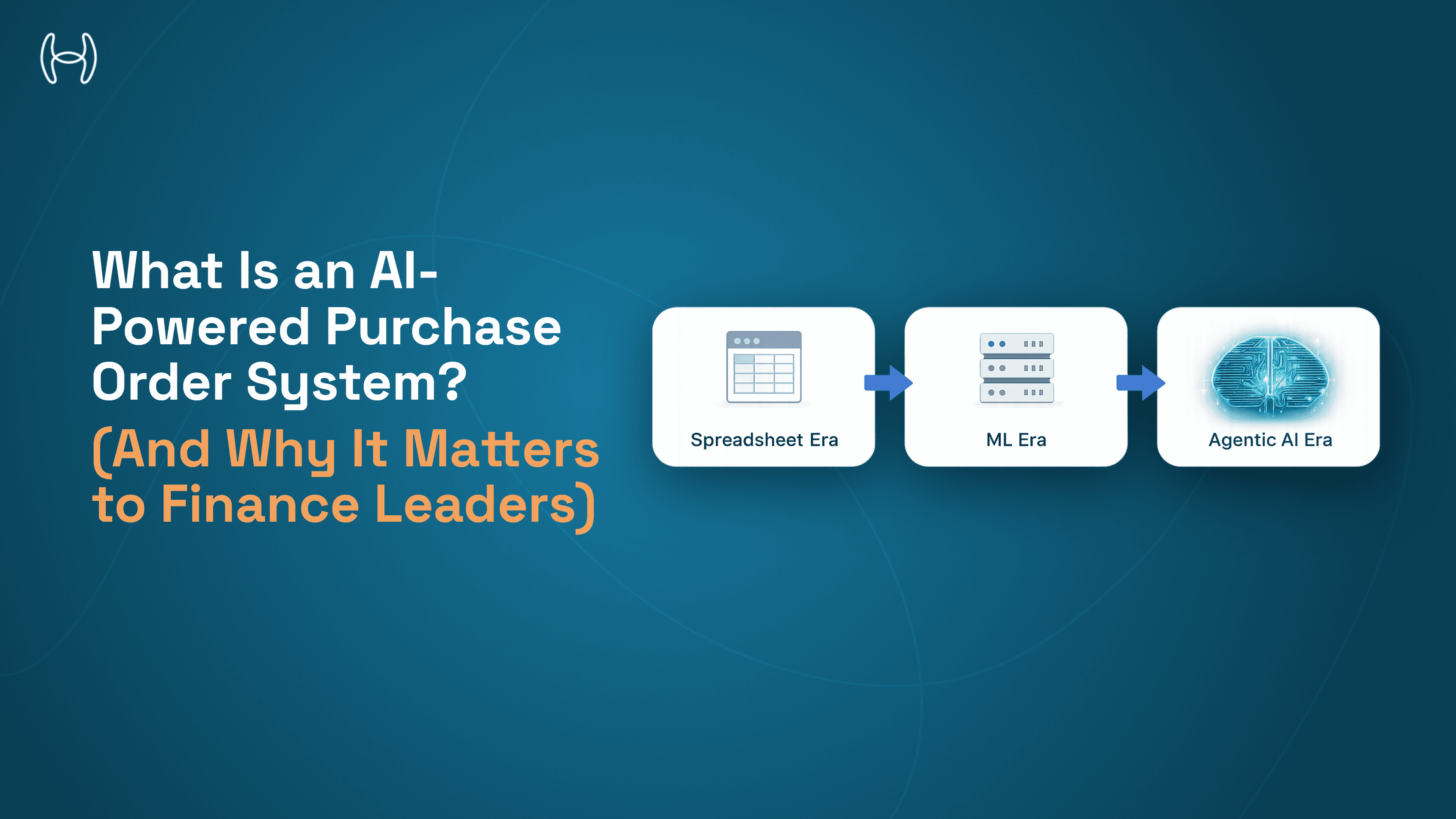
The Evolution of PO Systems: From Spreadsheets to Intelligence
The Spreadsheet Era: Visible but Chaotic
Not long ago, many organizations tracked purchase orders in Excel. Some still do.
The spreadsheet era had one advantage: visibility. Everyone could see which orders existed. But it had many disadvantages. Data lived in multiple places. Updates were manual and slow. Vendor information was scattered across emails and notes. When you needed to know "What did Vendor X promise to deliver this month?" the answer required digging through old communications.
Emergency sourcing was common because nobody saw supply chain risks until they became crises.
The ERP Era: Centralized but Rigid
Then came ERP systems. Suddenly, PO data was centralized. Audit trails were automatic. You could run reports showing all active orders, budget spend, vendor performance.
This was progress. But ERP systems came with a tradeoff: you had to work their way. Approval workflows were fixed. If you needed something different, you either adapted your process or custom-coded a workaround. And critically, ERP systems remained reactive. They showed you what happened. They didn't warn you about what was about to happen.
A vendor could be three days behind schedule, and you wouldn't know until the due date passed.
The AI Era: Predictive and Autonomous
The shift to AI-powered systems changes the equation entirely.
Instead of asking "Where is this order?" modern systems ask "Will this order arrive on time? If not, what should we do about it?" The system learns your vendor's historical delivery patterns, analyzes their current capacity, monitors external supply chain factors, and forecasts risk before it becomes a problem.
Real-world example: A mid-market manufacturer orders critical components from Vendor X with a promised 14-day delivery. With a traditional ERP, you wait. With an AI-powered system, the system analyzes Vendor X's current backlog, delivery variance history, and supply chain conditions on day 3, 4, and 5. If risk rises above a threshold, the system doesn't just alert procurement. Depending on how your organization sets it up, the system can act automatically identifying alternatives, placing backup orders, and notifying the team.
The result: an order that might have arrived three weeks late now arrives on schedule, because backup sourcing happened before it was needed.
This is the difference between reactive procurement (fixing problems after they happen) and predictive procurement (preventing them before they start). Understanding how real-time PO tracking with SLA monitoring works in practice helps explain why this shift is so consequential for finance teams.
What Actually Makes a System "AI-Powered"?
Not all software that claims to be "AI-powered" actually is. Marketing teams use the term loosely. So let's be specific about what we're talking about.
An AI-powered purchase order system uses machine learning to validate, predict, and automate decisions across the PO lifecycle. It learns from your data. It identifies patterns. It acts on what it learns.
The core capabilities that matter most:
Duplicate Detection: A system learns what makes orders similar like same vendor, same SKU, similar quantities, similar costs, similar timing. When a procurement team member creates a new PO, the system compares it against existing orders and flags potential duplicates in real time. Unlike a person manually reviewing, the system never gets tired and never misses duplicates buried in a month-old order.
Vendor Risk Assessment: The system monitors vendors continuously. It tracks delivery performance, financial health signals, backlog trends, and supply chain disruptions. When risk emerges and a vendor's lead times are lengthening, or their financial health metrics are declining, the system surfaces this before the typical quarterly business review.
SLA Breach Forecasting: The system compares a vendor's historical delivery variance against their current backlog and supply conditions, then forecasts whether they'll deliver on time. This happens days before the due date, giving procurement time to activate alternatives instead of scrambling when the deadline arrives.
Invoice Matching Automation: When an invoice arrives, the system reads it (even from poor scans), extracts the data, and matches it to the original PO in minutes instead of hours. For the vast majority of routine invoices, matching happens automatically. Only discrepancies get escalated to humans. A deeper look at how AI solves the challenges of 3-way matching illustrates just how much manual reconciliation this eliminates.
Intelligent Approval Routing: The system learns your organization's approval patterns. It knows which approvers handle which categories. It knows who's typically available. Instead of routing a PO to an approver who's traveling, it intelligently escalates to their delegate without any manual intervention or delay.
How does this work in practice? Let's trace a real PO:
Day 1: A procurement team member creates a PO for components from an approved vendor. The system validates in real time: Vendor is approved? Yes. Budget is available? Yes. Is this a duplicate of an existing order? Checking... No, this appears to be a new order, but you have a similar order from three weeks ago. Would you like to consolidate for volume discount? (The procurement team can act on this recommendation or proceed with the new order.)
Day 2-3: The PO moves through the approval process. Instead of getting stuck waiting for a specific approver, the system has learned that this category of order is typically approved by either Sarah (who's in a meeting) or Marcus (who just became available). The system routes to Marcus, and the PO is approved within hours.
Day 4-5: The system begins continuous monitoring. Vendor's backlog is normal. Delivery timeline remains on schedule. But the system is watching.
This is very different from traditional software that says "Your PO was created and is waiting for approval." It's more like having a colleague who's continuously asking, "Is this safe? Is this on track? Should we be preparing a backup plan?"
Three Types of Intelligence: Where AI-Powered Systems Really Differ
Here's where it gets important to be precise. Not all "AI systems" work the same way. The difference between traditional AI, generative AI, and agentic AI is fundamental and it changes what your team can actually do.
Level 1: Traditional AI – Validation and Pattern Recognition
Traditional AI answers yes-or-no questions with high accuracy.
"Is this a duplicate?" The system compares the new PO to existing orders, looks at vendor, SKU, cost, and timing. It flags matches with high confidence.
"Is the budget available?" The system checks the GL code. Is there remaining budget? Yes or no.
"Is the vendor approved?" The system checks the vendor master. Approved or not.
These validations are valuable. They prevent costly errors. A study by Gartner found that organizations lose significant money annually to duplicate orders, budget overruns, and unapproved vendor work. Traditional AI catches many of these problems automatically.
But here's the limitation: Traditional AI is reactive. It validates what humans ask it to validate, then humans make the decision.
Real example: The system flags "You have two pending Widget A orders, 50 units each, same vendor." Procurement team member sees the alert, manually reviews the orders, manually decides whether to consolidate, manually creates a consolidation. If the team member is in back-to-back meetings, this takes hours.
Time to decision: 2-5 hours (waiting for human availability and action).
CFO perspective: Better than pure manual review, but the bottleneck is still human.
Level 2: Generative AI – Predictive Insights and Recommendations
Generative AI analyzes your historical data and generates predictions and recommendations.
Instead of "Here's a duplicate flag," generative AI says, "You have two pending Widget A orders. Based on your historical purchasing patterns and current supplier capacity, consolidating would save you approximately 5-8% on unit cost and reduce supplier communication overhead. Recommend consolidation."
The system has learned from your data such as your buying patterns, your supplier relationships, your cost structures which enables it to offer intelligent guidance.
Real-world example: On day 5 of a 14-day delivery promise, the system analyzes Vendor X's current backlog, their historical delivery variance, and current supply chain disruptions. It forecasts, "Vendor X shows a significant probability of missing the promised delivery date. Vendor Y is available for expedited delivery at a 2-3% cost premium and can meet the original timeline with high confidence. Recommend approving backup order."
The procurement lead sees this recommendation, reviews it, and decides whether to act. If they approve, the backup order goes in motion.
Time to decision: 45 minutes to 2 hours (approval bottleneck only; the analysis is done by the system).
CFO perspective: Faster than traditional AI, but still dependent on human availability for approval.
The limitation remains: humans are still in the critical path. If the procurement lead is unavailable, the recommendation sits there. And in time-sensitive situations, that delay can be costly.
Level 3: Agentic AI – Autonomous Decision-Making
Agentic AI takes action within predefined guardrails. It doesn't just predict. It executes.
Here's the critical difference:
With generative AI, the system recommends and waits for approval.
With agentic AI, the system recommends, decides, and executes all within pre-configured rules.
Real-world example: On day 5 of the same 14-day delivery, the system detects the SLA risk. It analyzes alternatives. Within guardrails your organization pre-approved (for example, "activate backup sourcing for critical components up to 8% cost premium without additional approval"), the system automatically places the backup order with Vendor Y. It updates the budget. It notifies your procurement team: "SLA risk detected on critical components from Vendor X. Backup order automatically placed with Vendor Y (total cost $4,500; 5% cost premium). Original vendor still monitored. You can override this decision if desired."
The procurement team is informed. They're in control. They can override if they disagree. But they don't need to wait for the system to ask permission.
Time to decision: Minutes (system executes immediately).
What happens in practice: The procurement team sees the notification, confirms the action was appropriate (or overrides if needed), and moves on. The backup order is already in motion. If Vendor X delays as predicted, the backup arrives on schedule. If Vendor X delivers on time, you have extra inventory, but you already had that risk factored in. The team wins either way.
CFO perspective: SLA breaches become rare. Supply chain risks are mitigated automatically. Finance and procurement spend time on strategy instead of crisis management. This is also where policy-driven AI proves its value where the guardrails aren't arbitrary limits, they're the embedded logic of your organization's own procurement rules.
Comparing the Three Approaches
Here's how they differ on key capabilities:
Capability | Traditional AI | Generative AI | Agentic AI |
Duplicate Detection | Flags duplicates (reactive) | Predicts duplicate patterns from historical data | Auto-consolidates similar orders |
SLA Monitoring | Alerts after breach occurs | Forecasts breaches 3-5 days early | Auto-activates backup sourcing before breach |
Budget Validation | Rejects over-budget orders | Recommends GL code alternatives | Auto-routes to alternative GL codes with approval |
Invoice Matching | Flags discrepancies to finance | Generates matching rules based on patterns | Auto-matches majority of invoices, escalates only exceptions |
Approval Routing | Fixed approval rules | Learns approval patterns over time | Auto-escalates to available approvers intelligently |
Response Time | Hours to days | 2-4 hours | Minutes |
Human Decision Required? | Yes, on every alert | Yes, on all recommendations | No, unless human wants to override |
The practical difference: Traditional AI reduces manual work. Generative AI accelerates decision-making. Agentic AI removes the human bottleneck entirely for routine decisions.
For CFOs: Each level offers better outcomes than the previous one. The question is where your organization needs to be and that depends on your operation's complexity and the cost of delays in your specific industry.
What CFOs Actually Gain From AI-Powered PO Systems
Let's focus on what matters to finance leadership:
Lower Process Costs. Manual invoice matching, approval routing, and duplicate detection takes time. AI automation reduces the labor required per transaction. Studies indicate process cost savings in the range of 25-40%, though results vary by organization and initial maturity.
Better Compliance. Every PO decision is logged with reasoning. Who approved it? Why? What was the context? This creates audit-ready documentation without additional work from finance. Month-end audit preparation, which typically requires days of manual document gathering, becomes hours of report generation.
Faster Payment Cycles. When invoice matching moves from hours to minutes, payment can go out days earlier. This improves vendor relationships and can unlock early-payment discounts that wouldn't be possible with slower processing.
Predictable SLA Performance. Instead of discovering delivery delays after they happen, procurement has 3-5 days of early warning. This allows activation of backup sources before crisis mode. The result: SLA compliance improves from typical ranges of 70-75% to mid-90s percentages.
Reduced Duplicate Spend. Duplicate orders are caught at creation instead of after both shipments arrive. The cost avoidance compounds quickly across a large vendor base.
Real-Time Visibility. At any point in the month, finance can see exactly what's in flight, what's matched, what's pending payment. No month-end surprises. No scrambling to find POs that accounting can't locate. This changes the pace of month-end close significantly.
Better Vendor Relationships. Vendors notice when they work with organizations that pay on time, communicate clearly, and set realistic expectations. Organizations using agentic AI systems tend to become vendor priorities during supply constraints just because vendors know orders will be reliable and communication will be consistent.
Moving Forward: What's Next?
AI-powered PO systems are becoming table stakes in modern procurement. Organizations that don't adopt them aren't necessarily falling behind today but this will get to them in the next few years, as more companies unlock the benefits of predictive procurement.
If you're at an organization with an existing ERP system, you're probably asking: Do we need to replace our ERP? Or can we layer AI on top of what we have?
The answer is usually: you can do both. Many organizations add AI capabilities through integration without replacing their core ERP. Others eventually migrate to cloud-native platforms designed for AI from the ground up.
If you're evaluating new solutions, the critical questions are different: How autonomous do we want our system to be? What level of human oversight do we need? How do we set guardrails appropriately for our risk tolerance?
Those are bigger questions than "What is an AI-powered PO system?" They're about implementation, change management, and organizational readiness.
For CFOs evaluating whether to invest in PO automation, we've created a complete guide covering ROI, implementation timeline, common pitfalls, and the KPIs that actually matter. That's worth reading before you make a decision.
In the meantime, the key insight is this: The future of procurement isn't about having more features in your software. It's about humans focusing on strategic inputs like vendor relationships, supply chain resilience, cost optimization and let systems handle the thousands of routine decisions that happen every day.
Systems like Hyperbots extend AI capabilities all the way to agentic automation, handling thousands of daily decisions about approvals, duplicates, invoice matching, and SLA monitoring without human intervention. This shift from reactive monitoring to predictive action is what actually changes finance operations.