SAP and Ariba Purchase Order Process: Step-by-Step
Hyperbots AI Co-pilots transform how enterprises manage the SAP and Ariba purchase order process, reducing operational costs by up to 80% with intelligent automation.
Executive Summary
This blog explains the sap purchase order process flow in detail, step by step, and contrasts it with the Ariba purchase order process. It also explores common challenges organizations face when using SAP and Ariba's native capabilities. We highlight how Hyperbots AI Co-pilots deliver the most advanced automation layer for SAP and Ariba PO workflows. With 80% lower operational costs, near-zero error rates, and unparalleled auditability, Hyperbots is redefining purchase order automation for finance and procurement leaders across industries.
If you're a CFO, Controller, or Procurement Head looking to modernize the purchase order SAP process, this guide will show you both the standard best practices and the transformational impact of AI-powered automation.
Why the SAP and Ariba Purchase Order Process Matters
Efficient purchase order (PO) management ensures that enterprises can control spending, track supplier obligations, and maintain compliance. A streamlined PO process helps:
Prevent unauthorized purchases
Provide transparency for audits and compliance
Enable accurate budget tracking
Improve supplier trust through predictable workflows
Both SAP and Ariba are widely used platforms to manage procurement. While SAP offers robust ERP-driven workflows, Ariba extends supplier collaboration and guided buying experiences. Together, they form the backbone of many enterprises' procure-to-pay (P2P) cycles.
Understanding the SAP Purchase Order Process Flow
The SAP purchase order process flow is a structured lifecycle that begins with an internal request and ends with PO closure.
What is a Purchase Order in SAP?
A purchase order in SAP is a legally binding document issued by a buyer to a vendor, specifying goods or services, quantities, pricing, and delivery terms.
SAP Purchase Order Process Flow – Step by Step
The SAP purchase order process flow is one of the most widely adopted frameworks for managing enterprise procurement. Breaking down procurement into structured stages provides finance and procurement leaders with clarity, accountability, and audit readiness. Below is the step-by-step breakdown of the purchase order process in SAP:
1. Purchase Requisition Creation
The process begins when an internal department identifies a need for goods or services. A purchase requisition (PR) is created within SAP to formally capture this requirement. At this stage, SAP validates the request against available budgets, ensuring the organization maintains financial discipline before moving forward. Automating this step reduces the risk of overspending and ensures every request aligns with pre-defined cost centers.
2. PR Review & Approval
Once created, the PR enters the approval workflow. Managers and budget owners review the request, verifying details such as quantity, urgency, and cost. SAP enables configurable approval chains so that high-value or sensitive purchases require multiple sign-offs. This layer of control ensures compliance with company policies and reduces unauthorized purchases.
3. Source Determination
After approval, SAP assists in determining the appropriate vendor. This may involve referencing the vendor master database, running a request for quotation (RFQ), or leveraging existing contracts. By centralizing vendor selection, SAP helps enterprises maintain supplier consistency, enforce negotiated terms, and reduce procurement risks.
4. Purchase Order Creation
With a vendor confirmed, the purchase order (PO) is generated in SAP. The PO acts as a formal, legally binding contract specifying item descriptions, quantities, unit pricing, payment terms, and delivery schedules. At this stage, finance leaders gain visibility into upcoming obligations, while suppliers gain assurance of payment once conditions are met.
5. PO Approval Workflows
Before a PO is dispatched, SAP routes it through an internal approval chain. Multi-level approval workflows ensure compliance with internal controls and external regulations. Large enterprises often configure tiered thresholds, so high-value POs undergo executive review, while routine orders are automatically approved.
6. PO Release & Transmission to Vendor
Once approved, the PO is released and sent electronically to the vendor. Electronic data interchange (EDI) or vendor portals within SAP ensure suppliers receive POs instantly, reducing delays and miscommunication. This step formalizes the agreement and allows vendors to begin preparing goods or services.
7. Goods Receipt & Invoice Matching
When goods are delivered or services rendered, the receiving department records a goods receipt in SAP. The system then performs a three-way match - comparing the PO, goods receipt, and vendor invoice. This validation ensures payment is only made for goods that were actually ordered and received, significantly reducing the risk of fraud or duplicate billing.
8. PO Closing
Once the invoice is paid and reconciled, SAP closes the PO. Closing provides a clear audit trail and signals that all financial obligations under the order have been met. This final step improves reporting accuracy and ensures procurement data feeds into the overall enterprise resource planning.
The purchase order SAP process ensures that organizations maintain control, visibility, and compliance across procurement activities. For finance leaders, understanding and optimizing the SAP purchase order process flow is critical for minimizing risk and maximizing efficiency.
Ariba Purchase Order Process - Extending SAP Capabilities
While SAP provides robust ERP-driven purchase order workflows, many enterprises also leverage Ariba to extend supplier collaboration, enhance user experience, and streamline buying. The Ariba purchase order process integrates seamlessly with SAP through native integration, enabling a hybrid model where operational control and supplier engagement go hand-in-hand.
Guided Buying
One of Ariba's biggest advantages is guided buying, where employees can browse curated catalogs, punch out to vendor systems, or request non-catalog items. This consumer-like experience empowers employees to make compliant purchasing decisions without needing deep procurement knowledge.
Automated Routing for PR Approvals
Similar to SAP, requisitions in Ariba are automatically routed through approval workflows. However, Ariba enhances flexibility with rules-based routing that adapts to organizational hierarchies and spending thresholds. This reduces bottlenecks and accelerates turnaround times for requisitions.
Purchase Order Creation and Sync with SAP
Once approved, Ariba generates the PO, which is then synchronized with the SAP backend. This ensures that procurement teams can operate within Ariba's intuitive cloud interface while still maintaining the purchase order process in SAP as the financial system of record.
Vendor Portal Access
Suppliers benefit significantly from the Ariba Network, where they can confirm orders, submit advance shipping notices (ASN), and upload invoices. This transparency reduces disputes, accelerates communication, and enables real-time collaboration across geographies.
Enhanced Collaboration Features
Beyond transactions, Ariba's ecosystem supports contract management, supplier performance tracking, and dispute resolution. By embedding collaboration into the Ariba purchase order process, enterprises not only streamline operations but also build stronger, more resilient vendor relationships.
Common Challenges in SAP and Ariba PO Processes
Even with SAP and Ariba providing structured and standardized procurement workflows, enterprises often face practical challenges that impact efficiency, compliance, and supplier relationships.
1. Manual errors during PR or PO creation
Human involvement in data entry often leads to incorrect quantities, wrong cost centers, or vendor mismatches. These errors can propagate through the workflow, causing rework, delays, and strained supplier relationships.
2. Approval bottlenecks are slowing cycles
Both SAP and Ariba rely on approval hierarchies, but when managers are unavailable or approval paths are overly complex, purchase requisitions and purchase orders can sit idle, delaying procurement and affecting business operations.
3. Data mismatches across ERP and supplier portals
When information in SAP or Ariba isn't consistently updated, discrepancies arise between internal records and supplier-facing systems. This leads to confusion, duplicate communications, and sometimes even disputes with vendors.
4. Compliance gaps from manual workarounds
To bypass delays or system restrictions, employees sometimes resort to manual processes outside SAP or Ariba. While this may speed up a single transaction, it introduces compliance risks and breaks audit trails.
5. Limited audit visibility
Although SAP and Ariba provide logs, fragmented data between the two platforms can make it difficult for procurement and finance teams to gain full visibility into spend, approvals, and compliance metrics. This makes audits time-consuming and prone to oversight.
These challenges highlight the limitations of even robust ERP systems when heavily dependent on manual effort. They often drive enterprises to explore purchase order automation solutions that integrate seamlessly with SAP and Ariba, reducing errors, accelerating approvals, and strengthening compliance.
Hyperbots AI Co-pilots – Redefining Purchase Order Automation
This is where Hyperbots stands apart. As the leading AI-first platform for Finance and Accounting automation, Hyperbots enhances SAP and Ariba workflows by embedding AI Co-pilots directly into every stage of the purchase order lifecycle. Instead of relying on fragmented manual steps, enterprises gain an intelligent layer of automation that ensures accuracy, compliance, and speed at scale.
Procurement Co-pilot: Core Functions
The Procurement Co-pilot is designed to directly tackle inefficiencies in SAP and Ariba PO processes with capabilities such as:
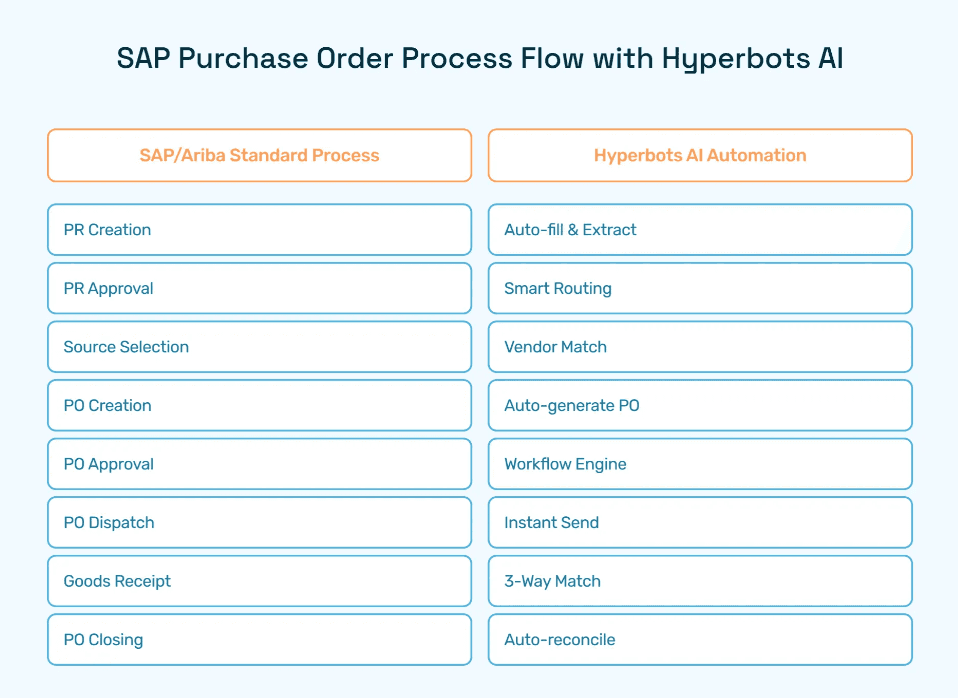
Automated field extraction and PR autofill - Reduces manual effort by pulling required details from emails, contracts, or requisitions and auto-populating PRs.
Validation, duplication & anomaly detection - AI-powered checks catch duplicate PRs/POs, quantity mismatches, or unusual vendor activity before approvals.
Budget controls & GL coding recommendations - Ensures accurate spend classification by automatically recommending cost centers and GL codes, aligning with budgets.
Configurable workflows - Flexible workflows adapt to unique organizational policies without lengthy IT intervention.
Automated PO creation & dispatch - Once approvals are in place, POs are instantly generated and transmitted to vendors, cutting cycle times drastically.
PO closing & reconciliation- Hyperbots maintains a digital audit trail across every PR and PO, simplifying compliance and financial reporting.
Supporting Co-pilots
Beyond procurement, Hyperbots extends value with a suite of interconnected Co-pilots that streamline adjacent finance processes:
Invoice Processing Co-pilot – Automates invoice capture, 3-way matching, and exception handling.
Accruals Co-Pilot – Ensures accurate month-end and year-end accruals with AI-driven predictions.
Payments Co-pilot – Validates payment runs, flags risks, and ensures compliance with tax and treasury policies.
Sales Tax Verification Co-pilot – Automates tax checks, reducing exposure to compliance penalties.
Vendor Management Co-pilot – Simplifies onboarding, validations, and vendor lifecycle management with continuous monitoring.
Together, these AI Co-pilots form an intelligent procurement and finance ecosystem, ensuring SAP and Ariba users achieve unmatched productivity, compliance, and cost efficiency without replacing their existing ERP investments.
Hyperbots ROI in Purchase Order Automation
Hyperbots' impact is measurable and transformational:
Tangible ROI
80% reduction in operational costs
Faster PO cycle times
99.8% accuracy with AI-driven validations
Intangible ROI
Strengthened vendor trust with timely, error-free orders
Simplified audits with full traceability
Improved compliance confidence for finance leaders
External validation: Gartner and Deloitte both highlight automation as a top driver for procurement cost efficiency.
Hyperbots Platform Capabilities: Creating Transformational Impact
AI-first architecture enabling predictive insights
Plug-and-play integration with SAP and Ariba
Configurable workflows for enterprise scalability
Robust compliance and data security
This positions Hyperbots far ahead of traditional procure-to-pay players.
SAP Purchase Order Process Flow Chart – With Hyperbots Embedded
Bringing It All Together – The Future of SAP and Ariba PO Automation
The SAP purchase order process flow is fundamental for finance and procurement teams, but its true potential emerges only when paired with AI-driven automation.
Hyperbots AI Co-pilots deliver the most comprehensive automation suite available today, ensuring cost savings, compliance, and strategic agility.
Next Step: Explore how Hyperbots can transform your PO workflows. Visit our Procurement Co-pilot page or schedule a personalized demo today.
FAQs on SAP and Ariba Purchase Order Process
Q1. What is the difference between SAP PO and Ariba PO?
A: SAP POs are ERP-driven purchase documents; Ariba extends supplier collaboration via the cloud.
Q2. How does automation improve the PO process?
A: Automation reduces errors, accelerates cycles, and ensures compliance.
Q3. Can Hyperbots integrate directly into SAP and Ariba?
A: Yes, Hyperbots offers seamless integration without disrupting existing ERP infrastructure.
Q4. How fast is the deployment cycle?
A: Typical deployment takes weeks, not months, thanks to Hyperbots' ready-to-deploy ERP connectors.