SAP Modernization Roadmap: From Legacy ECC to S/4HANA Transformation
A strategic guide to planning, executing, and optimizing your ERP transition from legacy systems to the intelligent enterprise capabilities of SAP S/4HANA.
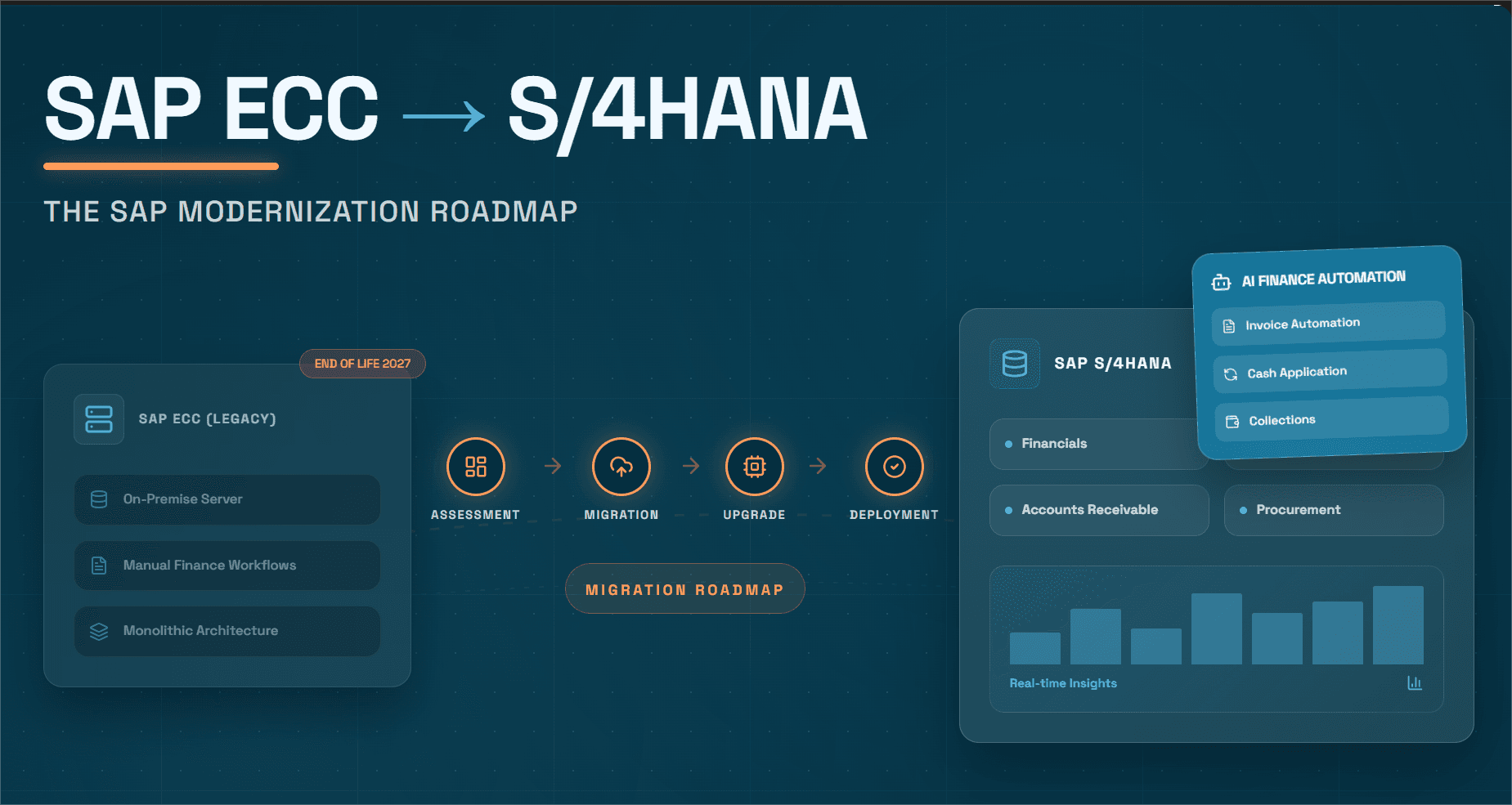
There is a deadline that is reshaping the strategic priorities of thousands of enterprises worldwide, and many organizations are running out of time to address it properly.
SAP will provide mainstream maintenance for SAP Business Suite 7 core applications, the platform that millions of finance, procurement, and operations professionals use every day until the end of 2027. After that date, organizations still running SAP ECC face a stark reality: no more security patches, no compliance updates, no bug fixes from SAP. The impact of the 2027 deadline can be devastating, potentially leading to disruptions in security patches, bug fixes, and software updates, leaving SAP ECC systems vulnerable and outdated.
According to CIO.com reporting on Gartner research, at the end of 2024, only 39%, or about 14,000, of the 35,000 SAP ECC customers had migrated to S/4HANA. At the current rate of migration, Gartner projects there will still be 17,000 holdouts, nearly half of the ECC customer base by 2027. Basware and Deloitte's joint research further state that large enterprises can spend between $100 million and $500 million over several years to fully modernize their ERP systems, and every month of delay brings greater compliance risk, uncertainty, and escalating costs.
And the window is narrowing faster than most organizations realize. A full ECC to S/4HANA migration typically spans 18 to 36 months or longer for large enterprises, making early project initiation essential given the approaching 2027 deadline. Organizations starting migration initiatives in 2026 or later face severe timeline compression that increases risk and potentially compromises quality. Consulting rates are expected to spike 10–20% in the final year, and demand for S/4HANA talent could be three times the available supply by 2027.
This guide gives enterprise architects, CFOs, CIOs, and programme managers the complete strategic roadmap for SAP cloud modernization services, from assessing your current ECC landscape through choosing the right migration approach, executing the transformation, and critically, unlocking the full ROI of S/4HANA through purpose-built AI co-pilots that go live with your new system from day one.
Why SAP ECC Is No Longer a Viable Long-Term Platform
Before mapping the road forward, it is worth understanding exactly what staying on ECC means beyond the headline support deadline.
The 2027 Deadline Is Not the Only Deadline
Many SAP ECC customers still see 2027 as a distant end-of-support date, but a more urgent deadline is much closer. Companies using SAP ERP 6.0 with no enhancement packages or packages 1–5 will lose mainstream maintenance by December 31, 2025. Those who use enhancement packages 6–8 have until December 31, 2027 before their mainstream support ends. If your organization is on an older ECC version, your runway is shorter than you think.
Companies have multiple strategies to extend ECC usage: staying on ECC until 2030 requires an additional 2% cost on maintenance. Shifting to third-party maintenance avoids SAP's increased fees, but organizations lose access to SAP updates and innovations entirely. Extended maintenance is a tactical bridge, not a long-term strategy.
The Compounding Cost of ECC Inaction
Organizations that delay are at high risk of technical obligations, rushed implementations, escalating consultant costs, and operational disruptions that compromise business continuity. But the costs go beyond the obvious. Every year on ECC is a year of foregone innovation: no embedded AI, no real-time HANA analytics, no SAP Fiori experience, no access to SAP Business AI, and no ability to leverage the intelligent automation capabilities that S/4HANA enables.
IBM completed its migration to SAP's cloud ERP platform in July 2024 and has seen a 30% reduction in infrastructure-related operational costs since. That is the kind of operational leverage that ECC simply cannot replicate.
The Technical Debt Accumulation Problem
Most ECC systems running in 2026 have been in production for 15–20 years. They carry decades of custom ABAP code, non-standard configurations, undocumented workarounds, and data that has never been cleaned. Even for customers who have already migrated to S/4HANA, the resource peak for transformation projects could be another three to four years away, with more than 75% additional resources involved compared to today because post-migration optimization is as significant a workload as the migration itself.
The longer an organization waits to start S/4HANA transformation, the more technical debt accumulates, the more complex the migration becomes, and the less time there is to execute it properly before the 2027 deadline.
Understanding Your S/4HANA Transformation Options
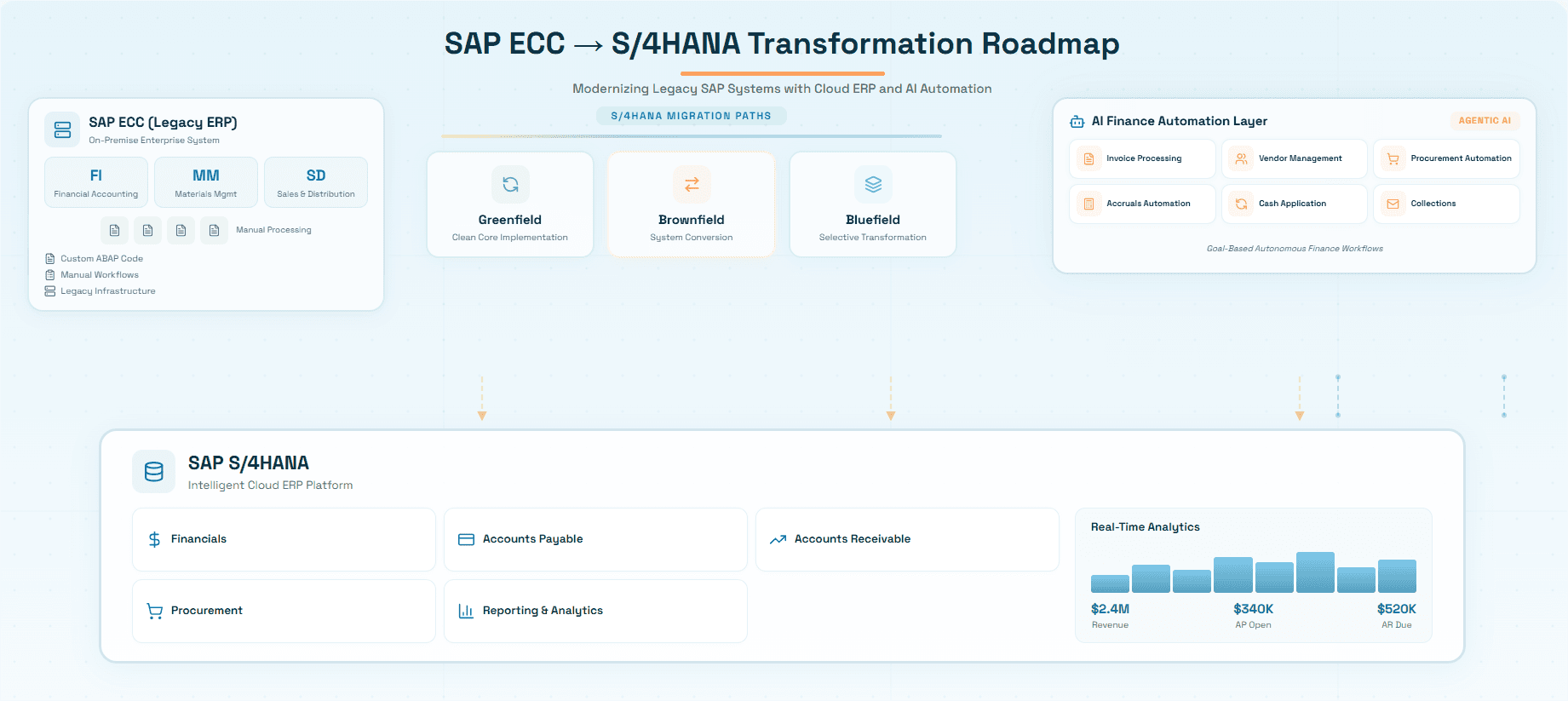
One of the most consequential decisions in any S/4HANA transformation is the migration approach. There is no single right answer as the correct choice depends on your organization's existing SAP landscape, business process maturity, risk appetite, timeline, and strategic objectives. There are three main paths.
Greenfield — The Clean Slate Transformation
Greenfield starts with a blank slate. The primary advantage of a greenfield approach is achieving a clean core, eliminating outdated or unused code. Greenfield allows organizations to redesign processes, use SAP's best practices, and access business AI and sustainability solutions such as the Green Ledger, which legacy systems lack. Greenfield projects can enhance system efficiency and reduce upgrade times by simplifying adoption of SAP new service releases and updates.
A greenfield approach involves process restructuring and comprehensive simplification through the implementation of SAP best practices. The customer's systems are completely reinstalled and reconfigured under the project. From day one, organizations can leverage the full potential of cutting-edge technologies like AI, machine learning, and SAP Fiori.
Best for: Organizations that have expanded through acquisitions and have fragmented or inconsistent ECC landscapes; companies with heavily customized ECC systems where the custom code is more liability than asset; and organizations that see S/4HANA transformation as a full business transformation opportunity, not just a technical upgrade.
The tradeoff: Greenfield implementations often require re-engineering business processes to align with S/4HANA's clean core model and building customizations on the SAP Business Technology Platform. Securing agreement and implementing these customizations requires careful planning and coordination. Timelines and costs are higher than brownfield. Historical data is typically not migratedm only opening balances, which means losing immediate drill-through to legacy transactions.
Brownfield — The System Conversion Approach
A brownfield approach involves a system conversion, upgrading the existing SAP ERP (ECC) system to S/4HANA. It retains most of the existing customizations, processes, and data, but moves them onto the S/4HANA platform.
Brownfield implementations significantly reduce migration risk by maintaining familiar processes, preserving institutional knowledge, and enabling continuity in business operations. Organizations experience faster implementation timelines compared to greenfield approaches, typically completing conversions in months rather than years. Historical data remains fully accessible without complex extraction and loading procedures, maintaining comprehensive audit trails and regulatory compliance.
Best for: Organizations with stable, well-functioning SAP landscapes where existing business processes are sound; companies with compressed timelines facing the 2027 deadline; and enterprises where business continuity during migration is a non-negotiable requirement.
The tradeoff: Customers who opt for a brownfield migration will have considerably less flexibility when it comes to overhauling the way they use their SAP software. Brownfield migrations require a "big bang" approach; the actual migration procedures must all be performed at more or less the same time, requiring system downtime. Perhaps most significantly, brownfield carries existing technical debt and suboptimal processes into the new system. You get S/4HANA, but you do not necessarily get a better-designed process landscape.
Bluefield — The Selective Hybrid Path
Take the advantages of both the Greenfield and Brownfield approaches and you have Bluefield which is an effective hybrid strategy that combines their strengths. With Bluefield, you have the opportunity to select and migrate only the data and processes relevant to your business. This allows you to retain customizations without redesigning your entire system. It's a fully documented, easy-to-understand transformation that can be executed according to your specifications, and the migrated data is consistent.
The bluefield approach is a hybrid of greenfield and brownfield. It reduces downtime compared to Greenfield and allows better customization compared to Brownfield. Often involves the use of specialized tools to filter out unwanted data and processes, enabling selective transformation.
Best for: Large, complex organizations with multiple entities, mixed process quality across business units, and data landscapes where some historical records are valuable and others are not worth migrating. When Airbus Commercial Aircraft were looking to upgrade their five local ERP systems to SAP S/4HANA, they needed an approach that allowed them to centralize their local finance processes on a single aligned platform — the Bluefield approach enabled them to combine what they had into a single project plan as seamlessly as possible.
SAP Cloud Modernization Services — The Deployment Model Decision
Alongside the migration approach decision, organizations must choose their deployment model for S/4HANA. SAP's cloud modernization services landscape has evolved significantly and now offers a range of options.

RISE with SAP / SAP Cloud ERP Private Edition
SAP has begun rebranding its RISE with SAP programme under the broader SAP Cloud ERP umbrella. The RISE Premium Edition is now called SAP Cloud ERP Private Edition, and the familiar "RISE" branding is being phased out. While the concept remains the same — a subscription model combining S/4HANA, infrastructure, and support — the details have shifted.
This is SAP's managed cloud offering: S/4HANA delivered as a subscription, with SAP (or a certified hyperscaler partner) managing the underlying infrastructure. It combines the full functionality of S/4HANA with cloud infrastructure and SAP Enterprise Support, bundled into a single contract. RISE with SAP accounted for 41% of deals in mid-2024, driven largely by enterprise customers seeking a managed cloud path that reduces infrastructure burden while maintaining the deep customization capabilities of S/4HANA.
According to Gartner data cited by The Baer Group, as of Q2 2024, 60% of S/4HANA sales were to new customers, with 41% of those new customers choosing RISE and 45% choosing GROW with SAP, both public cloud offerings, signaling strong momentum for cloud-native S/4HANA adoption among organizations starting fresh.
S/4HANA On-Premise
For organizations with specific data sovereignty requirements, regulatory constraints, or existing hyperscaler commitments, S/4HANA on-premise or private cloud on AWS/Azure/GCP remains a viable option. Many organizations use many applications and migrate their loads to AWS or Azure for speed, using massive pre-existing contracts with hyperscalers to host S/4HANA. This approach gives organizations full control of their infrastructure while benefiting from S/4HANA's functional capabilities.
The practical decision framework:
Factor | SAP Cloud ERP Private | S/4HANA Cloud Public | S/4HANA On-Premise |
|---|---|---|---|
Customization level | High | Low-Medium | Highest |
Update frequency | Twice yearly | Quarterly | Your choice |
Infrastructure management | SAP/partner managed | SAP managed | Self-managed |
Migration approach | Greenfield/Brownfield/Bluefield | Greenfield only | All three |
Best for | Large enterprise | Mid-market | Regulated industries |
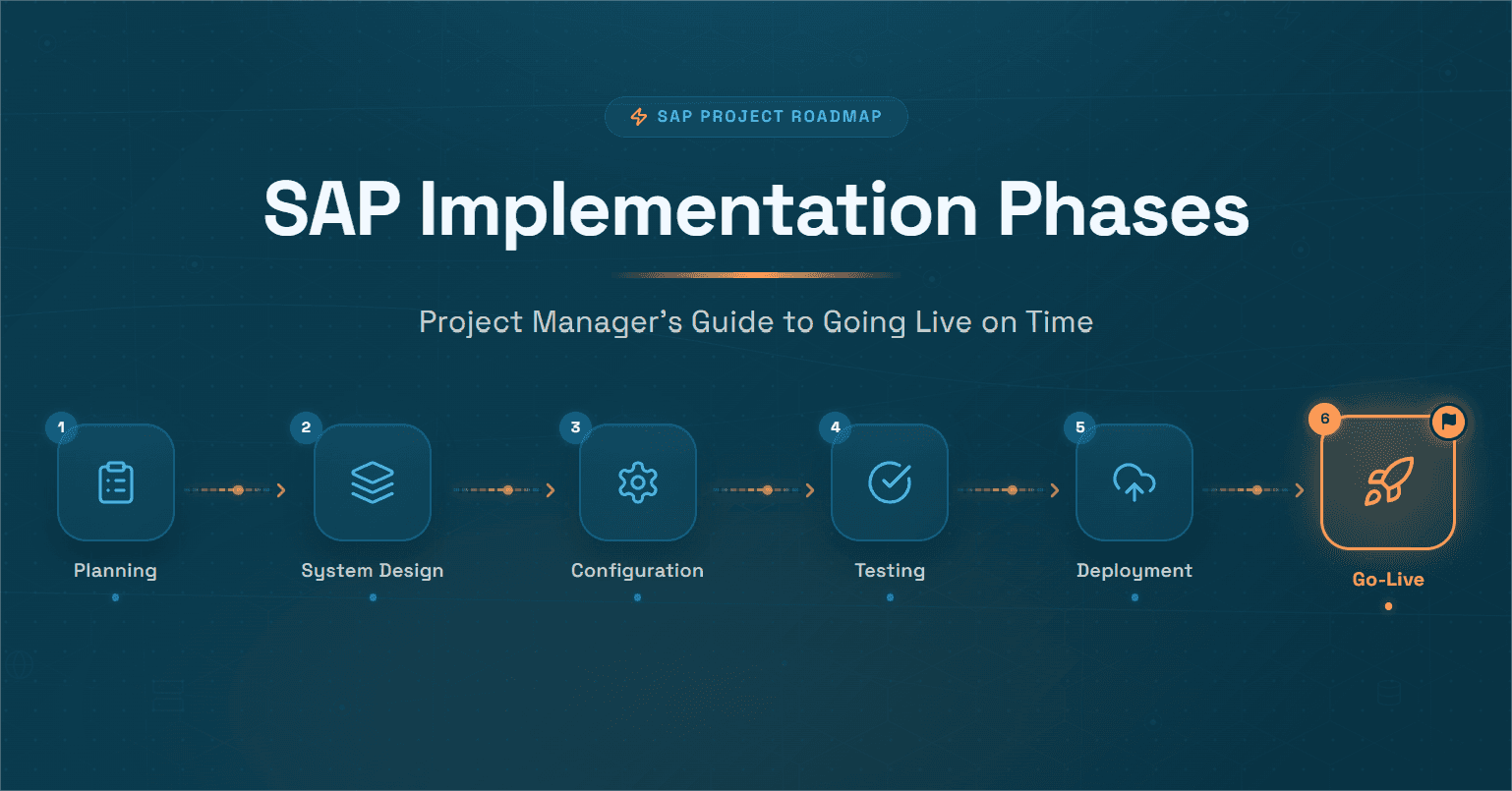
The SAP ECC to S/4HANA Transformation Roadmap — Phase by Phase
Regardless of which migration approach or deployment model you choose, a successful S/4HANA transformation follows a structured roadmap. Here is the phase-by-phase guide.
Phase 1 — Assessment and Business Case (Weeks 1–8)
Every transformation starts with honest self-assessment. Before a single migration decision is made, organizations need a clear picture of what they have, what it costs, and what the transformation needs to deliver.
Key activities:
SAP landscape inventory: Document all ECC modules in use, customizations, integrations, and data volumes
Custom code analysis: Use SAP's Custom Code Migration Worklist to identify all Z-objects and assess which are needed in S/4HANA
Simplification list check: SAP's Simplification List documents all items changed, replaced, or removed in S/4HANA; run this against your landscape to quantify the delta
Business case construction: Quantify current-state costs (infrastructure, maintenance, manual processes), transformation investment, and expected S/4HANA benefits
Migration approach selection: Based on landscape complexity, timeline, and strategic ambition, select Greenfield, Brownfield, or Bluefield
The finance ROI dimension is critical here. Beyond the infrastructure cost savings that S/4HANA enables, the business case should quantify the process automation opportunity. A mid-market organization with 5,000 invoices per month, a 11-day average AP cycle time, and a manual accruals process consuming four days of controller time per month has quantifiable automation value that forms part of the S/4HANA business case and is unlocked through AI co-pilots like Hyperbots that deploy on top of S/4HANA.
Phase 2 — Project Preparation and Architecture Design (Weeks 8–16)
With the business case approved and migration approach selected, the project infrastructure is assembled.
Key activities:
Project governance: steering committee, PMO, workstream leads for Finance, Procurement, Logistics, IT
System landscape design: development, quality, and production environments, plus a sandbox for fit-to-standard workshops
Integration architecture: mapping all third-party integrations that need to connect to S/4HANA — this includes the AI automation layer
Data migration strategy: source system mapping, data cleansing scope, migration tooling selection (SAP Data Migration Cockpit, SAP Migration Factory)
Security and authorization design: role matrix, SoD framework, identity management integration
Change management and training plan: stakeholder communication, training approach, adoption metrics
The integration inventory is where most projects underestimate scope. Every third-party system connected to ECC such as banking platforms, tax engines, EDI networks, treasury management, expense tools, and AI automation co-pilots, needs an updated integration design for S/4HANA. Planning this in Phase 2 rather than discovering it in build is the difference between an on-time go-live and a crisis.
Phase 3 — Fit-to-Standard Workshops and Delta Design (Weeks 16–28)
Organizations can redesign processes and use SAP's best practices in S/4HANA and this phase is where that decision happens. Fit-to-standard workshops are structured demonstrations of S/4HANA standard processes, held for each functional area, where business stakeholders compare current-state processes against the S/4HANA standard and decide whether to adopt the standard or document a delta requirement.
The cardinal rule of fit-to-standard: Every customization (deviation from SAP standard) must be justified by quantified business value and a maintenance cost assessment. Organizations should leverage S/4HANA's innovative features to drive simplified transformation, including adopting new technologies like analytics, machine learning, and intelligent automation rather than replicating legacy processes that were often built around ECC's constraints rather than genuine business requirements.
For finance teams specifically, this phase is where AP, AR, GL, procurement, and close processes are redesigned for S/4HANA. It is also the ideal moment to design the AI automation layer, planning where Hyperbots co-pilots will sit in the process flow, what data they will read from S/4HANA, and what they will write back so that automation is built into the design from the start, not bolted on after go-live.
Phase 4 — System Build and Configuration (Weeks 28–52+)
The Realize phase in SAP Activate terms where S/4HANA is actually configured and built. In a brownfield migration this includes the technical system conversion using SAP's Software Update Manager (SUM). In a greenfield it is a clean configuration build on top of SAP Best Practices content.
Key workstreams running in parallel:
Core system configuration across all in-scope modules
Custom code remediation: adapting Z-objects for S/4HANA compatibility or decommissioning obsolete ones
Interface development: updating all third-party integrations for S/4HANA APIs
Data migration technical development: ETL programs for master data and open transactional data
Forms and output management: rebuilding SAP output forms for S/4HANA
Testing: unit, string, integration, and UAT cycles with quality gates between each
The critical parallel workstream: AI co-pilot deployment. With Hyperbots, the Invoice Processing, Vendor Management, and Procurement co-pilots can be configured and tested in parallel with the core S/4HANA build, using sandbox S/4HANA data, so they are ready to go live simultaneously with the ERP. This parallel approach ensures day-one automation, not a delayed automation phase six months after go-live.
Phase 5 — Data Migration, Testing, and Cutover (Weeks 52–64)
The highest-risk phase of any S/4HANA transformation. Three activities dominate:
Data migration rehearsals: Most projects run three full mock migrations before production cutover, extracting data from ECC, transforming it to S/4HANA data structures, loading it to the quality system, and validating it against business rules. Each rehearsal reveals data quality issues that need remediation. Do not compress this phase.
User acceptance testing: Business users validate that S/4HANA meets their requirements against predefined test scenarios. UAT is the last quality gate before go-live and the appropriate place to catch configuration errors, not after go-live.
Cutover planning: The minute-by-minute plan for the production cutover weekend. For brownfield migrations with the big-bang constraint, this plan is particularly critical. Define go/no-go criteria objectively before the deployment phase begins so the decision is data-driven, not political.
Phase 6 — Go-Live, Hypercare, and Continuous Optimization
Go-live is not the finish line, it is the starting line for realizing the transformation's business value.
Hypercare (first 60–90 days): Dedicated support team on-site or on-call. Daily triage calls. Performance monitoring. Rapid-response defect resolution. Organizations that invest in hypercare experience significantly faster user adoption and shorter time-to-proficiency.
Continuous optimization: The Run phase is where the real ROI of S/4HANA transformation accumulates through embedded analytics, intelligent automation, and the AI co-pilot layer that continuously improves as it processes live transaction data. This includes automated currency rate updates, transparent cost and profit structures, integration and automation that streamlines invoice processing, with document handling time reduced by 40% and financial reporting accuracy improved by 30% in documented S/4HANA transformation outcomes.
The Finance Automation Opportunity Inside Your S/4HANA Transformation
Here is the insight that most S/4HANA transformation programmes miss: the migration project is the single best opportunity to transform finance operations not just modernize the technology platform.
Every S/4HANA transformation involves redesigning business processes. The AP process, the accruals process, the collections process, the cash application process, these are all on the table during fit-to-standard workshops. This is the moment to design them for AI-driven automation from the ground up, not to replicate the manual processes that existed in ECC.
Organizations that plan their finance automation strategy during the transformation rather than after it go live with an S/4HANA instance that is already operating at 80% invoice STP, already applying cash automatically, and already running AI-driven collections. The competitive advantage begins on day one of production.
Hyperbots is specifically designed for this approach. Its co-pilots integrate with S/4HANA through native connectors, require no ABAP development, deploy in three to five weeks, and can be configured and tested in parallel with the core S/4HANA build during the Realize phase.
Hyperbots AI Co-Pilots — Finance Automation for Your S/4HANA Environment
Hyperbots has built the most comprehensive suite of agentic AI co-pilots for finance automation on SAP S/4HANA. Every co-pilot delivers measurable, production-grade ROI from the moment it goes live.
Procure-to-Pay Co-Pilots
Invoice Processing Co-pilot Achieves 80% straight-through processing from email to SAP GL posting, with zero human intervention. Reduces invoice cycle time from 11 days to under one minute. Pre-trained on 35 million invoice fields with 99.8% extraction accuracy. Performs 2-way and 3-way matching across 140+ fields and posts directly to SAP FI-AP. No ABAP required. Deploys in two to three weeks.
Vendor Management Co-pilot Automates full SAP Business Partner onboarding with document collection, W-9 verification, duplicate checking, and ERP record creation. Reduces vendor onboarding time 8x, from nine days to under one day, and cuts vendor data error rates from ~6% to under 1%.
Procurement Co-pilot Automates the full PR-to-PO lifecycle in SAP MM. Auto-fills procurement forms in five minutes, converts PRs to POs automatically, and dispatches to vendors without human intervention. Self-learning GL recommender continuously improves coding accuracy.
Accruals Co-pilot Queries S/4HANA at month-end cut-off for all uninvoiced POs and GRNs, calculates accrual amounts, posts journal entries to SAP GL, and reverses them automatically when invoices arrive. Close compresses from days to hours, with variance to actual consistently under 5%. No equivalent capability exists elsewhere in the market.
Payment Co-pilot Manages the complete SAP payment run: scheduling, approval routing, bank file generation, fraud detection, and bank-to-SAP reconciliation. Validates vendor bank details before every payment. Optimizes payment timing for early payment discount capture.
Sales Tax Verification Co-pilot Validates sales tax on every AP invoice at line-item level before SAP posting. Covers all U.S. states, continuously updates its tax database, and produces a timestamped audit trail for every decision.
Order-to-Cash Co-Pilots
Collections Co-pilot Reads live SAP FI-AR data and autonomously orchestrates the entire collections lifecycle. 70% of collections happen automatically without human chasing. Delivers 40% DSO reduction and 70% reduction in cost to collect. Writes all outcomes directly back to SAP FI-AR.
Cash Application Co-pilot Achieves 80%+ straight-through processing on cash application, reducing unapplied cash to less than 10% and cutting reconciliation costs by up to 80%. Posts SAP AR clearing documents automatically at 99.8% accuracy.
How Hyperbots Differentiates in the SAP S/4HANA Ecosystem
The SAP ecosystem has no shortage of tools. Here is how Hyperbots compares to what organizations typically encounter:
Dimension | SAP Native (VIM / Build) | RPA Tools | iPaaS Middleware | Hyperbots AI Co-pilots |
|---|---|---|---|---|
Requires ABAP / BTP development | Yes | No, but fragile | Sometimes | Never |
Real-time bidirectional S/4HANA | Partial | No; batch | Configurable | Always |
Handles S/4HANA custom fields | Manual config | No | Manual mapping | AI auto-discovers |
Upgrade safe | Within BTP | Breaks frequently | Depends | Yes; no code changes |
AI decision architecture | Generative AI + rules | None | None | Agentic LLM-powered |
Invoice STP rate | 40–60% | 20–40% | N/A | 80%+ |
Deployment timeline | 3–6 months | 2–4 months | 4–12 weeks | 3–4 weeks |
Self-learning | No | No | No | Continuous |
SOX audit trail | Basic | Minimal | None | Immutable, full-context |
Works during ECC-to-S/4 migration | No | Partially | Partially | Yes; ECC and S/4HANA both supported |
The last row in that table is particularly important for organizations currently in the middle of their S/4HANA transformation. Hyperbots supports both SAP ECC and SAP S/4HANA which means you can deploy co-pilots on your current ECC system today, realize immediate ROI during the migration period, and carry the same deployment forward to S/4HANA at go-live. No re-implementation. No interruption of automation during cutover.
Hyperbots Platform Capabilities — Transformational Impact on S/4HANA
AI Auto-Discovery of S/4HANA Custom Fields Every real-world S/4HANA instance has custom fields and non-standard configurations. Hyperbots AI automatically discovers and maps these, adapting to your specific S/4HANA configuration without manual setup or basis team involvement.
Real-Time Bidirectional S/4HANA Integration Connects through native SAP APIs and BAPIs. After every posting, Hyperbots reads the S/4HANA record back to verify the transaction landed correctly — catching errors before they propagate and ensuring data integrity at all times.
No Code Changes Through S/4HANA Upgrades Because Hyperbots integrates through standard, documented APIs rather than custom code, the integration remains stable through every S/4HANA release. This is particularly valuable for organizations on SAP Cloud ERP with quarterly updates.
SOX-Ready Immutable Audit Trail Every action — every AI decision, every S/4HANA posting, every approval — is logged in a tamper-proof audit trail meeting SOX, PCI-DSS, and FedRAMP standards. Auditors can review the complete decision trail for any transaction in minutes.
Multi-Entity and Multi-Instance Support Native support for multi-entity, multi-company-code, and multi-instance S/4HANA environments. Particularly valuable for global ERP transformations where the S/4HANA template is deployed across multiple legal entities and geographies.
Works Throughout the ECC-to-S/4 Journey Hyperbots can be deployed on your current ECC system during the transformation period, delivering ROI while S/4HANA is being built. At go-live, the same deployment extends to S/4HANA, providing continuity of automation throughout the migration, not just at the destination.
ROI — What Hyperbots Delivers on Your S/4HANA Investment
Procure-to-Pay ROI
Tangible:
80% of AP invoices processed without human touch — the majority of SAP FI-AP postings happen autonomously from day one of S/4HANA go-live
Invoice cycle time from 11 days to under one minute — immediate, measurable transformation in AP operations
99.8% GL coding accuracy on S/4HANA postings — fewer reclassification journals, cleaner financial data
Vendor onboarding 8x faster — clean Business Partner records from day one of the new S/4HANA system
Month-end close from days to hours — accruals automated in S/4HANA GL, variance to actual under 5%
Near-zero sales tax errors — every invoice validated before S/4HANA posting
Deployment in 3–5 weeks — AI automation live simultaneously with S/4HANA go-live, not months later
Intangible:
S/4HANA investment delivers full ROI from day one, not months after go-live
IT team freed from integration maintenance — no ABAP code to support through S/4HANA upgrades
Finance team transformation: from transaction processors to strategic analysts
Clean, accurate S/4HANA data from the start — audit-ready at all times
Scalability built in: 3x volume growth absorbed without adding headcount
Order-to-Cash ROI
Tangible:
40% reduction in DSO — live S/4HANA AR data powering AI-driven collections from day one
70% reduction in cost to collect — 70% of AR follow-up automated
80%+ STP on cash application — S/4HANA AR cleared automatically, unapplied cash under 10%
80% reduction in reconciliation costs — bank-to-S/4HANA matching at 99.8% accuracy
Collections team productivity up 80% — focused on relationships, not chasing
Intangible:
Real-time cash flow forecasting from live S/4HANA AR data — replacing static aging reports
Customer experience improves — accurate, AI-driven collections communications
Revenue assurance strengthens — every S/4HANA AR item tracked and acted on
Frequently Asked Questions (FAQs):
Q1: What is the real deadline for SAP ECC end of support?
Companies using SAP ERP 6.0 with no enhancement packages or packages 1–5 will lose mainstream maintenance by December 31, 2025. Those who use enhancement packages 6–8 have until December 31, 2027 before their mainstream support ends. Following mainstream maintenance, SAP will offer optional extended maintenance from 2028 onwards at an incremental 2% on standard maintenance fees, available through 2030. Extended maintenance is not a long-term strategy, it costs more and provides no new features or innovations.
Q2. How long does an ECC to S/4HANA transformation take?
A full ECC to S/4HANA migration typically spans 18 to 36 months or longer for large enterprises, making early project initiation essential given the approaching 2027 deadline. Mid-market organizations with moderate complexity can complete greenfield or brownfield migrations in 12–18 months. Bluefield migrations of specific processes or entities can be executed incrementally in shorter windows.
Q3. What is the difference between Greenfield, Brownfield, and Bluefield S/4HANA migration?
Greenfield is a clean-slate S/4HANA implementation — highest transformation potential, highest cost and disruption. Brownfield is a system conversion of your existing ECC to make it faster, less disruptive, but carries forward existing processes and technical debt. Bluefield combines both so you can select and migrate only the data and processes relevant to your business, retaining customizations without redesigning the entire system. The right choice depends on your landscape complexity, timeline pressure, and strategic ambition.
Q4. What is RISE with SAP and is it the same as SAP Cloud ERP?
SAP has begun rebranding its RISE with SAP programme under the broader SAP Cloud ERP umbrella. The RISE Premium Edition is now called SAP Cloud ERP Private Edition. While the concept remains the same, a subscription model combining S/4HANA, infrastructure, and support, the branding and some contractual details have shifted. GROW with SAP is the equivalent programme for mid-market organizations using S/4HANA Cloud Public Edition.
Q5. Can Hyperbots be deployed on ECC before S/4HANA go-live?
Yes and this is one of the strongest arguments for deploying Hyperbots during your transformation rather than after it. Hyperbots supports both SAP ECC and SAP S/4HANA. You can deploy the Invoice Processing, Vendor Management, and other co-pilots on your current ECC system, realize immediate ROI during the migration period, and carry the same deployment forward to S/4HANA at go-live. No re-implementation required.
Q6. Does Hyperbots require any changes to our S/4HANA system?
No. Hyperbots integrates with S/4HANA through standard, documented SAP APIs and BAPIs so no ABAP development, no custom tables, no basis team involvement. This also means the integration is fully upgrade-safe: when SAP releases quarterly or bi-annual S/4HANA updates, Hyperbots continues working without any code changes.
Q7. What finance processes can Hyperbots automate on S/4HANA?
Hyperbots covers the complete P2P and O2C stack on S/4HANA: AP invoice processing and GL posting (FI-AP), vendor master management (Business Partner), procurement and PO management (MM), month-end accruals and journal entries (FI-GL), payment runs and bank reconciliation (FI-AP/FSCM), sales tax verification, AR collections (FI-AR), and cash application (FI-AR clearing).
Q8. How do we make the business case for AI co-pilots as part of an S/4HANA transformation?
The business case follows from your current-state baseline. Quantify: fully loaded cost per invoice processed, current DSO, month-end close duration, and AP/AR headcount. Apply Hyperbots benchmarks: 80% invoice STP, 40% DSO reduction, close in hours not days, 80%+ cash application STP. In most mid-market environments, the combined S/4HANA + Hyperbots business case produces payback on the automation layer within 12 months, often significantly less when working capital improvements from DSO reduction are included.
Q9. What happens to organizations that do not migrate from ECC by 2027?
Organizations that continue to operate on unsupported ECC systems will be at high risk of cybersecurity vulnerabilities due to unpatched systems, regulatory compliance failures, and operational inefficiencies as a result of compromised legacy system capabilities. They will also face escalating costs: consulting rates are expected to spike 10–20% in the final year as demand for S/4HANA talent could be three times the available supply by 2027. Extended maintenance is available to 2030 at additional cost, but it is a tactical bridge, not a strategy.