The AI-First Architecture Behind Hyperbots’ 99.8% Finance Doc Extraction Accuracy
Inside the AI-native architecture behind 99% GL coding accuracy, 82% straight-through processing, and 70% faster payment prep
Every finance software vendor seems to call itself "AI native" these days. But there's a real architectural difference between a platform built around AI from day one and one that bolted AI onto a system built years before machine learning was practical for finance.
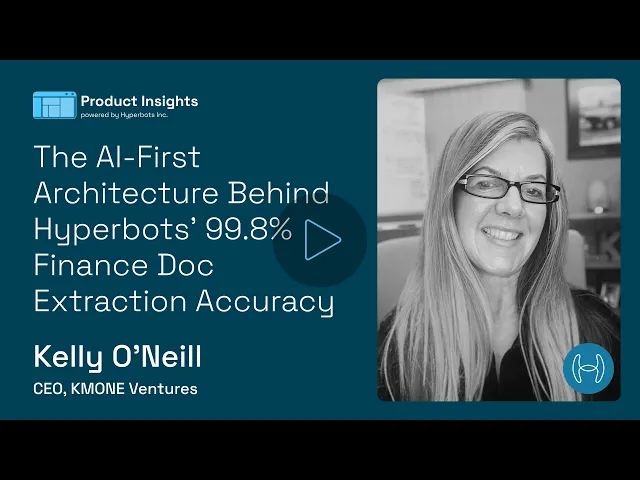
In this conversation from the CFO Insight series, Brad Boehmke sits down with Kelly O'Neill to unpack what AI native actually means inside Hyperbots, where the line between AI native and bolt-on AI shows up in practice, and why that line matters more than most CFOs realize.
AI Native vs. AI Enhanced: What's Actually Different in the Architecture
Brad: Hyperbots calls itself AI native rather than AI enhanced. What's the difference in architecture?
Kelly: When we talk about AI native, it means the models come first. Hyperbots started by building mixture-of-experts models, an architecture that can read an invoice, reason over tax, and recommend codes. Only after those models hit high accuracy did our engineers add the screens, APIs, and workflow logic to connect everything.
Traditional vendors mostly bolt their AI onto rules they wrote a decade ago. The automation never goes as deep, because it wasn't designed AI-first to begin with.
Models First, UI Second: AI Native Design in Practice
Brad: Can you give a concrete example of that AI-first design philosophy in action?
Kelly: In the Invoice Processing co-pilot, the extraction model hit 99% accuracy before we'd written a single line of UI code. Once that extraction was solid, our developers layered on approval routing, audit trails, and analytics on top of it.
That's the reverse of how legacy software works. Legacy tools capture the data first and then try to patch AI on afterward to catch the errors that approach creates.
Purpose-Built AI for Finance: GL Coding, Tax Lookups, and Vendor Validation
Brad: Ninety-nine percent accuracy is huge. How does Hyperbots build purpose-built AI for specific finance tasks?
Kelly: Each module runs its own specialist model. For GL recommendation, the model trains on chart-of-accounts data to power coding. We have a tax lookup model built around jurisdiction rules, and an identity validation model that handles W-9s. These are built specifically for finance, not generic text or image AI repurposed for accounting.
The Productivity Numbers: Straight-Through Processing and Payment Prep Time
Brad: What kind of productivity gain did you see with Hyperbots compared to previous tools?
Kelly: Invoice straight-through processing climbed to 82%, and GL coding accuracy reached 99%. Payment prep time dropped 70%. Overall, we estimate an 80%+ productivity lift compared to the 25% we got when we'd patched OCR onto our old AP system. That's a 65-point gap between the two approaches.
Why Dashboards Aren't Enough: Where Bolt-On AI Falls Short
Brad: Competitors show dashboards with AI too. Where do they fall short?
Kelly: They typically add an LLM for chat, or plug in a small model or general-purpose API that isn't trained deeply enough for finance and accounting. Underneath that layer, human data entry is still doing the real work.
Hyperbots runs deep agentic AI throughout the stack. The same mixture-of-experts model we use for extraction also feeds reasoning agents for tax, predictive engines, and payment timing. That's how you get close to zero human touches instead of a chatbot sitting on top of the same manual process.
What Is Deep Agentic AI? A Plain-English Explanation for Finance Teams
Brad: Agentic is a buzzword right now. Can you explain deep agentic AI in finance terms?
Kelly: Think of it as a colony of specialized agents. One extracts data, another validates it, a third reasons over policy, and they all talk to each other. As an example, once a vendor co-pilot finishes a W-9 check, the invoice co-pilot can trust that supplier record and post the invoice automatically, without waiting on a person to confirm it.
Built to Evolve: How Continuous Model Upgrades Support Innovation
Brad: How does the AI native stack support continuous innovation?
Kelly: Because the modules are independent, we can swap in a better extraction model roughly every six weeks without rewriting the app around it. We've already shipped three accuracy upgrades since go-live, with no downtime and no service fees attached.
Bradley: That's like getting an update on your computer, just more often.
AI Native vs. Bolt-On Deployment: Day-One Accuracy vs. Months of Training
Brad: Is there a difference in deployment effort between AI native and bolt-on AI on top of legacy systems?
Kelly: A big one. We didn't have to label data or run our own training pipelines. The models arrive pre-trained with day-one accuracy. Bolt-on vendors we've evaluated typically ask for around 10,000 historical invoices to train on first, then quote a three-month timeline before anything goes live. That's a real gap, both in time and in effort.
Audit and Governance: Why Explainable AI Matters in Finance
Brad: Does the AI native model change how you audit and govern finance data?
Kelly: Yes. Every prediction carries a confidence score and an explanation for why the model made that call, so auditors can see the reasoning chain. Bolt-on AI often behaves like a black box. There's no traceability, and no reasoning to point to when someone asks why a decision was made.
Where Generic AI Still Breaks: Complex GL Coding
Brad: Can you cite a task where non-native AI can't automate deeply enough?
Kelly: GL coding on mixed-purpose invoice lines. Generic AI tags by keyword. Our model reasons over vendor history, contract terms, and cost center, then splits a $100,000 invoice across five accounts automatically. Legacy tools punt that work to AP clerks, which means a lot of manual effort just to get one invoice coded correctly.
Guardrails Against Hallucination: How Self-Learning Stays Safe
Brad: How do co-pilots keep learning without picking up bad habits? Hallucination comes up constantly in AI conversations.
Kelly: Self-learning is gated. The system needs multiple consistent human confirmations before it promotes any change, so there's a verification and validation step built in. Outliers get quarantined for review instead of being applied automatically. That's how a one-off error never turns into a permanent habit.
Is AI Native Flexible? Configurability Without Touching the Core Model
Brad: Some finance leaders worry that AI native means more rigid. How configurable is the platform?
Kelly: Very configurable. We tune tolerances, approval tiers, and custom fields, all no-code, without touching the core models. AI native doesn't mean hardwired. It means the intelligence is built in while the configuration stays flexible enough for each finance team to set it up their way.
Future-Proofing Finance: Will These AI Models Age Out?
Brad: What about long-term value? Will these models age out?
Kelly: Because Hyperbots pushes incremental model upgrades, the capabilities keep compounding as a business grows. Last month, the co-pilots absorbed a new ESG expense category overnight, no manual reconfiguration needed. That's the kind of thing that makes me confident the long-term value sticks around instead of fading after the first year.
The AI Native Dividend: Straight-Through Processing Compared
Brad: Can you summarize the competitive gap with one metric?
Kelly: If we look at straight-through processing rates, Hyperbots runs at 80%+ versus the best competitor we tested at 35%. That gap is what I'd call the AI native dividend. It's the difference architecture makes once you measure it.
Why CFOs Should Bet on AI Native Now
Brad: Last question, as a final thought. Why should CFOs bet on an AI native approach now rather than wait?
Kelly: Finance is moving from automating clicks to automating thinking. AI native platforms like Hyperbots are already delivering five times the efficiency of patched-on AI. Waiting doesn't make the decision safer. It just means leaving money on the table while everyone else closes the gap.