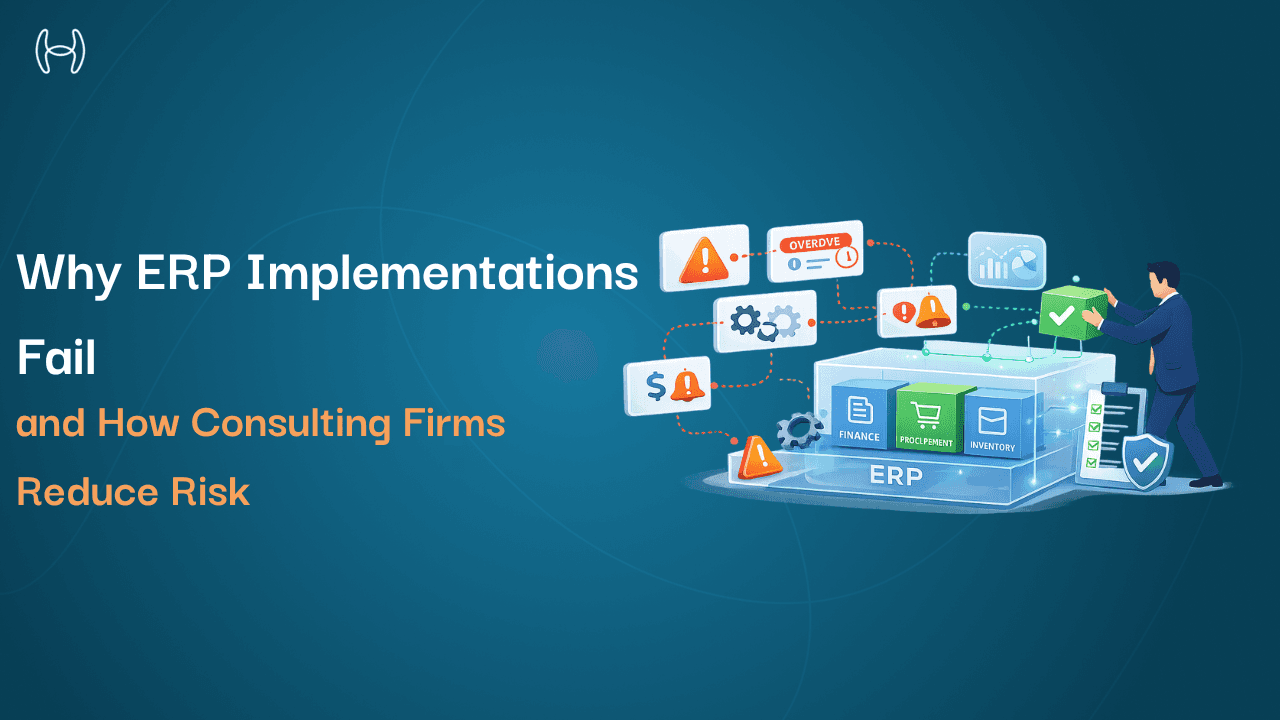
Why ERP Implementations Fail and How Consulting Firms Reduce Risk
A practical guide for finance and operations leaders navigating the real risks of ERP transformation
If you have been involved in an ERP implementation, you already know the feeling. The project kicks off with genuine optimism. The demos looked clean. The vendor promised a smooth go-live. Six months in, the timeline has slipped, the budget has ballooned, and half the finance team is running parallel processes on spreadsheets because the new system still can't close the books reliably.
This is not an unusual story. According to Gartner, ERP implementation failure rates can exceed 75%. McKinsey puts the broader digital transformation failure rate at over 70%. For a technology category that absorbs millions of dollars and years of organizational energy, those numbers should give every CFO pause.
This guide explains why ERP projects fail at such a consistent rate, what the failure patterns look like in practice, and how experienced ERP consulting firms help organizations get to a successful go-live instead of a post-mortem.
Why ERP Projects Fail So Often
It is worth being honest about what "failure" actually means in the ERP context. A failed implementation is not always a project that gets cancelled outright. More often, it is a project that:
Goes live 12 to 18 months later than planned
Costs 30% to 50% more than the original budget
Delivers only a fraction of the functionality that was scoped
Leaves core finance and procurement workflows broken or dependent on manual workarounds
Panorama Consulting's 2024 ERP Report found that 33% of ERP projects exceeded their expected budget, with the most common driver being the unexpected need for additional technology and underestimating the work involved. Those are not vendor problems. They are planning problems.
The root causes cluster around a few recurring themes: poor process mapping before configuration, uncontrolled scope, data that wasn't ready, integrations that were more complex than anyone estimated, and a change management program that existed mostly on paper. Each of these deserves a detailed look.
Poor ERP Process Mapping
The most underestimated phase of any ERP project is also the earliest one: understanding how your business actually operates before you start configuring the system.
Most organizations start ERP projects with an implicit assumption that their processes are standardized and well-documented. They rarely are. What you find when you go looking is a mixture of formal documented processes, informal workarounds that have built up over years, and regional or departmental variations that nobody at the executive level knew existed.
When those variations hit the configuration phase, one of two things happens. Either the system gets customized to accommodate every variation (which is expensive and creates long-term maintenance debt), or the process inconsistencies get ignored and the system goes live with gaps that surface during month-end close or purchase order approval cycles.
What good process mapping looks like
Effective process mapping before an ERP implementation is not a two-week workshop. It is a structured exercise that typically includes:
Process discovery interviews across all affected departments (not just power users)
Current-state documentation of every process that will touch the new system
Gap analysis comparing current-state processes against the ERP's standard capabilities
A deliberate decision point: adapt the business process to fit the standard, or customize the system
That last decision point is where many implementations go wrong. The path of least resistance is always customization, because it feels like it protects the business from disruption. But Panorama Consulting consistently finds that deep customization is one of the leading drivers of budget overruns and implementation delays. A system that is heavily customized is also harder to upgrade, harder to support, and harder to hand off to a new team.
The better answer, in most cases, is to redesign the business process to align with the ERP's standard functionality. That requires change management and executive commitment, which is why it rarely happens without outside pressure.
Scope Creep and Customization Risks
Scope creep is the polite term for what is actually a governance failure. It happens when the boundaries of the project are not clearly defined, or when they are defined clearly but then eroded gradually under pressure from business stakeholders who want to add functionality that was not in the original scope.
In practice, scope creep looks like this: the initial project scope includes core financials, procurement, and inventory management. Three months into the project, the sales team asks whether the CRM integration can be added. Then someone from operations asks about the asset management module. Then HR wants to know about payroll. Each request feels reasonable on its own. Cumulatively, they can double the complexity and cost of the project.
According to Panorama Consulting, organizations that lack formal project governance experience an average of 23% more change orders than those with a defined scope management process. Change orders add consulting hours, extend timelines, and put go-live dates at risk.
The customization trap
Customization compounds the scope problem. When you customize an ERP system, you are essentially creating a software fork that diverges from the vendor's standard codebase. Every upgrade becomes a regression risk. Every patch needs to be tested against your custom code. The consulting hours required to maintain a heavily customized system can rival the original implementation cost over a 5-year period.
The rule most experienced ERP consultants follow is: configure, don't customize. Use the system's built-in configuration options to match your processes. If you genuinely cannot map a business-critical process to the standard system, that is a signal to reconsider the process, not to start writing custom code.
Risk Factor | Impact on Timeline | Impact on Budget |
Uncontrolled scope additions | High (3-6 month delays typical) | High (20-40% overrun) |
Heavy customization | Medium-High (ongoing) | High (maintenance costs compound) |
Insufficient process mapping | High (rework during UAT) | Medium-High |
Late stakeholder requirements | Medium | Medium |
Vendor change orders | Medium | Medium-High |
ERP Data Migration Challenges
Data migration is where many otherwise well-planned ERP projects run into serious trouble. It is consistently underestimated, consistently underfunded, and consistently delayed.
The reason data migration is so difficult is not technical. Modern ETL (extract, transform, load) tools are reasonably mature. The problem is data quality. When you start pulling data from legacy systems, you find years of accumulated issues: duplicate records, inconsistent formats across departments, missing fields, outdated vendor and customer information, and historical transactions that don't reconcile cleanly against each other.
Panorama Consulting notes that different departments often have their own versions of the same records. The sales team's customer address might be formatted differently from the project management team's version of the same address. At the record level, these differences seem trivial. At scale, across millions of records, they create data quality problems that block go-live.
What data migration actually costs
According to Panorama Consulting and DualEntry's 2025 benchmark data, data migration costs break down roughly as follows:
Data Volume | Estimated Migration Cost |
Under 2 years of data | $5,000 to $12,000 |
3 to 7 years of data | $12,000 to $30,000 |
8+ years across multiple legacy systems | $30,000 to $75,000 |
Roughly half of organizations significantly underestimate their migration costs during planning. That gap between what was budgeted and what migration actually requires is a common trigger for emergency budget requests mid-project.
Data governance as a prerequisite
The best ERP implementations treat data readiness as a pre-project gate. Before the implementation begins, the team should complete a data audit that identifies key data quality issues, assigns ownership for remediation, and establishes a data governance policy that will carry forward into the new system. Without this, you are migrating the same bad data into a new system and compressing the cleanup work into the most stressful period of the project.
ERP Integration Complexity
Very few ERP implementations exist in isolation. The new system needs to talk to the payroll platform, the eCommerce layer, the warehouse management system, the CRM, and often a collection of legacy point solutions that nobody wants to decommission yet.
Each integration is a risk surface. The interface needs to be built, tested, and validated. The data flowing across it needs to be mapped and reconciled. When the interface breaks (and interfaces do break), the downstream impact can be significant.
What makes integration complexity particularly dangerous is that it tends to be discovered late. Organizations often start implementation projects with an incomplete inventory of their current integrations. Two or three months into the project, someone realizes that the accounts payable team relies on a custom feed from a logistics platform that nobody documented. That undiscovered integration becomes an unbudgeted change order.
AP and procurement workflow implications
For finance and procurement teams, integration failures often show up in the most operationally sensitive workflows. Invoice processing depends on clean data flowing from the procurement system. Purchase order approvals require reliable connections between the ERP, the procurement module, and sometimes a third-party approval platform. Payment runs need the ERP to talk accurately to the bank's payment system.
When these integrations are not tested end-to-end before go-live, the AP team finds out the hard way: invoices that don't match, payments that don't reconcile, and accruals that need to be run manually because the automated feed isn't reliable yet.
This is one reason that mid-market finance teams increasingly use AI-native tools alongside their ERP, rather than relying solely on the ERP's native functionality for high-frequency operational tasks. Hyperbots' invoice processing, procurement, payments, and accruals capabilities are designed to work alongside ERPs as an intelligent automation layer, so that operational finance workflows keep running even when the underlying ERP integration is still being stabilized.
Change Management Failures
Ask any experienced ERP program manager what kills more implementations than anything else and the answer is almost always the same: change management. Not the technology. Not the vendor. The people.
McKinsey's research consistently finds that among transformations that fail to engage frontline employees and line managers, only 3% of respondents report success. Three percent. That is not a marginal effect. That is a near-total dependency on human adoption.
Deloitte research found that 82% of organizations experienced resistance to change due to inadequate communication about the benefits and impacts of new systems. The employees most likely to resist are not necessarily the ones who are obstinate. They are often the ones who understand the current process best, who see clearly what the new system gets wrong, and who have no forum to raise those concerns constructively.
What change management actually requires
A two-day training session at go-live is not a change management program. Real change management in an ERP context requires:
Early stakeholder engagement, ideally during the process mapping phase
Regular communication about what is changing, for whom, and why
Training that is role-specific, not just system-generic
Designated champions within each affected department who can surface issues quickly
A feedback loop that allows the implementation team to respond to adoption problems before they become go-live failures
McKinsey also found that 44% of executives, reflecting on failed transformations, said they would have moved faster to remove or neutralize people who were actively resistant to change. That is a harder lesson, but an important one. A department head who visibly refuses to adopt the new process can undo months of change management work in a single team meeting.
Weak Executive Alignment
Change management failures usually trace back to one level higher: a lack of genuine executive commitment to the implementation.
"Executive sponsorship" is a phrase that appears in every ERP project charter. In practice, it often means a senior leader who agreed to have their name on the project documentation and shows up to the kickoff meeting. That is not sponsorship. Real executive alignment means:
An executive who actively prioritizes ERP resources over competing initiatives
Clear decision-making authority when the project hits trade-offs (and it will)
Willingness to hold department heads accountable for process adoption
Budget protection when scope changes and contingency needs arise
Without this, ERP projects drift. Timeline pressures lead to scope compromises. Scope compromises lead to a system that doesn't fully meet requirements. The gap between what was promised and what was delivered becomes the basis for internal politics that can follow the program leadership for years.
The most common sign of weak executive alignment is a steering committee that meets infrequently, receives sanitized status reports, and never makes a difficult decision. If the steering committee is not aware of the project's real risk profile, it cannot be genuinely accountable for outcomes.
Why ERP Consulting Firms Matter
Given all of the above, the case for experienced ERP consulting firms is not primarily about technical skills. Most companies can hire people who know how to configure SAP or Oracle. What they cannot easily replicate internally is the pattern recognition that comes from having been through dozens of implementations across multiple industries.
An experienced consulting firm has seen this exact configuration of risks before. They know which project decisions tend to cascade into go-live failures six months later. They know which data quality issues tend to surface in month-end close and which integrations need to be tested at full production volume before anyone declares them stable.
For mid-market and enterprise organizations evaluating their options, a useful starting point is this ERP consulting firms comparison that covers leading firms operating across SAP, Oracle, Microsoft Dynamics, and other major platforms.
What distinguishes effective ERP consulting services
Not all consulting engagements are created equal. The difference between a consulting firm that delivers and one that delivers a stack of documentation and disappears tends to come down to a few factors:
Capability | What to Look For |
Process methodology | Structured discovery before configuration begins |
Data readiness | Formal data audit and governance framework |
Change management | Embedded OCM practice, not an afterthought |
Integration expertise | Pre-built connectors and documented integration playbooks |
Governance | Defined escalation paths and executive steering cadence |
Post-go-live support | Hypercare commitment with measurable exit criteria |
Consulting firms that have implemented the same ERP platform across multiple industries also bring benchmark data. They can tell you whether your timeline assumptions are realistic, whether your customization requests are unusual, and where in the implementation your risk profile is highest.
The Role of AI in ERP Transformations
AI is changing the ERP implementation landscape in two distinct ways: as a capability within the ERP system itself, and as an operational layer that runs alongside the ERP to handle high-frequency transactional workflows.
Within the ERP, vendors including SAP, Oracle, and Microsoft have embedded AI capabilities for demand forecasting, anomaly detection, and automated approval workflows. These capabilities are genuinely useful, but they require clean data to function well. An implementation that skips data governance will not benefit from embedded AI.
The more immediately practical application of AI is in the operational layer around the ERP. Finance teams implementing a new ERP still need to process invoices, run procurement approvals, manage accruals, and execute payments during the transition period. The ERP's native functionality for these workflows is often not fully operational until months after go-live. AI-native automation tools can bridge that gap, keeping core AP and procurement workflows running without requiring manual intervention.
This matters more than it might seem. A finance team that is simultaneously learning a new ERP and managing manual workarounds for broken automation is a team that is going to make errors. Those errors compound during period-end close. The operational risk during the immediate post-go-live period is one of the most underestimated elements of ERP project planning.
ERP Governance Best Practices
Governance is the infrastructure that holds a complex ERP project together. Without it, decisions take too long, risks go unescalated, and scope changes happen without proper review.
Effective ERP governance structures typically include:
Project steering committee. Senior executives representing each major business function, meeting at a defined cadence with visibility into real project status (not filtered status reports).
Program management office. A dedicated PMO function responsible for tracking scope, budget, timeline, and risk across all workstreams. The PMO should be empowered to escalate issues, not just document them.
Workstream leads. Accountable owners for each functional area (finance, procurement, HR, operations) who are responsible for requirements, testing sign-off, and adoption within their domain.
Change control process. A formal mechanism for evaluating scope change requests, including a cost and timeline impact assessment before any change is approved.
Risk register. A live document that tracks known risks, their likelihood and impact, and the mitigation actions in place. The risk register should be a standing agenda item in steering committee meetings.
Go/no-go criteria. Defined, measurable conditions that must be met before the project can proceed to go-live. These should include data quality thresholds, integration test completion rates, and training completion metrics.
ERP Implementation Risk Checklist
Use this checklist to assess your project's risk profile before go-live.
Pre-implementation
[ ] Current-state process documentation completed for all affected workflows
[ ] Gap analysis between current processes and ERP standard functionality
[ ] Data audit completed with quality issues identified and ownership assigned
[ ] Full integration inventory documented (including undocumented legacy connections)
[ ] Executive sponsor identified with defined decision-making authority
[ ] Steering committee charter agreed with meeting cadence and escalation process
[ ] Realistic timeline and budget agreed based on comparable implementation benchmarks
[ ] Change management plan developed (not just a training schedule)
[ ] Departmental champions identified and briefed
During implementation
[ ] Scope change control process in place and being enforced
[ ] Data migration dry runs completed before go-live
[ ] End-to-end integration testing completed at production data volumes
[ ] User acceptance testing completed by actual end users, not just power users
[ ] Hypercare support plan agreed with the consulting firm
[ ] Finance team operational readiness confirmed for period-end close in the new system
Post-go-live
[ ] Hypercare period defined with clear exit criteria
[ ] Benefits tracking in place against original business case
[ ] Adoption metrics being monitored and reported to steering committee
[ ] Feedback loop open for end users to surface issues
[ ] Plan in place for continuous process improvement within the new system
Frequently Asked Questions
What is the most common reason ERP implementations fail?
The most consistent cause is not technical. It is a combination of poor process mapping before configuration begins and insufficient change management during the project. Organizations underestimate how much organizational change an ERP implementation requires and underinvest in the people side of the project relative to the technology side.
How long does a typical ERP implementation take?
This depends significantly on scope, organization size, and the ERP platform selected. Mid-market implementations typically range from 6 to 18 months for core modules. Enterprise-scale implementations with multiple regions and business units can take 2 to 4 years. Timeline overruns are common. Panorama Consulting's 2024 data identifies resourcing issues as the leading cause of timeline overruns.
What is the difference between an ERP implementation failure and a partial failure?
A complete failure usually involves a project cancellation or a system rollback after go-live. Partial failures are far more common and include scenarios where the system goes live but key workflows are broken, where the project significantly exceeds budget or timeline, or where the system delivers only a fraction of its intended functionality. Gartner's analysis covers both categories when citing failure rates in the 55% to 75% range.
How do ERP consulting firms reduce implementation risk?
Experienced consulting firms bring pattern recognition from prior implementations, structured methodologies for process mapping and data readiness, and dedicated change management practices. They also provide independent governance oversight that internal project teams often lack. Firms with deep platform experience can identify configuration risks early, before they become expensive rework.
Should we implement all modules at once or phase the rollout?
Most experienced consultants recommend a phased approach rather than a "big bang" go-live, particularly for organizations above mid-market scale. A phased rollout limits operational risk by keeping the number of workflow changes in any given period manageable, and allows the team to learn from early phases before scaling to the full organization. The Hershey Foods implementation of 1999 is frequently cited as a cautionary example of a big bang go-live that created major supply chain disruption.
When does it make sense to use AI automation tools alongside an ERP?
AI-native automation makes most sense for high-frequency, document-heavy workflows: invoice processing, purchase order matching, payment approvals, and accruals management. These workflows generate the most operational risk during ERP transitions because they need to run reliably on a daily basis. AI tools that operate as an intelligent layer on top of the ERP can handle these workflows independently of whether the underlying ERP integration is fully stable.
What should we look for when selecting an ERP consulting partner?
Platform-specific experience is important, but it is not the only criterion. Look for firms with a structured methodology for the pre-implementation phases (process mapping, data readiness), a dedicated organizational change management practice, documented post-go-live support commitments, and references from implementations of comparable scope and complexity. For a detailed breakdown of firms operating across major platforms, the ERP implementation consulting guide is a useful resource.
Final Thoughts
ERP implementations fail for predictable reasons. The failure patterns repeat themselves across industries, company sizes, and ERP platforms. That consistency is actually good news, because predictable failure modes can be mitigated with the right planning and the right partners.
The organizations that get to a successful go-live share a few common traits. They invest seriously in process mapping before configuration begins. They treat data readiness as a pre-project gate, not an afterthought. They maintain tight scope control and don't let customization ambitions outrun the project's budget and timeline. They build genuine change management programs rather than end-of-project training sessions. And they have executive sponsors who are actively engaged, not just nominally attached.
Experienced ERP consulting firms contribute meaningfully to all of these outcomes, not by doing the work for you, but by providing the structure, methodology, and pattern recognition that internal teams typically lack on their first large-scale ERP project.
For finance and operations leaders who want to reduce implementation risk without sacrificing operational momentum, the combination of a capable consulting partner and purpose-built operational automation is increasingly the standard approach for mid-market and enterprise transformations.
See how Hyperbots streamlines invoice processing, procurement, accruals, and payments workflows. Book a demo or start your free trial.