How to Choose the Right ERP Consulting Firm for Your Business
The Buyer's Definitive Guide to ERP Consulting Company Selection
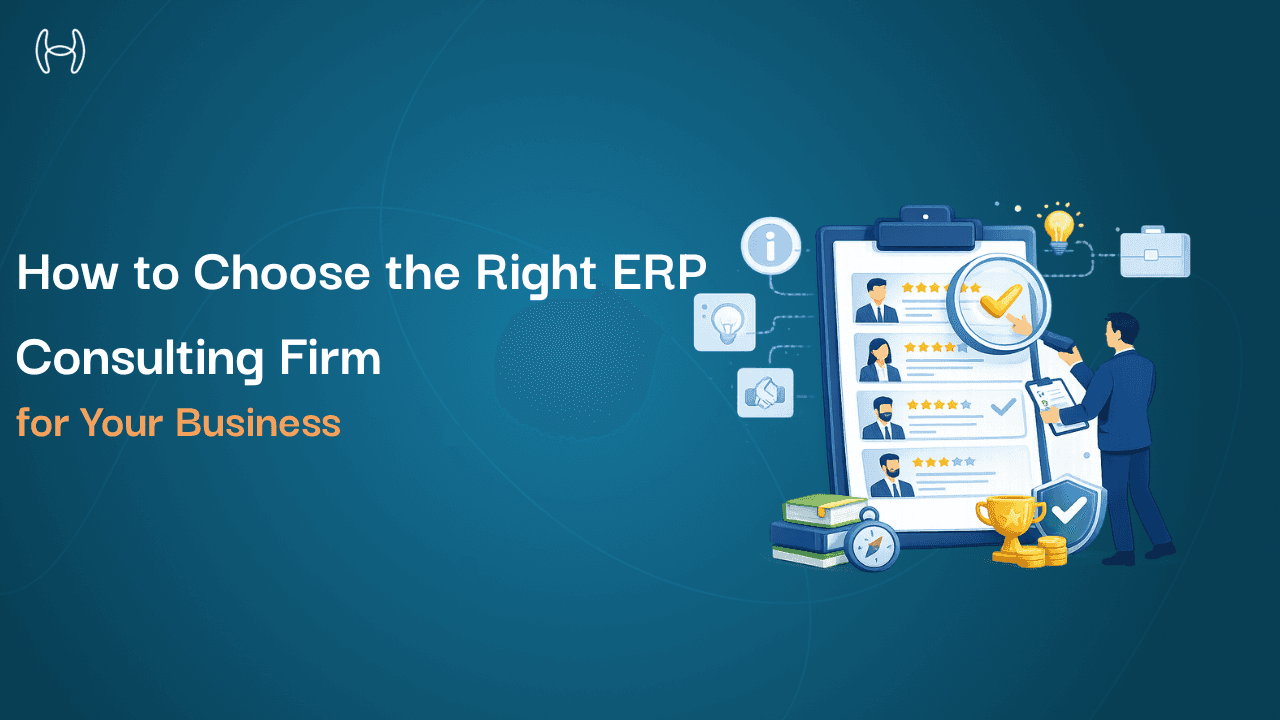
Selecting an ERP consulting firm is one of the most consequential procurement decisions a company makes. Get it right and you gain a trusted partner who accelerates your transformation. Get it wrong and you inherit months of delays, scope creep, change order battles, and a system that your team refuses to adopt.
This guide is written for finance leaders, CIOs, operations heads, and transformation program owners who are entering, or are already mid-way through an ERP consulting partner selection process. It is practical, direct, and grounded in what actually separates high-performing ERP engagements from the ones that end up as cautionary tales.
What ERP Consulting Firms Actually Do
ERP consulting is not a monolithic service. The term covers a wide spectrum of activities, and understanding exactly what you are buying and from whom, it is the first step in making a sound choice.
At its core, an ERP consulting firm helps organizations select, design, implement, and operate enterprise resource planning platforms such as SAP S/4HANA, Oracle Fusion Cloud, Microsoft Dynamics 365, NetSuite, or Infor. But the scope of involvement varies enormously.
The Core Service Categories
Strategy and system selection consulting involves helping you define your business requirements, evaluate ERP vendors, build a business case, and choose the right platform. Firms like Deloitte, KPMG, and Accenture run formal ERP selection and roadmap advisory practices for this.
Implementation consulting is the technical and functional delivery work like configuring the system, migrating data, integrating third-party tools, testing, training, and going live. This is where implementation consultants spend most of their time and where most of the budget goes.
Post-implementation support and optimization covers hypercare immediately after go-live, ongoing system administration, performance tuning, and capability building within your internal team.
Transformation consulting goes broader. It connects ERP to operating model redesign, process re-engineering, and organizational change. Firms like McKinsey and PwC blend business transformation advisory with technical delivery here. McKinsey's research on digital transformations consistently notes that technology is rarely the limiting factor — it is process and people change that determines outcomes.
Knowing which of these services you need — and whether a single firm can credibly deliver all of them — shapes every subsequent decision in your selection process.
Strategy Firms vs ERP Implementation Partners
One of the most common structural mistakes buyers make is conflating strategy advisory with implementation delivery. They are different capabilities, often housed in different parts of a consulting firm, and sometimes better served by different firms altogether.
Strategy-First Firms
Firms with deep management consulting DNA — Deloitte, PwC, Accenture, KPMG, and Booz Allen — tend to lead with business strategy and process design before touching the technology. Their value is in helping you define what "good" looks like before you configure anything.
The risk: their day rates are high, their engagement models can be heavy, and their implementation teams are sometimes thin on hands-on technical delivery — particularly for mid-market deployments.
Platform-Native Implementation Partners
These are firms that have built their entire practice around a specific ERP platform — SAP, Oracle, Microsoft, or NetSuite. They often carry formal certifications (SAP Recognized Expertise, Oracle Cloud partner status, Microsoft Gold Partner) and have delivery teams with deep product knowledge.
The value is depth and speed. The risk is scope narrowness: they may be excellent at configuring the system but less equipped to help you rethink the business process or manage the organizational change program.
Hybrid Delivery Models
Many mid-to-large engagements today use a layered model: a strategy or transformation firm owns the program, a platform implementation partner leads technical delivery, and the client retains a strong internal program management office. Gartner's ERP implementation guidance consistently recommends that buyers define this governance structure before issuing any RFP.
Understanding which model suits your needs — and being honest about your own internal capacity — is foundational to selecting the right ERP consulting partner.
Mid-Market vs Enterprise ERP Consultants
Not all ERP consulting firms are equipped to serve organizations at every scale. This matters more than most buyers initially realize.
Enterprise-Scale Engagements
Enterprise implementations — typically organizations with revenues above $1 billion, complex multi-entity structures, or global operations — require:
Dedicated global delivery capacity across time zones
Deep experience with complex data migrations and system integrations
Robust program governance and PMO capabilities
Executive-level advisory and stakeholder management
The Tier 1 system integrators (Accenture, Deloitte, IBM, Infosys, Capgemini, Wipro) are built for this scale. Their bench depth, geographic reach, and risk management frameworks are genuinely suited to programs running across 20+ countries and 18-month timelines.
Mid-Market Engagements
Mid-market companies — typically $50M to $1B in revenue — have different needs. They often require:
Leaner delivery teams with lower overhead cost structures
Faster implementation timelines (3–9 months rather than 18–36)
Practical pre-configured templates rather than greenfield builds
Consultants who can wear multiple hats rather than narrow specializations
Using a Tier 1 firm for a mid-market deployment often results in over-engineering, high bench costs, and teams that are too large for the problem at hand. Conversely, using a boutique firm without enterprise governance structures on a genuinely complex global rollout is equally risky.
Knowing your size, complexity, and implementation risk profile before you issue an RFP will help you shortlist the right tier of firm. For a structured breakdown of firm types, see this ERP consulting firms comparison across mid-market and enterprise providers.
Industry Expertise and Why It Matters
ERP consulting is not a generic discipline. The same underlying SAP or Oracle platform is configured very differently for a discrete manufacturing company versus a professional services firm versus a healthcare organization. Choosing a consulting firm with genuine industry depth — not just checkbox references — meaningfully reduces delivery risk.
Why Industry Experience Translates to Better Outcomes
Industry-specific consultants bring pre-built process templates, configuration accelerators, and benchmarking data from similar deployments. They know which standard features require customization in your sector, where the common integration points are (EDI, WMS, MES, LIMS, etc.), and how industry-specific compliance requirements affect system design.
SAP's industry cloud portfolio and Oracle's industry-specific solution libraries both reflect just how differently ERP platforms need to be deployed across verticals. A consulting firm's ability to leverage these pre-built industry assets correctly is directly correlated to their sector depth.
Questions to Probe Industry Expertise
How many full-cycle implementations have you completed in our industry in the past three years?
Can you provide references from comparable companies (size, geography, complexity) in our sector?
Do you have pre-configured industry templates? What is included and what requires custom build?
Who specifically on the proposed team has industry experience — and at what seniority level?
Beware firms that cite a broad range of industry experience without being able to name specific clients, describe specific process challenges they solved, or put forward CVs showing genuine sector tenure. Industry experience cited at the firm level but absent at the delivery team level is a common gap.
Questions to Ask ERP Consulting Firms
The RFP process filters firms on paper. The real differentiation emerges in structured dialogue. Below are the questions that experienced ERP program leaders ask — questions designed to surface genuine capability versus polished salesmanship.
On Delivery Model and Team
Who specifically will be assigned to this engagement, and what is their experience on comparable projects?
What is your staffing model — on-site, nearshore, offshore — and how do you manage knowledge transfer?
What is your typical consultant-to-client ratio, and how does that change across project phases?
How do you handle staff turnover on a live engagement? What is your bench depth for key roles?
On Methodology and Risk Management
Walk me through your implementation methodology. What does your go-live readiness assessment look like?
How do you manage scope change and change orders? Can you show us a project where scope changed and how you handled it?
What is your approach to data migration — strategy, tooling, cleansing, validation?
What does your hypercare model look like post go-live, and how long does it run?
On Business Case and Outcomes
How do you measure success on an ERP engagement? What KPIs do you track and report against?
Can you provide references we can contact directly — not just curated testimonials?
On Integration and Automation
How do you handle integrations to our existing systems — HR, CRM, WMS, banking, third-party platforms?
What is your approach to process automation within and adjacent to the ERP system?
ERP Integration and Automation Expertise
Modern ERP implementations are not standalone deployments. They sit at the center of a broader ecosystem — connecting to HR systems, banking platforms, procurement tools, warehouse management systems, and increasingly, AI-powered finance automation layers.
A consulting firm's ability to architect and execute these integrations is a critical and often underweighted evaluation criterion.
Integration Architecture Capabilities
Look for consulting firms that can demonstrate:
Experience with integration platforms (MuleSoft, Azure Integration Services, Dell Boomi, SAP Integration Suite)
API-first design principles that allow flexibility as your tech stack evolves
Proven approaches to handling real-time versus batch integration requirements
Data governance frameworks that maintain data integrity across systems
Microsoft's guidance on ERP integration architecture highlights the complexity of connecting ERP to enterprise messaging, event streams, and external APIs. Consultants without hands-on integration experience frequently underestimate this work — and it becomes the source of go-live delays.
Finance Process Automation Adjacent to ERP
ERP systems manage the core financial record, but a growing class of AI-powered tools handles the high-volume, repetitive transactional work that surrounds it — invoice processing, procurement workflows, payment execution, and accrual management.
When evaluating ERP consulting firms, it is worth asking how they approach the integration between ERP core and finance automation layers. For example, organizations using AI-native tools for automated invoice processing or intelligent procurement workflows need their ERP consultant to understand how these systems feed the ledger, how exceptions are managed, and how approvals are routed.
Similarly, firms deploying automated payment workflows or AI-driven accrual management need their ERP implementation to be designed with those integrations in mind from day one — not retrofitted after go-live.
Consultants who treat ERP as an isolated deployment, rather than as the financial backbone of a broader automation architecture, tend to create technical debt that surfaces 12–18 months post-implementation.
AI and ERP Transformation Consulting
Artificial intelligence is reshaping what ERP consulting firms need to deliver. The firms building genuine AI competency into their ERP practices are moving beyond pattern matching and into predictive operations, intelligent automation, and autonomous decision support.
What AI Capability in ERP Consulting Looks Like
Intelligent process automation goes beyond robotic process automation (RPA). It uses machine learning to handle exceptions, classify documents, predict outcomes, and route decisions dynamically. Consulting firms with genuine AI depth can help you deploy these capabilities in the ERP layer itself or in the adjacent tools that surround it.
Embedded analytics and forecasting uses AI to enhance ERP-native reporting — generating demand forecasts, cash flow predictions, and anomaly detection at the point of transaction, not only in retrospective dashboards.
AI-assisted migration and configuration is emerging as a genuine accelerator. IBM's ERP consulting practice and others are using AI tooling to accelerate data migration, test automation, and configuration review — materially reducing timelines on large deployments.
Questions to Assess AI Readiness in an ERP Consulting Firm
What specific AI tools or accelerators do you use in your ERP delivery methodology?
How do you approach the design of AI-adjacent integrations — automation tools, copilots, intelligent workflows?
Can you describe a recent engagement where AI meaningfully accelerated or improved ERP outcomes?
How do you approach AI governance and bias risk in finance and operations contexts?
Firms that respond to these questions with vague references to "AI capabilities" without concrete tooling, team skills, or client examples should be scrutinized. AI is increasingly a differentiator — but only when backed by genuine delivery expertise.
ERP Change Management Considerations
More ERP implementations fail due to poor change management than due to technical problems. This is well-documented and still persistently underinvested. PwC's global ERP survey research has repeatedly found that user adoption and process change are the primary determinants of whether an ERP investment delivers expected value.
What Rigorous Change Management Looks Like
A credible change management program in an ERP context includes:
Stakeholder mapping and impact assessment. Every business unit affected by the new system needs a clear picture of what is changing for them — processes, roles, reporting structures, approval hierarchies, and data access.
Communication planning. Regular, structured communication from program leadership — not just project status updates — that explains why the change is happening and what it means for the organization.
Training design and delivery. Role-specific training that reflects how users will actually interact with the system in their daily work. Not generic click-through demos of the platform.
Resistance management. Identifying and addressing pockets of resistance early — particularly among senior functional managers who have informal power to undermine adoption.
Benefit realization tracking. Defining measurable business outcomes before go-live and tracking actual versus expected performance post-implementation.
Evaluating Change Management Depth in Consulting Firms
When evaluating ERP implementation consultants, ask:
Is change management a dedicated practice area, or is it bundled into the project management role?
Who specifically leads change management on the proposed team, and what is their background?
How do you handle a situation where senior business stakeholders are resistant to the new system?
How do you measure adoption success, and over what time horizon?
Firms that position change management as a checkbox activity — a training plan and a stakeholder register — rather than a continuous, active program will struggle on complex deployments.
Common ERP Consulting Red Flags
After years of evaluating ERP consulting engagements, certain patterns consistently predict problems. Watch for these warning signals in your evaluation process.
Red Flag | What It Signals |
The firm is highly incentivized to recommend a specific vendor | Potential conflict of interest; vendor selection may not be objective |
They cannot provide references from comparable clients | Limited track record; curated references may not reflect true performance |
Senior partners present, junior consultants deliver | Bait-and-switch is common in consulting; always ask who specifically will be on-site |
Fixed-price proposals with unusually broad scope assumptions | Change orders will follow; broad assumptions are scope traps |
No structured data migration or cleansing approach | Data quality issues derail more implementations than any other factor |
Change management is a single line item with no methodology | Lip service to adoption; technical delivery will be prioritized over people change |
They have not asked enough questions about your business | They are selling a pre-packaged solution rather than diagnosing your actual problem |
No post-go-live support model defined | Hypercare plans left vague usually result in abandoned support or expensive extensions |
Unwillingness to provide a detailed project plan before contract signing | Signals limited planning rigor or deliberate scope vagueness |
"We've done hundreds of ERP implementations" with no specifics | Volume of projects matters less than depth of comparable experience |
ERP Consulting Evaluation Checklist
Use this checklist across your shortlisted ERP consulting firms. Score each criterion from 1–5 to enable structured comparison.
Organizational Fit
[ ] Firm has experience at our organization's scale (revenue, employee count, entity complexity)
[ ] Firm has genuine industry expertise in our sector — verifiable through named references
[ ] Proposed team includes senior resources with directly comparable project experience
[ ] Delivery model (on-site, nearshore, offshore) aligns with our governance preferences
[ ] Cultural fit with our internal team and ways of working
Technical Capability
[ ] Deep, certified expertise in our target ERP platform
[ ] Proven integration methodology and tooling for our ecosystem
[ ] Structured data migration and cleansing approach with defined quality gates
[ ] Testing methodology including unit, integration, UAT, and performance
[ ] Post-go-live support model and hypercare plan defined
Methodology and Risk Management
[ ] Documented implementation methodology (not just a template — evidence of how it has been applied)
[ ] Defined approach to scope management and change order governance
[ ] Risk management framework with named accountability
[ ] Clear project governance structure: steering committee, PMO, escalation paths
[ ] Go-live readiness assessment criteria defined in advance
Change Management
[ ] Dedicated change management practice with experienced practitioners named on the team
[ ] Stakeholder impact assessment approach defined
[ ] Role-specific training design methodology
[ ] Post-go-live adoption tracking and benefit realization framework
Commercial and Contractual
[ ] Pricing model (time-and-materials vs fixed-price) is clearly justified given scope certainty
[ ] Change order process is defined and transparent before contract signing
[ ] References from comparable clients (size, industry, platform) available and contactable
[ ] Contractual protections for staff continuity and key person commitments
[ ] Liability and warranty provisions are reasonable and understood
AI and Automation Readiness
[ ] Firm can articulate a credible approach to AI-enabled ERP features
[ ] Integration experience with adjacent automation tools (finance, procurement, payments)
[ ] Data governance and AI risk approach is defined
[ ] Firm's own delivery tooling includes AI or automation accelerators
Final Thoughts
Choosing the right ERP consulting partner is a high-stakes decision that deserves rigorous, structured evaluation — not a procurement process driven by brand recognition, lowest price, or whoever presented last.
The firms that consistently deliver strong ERP outcomes share common traits: they ask more questions than they answer in early conversations, they are transparent about risk and scope rather than optimistic to win the deal, and they put forward teams that can be held accountable rather than organizations that absorb accountability.
Your evaluation process should go beyond the RFP. Run structured reference checks with people who actually used the firm on comparable projects. Bring proposed delivery teams into working sessions before you sign. Stress-test assumptions about data quality, integration complexity, and go-live readiness. And never buy a fixed-price engagement without a rigorous shared understanding of scope.
For a structured comparison of firms across mid-market and enterprise tiers, the top ERP consulting companies resource provides useful context on how firm capabilities map to deployment scenarios.
The right consulting partner will not just implement software. They will help you transform how your business operates — and that partnership is worth getting right.
Frequently Asked Questions
How much does ERP consulting cost?
ERP consulting fees vary widely based on the size and complexity of the engagement, the firm's tier, and the platform being implemented. Mid-market implementations typically range from $200,000 to $2 million in consulting fees. Enterprise-scale global rollouts can run from $5 million to well over $50 million. Always request itemized cost breakdowns by phase and role — blended day rates without itemization make cost comparison impossible.
How long does an ERP implementation take?
Timeline depends on scope, complexity, and organizational readiness. Mid-market implementations with a defined scope typically run 4–12 months. Enterprise multi-country rollouts often span 18–36 months. Aggressive timelines driven by artificial deadlines — rather than realistic scope and resource planning — are a leading cause of quality problems at go-live.
What is the difference between a system integrator and an ERP consulting firm?
The terms are often used interchangeably, but technically a system integrator focuses on the technical delivery of the ERP implementation — configuration, integration, data migration, and go-live. An ERP consulting firm may provide both the strategic advisory (process design, business case, vendor selection) and the technical delivery. Many large firms do both; smaller boutiques often specialize in one or the other.
Should we use the ERP vendor's own implementation team or an independent firm?
Vendor-led implementations (SAP Services, Oracle Consulting, Microsoft FastTrack) offer deep platform knowledge and direct access to product teams. Independent firms often offer more flexibility, competitive pricing, and stronger business process expertise. Many organizations use a hybrid model: vendor resources for complex configuration or product-specific technical work, and an independent firm for program management, process design, and change management.
How many ERP consulting firms should we shortlist?
Best practice is to issue an initial RFI to six to eight firms, evaluate responses to create a shortlist of three to four, conduct structured presentations and working sessions with the shortlist, and make a final selection from the top two. Running too many firms through a full evaluation process consumes significant internal resources and rarely improves the outcome.
What should be in an ERP consulting contract?
At minimum: defined scope of work with explicit inclusions and exclusions, change order process and approval thresholds, key person commitments with notification requirements for staff changes, go-live criteria and acceptance testing provisions, warranty and post-go-live support obligations, IP ownership for any custom development, liability caps, and termination provisions. Have legal and procurement review any contract before signing.
How do we manage an ERP consulting partner once the project starts?
Establish a joint governance structure from day one: a steering committee with executive sponsors on both sides, a program management office with clear escalation paths, weekly status reporting against a baseline plan, and a defined change control process. The organizations that get the most from their consulting partners treat them as accountable delivery partners with contractual commitments — not as vendors operating at arm's length.
What role should finance leaders play in ERP consulting selection?
Finance leaders — CFOs, Controllers, VPs of Finance — should be actively involved in vendor selection, not just consulted on the business case. Finance processes (accounts payable, order-to-cash, financial close, management reporting) are typically the most complex and highest-risk parts of any ERP deployment. Finance ownership during selection ensures that the consulting firm's functional depth in these areas is properly tested before a contract is signed.
See how Hyperbots streamlines invoice processing, procurement, accruals, and payments workflows. Book a demo or start your free trial.