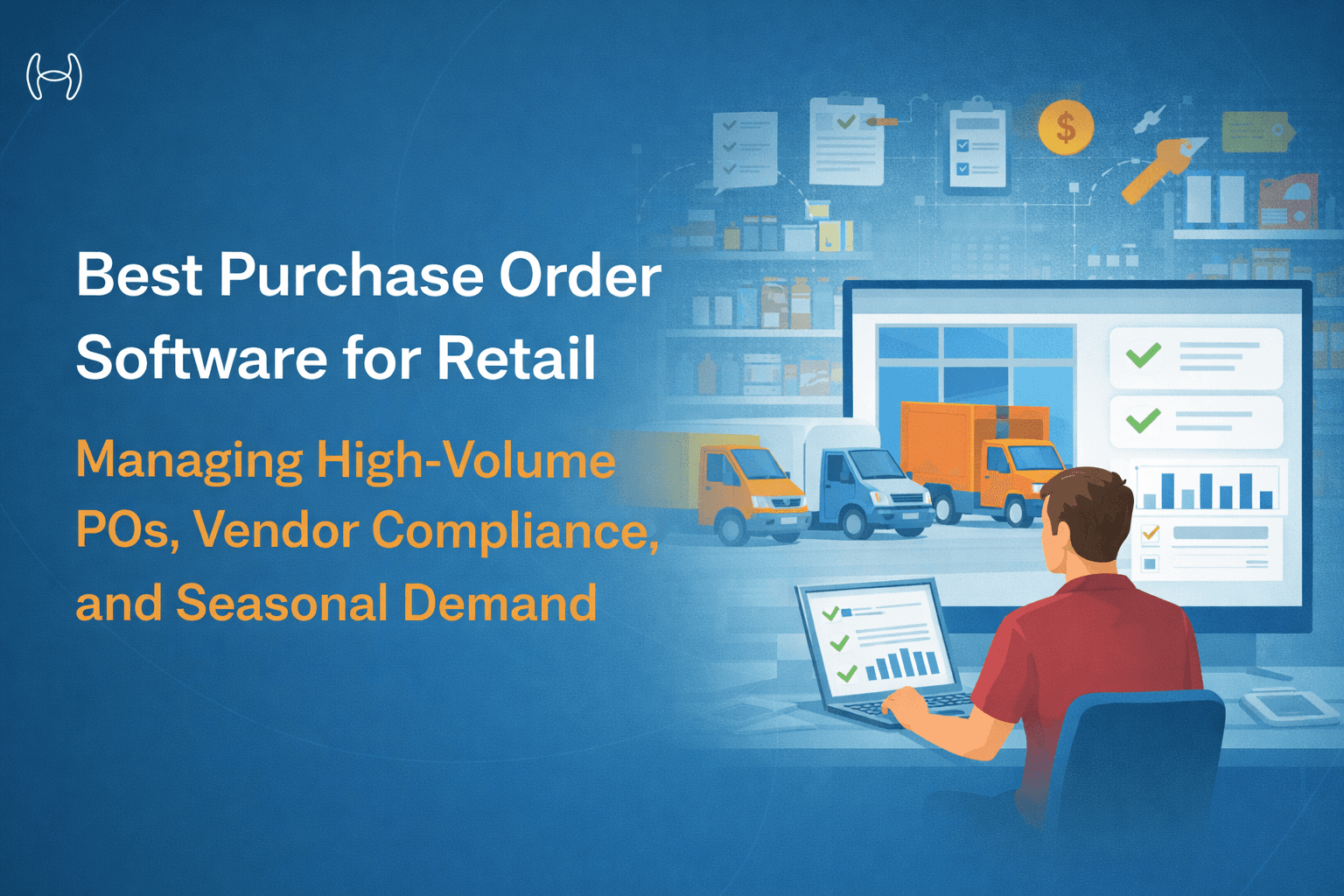
Best Purchase Order Software for Retail: Managing High-Volume POs, Vendor Compliance, and Seasonal Demand
Keep shelves stocked, vendors paid, and procurement compliant with the best purchase order software for retail, built for high-volume, multi-location operations.
Executive Summary
Retail procurement is one of the most demanding procurement environments that exists. Hundreds of vendors, thousands of SKUs, seasonal demand spikes, multi-location replenishment, and razor-thin margins mean that every purchase order either contributes to profitability or chips away at it. A delayed PO in the lead-up to peak season does not just slow things down. It means empty shelves, lost sales, and damaged supplier relationships that take months to repair.
The best purchase order software for retail is not a generic procurement tool with a retail label attached. It needs to handle high transaction volumes without breaking, enforce vendor compliance at scale, keep inventory and procurement data synchronized in real time, and give finance and operations teams the visibility to make smart buying decisions before problems emerge. This guide covers what retail POs demand, where standard tools fall short, and what to look for in a purpose-built solution.
What Makes Retail Procurement Uniquely Challenging
Retail procurement differs from most other industries in ways that compound quickly at scale.
Volume and Velocity
A mid-sized retail chain can generate hundreds of purchase orders every week across product categories, locations, and suppliers. Each one needs to be created accurately, approved promptly, dispatched to the right vendor, and matched against the delivery and invoice when goods arrive. At this volume, any manual step in the process becomes a bottleneck that ripples through the entire supply chain.
Seasonal Demand and Lead Time Pressure
Retail buyers must place orders weeks or months ahead of peak periods. Getting the timing wrong in either direction, whether ordering too late or over-ordering, creates either a stock-out or excess inventory that ties up working capital. The purchase order process needs to move fast enough to respond to demand signals without sacrificing accuracy or compliance.
Multi-Location Replenishment
Retailers operating across multiple stores or distribution centers need POs that are tracked and fulfilled at the location level, not just at the organization level. A PO that was delivered in full at the warehouse is not the same as stock arriving at the right stores in the right quantities. The system needs to maintain visibility at that level of granularity.
Vendor Compliance and Diversity
Retail vendor networks are wide and varied. National brand suppliers, regional distributors, private label manufacturers, and drop-ship partners all have different lead times, payment terms, compliance requirements, and order minimums. Managing all of them through the same procurement process without a system that can handle that diversity leads to errors, disputes, and delays.
Price Volatility and Contract Management
Retail buyers negotiate pricing constantly. Contracted prices, promotional allowances, volume discounts, and temporary markdowns all need to be reflected accurately in purchase orders. When a PO is raised at the wrong price, because vendor records are out of date or contract terms were not enforced, the downstream impact on margins and invoice matching is significant.
Why Standard PO Software Falls Short in Retail
Most general-purpose purchase order software is designed for organizations that buy relatively predictable goods and services on regular schedules. Retail breaks every one of those assumptions.
Standard tools struggle when PO volume spikes before peak season and the system cannot keep pace. They create matching failures when invoices carry promotional pricing that differs from the base contract. They have no mechanism for enforcing vendor-specific compliance rules at the point of order. And they typically lack the real-time inventory integration that retail operations need to avoid ordering stock that is already inbound from another location.
The result is finance teams manually reconciling invoices, operations teams chasing vendors for delivery confirmations, and buyers working around the system rather than through it.
How the Retail Purchase Order Process Should Work
Step | Stage | What Should Happen |
01 | Demand Signal and Requisition | Reorder points, sales forecasts, or manual requests trigger a purchase requisition. System auto-fills vendor, pricing, and quantity from approved catalog and contract data. |
02 | Budget and Policy Validation | Request is checked against available budget, approved vendor list, and buying policy. Off-contract requests or out-of-budget orders are flagged before routing. |
03 | Approval Routing | PO is routed based on order value, category, and location. Low-value replenishment orders may auto-approve. Higher-value or new-vendor orders route to the appropriate buyer or finance approver. |
04 | PO Generation and Dispatch | Approved PO is auto-generated with contracted pricing, delivery terms, and location-specific details, then dispatched directly to the vendor. |
05 | Goods Receipt and 3-Way Matching | On delivery, the system matches the PO against the delivery note and vendor invoice. Quantity discrepancies, pricing variances, and missing items are flagged automatically. |
06 | Payment Processing | Matched invoices are queued for payment. Early payment discount (https://blog.hyperbots.com/leveraging-ai-to-capture-missed-early-payment-discounts) opportunities are surfaced. All data is posted to the ERP ledger in real time. |
07 | Vendor Performance Tracking | Delivery accuracy, lead time compliance, and invoice accuracy are tracked per vendor. Data feeds into future buying decisions and contract negotiations. |
Key Features to Look for in Retail Purchase Order Software
High-Volume Processing Without Degradation
The system must handle hundreds or thousands of POs per week without slowing down or requiring manual workarounds. This means automation at every stage, from requisition creation through PO dispatch, and matching logic that scales with transaction volume rather than relying on manual review queues.
Contract and Catalog-Driven Ordering
Every PO should be generated from approved catalog data with contracted pricing automatically applied. This eliminates the pricing errors that cause invoice mismatches downstream and ensures that vendor agreements are actually being honored at the point of purchase, not discovered to be violated at invoice processing time.
Flexible Multi-Level Approval Workflows
Approval workflows need to be configurable by order value, vendor category, product category, and location. A standard replenishment order from an established vendor should move through the system in minutes. A first order from a new supplier or an unusually large seasonal buy should route to the appropriate level of review without slowing everything else down.
Automated 3-Way Matching with Tolerance Rules
Retail invoices rarely match POs perfectly. Partial deliveries, quantity substitutions, freight charges, and promotional pricing adjustments all create variance. 3-way matching logic needs to be configurable with tolerance rules by vendor type and product category so that minor variances auto-approve while genuine discrepancies are escalated without human intervention for everything.
Vendor Management and Compliance Tracking
Vendor management capabilities should include centralized vendor records with accurate payment terms, delivery windows, and compliance documentation. Vendor onboarding should be automated, with identity verification and contract terms captured before the first PO is raised. Vendor performance data should feed back into the system so that buyers can see delivery reliability and invoice accuracy trends at a glance.
Real-Time ERP and Inventory Integration
PO data needs to flow into the ERP and inventory system in real time, not at the end of the day. Retail buying decisions depend on accurate inventory positions. A PO that is not immediately reflected in the system leads to duplicate ordering, incorrect reorder triggers, and inventory imbalances across locations.
Sales Tax Validation
Retail procurement involves significant sales tax complexity, particularly for businesses operating across multiple states or jurisdictions. The system should validate tax treatment at the line-item level on vendor invoices, flagging discrepancies before payment and maintaining the documentation needed for compliance and audit purposes.
Comparison: Manual vs. Automated Retail PO Management
Area | Manual Process | Automated PO System |
PO creation speed | Hours per order, error-prone | Under 5 minutes, auto-filled from catalog |
Seasonal scaling | Breaks down at volume | Handles spikes without degradation |
Contract pricing enforcement | Checked manually, often missed | Applied automatically at point of order |
3-way matching | Manual reconciliation per invoice | Automated with configurable tolerances |
Vendor compliance | Tracked in spreadsheets | Centralized, real-time per vendor |
Approval routing | Email chains, no audit record | Configured workflows with full audit trail |
ERP synchronization | Batch updates, often delayed | Real-time, bi-directional |
Invoice processing | 30 to 60 minutes per invoice | Under 1 minute with 80% straight-through |
Audit readiness | Document retrieval takes hours | Instant export of complete records |
How Hyperbots Supports Retail Procurement
Hyperbots' Procurement Co-Pilot handles the procurement complexity that retail finance and operations teams deal with every day. It automates purchase requisition creation by pulling vendor records, contracted pricing, and catalog data, so that POs are generated accurately from the start without manual data entry. Real-time budget checks prevent orders from exceeding available spend, and configurable approval workflows route orders to the right approvers based on value, category, and vendor.
Once POs are dispatched and goods begin arriving, the invoice processing Co-Pilot automates the full downstream cycle. It extracts invoice data with 99.8% accuracy, performs automated matching against POs and delivery records, and flags genuine discrepancies for resolution rather than routing every variance to a human reviewer. This is where retail operations recover the most time, not in the buying process, but in the reconciliation work that follows every delivery.
Purchase order automation across the full cycle means retail teams can handle significantly higher PO volumes without adding headcount, and the audit trail captures every action automatically so that compliance documentation is always current.
Retail teams go live within one month through no-code configuration and pre-built ERP connectors. Positive ROI is consistently reached within six months, driven primarily by the reduction in manual reconciliation work, the elimination of pricing errors that cause payment delays, and the recovery of early payment discounts that manual processes routinely miss.
What to Ask When Evaluating Retail PO Software
When assessing platforms for retail procurement, finance and operations leaders should ask:
Can the system handle our peak-season PO volume without requiring additional manual processes?
How does it enforce contracted pricing at the point of order, not just at invoice matching?
What does 3-way matching look like for partial deliveries and promotional pricing variances?
How does vendor onboarding work, and what compliance checks are built in?
Does it integrate in real time with our ERP and inventory management system?
How are multi-location deliveries tracked at the store or distribution center level?
What does the audit trail capture, and how is it accessed during an audit or vendor dispute?
FAQs
Q1: What makes purchase order software suitable for retail specifically?
Retail-specific PO software needs to handle high transaction volumes, enforce contract pricing automatically, support multi-location replenishment, and integrate in real time with inventory and ERP systems. It also needs configurable matching tolerances for the partial deliveries and pricing variances that are common in retail supplier relationships.
Q2: How does PO automation help retail businesses manage seasonal demand?
By automating requisition creation, approval routing, and PO dispatch, retail teams can process significantly higher order volumes during peak periods without adding staff or slowing down. Automated reorder triggers and catalog-driven ordering mean POs go out faster and more accurately when demand signals arrive.
Q3: How does automated 3-way matching work for retail invoices?
The system matches each vendor invoice against the original PO and the delivery receipt, checking quantity, price, and terms against configurable tolerance rules. Invoices within tolerance are auto-approved and queued for payment. Invoices outside tolerance are flagged for human review with a clear explanation of the discrepancy, rather than routing everything manually.
Q4: Can PO software handle multiple vendor types in retail?
Yes. A well-designed system maintains separate vendor profiles with category-specific compliance requirements, payment terms, and lead time expectations. National brand suppliers, regional distributors, and private label manufacturers can all be managed through the same platform with configurations specific to each vendor relationship.
Q5: How long does implementation take for a retail business?
With AI-native platforms like Hyperbots that offer no-code configuration and pre-built ERP connectors, most retail teams are live within one month. The timeline is primarily determined by the number of vendor integrations and the complexity of the approval workflow configurations required.
For a broader evaluation framework covering all purchase order software categories, our guide to the best purchase order systems in 2026 includes a full selection checklist and vendor scorecard.
Hyperbots' Procurement Co-Pilot is built for the speed and volume that retail operations demand. Most teams go live within one month.
Request a demo.