Best Purchase Order Systems (2026): Selection Checklist and Scorecard
Most PO systems promise automation. Few deliver it end to end. This guide gives CFOs and procurement leaders a structured checklist and scorecard to tell the difference before they sign anything.
Executive Summary
Choosing the right purchase order automation software has always mattered, but the stakes are higher now. Finance and procurement teams in 2026 are dealing with more complex ERP environments, tighter compliance requirements, and pressure to do more without adding headcount. A PO system that just digitizes a paper process is not going to cut it anymore, see what a modern automated purchase order system actually looks like today.
This guide gives CFOs, controllers, and procurement leaders a practical selection checklist and vendor scorecard to evaluate purchase order automation platforms, and shows where procure-to-pay automation software is heading and what good actually looks like today.
Why the “Best Purchase Order System” Matters in 2026
Finance and procurement leaders are under pressure to:
Eliminate manual errors and inefficiencies.
Reduce procurement cycle times.
Strengthen auditability and compliance.
Integrate procurement seamlessly with ERP and accounting platforms.
According to MHC Automation, 66% of AP teams still manually enter invoice data into ERP systems which means the gap between where most teams are and where they need to be is wider than most CFOs realize. In short, the best purchase order system enables businesses to not only manage spend but also to turn procurement into a strategic function. As Deloitte highlights, modern procurement leaders are expected to deliver both efficiency and insight, not just transactions.
Key Selection Checklist for Choosing the Best Purchase Order System
When evaluating purchase order system software, finance leaders should consider these key criteria:
1. Integration
Does it integrate smoothly with existing ERP/accounting platforms?
Is there native support for systems like Oracle, SAP, Sage, or Microsoft Dynamics?
2. Compliance & Controls
Does the system enforce budget thresholds?
Can it detect anomalies, duplicates, and non-compliant spend?
Are audit trails automated and accessible?
3. Scalability
Can the system grow with the organization?
Does it support multiple business units, geographies, and currencies?
4. Usability & Automation
Is the user interface intuitive for finance and procurement teams?
Does it automate requisition creation, PO dispatch, and approvals?
Purchase Order System Scorecard
To simplify evaluation, organizations can adopt a scorecard approach to compare vendors. Below is a framework:
Criteria | Weight (%) | Average Vendor | Hyperbots |
Integration | 20% | 8/10 | 9/10 |
Compliance & Controls | 25% | 7/10 | 10/10 |
Usability & Automation | 25% | 6/10 | 10/10 |
Scalability | 15% | 7/10 | 9/10 |
ROI/Value Delivered | 15% | 8/10 | 10/10 |
The Role of AI in Modern Purchase Ordering Systems
Understanding what an AI-powered purchase order system can actually do is the starting point for any serious vendor evaluation. AI is redefining what businesses expect from the best purchase order system in accounting software. Instead of just digitizing paper processes, AI-enabled PO systems:
Automate data entry with field extraction.
Detect anomalies before approvals.
Recommend budget allocations and GL coding.
Learn from past transactions to optimize procurement.
Gartner notes that by 2026, over 80% of enterprises will have adopted AI-driven procurement solutions to drive efficiency and compliance.
Top Capabilities to Look for in Purchase Order Automation Platforms
Not all purchase order automation platforms are built the same way, and the differences become obvious once you move past the demo. Some are essentially digital versions of a paper process with an approval button. Others sit inside a broader procure-to-pay automation workflow, connecting requisitions to invoices to payments without anyone having to chase status updates through email.
When evaluating platforms, a few capabilities consistently separate the ones that deliver real efficiency from the ones that just add a new interface to an old problem.
End-to-end process coverage. A purchase order automation platform should handle the full cycle, from purchase requisition through PO creation, dispatch, receipt, and three-way match. If you need a separate tool for each of those steps, you haven't automated anything. You've just digitized the handoffs.
ERP integration without custom dev work. The best procure-to-pay automation software connects to your existing ERP natively. If implementation requires months of IT involvement just to sync vendor master data, that's a red flag worth taking seriously before signing a contract.
Intelligent exception handling. Automation breaks down at the edges: duplicate invoices, mismatched quantities, missing PO numbers. Platforms with built-in anomaly detection and configurable tolerance rules handle these without routing everything to a human. That's where most of the time savings actually come from.
Configurable approval workflows. Finance teams have specific approval hierarchies, budget thresholds, and department-level rules. A platform that forces you to adapt your workflow to its defaults adds friction rather than removing it.
Audit trails by default. In compliance-heavy environments, every approval decision, price change, and exception override needs to be logged automatically. This shouldn't be something you configure separately. It should just be how the platform works.
The broader shift happening in procurement right now is that purchase order automation platforms are moving from standalone tools into full procure-to-pay automation software suites, where PO management is one layer of a connected AP and procurement stack. For finance teams evaluating options in 2026, that integration depth is worth weighting heavily in any vendor comparison.
Hyperbots’ AI Co-Pilot Advantage
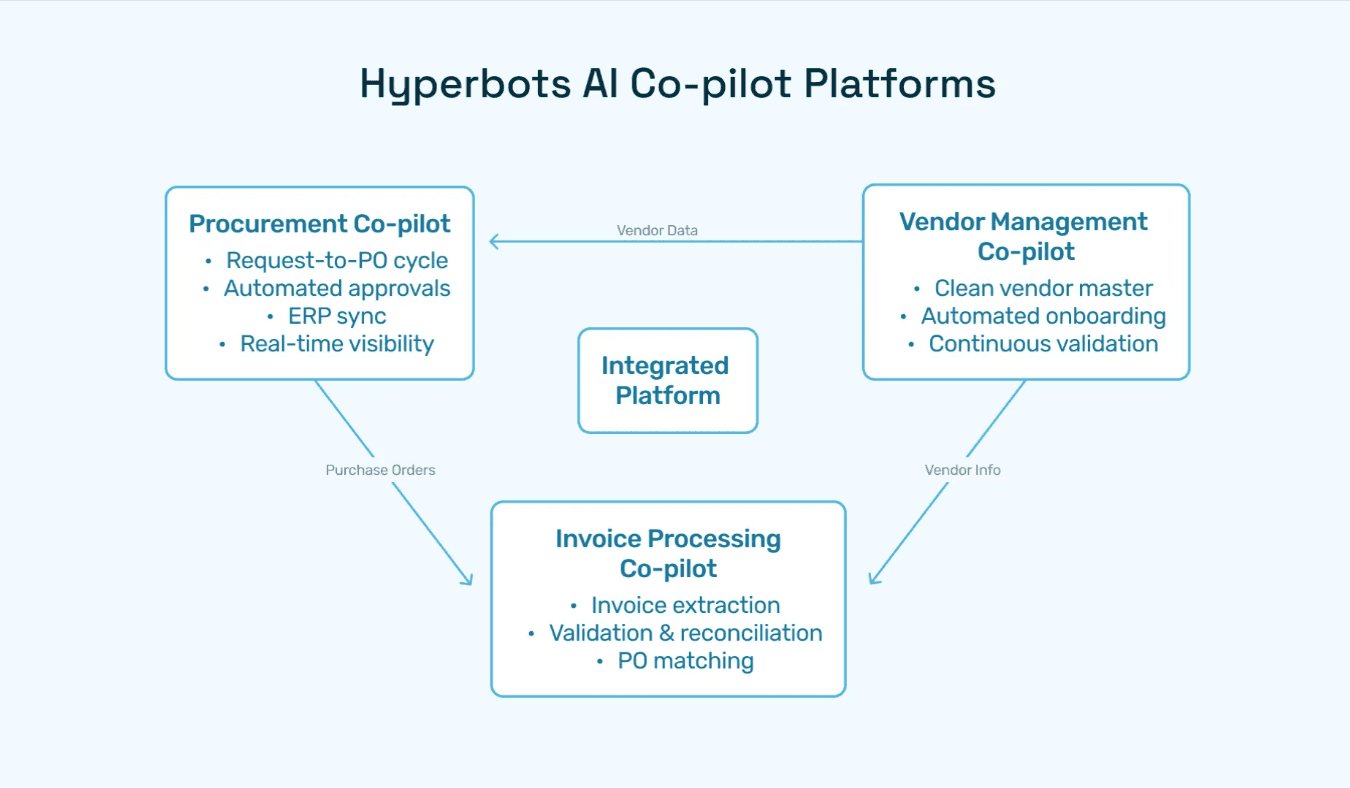
Hyperbots delivers the best purchase order system software by combining advanced automation with embedded intelligence. Its Procurement Co-Pilot serves as the nerve center of purchase order automation, supported by specialized Co-Pilots across procure-to-pay.
Procurement Co-Pilot
Core functions include:
Automated field extraction & PR autofill from PDFs, contracts, and emails
Validation, duplication & anomaly detection to eliminate errors
Budget controls & GL coding recommendations powered by AI
Configurable workflows & forms across departments
Automated PO creation & dispatch with vendor master validation
PO closing & reconciliation with invoices for auditability
Supporting Co-Pilots
Invoice Processing Co-pilot – Automates invoice capture and 3-way match.
Accruals Co-pilot – Ensures accurate period-end accruals.
Payments Co-pilot – Streamlines vendor payments with compliance checks.
Sales Tax Verification Co-pilot – Validates tax rules and compliance.
Vendor Management Co-pilot – Centralizes vendor onboarding, risk, and lifecycle management.
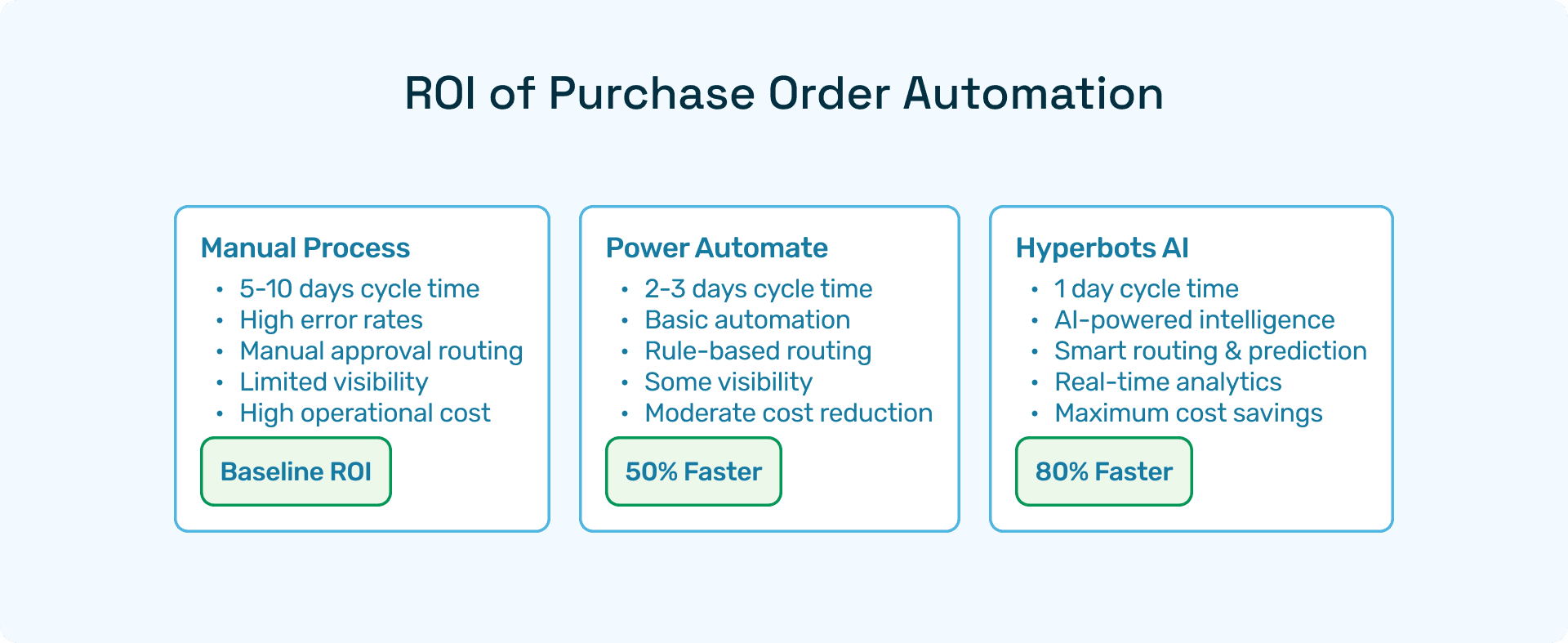
ROI from Hyperbots-led Purchase Order Automation
Hyperbots customers report significant ROI:
80% cost reduction in operations.
99.8% accuracy in PO processing.
Faster cycle times from requisition to approval.
Stronger compliance through anomaly detection and audit trails.
Beyond financial ROI, teams experience higher employee satisfaction by reducing manual, repetitive work.
How Hyperbots Differentiates vs Other P2P Vendors
Unlike traditional procure-to-pay providers, Hyperbots is built on an agentic AI platform. Differentiators include:
Comprehensive automation from requisition to payment.
Configurable workflows tailored to enterprise needs.
End-to-end auditability for compliance-heavy industries.
Scalable intelligence that learns and adapts with usage.
Where competitors offer siloed modules, Hyperbots delivers an integrated Co-Pilot ecosystem for true transformation.
Hyperbots Platform Capabilities: Creating Transformational Impact
The Hyperbots Platform enables finance and procurement leaders to:
Eliminate data silos across procurement and accounting.
Gain real-time insights into spend and vendor performance.
Reduce compliance risk through embedded policy enforcement.
Transform procurement from a cost center into a strategic lever.
Bringing It All Together
In 2026, procurement and finance leaders cannot afford to rely on outdated, manual processes. The best purchase order system combines automation, intelligence, and scalability to deliver real business value. Hyperbots AI Co-Pilots are not just automating workflows; they are transforming procurement into a strategic, insight-driven function.
👉 Ready to explore how Hyperbots can help your organization redefine purchase order management? Schedule a demo with our experts today.
FAQs
Q1: What is the best purchase order system for 2026?
A: The best purchase order system is one that integrates seamlessly with ERP platforms, automates requisitions and approvals, and ensures compliance. Hyperbots leads this space with its AI Co-Pilot suite.
Q2: What is the best purchase order automation platform for mid-market companies?
A: Mid-market companies need a purchase order automation platform that integrates natively with their existing ERP, handles multi-entity approval workflows, and scales without requiring a large IT team to maintain it. AI-native platforms like Hyperbots are built for exactly this profile, offering configurable workflows and 99.8% processing accuracy without the implementation overhead of enterprise-only solutions.
Q3: How does purchase order automation software fit into a procure-to-pay workflow?
A: Purchase order automation software handles the transactional core of the procure-to-pay cycle, sitting between the purchase requisition and the invoice matching stage. When it works well, it connects supplier management, budget controls, PO dispatch, and three-way matching in a single flow so that AP teams are not manually bridging the gaps between systems.
Q4: What is the difference between a PO system and a full procure-to-pay automation platform?
A: A PO system manages the creation, approval, and dispatch of purchase orders. A procure-to-pay automation platform covers the full cycle from requisition through vendor payment, including invoice capture, three-way matching, accruals, and compliance checks. Most finance teams outgrow standalone PO systems once invoice volumes and vendor complexity increase.
Q5: How does a purchase order system improve accounting software?
A: A purchase order system in accounting software improves spend control, enhances compliance, and ensures accurate budget allocations and accruals.
Q6: What ROI can companies expect from purchase order automation?
A: Companies using Hyperbots report up to 80% operational cost savings and faster approval cycles, alongside stronger compliance.
Q7: Can small and mid-sized enterprises adopt Hyperbots?
A: Yes. Hyperbots scales from mid-sized enterprises to large global organizations.