Goods Received Not Invoiced (GRNI): The Hidden Month-End Liability Finance Teams Keep Getting Wrong
Why GRNI errors quietly distort financials and how to fix them with automated accruals
What Is Goods Received Not Invoiced (GRNI)?
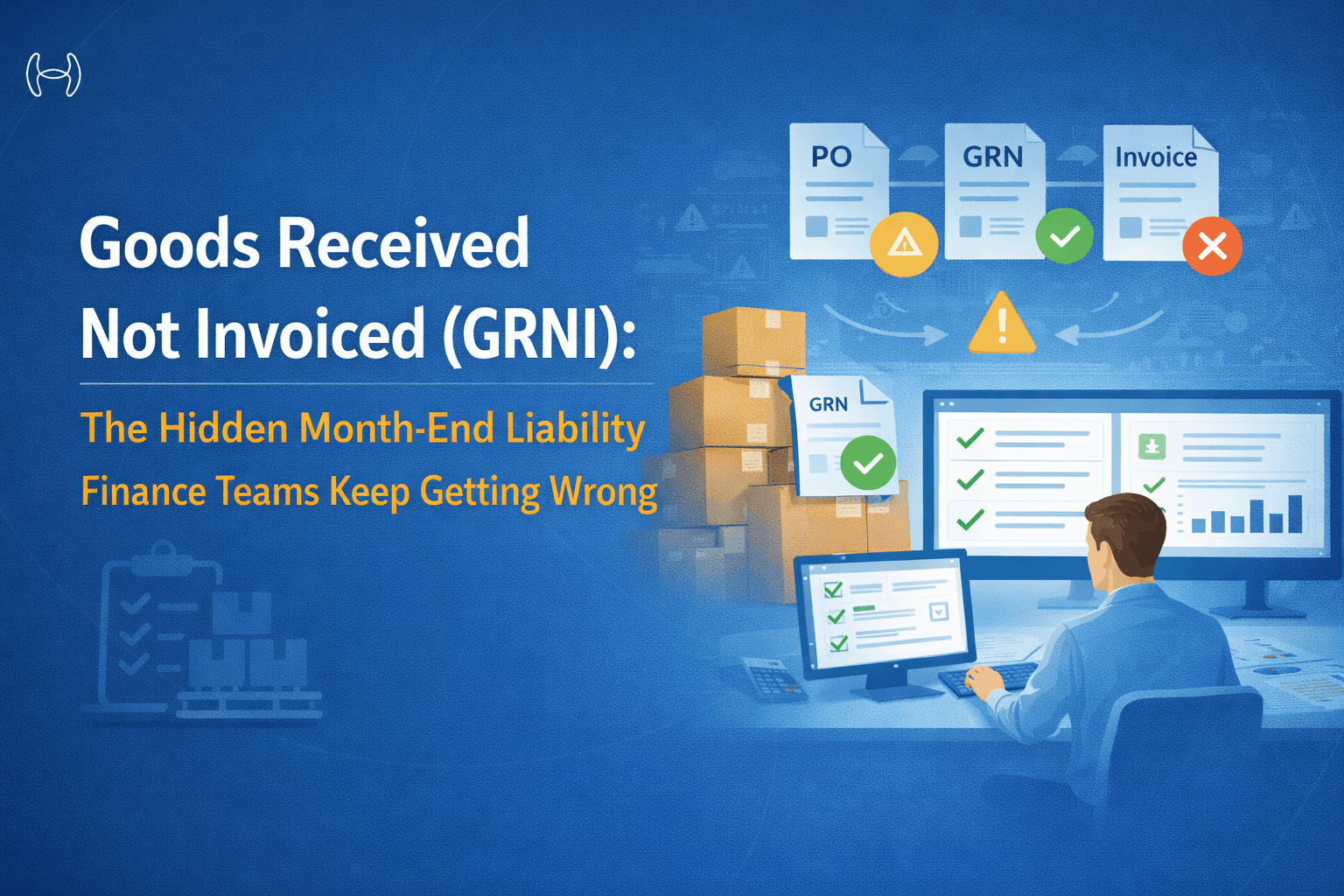
Every time a company receives a shipment of goods, a financial obligation is created the moment those goods cross the threshold, not when the invoice arrives, and certainly not when it gets paid. Goods received not invoiced (GRNI) is the accounting term for that gap: the liability that exists from the point of receipt until the supplier's invoice is matched and posted.
Under accrual accounting, this liability must be recorded in the period it is incurred. If goods arrived on the 27th of the month but the invoice won't show up until the 9th of next month, that cost belongs in this period's books. Full stop. GRNI accruals are the mechanism that enforces this rule at month-end.
In theory, it is straightforward. In practice, it is one of the most consistently mismanaged liabilities in enterprise finance.
The typical GRNI entry works like this: when goods are received and a Goods Receipt Note (GRN) is generated, a debit is posted to the GRNI account and a credit to the accrued liabilities account. When the invoice eventually arrives and is matched, the GRNI entry is reversed and the actual payable is recorded. The net effect is a clean handoff between receipt and invoice, but only if the process works as designed. Most of the time, it does not.
Why GRNI Keeps Going Wrong
The Volume Problem
Finance teams at mid-market and enterprise companies are not managing ten or twenty GRNI items at month-end. They are managing hundreds, sometimes thousands, of open GRNs across multiple suppliers, warehouses, cost centers, and ERP modules simultaneously. At that volume, the margin for error is not small. It is structural.
The Timing Problem
GRN data and invoice data do not live on the same clock. Goods arrive in real time. Invoices arrive on vendor schedules. ERP systems often update on batch cycles, meaning GRN records may not be current at the exact moment a finance team runs their accrual sweep. A batch that ran at 6 PM misses a receipt logged at 7 PM. That transaction disappears from the month, silently.
The Estimation Problem
When the invoice has not arrived, how does a finance team decide what to accrue? Most rely on the PO value. That sounds reasonable until partial deliveries, quantity variances, or price adjustments enter the picture. A PO for 500 units at $40 each does not automatically tell you that only 380 units arrived, that three were damaged, and that the supplier is crediting $200. Manual estimation under those conditions produces accruals that are consistently off, sometimes over, sometimes under, always requiring true-up adjustments in the following period.
The Reversal Problem
A GRNI accrual that does not reverse correctly in the following period creates a double-count. The liability is absorbed twice: once as an accrual and again when the invoice posts. Over multiple periods, unresolved reversals accumulate and silently inflate expense accounts. Identifying and unwinding them is expensive, time-consuming, and often requires a full reconciliation of the GRNI ledger.
The Audit Trail Problem
When an auditor asks why a specific GRNI accrual was posted at a specific amount in a specific period, the honest answer in most organizations is: "someone ran the spreadsheet." That is not a defensible audit trail. It is a documentation gap that creates SOX risk, extends audit cycles, and produces findings that take months to remediate.
What GRNI Errors Actually Cost
The financial impact of poorly managed GRNI goes well beyond the accounting adjustments. Consider what flows downstream from a single missed or misstated GRNI entry:
GRNI Failure Mode | Downstream Impact |
Missed GRNI accrual | Understated liabilities; overstated profit in current period |
Over-accrual from PO-based estimates | Inflated expenses; understated profit; large true-up next period |
Failed reversal | Double-counted expense; distorted cost of goods sold |
Late discovery of GRNI items | Post-close restatements; delayed board reporting |
Inadequate audit trail | SOX findings; extended audit cycles; remediation cost |
High volume of manual entries | 2–4 days of finance team time per close cycle |
These are not edge cases. They are the standard experience for finance teams relying on manual or semi-automated GRNI processes. And because GRNI liabilities are often the largest single category of unmatched transactions at period-end, the compounding effect across twelve close cycles per year is significant.
How the GRNI Process Should Work
A well-designed GRNI accrual process is systematic from the point of goods receipt through to invoice matching and reversal. Here is what that flow looks like end to end:
Goods Arrive at Warehouse
│
▼
┌─────────────────────────────┐
│ GRN Generated in ERP │
│ • Quantity logged │
│ • Date and supplier noted │
│ • Linked to open PO │
└────────────┬────────────────┘
│
▼
┌─────────────────────────────┐
│ GRNI Accrual Discovery │
│ • Match GRN to open PO │
│ • Check for posted invoice │
│ • Flag uninvoiced items │
└────────────┬────────────────┘
│
▼
┌─────────────────────────────┐
│ Amount Calculation │
│ • Unit price from PO │
│ • Qty received from GRN │
│ • Adjust for variances │
└────────────┬────────────────┘
│
▼
┌─────────────────────────────┐
│ GL Coding and Validation │
│ • Cost center assignment │
│ • Account code mapping │
│ • Policy compliance check │
└────────────┬────────────────┘
│
▼
┌─────────────────────────────┐
│ ERP Posting │
│ • Debit GRNI account │
│ • Credit accrued liability │
│ • Audit trail stamped │
└────────────┬────────────────┘
│
▼
┌─────────────────────────────┐
│ Invoice Arrives and Matches│
│ • GRNI accrual reversed │
│ • Actual payable posted │
│ • Variance flagged if any │
└─────────────────────────────┘
Every step in this flow needs to be automated, documented, and repeatable. The challenge for most organizations is that steps two through five are still largely manual, which is exactly where the errors accumulate.
Where Existing Technology Falls Short
Most enterprise finance teams already have an ERP in place with some form of GRNI module or goods receipt posting capability. So why does the problem persist?
Because ERP GRNI modules are reactive, not proactive. They record what has been entered; they do not go looking for what is missing. If a GRN was logged in a satellite warehouse system that is not yet synced, the ERP does not know about it. If a partial delivery was received against a blanket PO and the receiving team did not update the GRN quantity, the ERP accrues the wrong amount. If someone forgets to flag a receipt as uninvoiced, nothing flags it automatically.
Understanding how goods receipt, 3-way matching, and invoice processing interconnect makes it clear why GRN data quality is the upstream dependency that everything else relies on. When that data is incomplete or delayed, every downstream step, including accruals, matching, and payment, is compromised.
The result is that the bulk of GRNI management still depends on a finance team member manually pulling GRN and AP aging reports, cross-referencing them in a spreadsheet, estimating amounts for items with insufficient data, and posting entries before the cut-off deadline. At scale, this is not a process. It is a fire drill that happens twelve times a year.
How Hyperbots Solves the GRNI Problem
Hyperbots' Accruals Co-Pilot approaches GRNI from the position that discovery should be proactive and continuous, not a once-a-month scramble triggered by someone opening a spreadsheet.
Automated GRNI Discovery Directly from ERP Data
The Co-Pilot reads GRN data and open PO data directly from the ERP through native connectors, running AI-powered GRNI accrual discovery on a continuous basis, whether daily, weekly, or monthly, depending on the organization's close cadence. It identifies every GRN where a matching invoice has not been posted, without waiting for a human to initiate the search.
This is the difference between systematic coverage and memory-dependent coverage. The Co-Pilot does not forget the goods received at the satellite warehouse on the 29th. It does not miss the partial delivery that came in at 8 PM. It processes the full GRN population, not a subset filtered through a manual export.
Precise Amount Calculation from Actual Receipt Data
Rather than defaulting to PO value, the Hyperbots Co-Pilot calculates the accrual amount by multiplying the unit price from the PO against the actual quantity confirmed in the GRN. If 380 units arrived against a PO for 500, the accrual is based on 380, not 500. This single change in methodology is what drives the reduction to less than 5% variance between accrued and actual costs, compared to the 10–20% variance typical of estimate-based manual processes.
The Co-Pilot also handles partial receipts, multi-line POs, and quantity variances, which are the complex scenarios where manual processes most commonly produce errors.
Accurate Matching Across POs and GRNs
The Co-Pilot uses advanced 2-way matching logic across 100+ fields to reconcile POs and GRNs, using numeric reasoning, expression evaluators, and language models. Finance teams evaluating AI-driven invoice and GRN matching will recognize that this capability is what allows the Co-Pilot to distinguish between a genuine GRNI liability and a receipt that is already covered by a pending invoice in the approval queue, preventing both under-accrual and double-accrual.
Configurable Reversals on Invoice Receipt
When the actual invoice arrives and is matched, the GRNI accrual reverses automatically. Finance teams can configure this to happen at month-start on a scheduled basis, or in real time as invoices are posted, depending on their accounting policies. The configurable accrual reversal eliminates the highest-risk manual step in the traditional GRNI process: tracking which accruals need to come off the books and when.
Complete Audit Trail from Receipt to Reversal
Every GRNI accrual, from the GRN that triggered discovery through the amount calculation, GL coding, ERP posting, and eventual reversal, is time-stamped and documented automatically. The accruals audit trail gives auditors and SOX reviewers a traceable record for every entry without requiring the finance team to reconstruct documentation after the fact.
For teams exploring the broader transformation this enables, the guide on transforming accruals with Hyperbots' Agentic AI Co-Pilot covers how the end-to-end accruals process, spanning GRNI, services, recurring expenses, and pending invoices, is unified under a single automated workflow.
Manual vs. Automated GRNI Accruals: A Side-by-Side View
Capability | Manual Process | Hyperbots Accruals Co-Pilot |
GRNI discovery | Manual ERP export and spreadsheet review | Automated: continuous GRN and PO scanning |
Amount calculation | PO value estimates, prone to variance | Actual GRN quantity × PO unit price |
Partial receipt handling | Manual adjustment, frequently missed | Automated: quantity-level reconciliation |
Multi-line PO coverage | High error risk across line items | 2-way matching across 100+ fields |
Accrual variance (vs. actual invoice) | Typically 10–20% | Less than 5% |
Reversal management | Manual tracking, high failure risk | Configurable automatic reversals |
Audit trail | Spreadsheet records, fragmented | Complete end-to-end trail, ERP-stamped |
Close cycle time | 2–4 days of manual accruals work | Automated and continuous |
Accrual processing cost | High | 80% reduction |
The Business Impact of Getting GRNI Right
The outcomes from replacing manual GRNI accrual processes with Hyperbots' automated approach are measurable:
Less than 5% variance between accrued and actual costs. When accrual amounts are derived from actual GRN quantities rather than PO estimates, the gap between what is accrued and what the invoice eventually confirms is eliminated for the vast majority of transactions.
80% reduction in accrual processing cost. The manual effort of compiling GRNI schedules, chasing confirmations, estimating amounts, coding entries, and managing reversals is automated for the bulk of transactions, freeing finance team capacity for review and analysis rather than data assembly.
Faster, cleaner month-end close. GRNI is consistently one of the longest-running items in the accruals process. Automating discovery, calculation, and posting removes it as a close bottleneck, contributing directly to a faster overall close cycle.
Audit-ready documentation from day one. Every GRNI accrual has a traceable record. Auditors get the documentation they need without requiring the finance team to reconstruct it under pressure.
ROI and Implementation
Finance teams evaluating GRNI automation typically ask two questions: what does it cost, and how fast can we be live?
On ROI, the numbers are direct. An 80% reduction in accrual processing cost, combined with the reduction to less than 5% variance, means fewer post-close adjustments, fewer restatements, and significantly lower audit remediation costs. Across twelve close cycles per year, the impact compounds quickly.
On implementation, Hyperbots goes live in one month. The Accruals Co-Pilot comes pre-trained on finance-specific data and connects to major ERP platforms, including SAP, Oracle, NetSuite, Microsoft Dynamics, Sage, QuickBooks, and Deltek Costpoint, through native connectors. No custom middleware, no bespoke integration development, no model training required before go-live. The Co-Pilot begins discovering GRNI accruals, posting entries, and building its GL coding intelligence from the first close cycle.
FAQs
What is goods received not invoiced (GRNI)? GRNI is an accounting entry that records the liability for goods that have been physically received by a company but for which no supplier invoice has yet been posted. Under accrual accounting, this liability must be recognized in the period the goods are received, not the period the invoice arrives.
Why is GRNI a problem at month-end? At month-end, finance teams must identify every GRN where no matching invoice exists, estimate or calculate the correct accrual amount, post the entry before the cut-off deadline, and ensure it reverses correctly when the invoice arrives. At scale, doing this manually is slow, error-prone, and reliant on data that may not be current.
How does Hyperbots calculate the GRNI accrual amount? Hyperbots' Accruals Co-Pilot calculates the accrual by reading the actual quantity received from the GRN and multiplying it by the unit price from the corresponding PO. This approach accounts for partial deliveries and quantity variances, producing accruals that closely match the eventual invoice.
What happens when the invoice arrives after the GRNI accrual is posted? The Co-Pilot automatically reverses the GRNI accrual when the matching invoice is posted, either at month-start on a scheduled basis or in real time depending on the organization's configured policy. This eliminates double-counting and ensures the financial records reflect only the actual invoice liability.
How long does it take to implement Hyperbots' Accruals Co-Pilot? Hyperbots goes live in one month. Pre-built ERP connectors and pre-trained AI models mean finance teams can begin their first automated close cycle within weeks of implementation, with no custom development required.
Hyperbots' Accruals Co-Pilot automates GRNI discovery, booking, and reversal, delivering less than 5% variance between accrued and actual costs and an 80% reduction in accrual processing cost. Go live in one month. Request a demo.
Curious how Hyperbots' approach to live invoice-driven accruals stacks up? See how Hyperbots compares on month-end close speed and accrual automation.