How Finance Teams Validate Service Deliveries Without GRNs
Learn how finance teams validate service invoices without GRNs using timesheets, service entry sheets, and milestone approvals while reducing delays and audit risk.
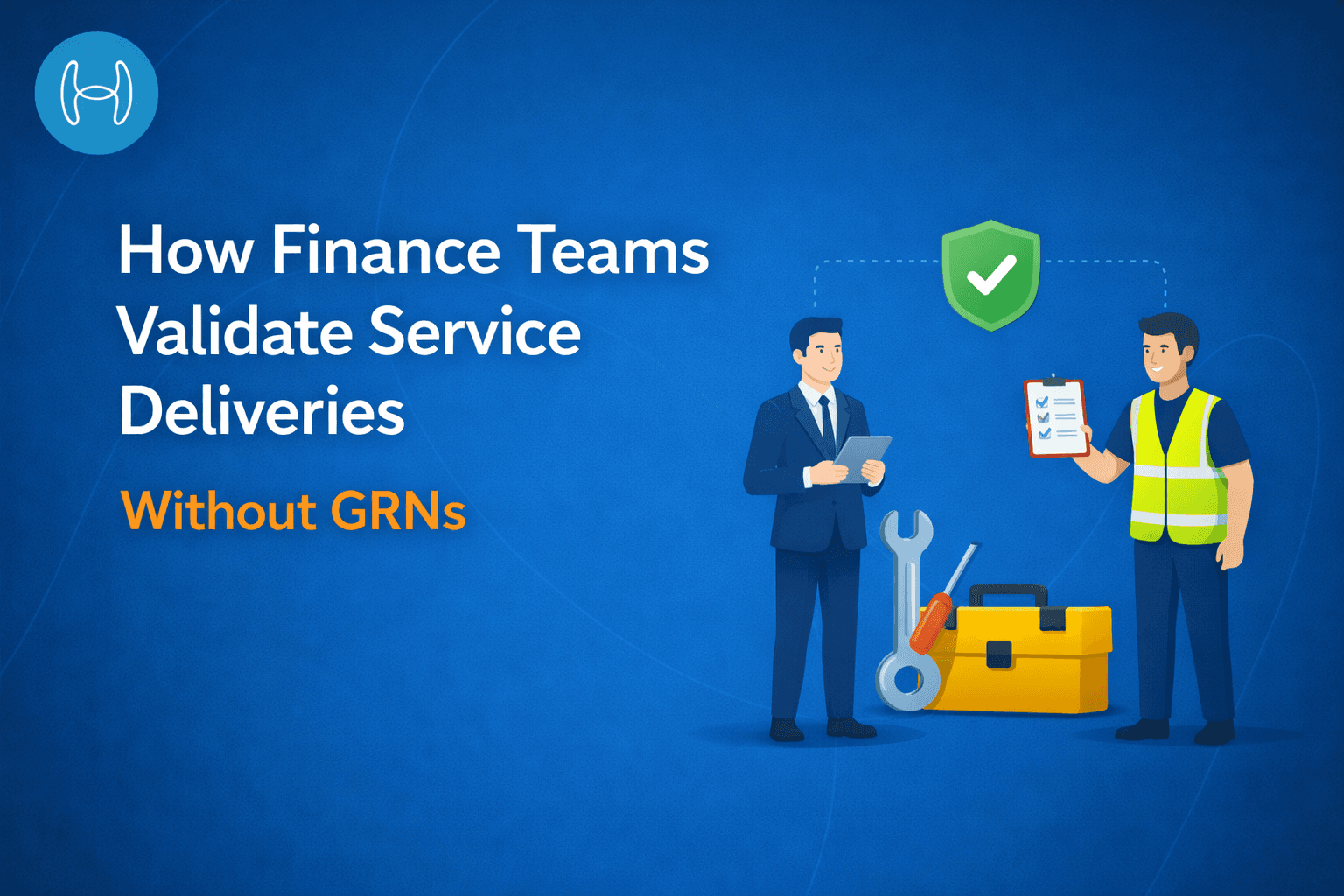
Picture this. A consulting firm submits an invoice for six weeks of strategy work. The engagement went well. The client is happy. Everyone agrees the work was done. But when the invoice lands in the AP queue, the finance team has a problem: there is nothing in the system to match it against.
No delivery confirmation. No receipt record. No document that says the work was completed and accepted. Just an invoice and a vague understanding that someone, somewhere, approved the engagement.
This is the daily reality of service invoice processing. And it is where a lot of AP teams quietly lose hours, miss accruals, and create audit trails that would not survive serious scrutiny.
This blog explains what finance teams actually do when there is no GRN to match against, why each approach has its limits, and where the process tends to break down. For a broader look at how goods and services procurement differ structurally, the guide on goods versus services purchases covers the full comparison including PO structure, matching strategies, and compliance requirements across both.
What a GRN Is and Why It Matters for Invoice Matching
A Goods Receipt Note, or GRN, is a document created when a business physically receives goods from a vendor. When a pallet of components arrives at the warehouse, someone counts the items, checks them against the purchase order, and confirms the delivery in the ERP. The system creates a GRN automatically. That document then becomes the middle leg of three-way matching.
Three-way matching is how finance verifies an invoice before paying it. It compares three things: the purchase order (what the business agreed to buy), the GRN (what was actually received), and the vendor invoice (what the vendor says is owed). When all three align, the invoice clears. When they do not, an exception is raised. The full accounts payable workflow maps out exactly where this matching sits in the broader process and why a missing document at any point creates a bottleneck.
The reason this works so well for physical goods is that the receipt event is objective. The items either arrived or they did not. The quantities either match or they do not. It is a yes or no question with a document as the answer.
Services do not give finance teams that document. There is no delivery. There is no warehouse. There is no moment when someone counts what arrived and enters it into the ERP. The work happens over time, often invisibly, and its completion is a matter of judgment, not measurement. That judgment still has to come from somewhere. Here is how finance teams get it.
How Finance Teams Confirm Service Delivery Without a Physical Receipt
Service Entry Sheets: The Formal Substitute
In organisations using SAP and similar enterprise systems, a Service Entry Sheet is the formal mechanism for confirming service delivery. Think of it as the service equivalent of a GRN: an internal record, raised in the ERP, that says a specified piece of work has been completed to the agreed standard.
The person who commissioned the service, typically a project manager, department head, or operations lead, creates the Service Entry Sheet once they are satisfied the work is done. It references the original purchase order and captures what was delivered, the period it covers, and any relevant notes. Finance then matches the vendor invoice against the PO and the Service Entry Sheet, following the same logic as goods matching.
It is a sensible system. But it has one dependency that makes it fragile: it relies entirely on the requester to raise it promptly and thoughtfully. When that person is stretched across three other priorities, the Service Entry Sheet either gets delayed, holding up payment and creating supplier friction, or it gets created without proper review, becoming a checkbox exercise rather than a genuine confirmation.
Timesheet Approvals: The Invisible Audit Trail
For time-based contracts, contractors and service providers submit timesheets detailing the hours worked, tasks completed, and period covered. An internal approver reviews and signs off. Finance then uses those approved timesheets as the evidence that the billed hours were real.
When this works well, it is clean and traceable. When it breaks down, it breaks down badly. Bulk approvals at month-end without anyone actually checking the detail. Approvers who have moved on to other projects rubber-stamping timesheets they have no real visibility into. Hours logged for work that was technically done but barely useful. None of these create fraudulent invoices in a legal sense, but all of them create invoices that are hard to justify and harder to audit. The specific matching challenges that arise with time-and-material and retainer agreements are worth understanding separately. The guide on matching strategies for open-ended service invoices explains how these contract types require a different validation approach entirely.
Milestone-Based Confirmations: Tied to Deliverables, Not Hours
Project-based engagements often tie payment to delivery milestones rather than time. A consulting project broken into four phases, each with a defined output and a corresponding payment. A software development engagement where billing follows sprint completion. In these arrangements, a milestone sign-off from the relevant stakeholder serves as the receipt confirmation.
Done properly, this is one of the more defensible approaches. The deliverable is defined upfront, the sign-off is formal, and the link between completion and payment is clear. Done poorly, the milestones are vague, the sign-off is an email from someone who skim-read the deliverable, and the documentation lives in someone's inbox rather than the finance system. For an overview of how service POs are structured to support milestone billing and other delivery models, the guide on purchase orders for services explains how they differ structurally from goods POs.
Project Deliverable Sign-Offs: When Confirmations Live Outside the System
For one-off engagements, a signed acceptance form, a formal email approval, or a sign-off recorded in a project management tool often serves as the confirmation that work is complete. The challenge is that none of these naturally live in the finance system.
They live in email inboxes. In shared drives. In project management tools that AP has no access to. Getting that confirmation into the matching process requires someone to manually retrieve it, attach it, and link it to the invoice. Every time. For every service invoice. That is a process that scales by headcount, not by system capability.
The Risks That Come With Informal Service Validation
Each of the four methods above can work. None of them work automatically, and all of them have failure modes that finance teams deal with more often than they probably should.
The most common one is approval without genuine engagement. A project manager approving a timesheet they have not looked at closely, or signing off a Service Entry Sheet because the invoice is sitting in their queue and payment is already late. The approval exists. The audit trail exists. But the review that should have happened did not. This is how businesses end up paying for work that was not fully completed, or at a rate that was not contractually justified.
The second is documentation that lives outside the system. A milestone sign-off in a project tool. A verbal confirmation that became an email that became a reference in a meeting note. Finance teams often have no reliable way to know whether confirmation actually exists until someone goes looking for it, usually because the invoice has been sitting in the queue for two weeks and the vendor is chasing payment.
The third is the reverse problem: work that has been confirmed but not yet billed. The service was delivered and accepted. The Service Entry Sheet was raised. But the vendor has not sent the invoice yet. Finance needs to accrue the liability for an accurate close, but without a vendor invoice, they are working from estimates. This is one of the most persistent causes of month-end variance, and it rarely gets fixed by adding more people to the process.
Where Automation Changes the Equation
The manual approach to service validation has a ceiling. You can add more approvers, tighten the sign-off process, and chase documentation more aggressively. But the underlying problem, that confirmation data lives in scattered places and needs to be manually collected and matched, does not go away. It just gets more expensive to manage.
AI-driven automation approaches this differently. Instead of relying on a human to collect confirmation documents and bring them into the AP process, the system does it continuously in the background. Open purchase orders, Service Entry Sheets, approved timesheets, and confirmed milestones are read automatically. Service invoices are matched against whichever confirmation type applies to that contract. Discrepancies are flagged before they reach a reviewer, with the relevant documents already attached and the specific mismatch identified.
For the accruals problem, automation removes the guesswork entirely. Rather than asking a finance team member to estimate what has been delivered but not yet billed at month-end, the system identifies those liabilities from live PO data and confirmed service receipts, books the accrual, and surfaces it for review. The close becomes a check rather than a calculation.
For time-and-material and retainer contracts, where billing is variable and does not map to a fixed PO quantity, automated workflows can be configured by contract type. T&M invoices are validated against approved timesheet hours. Retainer invoices are validated against the agreed period and scope. The matching logic fits the contract rather than forcing every service invoice through a goods-matching framework that was never designed for it.
The result is a validation process that is consistent, fully documented, and scalable without adding headcount.
How Hyperbots Handles Service Invoice Validation
The core challenge of service validation is not the matching logic. It is the information gathering. Confirmations are scattered across systems. Approvers are outside finance. Accruals require estimates because the data is not in one place. AI automation addresses this by making the gathering automatic and the matching structured.
Hyperbots handles three-way matching for service invoices by pulling together available confirmation signals, whether that is a Service Entry Sheet in the ERP, an approved timesheet from a connected system, or a confirmed milestone, and comparing them against the invoice before it reaches a human approver. Exceptions arrive with the specific discrepancy identified and the relevant documents already attached. Reviewers spend their time making decisions, not collecting evidence.
For the accruals problem, accrual discovery for services received but not yet invoiced reads open purchase orders, confirmed Service Entry Sheets, and approved milestones continuously to identify what has been delivered but not yet billed. Instead of asking the finance team to estimate at month-end, it surfaces the liability automatically, with the supporting data attached. The close becomes a review rather than a guessing exercise.
And for open-ended contracts like time-and-material agreements or retainers, where a rigid matching workflow produces constant exceptions because billing does not map to a fixed quantity, flexible workflow configuration lets finance set validation rules by contract type, so that T&M invoices are validated against approved timesheet hours rather than a PO line quantity.
Getting Service Invoice Validation Right
The absence of a GRN is not the problem. The problem is treating service invoice validation as something informal because there is no physical receipt to anchor it. Every organisation has a method, whether that is Service Entry Sheets, timesheets, milestone sign-offs, or deliverable approvals. The difference between finance teams that handle it well and those that struggle is not which method they use. It is whether the method is applied consistently, documented properly, and connected to the AP process in a way that survives an audit.
When those conditions are met, service invoice validation is no more difficult than goods validation. It just requires different inputs. Getting those inputs into the system automatically, rather than chasing them manually, is what makes the process scale.