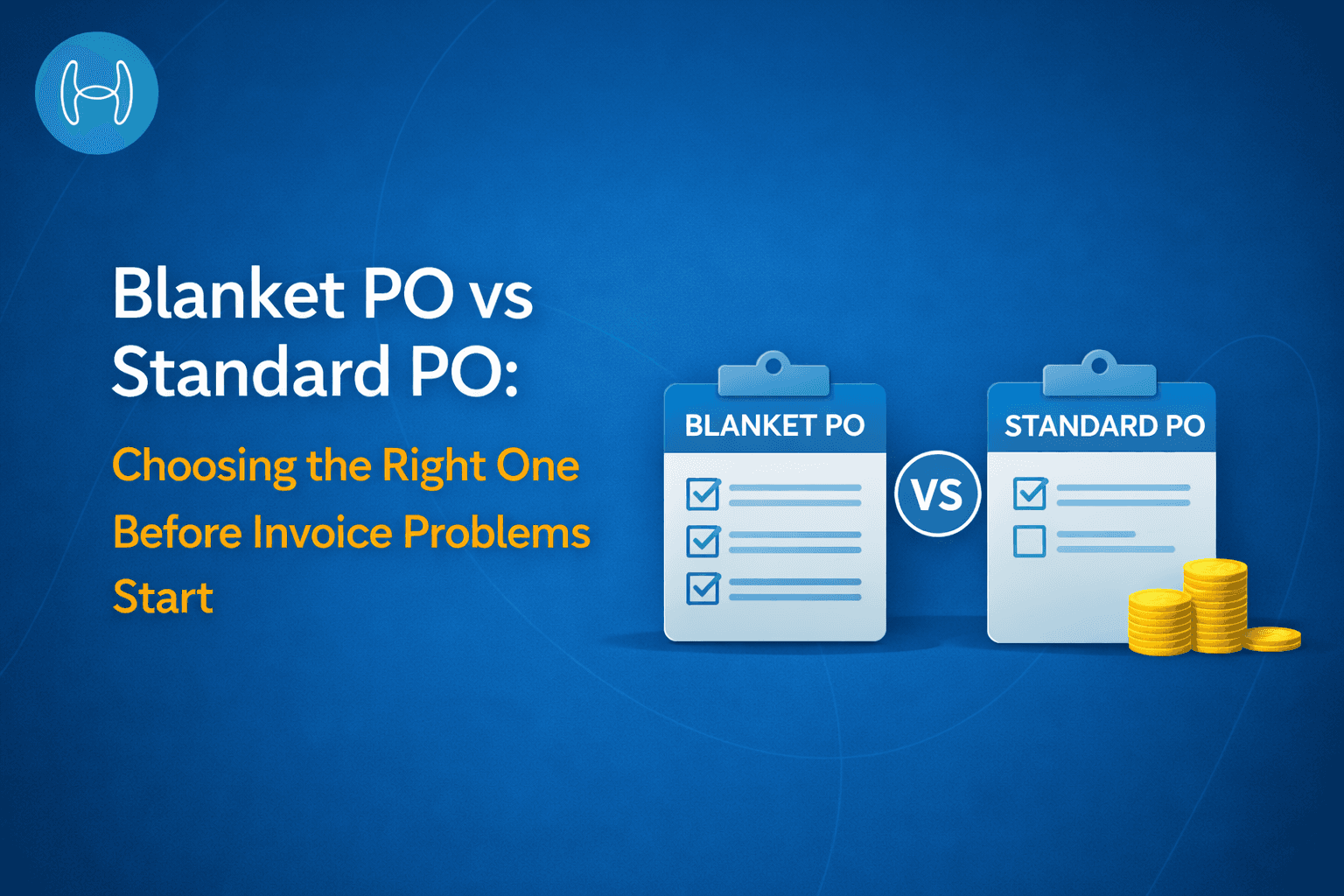
Blanket PO vs Standard PO: Choosing the Right One Before the Invoice Problems Start
Understand the difference between standard and blanket purchase orders and how choosing the right structure reduces invoice mismatches and speeds up accounts payable.
If you work in finance or procurement, you have dealt with an invoice that would not match, an approval that kept bouncing back, or a supplier chasing payment for something you know was delivered weeks ago. The usual suspects get blamed: the vendor sent the wrong amount, someone forgot to approve, the ERP is playing up again.
But in a large number of cases, the actual problem started earlier. It started the moment the purchase order was raised using the wrong structure for the type of spend it was covering.
This blog is for anyone who raises, approves, or processes purchase orders, and for anyone who deals with the invoice problems that follow when the PO structure is wrong. You do not need a finance background to follow it. By the end, you will understand the two most common PO types, what each one is designed to do, and how choosing the right one upstream makes every step that follows faster and cleaner.
What a Purchase Order Actually Does
A purchase order, commonly called a PO, is a formal document that authorises a vendor to supply goods or services at an agreed price, in an agreed quantity, within an agreed timeframe. Once the vendor accepts it, it becomes a binding commercial agreement.
For a finance team, the PO does three things. It creates a documented commitment before money is spent. It gives accounts payable a reference point to match against when the invoice arrives. And it gives the business a control mechanism, requiring approval before a commitment is made.
What the PO does not do is automatically adapt to how different types of purchases work. A one-time order for 500 components and a 12-month managed services contract are both vendor transactions. But they have almost nothing in common in terms of quantity, frequency, delivery, and billing. Using the same PO format for both creates friction at every stage: at creation, at receipt, and at invoice matching.
That friction is where most AP bottlenecks begin. For a full look at the PO lifecycle from creation through approval, dispatch, and closure, the ultimate guide to purchase orders covers the complete process with templates and best practices.
Standard Purchase Orders: Good for Defined, One-Time Purchases
A standard purchase order is a single, specific commitment to a vendor for a fixed quantity at a fixed price by a fixed date. Everything is agreed at the point of creation and does not change.
Standard POs work best when the purchase is predictable and bounded. You know exactly what you are buying, how much, what it costs, and when it will arrive. The vendor delivers, the receiving team creates a goods receipt note confirming what arrived, and AP matches the supplier invoice against both the PO and the goods receipt in what is called a three-way match. When all three align, the invoice clears and moves to payment.
This structure fits physical goods naturally. A factory ordering components, a business buying office furniture, a warehouse restocking inventory: all of these have a clear start and end, a specific quantity, and a delivery that can be physically confirmed.
The weakness of a standard PO is its rigidity. The moment a quantity changes, a price is renegotiated, or a delivery splits across multiple shipments, the standard PO starts generating exceptions. Each exception lands in a queue that someone has to manually resolve. One exception is manageable. Hundreds a month, across multiple suppliers, becomes a real problem.
Blanket Purchase Orders: Good for Ongoing, Variable Spend
A blanket purchase order, also called a standing order or framework PO in some organisations, is a long-term agreement with a vendor that covers multiple deliveries or invoices over a defined period. Instead of committing to a single fixed transaction, a blanket PO sets a total value ceiling, an agreed price or rate, and a validity period. Individual transactions are then drawn down against it over time.
This structure was built for the reality of ongoing vendor relationships. A business does not raise a new PO every time a cleaning invoice arrives, every week temporary staff are billed, or every month a software subscription renews. One blanket PO covers the full contract period, and each invoice is a release against that standing commitment.
Blanket POs suit services almost perfectly. A retainer with a consulting firm, a maintenance contract with a facilities provider, a subscription licence: all involve recurring billing against an agreed rate over time. The blanket PO captures the commercial relationship at the start and gives AP a standing reference for every invoice that follows, without anyone having to raise a new authorisation each time.
They also suit high-frequency goods procurement. A manufacturer ordering the same components repeatedly from the same supplier benefits from locking in price and terms for the year rather than raising a new PO with each order.
The matching challenge with blanket POs is cumulative rather than transactional. AP is not checking whether one invoice matches one receipt. It is checking whether the invoices received so far remain within the agreed ceiling, at the agreed rate, within the validity period. The guide on effective matching strategies for blanket purchase orders covers exactly how this cumulative tracking works and where it tends to break down in practice.
Why Services Almost Always Need a Blanket PO
Services and goods do not just differ in what is purchased. They differ in almost every structural aspect of how a purchase is organised, delivered, confirmed, and billed. The differences matter because they determine which PO type actually fits.
Quantity is rarely fixed. A consulting project scoped at 200 hours might run to 230 if the scope expands. A maintenance contract priced monthly might include variable call-out charges. A staffing agreement billed weekly fluctuates with headcount. None of these fit cleanly into a standard PO without constant amendment.
Delivery is not a single event. A physical goods delivery happens once, or in a discrete number of shipments. A service is delivered continuously or in milestones. There is no warehouse to receive it, no goods receipt note to confirm it. Delivery happens over time and its completion is a matter of agreement rather than a physical count.
Billing follows a schedule, not a delivery. Physical goods are typically invoiced on delivery. Services are typically invoiced weekly, monthly, or at project milestones. Each invoice represents a partial draw-down against a longer commitment, not a standalone transaction.
All of this points the same direction. For services, the blanket PO is not just a convenience. It is the structure that fits how the commercial relationship actually works. The guides on purchase orders for services and on goods versus services procurement cover the structural differences in full, including delivery verification, compliance requirements, and matching strategies across both.
Where Each Structure Breaks Down
Standard POs break down when the purchase changes. Partial deliveries against a fixed quantity create open commitments that need to be tracked and eventually closed. Price changes require PO amendments that trigger re-approval. Split invoices across multiple delivery dates need reconciling against a single PO line. Each is manageable individually. Across high invoice volumes, they accumulate into a significant drain on AP capacity.
Blanket POs break down when cumulative tracking is not maintained. Finance needs to know at any point how much of the blanket PO value has been drawn down and how much remains. Without that visibility, one of two things happens. Invoices get approved beyond the agreed ceiling because nobody noticed the limit had been reached. Or invoices get held because AP cannot confirm whether the remaining balance covers the current amount. One is a financial control failure. The other is a vendor payment delay.
Blanket POs can also remain open indefinitely if the closure process is not managed. Unlike standard POs, which close when the delivery is confirmed, blanket POs need an active end date or a ceiling that triggers closure. When that is not enforced, unused commitments sit on the books as outstanding liabilities, distorting cash flow forecasting and complicating the financial close.
Standard PO vs Blanket PO: A Quick Reference
Standard PO | Blanket PO | |
Commitment type | Single, fixed transaction | Standing agreement over a period |
Quantity | Fixed at creation | Variable, drawn down over time |
Price | Fixed per line item | Agreed rate or ceiling |
Delivery | One-time or discrete shipments | Recurring or milestone-based |
Invoice pattern | One invoice per delivery | Multiple invoices against one PO |
Receipt confirmation | Goods receipt note | Service confirmation or milestone sign-off |
Matching approach | Three-way match per invoice | Cumulative matching against ceiling |
Best suited for | Physical goods, one-off purchases | Services, recurring goods, ongoing contracts |
Closure trigger | Delivery confirmed and invoiced | Period end or value ceiling reached |
Main risk | Amendments when scope changes | Overspend against ceiling, unclosed commitments |
Why Most ERP Systems Struggle With This, and What Fixes It
Most ERP systems handle standard POs reasonably well when the purchase is clean. The three-way match is a defined process, and the system processes it without significant manual intervention. The problems grow when the purchase is not clean: a partial delivery, a price tolerance, a split invoice.
Blanket POs are where most ERPs start showing their limits. Cumulative spend tracking, rate validation, period-based matching, and ceiling monitoring all require either significant configuration or an automation layer that handles them continuously. Without that, someone is manually checking a spreadsheet against the blanket PO every time an invoice arrives.
Hyperbots handles both PO structures natively. The PO configurability capability supports both standard and blanket PO creation and management, with the structure configured to match the type of spend. Services are set up under blanket POs with the right ceiling and validity period. One-time goods orders run through standard POs with three-way match logic. Each type is processed according to the rules that fit it, without forcing all purchases through the same template.
The matching strategy configuration allows finance teams to define precisely how invoices are validated against each PO type. A blanket PO invoice is checked cumulatively against the remaining balance at the agreed rate within the validity period. A standard PO invoice is matched transaction by transaction. The matching logic follows the PO structure, so exceptions are genuine exceptions rather than false positives generated by applying the wrong matching rule to the wrong PO type.
Budget control checks run against live ERP data before any order is placed. If a new release would exceed a blanket PO ceiling, the system flags it before the commitment is made. If a standard PO is being raised for a category already covered by a blanket PO, that surfaces immediately. The control happens at the point of purchase, not after the invoice has arrived and the damage is done.
How to Choose the Right Structure
The decision is straightforward when the purchase is clearly defined. A one-time goods order uses a standard PO. A 12-month service contract uses a blanket PO.
The complexity sits in the middle ground. A goods supplier with a long-term relationship but variable order quantities. A services engagement with defined milestones but potential scope changes. A software subscription billed monthly with usage-based add-ons.
In those cases, the right question is not which PO type technically applies, but which structure gives AP the clearest matching reference and the business the clearest view of its commitments. If the purchase is ongoing, recurs on a schedule, or involves a vendor relationship rather than a single transaction, a blanket PO is almost always the right answer. If it is genuinely discrete, bounded, and unlikely to change, use a standard PO and close it cleanly when delivery is confirmed.
Getting this right upstream reduces exceptions, speeds up invoice approval, and gives finance a cleaner picture of open commitments at any point in the month. Getting it wrong creates work at every stage, from the initial approval down to the payment run.
The Bottom Line
The choice between a blanket PO and a standard PO is not a procurement formality. It is the foundation that invoice matching, spend control, and financial close are all built on. Use the right structure for the right type of spend, and every step that follows is simpler, faster, and easier to audit. Use the wrong one, and the exceptions accumulate long before anyone realises the root cause.
FAQs
What is the difference between a standard PO and a blanket PO?
A standard PO is a single, fixed commitment for a specific quantity at a specific price on a specific date. A blanket PO is a standing agreement that covers multiple transactions over a period, with individual invoices drawn down against an agreed ceiling or rate.
When should you use a blanket PO instead of a standard PO?
Use a blanket PO when the purchase is ongoing, recurring, or involves a vendor relationship over time: services contracts, maintenance agreements, software subscriptions, or high-frequency goods orders from the same supplier. Use a standard PO when the purchase is discrete, bounded, and fully defined upfront.
Why do blanket POs cause invoice matching problems?
Blanket PO matching is cumulative rather than transactional. AP needs to track total spend against the ceiling, validate the rate, and check the validity period with every invoice. Most ERP systems do not do this automatically, which means it falls to manual oversight and creates errors when that oversight is inconsistent.
What happens if a blanket PO is not closed properly?
The commitment remains open on the books as an outstanding liability. This distorts cash flow forecasting, inflates open commitment reports, and complicates the financial close. Blanket POs need an active end date or a ceiling that triggers automatic closure.
How does Hyperbots handle both PO types?
Hyperbots supports both standard and blanket PO structures with configurable matching logic for each. Standard POs are matched transaction by transaction. Blanket POs are matched cumulatively against the remaining balance at the agreed rate. Budget control checks run before any order is placed, preventing overspend at the source.