The Ultimate Guide to Purchase Orders: Process, Templates, and Best Practices
Your Complete Roadmap to Flawless Procurement: Understanding the PO Process, Utilizing Essential Templates, and Implementing Industry Best Practices.
Introduction
In today's business landscape, purchase orders (POs) serve as the backbone of transparent, accountable procurement operations. Yet despite their critical importance, many organizations struggle with manual PO processes, inconsistent templates, and approval bottlenecks that slow down procurement cycles and increase compliance risks.
This comprehensive guide addresses the full spectrum of purchase order management, from fundamental concepts to advanced automation strategies. Whether you're a finance professional seeking to streamline your accounts payable workflow, a procurement manager looking to enforce better controls, a small-to-medium business owner building scalable purchasing processes, or an ERP user wanting to maximize your system's PO capabilities, this resource provides actionable insights for every stage of your journey.
What This Guide Covers:
Core definitions and distinctions between POs, invoices, and requisitions
The complete purchase order lifecycle from requisition to payment
Step-by-step instructions for creating and issuing purchase orders
Standardized templates and document formats
Best practices for approval workflows, compliance, and recordkeeping
Solutions to common challenges through automation and AI-powered tools
Modern procurement demands more than basic documentation. Organizations that master purchase order management gain real-time visibility into spending, enforce budget controls, strengthen supplier relationships, and create audit-ready paper trails. With the right processes and purchase order automation software, companies achieve 80% faster cycle times and near-perfect accuracy in three-way matching.
Let's begin by establishing the foundational understanding of what purchase orders are and why they matter.
What Is a Purchase Order (PO) in Business?
Basic Definition and Purpose
A purchase order is a legally binding commercial document issued by a buyer to a seller, authorizing a transaction before goods or services are delivered. Understanding what a PO is in business begins with recognizing its dual role: it's both a control mechanism for the buyer and a commitment document for the seller.
Key characteristics of a purchase order:
Authorization instrument: Represents formal approval to proceed with a purchase
Legal contract: Creates binding obligations once accepted by the supplier
Budget control tool: Locks spending against approved budgets or cost centers
Audit documentation: Provides traceable evidence of purchasing decisions
Communication vehicle: Clearly specifies quantities, prices, delivery terms, and payment conditions
From an accounting perspective, purchase orders play a crucial role in accrual-based financial management. When a PO is issued, many ERP systems create an encumbrance or commitment in the general ledger, reserving funds against the budget without yet recording an actual expense. This prevents overspending and gives finance teams real-time visibility into both actual and committed expenditures.
The PO vs. Invoice Distinction:
One of the most common points of confusion in procurement is distinguishing purchase orders from invoices. While both are critical procurement documents, they serve opposite functions:
Aspect | Purchase Order | Invoice |
Issuer | Buyer creates and sends to seller | Seller creates and sends to buyer |
Timing | Before goods/services are delivered | After goods/services are delivered |
Purpose | Authorizes the purchase | Requests payment |
Legal Status | Creates contractual obligation | Fulfills contractual obligation |
Accounting Impact | Creates commitment/encumbrance | Records actual expense and liability |
Understanding this distinction is essential for proper invoice processing and three-way matching, where purchase orders, receiving documents, and invoices must align before payment approval.
Types of Purchase Orders
Not all purchase orders follow the same structure. Organizations use different PO types depending on the nature of their purchasing needs, supplier relationships, and the predictability of requirements. Understanding what constitutes a standard purchase order and its variations helps organizations choose the right approach for each scenario.
1. Standard Purchase Order
The most common type, used for one-time purchases with clearly defined specifications:
Specific quantities and line items
Fixed pricing
Defined delivery date
Single transaction
Complete specification at time of issuance
Use cases: Equipment purchases, specific project materials, one-time service engagements
2. Blanket Purchase Order
An agreement for multiple purchases over a period, typically used when:
Quantities are uncertain but expected to be ongoing
Pricing is negotiated upfront
Items are standard and regularly needed
Administrative efficiency is prioritized over per-transaction control
Example: A manufacturing company establishes a blanket PO with an office supply vendor for $50,000 over 12 months. Individual releases against this blanket order don't require new approvals, streamlining the procurement process while maintaining spending limits.
3. Contract Purchase Order
Used for long-term relationships where terms are established but specific delivery schedules may vary:
Extended timeframe (often multi-year)
Detailed terms and conditions
May include service level agreements (SLAs)
Pricing framework with potential adjustment clauses
Requires periodic review and renewal
Use cases: Enterprise software subscriptions, facility maintenance contracts, professional services retainers
4. Planned Purchase Order
Similar to blanket POs but with more structure around delivery schedules:
Specified delivery dates or milestones
Quantities defined per period
Used in production planning scenarios
Enables better inventory management
Supplier receives advance notice of requirements
Use cases: Manufacturing components with just-in-time delivery, seasonal inventory builds, construction projects with phased material needs
Selecting the appropriate PO type impacts both operational efficiency and financial controls. Organizations with mature procurement processes typically maintain policies defining which type applies to different spending categories, approval authorities, and supplier relationships.
How Does a Purchase Order Work?
The Purchase Order Lifecycle
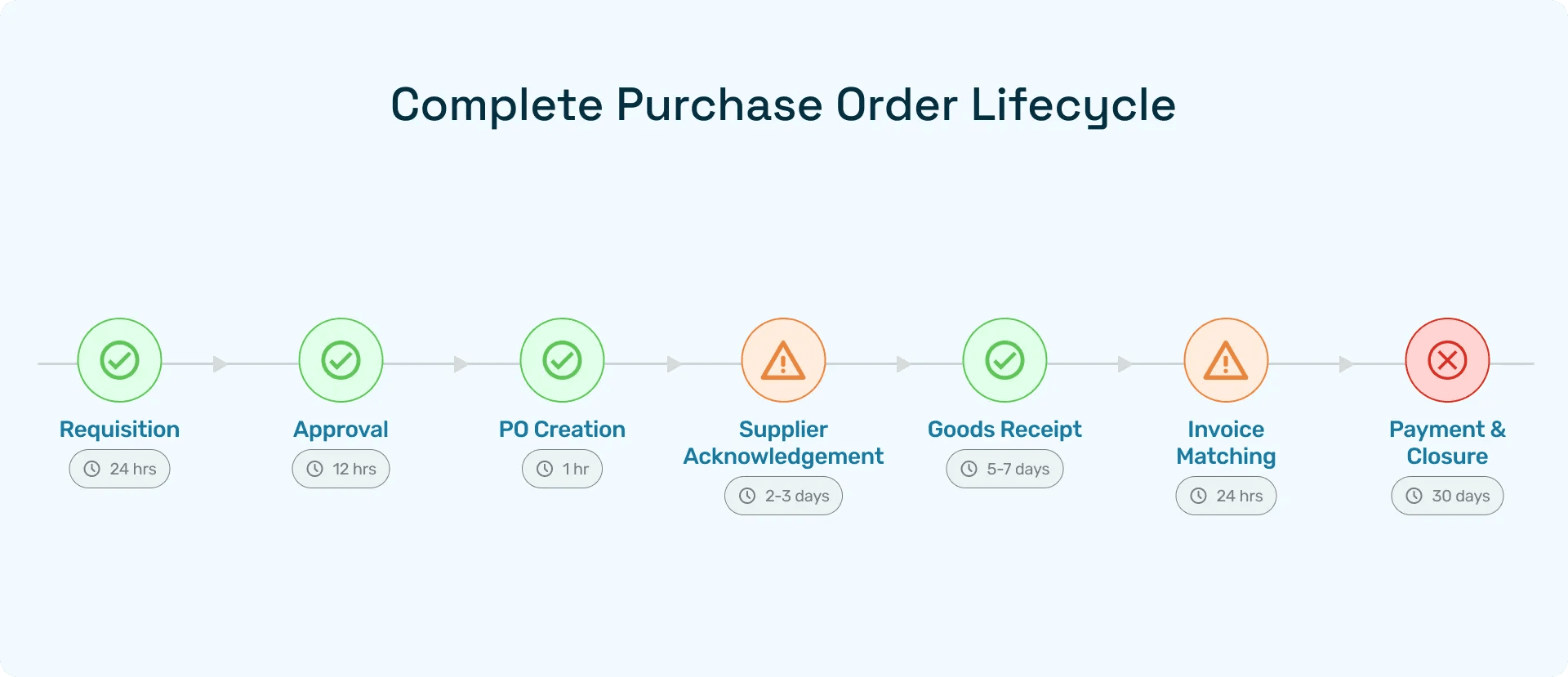
Understanding how a purchase order works requires following the complete lifecycle from initial need identification through final payment. This end-to-end process typically consists of seven key stages:
Stage 1: Requisition
The lifecycle begins when an employee or department identifies a purchasing need and creates a purchase requisition (PR). This internal document:
Describes what needs to be purchased and why
Estimates cost and specifies budget code
Identifies preferred supplier (if known)
Includes approval from department manager or budget owner
The distinction between purchase requisitions and purchase orders is critical: requisitions are internal requests for permission to buy, while POs are external commitments to suppliers.
Stage 2: Approval
Once submitted, the requisition enters an approval workflow based on:
Dollar amount thresholds
Department and cost center
Type of goods or services
Supplier risk profile
Budget availability
Modern organizations leverage automated approval workflows that route requisitions based on configurable rules, dramatically reducing cycle times from days to hours or minutes.
Stage 3: PO Creation and Issuance
After approval, procurement converts the requisition into a formal purchase order. The purchase order creation process involves:
Assigning a unique PO number for tracking
Verifying supplier information and delivery address
Confirming line items, quantities, and prices
Including terms, conditions, and delivery requirements
Obtaining final authorization signature or digital approval
Issuing the purchase order to the supplier can happen through multiple channels: email, EDI transmission, supplier portal upload, or integration with supplier systems.
Stage 4: Supplier Acknowledgment
Professional suppliers confirm receipt and acceptance of the PO, indicating:
Ability to fulfill the order as specified
Confirmation of pricing and terms
Expected delivery date
Any exceptions or required modifications
This acknowledgment transforms the PO from a proposal into a binding contract.
Stage 5: Goods Receipt / Service Completion
When items arrive or services are rendered:
Receiving department inspects and confirms quantity and quality
Goods Receipt Note (GRN) or service completion certificate is created
Variances are documented (shortages, damages, quality issues)
ERP system updates inventory and PO status
Stage 6: Invoice Matching
The supplier sends an invoice requesting payment. Automated invoice processing systems perform three-way matching:
Document | Key Data Points Compared |
Purchase Order | Authorized quantities, prices, terms |
Goods Receipt | Actual quantities received, condition |
Invoice | Billed quantities, prices, amounts |
Discrepancies trigger exception workflows for investigation and resolution. Organizations implementing AI-driven matching strategies achieve 95%+ straight-through processing rates.
Stage 7: Payment Authorization and PO Closure
Once matching is successful:
Invoice is approved for payment
Payment is scheduled according to terms (net 30, net 60, etc.)
Payment execution occurs via ACH, check, or virtual card
Purchase order is marked as completed and closed
Closed POs remain in the system as part of the permanent procurement record but no longer encumber budgets or appear on open PO reports.
POs in the Business Ecosystem
Purchase orders don't exist in isolation - they're interconnected with virtually every business function and system. Understanding these relationships is crucial for designing effective procurement processes.
Procurement's Role:
Sources suppliers and negotiates terms
Establishes preferred vendor lists and contracts
Manages supplier relationships and performance
Ensures competitive pricing and quality standards
Maintains compliance with purchasing policies
Modern vendor management systems track supplier performance metrics, contract terms, and risk factors that influence PO creation and approval thresholds.
Finance and Accounting Integration:
Validates budget availability before PO approval
Creates accruals for received but not yet invoiced goods
Reconciles PO commitments with actual spending
Manages cash flow forecasting based on PO pipeline
Ensures proper GL coding and cost allocation
The integration between purchase orders and GL coding structures determines how spending is categorized, reported, and analyzed.
Operations and Inventory:
Triggers inventory replenishment based on stock levels
Coordinates delivery timing with production schedules
Manages receiving and quality inspection
Updates inventory systems upon goods receipt
Coordinates with warehouse operations
Sales and Customer Success:
Understanding how POs fit into the sales cycle is equally important. From the supplier's perspective, customer POs:
Trigger order fulfillment workflows
Establish legally binding terms of sale
Define delivery and invoicing requirements
Form the basis for revenue recognition
Create obligations for performance and quality
Real-World Application Examples:
B2B Scenario: A manufacturing company receives a $150,000 PO from an automotive client for custom components. The PO specifies:
Exact part numbers and specifications
Delivery schedule aligned with production
Quality inspection requirements
Payment terms: net 45 days
Penalties for late delivery or quality issues
This PO drives production scheduling, materials procurement, quality assurance protocols, and revenue forecasting.
B2C Scenario: While less common in direct consumer transactions, POs appear in:
Government agencies purchasing from businesses
Large construction projects with homeowners
Commercial services (catering, event planning)
Custom manufacturing for individual clients
The formality of the PO process scales with transaction size, complexity, and the need for documentation and control.
How to Make a Purchase Order (Step-by-Step)
Key Steps to Create a Purchase Order
Creating an effective purchase order requires attention to detail and adherence to organizational standards. Learning how to make a purchase order begins with understanding the essential information that must be included and validated.
Step 1: Gather Essential Information
Before creating a PO, collect:
Supplier Information:
Legal business name and tax ID
Billing address
Shipping/delivery address (if different)
Primary contact name, email, and phone
Remittance details for payment
Internal Information:
Requesting department and cost center
Budget code or project number
Delivery location and receiving contact
Approver names and authorization levels
Transaction Details:
Complete item descriptions or service specifications
Quantities needed
Unit prices and currency
Delivery date or service completion timeline
Payment terms (net 30, 2/10 net 30, etc.)
Shipping method and cost
Any special instructions or requirements
Step 2: Assign PO Number
Every purchase order requires a unique identifier for tracking and reference. Organizations typically use:
Sequential numbering (PO-2025-0001, PO-2025-0002)
Department-specific prefixes (MKT-2025-0145, IT-2025-0089)
Project-based coding for better cost tracking
Date-based formats for easier filing
Modern purchase order automation platforms auto-generate PO numbers, eliminating duplication risks and ensuring consistent formatting.
Step 3: Specify Line Items with Precision
Each line item should include:
Field | Description | Example |
Line # | Sequential identifier | 1, 2, 3... |
Item Code | SKU or service code | COMP-2024-X15 |
Description | Clear, unambiguous specification | Dell Latitude 5540 Laptop, 16GB RAM, 512GB SSD |
Quantity | Number of units | 25 |
Unit of Measure | Standard measurement | Each (EA), hours (HR), cases (CS) |
Unit Price | Cost per unit | $1,299.00 |
Line Total | Quantity × Unit Price | $32,475.00 |
GL Code | Accounting classification | 5200-IT-Hardware |
Delivery Date | Required arrival date | 2025-11-15 |
Clear item descriptions prevent confusion, reduce errors, and facilitate accurate receiving and invoice matching.
Step 4: Define Terms and Conditions
Standard terms to include:
Payment Terms: When payment is due (net 30, net 60, 2/10 net 30)
Delivery Terms: FOB point, shipping responsibility, insurance
Warranties: Product warranties or service guarantees
Returns Policy: Conditions for returns or exchanges
Quality Standards: Specifications or inspection requirements
Compliance Requirements: Regulatory or certification needs
Organizations should maintain standardized terms templates that automatically populate based on supplier relationship and transaction type.
Step 5: Include Tax Information
Proper sales tax verification is critical:
Verify applicable tax jurisdictions based on delivery location
Apply correct tax rates to taxable items
Identify tax-exempt items or transactions
Include tax exemption certificates when applicable
Calculate and display tax separately on the PO
Errors in tax calculation create downstream problems in invoice matching and can result in compliance issues or overpayments.
Step 6: Add Approval Signatures
Depending on organizational policies:
Single approver for low-value POs
Multiple approvers for larger amounts or specific categories
Budget owner approval for department spending
Procurement approval for supplier and terms validation
Executive approval above threshold amounts
Digital approval workflows dramatically accelerate this step while maintaining proper controls and audit trails.
Step 7: Review for Accuracy
Before issuing, verify:
All fields are complete and accurate
Mathematical calculations are correct
Supplier information matches master data
Terms align with contracts or standard agreements
Budget availability is confirmed
Delivery dates are realistic and coordinated
A thorough review prevents costly errors, supplier confusion, and processing delays.
Purchase Order Creation in Practice
Understanding the theoretical steps is valuable, but practical implementation varies based on tools and organizational sophistication.
Common Tools for PO Creation:
Excel-Based Systems:
Simple template with formulas for calculations
Suitable for very small businesses with low volumes
Limited automation and control
Manual tracking and filing required
High risk of errors and version control issues
For organizations starting from scratch, creating purchase orders in Excel can work initially, but scalability and control limitations quickly become apparent.
Accounting Software:
QuickBooks, Xero, Sage, FreshBooks
Integrated with financial systems
Basic approval workflows
Standard templates and reporting
Limited customization for complex requirements
ERP Systems:
SAP, Oracle NetSuite, Microsoft Dynamics, Sage Intacct
Full procurement-to-pay integration
Advanced approval routing and controls
Multi-entity and multi-currency support
Comprehensive reporting and analytics
Organizations using NetSuite or Microsoft Dynamics benefit from tight integration between requisitions, POs, receiving, and invoice processing.
Specialized Procurement Platforms:
Coupa, Ariba, Procurify, Tipalti
Purpose-built for procurement workflows
Supplier collaboration portals
Advanced analytics and spend visibility
Can integrate with existing ERP systems
AI-Powered Automation:
The newest category, represented by platforms like Hyperbots' Procurement Co-Pilot, leverages artificial intelligence to:
Auto-extract information from requisitions and emails
Pre-populate PO fields based on historical data
Suggest suppliers and terms based on spend patterns
Intelligently route for approvals
Flag anomalies or policy violations
Continuously learn and improve from user corrections
Example Workflow: From Requisition to Issued PO
Day 1, 9:00 AM: Marketing manager emails procurement: "Need 50 branded backpacks for conference, budget $2,000, needed by Oct 30"
Day 1, 9:15 AM: AI assistant extracts key information and creates draft PR:
Item: Branded backpacks with logo
Quantity: 50
Budget: $2,000 ($40/unit)
Delivery: Oct 30, 2025
Cost Center: Marketing-Events
Day 1, 10:00 AM: System routes to marketing director for budget approval based on threshold rules
Day 1, 2:30 PM: Approved; automatically routed to procurement for supplier selection
Day 1, 3:45 PM: Procurement selects preferred supplier from master list, system pre-populates supplier details and standard terms
Day 1, 4:00 PM: PO created with auto-assigned number PO-2025-1847, reviewed, and issued electronically to supplier
Day 1, 4:15 PM: Supplier receives PO via email and portal notification, confirms acceptance and Oct 28 delivery
Total time: Same day vs. 3-5 days in manual processes
This acceleration comes from eliminating handoffs, automating data entry, and leveraging intelligent routing benefits clearly demonstrated in purchase order process automation case studies.
How to Issue a Purchase Order
Issuing POs to Suppliers
Creating a purchase order is only half the equation, effective issuance ensures suppliers receive, understand, and acknowledge orders promptly. Best practices for issuing purchase orders focus on clarity, speed, and confirmation.
Digital Issuance Methods:
Email Transmission:
Most common method for small-to-medium businesses
PO sent as PDF attachment
Subject line includes PO number for easy tracking
Body text highlights key details and delivery date
Request explicit acknowledgment from supplier
Pros: Universal, simple, creates automatic documentation Cons: Manual tracking required, potential delivery/spam issues, no automated workflow
EDI (Electronic Data Interchange):
Standardized computer-to-computer document exchange
Common EDI transaction sets: 850 (Purchase Order), 855 (PO Acknowledgment)
Used extensively in retail, manufacturing, and logistics
Requires EDI capability on both sides
Pros: Highly automated, minimal errors, instant transmission Cons: Implementation complexity, limited to capable trading partners
Supplier Portals:
Web-based interfaces provided by procurement platforms
Suppliers log in to view, acknowledge, and manage orders
Enable real-time status updates and document sharing
Support messaging and collaboration
Pros: Visibility, self-service, document centralization Cons: Requires supplier onboarding and training
ERP-to-ERP Integration:
Direct system integration between buyer and supplier
Real-time order transmission and status synchronization
Typically for strategic, high-volume relationships
Requires technical integration investment
Pros: Maximum automation and accuracy Cons: High implementation cost, limited applicability
Best Practices for PO Issuance:
Issue Promptly After Approval: Delays between approval and issuance can cause:
Price changes
Availability issues
Confusion about order status
Delayed delivery
Use Consistent Formatting: Standardized PO document templates ensure:
Professional appearance
Easy comprehension by suppliers
Consistent information placement
Recognition and trust
Include Clear Contact Information: Specify:
Procurement contact for order questions
Receiving contact for delivery coordination
Accounts payable contact for invoice submission
Escalation contact for urgent issues
Highlight Critical Information: Draw attention to:
Urgent delivery requirements
Special handling instructions
Quality or certification requirements
Changed terms from previous orders
Confirm Receipt: Implement confirmation workflows:
Request acknowledgment within 24 hours
Follow up on non-acknowledgment
Track acknowledgment rates by supplier
Flag potential issues early
Supplier Confirmation and Acknowledgment
The purchase order lifecycle includes a critical but often overlooked step: formal supplier acknowledgment. This confirmation serves multiple purposes:
Legal Clarity: Acknowledgment transforms the PO from an offer into a binding contract, establishing mutual agreement on terms.
Operational Alignment: Confirmation ensures the supplier:
Can fulfill the order as specified
Commits to the delivery timeline
Accepts the pricing and payment terms
Understands special requirements
Early Exception Detection: Acknowledgment responses may reveal:
Availability issues requiring timeline adjustments
Pricing discrepancies needing resolution
Specification clarifications
Capability limitations
What Should Supplier Acknowledgment Include?
PO number reference
Acceptance or exception status
Confirmed delivery date (or alternative if needed)
Any changes to quantities, pricing, or terms
Expected invoice date and amount
Tracking or reference numbers
Managing Acknowledgment Workflows:
Organizations with mature procurement processes implement systematic acknowledgment tracking:
Auto-request acknowledgment when PO is issued
Set expected response timeframe (typically 24-48 hours)
Automatically escalate non-responses to procurement team
Flag exceptions for immediate buyer review
Update ERP with confirmed delivery dates for accurate forecasting
Modern supplier management platforms automate these workflows, providing real-time visibility into which orders have been confirmed and which require attention.
Handling Exceptions:
When suppliers cannot accept POs as-is:
Availability Issues: Item is back-ordered or discontinued
Action: Identify acceptable alternatives or adjust timeline
Documentation: Update PO with revised item or delivery date
Communication: Inform requestor of change
Pricing Discrepancies: PO price differs from current supplier pricing
Action: Verify contract terms or negotiate resolution
Documentation: Update PO if price change accepted, or cancel and re-source
Communication: Obtain approval for price variance if above threshold
Specification Questions: Supplier needs clarification
Action: Provide additional details or technical specifications
Documentation: Add clarifying notes to PO
Communication: Confirm supplier understanding before proceeding
Effective exception management prevents order delays and builds stronger supplier relationships through clear communication and collaborative problem-solving.
Key Purchase Order Documents and Formats
What a PO Includes
Purchase order documents must contain specific information to be legally valid, operationally useful, and audit-compliant. Understanding the anatomy of a complete PO helps ensure nothing critical is omitted.
Header Information:
Element | Purpose | Example |
PO Number | Unique identifier for tracking | PO-2025-18475 |
PO Date | Date order was created | October 9, 2025 |
Required By Date | When items must arrive | November 15, 2025 |
Buyer Company Name | Legal entity placing order | Acme Manufacturing Inc. |
Buyer Address | Legal and shipping address | 123 Industrial Pkwy, Chicago, IL 60601 |
Buyer Tax ID | Federal EIN or VAT number | 12-3456789 |
Supplier Information:
Legal business name
Remit-to address for payment
Ship-from address if different
Supplier contact name, email, phone
Supplier account number (if applicable)
Delivery Information:
Ship-to address (may differ from buyer address)
Receiving contact name and phone
Receiving hours and special instructions
Delivery method (standard, expedited, freight)
Packaging requirements
Line Item Details:
Each line item must specify:
Line Number: Sequential identifier (1, 2, 3...)
Item Code/SKU: Supplier's product identifier
Description: Clear, complete specification including:
Product name and model
Size, color, or configuration details
Technical specifications if relevant
Service details if applicable
Quantity: How many units
Unit of Measure: EA, HR, CS, LB, etc.
Unit Price: Cost per unit in specified currency
Line Total: Quantity × Unit Price
GL Code: Accounting classification
Tax Code: Applicable tax treatment
Delivery Date: When this line item is needed
Financial Summary:
Subtotal: Sum of all line totals
Shipping/Freight: Delivery charges
Handling Fees: Any additional charges
Subtotal Before Tax: Subtotal + freight + fees
Tax: Calculated based on applicable rates
Total PO Amount: Final payable amount
Terms and Conditions:
Payment Terms: Net 30, 2/10 Net 30, Due on Receipt, etc.
Delivery Terms: FOB Origin, FOB Destination, CIF, etc.
Warranty: Standard or extended warranty terms
Returns: Conditions for product returns
Insurance: Who bears risk during shipment
Late Delivery: Penalties or remedies
Quality Standards: Specifications or certifications required
Confidentiality: NDA terms if applicable
Approval Information:
Names and titles of approvers
Approval dates
Electronic signature or digital authorization
Budget authorization reference
Why Document Accuracy Matters:
Inaccurate purchase orders create cascading problems:
Receiving Issues: Wrong items delivered, confusion about what was ordered, unable to match delivery to PO
Invoice Matching Failures: Discrepancies between PO, receipt, and invoice trigger holds and delays
Payment Disputes: Suppliers dispute short payments due to PO errors
Budget Problems: Incorrect GL codes lead to wrong cost allocation and budget tracking
Audit Findings: Incomplete or inaccurate POs fail compliance checks
Supplier Relationship Strain: Frequent errors damage credibility and trust
Organizations using AI-powered PO validation catch errors before issuance, maintaining 99%+ accuracy rates and virtually eliminating matching exceptions.
Templates and Samples
Standardized templates are foundational to efficient, consistent purchase order creation. Organizations should maintain a library of templates for different scenarios rather than recreating documents from scratch.
Common PO Template Formats:
Excel Templates:
Simple, widely accessible
Formulas calculate totals and taxes
Can include dropdown lists for consistent data entry
Easy to customize
Requires manual numbering and filing
Free purchase order sample templates are available for immediate use
Word Templates:
Professional formatting
Good for service-oriented purchases
Easy to create PDF versions
Limited calculation capability
Best for one-off or unique purchases
PDF Forms:
Professional appearance
Fillable fields for digital completion
Universal viewing compatibility
Cannot perform calculations
Best for distribution to suppliers
Cloud-Based Templates:
Google Sheets/Docs, Microsoft 365
Real-time collaboration
Version control and history
Auto-save and backup
Accessible from anywhere
Template Customization Guidelines:
By Department:
IT: Include technical specifications, software licensing details, installation requirements
Marketing: Creative assets, brand compliance, usage rights, event details
Facilities: Site-specific requirements, safety compliance, access needs
HR: Service dates, candidate details, confidentiality requirements
By Purchase Type:
Goods/Products:
Detailed item specifications
Quality standards
Warranty information
Return policies
Services: Understanding how purchase orders for services differ is critical:
Scope of work description
Deliverables and milestones
Hourly rates or fixed fees
Not-to-exceed amounts
Service levels and response times
Acceptance criteria
By Supplier Relationship:
Preferred suppliers: Simplified terms, pre-negotiated pricing, streamlined approval
New suppliers: Enhanced due diligence, additional terms, probationary conditions
High-risk suppliers: Additional insurance requirements, performance bonds, enhanced oversight
Template Best Practices:
Include Clear Instructions: Add notes explaining how to complete each section
Use Data Validation: Implement dropdown lists and format restrictions
Auto-Calculate Where Possible: Formulas for totals, taxes, discounts
Version Control: Date templates and maintain revision history
Accessibility: Ensure templates work on various devices and platforms
Branding: Include company logo, colors, and standard legal language
Regulatory Compliance: Incorporate required terms for your industry
Company Purchase Orders and Templates
Company purchase order best practices extend beyond individual transactions to encompass organizational standards, compliance requirements, and scalable systems.
Enterprise-Grade PO Management:
Centralized Template Library:
Single source of truth for all PO templates
Version-controlled with change tracking
Access-controlled based on user roles
Regularly reviewed and updated
Compliance-validated
Standardized Numbering Conventions: Organizations should establish clear PO numbering schemes:
Sequential: PO-100001, PO-100002 (simple but limited information)
Year-Based: 2025-0001, 2025-0002 (enables annual reset)
Department-Specific: IT-2025-0045, MKT-2025-0123 (tracks by function)
Entity-Based: US01-2025-0456, UK02-2025-0789 (multi-entity organizations)
Hybrid: 2025-IT-CHI-0045 (year-department-location-sequence)
Compliance Requirements by Industry:
Different industries face unique regulatory requirements that must be reflected in PO documentation:
Healthcare:
HIPAA compliance for service providers with data access
FDA requirements for medical devices and supplies
Biocompatibility and sterilization certifications
Chain-of-custody documentation
Financial Services:
SOC 2 compliance for technology vendors
Background check requirements for contractors
Data security and encryption standards
Business continuity requirements
Manufacturing:
ISO 9001 quality management documentation
Material certifications and test reports
RoHS and REACH compliance for electronics
Country of origin documentation for customs
Government Contractors:
FAR/DFARS compliance requirements
Small business and diversity reporting
Buy American Act provisions
Security clearance requirements
Organizations should work with legal and compliance teams to ensure company purchase order templates incorporate all necessary provisions.
Audit-Ready Documentation:
Purchase orders form a critical component of audit trails. To ensure audit readiness:
Complete Information: Every required field populated
Clear Approvals: Documented authorization at appropriate levels
Timestamp Tracking: Date/time stamps for creation, approval, issuance
Change History: Log of any modifications post-issuance
Supporting Documentation: Link to requisition, quotes, contracts
Archival Compliance: Retention per regulatory and tax requirements
Modern purchase order automation systems maintain immutable audit logs that track every action, providing complete transparency for internal and external auditors.
Specialized Types of Purchase Orders
Product vs. Service POs
While the fundamental purpose remains the same, purchase orders for services require different structural elements and approval logic compared to product-based POs.
Key Differences:
Aspect | Product POs | Service POs |
Specifications | Part numbers, quantities, dimensions | Scope of work, deliverables, outcomes |
Measurement | Discrete units (each, case, pound) | Time-based (hours, days) or milestone-based |
Receipt | Physical delivery, inspection, inventory | Service completion, acceptance criteria |
Pricing | Per-unit or total product cost | Hourly rates, fixed fee, or not-to-exceed |
Quality Control | Physical inspection, testing | Performance review, deliverable acceptance |
Matching | 3-way match (PO-GRN-Invoice) | 2-way or milestone-based matching |
Service PO Structure:
Scope of Work Section:
Detailed description of services to be performed
Expected outcomes and deliverables
Timeline and milestones
Performance standards and metrics
Dependencies and assumptions
Resource Allocation:
Specific individuals or skill levels required
On-site vs. remote work specifications
Equipment or tools to be provided
Workspace or access requirements
Deliverables and Acceptance:
Tangible outputs expected
Format and delivery method
Review and approval process
Acceptance criteria
Revision or correction process
Service Level Agreements (SLAs):
Response time requirements
Availability commitments
Quality standards
Escalation procedures
Remedies for non-performance
Examples of Service POs:
Consulting Services:
Service: Market Research and Strategy Development
Provider: Strategic Insights LLC
Duration: 8 weeks (Nov 1 - Dec 31, 2025)
Deliverables:
- Week 2: Industry analysis report
- Week 4: Competitive landscape assessment
- Week 6: Customer survey results and analysis
- Week 8: Strategic recommendations presentation
Rate: $250/hour for senior consultant, $150/hour for analyst
Not-to-exceed: $45,000
Payment: Net 30 upon milestone completion and approval
Maintenance Services:
Service: Quarterly HVAC Maintenance
Provider: Climate Control Services
Coverage: 5 locations, 24 units
Schedule: January, April, July, October 2025
Scope:
- Filter replacement
- System inspection and testing
- Preventive maintenance per manufacturer specs
- Emergency service (4-hour response) included
Pricing: $8,500 per quarter ($34,000 annual)
Payment: Invoiced quarterly in arrears
Software/IT Services:
Service: Cloud Infrastructure Management
Provider: CloudOps Partners
Term: 12 months (Nov 1, 2025 - Oct 31, 2026)
Services Included:
- 24/7 monitoring and alerting
- Patch management and updates
- Monthly optimization reviews
- Quarterly capacity planning
- Unlimited support tickets
SLA: 99.9% uptime, 15-minute response to critical issues
Monthly Fee: $12,000
Annual Total: $144,000
Payment: Monthly in advance via ACH
Service PO Approval Considerations:
Service purchases often warrant different approval flows:
Scope Validation: Does the service align with business needs?
Resource Verification: Are internal resources unavailable or insufficient?
Budget Impact: Does the cost justify the value delivered?
Vendor Capability: Does the supplier have proven expertise?
Risk Assessment: What are the consequences of poor performance?
Organizations implementing intelligent approval workflows route service POs to appropriate subject matter experts, not just financial approvers.
Supplier-Specific POs
Different suppliers require tailored approaches based on relationship type, business volume, and contractual arrangements. Managing supplier-specific purchase orders optimizes both efficiency and relationship quality.
Strategic Suppliers:
High-volume, long-term relationships characterized by:
Master Service Agreements (MSAs): Overarching terms governing all transactions
Blanket POs: Streamlined releases against pre-negotiated terms
Preferred Pricing: Volume discounts and special rates
Integration: EDI or API connections for automated ordering
Collaborative Planning: Demand forecasts and capacity planning
Example: A manufacturer with a critical component supplier issues a $2M annual blanket PO with quarterly reviews, automated release triggers based on inventory levels, and integrated delivery scheduling.
Tactical Suppliers:
Regular but not strategic relationships:
Standard Terms: Negotiated terms for common purchases
Simplified Approval: Pre-approved for specific categories
Moderate Documentation: Standard PO templates
Performance Monitoring: Basic delivery and quality tracking
Spot Suppliers:
One-time or infrequent purchases:
Full Documentation: Complete PO with all terms specified
Enhanced Due Diligence: Verification of capability and credentials
Standard Payment Terms: No special arrangements
Higher Approval Thresholds: Additional scrutiny for new vendors
Managing Supplier Variations:
Custom Terms Handling:
Different suppliers may require unique terms:
Payment Terms: Some offer discounts for early payment, others require deposits
Shipping: Freight terms vary by supplier size and location
Returns: Restocking fees, RMA processes, warranty periods
Minimums: Order minimums or lot sizes
Lead Times: Production and delivery schedules
Organizations should maintain supplier profiles in their ERP or vendor management system that automatically populate POs with supplier-specific terms.
Delivery Milestone Management:
Complex purchases may require phased delivery:
Construction Project Example:
PO Total: $450,000 - Commercial HVAC Installation
Milestone 1 (Week 2): Design and Engineering - $50,000
Milestone 2 (Week 6): Equipment Procurement - $200,000
Milestone 3 (Week 10): Installation Phase 1 - $100,000
Milestone 4 (Week 14): Installation Phase 2 - $100,000
Payment: Net 15 after milestone completion and inspection
Retention: 10% held until final acceptance
Software Implementation Example:
PO Total: $180,000 - ERP Implementation Services
Phase 1: Discovery and Design (Weeks 1-4) - $40,000
Phase 2: Configuration and Development (Weeks 5-12) - $70,000
Phase 3: Testing and Training (Weeks 13-16) - $40,000
Phase 4: Go-Live Support (Weeks 17-20) - $30,000
Payment: Upon phase acceptance
Warranty: 90 days post-implementation support included
Tracking Purchase Orders across multiple milestones requires robust PO tracking systems that monitor both financial and operational progress.
Supplier Relationship Considerations:
Strong supplier relationships benefit from:
Clear Communication: Unambiguous PO terms and expectations
Timely Payment: Adherence to payment terms builds trust
Performance Feedback: Regular reviews and constructive dialogue
Issue Resolution: Fair and prompt handling of problems
Growth Opportunities: Increasing business for good performers
Vendor relationship management extends beyond transactions to strategic partnership development, and purchase orders serve as the tactical execution mechanism for these relationships.
Purchase Order Best Practices
Process Efficiency
Efficient purchase order processes directly impact procurement cycle times, working capital management, and overall organizational agility. Leading practices focus on automation, standardization, and continuous improvement.
Centralized PO Tracking:
Organizations should maintain a single source of truth for all purchase orders:
Key Tracking Metrics:
Metric | Definition | Target |
PO Creation Time | Hours from requisition to issued PO | < 24 hours |
Approval Cycle Time | Hours in approval workflow | < 4 hours |
Supplier Acknowledgment Rate | % of POs acknowledged within 48 hours | > 95% |
On-Time Delivery | % delivered by required date | > 90% |
Perfect Order Rate | % with no receiving or invoice issues | > 85% |
PO Closure Time | Days from receipt to PO closure | < 7 days |
Automated PO tracking systems provide real-time visibility into these metrics, enabling proactive management of exceptions and bottlenecks.
Version Control:
Purchase orders may require modifications after issuance:
Change Orders: Formal amendments to original PO
Version Numbering: PO-2025-1234 Rev 1, Rev 2, etc.
Audit Trail: Complete history of what changed, when, and by whom
Supplier Notification: Automatic alerting of changes
Historical Access: Ability to view previous versions
Modern systems maintain immutable logs of all PO changes, ensuring audit compliance and eliminating confusion about which version is current.
Automation Opportunities:
Pre-Approval Automation:
Budget availability checks before PO creation
Policy compliance validation
Duplicate PO detection
Preferred supplier recommendations
Approval Routing:
Rule-based routing by amount, category, department
Parallel approvals for faster processing
Mobile approval capabilities
Automatic escalation for aged approvals
PO Generation:
Auto-populate from requisitions
Supplier master data integration
Standard terms application
Tax calculation automation
Post-Issuance:
Automatic supplier notification
Acknowledgment tracking and follow-up
Delivery status monitoring
Exception alerting
Organizations implementing end-to-end PO automation report 60-80% reduction in cycle times and 95%+ reduction in manual data entry.
Reducing Manual Handoffs:
Each handoff in the PO process introduces delay and error risk:
Traditional Process:
Requestor emails need to procurement (handoff)
Procurement creates requisition (handoff)
Manager approves via email (handoff)
Procurement creates PO manually (handoff)
Procurement emails PO to supplier (handoff)
Supplier emails acknowledgment (handoff)
Automated Process:
Requestor submits via self-service portal
System routes for approval based on rules
Auto-generates PO upon approval
Electronically transmits to supplier
Captures acknowledgment in system
From six handoffs to zero, with complete digital workflow.
Compliance and Recordkeeping
Purchase orders create legal obligations and financial commitments that must be properly documented, controlled, and retained.
Audit Trail Requirements:
Every PO should have a complete digital trail documenting:
Pre-Approval:
Who requested the purchase and when
Business justification provided
Budget authorization reference
Alternative options considered
Approval:
Who approved and at what level
Timestamp of each approval
Any conditions or notes attached
Policy rules applied
Issuance:
When PO was issued to supplier
Transmission method and confirmation
Supplier acknowledgment received
Any negotiations or changes
Execution:
Delivery dates and receiving records
Quality inspection results
Invoice receipt and matching
Payment execution and date
Closure:
Final reconciliation
Warranty or service period tracking
Close-out approval
Archival location
Accounts payable document management systems maintain these comprehensive records while ensuring proper access controls and retention policies.
Internal Controls:
Effective PO processes incorporate segregation of duties:
Function | Responsible Party | Never Same As |
Requisition | Department/Requester | Approver, Receiver |
Approval | Manager/Budget Owner | Requisitioner, PO Creator |
PO Creation | Procurement | Approver, Receiver |
Receiving | Warehouse/Dept | Requisitioner, AP |
Invoice Processing | Accounts Payable | Requisitioner, Receiver |
Payment | Treasury/AP | All above |
This separation prevents fraud and ensures proper checks and balances.
Policy Compliance:
Organizations should maintain documented purchasing policies covering:
Authority Limits: Who can approve what dollar amounts
Supplier Selection: Competitive bidding requirements, preferred vendors
Approval Requirements: When multiple approvals are needed
Documentation Standards: Required supporting documents
Exceptions Process: How to handle policy variances
AI-powered policy checking can automatically flag POs that violate policy rules, preventing non-compliant purchases before they occur.
Data Accuracy:
Inaccurate data creates operational problems and compliance risks:
Common Data Quality Issues:
Incorrect supplier information (wrong address, contact, terms)
Missing or wrong GL codes (misallocated expenses)
Tax calculation errors (over/underpayment, compliance issues)
Incomplete item descriptions (receiving confusion, wrong items)
Price discrepancies (budget impact, matching failures)
Data Quality Controls:
Master data governance for suppliers and items
Validation rules preventing incomplete submissions
Duplicate detection algorithms
Standardized formats and dropdown lists
Regular data quality audits
Organizations with strong data governance achieve 99%+ PO accuracy, virtually eliminating downstream processing issues.
Retention and Archival:
Purchase orders must be retained per regulatory and business requirements:
Typical Retention Periods:
Tax Purposes: 7 years (IRS requirement)
Legal: Per statute of limitations (varies by jurisdiction)
Warranty: Duration of warranty period
Contracts: Per contract term plus 7 years
Audit: Per audit schedule and requirements
Archival Best Practices:
Digital archival in searchable, indexed systems
Offsite backup with disaster recovery
Access controls ensuring only authorized retrieval
Immutable records preventing post-facto alterations
Regular testing of archival integrity
Cloud-based systems offer advantages for long-term retention, with geographic redundancy and automatic backup.
Template Management and Customization
Organizations evolve, and purchase order templates must evolve with them. Effective template management balances standardization with flexibility.
Template Governance:
Ownership and Maintenance:
Procurement owns template standards
Finance reviews for compliance and controls
Legal reviews terms and conditions
IT ensures technical compatibility
Department heads provide functional input
Review Cadence:
Annual comprehensive review
Quarterly update for regulatory changes
Ad hoc updates for business changes
Version control and change documentation
Template Library Structure:
By Transaction Type:
Standard goods purchase
Services and consulting
Construction and capital projects
Software and technology
Travel and entertainment
Blanket and standing orders
By Department:
Department-specific fields and approvals
Tailored terms and conditions
Custom GL code structures
Unique compliance requirements
By Approval Level:
Simplified templates for low-value purchases
Enhanced documentation for high-value orders
Executive-level approval formats
Emergency purchase procedures
Customization Guidelines:
When to Customize:
Unique legal requirements
Specialized supplier relationships
Complex project structures
Multi-phase deliverables
International transactions
When to Standardize:
Routine, repetitive purchases
Established supplier relationships
Standard goods and services
Low-value transactions
High-volume categories
Balancing Act:
Too much customization creates:
Training complexity
Processing delays
Quality control challenges
System maintenance burden
Too little customization creates:
Inadequate documentation
Compliance gaps
Supplier confusion
Operational inefficiencies
Leading organizations maintain 5-10 core templates covering 90%+ of transactions, with custom templates requiring special approval.
Common Challenges and How to Overcome Them
Manual Errors and Delays
Despite best intentions, manual purchase order processes suffer from predictable problems that automation effectively solves.
Typical Manual Errors:
Data Entry Mistakes:
Transposed numbers in pricing or quantities
Incorrect supplier information
Wrong GL codes or cost centers
Miscalculated taxes or totals
Typos in item descriptions
Impact: Receiving errors, invoice matching failures, budget misallocation, payment delays, supplier frustration
Missing Information:
Incomplete delivery addresses
Missing required approval signatures
Omitted tax exemption certificates
Unclear payment terms
Absent delivery dates
Impact: Delivery problems, processing holds, compliance issues, supplier confusion
Duplicate POs:
Same request processed multiple times
Manual and system POs for same purchase
Multiple team members creating POs independently
Impact: Double deliveries, overspending, payment disputes, inventory issues
Version Confusion:
Multiple PO drafts in circulation
Outdated templates used
Changes not communicated
Supplier working from wrong version
Impact: Wrong items delivered, pricing disputes, contract disagreements
Process Delays:
Manual processes introduce delays at every step:
Approval Bottlenecks:
Approvers on vacation or unavailable
Email approvals lost or overlooked
Unclear routing or authorization levels
Multiple sequential approvals required
Manual Data Entry:
Retyping information from requisitions
Looking up supplier details manually
Calculating totals and taxes by hand
Formatting and printing POs
Physical Routing:
Paper documents circulated for signatures
Faxing or mailing POs to suppliers
Filing and archiving physical copies
Follow-up Activities:
Manual tracking of acknowledgments
Checking delivery status individually
Reconciling POs to receipts and invoices
Solutions:
Purchase order automation platforms address these challenges through:
Automated Data Validation:
Required field enforcement
Format checking (dates, phone numbers, emails)
Mathematical validation
Duplicate detection
Master data lookup and verification
Intelligent Workflows:
Rule-based approval routing
Parallel approvals when appropriate
Mobile approval capabilities
Automatic escalation
Real-time status visibility
Electronic Document Management:
Digital storage and retrieval
Version control
Audit trail capture
Secure access controls
Searchable archive
Integration:
Direct ERP connectivity
Supplier portal access
Email and notification automation
Electronic acknowledgment capture
Organizations implementing these solutions report 75-90% reduction in errors and 60-80% reduction in cycle times.
Lost Visibility Across Teams
Purchase orders touch multiple departments, and without centralized visibility, coordination suffers.
Common Visibility Gaps:
Procurement's Perspective:
What has been requested but not yet approved?
Which POs are awaiting supplier acknowledgment?
Where are delivery delays occurring?
What spend is committed but not yet received?
Finance's Perspective:
What commitments exist against budgets?
Which invoices should we expect and when?
Are there unmatched invoices or receipts?
What accruals need to be recorded?
Department's Perspective:
What is the status of my requisition?
When will my order arrive?
Why hasn't my PO been approved?
Where is the item I ordered weeks ago?
Receiving's Perspective:
What deliveries are expected today/this week?
Which POs should these receipts be matched to?
Who should I contact about discrepancies?
Where should different items be delivered?
Solutions for Visibility:
Centralized PO Management Platform:
A single system of record that provides:
Real-time Status: Where every PO is in the workflow
Role-Based Dashboards: Relevant view for each stakeholder
Search and Filter: Find specific POs instantly
Notifications: Proactive alerts for exceptions
Reporting: Analytics and trend analysis
Self-Service Portals:
Empower stakeholders to check status without contacting procurement:
Requestors track requisition and PO status
Departments view spending against budgets
Suppliers access PO details and update delivery information
Finance sees committed vs. actual spending
Automated Status Updates:
Eliminate manual status requests through:
Automatic email notifications at key milestones
Mobile app push notifications
Integration with collaboration tools (Slack, Teams)
Scheduled status reports
Exception-Based Management:
Rather than tracking everything manually, focus on exceptions:
POs awaiting approval beyond SLA
Overdue supplier acknowledgments
Late deliveries
Receiving discrepancies
Invoice matching failures
SLA and exception management tools automatically surface issues requiring attention, allowing teams to manage by exception rather than constant monitoring.
Solutions and Tools
The purchase order management landscape includes diverse technology solutions, from basic spreadsheets to advanced AI-powered platforms.
Solution Categories:
1. Manual/Spreadsheet-Based:
Pros:
No software cost
Familiar to all users
Completely customizable
No implementation required
Cons:
High error rates
No workflow automation
Limited scalability
Version control challenges
No integration capabilities
Appropriate for: Micro businesses with very low transaction volumes (< 20 POs/month)
2. Accounting Software:
Examples: QuickBooks, Xero, FreshBooks, Sage
Pros:
Integrated with financial system
Basic approval workflows
Standard reporting
Moderate cost
Familiar interface
Cons:
Limited customization
Basic procurement features
May lack advanced approval routing
Limited supplier collaboration
Appropriate for: Small businesses with straightforward requirements (20-200 POs/month)
3. ERP Systems:
Examples: SAP, Oracle NetSuite, Microsoft Dynamics, Sage Intacct, Epicor
Pros:
Comprehensive P2P integration
Multi-entity and multi-currency
Advanced controls and compliance
Extensive reporting and analytics
Mature, proven systems
Cons:
High implementation cost and time
Complexity requires training
May require customization
User experience can be dated
Change management required
Appropriate for: Mid-market to enterprise organizations with complex requirements
Leading ERP platforms like NetSuite, Microsoft Dynamics, and SAP provide robust PO management, but often benefit from supplementary AI automation layers.
4. Specialized Procurement Platforms:
Examples: Coupa, SAP Ariba, Procurify, Ivalua
Pros:
Purpose-built for procurement
Supplier collaboration portals
Advanced sourcing and analytics
Spend visibility and control
Modern user experience
Cons:
Requires integration with ERP/accounting
Significant implementation effort
May duplicate some ERP functionality
Ongoing license costs
Appropriate for: Organizations prioritizing procurement excellence and supplier collaboration
5. AI-Powered Automation:
Examples: Hyperbots, emerging AI-first platforms
Pros:
Intelligent document processing
Natural language interactions
Continuous learning and improvement
Rapid deployment
Enhances existing systems rather than replacing
Cons:
Newer technology category
Requires change management
AI accuracy requires monitoring
Appropriate for: Organizations seeking breakthrough efficiency gains without ERP replacement
Hyperbots' Procurement Co-Pilot exemplifies this category, providing:
Conversational requisition intake
Intelligent PO generation
Smart approval routing
Automated supplier communication
Exception detection and resolution
Continuous process optimization
Selection Criteria:
When evaluating PO management solutions, consider:
1. Transaction Volume:
How many POs do you create monthly?
What is your growth trajectory?
Are there seasonal spikes?
2. Complexity:
Single vs. multi-entity
Domestic vs. international
Simple vs. complex approval chains
Standard vs. customized requirements
3. Integration Needs:
What systems must the PO system connect to?
Are APIs available?
Is real-time vs. batch integration required?
4. User Experience:
Who will use the system and how frequently?
What is their technical sophistication?
Mobile access requirements?
5. Budget:
Upfront vs. subscription costs
Implementation and training expenses
Ongoing maintenance and support
ROI timeline expectations
6. Vendor Stability:
Financial health and customer base
Product roadmap and innovation
Support quality and responsiveness
Industry expertise
Organizations increasingly adopt a "best-of-breed" approach, combining ERP core functionality with specialized tools like automated invoice processing, payment optimization, and accruals management that integrate with existing systems.
Conclusion
Purchase orders represent far more than administrative paperwork, they're the foundation of transparent, controlled, and efficient procurement operations. Organizations that master PO management gain competitive advantages through faster cycle times, better supplier relationships, tighter budget controls, and audit-ready documentation.
Key Takeaways:
1. Foundation Matters: Understanding what purchase orders are, their legal significance, and how they differ from requisitions and invoices is essential for everyone involved in procurement and finance.
2. Process Excellence: The complete PO lifecycle, from requisition through payment must be well-defined, consistently followed, and continuously improved. Each step adds value through authorization, documentation, and control.
3. Templates and Standards: Standardized PO templates and document formats ensure consistency, reduce errors, and accelerate processing. Organizations should maintain template libraries tailored to different transaction types while avoiding excessive customization.
4. Specialized Approaches: Different purchasing scenarios standard goods vs. services, strategic vs. spot suppliers, require adapted PO structures and approval logic.
5. Automation Imperative: Manual PO processes simply cannot deliver the speed, accuracy, and visibility modern businesses require. Purchase order automation has evolved from basic workflow tools to intelligent, AI-powered systems that learn, adapt, and optimize continuously.
6. Integration and Visibility: Purchase orders must integrate seamlessly with requisitioning, receiving, invoice processing, and payment systems. End-to-end P2P automation eliminates silos and provides real-time visibility across the procurement lifecycle.
7. Compliance and Controls: Proper PO processes enforce segregation of duties, maintain audit trails, ensure policy compliance, and create the documentation necessary for internal and external audits.
Next Steps:
Organizations looking to improve their purchase order processes should:
Assess Current State: Document existing processes, identify pain points, measure key metrics
Define Future State: Establish goals for cycle time, accuracy, visibility, and compliance
Select Appropriate Tools: Match solution sophistication to organizational needs and budget
Implement Systematically: Phase rollout by department, transaction type, or volume
Train and Support: Ensure all stakeholders understand new processes and tools
Measure and Optimize: Track metrics, gather feedback, continuously refine
Explore Further:
This pillar guide provides comprehensive coverage of purchase order fundamentals, but many topics deserve deeper exploration:
For organizations ready to transform their procurement operations, Hyperbots' AI-powered solutions offer:
Intelligent requisition intake and PO generation
Automated approval routing and exception handling
Supplier communication and collaboration
Three-way matching and invoice processing
Payment optimization and cash management
Continuous learning and process improvement
The future of purchase order management lies not in incremental improvements to manual processes, but in fundamentally reimagining procurement through artificial intelligence that handles routine transactions flawlessly while elevating human expertise to focus on strategy, relationships, and value creation.
Organizations that embrace this transformation today will lead their industries tomorrow - with faster operations, better controls, stronger supplier partnerships, and finance teams freed to focus on insight and strategy rather than transaction processing.
Start your purchase order transformation journey today by exploring the detailed guides linked throughout this resource and evaluating how modern automation can revolutionize your procurement operations.
Frequently Asked Questions (FAQs)
Q: What's the difference between a purchase order and an invoice?
A: A purchase order is created by the buyer before goods or services are delivered, authorizing the purchase. An invoice is created by the seller after delivery, requesting payment. The PO creates the obligation; the invoice fulfills it. Understanding this distinction is crucial for proper invoice processing and three-way matching.
Q: Do I need a purchase order for every purchase?
A: Not necessarily. Organizations typically set dollar thresholds below which POs aren't required (e.g., purchases under $500). However, even small purchases benefit from PO discipline for budget tracking and audit trails. Best practices for PO approvals help determine when POs add value versus administrative burden.
Q: How long should I retain purchase orders?
A: Generally, retain POs for at least 7 years to satisfy tax and audit requirements. Certain industries or contract types may require longer retention. Digital archival in accounts payable document management systems makes long-term retention practical and cost-effective.
Q: Can I modify a purchase order after it's been issued?
A: Yes, but with proper controls. Issue a change order or amended PO, maintain version control, notify the supplier formally, and document the reason for changes. Never modify the original without creating an audit trail. Modern PO management systems automatically track revisions and maintain complete history.
Q: What is three-way matching and why does it matter?
A: Three-way matching compares the purchase order, goods receipt, and supplier invoice to ensure they align before approving payment. This prevents overpayment, catches errors, and detects potential fraud. AI-powered matching solutions achieve 95%+ automation rates, dramatically reducing manual effort.
Q: How can I speed up PO approval cycles?
A: Implement automated approval workflows with rule-based routing, enable mobile approvals, use parallel approvals when appropriate, set up automatic escalation for aged approvals, and eliminate unnecessary approval layers. Organizations using intelligent PO approval software reduce approval times from days to hours or minutes.
Q: What's the best way to handle emergency purchases?
A: Establish a documented emergency purchase procedure with: (1) clear definition of what qualifies as an emergency, (2) designated emergency approvers available 24/7, (3) simplified PO process with abbreviated approval chain, (4) requirement for follow-up documentation, and (5) periodic review to prevent abuse. Even emergencies benefit from streamlined PO creation processes.
Q: Should purchase orders for services differ from product POs?
A: Yes. Service POs require different elements including scope of work, deliverables, acceptance criteria, hourly rates or milestone payments, and service level agreements. The approval logic often differs too, with emphasis on scope validation rather than just price.
Q: How do I prevent duplicate purchase orders?
A: Implement duplicate detection algorithms that check for matching supplier, amount, and line items. Centralize PO creation in procurement rather than allowing multiple departments to create POs independently. Use automated PO systems that flag potential duplicates before issuance.
Q: What information is legally required on a purchase order?
A: At minimum: unique PO number, buyer and seller legal names and addresses, PO date, itemized description of goods/services, quantities, prices, total amount, delivery terms, and payment terms. Additional requirements vary by jurisdiction and industry. Consult legal counsel for specific compliance needs.
Q: How can AI improve purchase order processes?
A: AI enhances PO processes through intelligent document extraction, automated data validation, smart approval routing, anomaly detection, spend pattern analysis, and continuous learning. AI-powered procurement solutions achieve 80%+ efficiency gains while improving accuracy and compliance.
Q: What's a blanket purchase order and when should I use one?
A: A blanket PO establishes terms for multiple purchases over time, typically with a maximum dollar amount and validity period. Use blanket POs for regularly purchased items with predictable ongoing needs, like office supplies, maintenance services, or standard components. They reduce administrative overhead while maintaining spending controls.
Q: How do I handle purchase orders in multiple currencies?
A: Specify the currency clearly on the PO, use exchange rates from your financial system or a standard source, consider exchange rate hedging for large amounts, and document the exchange rate methodology. Modern ERP systems handle multi-currency transactions automatically with built-in exchange rate management.
Q: What reports should I generate from my PO system?
A: Key reports include: open POs by department/supplier/age, committed vs. actual spending, PO approval cycle time, supplier acknowledgment rates, on-time delivery performance, invoice matching exceptions, and PO-to-payment cycle time. Comprehensive PO tracking enables these critical analytics.
Q: Should I use an online purchase order system?
A: Cloud-based systems offer significant advantages: anywhere/anytime access, automatic updates and backups, scalability without infrastructure investment, lower upfront costs, and easier integration. The question isn't whether to go online, but which online PO system best fits your needs.
The Future of Purchase Order Management
The purchase order landscape continues evolving rapidly, driven by technological innovation and changing business needs:
Emerging Trends:
1. Artificial Intelligence and Machine Learning: Beyond today's automation, AI will increasingly:
Predict optimal order quantities and timing
Recommend suppliers based on performance and risk
Identify savings opportunities automatically
Detect fraud and anomalies in real-time
Negotiate terms on behalf of procurement
Agentic AI in finance and procurement represents the next frontier, with autonomous agents handling routine decisions while escalating exceptions to humans.
2. Blockchain and Smart Contracts: Distributed ledger technology enables:
Immutable PO records and audit trails
Automated execution of contract terms
Real-time payment upon delivery confirmation
Enhanced transparency across supply chains
Reduced dispute resolution time
3. Internet of Things (IoT) Integration: Connected devices will:
Trigger automatic reordering based on inventory sensors
Provide real-time delivery tracking
Confirm receipt automatically via RFID
Monitor quality conditions during transit
Update PO status without human intervention
4. Conversational Commerce: Natural language interfaces will enable:
Voice-activated requisition and PO creation
Chatbot-driven supplier communication
Question-answering about PO status
Verbal approval workflows
Hands-free procurement operations
5. Sustainability and ESG Integration: Purchase orders will increasingly incorporate:
Carbon footprint tracking
Supplier diversity metrics
Ethical sourcing certifications
Circular economy provisions
ESG scoring and reporting
6. Hyper-Automation: The convergence of AI, RPA, and workflow automation will:
Achieve 95%+ straight-through processing
Eliminate manual data entry completely
Enable touchless procurement cycles
Reduce PO-to-payment from weeks to hours
Free procurement teams for strategic work
Preparing for the Future:
Organizations should position themselves for these advances by:
Building Digital Foundations: Move from paper and email to digital PO systems
Investing in Data Quality: Clean, standardized master data is prerequisite for AI
Embracing Cloud Platforms: Cloud-based systems receive continuous innovation
Cultivating Change Readiness: Prepare teams for rapidly evolving processes
Partnering with Innovators: Work with vendors pushing technological boundaries
The future of purchase order management isn't about incremental improvements, it's about fundamental transformation. Organizations that embrace this change will gain dramatic competitive advantages in speed, cost, and strategic capability.
Transform Your Procurement:
Ready to revolutionize your purchase order processes? Explore how Hyperbots' AI-powered co-pilots can help you:
✓ Reduce PO cycle time by 80% through intelligent automation
✓ Achieve 99%+ accuracy in PO creation and matching
✓ Free your team from manual work to focus on strategic value
✓ Gain real-time visibility across the entire procurement lifecycle
✓ Ensure compliance with automated policy enforcement
✓ Optimize spending through AI-powered insights and recommendations
Whether you're creating your first purchase order or managing thousands monthly, the principles remain the same: clarity, control, consistency, and continuous improvement. Apply the practices outlined in this guide, leverage the resources provided, and embrace technology that amplifies human expertise.
The future of purchase order management is intelligent, automated, and strategic. Your journey toward that future starts now.