How does a Purchase Order Work: The Finance Team's Guide
Demystifying procurement: A clear, step-by-step breakdown of the Purchase Order (PO) lifecycle—from initial request to final payment—explaining its crucial role in managing company spending and ensuring financial control.
Executive Summary
Understanding how a purchase order works is fundamental to effective procurement management and financial control. A purchase order (PO) serves as a legally binding contract between buyer and supplier, initiating a structured workflow that encompasses requisition creation, approval routing, vendor communication, and payment processing. Modern organizations leverage AI-powered automation to streamline this process, with industry leaders achieving up to 80% operational cost reductions through intelligent PO automation.
This comprehensive guide explores the complete purchase order process, from initial request to final payment, while highlighting how advanced AI co-pilots transform traditional procurement workflows. Finance professionals will discover actionable insights for optimizing their PO processes, implementing automation technologies, and achieving measurable ROI improvements in their procurement operations.
What is a Purchase Order and Why Does it Matter?
A purchase order is a commercial document issued by a buyer to a seller, indicating the types, quantities, and agreed prices for products or services. It represents the buyer's formal offer to purchase goods or services from a vendor under specified terms and conditions.
The purchase order explained simply: it's your organization's official request to buy something, complete with all the necessary details to ensure both parties understand exactly what's being purchased, when it's needed, and how much it will cost.
Key components of every purchase order include:
• Unique PO number for tracking and reference
• Vendor information including billing and shipping addresses
• Line item details specifying products, quantities, and unit prices
• Delivery requirements including dates and shipping instructions
• Payment terms and approved total amount
• Authorization signatures from designated approvers
Purchase orders serve multiple critical business functions beyond simple procurement. They establish legal protection by creating enforceable contracts, enable accurate budget tracking and spend visibility, facilitate inventory management through delivery scheduling, and provide essential documentation for audits and compliance requirements.
The Complete Purchase Order Process: Step-by-Step Breakdown
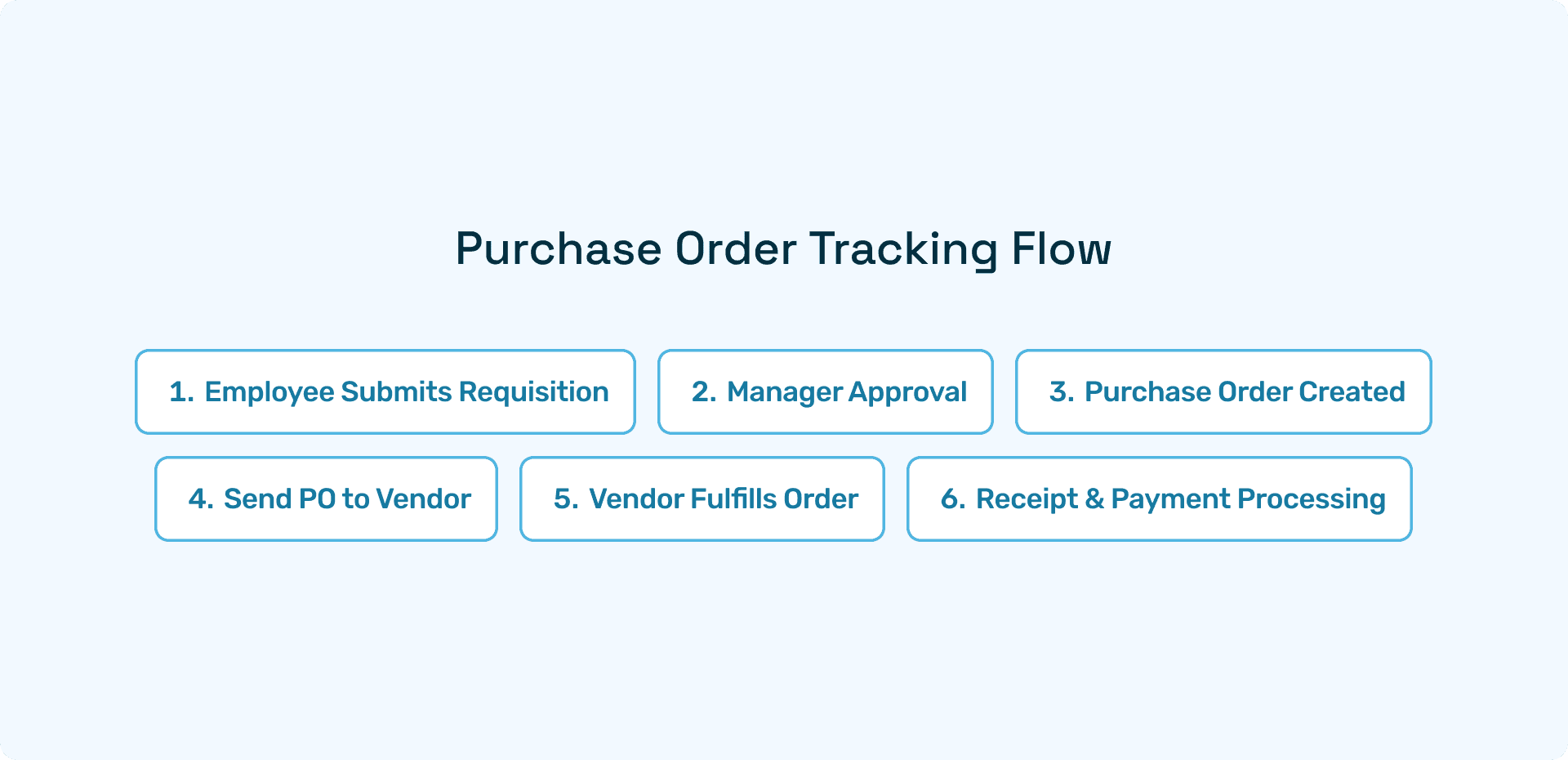
Step 1: Requisition Initiation
The po process begins when an employee identifies a business need and submits a purchase requisition. This initial step captures essential requirements including item specifications, quantity needed, preferred vendors, and business justification for the purchase.
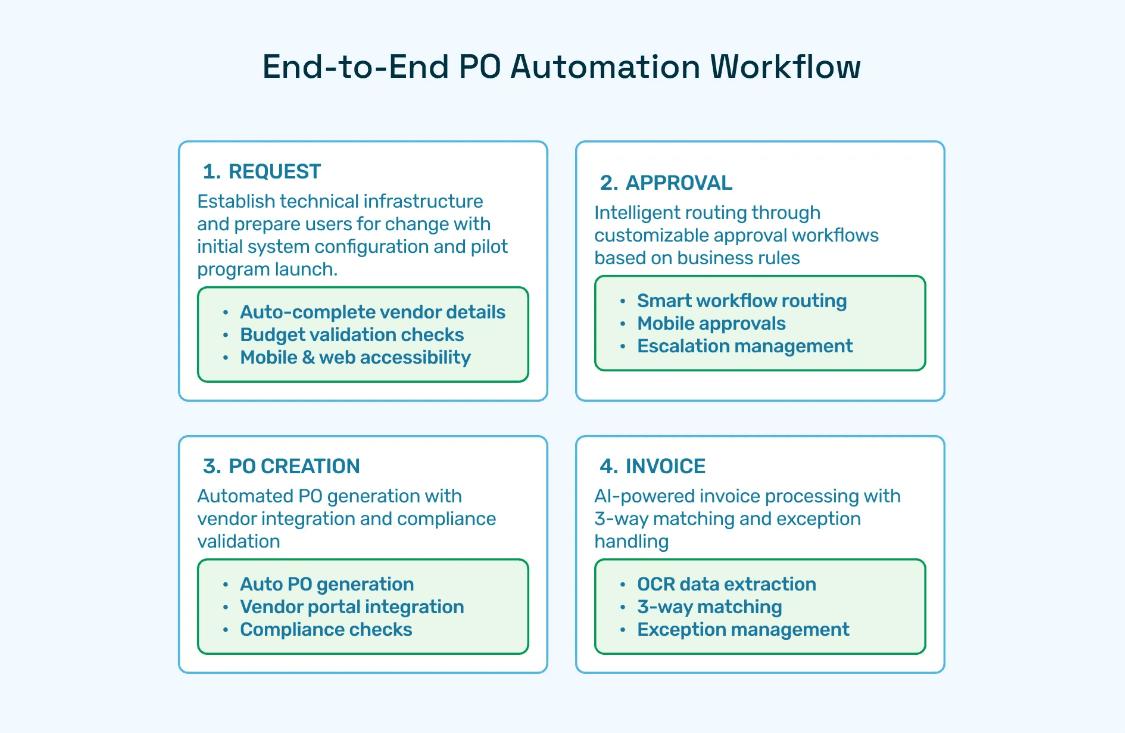
Modern organizations use automated requisition systems to streamline this intake process. AI-powered tools can auto-populate vendor information, suggest approved alternatives, and validate budget availability in real-time.
Step 2: Approval Workflow Routing
Once submitted, the requisition enters a structured approval workflow based on predefined rules. Approval requirements typically depend on purchase amount, category type, and departmental policies.
Common approval hierarchies include:
• Under $1,000: Department manager approval only
• $1,000-$5,000: Department manager plus finance approval
• Above $5,000: Multi-level approval including senior management
Advanced approval automation uses intelligent routing to accelerate decisions while maintaining proper financial controls.
Step 3: Purchase Order Creation and Review
Approved requisitions are automatically converted into formal purchase orders. The system generates comprehensive PO documents containing all necessary commercial terms, delivery specifications, and legal conditions.
Quality control measures during this phase include automated validation of vendor information, verification of available budget allocation, confirmation of delivery dates against business requirements, and review of terms and conditions for compliance.
Step 4: Vendor Communication and Confirmation
The completed purchase order is transmitted to the selected vendor through secure channels. Vendors review the PO terms and provide formal acceptance, creating a binding contractual agreement.
Automated PO communication systems eliminate manual intervention by electronically sending POs, tracking vendor acknowledgments, and managing any requested modifications to terms.
Step 5: Order Fulfillment and Tracking
Vendors fulfill orders according to PO specifications while buyers monitor delivery progress. Modern systems provide real-time visibility into order status, shipping updates, and expected receipt dates.
Effective purchase order tracking enables proactive management of delivery schedules and helps identify potential delays before they impact business operations.
Step 6: Receipt and Three-Way Matching
Upon delivery, organizations verify that received goods match the original purchase order specifications. This verification process, known as goods receipt, triggers the final step in the po workflow.
The three-way matching process compares the purchase order, goods receipt, and vendor invoice to ensure complete accuracy. AI-powered matching systems can automatically resolve discrepancies and expedite payment processing.
Purchase Order Workflow: Understanding the Digital Transformation
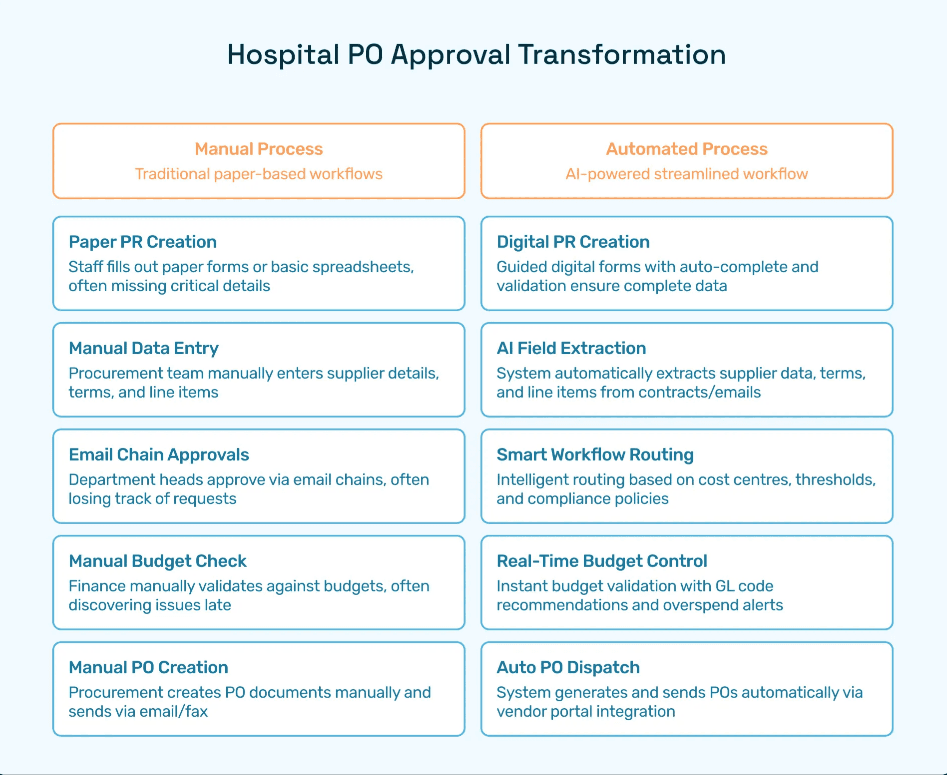
Traditional purchase order workflows rely heavily on manual processes that create inefficiencies and compliance risks. Paper-based systems require physical routing of documents, manual data entry across multiple systems, and time-consuming approval processes that slow procurement cycles.
The po workflow has evolved dramatically with digital transformation. Modern cloud-based systems integrate purchase order management with ERP platforms, enabling seamless data flow and real-time visibility across the entire procurement lifecycle.
Key workflow automation benefits include:
• Cycle time reduction from days to hours for standard purchases
• Error elimination through automated data validation and matching
• Compliance assurance via built-in policy enforcement and audit trails
• Cost savings through improved spend visibility and contract compliance
Hyperbots' Procurement Co-pilot exemplifies next-generation workflow automation, delivering instant ERP-synced approvals and real-time spend visibility for compliant, cost-effective purchasing.
The Business Impact of Purchase Order Automation
Organizations implementing purchase order automation achieve significant operational improvements and financial benefits. Industry data shows that automated procurement solutions can save 40 to 70% over the costs associated with manual systems, while the average return on investment (ROI) for procurement automation is 220%.
Operational Efficiency Gains
Automation transforms procurement operations by eliminating manual tasks and accelerating process cycles. Top-performing organizations approve 98 percent of purchase orders electronically, as compared to only a little more than half of POs approved electronically among bottom-performing organizations.
Measurable efficiency improvements include:
• Reduction in purchase order processing time
• Decrease in manual data entry requirements
• Faster vendor payment cycles
• 99.8% accuracy in automated matching processes
Financial Control and Visibility
Automated systems provide unprecedented visibility into procurement spending and compliance metrics. Real-time dashboards enable finance teams to monitor budget utilization, track contract compliance, and identify cost-saving opportunities.
Advanced analytics capabilities help organizations optimize their procurement strategies by analyzing spending patterns, vendor performance metrics, and process bottlenecks. This data-driven approach enables continuous improvement and strategic decision-making.
Hyperbots: Transforming Purchase Order Automation with AI Co-pilots
Hyperbots represents the next evolution in procurement automation, leveraging agentic AI to deliver autonomous purchase order processing capabilities. Unlike traditional automation solutions that simply digitize existing processes, Hyperbots' AI co-pilots fundamentally reimagine how purchase orders work.
The Hyperbots Advantage: Beyond Traditional Automation
Hyperbots' Procurement Co-pilot shrinks cycle times from request to purchase order, freeing teams from manual effort while delivering instant ERP-synced approvals. The platform provides finance teams with real-time spend visibility for compliant, cost-effective purchasing.
Key differentiators include:
• Agentic AI architecture that learns and adapts to organizational patterns
• Multi-agent collaboration across procurement, invoice processing, and vendor management
• Real-time ERP synchronization eliminating data silos and integration delays
• Intelligent exception handling for complex scenarios requiring human oversight
Comprehensive End-to-End Automation
The Hyperbots platform delivers complete procure-to-pay automation through integrated AI co-pilots:
Primary Co-pilot: Procurement Automation
Automated requisition intake and validation
Intelligent approval routing and policy enforcement
Real-time purchase order generation and tracking
Dynamic vendor communication and confirmation management
Supporting Co-pilots for Complete P2P Coverage:
Invoice Processing Co-pilot: Autonomous invoice capture, validation, and matching
Vendor Management Co-pilot: Streamlined onboarding and relationship optimization
Payment Co-pilot: Intelligent payment timing and cash flow optimization
Proven ROI and Performance Metrics
Organizations implementing Hyperbots AI co-pilots achieve transformational improvements in procurement performance:
Quantifiable Benefits:
• Reduction in operational costs
• Improvement in processing accuracy
• Faster procurement cycle times
• Decrease in manual intervention requirements
Intangible Value Creation:
• Enhanced compliance and audit readiness
• Improved vendor relationship management
• Strategic procurement insights and analytics
• Scalable operations without proportional headcount increases
Best Practices for Purchase Order Process Optimization
Successful purchase order management requires strategic implementation of best practices across people, processes, and technology dimensions.
Process Standardization
Establish consistent procedures for requisition creation, approval workflows, and vendor communication. Standardized processes reduce training requirements, minimize errors, and enable effective automation implementation.
Essential standardization elements:
• Unified requisition templates and data requirements
• Consistent approval hierarchies and spending thresholds
• Standardized vendor communication protocols
• Regular process reviews and continuous improvement cycles
Technology Integration and Data Quality
Ensure seamless integration between purchase order systems and enterprise applications. Poor data quality undermines automation effectiveness and creates compliance risks.
Focus on master data management for vendors, products, and organizational hierarchies. Implement automated validation rules to maintain data integrity and establish regular cleansing procedures for optimal system performance.
Change Management and User Adoption
Successful automation requires effective change management strategies that address user concerns and provide comprehensive training. Focus on demonstrating value to end users while providing ongoing support during transition periods.
Building effective PO management stacks requires careful consideration of organizational culture, technical capabilities, and strategic procurement objectives.
Future Trends in Purchase Order Management
The procurement landscape continues evolving rapidly with emerging technologies reshaping how purchase orders work. Procurement leadership anticipates a 21.7% increase in productivity from the use of GenAI in the next 12 to 18 months, while GenAI is expected to increase cost savings by 12% and improve revenue by 11%.
Artificial Intelligence and Machine Learning
Advanced AI capabilities are transforming purchase order automation beyond simple workflow digitization. Machine learning algorithms analyze historical patterns to predict optimal procurement strategies, identify potential risks, and automate complex decision-making processes.
Generative AI enables natural language processing for requisition creation, automated vendor communications, and intelligent document analysis. These capabilities significantly reduce manual effort while improving accuracy and compliance.
Integration and Ecosystem Connectivity
Modern purchase order systems integrate seamlessly with broader business ecosystems including ERP platforms, supplier networks, and financial systems. API-first architectures enable real-time data exchange and collaborative workflows across organizational boundaries.
Cloud-native solutions provide scalability and flexibility while reducing infrastructure requirements and maintenance overhead.
Ready to Transform Your Purchase Order Process?
Understanding how purchase orders work is just the beginning. The real transformation happens when organizations implement intelligent automation that delivers measurable business results.
Hyperbots' AI co-pilots provide the most comprehensive solution for purchase order automation, delivering 80% operational cost reductions while maintaining the highest standards of accuracy and compliance. Our agentic AI platform learns your organization's unique patterns and continuously optimizes performance for maximum ROI.
Discover how leading finance teams are revolutionizing their procurement operations with AI-powered automation. Explore Hyperbots' Procurement Co-pilot or schedule a personalized demonstration to see how your organization can achieve transformational procurement results.
Frequently Asked Questions
Q1: How long does a typical purchase order process take?
A: Traditional manual processes can take 5-10 business days from requisition to PO issuance. With automation, this timeline reduces to hours or even minutes for standard purchases. Automated PO systems can process routine orders in real-time while routing complex requests for appropriate approvals.
Q2: What are the legal implications of purchase orders?
A: Purchase orders create legally binding contracts when accepted by vendors. They establish clear terms for products, pricing, delivery, and payment conditions. Proper PO management helps organizations maintain contract compliance and provides legal protection in dispute situations.
Q3: How do electronic purchase orders improve accuracy?
A: Electronic systems eliminate manual data entry errors and provide automated validation of vendor information, pricing, and budget availability. AI-powered tools can cross-reference historical purchases, suggest approved alternatives, and flag potential discrepancies before orders are issued.
Q4: What integration capabilities are required for PO automation?
A: Effective automation requires integration with ERP systems, accounting platforms, and vendor management tools. Modern solutions use APIs for real-time data synchronization, ensuring consistent information across all business systems while maintaining data integrity.
Q5: How do automated purchase orders handle exceptions and complex scenarios?
A: Advanced AI systems use intelligent exception handling to route complex scenarios to appropriate personnel while processing routine orders automatically. Machine learning algorithms continuously improve decision-making capabilities based on organizational patterns and historical outcomes.