Purchase Orders for Services: How They Differ from Product POs
Understand the difference between service and product purchase orders to improve procurement efficiency, ensure compliance, and optimize vendor management.
Executive Summary
Purchase orders for services enable organizations to formalize consultant and vendor engagements, improving financial control, compliance, and efficiency. Unlike product POs, service purchase orders are more flexible and tailored to intangible tasks, milestones, and hourly rates. This guide explains the distinction between product and service POs, offers actionable best practices, and highlights how automated PO solutions—like Hyperbots—create ROI for finance teams across professional service management, vendor spend, and consultant contracting.
The Strategic Role of Service Purchase Orders
When most people hear the word procurement, they think of hospital beds, syringes, or IT hardware. But here’s a surprise: in many organizations, more than half of total spend now goes to services—consultants, contractors, marketing agencies, IT support, and even facilities management. That means services are no longer the “side dish” of procurement—they’re the main course.
And yet, while physical goods often enjoy a neat, well-documented purchase order process, services can feel a bit like the Wild West. Without structure, CFOs face:
Uncontrolled budgets – scope creep and “surprise” invoices that appear out of nowhere.
Ad-hoc contracts – vague terms that make audits a nightmare.
Messy invoice reconciliation – unclear deliverables leading to endless back-and-forth with finance teams.
That’s where Service Purchase Orders (Service POs) come to the rescue. Think of them as the CFO’s financial seatbelt—keeping service spend safe, predictable, and accountable.
Why Service POs Matter to CFOs
Clear Deliverables – Define what success looks like upfront. No “we thought you meant…” excuses.
Budget Discipline – Every service PO ties spend to a department, project, or cost center. CFOs get visibility and can curb overruns before they happen.
Stronger Vendor Relationships – When payment terms and expectations are crystal clear, vendors are happier and more cooperative.
Audit Readiness – With documented POs, every invoice has a paper trail. No scrambling during compliance reviews.
Better Cash Flow Forecasting – CFOs can map out service commitments in advance, reducing month-end surprises.
From Chaos to Control
Imagine trying to reconcile a $200,000 “consulting services” invoice with zero supporting details. Painful, right? Now imagine instead:
A service PO that specifies hours, rates, deliverables, and milestones.
An approval workflow that locks spend before the first consultant shows up.
A digital audit trail that connects invoice, PO, and contract in one click.
The Bottom Line
For CFOs, Service POs aren’t just another piece of paperwork. They’re the financial guardrails that turn service spend from a risky black hole into a strategic lever for cost control, compliance, and vendor trust. No CFO wants to explain to the board why “miscellaneous services” ate half the budget.
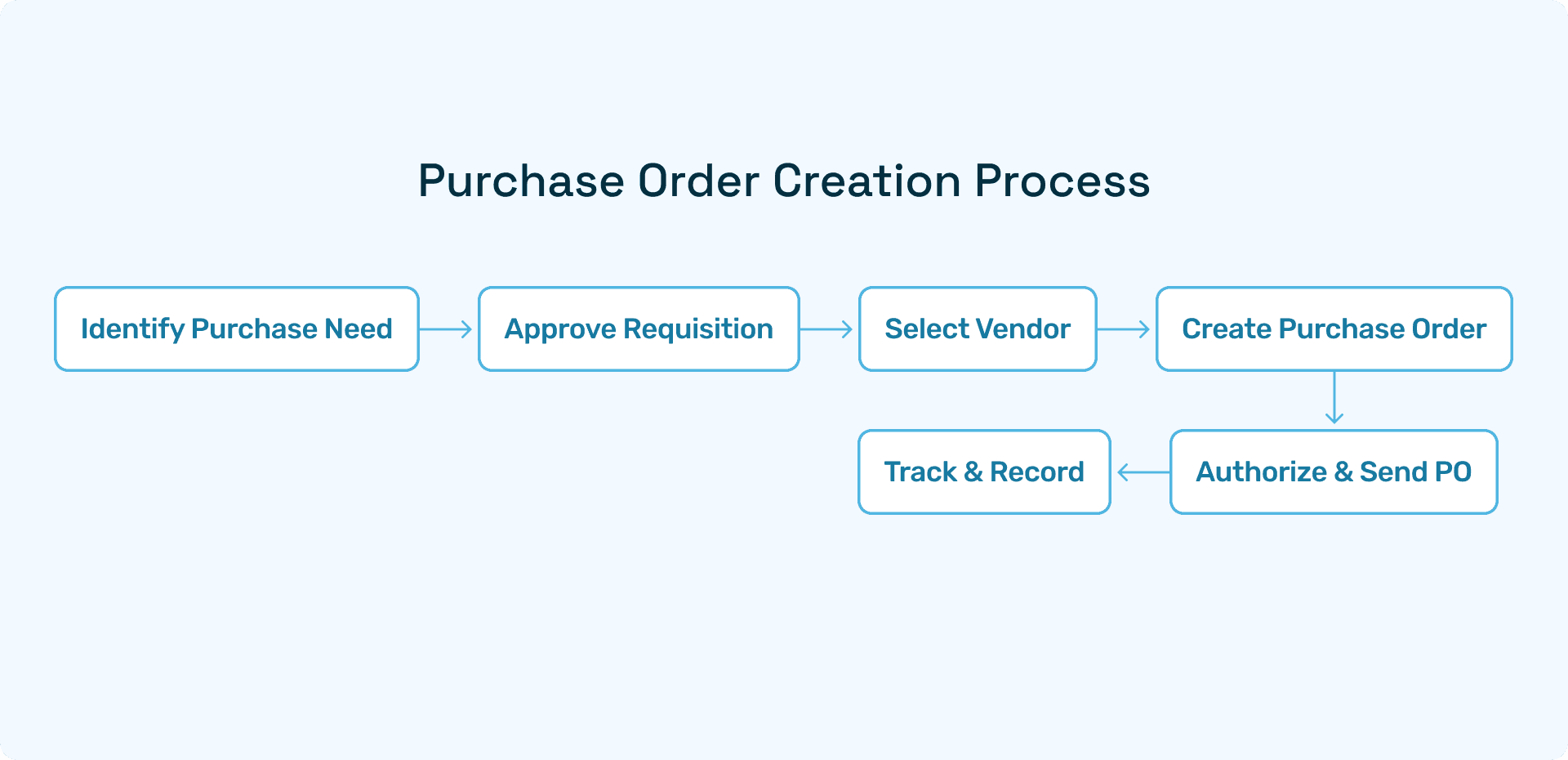
What Is a Service Purchase Order?
Service purchase order (SPO) is the CFO’s best friend when it comes to keeping services organized, budget-aligned, and audit-ready. Unlike product POs that deal with tangible goods, service POs govern intangible engagements—from IT consulting to facility maintenance to specialized healthcare services.
At its core, a service PO is both a financial safeguard and a clarity tool. It locks down the scope, cost, and timeline of services before the first invoice ever arrives. This means fewer “surprise” bills, tighter budget controls, and easier compliance checks—something every finance leader appreciates.
Key elements you’ll find in a service PO include:
Detailed service description & milestones – Who’s doing what, by when.
Pricing structure – Whether it’s hourly rates, monthly retainers, or a fixed project fee.
Consultant/vendor details – Clear contacts for accountability.
Service timeline or duration – Keeps projects on track and predictable.
Payment terms – Progress payments, monthly installments, or upon completion.
Extra clauses – Confidentiality, warranties, or options for contract extension/termination.
From a CFO’s perspective, service POs shine because they:
Prevent scope creep (no “mystery add-ons”).
Provide transparency for forecasting and cash flow.
Strengthen compliance with regulatory and audit requirements.
Reduce vendor disputes by documenting acceptance criteria upfront.
A service PO is supposed to be a strategic control lever that helps finance teams manage costs, ensure accountability, and keep vendors honest.
Service Purchase Order vs. Product PO: Key Differences
Feature | Service Purchase Order | Product Purchase Order |
Item | Task, milestone, rate (hours/months) | SKU, material, quantity, unit price |
Receipt requirement | Milestones or deliverable acceptance | Physical delivery and goods receipt |
Duration | Variable—project, ongoing, retainer | Fixed—per order |
Invoice matching | Based on services performed, hours, deliverables | 3-way match: PO, invoice, goods receipt |
Vendor/Consultant PO Use | Yes—critical for outsourcing, consulting | Yes—with goods, logistics, manufacturing |
Change Management | Revision often needed for scope/control | Less revision needed |
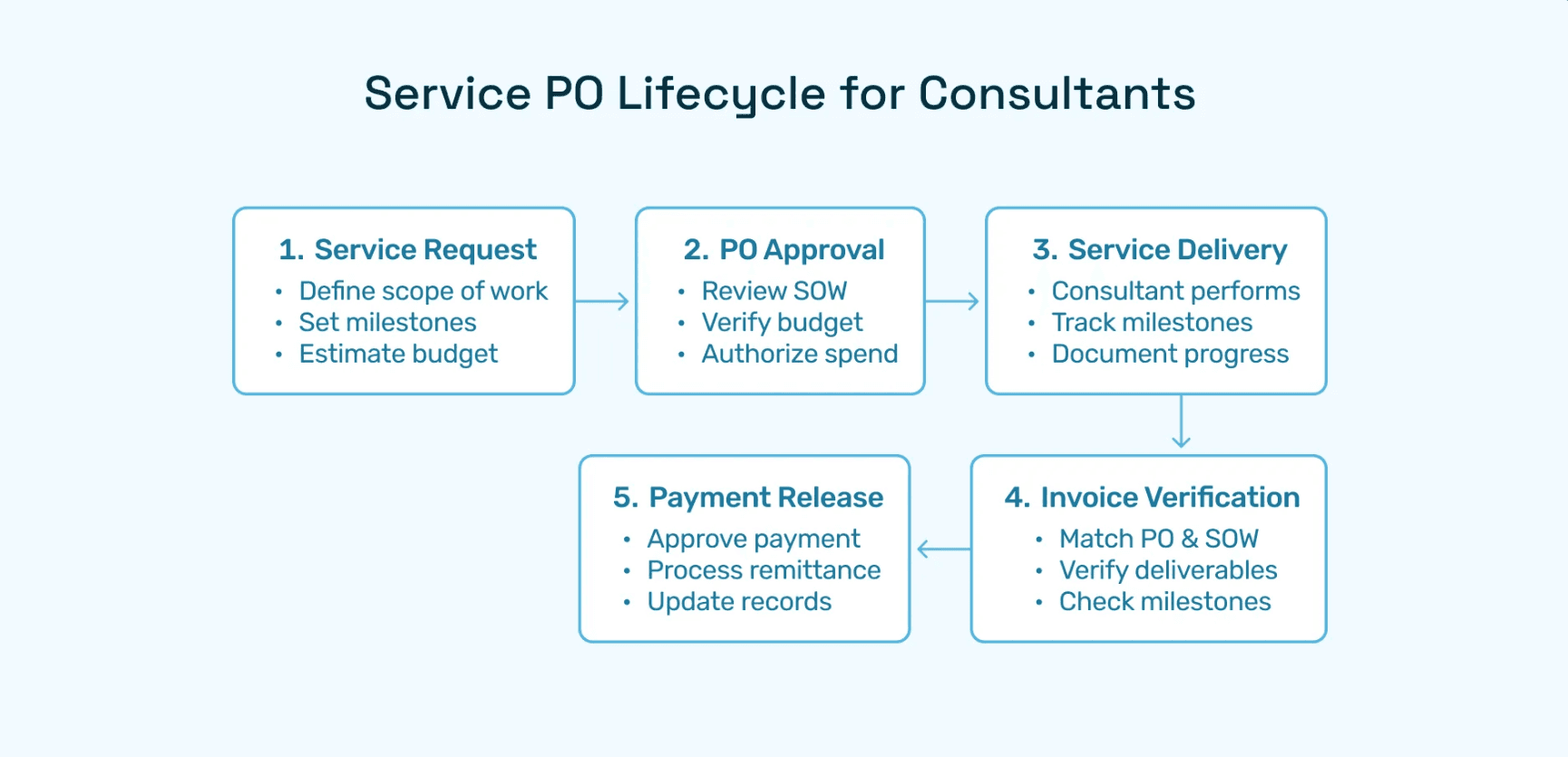
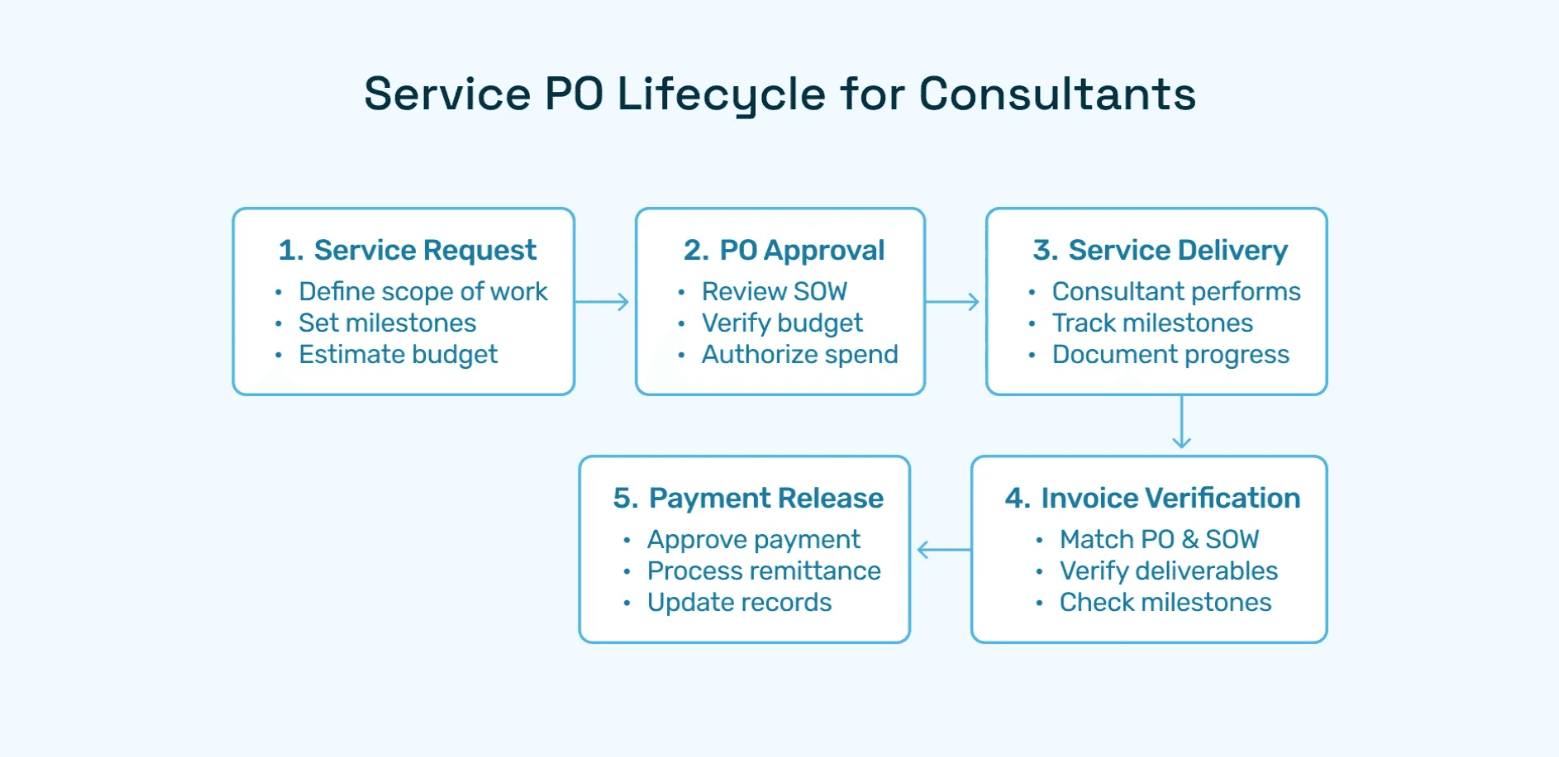
Service POs require ongoing visibility and clear engagement terms, particularly when working with consultants or vendor teams on milestone-based projects.
Why Are Service POs Crucial for CFOs?
Service Purchase Orders (SPOs) are the unsung heroes of finance. They turn what could be a wild guessing game into a controlled, transparent, and CFO-approved process.
Here’s why Service POs deserve a permanent seat at the finance table:
Budget Control
Service POs lock in spending before services start, ensuring every dollar aligns with financial goals.
No more “maverick spend” or endless consulting hours that snowball into uncapped fees.
Think of it as a seatbelt for your budget—keeping finances safe even when projects take sharp turns.
Auditability
Every SPO doubles as a compliance trail.
Whether it’s SOX, HIPAA, or internal audits, you’ve got clean documentation to prove services were approved, scoped, and delivered.
In short: your audit file looks like a polished Netflix series, not a messy reality show.
Dispute Protection
Service scope, pricing, and acceptance criteria are clearly written.
If invoices don’t match, you’ve got contractual backup to resolve the issue swiftly.
No more “he said, she said”—it’s all there in black and white.
Cash Flow Visibility
Service POs let Finance and AP teams see obligations ahead of time.
They simplify accruals, improve reconciliation, and reduce last-minute surprises.
It’s like turning on the headlights during a night drive—you always know what’s coming.
Vendor Management
SPOs help standardize terms across consultants, IT firms, and contractors.
Onboarding vendors becomes smoother, renewals more predictable, and reviews easier.
Vendors know the rules of engagement upfront—no hidden clauses or grey areas.
Service POs are more than paperwork. They’re the CFO’s strategic safety net, keeping budgets tight, vendors honest, and audits painless. Without them, service procurement is like running payroll without timesheets—risky, chaotic, and guaranteed to give Finance a headache.
Key Use Cases for Service Purchase Orders
Professional services spending is skyrocketing all thanks to digital transformation, remote work, and the never-ending list of compliance requirements. For CFOs, that means more invoices flying in, more budgets to track, and a greater need for control. That’s where Service Purchase Orders (SPOs) step in. They act like financial guardrails, ensuring service spend stays visible, predictable, and compliant.
Here are some real-world use cases where service POs make life (and audits) easier:
Consulting Projects
Think IT rollouts, audits, or strategy roadmaps. With milestone-based payments and a clear Statement of Work (SOW), SPOs prevent projects from turning into a money pit.Facilities Management
Security, janitorial, maintenance—these recurring services keep hospitals, offices, and plants running smoothly. A service PO sets the cadence of scheduled payments so there are no billing surprises.Marketing & Creative Agencies
Whether it’s a monthly retainer for ongoing campaigns or one-off creative bursts, SPOs make sure budgets are respected while allowing teams to get their Instagram-worthy ads delivered on time.Legal Services
From fixed-fee advisory to quarterly billing, legal expenses can rack up fast. A service PO keeps engagements transparent and ensures no “mystery billables” sneak past finance.Software & SaaS
Subscriptions, integrations, and support retainers all benefit from SPOs. They bring visibility into recurring costs while tying payments to performance and compliance.Temporary Labor/Contracting
Contractors and freelancers often bill by the hour. With time-sheet based approvals baked into a service PO, CFOs get peace of mind and accurate expense tracking.
If it’s intangible, recurring, or milestone-based, it probably deserves a Service Purchase Order. That’s how you keep spending smart, not messy.
Service PO Best Practices & Template Elements
When it comes to service purchase orders (SPOs), the magic is in the details. A well-structured template doesn’t just keep vendors happy—it keeps CFOs sleeping soundly at night. Think of it as your service playbook, ensuring no one drops the ball (or the invoice!).
Here are the must-have elements every great Service PO should include:
Detailed Scope of Work (SOW) & Description
Spell out exactly what services are being delivered. No vague “consulting” entries—be specific. This avoids scope creep and keeps costs tied to real deliverables.Deliverables & Acceptance Criteria
Define what “done” looks like. Whether it’s a monthly report, system upgrade, or on-site training, CFOs love having clear benchmarks.Hourly/Project-Based Pricing
Break costs into digestible bites: hourly rates, monthly retainers, or fixed project fees. This ensures financial predictability and transparency.Payment Milestones or Schedules
Align payments with progress. Pay as milestones are hit, monthly, or on completion. It’s a cash flow-friendly way to manage vendor relationships.Approval & Signature Fields
A PO isn’t real until it’s signed. Make space for authorized approvals—it keeps everything legally airtight and audit-ready.Service Timeline, Renewal & Extension Terms
Set start and end dates, with options to extend if needed. CFOs prefer timelines that don’t stretch endlessly (and eat into budgets).Confidentiality, IP, & Non-Solicitation Clauses
Protect sensitive data, intellectual property, and your talent pool. These clauses are like insurance policies for peace of mind.
💡 Pro Tip: A great Service PO template isn’t about red tape—it’s about clarity. The more structured it is, the smoother your vendor relationships and the happier your finance team.
Product Purchase Order Essentials
If service POs are about brains, product purchase orders (PPOs) are all about muscle. They keep shelves stocked, manufacturing lines humming, and warehouses from turning into empty echo chambers. For CFOs, product POs are the financial GPS that keeps procurement predictable, traceable, and cost-controlled.
At their core, product POs ensure every nut, bolt, and box of gloves is accounted for. No vague “send us stuff” emails—just structured documents that vendors and finance teams can both trust.
Here’s what a solid product PO typically includes:
Precise SKU, quantity, and shelf life – Because “10 boxes of syringes” is not the same as “10,000 sterile syringes expiring in 2027.”
Delivery dates – Keeps production and patient care timelines on schedule.
Shipping and receiving details – The “where and how” so goods don’t wander off to the wrong dock.
Three-way matching – PO, goods receipt, and invoice must align before payment. Think of it as the CFO’s lie detector test for procurement.
Automated reorder points – Triggers replenishment before stock runs out, avoiding those dreaded “we’re out of PPE” moments.
Contract pricing – Ensures negotiated rates actually show up on invoices (no sneaky price hikes).
Template formats with line items and approval codes – Standardization = fewer errors and faster processing.
Why CFOs love product POs:
They safeguard cash flow with predictable spend.
They strengthen audit readiness by creating clear trails.
They reduce disputes by putting everything in writing.
Product POs are about bringing order to chaos, keeping procurement transparent, and ensuring finance leaders sleep soundly at night.
Common PO Pitfalls & Solutions
Using Product PO for Services: Leads to mismatches; always use service PO format for non-tangible deliverables.
Missing Milestones or Acceptance Criteria: Hard to audit; always specify measurable milestones.
Skipping Approval Controls: Exposes companies to unauthorized spend; enforce digital approvals.
Poor Vendor Communication: Confirm PO receipt and clarify terms to avoid disputes.
Manual/Disconnected Workflows: Leads to lost records and errors; digital solutions provide audit trails.
Why Automate Service POs?
Managing service purchase orders (SPOs) the old-fashioned way—through spreadsheets, emails, and manual routing—can feel like running a marathon with ankle weights. Service engagements are complex by nature, with milestones, variable rates, and multiple stakeholders to align. That’s where digital automation comes in, transforming SPOs from administrative headaches into streamlined, auditable workflows that save both time and money.
Here’s how automation makes life easier for procurement and finance teams:
Faster PO issuance and routing – Automated systems cut down the back-and-forth emails. Requests are instantly routed to the right approvers, vendors, or consultants, shaving days off the cycle.
Real-time approvals and notifications – No more chasing signatures. Managers can approve on mobile, receive alerts, and track PO progress in real time.
Multi-vendor, multi-project visibility – A single dashboard view provides CFOs and procurement leaders with complete oversight of who is engaged, for what, and at what cost.
Simplified invoice reconciliation – Automated three-way matching (PO, invoice, milestone delivery) eliminates the tug-of-war between accounts payable and vendors.
Centralized record-keeping – Every approval, update, and clause is logged for future reference, ensuring compliance and making audits far less painful.
And it’s not just theory—external research backs this up:
Gartner highlights that automating sourcing and procurement workflows improves supplier collaboration, boosts compliance, and reduces cycle times by up to 70%—a critical edge for service-heavy organizations.
Deloitte emphasizes that AI and digital procurement tools drive 45–80% cost savings by eliminating manual touchpoints, improving visibility, and enhancing decision-making speed.
Faster cycles mean reduced bottlenecks, and fewer manual errors mean fewer financial leaks. Most importantly, automation brings predictability, which strengthens cash flow forecasting and vendor trust.
Hyperbots: Agentic AI Platform for Finance & Accounting
First, to frame the bigger picture: Hyperbots is built around an Agentic AI platform specifically focused on finance and accounting (not just generic automation).
Important platform-wide capabilities include:
Unlimited user access / no per-seat licensing (so scalability isn’t gated by user count)
ERP integrations (NetSuite, SAP S/4HANA, Microsoft Dynamics, etc.), including read and write access to GL, vendor master, item master, etc.
Self-learning / adaptive AI — the Co-Pilots improve over time based on exceptions, feedback, and evolving organizational rules.
Human-in-the-loop capabilities — where human review is needed (exceptions, policy conflicts) the system pauses or escalates, preserving control and oversight.
Comprehensive audit trails & observability — all actions (AI or human) are logged, and the system supports configurable audit trails and analytics.
Domain-trained / process-specific models — instead of trying to be everything for everyone, Hyperbots trains Co-Pilots for specific F&A tasks (invoice processing, accruals, tax validation, etc.).
Together, these capabilities create a foundation for multiple Co-Pilots to work in concert, share data, and maintain consistency across financial operations.
Key Hyperbots Co-Pilots Beyond Procurement
Here’s a rundown of the major Co-Pilots (aside from Procurement) that Hyperbots offers, with their core responsibilities and advantages:
1. Invoice Processing Co-Pilot
Extracts invoice data, mapping line items, matching to PO/receipt (three-way or multi-way match)
GL coding suggestions and validations
Exception detection (duplicate invoices, mismatches, anomalies)
Integration with ERP to post invoices reliably.
2. Accruals Co-Pilot
Automatically recognize which expenses require accruals
Compute accrual amounts and reconcile with existing invoices or receipts
Post accrual entries to the GL via ERP integration
Adjust or reverse accruals when invoices or deliveries finalize
3. Payments Co-Pilot
Payment timing optimization to maximize early-pay discounts, avoid late fees, and optimize cash outflows.
Support for multiple payment methods (ACH, checks, wire transfers, etc.) with built-in audit trails and reconciliation.
Invoice-to-bank reconciliation: matching payment records back to invoices and updating status in ERP
Fraud detection guards, duplicate pay checks, vendor validation prior to execution
4. Vendor Management Co-Pilot
Vendor onboarding: verifying identity (e.g. W-9 in U.S. context), capturing compliance documents, validating against external sources
Duplicate vendor detection / deduplication
Providing vendors a portal to see status of POs, invoices, and payments to reduce repeated inquiries
Workflow customization for vendor approval, exception handling, and vendor performance monitoring
5. Sales Tax Verification Co-Pilot
Automatically verifies whether the correct sales tax is applied per line item based on jurisdiction and product/service type
Detects undercharged or overcharged taxes and flags them
Ensures auditability and compliance with tax regulations
Designed with pre-trained models on millions of vendor and tax documents for rapid deployment
Synergies, Differentiators & Strategic Advantages
A few additional highlights (rooted in Hyperbots’ own positioning):
The Co-Pilots don’t work in silos — they collaborate. For example, information from Vendor Management flows into Procurement and Payments, and GL recommendations feed into Invoice and Accruals.
Many Co-Pilots are pre-trained (on hundreds of thousands / millions of financial documents) so organizations get high accuracy early, reducing the burden of training from scratch.
Because the platform is tailored to the finance domain (not generic automation), the models understand the semantics of invoices, GL accounts, vendor contracts, etc. — giving them higher precision.
Their ERP integration approach is robust and configurable — not just “connect and forget,” but supports custom fields, exceptions, retries, and read-back validation to maintain data integrity.
The Future of Service Purchase Orders
Purchase orders for services are now essential for financial control in enterprises. Automation platforms—especially with agentic AI like Hyperbots—transform the experience, simplify vendor and consultant engagement, and slash costs. Future-ready finance teams automate the PO cycle to maximize approval speed, control spend, and eliminate errors for every vendor, consultant, and contract.
FAQs on Purchase Orders for Services
Q1. What is the difference between product PO and purchase order for services?
A product PO covers physical goods with delivery and receipt, while a service PO manages intangible deliverables, milestones, or hourly engagement, prioritizing flexibility and acceptance criteria.
Q2. Can a PO be used for consultants and vendors?
Yes. POs are a best-practice for managing spend with consultants, agencies, and any external vendors, especially where milestones, retainer fees, or deliverables matter.
Q3. How do automated solutions improve service PO management?
Automation reduces manual entry, streamlines approvals, auto-matches invoices, and keeps auditable records.
Q4. How does Hyperbots help with service PO workflows?
Hyperbots’ agentic AI copilot automates every step: service request intake, approval, PO delivery to vendors, and invoice matching, ensuring 95%+ compliance and dramatic ROI.