Why Invoice Numbers Matter in Accounts Payable: The Identifier That Controls Everything Downstream
Why invoice numbers are critical to accounts payable accuracy and how automation prevents errors, duplicates, and audit risks
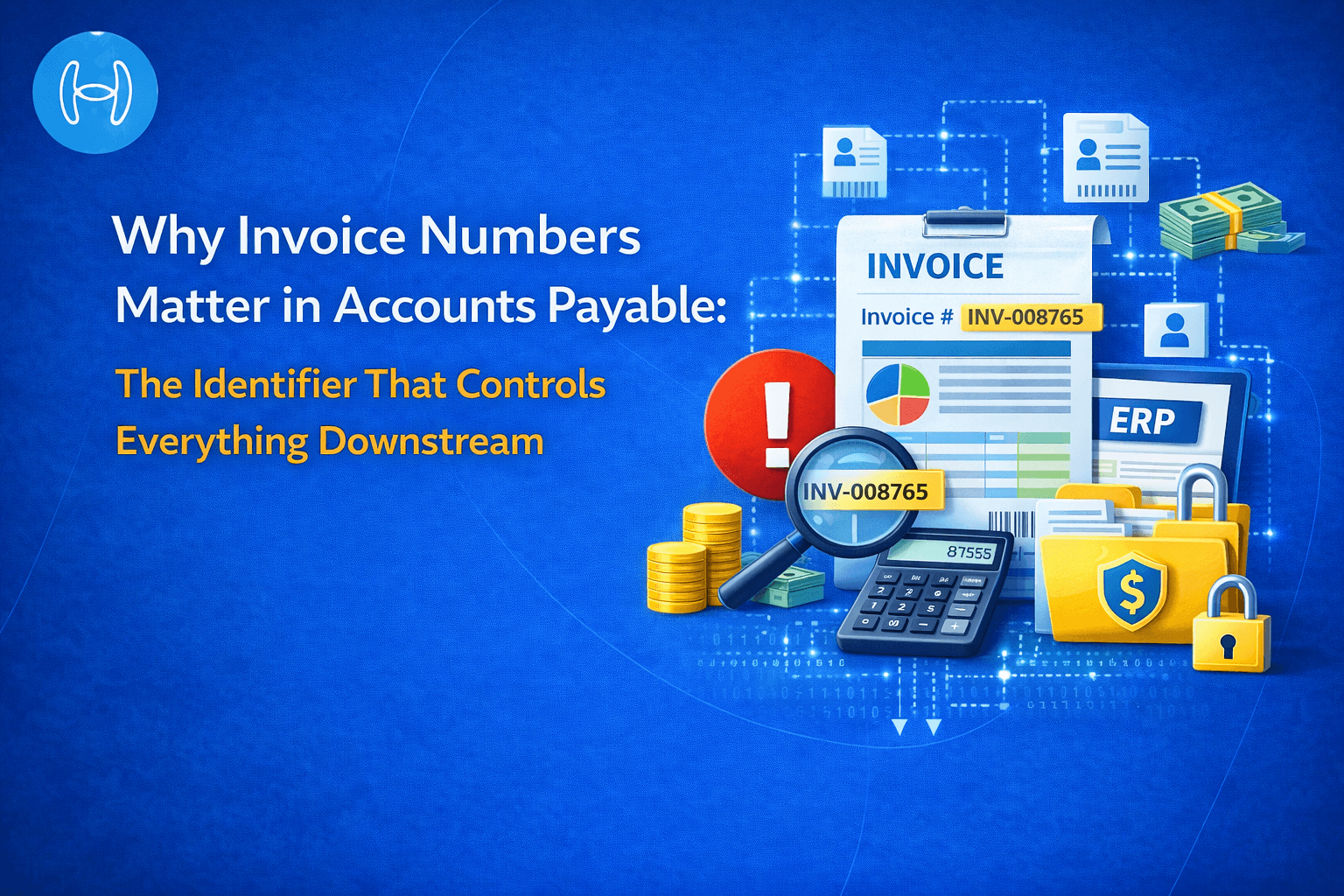
Most AP teams think of an invoice number as a label. A reference. Something to put in the subject line when emailing a supplier. It is, in practice, far more than that. The invoice number is the primary identifier that controls how every invoice moves through the accounts payable process, covering how it is matched against purchase orders, how duplicates are detected, how it posts to the ERP, how it appears in the audit trail, and how it is retrieved when an auditor asks for it six months later.
When invoice numbers are missing, inconsistent, or duplicated, the downstream consequences compound. Matching fails. Posting errors accumulate. Payments go out twice. Auditors cannot reconstruct transaction trails. The problems are visible, but the root cause, a weakness in how invoice numbers are captured, validated, and tracked, often goes unidentified.
This guide explains what invoice numbers are, why they function as the backbone of accounts payable control, where failures originate, and how AI-powered automation uses invoice numbers to enforce accuracy at scale.
What Is an Invoice Number?
An invoice number is a unique alphanumeric identifier assigned by the vendor to a specific invoice, used to distinguish that invoice from every other document the vendor has issued.
Invoice numbers are assigned by the supplier, not the buyer. Every vendor has their own numbering convention. Some use sequential integers: 1001, 1002, 1003. Some combine a date prefix with a sequence: INV-2025-0047. Some include client codes: ABC-2025-001. Some are generated automatically by accounting software. Some are assigned manually.
From the buyer's perspective, the invoice number is the key that links every downstream document and action to the original invoice. When the AP team approves a payment, the payment references the invoice number. When the ERP posts the transaction, the invoice number appears in the ledger entry. When an auditor asks for documentation supporting a payment, the invoice number is how they locate the original document, the purchase order it matched against, the approval record, and the payment confirmation.
Without a valid, unique invoice number, none of these lookups work reliably.
Why Invoice Numbers Are Unique Identifiers, Not Just Labels
A unique identifier is a value that, within a defined system, refers to one and only one record. In accounts payable, the combination of vendor ID and invoice number functions as a unique identifier for each transaction. No two invoices from the same vendor should carry the same number.
This uniqueness property is what makes invoice numbers so consequential. The entire duplicate detection logic in accounts payable depends on it. If a vendor submits the same invoice twice, whether by error or intent, the AP system can catch it by checking whether an invoice with that number from that vendor has already been received and processed. If the invoice number is missing, inconsistent, or has been altered, that check fails.
The same logic applies to the three-way matching process. When matching an invoice against a purchase order and a goods receipt note, the AP system uses the invoice number to locate the correct transaction records. A missing or incorrectly extracted invoice number causes the match to fail and sends the invoice to a manual exception queue.
In the ERP, the invoice number is the reference key used for posting, retrieval, and reconciliation. Most ERP systems enforce invoice number uniqueness per vendor as a control. They will reject a posting attempt if the same invoice number from the same vendor already exists in the system. This is an important fraud and error control, but it only works if the invoice number was correctly captured in the first place.
Common Invoice Numbering Conventions
Before examining where invoice number failures occur, it helps to understand the formats AP teams encounter. Knowing what a valid invoice number looks like for a given vendor class makes extraction, validation, and anomaly detection more effective.
Sequential numeric: The simplest format. Numbers increment by one with each invoice: 001, 002, 003 or 10001, 10002, 10003. Common among small suppliers and sole traders. Easy to validate: any number significantly out of sequence from the same vendor is a signal worth investigating.
Alphanumeric with prefix: A code followed by a number: INV-2025-0047, PO-REF-1234, or SI-0009. The prefix often indicates the document type (INV for invoice, SI for sales invoice, CN for credit note). Common among mid-sized vendors using accounting software.
Date-embedded: The invoice number encodes the issue date: 20250415-001 means the first invoice issued on 15 April 2025. Useful for chronological validation: an invoice dated April 2025 should not have a number that encodes March 2024.
Client-prefixed: Common in professional services and consulting. The client's code or project code is embedded: ABC-2025-031 for Client ABC's 31st invoice in 2025. Useful for matching to the correct cost center automatically.
System-generated: Many vendors use accounting software that auto-generates invoice numbers in their own format. These are typically consistent and predictable, making pattern-based validation straightforward.
Non-standard and manual: Some suppliers, particularly small contractors and sole traders, assign invoice numbers manually without a consistent convention. These require the most careful validation because the signals of fraud or error, including a repeated number, an out-of-sequence number, or a number that resembles a previously paid invoice, are harder to detect algorithmically.
What Happens in Accounts Payable When Invoice Numbers Fail
Invoice number failures occur at different points in the AP workflow and generate different types of consequences. Understanding where each failure type originates helps AP teams and finance leaders design controls that intercept them before they cause payment or audit problems.
Missing invoice number. A vendor submits an invoice without a number, either because their invoicing process is informal, because the number was cut off during scanning, or because the document is a pro-forma invoice or a statement rather than a formal tax invoice. An invoice without a number cannot be posted to most ERP systems without manual intervention. It cannot be matched against a purchase order by number. It cannot be de-duplicated. Every downstream process that relies on the invoice number as a reference key fails.
Incorrectly extracted invoice number. AI extraction systems and OCR tools extract invoice numbers from documents. When the document format is unusual, when the invoice number is positioned unexpectedly on the page, or when the number is partially obscured or formatted ambiguously, the extraction may capture the wrong value, such as a date, a PO reference, or a line item code in place of the actual invoice number. The invoice proceeds through the workflow with an incorrect identifier, matches against wrong records, and posts to the ERP with an identifier that does not correspond to the vendor's record.
Duplicate invoice number. A vendor submits the same invoice twice, a common occurrence when vendors re-send invoices they believe have not been received. If the AP system does not detect that the invoice number and vendor combination already exists in the system, both invoices may be approved and paid. The duplicate payment is often discovered only during vendor statement reconciliation, weeks after the fact. This is one of the most quantifiable sources of AP leakage in high-volume environments.
Manipulated invoice number. Payment fraud frequently involves submitting a fraudulent invoice with a number that is close to, but not identical to, a legitimate invoice already in the system. The altered number bypasses exact-match duplicate detection while the rest of the invoice, including vendor name, amount, and description, appears legitimate. Without fuzzy matching across invoice numbers, vendor identifiers, amounts, and dates simultaneously, this category of fraud is difficult to detect manually.
Inconsistent numbering across entities. In multi-entity organizations, the same vendor may submit invoices to different subsidiaries with their own numbering series. Without a cross-entity view of invoice numbers from each vendor, the same invoice can be paid by two different entities without either recognizing the duplication.
How ERP Systems Validate Invoice Numbers
Enterprise Resource Planning systems enforce invoice number validation as a core AP control. Understanding what ERP validation does, and what it does not do, clarifies where AI automation adds value.
What ERP validation enforces:
Most ERP systems reject a posting attempt if a vendor invoice with the same number already exists in the system for that vendor. This is the primary ERP-level control against duplicate payment from identical re-submissions. It is effective against straightforward re-submissions but ineffective against altered numbers or cross-entity duplicates.
ERP systems also enforce mandatory fields. An invoice without a number, or with a number that exceeds the field length limit, will typically fail posting validation. This forces the AP team to resolve the missing or invalid number before the transaction can be recorded.
What ERP validation does not enforce:
ERP systems do not validate whether the extracted invoice number is actually the invoice number on the original document. That is an extraction accuracy problem that sits upstream of the ERP. They do not perform fuzzy matching across near-identical invoice numbers. They do not cross-reference invoice numbers across multiple entity records to detect cross-entity duplicates. And they do not analyse patterns in invoice numbers, such as a sequence that suggests back-dating or a number that appears out of order for a vendor whose series has been consistent for years.
These gaps are where the accounts payable workflow requires intelligence beyond what the ERP's native AP module provides.
Invoice Number Validation Flowchart
The following represents the invoice number validation logic that should run at the point of invoice receipt, before any matching or posting occurs:
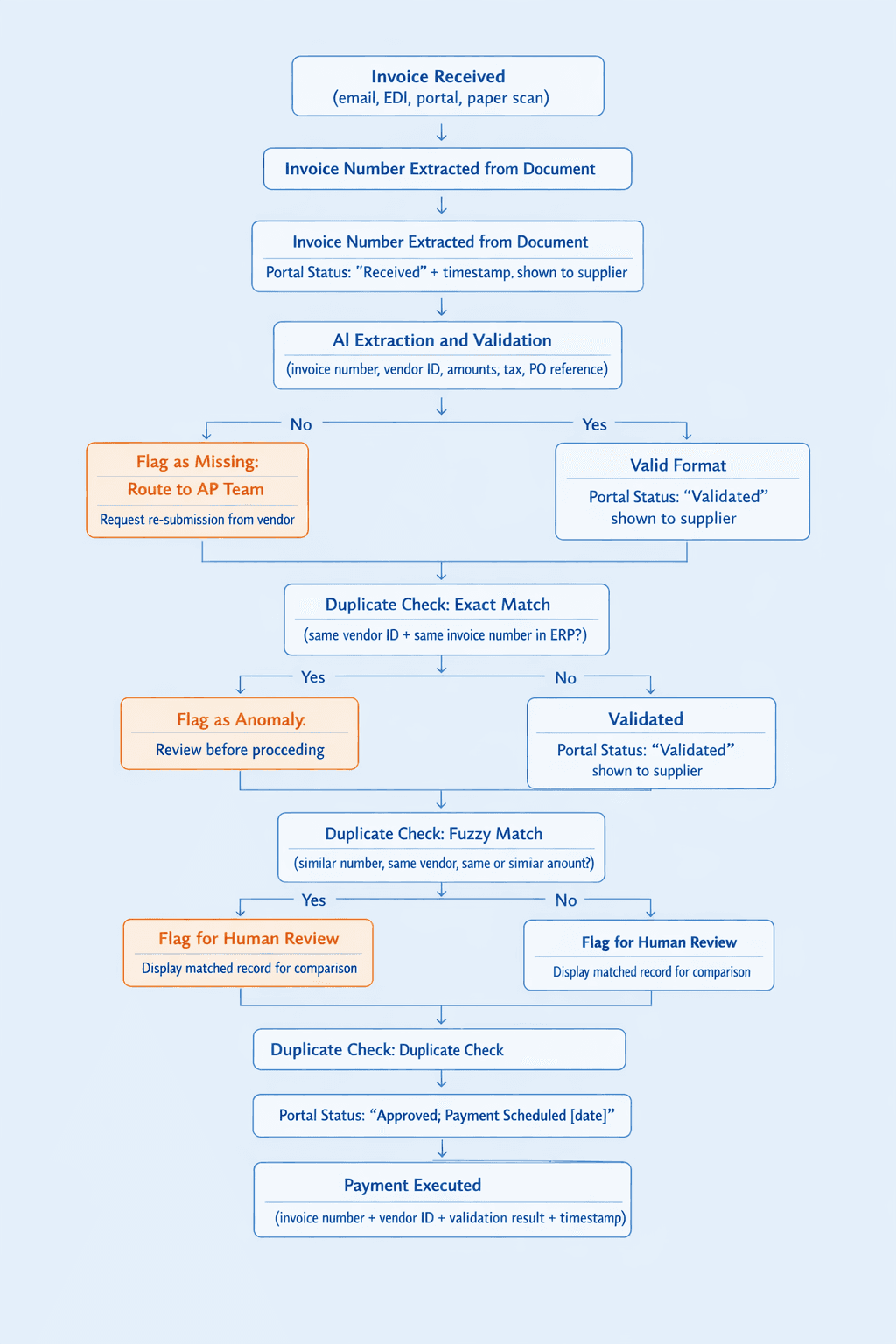
Every step in this flow should happen automatically, before the invoice reaches a human approver. The only steps that require human attention are genuine anomalies and confirmed duplicates.
How AI Uses Invoice Numbers in Automated AP Processing
AI-powered invoice processing treats the invoice number as a first-order data point, not an afterthought. The extraction, validation, and matching logic that drives straight-through processing depends on accurately capturing and verifying the invoice number before any downstream process begins.
Extraction accuracy. AI models trained on large volumes of financial documents learn to locate invoice numbers reliably across diverse document formats, regardless of where on the page the number appears, what prefix or suffix the vendor uses, and whether the document is a PDF, a scanned image, or an EDI file. Unlike template-based OCR systems that require a pre-configured field position for each vendor, AI extraction identifies the invoice number contextually, by understanding what an invoice number looks like and where it typically appears in the document structure.
Validation against convention. Once extracted, the invoice number can be validated against the known numbering pattern for that vendor. If a vendor has consistently submitted invoices in the format INV-2025-XXXX and a new invoice arrives with a number in a completely different format, that is an anomaly signal worth flagging before the invoice proceeds.
Exact and fuzzy duplicate detection. Exact duplicate detection, comparing vendor ID and invoice number, catches straightforward re-submissions. Fuzzy duplicate detection extends this to catch manipulated numbers, scanning errors that alter digits, and near-identical submissions where a fraudulent invoice has been submitted with a number that differs by one character from a legitimate invoice. Running both checks automatically at the point of receipt is more reliable than any manual review process at high volume.
Cross-referencing with the invoice tracking system. An automated invoice tracking system maintains a live record of every invoice number received, its current status in the workflow, and its ERP posting reference. Cross-referencing new invoices against this live record catches duplicates that have not yet been posted to the ERP, a gap that ERP-only validation leaves open, because the ERP can only reject duplicates that have already been posted.
Audit trail anchoring. The invoice number becomes the primary key of the audit trail record for every processed invoice. Every action taken on that invoice, including extraction result, validation outcome, matching result, approval, GL coding decision, and ERP posting, is logged with the invoice number as the connecting identifier. When an auditor requests documentation for a specific payment, the invoice number retrieves the complete chain of evidence instantly.
How Hyperbots Handles Invoice Number Extraction and Validation
The Invoice Processing Co-Pilot from Hyperbots is pre-trained on more than 35 million invoice fields. Invoice number extraction is a first-order task for the extraction engine, not a field mapped from a template. The co-pilot identifies invoice numbers across diverse vendor formats, document layouts, and file types with 99.8% extraction accuracy.
The validation layer runs before any invoice proceeds to matching or approval. Invoice numbers are cross-referenced against the ERP's existing records and the live invoice tracking register simultaneously. Exact duplicates are blocked before they reach the approval queue. Near-duplicates are flagged with the matched record displayed, giving the reviewer the context needed to make a decision in seconds rather than minutes.
For AP teams processing high volumes of invoices, the impact of this accuracy is direct. Up to 80% of invoices complete the full workflow without any human touchpoint, from receipt through extraction, validation, matching, GL coding, and ERP posting, because the invoice number and every other field is captured correctly and validated before the process moves forward. The invoices that require human attention are genuine exceptions, not extraction errors or false positives from stale data.
Invoice processing time falls to under one minute per invoice. Invoice processing costs fall by 80%. And the audit trail connecting each invoice number to its complete processing record is maintained automatically, without manual assembly.
The co-pilot goes live within one month and delivers ROI within 6 months, driven by the elimination of duplicate payments, reduction in manual exception handling, and the removal of the reconciliation work that invoice number failures generate.
Before and After: Invoice Number Handling in AP
Dimension | Manual or Template-Based Processing | Hyperbots' AI-Powered Invoice Processing |
Invoice number extraction | Template-dependent, fails on new or changed vendor formats | Contextual extraction across all formats, 99.8% accuracy |
Missing number detection | Noticed at posting when ERP rejects the transaction | Flagged at receipt before any downstream process begins |
Exact duplicate detection | ERP-level check only, catches post-submission duplicates | Checked at receipt against ERP records and live tracking register |
Fuzzy duplicate detection | Not performed, manipulated numbers bypass exact-match checks | Simultaneous fuzzy match across number, vendor, amount, and date |
Cross-entity duplicate detection | Requires manual cross-referencing across entity records | Automated cross-entity check before invoice proceeds |
Format and convention validation | Not performed | Validated against vendor's known numbering pattern |
Audit trail connection | Invoice number manually recorded in logs and spreadsheets | Invoice number is the primary key of the automated audit trail |
Straight-through processing rate | Suppressed by number extraction errors and false positives | Up to 80% STP when invoice numbers are extracted and validated accurately |
Processing time | Days in queue for manual review | Under 1 minute per invoice |
Processing cost | High manual processing cost | 80% reduction in invoice processing cost |
FAQs
What is an invoice number and who assigns it?
An invoice number is a unique alphanumeric identifier assigned by the vendor to a specific invoice they have issued. It is assigned by the supplier, not the buyer. Its purpose is to distinguish that invoice from every other document the vendor has issued, enabling the buyer's AP system to track, match, validate, and audit it reliably.
Why do ERP systems enforce invoice number uniqueness?
ERP systems enforce uniqueness of the combination of vendor ID and invoice number to prevent duplicate payments. If the same vendor submits the same invoice twice, the ERP rejects the second posting attempt because the invoice number already exists in the system for that vendor. This is a fundamental AP control but only catches exact duplicates that have already been posted.
What is duplicate invoice detection and why is both exact and fuzzy matching needed?
Exact duplicate detection compares the vendor ID and invoice number of a new invoice against all existing records. It catches straightforward re-submissions where the invoice is identical. Fuzzy duplicate detection compares similar but not identical records, catching manipulated numbers, scanning errors, and near-identical fraudulent invoices that differ by one character. Organizations relying on exact matching alone miss the category of fraud and error that fuzzy matching is designed to catch.
What happens when an invoice number is missing?
A missing invoice number prevents ERP posting because most ERP systems require a valid invoice number as a mandatory field. More importantly, it prevents duplicate detection, accurate matching, and audit trail creation. The invoice must be returned to the vendor for reissue or have a reference number assigned manually, both of which introduce delay and manual effort.
How does invoice number extraction accuracy affect the straight-through processing rate?
Straight-through processing is the rate at which invoices complete the full workflow without human intervention. Every invoice with an incorrectly extracted or missing invoice number requires manual correction before it can proceed. In high-volume environments, even a small extraction error rate produces a significant number of manual exceptions per day. Improving extraction accuracy to 99.8% directly increases the STP rate by reducing the pool of invoices that fail at the number validation step.
Can AI detect invoice number fraud?
AI can detect patterns that indicate invoice number manipulation, such as a number that appears out of sequence for a vendor with a consistent history, a number that closely resembles a recently paid legitimate invoice, or a number format that does not match the vendor's known convention. These signals, combined with amount and date cross-referencing, catch the category of fraud that exact-match duplicate detection misses.
For a complete view of how invoice data flows through the AP process from receipt to ERP posting, including how invoice numbers anchor every stage of the workflow, see the playbook on vendor invoice processing.
The Hyperbots Invoice Processing Co-Pilot extracts invoice numbers with 99.8% accuracy across all vendor formats, validates them against ERP records and the live invoice register, and detects both exact and near-duplicate submissions before any invoice reaches the approval queue. Up to 80% straight-through processing. Processing time under one minute. Live within one month. Request a demo at hyperbots.com.