NetSuite Partners Explained: What They Do, What They Don't, and Where Automation Fits
A clear breakdown of partner roles, responsibilities, and the gap between ERP implementation and real finance automation
When a business decides to implement NetSuite, the next question is almost always the same: do we need a partner? The answer, for the vast majority of mid-market organisations, is yes. But knowing that you need a partner is the easy part. Understanding what a NetSuite partner actually does, where their scope ends, and what that means for the finance team's day-to-day operations after go-live is where most buyers are underprepared.
This guide is written for CFOs, finance directors, IT leaders, and operations managers who are either evaluating NetSuite for the first time, mid-way through an implementation, or already live and wondering why the system is not delivering the efficiency they expected. You do not need a technical background to follow it. What you need is a clear picture of who does what, and where the gaps tend to appear.
It covers what the different partner types are, what implementation partners are and are not responsible for, how to evaluate whether a partner is right for your organisation, and why the capabilities a partner delivers at implementation are different from the automation capabilities a finance team needs after the project closes.
For a detailed buyer's guide covering NetSuite partners region by region, the guide to NetSuite partners across the US covers partner selection criteria, regional expertise, and how to multiply the ROI of your NetSuite investment.
What Is a NetSuite Partner?
A NetSuite partner is a company that Oracle has certified to sell, implement, customise, or support NetSuite deployments. The partnership programme has different tiers and designations, and the type of partner you engage depends on what you need.
The three most relevant partner types for buyers to understand are the following.
Solution Providers are the most commonly engaged partners for mid-market implementations. They are authorised to resell NetSuite licences, manage the implementation project, configure the system to the client's requirements, and provide ongoing support after go-live. A Solution Provider is typically the primary relationship for a business going through its first NetSuite deployment.
Alliance Partners are typically larger consulting firms, system integrators, or technology companies that work with NetSuite as part of a broader practice. They may not resell licences directly but are engaged for complex, multi-system implementations where NetSuite is one component of a larger technology transformation.
SuiteApp Partners are independent software vendors that build applications on the NetSuite SuiteApp platform. These are add-on tools, vertical-specific modules, or automation products that extend NetSuite's native capabilities without replacing the core ERP.
Each type serves a different need. Knowing which one you are engaging prevents surprises about what they are actually responsible for.
What NetSuite Implementation Partners Actually Do
A NetSuite implementation partner's core responsibility is to configure and deploy NetSuite so that the client's business processes work within the system. This involves several distinct workstreams.
Requirements gathering and process mapping. Before any configuration begins, the partner needs to understand how the business operates: how purchase orders are raised and approved, how invoices are processed, how entities are structured, what reporting the finance team needs, and what integrations are required with other systems. This phase is often underestimated in time and rigour, and gaps here create configuration problems later.
System configuration. The partner configures NetSuite's modules, roles, workflows, approval rules, GL structure, and entity hierarchy to match the client's requirements. This is the core technical work of the implementation and covers everything from chart of accounts setup to multi-currency configuration to custom approval thresholds.
Data migration. Moving historical data from the previous system into NetSuite requires extraction, mapping, cleansing, and validation. The quality of this work determines how complete and accurate the data in the new system is from day one. Poor data migration is one of the most common sources of post-go-live finance team frustration.
Training and change management. Finance and operations teams need to understand how to use the new system before go-live. Partners typically deliver end-user training and may support change management activities to drive adoption across departments.
Go-live support. In the period immediately after launch, the partner provides support for issues that arise as the system encounters real-world data and usage patterns. This period is critical. No amount of testing fully replicates the first few weeks of production operation.
For a detailed view of what a well-structured NetSuite implementation looks like from strategy through go-live, the NetSuite implementation practitioner guide covers each phase in depth.
What NetSuite Partners Do Not Do
This is where buyer expectations most often diverge from reality, and where understanding the partner's scope prevents disappointment after go-live.
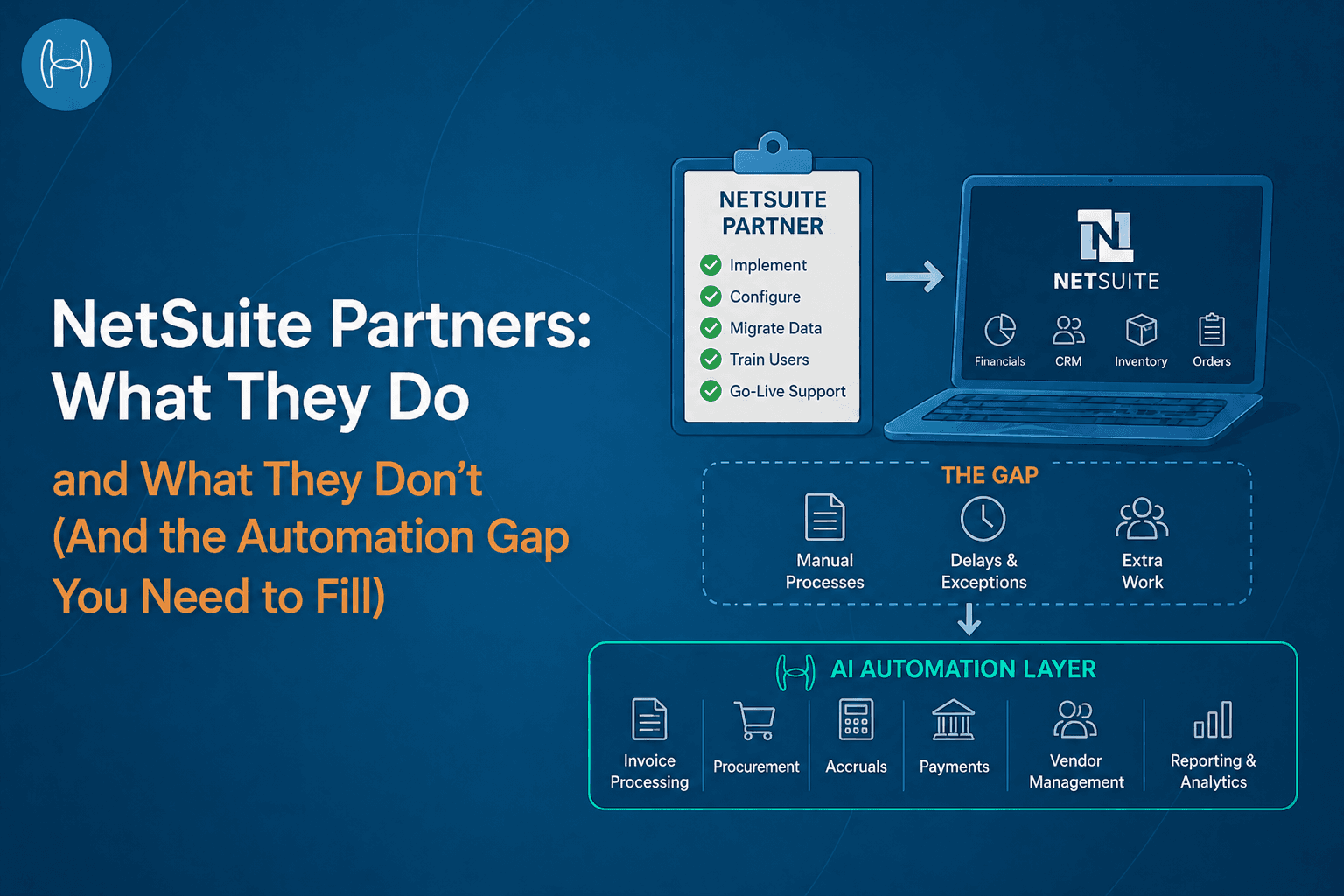
Partners do not run your finance operations. The partner's responsibility ends at delivery of a functioning, configured system. What happens on that system after go-live, how quickly invoices are processed, how many exceptions the AP team handles each day, how accurate month-end accruals are, is the finance team's responsibility to operate.
Partners do not add automation above the ERP. A NetSuite implementation partner configures what NetSuite does natively. They do not typically scope, procure, or implement the AI automation tools that sit above the ERP and handle the processing work that native NetSuite modules leave to humans. Invoice capture from diverse formats, intelligent three-way matching, automated accrual estimation, and vendor communication automation are not deliverables in a standard implementation engagement.
Partners do not maintain the automation layer. Even where a partner has helped connect a third-party tool to NetSuite during implementation, ongoing maintenance of that integration is typically outside the standard support engagement. When the connected tool updates its API or NetSuite releases a platform update that changes integration behaviour, the finance team often discovers this at the worst possible time.
Partners do not scale with volume growth. An implementation is scoped to the business's current state. As transaction volumes increase, the number of entities expands, or new vendor categories are added, the configuration may not keep pace. Finance teams frequently find that the system that worked well at implementation requires revisiting as the business grows.
Understanding these boundaries is not a criticism of implementation partners. They deliver real, substantial value in deploying a complex system correctly. The point is that implementation and operational automation are two separate problems requiring two separate solutions.
How to Evaluate a NetSuite Partner
The partner selection decision deserves as much rigour as the ERP selection itself. These are the dimensions that separate a good implementation experience from a difficult one.
Industry experience. A partner that has implemented NetSuite for businesses in your sector understands the configuration requirements, compliance considerations, and process nuances that a generalist partner may not. Ask specifically for examples of implementations in your industry, not just in adjacent sectors.
Team continuity. The people presented in the sales process are not always the people who deliver the engagement. Clarify who will lead the implementation, what their individual experience level is, and what the partner's policy is on team changes during the project.
Post-go-live support model. Understand what the partner's support engagement looks like after go-live: response times, support channel options, whether post-implementation changes are billed separately, and how platform update impacts are managed. The quality of post-go-live support often matters more than implementation quality once the system is live.
Integration capability. If the implementation will involve connecting NetSuite to other systems, the partner's integration experience is critical. Ask about specific tools, frameworks, and past integration projects, not just general claims about integration capability.
References from similar organisations. A partner's track record with businesses of your size, structure, and complexity is the most reliable indicator of what your experience will look like. The buyer's guide to the best NetSuite partners in 2025 covers partner evaluation criteria in detail and provides a structured framework for comparing options.
The Gap Partners Leave and Where Automation Fills It
After a well-executed NetSuite implementation, the finance team has a correctly configured ERP. The GL structure is right. The approval workflows fire as expected. The entities consolidate properly. Reports come out of the system in a usable format.
What the team does not have, unless it was explicitly scoped and procured separately, is the automation layer that handles the processing work NetSuite's native modules leave to humans.
On a typical day, this means AP staff are still manually keying invoice data from PDFs, matching invoices to purchase orders by hand, chasing approval signatures by email, and estimating month-end accruals from open PO lists. The ERP records what the team processes. The team processes an enormous amount.
This is not a partner failure. It is a scope boundary. The implementation partner delivered a functioning NetSuite instance. The automation layer that sits above it is a different product category entirely.
Here is how the two responsibilities map against each other:
Responsibility | NetSuite Partner | Hyperbots |
ERP configuration | Core deliverable | Not in scope |
Data migration | Core deliverable | Not in scope |
User training | Core deliverable | Not in scope |
Approval workflow setup | Configures native NetSuite workflows | Adds AI-driven routing on top |
Invoice data extraction | Not in scope | From any format, 99.8% accuracy |
Three-way matching | Not in scope | Automated across 140+ fields |
GL coding | Basic configuration | AI recommender that learns over time |
Accrual estimation | Not in scope | Continuous, from live PO data |
Vendor communication | Not in scope | Automated via vendor portal |
Integration maintenance | One-time setup | Maintained across NetSuite updates |
Go-live timeframe | 3 to 18 months | Within one month of ERP being live |
How a NetSuite Deployment Looks With and Without Hyperbots
Understanding where the two layers sit in the deployment timeline makes the relationship between them clear.
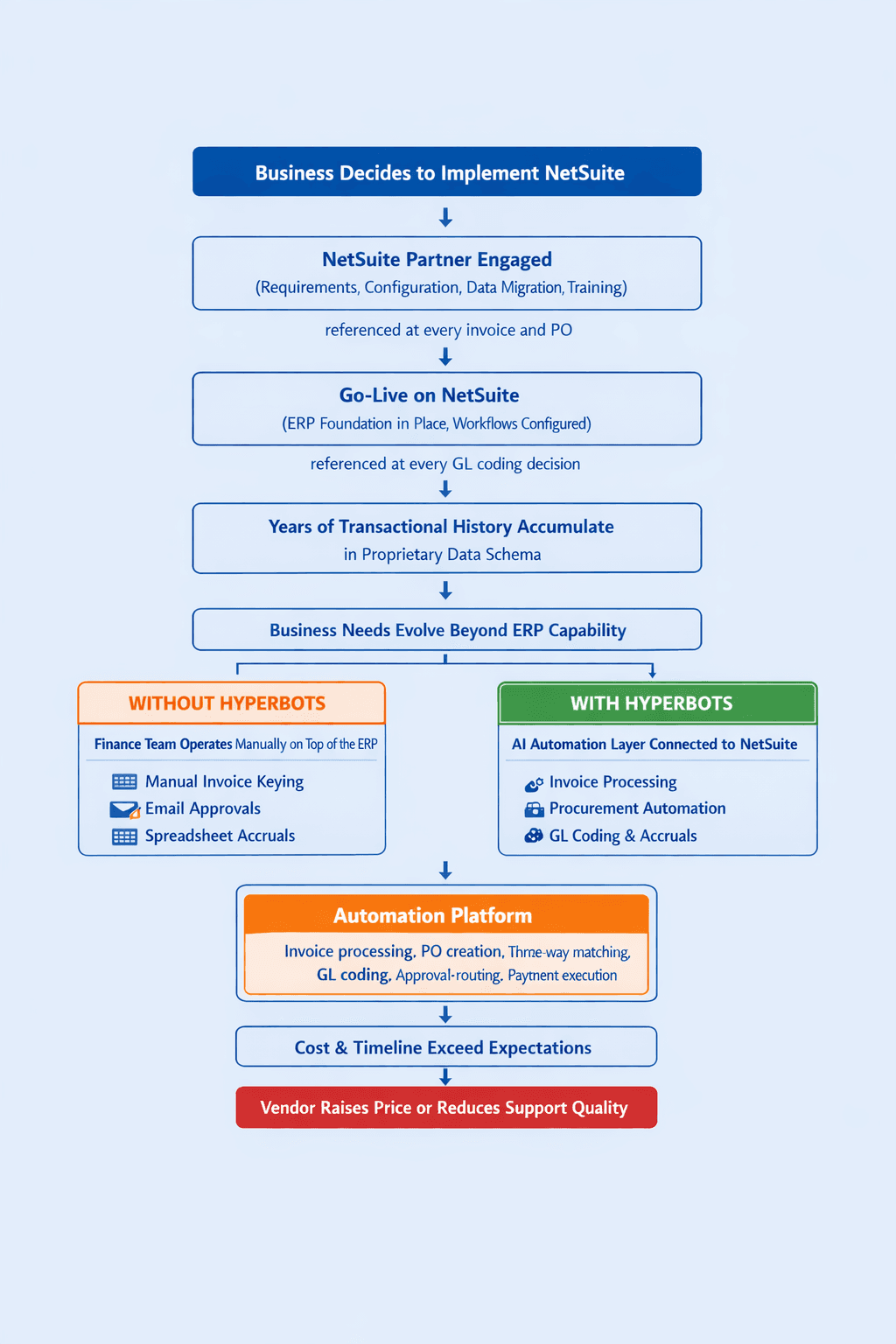
The implementation partner and Hyperbots are not in competition. They operate at different layers and at different points in the project lifecycle. The partner builds the foundation. Hyperbots activates it.
How Hyperbots Extends What NetSuite Partners Deliver
Once your NetSuite instance is live, Hyperbots connects to it and handles the finance processing work that sits above what the ERP does natively. It is not a replacement for NetSuite. It is the AI layer that makes the system your partner configured work significantly harder for your finance team.
Hyperbots is built specifically for finance operations, designed alongside CFOs, and pre-trained on millions of financial documents. Every co-pilot connects to NetSuite through a pre-built native integration that is maintained and updated as Oracle releases platform updates, so the finance team never manages integration maintenance.
Here is what each co-pilot covers.
The Invoice Processing Co-Pilot handles the full invoice lifecycle from the moment an invoice arrives to the point it is posted in NetSuite. It reads invoices from any format and source, extracts data with 99.8% accuracy, runs three-way matching automatically, and processes up to 80% of invoices straight through without human intervention. Invoice processing time drops from an industry average of 11 days to under one minute.
The Procurement Co-Pilot takes over the manual work in purchasing. Purchase requisitions are created in under 5 minutes using data from contracts and vendor records. Budget checks run against live NetSuite data before any order is placed. PO creation and dispatch time is reduced by 80%.
The Accruals Co-Pilot removes the guesswork from month-end close. It reads open purchase orders, partial receipts, and vendor billing patterns continuously to estimate what has been received but not yet invoiced. Variance between accrued and actual costs stays below 5%.
The Payments Co-Pilot automates payment recommendations, approvals, and execution across ACH, check, and card. It identifies early payment discount opportunities before the window closes and handles GL posting and reconciliation automatically.
The Vendor Management Co-Pilot manages the compliance and communication layer of your vendor relationships. Onboarding, identity verification, certificate tracking, and invoice status communication are all handled automatically, reducing the volume of inbound vendor queries the finance team has to respond to.
The Collections Co-Pilot automates accounts receivable follow-up, tracks overdue invoices, and manages dispute workflows. DSO is reduced by 40% and collections costs fall by 70%.
The Cash Application Co-Pilot matches incoming payments to open invoices automatically, processes remittance advice, and handles short payments. Unapplied cash is reduced by 90%.
The Sales Tax Verification Co-Pilot validates tax charges at the line-item level on every vendor invoice, using origin, destination, and item descriptions to ensure accurate and compliant tax calculations without manual review.
All eight co-pilots connect to the same NetSuite instance your partner configured. Go-live is within one month. ROI is typically reached within six months.
For a detailed look at what this combination produces day to day, the guide on advancing Oracle NetSuite operations with Hyperbots covers the integration architecture and the outcomes NetSuite customers experience when both are in place.
Conclusion
NetSuite partners are essential to getting the ERP deployed correctly. They configure the system, migrate the data, train the team, and support the go-live. That is genuinely difficult work and it matters enormously. What partners do not deliver is the automation layer that makes the configured system operate efficiently at scale.
Choosing the right implementation partner is your decision, and it should be based on what matters most to your organisation: industry experience, team quality, support model, and integration capability. That choice stands entirely on its own.
What Hyperbots does is work with whichever NetSuite instance your partner delivers. The ERP foundation your partner builds stays exactly as it is. Hyperbots connects to it and adds the AI automation layer above it, handling the invoice processing, procurement automation, GL coding, and accrual estimation that native NetSuite modules leave to humans. The partner decision and the automation decision are separate. Making both well produces a NetSuite deployment that actually scales with the business.
See it in action with a demo or start your free trial today.