QuickBooks, Xero, Sage: How PO Systems Integrate and Operate
Unlock smarter, faster purchase order workflows with QuickBooks, Xero, and Sage, plus the power of AI automation.
Executive Summary
Modern finance teams are increasingly seeking integrated purchase order solutions that streamline procurement processes across multiple platforms. The QuickBooks purchase order system, along with Xero and Sage alternatives, offers businesses various pathways to automate their procure-to-pay operations. However, traditional ERP-based purchase order systems often fall short of delivering the operational efficiency and cost reduction that today’s CFOs demand. This comprehensive guide examines how purchase order systems operate within QuickBooks, Xero, and Sage environments, their integration capabilities, and limitations. More importantly, we’ll explore how AI-powered procurement automation platforms like Hyperbots are transforming purchase order management, delivering up to 80% operational cost reductions while maintaining compliance and financial control. Key takeaways include understanding native PO functionalities, integration challenges, and the transformational impact of AI co-pilots in procurement automation that are revolutionizing how finance teams manage their purchase order workflows.
Understanding Purchase Order Systems Across Major Platforms
Does QuickBooks Have a Purchase Order System?
Yes, QuickBooks does have a purchase order system built into most of its business editions. The QuickBooks purchase order system enables users to create, track, and manage purchase orders directly within their accounting workflow. However, the functionality varies significantly between QuickBooks Desktop and QuickBooks Online versions.
For detailed architecture and security practices on cloud-based purchase order systems, see Cloud and Web-Based Purchase Order Systems: Architecture, Security & SSO.
QuickBooks Desktop Purchase Order Features
Create detailed purchase orders with item descriptions, quantities, and pricing
Track order status from creation to receipt
Convert purchase orders to bills upon delivery
Generate purchase order reports for vendor analysis
Customize purchase order templates with company branding
QuickBooks Online Purchase Order System
The QuickBooks Online purchase order system offers cloud-based accessibility with real-time collaboration features.
Mobile purchase order creation and approval
Automated email delivery to vendors
Integration with inventory management
Multi-location purchase order tracking
Advanced reporting and analytics dashboard
For a complete guide to building end-to-end workflows with cloud PO software, see Building a Digital PO Workflow: End-to-End.
Xero Purchase Order System Capabilities
The Xero purchase order system provides robust procurement functionality designed for small to medium enterprises. Unlike QuickBooks, Xero’s purchase order system emphasizes simplicity and automation from the ground up.
Streamlined three-step purchase order creation
Automated approval workflows with customizable rules
Real-time inventory updates upon PO conversion
Mobile-responsive purchase order management
Integration with over 1,000 third-party applications
To see real-world ERP software flows and examples, review ERP Software Examples: Real Companies, Real Flows.
Xero Purchase Order Automation
Automatic vendor selection based on historical data
Recurring purchase order templates
Budget alerts and spending controls
Advanced analytics and spend reporting
Sage Purchase Order System Overview
The Sage purchase order system caters to mid-market and enterprise clients with sophisticated procurement requirements. Sage offers multiple products, each with varying PO capabilities.
Comprehensive vendor management integration
Multi-currency purchase order support
Advanced approval hierarchies
Detailed audit trails and compliance reporting
Sage users can boost automation by learning How to Automate Purchase Orders: An End-to-End Guide.
Integration Capabilities and Challenges
QuickBooks Integration with External PO Systems
Purchase order system QuickBooks integration presents both opportunities and limitations. While QuickBooks offers API connectivity, many businesses find native integration insufficient for complex procurement workflows.
Common Integration Scenarios:
E-commerce platform synchronization
Inventory management system connectivity
Supplier portal integration
Advanced approval workflow tools
Spend analytics and reporting platforms
Integration Limitations:
Limited API rate limits affecting real-time synchronization
Restricted customization of approval workflows
Minimal AI-powered automation capabilities
Basic reporting and analytics functionality
Limited multi-entity support
For best practices in GL posting and compliance, refer to Best Practices for GL Posting.
Xero Integration Ecosystem
The purchase order system Xero integration ecosystem is notably more extensive than QuickBooks, with over 1,000 certified applications available through the Xero App Store.
Popular Integration Categories:
Procurement automation platforms
Inventory management solutions
Expense management tools
Project management software
Business intelligence platforms
Integration Benefits:
Real-time data synchronization
Unified reporting across platforms
Automated workflow triggers
Enhanced vendor management capabilities
Sage Integration Architecture
Purchase order system Sage integration relies on robust APIs and middleware solutions, particularly for enterprise implementations.
Enterprise Integration Features:
EDI connectivity for supplier communications
ERP-to-ERP data exchange
Advanced workflow automation
Custom reporting and analytics
Multi-subsidiary consolidation
Operational Workflows and Best Practices
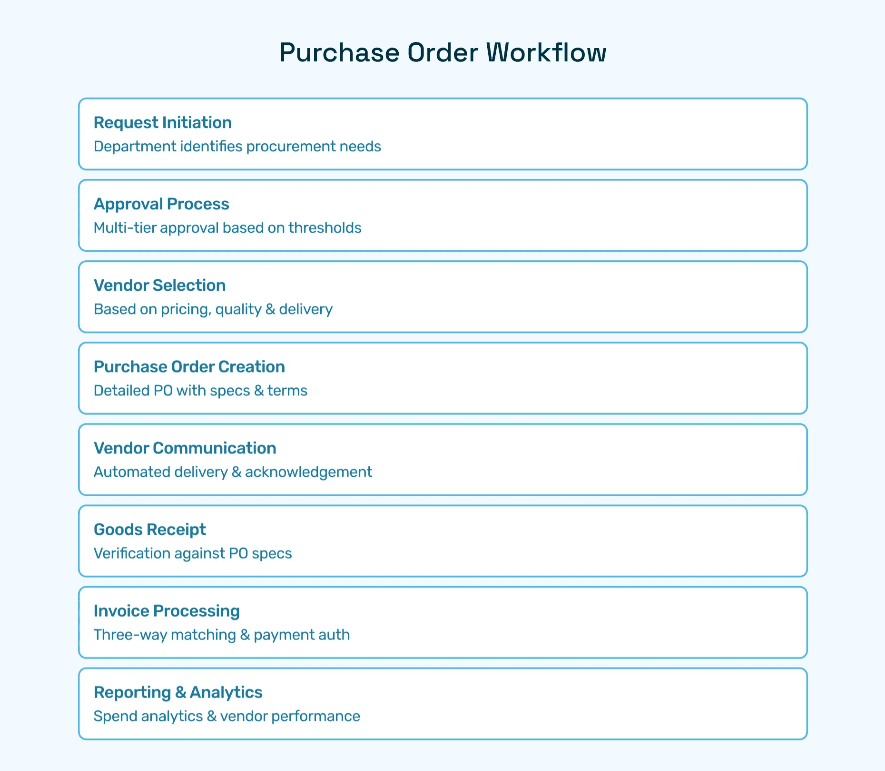
Standard Purchase Order Workflow - Regardless of platform choice, effective purchase order management follows a standardized workflow:
Request Initiation: Department identifies procurement need
Approval Process: Multi-tier approval based on spend thresholds
Vendor Selection: Based on pricing, quality, and delivery criteria
Purchase Order Creation: Detailed PO with specifications and terms
Vendor Communication: Automated delivery and acknowledgment
Goods Receipt: Verification against PO specifications
Invoice Processing: Three-way matching and payment authorization
Reporting and Analysis: Spend analytics and vendor performance review
Platform-Specific Workflow Optimizations
QuickBooks Workflow Optimization:
Leverage custom fields for enhanced tracking
Implement approval rules using third-party add-ons
Utilize purchase order templates for consistency
Configure automated inventory adjustments
Xero Workflow Enhancement:
Implement Hubdoc for automated document capture
Use Xero Projects for job-specific procurement
Configure spending alerts and controls
Leverage mobile apps for field-based approvals
Sage Workflow Automation:
Deploy dimensional accounting for detailed analytics
Implement advanced approval hierarchies
Use Sage Intelligence for custom reporting
Configure automated vendor communications
The AI Revolution in Purchase Order Management
Traditional PO System Limitations
Despite advances in ERP technology, traditional purchase order systems suffer from significant operational inefficiencies:
Manual Process Dependencies: Time-intensive approval workflows, paper-based or email-driven communications, manual data entry and verification, limited real-time visibility into spend patterns, reactive rather than predictive procurement decisions
Compliance and Control Challenges: Inconsistent approval processes, limited audit trail capabilities, difficulty enforcing spending policies, manual reconciliation requirements, inadequate vendor performance tracking
Discover how AI agents are transforming finance/accounting in The Agentic AI Revolution: Transforming Finance & Accounting through Multi-Agent Collaboration.
Hyperbots AI Co-pilots Transformational Purchase Order Automation
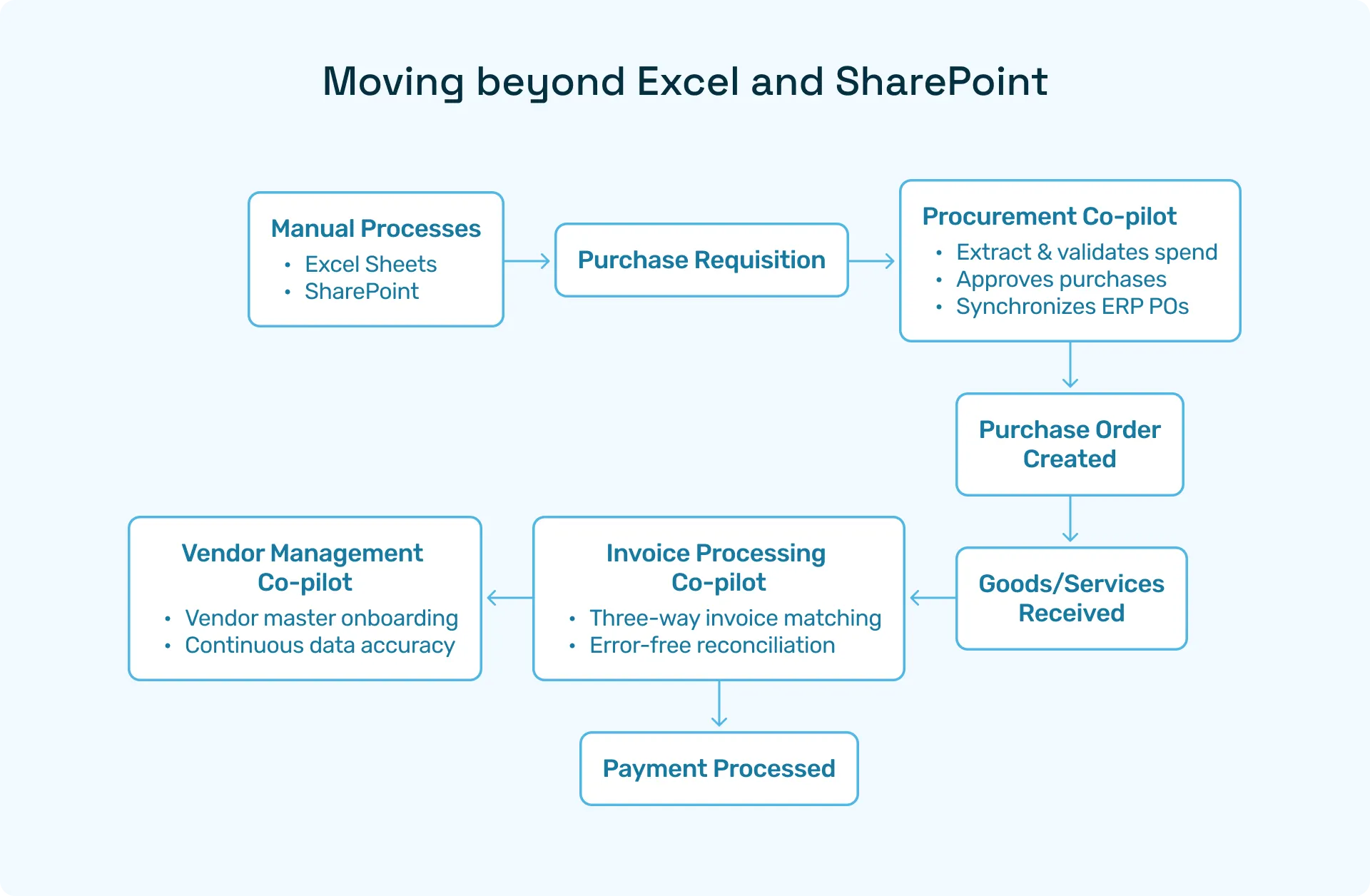
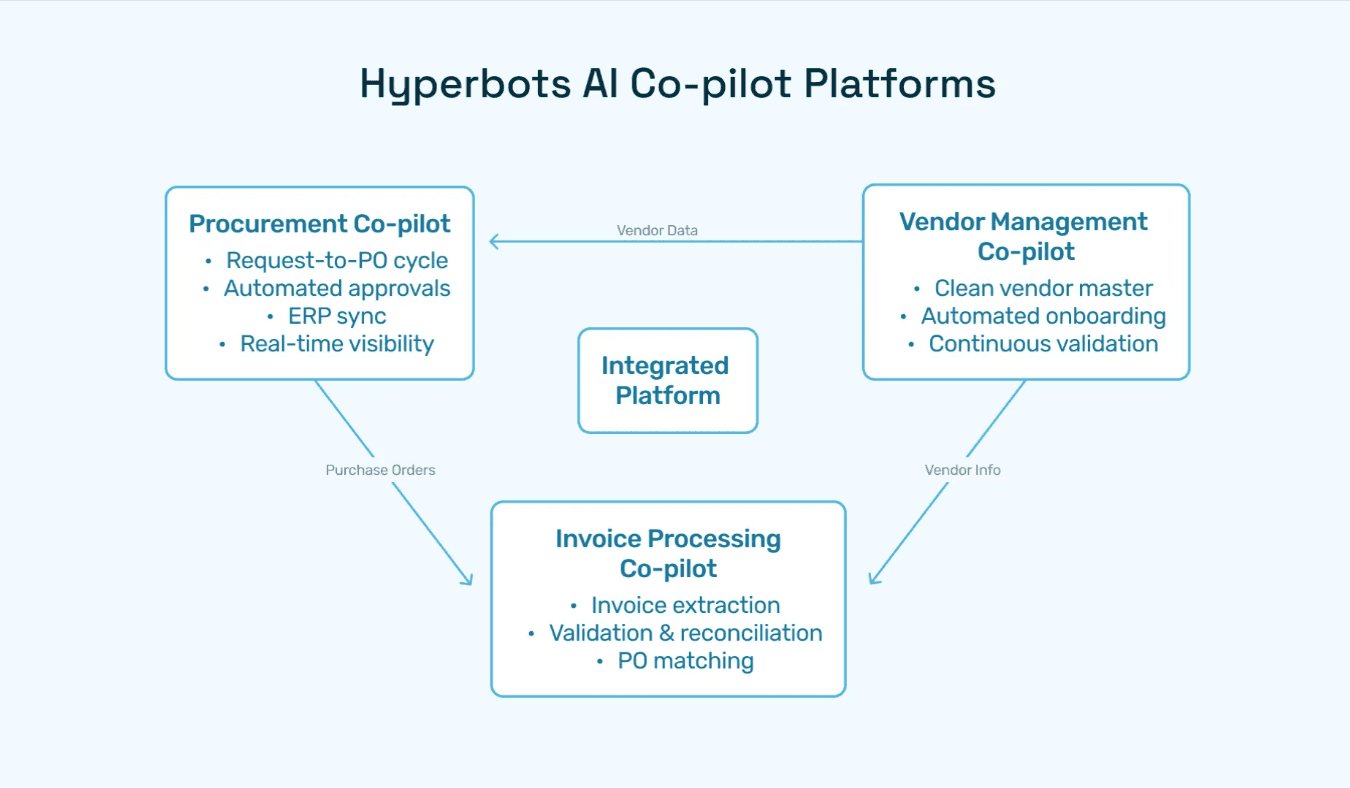
Hyperbots has revolutionized purchase order management through comprehensive AI-powered co-pilots that address these fundamental limitations. The platform’s Procurement Co-pilot serves as the cornerstone of an integrated approach to procurement automation.
Primary AI Co-pilot Capabilities
Intelligent Request Processing: AI analyzes procurement requests and automatically routes them through optimized approval workflows.
ERP-Synced Approvals: Real-time synchronization with existing ERP systems ensures seamless integration without workflow disruption
Cycle Time Reduction: Shrinks request-to-purchase-order cycles from days to hours through automated decision-making
Real-time Spend Visibility: Provides finance teams with instantaneous visibility into spending patterns and budget utilization
Compliance Automation: Ensures all purchase orders meet organizational policies and regulatory requirements
Supporting Co-pilots for End-to-End Automation
Invoice Processing Co-pilot: Automated three-way matching between purchase orders, receipts, and invoices, exception handling, duplicate detection and prevention, vendor communication automation
Vendor Management Co-pilot: Supplier performance analytics, automated vendor onboarding, contract management and renewal alerts, risk assessment and mitigation strategies
Hyperbots Platform Differentiation
Superior AI Architecture
Unlike traditional procure-to-pay solutions that rely on rule-based automation, Hyperbots leverages advanced machine learning algorithms that continuously improve decision-making accuracy. The platform’s AI co-pilots learn from organizational patterns and preferences, delivering increasingly sophisticated automation over time.
Seamless Integration Capabilities
Universal ERP Connectivity: Native integration with QuickBooks, Xero, Sage, NetSuite, SAP, and other major ERP platforms
API-First Architecture: Enables rapid deployment and customization without disrupting existing workflows
Real-time Data Synchronization: Eliminates data silos and ensures consistent information across all platforms
Comprehensive Automation Coverage
While competitors focus on specific aspects of procurement, Hyperbots provides end-to-end automation spanning the entire procure-to-pay lifecycle. This holistic approach eliminates workflow gaps that typically require manual intervention.
Measurable ROI and Business Impact
Quantifiable Operational Improvements
Organizations implementing Hyperbots AI co-pilots consistently achieve transformational results:
Cost Reduction Metrics
80% Reduction in Operational Costs: Through automated processing and reduced manual intervention
Faster Procurement Cycles: From request initiation to purchase order approval
Reduction in Processing Errors: Through intelligent validation and three-way matching
Decrease in Vendor Communication Time: Via automated status updates and exception handling
Process Efficiency Gains
Real-time Approval Processing: Eliminates delays caused by manual routing and paper-based workflows
Predictive Analytics: Enables proactive procurement decisions based on historical patterns and market trends
Automated Compliance Monitoring: Ensures adherence to organizational policies without manual oversight
Enhanced Vendor Relations: Through consistent communication and streamlined processes
Intangible Benefits and Strategic Value
Organizational Transformation
Strategic Focus Shift: Finance teams can focus on strategic initiatives rather than transactional processing
Enhanced Decision-Making: Real-time data visibility enables more informed procurement decisions
Improved Vendor Relationships: Consistent, automated communications improve supplier satisfaction
Risk Mitigation: Automated compliance monitoring reduces regulatory and operational risks
Competitive Advantage
Market Responsiveness: Faster procurement cycles enable quicker response to market opportunities
Cost Optimization: AI-driven insights identify cost-saving opportunities across vendor relationships
Scalability: Automated processes support business growth without proportional increases in operational costs
Implementation Strategies and Considerations
Platform Selection Criteria
For guidance in managing complex payment terms and vendor relationships, refer to Rationalizing Payment Terms Across Vendors.
For QuickBooks Users
Evaluate current PO volume and complexity requirements
Consider integration needs with existing workflows
Assess reporting and analytics requirements
Plan for scalability as business grows
For Xero Implementations
Leverage extensive app marketplace for specialized functionality
Consider mobile-first requirements for field teams
Evaluate multi-currency and international needs
Plan integration with project management systems
For Sage Environments
Assess enterprise-level compliance requirements
Consider multi-entity and consolidation needs
Evaluate advanced reporting and analytics requirements
Plan for EDI and supplier portal integration
Migration and Integration Planning
Pre-Implementation Assessment
Current state process mapping and documentation
System integration requirements analysis
User training and change management planning
Data migration and cleansing strategies
Implementation Best Practices
Phased rollout approach to minimize disruption
Comprehensive user training and support
Regular performance monitoring and optimization
Continuous improvement based on user feedback
Industry Trends and Future Outlook
Emerging Technologies in Procurement:
Artificial Intelligence and Machine Learning
The integration of AI in purchase order systems is accelerating, with predictive analytics, automated decision-making, and intelligent exception handling becoming standard features. Organizations are increasingly seeking solutions that can learn and adapt to their specific business patterns.
Cloud-First Architecture
Migration to cloud-based procurement solutions continues to accelerate, driven by demands for remote accessibility, real-time collaboration, and reduced IT infrastructure costs.
Mobile-Enabled Workflows
Mobile-first procurement solutions are becoming essential as organizations embrace remote and hybrid work models. The ability to approve purchase orders, communicate with vendors, and access real-time data from mobile devices is now a competitive requirement.
Regulatory and Compliance Evolution
Enhanced Audit Requirements: Regulatory bodies are increasing scrutiny of procurement processes, particularly in industries such as healthcare, government contracting, and financial services. Organizations need purchase order systems that provide comprehensive audit trails and automated compliance monitoring.
Sustainability and ESG Reporting: Environmental, social, and governance (ESG) considerations are becoming integral to procurement decisions. Modern purchase order systems must support supplier diversity tracking, sustainability metrics, and social responsibility reporting.
Advanced Features and Capabilities Comparison
Feature Category | QuickBooks | Xero | Sage | Hyperbots AI |
Approval Workflows | Basic QuickBooks.docx | Advanced QuickBooks.docx | Enterprise QuickBooks.docx | AI-Optimized QuickBooks.docx |
Mobile Access | Limited QuickBooks.docx | Excellent QuickBooks.docx | Good QuickBooks.docx | Comprehensive QuickBooks.docx |
Integration APIs | Moderate QuickBooks.docx | Extensive QuickBooks.docx | Robust QuickBooks.docx | Universal QuickBooks.docx |
Reporting Analytics | Standard QuickBooks.docx | Advanced QuickBooks.docx | Enterprise QuickBooks.docx | AI-Powered QuickBooks.docx |
Automation Level | Basic QuickBooks.docx | Moderate QuickBooks.docx | Advanced QuickBooks.docx | Transformational QuickBooks.docx |
Scalability | SMB QuickBooks.docx | SMB-Mid QuickBooks.docx | Enterprise QuickBooks.docx | Universal QuickBooks.docx |
Transform Your Purchase Order Operations
Modern finance teams recognize that traditional purchase order systems, while functional, fall short of delivering the operational efficiency and strategic value required in today’s competitive landscape. Whether you’re currently using QuickBooks, Xero, or Sage, the limitations of manual processes and reactive workflows are constraining your organization’s potential. Hyperbots AI-powered Procurement Co-pilot represents a paradigm shift in purchase order automation, delivering tangible results that transform procurement operations. With proven 80% reductions in operational costs and the ability to shrink procurement cycles from days to hours, organizations are discovering that AI automation isn’t just an incremental improvement—it’s a competitive necessity. The comprehensive suite of AI co-pilots handles everything from initial procurement requests through final payment processing, eliminating the workflow gaps and manual interventions that plague traditional systems. Real-time ERP synchronization ensures seamless integration with your existing QuickBooks, Xero, or Sage environment while delivering the advanced functionality these platforms cannot provide natively.
Frequently Asked Questions
Q1: Does QuickBooks have a built-in purchase order system?
A: Yes, QuickBooks includes purchase order functionality in most business editions. The QuickBooks purchase order system allows users to create, track, and manage purchase orders directly within their accounting workflow. However, functionality varies between QuickBooks Desktop and QuickBooks Online versions, with the online version offering more collaborative features and mobile access.
Q2: How does the QuickBooks Online purchase order system differ from the desktop version?
A: The QuickBooks Online purchase order system provides cloud-based accessibility, real-time collaboration, mobile purchase order creation, and automated email delivery to vendors. The desktop version offers more customization options but lacks the collaborative and mobile features of the online platform.
Q3: Can purchase order systems integrate with multiple ERP platforms?
A: Yes, modern purchase order automation platforms like Hyperbots offer universal ERP connectivity, providing native integration with QuickBooks, Xero, Sage, NetSuite, SAP, and other major systems. This eliminates the need for multiple point solutions and ensures consistent data across all platforms.
Q4: What are the main limitations of traditional purchase order systems?
A: Traditional systems suffer from manual process dependencies, limited automation capabilities, basic reporting functionality, and workflow inefficiencies. These limitations result in longer procurement cycles, higher operational costs, and reduced visibility into spending patterns.
Q5: How can AI improve purchase order management?
A: AI-powered systems like Hyperbots Procurement Co-pilot automate approval workflows, provide predictive analytics, enable real-time spend visibility, and continuously learn from organizational patterns. This results in up to 80% reduction in operational costs and significantly faster procurement cycles.
Q6: Is the Xero purchase order system suitable for enterprise-level operations?
A: While the Xero purchase order system is robust for small to medium enterprises, it may lack some advanced features required by large enterprises, such as complex approval hierarchies, multi-entity support, and advanced compliance reporting. Enterprise organizations often require additional integration with specialized procurement platforms.
Q7: What should organizations consider when choosing between QuickBooks, Xero, and Sage for purchase orders?
A: Consider factors such as business size, integration requirements, mobile access needs, reporting complexity, and scalability requirements. QuickBooks suits small businesses, Xero excels in SMB environments with extensive integration needs, and Sage caters to mid-market and enterprise requirements.