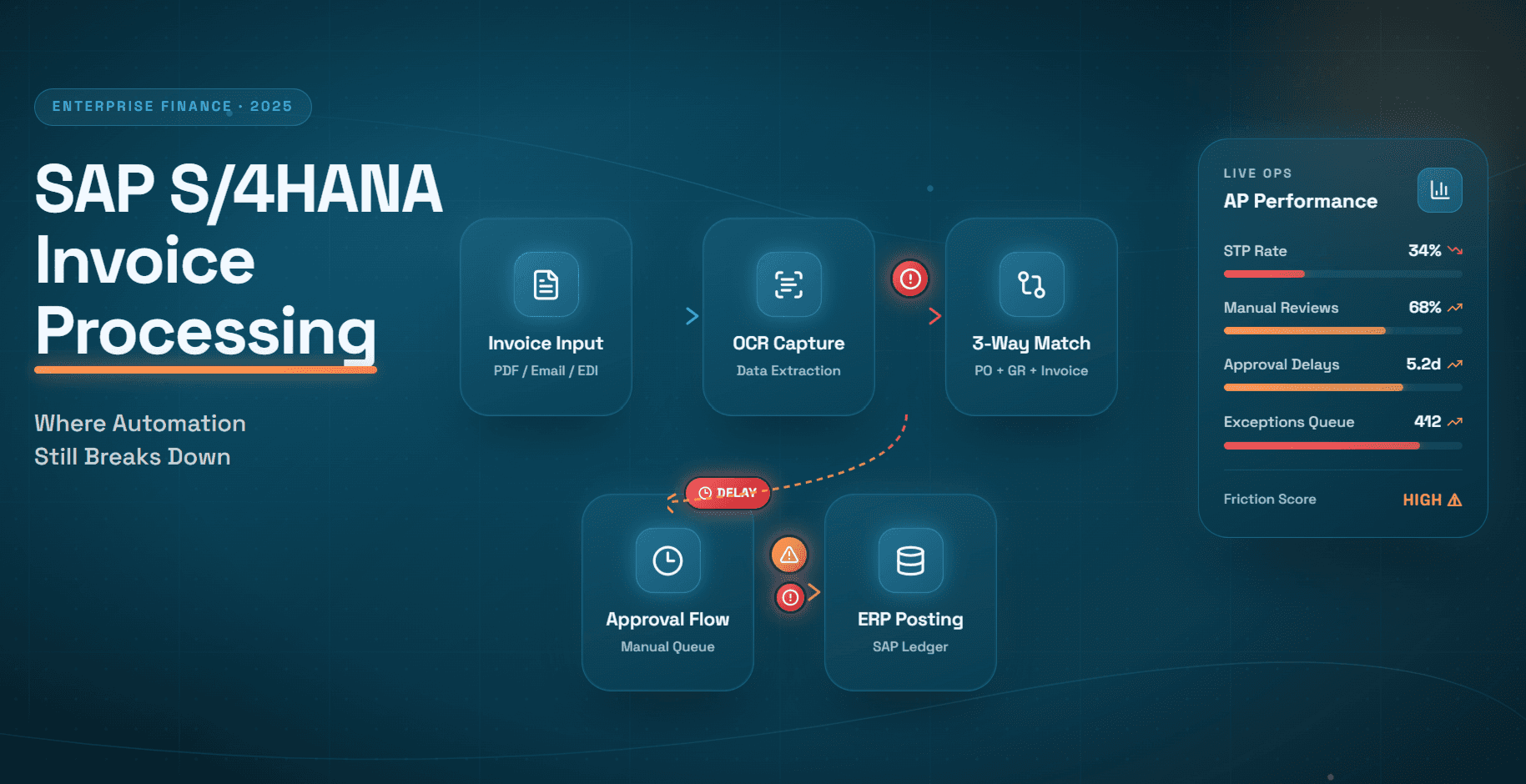
Vendor Management in SAP S/4HANA: Operational Complexity, Risk, and Data Gaps
Why supplier onboarding, governance, and master data remain major finance challenges
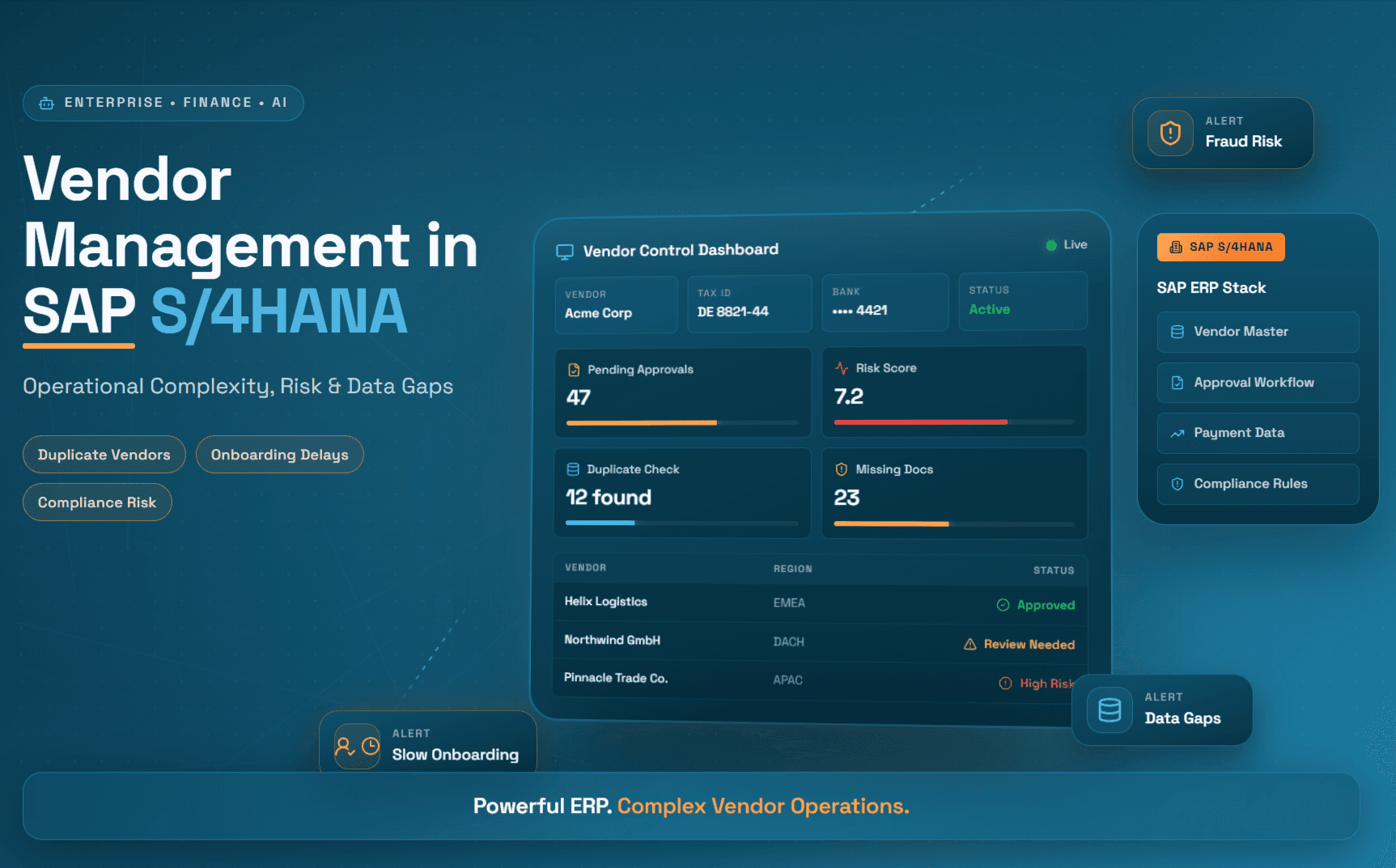
Why Vendor Management in SAP S/4HANA Is Harder Than It Looks
SAP S/4HANA is the backbone of finance operations for thousands of mid-market and enterprise organizations worldwide. Its vendor management capabilities are deeply integrated into the broader procure-to-pay (P2P) ecosystem, connecting purchasing, accounts payable, general ledger, and compliance in one system. Yet, despite its power, day-to-day vendor management in SAP S/4HANA remains one of the most operationally complex and risk-prone activities in finance.
The root of the problem is this: SAP S/4HANA is an excellent system of record, but it is not an intelligent system of action. It stores vendor master data with precision, but it cannot proactively identify when that data is wrong, outdated, or incomplete. It supports supplier onboarding workflows, but it relies heavily on manual data entry and human validation. It captures transactional history, but it cannot autonomously assess vendor risk or flag anomalies in real time.
The result? Finance and procurement teams spend enormous effort keeping vendor data clean, onboarding new suppliers accurately, managing risk manually, and resolving disputes that should never have happened. This blog unpacks each of these layers in depth.
The Anatomy of SAP S/4HANA Vendor Master Data
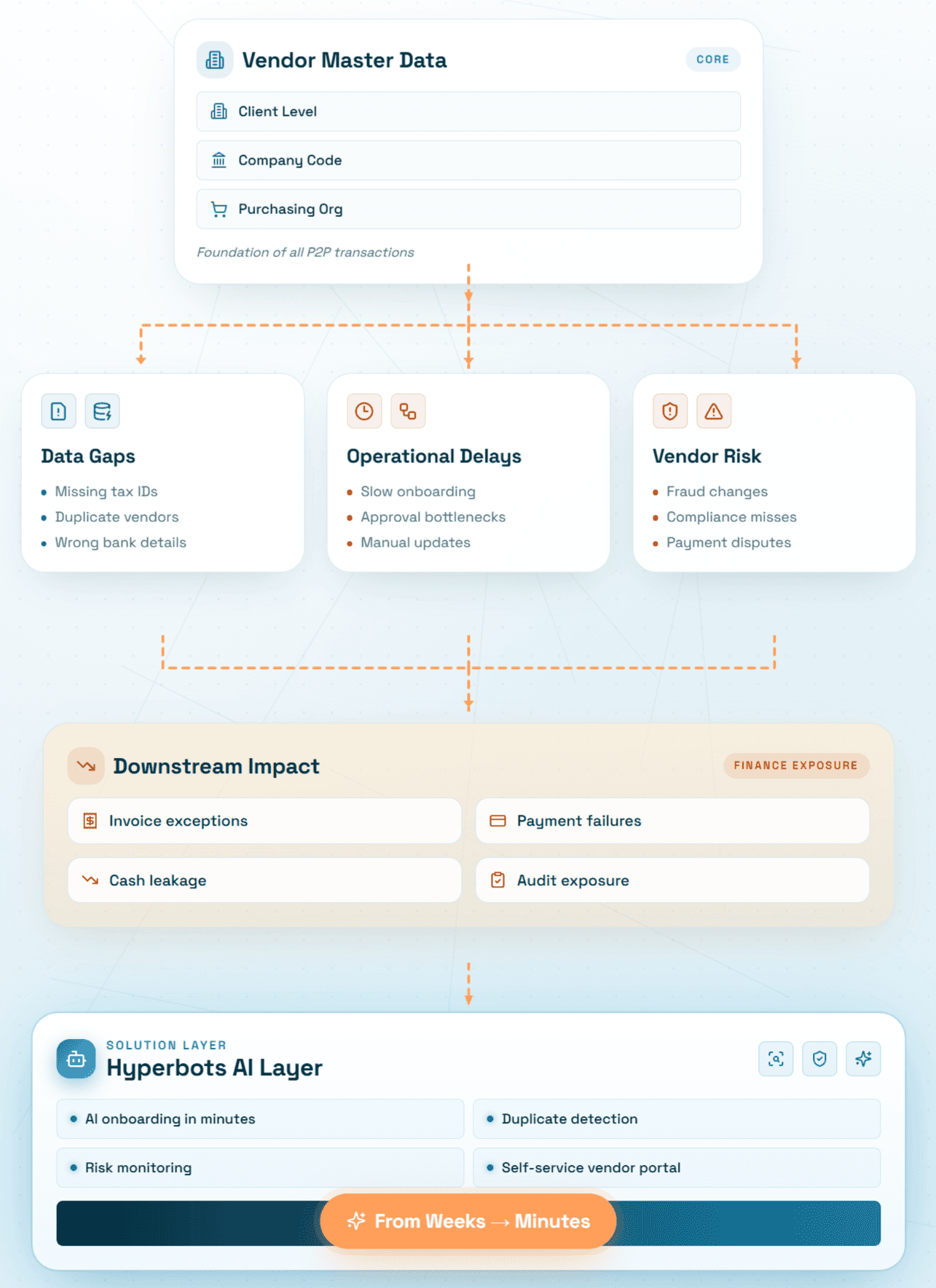
Vendor master data in SAP S/4HANA sits at the heart of every purchasing and payables transaction. It is structured across three key organizational levels:
Data Level | What It Contains | Who Manages It |
Client Level | Vendor name, address, tax numbers, payment terms, bank account details | Centralized AP / Finance |
Company Code Level | Reconciliation accounts, payment methods, correspondence language | Accounts Payable team |
Purchasing Organization Level | Ordering currency, incoterms, confirmed delivery times, default buyers | Procurement team |
Each of these levels must be populated correctly and kept synchronized for transactions to flow without exceptions. A mismatch between, say, the bank account at client level and the payment method at company code level can cause payment failures, vendor disputes, or duplicate disbursements.
Key Data Fields That Drive Downstream Accuracy
The quality of vendor master data directly determines the accuracy of invoice matching, payment processing, and compliance reporting. Critical fields include:
Vendor name and legal entity type: affects tax classification and W-9/W-8 validation
Tax ID / EIN: essential for 1099 reporting compliance in the US; VAT number for EU transactions
Bank account details: the single most targeted field in Business Email Compromise (BEC) fraud schemes
Payment terms: drives early payment discount capture and cash flow forecasting
Reconciliation GL account: determines how payables are posted and aged
Incoterms and delivery address: critical for 3-way matching and sales tax nexus determination
When any of these fields is incorrect, incomplete, or outdated, the downstream consequences ripple across AP, procurement, treasury, and compliance simultaneously. This is why vendor onboarding challenges and the advantages of AI are increasingly a top priority for finance leaders.
Supplier Onboarding in SAP: Where Complexity Begins
Supplier onboarding is the first and most consequential step in the vendor lifecycle. It is where the quality of vendor master data is established and where most organizations accumulate their highest concentration of data errors.
The Standard SAP Onboarding Journey
In a typical SAP S/4HANA environment, supplier onboarding follows a multi-step manual workflow:
Vendor request: internal requestor submits a new vendor request via email, paper form, or a basic portal
Document collection: AP team requests W-9 (US), VAT certificate (EU), bank letter, company registration
Data entry: AP clerk manually keys all vendor details into SAP transaction XK01
Validation and approval: supervisor reviews for duplicates, completeness, and policy compliance
ERP activation: vendor is activated in SAP across relevant company codes and purchasing organizations
Vendor notification: new vendor is informed and begins receiving POs
This process sounds linear. In practice, it is anything but. Documents arrive in inconsistent formats like scanned PDFs, screenshots, handwritten letters. Data entry errors are common. Duplicate vendor creation is endemic. Review cycles involve multiple email threads with no audit trail. And because onboarding is largely manual, cycle times of two to three weeks for a new supplier are not unusual.
The Cost of Slow and Inaccurate Onboarding
Delayed supplier onboarding has real business consequences. It stalls procurement when critical goods or services cannot be ordered from a new supplier until they are fully activated in SAP. It creates off-PO buying as requestors work around the delay. And it introduces compliance risk when suppliers begin delivering before identity verification is complete.
The procurement co-pilot capabilities needed to compress onboarding timelines are well-understood but most organizations have not yet deployed them. The gap between what is possible and what is practiced remains wide.
Common Onboarding Failures in SAP Environments
Failure Type | Root Cause | Business Impact |
Duplicate vendor records | No automated deduplication at point of entry | Duplicate payments, reconciliation failures |
Incorrect bank details | Manual transcription errors, no bank validation API | Misdirected payments, fraud exposure |
Missing tax documents | No automated W-9 chasing workflow | 1099 filing errors, IRS penalty risk |
Incomplete purchasing org data | Handoff failure between AP and procurement | Invoice matching failures, delayed POs |
Vendor activated without identity check | Overloaded AP teams skipping controls | Fraud risk, compliance violation |
The best practices for managing vendor relationships during onboarding are well-documented, yet many SAP environments still rely on largely manual controls that are inconsistently applied.
Vendor Risk in SAP S/4HANA: Hidden Exposures Finance Teams Miss
Vendor risk is one of the most under-managed dimensions of SAP operations. Most finance teams think of vendor risk primarily in terms of payment fraud or credit terms. In reality, vendor risk in a SAP S/4HANA environment spans at least five distinct categories.
The Five Dimensions of Vendor Risk
1. Identity and Fraud Risk This is the most acute and immediate vendor risk. Fraudsters increasingly use vendor impersonation, submitting change requests to update bank account details, to redirect payments. SAP's standard controls do not automatically verify whether a bank account change request is legitimate or fraudulent. Without AI-driven vendor identity verification, finance teams rely on phone callbacks and email confirmation, both of which are slow and gameable.
2. Compliance and Regulatory Risk Vendors must meet a range of regulatory requirements depending on their category and geography. In the US, this includes W-9 validation for domestic suppliers, OFAC sanctions screening, and 1099/1042 reporting obligations. In the EU, VAT validation and GDPR data handling requirements add additional layers. SAP stores this data but does not proactively flag when a vendor's tax status has changed or when a sanctions list match appears.
3. Data Quality Risk This is perhaps the most pervasive vendor risk in SAP environments. Stale, duplicate, or incomplete vendor master data creates continuous operational friction such as invoice matching failures, payment delays, incorrect GL postings. Detecting anomalies and frauds through AI-based matching is one of the highest-value applications of AI in AP operations precisely because the SAP system alone cannot surface these signals.
4. Concentration and Strategic Risk Organizations often discover too late that they have excessive spend concentration with a single supplier or supplier group. SAP's reporting tools can surface this data, but only if someone is actively running the right queries. Vendor rationalization, identifying where consolidation can drive better terms and reduce administrative overhead, is rarely done systematically. The quantifying vendor relationships for optimized payment decisions framework offers a practical lens for this analysis.
5. Payment Terms and Cash Flow Risk Inconsistent or unfavorable payment terms across the vendor portfolio create hidden cash flow costs. Organizations with hundreds or thousands of active vendors in SAP rarely have a clear, up-to-date picture of their aggregate payment terms exposure. Rationalizing payment terms across vendors is a strategic lever that most finance teams leave unpulled.
Common Data Gaps in SAP Vendor Master Records
Even in mature SAP environments, vendor master data quality degrades over time. The causes are well understood:
No governance process for periodic review and cleansing: vendor records created years ago are never updated
Mergers and acquisitions: acquired entities bring their own ERP instances with different vendor naming conventions, creating duplicates when consolidated
Decentralized onboarding: multiple business units create vendors independently, with inconsistent field completion standards
ERP migrations: data migrated from legacy systems (SAP ECC, Oracle, JDE) often arrives with gaps that are never remediated
Vendor lifecycle changes: suppliers change legal names, addresses, banking relationships, and tax status; SAP doesn't proactively prompt updates
The result is a vendor master that is a mixture of clean and dirty records, with no easy way to distinguish them at the point of transaction processing. This directly increases exception rates in invoice processing, matching failures, and payment errors.
Most Frequently Incomplete Fields in SAP Vendor Master
Field | % of Records Commonly Incomplete | Downstream Risk |
Tax ID / EIN | 15–25% | 1099 filing failures |
Bank account details | 10–20% | Payment processing delays |
Payment terms | 20–30% | DPO management, cash forecasting |
Vendor category / spend class | 30–40% | Reporting inaccuracy, tax misclassification |
OFAC screening date | Often not tracked | Regulatory exposure |
Duplicate check / deduplication flag | Rarely enforced | Duplicate payments |
This is why maintaining, reviewing, and auditing the Chart of Accounts and by extension, the vendor master, requires a systematic, AI-assisted approach rather than periodic manual audits.
Operational Challenges Across the P2P Lifecycle
Vendor master data quality doesn't just affect onboarding, it creates friction across every stage of the procure-to-pay process.
In Procurement (PR to PO)
When vendor data is incomplete at the purchasing organization level, purchase orders cannot be dispatched correctly. Missing international commerce terms cause delivery disputes. Incorrect ordering currency triggers FX complications. And when PR to PO cycle times are already under pressure, these data gaps become a significant bottleneck.
In Invoice Processing
Invoice matching against SAP data depends entirely on the accuracy of the vendor master. When vendor names on invoices don't exactly match SAP records, due to legal name changes, trading name variations, or data entry inconsistencies, automated matching fails. This is a leading cause of straight-through processing (STP) failures. The challenge of overcoming straight-through invoice processing barriers is directly connected to vendor data quality.
In Payments
Payment runs in SAP depend on the accuracy of bank account details, payment method configurations, and payment terms. Data errors at any of these points can result in failed payments, duplicate disbursements, or in the worst case, successful fraud. Understanding variations in payment instructions and building automated validation around them is essential for organizations processing high payment volumes.
In Compliance and Audit
SAP's audit trail capabilities are strong for transactional data but limited when it comes to documenting the rationale behind vendor master changes. Auditors increasingly expect a complete, timestamped record of who changed what vendor data, when, and why, along with evidence that identity verification was performed. Without an AI layer to enforce and document these controls, SAP environments often struggle to meet this standard.
Multi-Entity and Global Vendor Management Complexity
For organizations running multiple SAP company codes, purchasing organizations, or operating in multiple geographies, vendor management complexity multiplies significantly.
A single supplier may exist as separate vendor records across different company codes with different payment terms, different GL reconciliation accounts, and different contact information in each. There is no inherent mechanism in SAP S/4HANA to synchronize these records or alert finance when they diverge.
Global operations add further complexity:
Currency and banking complexity: vendors in multiple countries require multi-currency payment handling and local banking validation
Tax compliance by jurisdiction: VAT numbers in Europe, GST in India and Australia, withholding tax configurations across dozens of countries
GDPR and data sovereignty: vendor personal data (individual contractor information) must be handled according to the data protection regulations of each relevant jurisdiction
Language and format diversity: invoices and vendor documents arrive in multiple languages with varying date, number, and address formats
The best practices for handling multi-currency transactions in AP and procurement are especially relevant here, as currency mismatches in vendor records compound the matching and payment challenges described above.
How Hyperbots AI Co-Pilots Transform Vendor Management in SAP S/4HANA
While SAP S/4HANA provides the system of record, Hyperbots provides the intelligence layer that makes that system actively self-managing. Hyperbots' suite of AI co-pilots addresses the full spectrum of vendor management challenges described above, from initial onboarding through ongoing risk monitoring, invoice processing, payments, and compliance.
Vendor Management Co-Pilot
The Hyperbots Vendor Management Co-Pilot is purpose-built to eliminate the manual effort and compliance risk that characterizes vendor management in SAP environments.
Key capabilities:
AI-powered supplier onboarding: W-9s, company registrations, and identity documents are automatically extracted, validated, and matched against authoritative sources. New vendor records are created in SAP in minutes, not weeks.
Vendor identity verification: AI matches submitted documents against authoritative data sources, flagging discrepancies before a vendor is activated. This directly addresses Business Email Compromise and supplier impersonation risk.
Duplicate detection: Before any new vendor record is created in SAP, the co-pilot automatically scans existing records for potential duplicates using fuzzy matching on name, address, tax ID, and banking details.
Self-service vendor portal: Suppliers get real-time visibility into PO status, invoice processing status, and payment status through a secure portal. This eliminates the bulk of vendor inquiry emails and calls that burden AP teams.
Automated remittance communication: Payment confirmations and remittance advice are automatically pushed to vendors through the portal, synchronized with the Payments Co-Pilot.
Vendor rationalization insights: The co-pilot identifies redundant vendors, consolidation opportunities, and spend concentration risks across the SAP vendor master.
Invoice Processing Co-Pilot
The Invoice Processing Co-Pilot achieves 80%+ straight-through processing and 99.8% accuracy in invoice data extraction, directly addressing the STP failures caused by vendor data inconsistencies.
It handles 2-way and 3-way matching, GL coding, validation, and ERP posting, all with a full audit trail. When vendor name variations or data mismatches would typically cause exceptions, the AI reasons through them contextually rather than defaulting to manual review.
Procurement Co-Pilot
The Procurement Co-Pilot compresses the PR-to-PO cycle from three days to four hours. It automates requisition extraction, validation, budget control, PO creation, and dispatch to vendors, all with configurable approval workflows aligned to SAP's organizational structure.
Payments Co-Pilot
The Payments Co-Pilot brings intelligence to payment timing decisions, automatically identifying early payment discount opportunities, modeling late payment strategies, and processing payments via ACH, check, or virtual card. Fraud prevention mechanisms, including anomaly detection and duplicate payment checks, protect against the vendor impersonation risks described above.
Sales Tax Verification Co-Pilot
The Sales Tax Verification Co-Pilot automates tax category classification, nexus determination, and rate validation across all vendor invoices, eliminating the tax leakage and compliance risk that stems from incorrect vendor address data and manual tax coding.
Accruals Co-Pilot
The Accruals Co-Pilot automates the discovery and booking of accruals for goods received but not yet invoiced, a category of liability that is especially difficult to manage accurately when vendor data and PO records are incomplete.
Hyperbots Platform Capabilities: Transformational Impact
The Hyperbots AI co-pilots are not standalone point solutions. They operate on a unified Agentic AI Platform purpose-built for finance and accounting and the difference is significant.
What Makes the Platform Different
Capability | What It Means in Practice |
Finance-specific LLMs trained on 3M+ samples | AI understands financial documents with domain expertise, not generic NLP |
99%+ extraction accuracy | Vendor documents, invoices, and contracts are read with near-perfect precision |
Pre-trained, ready-to-deploy models | Go live in 3-4 weeks, not months; no lengthy training period on customer data |
Self-learning AI | Accuracy improves continuously based on exceptions and human feedback |
ISO 27001, SOC 1 Type 2, SOC 2 Type 2 certified | Enterprise-grade security with full data redaction and encryption |
Unlimited user licensing | No per-seat cost, deploy across the entire finance and procurement organization |
24/7 autonomous operation | Co-pilots run continuously, processing invoices and flagging exceptions without downtime |
Human-in-the-loop design | Humans are engaged at exception points, not for routine processing |
Multi-entity support | Supports complex SAP environments with multiple company codes and purchasing organizations |
Native ERP connectors | Pre-built SAP integration with no custom development required |
This architecture is why organizations deploying Hyperbots consistently achieve 80% productivity gains in AP and procurement operations, not through incremental process improvement, but through a fundamental shift in how work is allocated between humans and AI.
The policy-driven AI approach is central to this: automation rules are configured to reflect company-specific policies, not generic best practices, which is why accuracy and compliance outcomes are consistently high across diverse SAP environments.
Industry-Specific Advantages
Vendor management complexity varies significantly by industry. Hyperbots delivers industry-specific AI configurations tailored to these differences.
Manufacturing: Manufacturing environments require PO-heavy invoice processing, multi-site procurement, MRP-driven PO generation, and complex matching for goods receipts across distributed warehouses. Hyperbots' manufacturing-specific configurations handle these requirements natively, delivering 98.8% accuracy in SAP Business One environments and equivalent performance in SAP S/4HANA.
Retail: Retail AP teams process high volumes of vendor invoices across geographically distributed suppliers, with complex promotional pricing, rebate management, and returns. Hyperbots handles the invoice volume and variability that overwhelms manual processes.
Professional Services: Services procurement involves open-ended POs, time-and-material invoicing, and complex accruals for unbilled work. Hyperbots' matching strategies for service invoices address the specific challenges that standard SAP matching cannot handle.
Healthcare: Healthcare procurement involves medical supply vendors, GPO contracts, and strict compliance requirements. Hyperbots supports automated PO management and vendor verification aligned to these requirements.
Across all industries, Hyperbots supports the benefits of cloud-based ERP enhanced with AI co-pilots, maximizing ROI from existing SAP S/4HANA investments rather than replacing them.
ROI of AI-Led Vendor Management Automation
The business case for AI-led vendor management improvement in SAP environments is well-established. Here are the tangible and intangible ROI dimensions:
Tangible ROI Metrics
Metric | Benchmark Improvement |
Vendor onboarding cycle time | Weeks → Minutes |
Invoice straight-through processing rate | 80%+ |
Invoice processing accuracy | 99.8% |
AP productivity gain | Up to 80% |
Duplicate payment rate | Near zero |
Early payment discount capture | Significantly increased |
Tax leakage reduction | Up to $200K+ per deployment (documented case study) |
Cost per invoice processed | 80% reduction |
Intangible ROI Dimensions
Reduced fraud exposure: AI identity verification and anomaly detection provide protections that manual controls cannot match
Audit readiness: comprehensive, timestamped audit trails reduce audit preparation time and external auditor findings
Vendor relationship quality: self-service portal and real-time status visibility improve vendor satisfaction and reduce disputes
Finance team morale: removing repetitive, low-value work from AP and procurement teams improves retention and allows redeployment to strategic activities
Scalability: AI co-pilots scale instantly with volume increases, eliminating the need to add headcount in proportion to invoice and vendor growth
A documented customer outcome: Extreme Reach achieved 80% straight-through processing and 99.8% accuracy with zero manual touch-ups after deploying Hyperbots, a result that represents the standard, not the exception, across Hyperbots deployments.
To calculate your organization's specific ROI potential, Hyperbots provides dedicated calculators including the Vendor Management ROI Calculator, Invoice Processing ROI Calculator, and Procurement ROI Calculator.
Finance leaders interested in AI-driven transformation can also explore the full multi-agent collaboration in finance and accounting framework to understand how these co-pilots work together as an integrated system.
The Path Forward: From Operational Complexity to AI-Native Finance
Vendor management in SAP S/4HANA is operationally complex not because SAP is a poor system, but because the challenges of vendor master data quality, supplier onboarding accuracy, and vendor risk management require a level of intelligence and continuous attention that no ERP system is designed to provide on its own.
The organizations achieving transformational outcomes, 80% productivity gains, 99.8% accuracy, weeks-to-minutes onboarding, are those that have added an AI intelligence layer on top of their SAP investments. They are not replacing SAP. They are making SAP work the way it was always intended to: as a reliable, accurate, and compliant system of record fed by intelligent, automated processes.
If your SAP S/4HANA environment is struggling with vendor master data gaps, slow supplier onboarding, or unmanaged vendor risk, the agentic AI revolution in finance is not a future aspiration, it is available today, deployable in days, and measurable in ROI terms that your CFO and board will recognize immediately.
Request a personalized Hyperbots demo to see how the Vendor Management Co-Pilot and the full P2P suite perform in a SAP S/4HANA environment similar to yours or start a free trial to experience the platform with your own data.
Frequently Asked Questions (FAQs)
Q1. What is vendor master data in SAP S/4HANA?
Vendor master data in SAP S/4HANA is the structured dataset that defines a supplier's identity, banking details, payment terms, tax information, and accounting configuration across multiple organizational levels (client, company code, and purchasing organization). It is the foundational data that drives every purchasing and payables transaction involving that supplier.
Q2. Why is supplier onboarding so difficult in SAP S/4HANA?
SAP S/4HANA provides the data structure for vendor records but relies heavily on manual data entry, document collection, and human validation during onboarding. Without an intelligent layer to automate document extraction, validate identities, check for duplicates, and enforce field completion standards, onboarding becomes slow, error-prone, and a persistent source of downstream data quality problems.
Q3. What are the main types of vendor risk in SAP environments?
The five main vendor risk dimensions in SAP environments are: identity and fraud risk (including payment redirection fraud), compliance and regulatory risk (W-9, OFAC, VAT), data quality risk (stale or incomplete master records), concentration and strategic risk (over-reliance on a single supplier), and payment terms risk (unfavorable or inconsistent terms across the portfolio).
Q4. How does AI improve vendor master data quality in SAP S/4HANA?
AI improves vendor master data quality by automating the extraction and validation of vendor documents at the point of onboarding, continuously monitoring for anomalies and changes in vendor data, deduplicating records before they are created, and providing predictive intelligence that identifies records likely to cause downstream exceptions.
Q5. What is the typical ROI of automating vendor management in SAP?
Organizations deploying AI co-pilots for vendor management in SAP environments typically see vendor onboarding cycle times reduced from weeks to minutes, AP productivity gains of up to 80%, invoice processing accuracy of 99.8%, and near-elimination of duplicate payments. The intangible benefits, reduced fraud exposure, better audit readiness, improved vendor relationships, are equally significant.
Q6. How does Hyperbots integrate with SAP S/4HANA?
Hyperbots uses pre-built, native connectors for SAP S/4HANA and SAP Business One that require no custom development. The faster onboarding with Hyperbots ERP integration approach allows organizations to go live in days, not months, with full data model compatibility and real-time synchronization between Hyperbots co-pilots and SAP.
Q7. Can Hyperbots support multi-entity SAP environments?
Yes. Hyperbots' co-pilots natively support multi-entity SAP deployments with separate company codes, purchasing organizations, ledgers, and approval workflows. The unified task view provided by the Agentic AI platform allows finance teams to manage vendor data across all entities from a single interface.
Q8. How does Hyperbots' vendor portal work for suppliers?
Hyperbots provides a self-service vendor portal where suppliers can submit onboarding documents, track PO acknowledgment, monitor invoice processing status, view payment schedules, and receive remittance advice without any email or phone interaction required. This real-time visibility eliminates the majority of inbound vendor inquiry volume that burdens AP teams.