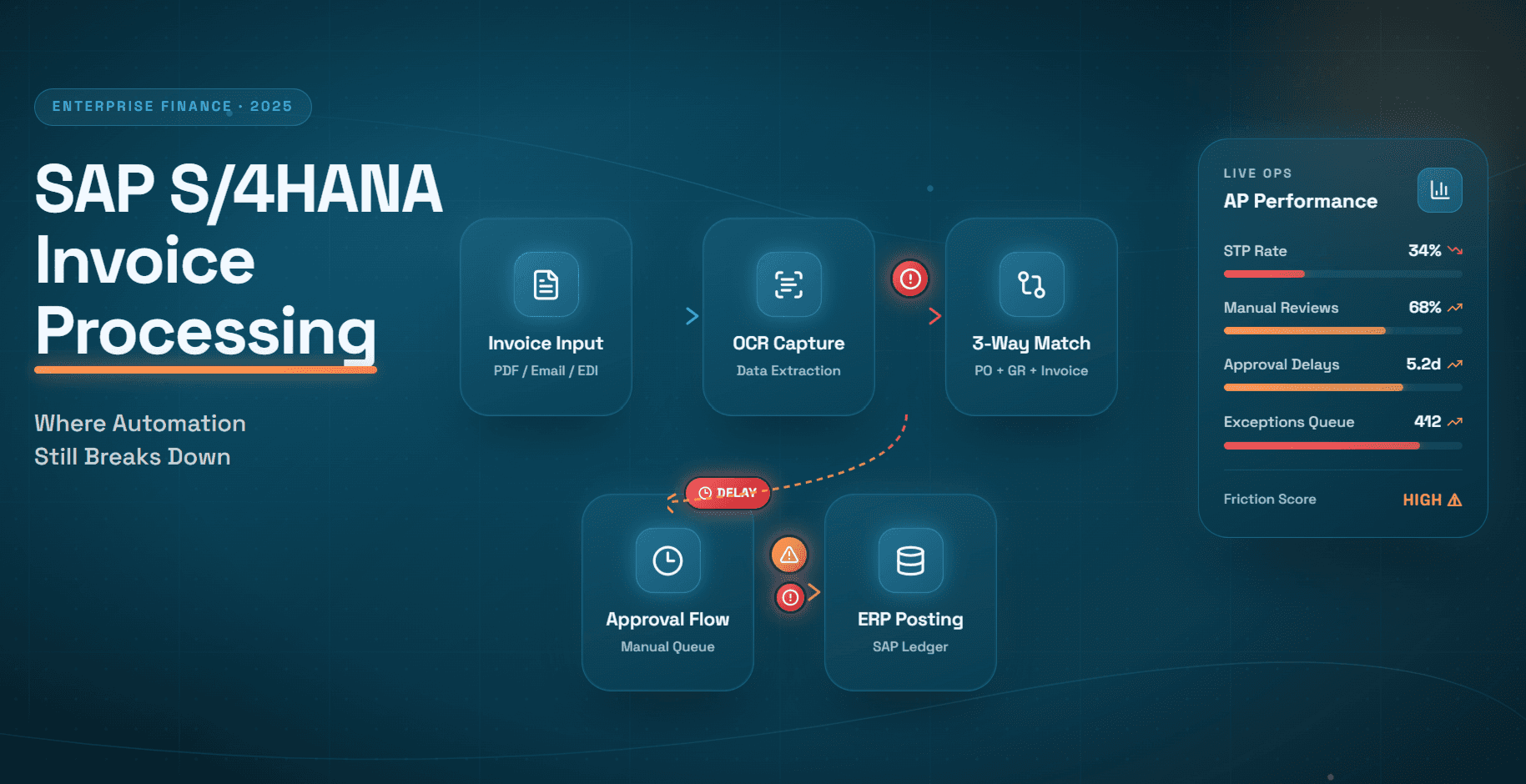
SAP S/4HANA Invoice Processing: Where Automation Still Breaks Down
Why modern ERP workflows still struggle with invoice exceptions and AP efficiency
SAP S/4HANA Is Powerful But Not Complete
SAP S/4HANA is one of the most capable ERP platforms on the market. Finance leaders choose it for its integrated architecture, real-time analytics, and deep process coverage. And yet, in invoice processing, one of the most transactional, high-volume, error-prone areas in finance, even SAP S/4HANA leaves significant gaps.
Talk to any AP manager running on SAP S/4HANA and you'll hear the same themes: invoices that queue up because matching rules don't fire correctly, exception backlogs that bloat at month-end, GL coding errors that require manual corrections, and matching workflows that crumble against non-standard invoice formats. These aren't edge cases. They represent a structural limitation of ERP-native automation and understanding them is the first step to solving them.
This article is a detailed, practitioner-level analysis of exactly where SAP S/4HANA invoice processing automation breaks down, why it breaks down, and what it costs you. We'll cover the full invoice lifecycle, the mechanics of 2-way and 3-way matching in SAP, the anatomy of invoice exceptions, and what the most forward-thinking finance teams are doing to address these failures at scale.
What SAP S/4HANA Does Well in Invoice Processing
Before identifying gaps, it's important to be fair. SAP S/4HANA has made significant strides in AP automation compared to its predecessors (SAP ECC, SAP R/3). Its native capabilities include:
Capability | SAP S/4HANA Feature |
Invoice ingestion | SAP Capture Center / OpenText VIM integration |
PO matching | Automatic 2-way and 3-way matching via MIRO |
Workflow management | SAP Business Workflow / SAP Fiori Approval Apps |
Duplicate invoice check | Standard duplicate check via FI document rules |
GL posting | Automated posting on match success |
Audit trails | Document Management System (DMS) integration |
Vendor communications | SAP Business Network (formerly Ariba Network) |
For high-volume, structured invoice flows, particularly EDI-based supplier invoices from large vendors who follow strict templates, SAP S/4HANA performs admirably. When a purchase order is correctly set up, the goods receipt is accurate, and the vendor invoice matches exactly, the system does what it promises.
The problem is that this scenario, the clean, perfectly structured, template-compliant invoice, describes only a fraction of real-world AP volume.
The Invoice Lifecycle in SAP S/4HANA: A Step-by-Step Breakdown
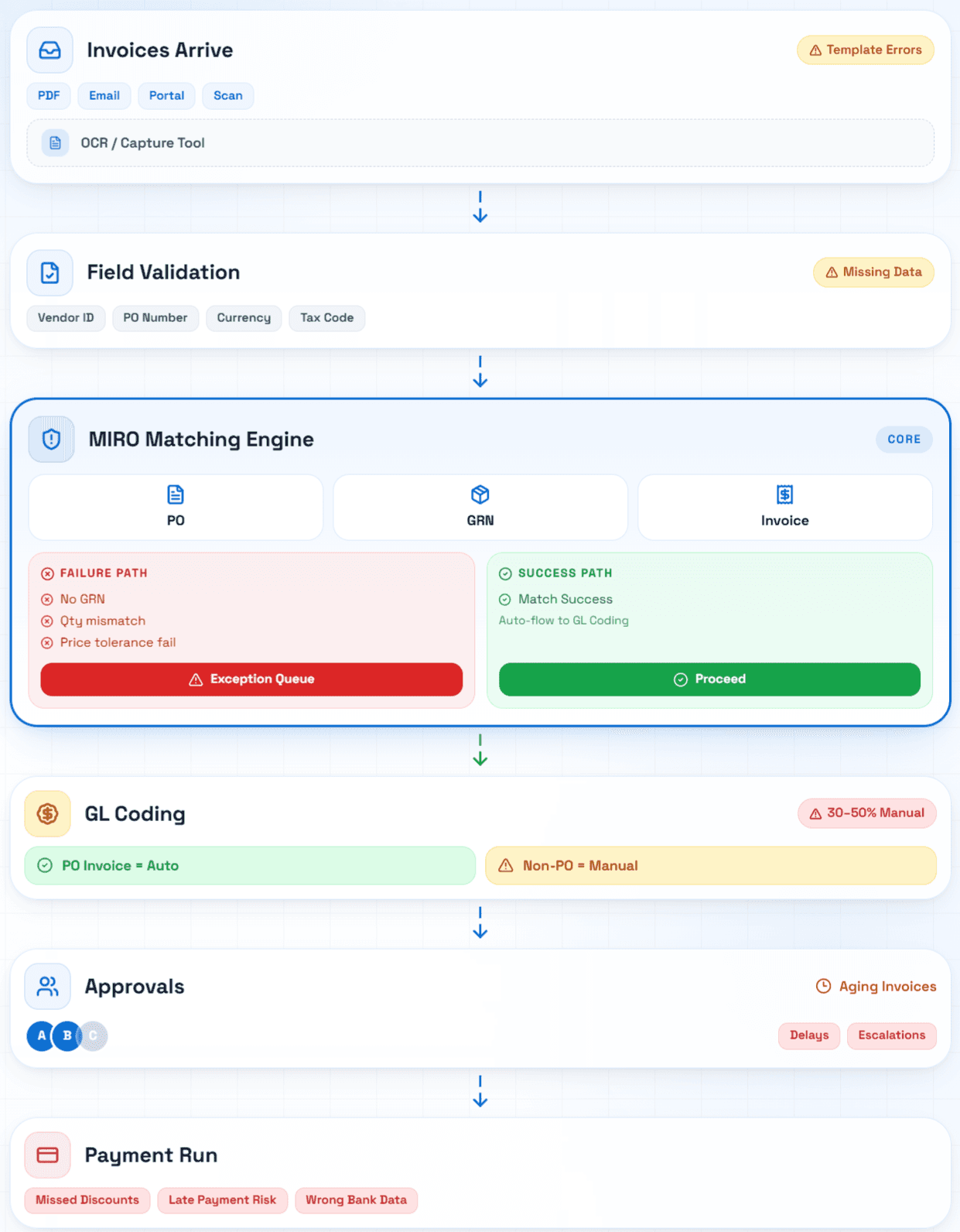
Understanding where automation breaks down requires understanding the full invoice lifecycle as it exists in SAP S/4HANA. Here is how a typical invoice flows through the system:
Stage 1: Invoice Capture and Ingestion
Invoices arrive via email, vendor portals, EDI, scanned paper, or PDFs. SAP S/4HANA relies on either OCR-based capture tools (often OpenText or ReadSoft) or direct electronic submission via SAP Business Network. The system converts physical or unstructured invoice data into structured SAP documents.
Where it breaks: OCR engines trained on structured templates fail on non-standard invoice layouts. A vendor who changes their invoice template, adds a new field, or uses a non-Latin character set can cause OCR misreads that cascade through the entire downstream process. Studies consistently show OCR-based invoice extraction achieving 85–90% field accuracy at best, meaning 10–15% of all fields require human correction before processing can continue.
Stage 2: Header and Line-Item Validation
Once ingested, the system validates mandatory fields: vendor ID, invoice date, invoice number, PO reference, currency, tax codes, and line-item details. SAP checks these against vendor master data and configuration rules.
Where it breaks: Missing PO references, incorrect vendor IDs, mismatched currency codes, and malformed tax codes are extremely common. Any validation failure routes the invoice to an exception queue often managed manually by an AP clerk.
Stage 3: 2-Way and 3-Way Matching
This is the heart of the invoice lifecycle. SAP's MIRO transaction performs:
2-way matching: Invoice vs. Purchase Order (quantity and price)
3-way matching: Invoice vs. Purchase Order vs. Goods Receipt (MIGO document)
When matching succeeds within configured tolerances, the invoice is approved for posting. When it fails, an exception is generated.
Where it breaks: Breaks due to delays in GRN retrieval and quantity/prices going beyond the tolerance threshold set up and this eventually results in an exceptionally large backlog to be handled at month-end.
Stage 4: GL Coding and Account Assignment
SAP derives GL accounts from account determination rules (configured via transaction OBYC and related tables). For PO-linked invoices, GL accounts are usually pre-determined from the PO itself. For non-PO invoices (overhead, services, subscriptions), GL coding requires manual assignment.
Where it breaks: Non-PO invoices, which in most organizations represent 30–50% of total invoice volume, require humans to manually select GL codes. Miscoding is common, creating downstream reporting errors and audit risk.
Stage 5: Approval Workflows
SAP routes approved invoices through workflow based on configured rules (amount thresholds, cost center, document type). Approvers receive tasks in SAP Fiori or via email.
Where it breaks: Workflow bottlenecks occur when approvers are unavailable, when escalation rules aren't configured correctly, or when invoices are stuck in limbo due to upstream validation failures. SLA monitoring is limited natively.
Stage 6: GL Posting and Payment Scheduling
Once approved, the system posts to the general ledger and schedules payment based on vendor payment terms.
Where it breaks: Payment term mismatches between the invoice and vendor master, incorrect bank details, and holdovers from exception queues cause late payments, missed early payment discounts, and vendor relationship friction.
Where SAP S/4HANA Automation Still Breaks Down: The Real List
Here is a consolidated view of the breakdown points, their root causes, and their operational impact:
Breakdown Point | Root Cause | Operational Impact |
OCR / extraction failures | Template dependency in optical character recognition | 10–15% manual field correction rate |
Missing PO references | Maverick buying, poor procurement discipline | High non-PO invoice volume, manual coding required |
3-way match failures | GRN timing delays, quantity/price tolerances | Large exception backlogs at month-end |
Non-PO invoice GL coding | No intelligent coding for overhead/services invoices | Miscoding, rework, audit exposure |
Workflow bottlenecks | Static routing rules, no dynamic escalation | Invoices aging past due dates |
Duplicate invoice detection | Rudimentary rule-based duplicate checks | Duplicate payments, fraud risk |
Multi-entity complexity | Separate configuration per entity required | Inconsistent processing, intercompany errors |
Tax code assignment | Manual tax determination for complex scenarios | Compliance risk, overpayment or underpayment |
Vendor onboarding gaps | No automated verification of new vendor data | Fraudulent vendor setup, data quality issues |
Accruals at period-end | No automated identification of unbilled liabilities | Under-accrual, period-end scramble |
The pattern is clear: SAP S/4HANA's automation is largely deterministic and rules-based. It works when data is perfect and processes are standardized. The moment variation enters the picture and in AP, variation is the norm, not the exception, the system routes work to humans.
2-Way and 3-Way Matching: The Persistent Pain Points in SAP
2-way and 3-way matching represents the most technically complex part of the invoice lifecycle and the most common source of exceptions in SAP S/4HANA environments.
How SAP Handles Matching Natively
SAP's MIRO transaction performs matching by comparing:
2-way match: Invoice quantity and price vs. PO line items. If within tolerance (configured as a percentage or absolute value in SAP), the system posts automatically.
3-way match: Invoice quantity and price vs. PO AND Goods Receipt Note (GRN). The GRN must exist (posted via MIGO) before the invoice can be matched and approved.
The GRN Timing Problem
The single most common 3-way matching failure in SAP S/4HANA is the GRN timing gap. Here's what happens:
Vendor delivers goods and immediately sends an invoice
AP receives the invoice and submits it to SAP
The warehouse team hasn't yet posted the GRN in MIGO
SAP cannot match the invoice (no GRN exists)
Invoice sits in exception queue until GRN is posted
This delay can be hours or days
For organizations with high invoice volumes and distributed warehouse operations, hundreds of invoices can sit in this holding pattern simultaneously. At month-end, this creates a reconciliation crisis.
Tolerance Configuration Is a Double-Edged Sword
SAP allows organizations to configure tolerance limits for matching (e.g., allow up to 5% price variance, allow up to 2 units quantity variance). Setting tolerances too tight generates excessive exceptions; setting them too loose creates financial exposure.
Most organizations end up reconfiguring tolerances multiple times as they discover the real-world variance patterns of their vendor base. This is a continuous maintenance burden and it still doesn't address the root issue: SAP matching is field-by-field rule application, not intelligent reasoning.
Service Invoice Matching Is Particularly Hard
For product invoices, matching is at least conceptually straightforward: quantities and prices. For service invoices like consulting, maintenance, time-and-materials contracts, the challenge is fundamentally different:
No physical goods receipt to confirm
Quantities may be in hours, milestones, or deliverables
Pricing may vary based on rate cards or blended rates
PO values are often estimated ranges, not exact figures
SAP's native service entry sheets (SES via transaction ML81N) provide a mechanism, but they require manual creation by the service recipient which thus adds another human dependency to the process. Matching strategies for service invoices require a fundamentally different approach than product POs.
The Multi-Currency Matching Problem
For organizations operating across multiple countries, currency conversion at the time of matching introduces another layer of complexity. SAP handles this through exchange rate types but when invoice currencies, PO currencies, and GRN currencies differ, tolerance calculations become murky and exception rates spike.
Invoice Exceptions: The Silent Killer of AP Efficiency in SAP
Invoice exceptions are invoices that cannot be processed automatically and require human intervention. In a mature SAP S/4HANA environment with well-configured tolerances and clean vendor master data, exception rates might be 20–30% of invoice volume. In less mature implementations, exception rates of 50–70% are common.
The True Cost of Invoice Exceptions
Most organizations underestimate the true cost of exception handling. The math is sobering:
Cost Component | Manual Exception Processing |
Average time per exception | 15–45 minutes |
Fully-loaded AP staff cost | $40–80/hour |
Cost per exception | $10–$60 |
Exception rate (industry average) | 25–40% of invoice volume |
Organization processing 10,000 invoices/month | 2,500–4,000 exceptions/month |
Monthly exception handling cost | $25,000–$240,000 |
Beyond direct costs, exceptions create:
Late payment penalties: Invoices stuck in exception queues age past due dates
Lost early payment discounts: Discount windows close while invoices wait for human review
Vendor relationship damage: Suppliers who aren't paid on time become less cooperative
Month-end close delays: Unresolved exceptions prevent period-end reconciliation
Audit exposure: Inconsistent exception handling creates documentation gaps
The Most Common Invoice Exception Categories in SAP
Price mismatches occur when the invoice price deviates from the PO price beyond tolerance. Common causes include vendor price increases not reflected in the PO, volume discount adjustments, and regional pricing variations.
Quantity mismatches arise when invoiced quantities don't match goods receipt quantities. Partial deliveries, return shipments, and receiving errors are frequent culprits.
Missing or incorrect PO references affect non-PO invoices and invoices where vendors reference internal PO numbers incorrectly. SAP cannot match without a valid PO reference.
Vendor master discrepancies occur when invoice details (name, address, bank account) don't match the vendor master record. These are particularly dangerous from a fraud perspective.
Tax code errors arise when vendors apply incorrect tax codes or when SAP's automatic tax determination doesn't align with the actual transaction.
Duplicate invoice flags are generated when SAP's duplicate detection fires, sometimes correctly, sometimes as false positives when vendors legitimately reissue invoices with corrections.
The Exception Backlog Compounding Effect
Here's what makes invoice exceptions particularly damaging: they compound. An invoice that enters the exception queue on Day 1 due to a GRN timing issue may still be unresolved on Day 7 when the GRN is finally posted but by then, the payment due date may have passed. Now it's both a matching exception and a late payment. Two problems where there was originally one.
Finance teams running SAP S/4HANA without intelligent exception management are effectively running a manual-labor-intensive process on top of an expensive ERP platform. The ERP handles the easy invoices; humans handle everything else. And in most organizations, "everything else" is enormous.
Why These Gaps Are Getting Costlier Over Time
The cost of these SAP invoice processing gaps is not static, it's increasing. Several macro trends are amplifying the problem:
Invoice volume growth: As supply chains become more complex and organizations add vendors, invoice volumes grow but AP team headcount does not grow proportionally.
Vendor diversity: Global procurement means more vendors with more varied invoice formats, currencies, and tax treatment requirements.
Regulatory complexity: Sales and use tax rules, VAT requirements, and e-invoicing mandates are expanding globally, increasing the compliance burden on every invoice.
Talent shortage: Experienced AP professionals are increasingly difficult to hire and retain. Exception-heavy workflows are exactly the kind of repetitive, frustrating work that drives turnover.
Audit pressure: Regulatory scrutiny of financial processes is intensifying. Exception-handling inconsistencies create audit vulnerabilities.
The organizations that are winning in this environment are those that have moved beyond ERP-native automation and deployed intelligent AI layers that can reason about exceptions, not just route them.
How Hyperbots AI Co-Pilots Solve What SAP S/4HANA Cannot
Hyperbots has built a suite of AI co-pilots specifically designed to address the gaps that ERP-native automation, including SAP S/4HANA, cannot bridge. The approach is not to replace SAP, but to sit on top of it as an intelligent layer that handles the complexity, variation, and reasoning that rules-based systems cannot.
Invoice Processing Co-Pilot: Eliminating the Exception Backlog
The Hyperbots Invoice Processing Co-Pilot automates the complete invoice lifecycle from discovery through GL posting. Key capabilities that directly address SAP's gaps:
AI-native extraction (not OCR): Rather than template-dependent OCR, Hyperbots uses vision-language models and large language models pre-trained on over 35 million invoice fields, achieving 99.8% extraction accuracy regardless of invoice format, layout, or language. This eliminates the OCR failure point entirely.
Intelligent 2-way and 3-way matching: Hyperbots' matching engine compares up to 140 fields across invoices, POs, and GRNs, far beyond SAP's standard matching fields. More importantly, when a mismatch occurs, the AI reasons about whether it's a genuine discrepancy or an expected variation (e.g., standard vendor rounding practice, known price adjustment pattern), dramatically reducing false-positive exceptions.
Self-correcting GL coding: For non-PO invoices, the category where SAP leaves finance teams to manually assign GL codes, Hyperbots' AI recommender learns from historical coding patterns and human corrections, delivering accurate GL code suggestions that improve over time.
80% straight-through processing: By combining accurate extraction, intelligent matching, and AI-driven GL coding, Hyperbots achieves 80% STP, meaning 4 in 5 invoices are processed completely without human touch, from email to GL entry.
Processing time: under 1 minute per invoice, compared to an industry average of 11 days in manual-heavy environments.
Procurement Co-Pilot: Closing the PO Gap
Many SAP invoice exceptions start upstream in procurement. Maverick buying, late PO creation, and incorrect PO data generate invoice exceptions downstream. The Hyperbots Procurement Co-Pilot automates the full PR-to-PO lifecycle, ensuring that purchase orders are created accurately, approved quickly, and dispatched to vendors before invoices arrive. This closes the root cause of many matching exceptions before they occur.
The co-pilot reduces the traditional 3-day procurement cycle to just 4 hours, with automated budget validation, policy compliance checks, and vendor master alignment built in.
Vendor Management Co-Pilot: Eliminating Vendor Master Exceptions
Vendor master data quality is a primary driver of SAP invoice exceptions. The Hyperbots Vendor Management Co-Pilot automates vendor onboarding with AI-driven identity verification, data validation, and automated document collection. Clean vendor master data means fewer downstream matching and validation failures. The co-pilot also manages ongoing vendor communication, PO acknowledgment, and remittance advice, reducing the friction that leads to invoice disputes.
Sales Tax Verification Co-Pilot: Eliminating Tax Code Exceptions
Tax code errors are among the most dangerous invoice exceptions, they create compliance risk, not just processing delays. The Hyperbots Sales Tax Verification Co-Pilot validates tax at the line-item level using origin and destination addresses, tax category dictionaries, and economic nexus threshold monitoring. In one documented case, a CFO using this co-pilot identified and eliminated $200,000 in annual tax leakage that had been invisible in the standard SAP workflow.
Payments Co-Pilot: Turning Exception Resolution Into Financial Opportunity
The Hyperbots Payments Co-Pilot doesn't just process payments, it optimizes them. When invoices are resolved faster (thanks to AI-driven exception handling), payment timing becomes a strategic lever. The co-pilot identifies early payment discount opportunities, recommends optimal payment timing based on cash position and vendor relationship priority, and automates approval workflows. The procure-to-pay transformation enabled by this co-pilot converts what was a cost center into a source of working capital optimization.
Accruals Co-Pilot: Solving the Month-End Crisis
One of the most painful consequences of high invoice exception rates in SAP is the month-end accruals crisis. When invoices are stuck in exception queues at period-end, finance teams must manually estimate accruals for unbilled liabilities, a time-consuming, error-prone process. The Hyperbots Accruals Co-Pilot automates accrual discovery for goods received but not invoiced (GRNI), services received but not billed, and recurring expenses. It books and reverses accrual journal entries automatically, with configurable cut-off dates and full audit trails.
Hyperbots Platform Capabilities: Transformational Impact
Hyperbots' advantage isn't just in individual co-pilots, it's in the underlying platform architecture that powers all of them.
Pre-Trained on Finance Data
Unlike generic AI platforms, Hyperbots' models are pre-trained on millions of real financial documents such as invoices, POs, GRNs, and vendor records. This means finance teams go live in days, not months, with high accuracy from day one, without lengthy training periods.
Multi-Agent Collaboration Architecture
Hyperbots uses a multi-agent AI architecture where specialized agents handle specific tasks, extraction, validation, matching, coding, posting and collaboration intelligently. This mirrors how a high-performing human AP team works, with specialists handling different aspects of complex invoices.
Policy-Driven AI
Every organization has unique approval policies, coding rules, and matching tolerances. Hyperbots' policy-driven AI embeds these company-specific rules directly into the automation so the AI doesn't just process invoices generically, it processes them according to your specific controls framework.
Explainable AI and Audit Trails
Every decision made by Hyperbots' AI is logged with a full explanation like which fields matched, which rules applied, why an exception was flagged. This explainable AI approach is critical for audit readiness and for building finance team confidence in AI-driven decisions.
Unlimited-User Licensing
Unlike traditional enterprise software priced per user, Hyperbots offers an unlimited-user licensing model. Every member of the finance team, from AP clerks to CFO, can access the platform without incremental license costs.
Deep ERP Connectivity
Hyperbots integrates natively with SAP Business One, SAP S/4HANA, Oracle NetSuite, Microsoft Dynamics, QuickBooks, Sage, Deltek Costpoint, and more. The data model designer enables out-of-the-box ERP mapping, dramatically reducing implementation timelines.
Industry-Specific Configurations
Hyperbots serves finance teams across industries with configurations tailored to sector-specific requirements. For manufacturing companies, this means handling high-volume PO-matched invoices with complex multi-site GRN scenarios. View the full industry overview to see how Hyperbots is deployed across sectors including retail, professional services, healthcare, and more.
Hyperbots-Led ROI Improvements in P2P: The Numbers
Metric | With Hyperbots |
Invoice processing STP rate | 80% |
Invoice extraction accuracy | 99.8% |
Invoice processing time | < 1 minute |
Operations cost reduction | Up to 80% |
Procurement cycle time | 4 hours |
Manual review reduction | 80% reduction |
Variance between accrued and actual costs | < 5% |
Tax leakage identification | $200K+ recovered (documented case) |
Tangible ROI drivers:
Elimination of AP headcount growth despite invoice volume increases
Capture of early payment discounts previously missed due to slow processing
Avoidance of late payment penalties
Recovery of overpaid or incorrectly taxed invoices
Intangible ROI drivers:
Audit-ready documentation for every invoice decision
Reduced AP team burnout and turnover
Faster month-end close
Stronger vendor relationships through timely, accurate payment
Finance leadership freed from operational firefighting to focus on strategic work
Real-world results: Extreme Reach (XR) achieved 80% straight-through processing and 99.8% accuracy with zero manual touch-ups, a documented Hyperbots customer success story.
To model your own potential savings, explore the Hyperbots Invoice Processing ROI Calculator or the full suite of ROI calculators.
Summary: What SAP Gives You vs. What You Actually Need
Capability | SAP S/4HANA Native | Hyperbots AI Layer |
Invoice extraction accuracy | ~85–90% (OCR-dependent) | 99.8% (AI-native) |
Straight-through processing | 20–40% typical | 80% |
Non-PO GL coding | Manual | AI-automated |
Service invoice matching | Requires manual SES | Intelligent reasoning-based |
Exception root cause analysis | Routing only | AI explains root cause |
Accruals at period-end | Manual | Fully automated |
Vendor onboarding quality | Configured by IT | AI-verified, continuous |
Tax code verification | Rule-based | Line-item AI validation |
Time to process one invoice | Days (with exceptions) | Under 1 minute |
The conclusion is not that SAP S/4HANA is a poor choice, it remains one of the most robust ERP platforms available. The conclusion is that ERP-native automation, by design, handles the structured and predictable. The unstructured, variable, and exception-heavy reality of real-world AP requires an intelligent AI layer on top.
SAP S/4 HANA Invoice Processing isn’t Enough for Today’s Organizations
SAP S/4HANA is a powerful ERP platform but it was built to manage structured data and standardized processes, not to reason intelligently about the messy, variable reality of high-volume invoice processing. The invoice lifecycle contains too many variations, the matching process too many edge cases, and invoice exceptions too many root causes for rules-based automation alone to handle effectively.
The organizations closing this gap are those deploying AI co-pilots that can extract intelligently, match with reasoning, code accurately, and handle exceptions autonomously, turning an 11-day invoice cycle into a sub-minute automated flow.
If you're running SAP S/4HANA and your AP team is still spending significant time on exceptions, matching issues, or month-end accrual scrambles, the gap isn't in your ERP configuration. It's in the AI layer you haven't yet added.
Ready to see what 80% straight-through processing looks like for your organization? Request a demo or start a free trial to see Hyperbots in action on your own invoice data.
Frequently Asked Questions
Q1: Does SAP S/4HANA have built-in AI for invoice processing?
SAP S/4HANA includes some machine learning capabilities (e.g., for GL account suggestion via SAP Cash Application), but its core invoice processing automation remains largely rules-based. SAP's AI features are embedded in specific modules and don't address the full invoice lifecycle comprehensively. Dedicated AI co-pilots like Hyperbots provide significantly deeper automation across the end-to-end flow.
Q2: What is the difference between 2-way and 3-way matching in SAP?
2-way matching in SAP (via MIRO) compares invoice quantities and prices against the purchase order. 3-way matching adds the goods receipt note (GRN/MIGO document) as a third verification point, confirming that goods were actually received before the invoice is approved. 3-way matching provides stronger financial control but introduces the GRN timing gap as a common failure point.
Q3: Why do invoice exceptions accumulate at month-end in SAP environments?
Month-end is when the timing mismatch between delivery, GRN posting, and invoice arrival is most acute. Warehouse and procurement teams focused on period-end activities may delay GRN postings; AP teams processing high volumes route exceptions to queues rather than resolve them immediately. The result is an exception backlog that delays close and requires emergency manual reconciliation.
Q4: Can an AI layer like Hyperbots work with existing SAP configurations without replacing them?
Yes. Hyperbots is designed to complement, not replace, SAP S/4HANA. It integrates via pre-built ERP connectors, reads and writes data to SAP, and handles the intelligent processing layer that SAP's rules-based automation cannot. Your SAP configuration, vendor master, and GL structure remain intact.
Q5: What percentage of invoices typically require human intervention in a standard SAP environment?
In well-configured SAP S/4HANA environments, 20–30% of invoices typically require some human intervention. In organizations with diverse vendor bases, high service invoice volumes, or less mature implementations, exception rates of 40–60% are common. Hyperbots reduces this to approximately 20% by handling 80% of invoices through straight-through processing.
Q6: How long does it take to deploy Hyperbots on top of SAP S/4HANA?
Hyperbots is pre-trained on financial documents and uses pre-built ERP connectors, enabling rapid deployment. Finance teams typically go live within days to weeks, not months, a stark contrast to lengthy ERP implementation projects.
Q7: Does Hyperbots help with detecting fraud and anomalies in invoice processing?
Yes. Hyperbots' AI continuously monitors for anomaly patterns including duplicate invoices, unusual vendor payment instructions, abnormal pricing, and statistical outliers, providing a fraud prevention layer that goes beyond SAP's standard duplicate document checks.