Life After SAP S/4HANA Go-Live: What Finance Teams Don't Expect
Why the real finance transformation begins after implementation goes live
The Real Surprise Begins at Go-Live
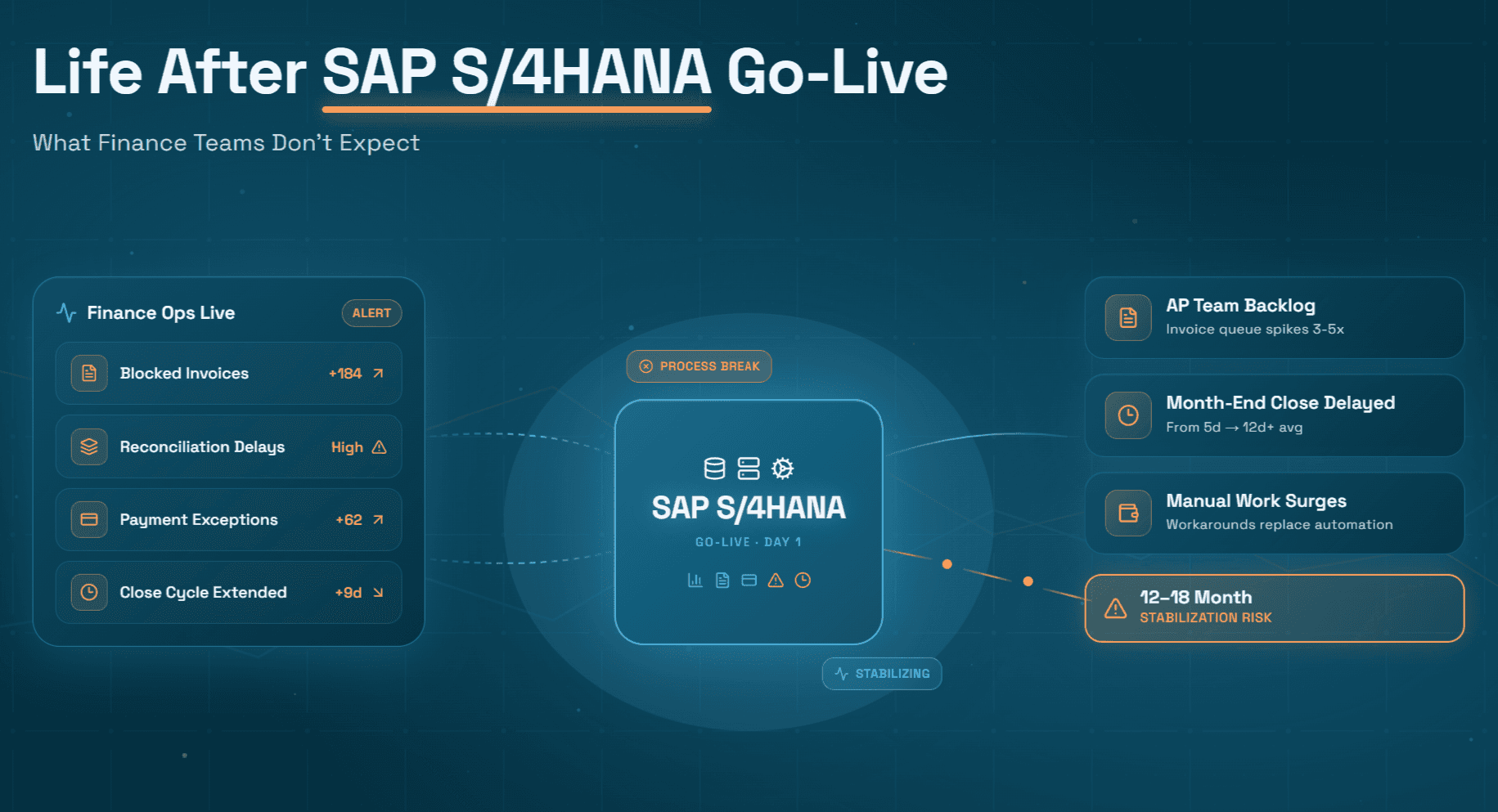
Most SAP S/4HANA implementations are sold on a promise: unified data, real-time reporting, automated workflows, and a leaner finance team. After months or years of discovery, configuration, and testing, go-live day arrives and it delivers exactly that promise, for about three weeks. Then reality sets in. The data migration has gaps nobody spotted in UAT. Your GL coding logic doesn't map cleanly to the new chart of accounts. Vendors are sending invoices in 14 different formats, and the FIORI interface that looked clean in training is grinding experienced AP clerks to a halt on real-world volume. Finance issues that were theoretically "handled" during implementation start surfacing in week four, five, and six, right when hypercare support is winding down.
This guide is an honest, detailed account of what finance teams actually encounter during post go-live stabilization on SAP S/4HANA, why these finance issues persist for months, and what modern teams are doing to resolve them faster.
Post go-live stabilization is not a cleanup exercise, it's a second implementation. Teams that treat it as a short mop-up phase consistently struggle for 6–12 months longer than those who plan for it deliberately.
Post Go-Live Stabilization: The Three Phases
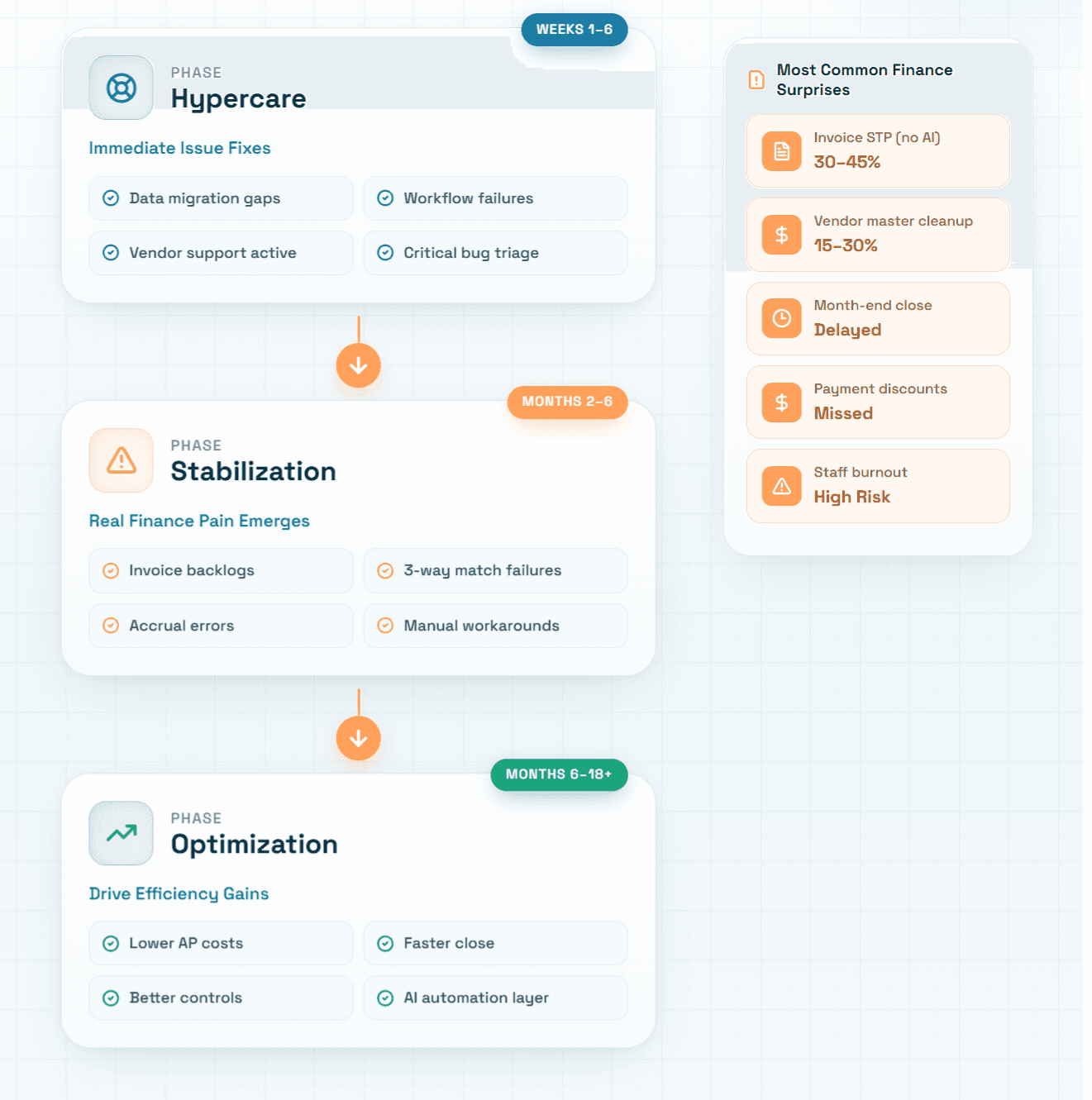
Understanding the rhythm of post go-live stabilization helps finance leaders set realistic expectations with their teams and boards.
Phase | Typical Timeline | What's Happening | Key Finance Issues |
Hypercare | Weeks 1–6 | Vendor support on-site or on-call; major blockers resolved reactively | Data migration errors, master data gaps, basic workflow failures |
Stabilization | Months 2–6 | Team works independently; workarounds become habits; real-volume stress testing | Invoice processing backlogs, PO matching failures, accrual calculation errors |
Optimization | Months 6–18+ | Finance leadership pushes for efficiency gains promised at project outset | Persistent manual effort, missed early payment discounts, month-end close delays |
The gap between Phase 1 and Phase 3 is where most of the organizational pain lives. And it's almost entirely concentrated in finance and accounting operations.
The Finance Issues Nobody Warns You About
SAP S/4HANA is genuinely powerful. But power is not the same as ease. Below are the most common, most damaging finance issues that teams encounter after go-live, grouped by process area.
1. Master data is messier than anyone admitted
Vendor master records migrated from the legacy system carry every inconsistency, duplicate, and outdated entry from the past decade. Payment terms conflict between vendor master and live invoices. Bank details don't match remittance files. Tax IDs are missing or misformatted. These aren't edge cases, in most migrations, 15–30% of vendor records need manual remediation within the first 90 days.
2. The chart of accounts doesn't match operational reality
S/4HANA's Universal Journal is designed around a single, unified chart of accounts and GL coding framework. The problem is that legacy systems often had department-specific coding that was "cleaned up" during migration in ways that don't reflect how costs actually flow. Finance teams spend months correcting misposted entries and reconfiguring GL code structures.
3. Approval workflows break at volume
Workflows tested in UAT with 50 invoices behave very differently when processing 5,000 a month. Escalation rules trigger incorrectly. Approvers receive duplicate notifications. SLA timers don't account for holidays or vacation coverage. The PO approval workflow becomes a source of constant manual intervention.
4. Reporting outputs are misaligned with business expectations
Finance leaders were promised real-time visibility. What they got was real-time access to a system that still needs significant manual input to produce accurate outputs. Month-end close doesn't shorten automatically, it just moves the bottleneck from data entry to data validation.
5. User adoption is lower than anyone projected
SAP S/4HANA's interface is more intuitive than its predecessors, but it still requires significant change management. Experienced finance staff default to familiar workarounds, spreadsheets, email chains, manual checks, rather than using the system as intended. This is the single biggest cause of data quality degradation in the first year.
Invoice Processing: Still a Manual Nightmare
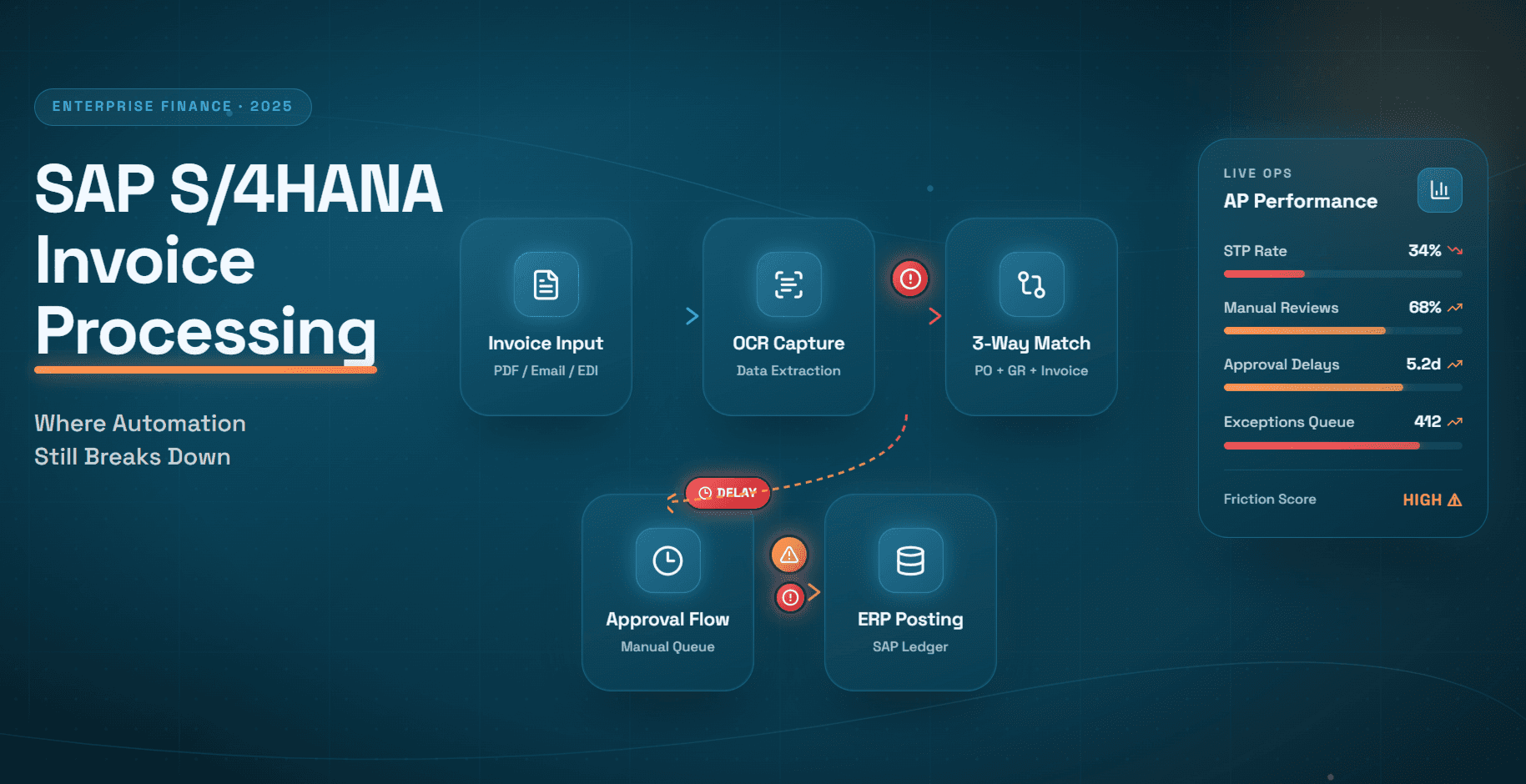
Invoice processing is where post go-live stabilization finance issues become most visible and most costly. SAP S/4HANA provides a capable transaction processing engine, but it does not solve the upstream problem: unstructured invoice data arriving in dozens of formats from hundreds of vendors.
Invoice Challenge | Why It Persists After S/4HANA Go-Live | Typical Impact |
Format variability | SAP captures structured data; it cannot extract and standardize unstructured PDF/email invoices | High manual keying, 3–5% error rate |
3-way match failures | PO data migrated with tolerances not reconfigured for new vendor mix | 20–40% of invoices require manual resolution |
Duplicate invoice risk | Legacy data migration brings duplicate vendor records; no automated de-dupe layer | Estimated 0.1–0.5% overpayment exposure |
GL coding accuracy | S/4HANA relies on rules configured during implementation; exceptions fall to manual coding | Reconciliation delays, audit findings |
Straight-through processing | STP requires all upstream data to be clean; most post-go-live environments are not | STP rates often below 40% in year one |
The future-ready AP function doesn't wait for SAP to solve these problems natively, it adds an intelligence layer on top. This is why teams working on overcoming straight-through processing challenges increasingly turn to AI-native automation rather than extended SAP configuration.
Industry data consistently shows that organizations operating on S/4HANA without an AI extraction and matching layer achieve straight-through processing rates of 30–45%. With AI co-pilots, that number climbs to 80%+.
The 3-way match problem is underestimated
Many implementations configure 3-way matching in SAP during the project, then find that real-world invoices consistently fail on tolerances, unit-of-measure conversions, or partial delivery confirmations. Every failed match creates a manual exception that delays payment, frustrates vendors, and consumes AP team time that should be spent on higher-value work.
Procurement & PO Workflows Under Strain
SAP S/4HANA's procurement module is sophisticated. But sophistication without intelligence creates its own bottlenecks. The PO creation process post go-live is often slower than it was before implementation because users are now required to follow formal workflows they previously bypassed.
PR-to-PO cycle times that were supposed to drop to hours remain at 2–3 days because approval chains weren't properly configured for the real organizational structure
Budget validation failures trigger for legitimate purchases because cost center hierarchies weren't fully mapped during migration
Vendor data gaps prevent automatic PO dispatch, requiring manual vendor communication for each order
Maverick spending persists as business units route around the slow procurement process
The distinction between purchase requisition and purchase order processes becomes a friction point when handoff rules aren't clear to every user in the system. And without intelligent automation, the approval workflow becomes a queue rather than a process.
A common post go-live finding: the procurement process that took 3 days in the legacy system now takes 4–5 days in S/4HANA, because the new system requires complete data that the old system accepted as incomplete. The system is more rigorous but that rigor needs intelligent support to not become a bottleneck.
The hidden cost of PO lifecycle gaps
Open PO management is one of the most overlooked post go-live finance issues. Commitments that should be closed remain open on the balance sheet, distorting budget availability reports. Goods receipts posted against wrong PO lines create matching exceptions that cascade through the AP process. And without automated PO tracking, finance teams have no visibility into where a transaction is stuck until a vendor escalates.
Accruals, GL Coding & Month-End Chaos
Month-end close is where the cumulative effect of all other post go-live finance issues becomes visible to the CFO. Accruals that were manual in the legacy system remain manual in S/4HANA because the system doesn't know what to accrue unless it's been told. And it usually hasn't been told comprehensively.
Accrual Challenge | Frequency | Impact on Close |
Services received but not invoiced (SRNI) | Every period | Understated liabilities; period restatements |
Recurring expense accruals without a PO | Every period | Manual journal entry burden; error risk |
Reversal timing mismatches | Frequently in first year | Duplicate expense recognition; audit queries |
GL coding errors on accrual postings | Common in post-migration environment | P&L misstatement; reclassification entries |
Cut-off date disputes | Every quarter-end | Delayed close; senior management escalations |
Best practices for GL posting and maintaining a well-governed chart of accounts are well documented but applying them consistently in a post-migration environment requires disciplined automation. The impact of GL coding accuracy on financial reporting and audits is direct and significant: misposted entries don't just create accounting work, they create audit risk.
Vendor Management & Tax Compliance Gaps
SAP S/4HANA centralizes vendor master data, but it does not actively manage the vendor relationship. After go-live, organizations discover that vendor onboarding for new suppliers is still heavily manual, vendor banking changes create payment risk, and tax compliance on invoices, particularly sales and use tax, is inconsistently enforced.
Vendor onboarding friction
The vendor onboarding challenges that existed before S/4HANA don't disappear with go-live. New vendor setup still requires document collection, identity verification, and master data entry. Without automation, a new vendor can take 5–10 business days to activate, delaying first purchases and frustrating procurement teams.
Sales and use tax exposure
S/4HANA's tax engine is powerful but requires comprehensive configuration and ongoing maintenance. In practice, post go-live organizations frequently find:
Tax codes misconfigured for new GL account mappings
Use tax self-assessment not triggered for out-of-state purchases
Vendor invoices with incorrect tax amounts processed without validation
Multi-jurisdiction transactions applied at the wrong rate
The cost of incorrect sales tax isn't just financial, it's a compliance and audit exposure that compounds over time. Many finance teams discover this problem during their first post-implementation audit rather than during day-to-day operations.
Payments: Speed vs. Control
SAP S/4HANA's payment run capability is robust. But the intelligence layer, deciding when to pay, which discounts to capture, how to optimize cash timing, and how to prevent fraud, is not native to the platform. This is a major post go-live gap.
Payment Optimization Opportunity | SAP S/4HANA Native Capability | Gap |
Early payment discount capture | Partial; terms stored, discount not actively recommended | Requires manual monitoring of discount windows |
Dynamic payment timing | Limited; rule-based payment runs on schedule | No AI-driven cash flow optimization |
Fraud detection on payment instructions | Limited; no behavioral anomaly detection | Bank detail changes not automatically flagged |
Partial payment management | Available but complex to configure | Exception handling still manual |
Remittance automation | Partial; standard remittance output available | Vendor-specific formats require custom development |
The strategic opportunity around capturing missed early payment discounts and optimizing payment decisions based on vendor relationships is substantial but it requires intelligence beyond what SAP provides out of the box. Organizations that don't add this layer are leaving measurable cash on the table every month.
How AI Co-Pilots Close the SAP Gap - Hyperbots on S/4HANA
The Hyperbots Platform: Built for Post Go-Live Reality
Hyperbots delivers a suite of pre-trained, finance-specific AI co-pilots that sit on top of SAP S/4HANA, adding the intelligence layer the ERP platform was never designed to provide natively. The result: the operational efficiency SAP promised at go-live, actually delivered.
Hyperbots' AI co-pilots are not an ERP replacement or a bolt-on OCR tool. They are a coordinated, multi-agent AI layer purpose-built for finance and accounting workflows. Each co-pilot addresses a specific process area, but they work collaboratively across the full P2P and O2C cycle, sharing data, learning from exceptions, and improving accuracy over time.
Procure-to-Pay (P2P) Co-Pilots
Invoice Processing Co-Pilot
Extracts, validates, matches, and GL-codes invoices with 99.8% accuracy. Achieves 80%+ straight-through processing, no templates, no manual keying. Every invoice is captured from email, portal, or ERP and processed end-to-end.
Procurement Co-Pilot
Compresses the PR-to-PO cycle from 3 days to under 4 hours. Auto-fills requisition fields, validates against budget and policy, routes for approval, and dispatches POs, removing manual handoffs entirely.
Vendor Management Co-Pilot
Automates vendor onboarding, identity verification, and communication. Detects anomalies in payment instructions and flags banking changes, significantly reducing fraud exposure during post go-live stabilization.
Sales Tax Verification Co-Pilot
Validates sales and use tax on every invoice line item, automatically checking rates, jurisdictions, and exemptions. One team eliminated $200,000 in annual tax leakage within months of deployment.
Payments Co-Pilot
Intelligently recommends payment timing to capture early payment discounts, optimize cash flow, and prevent fraud. Supports ACH, check, virtual card, and wire with automated remittance and full audit trails.
Accruals Co-Pilot
Automatically discovers unbilled liabilities, GRNI, SRNI, recurring expenses, and books and reverses accrual journal entries. Month-end accrual cycles that took days now take hours, with full auditability.
Order-to-Cash (O2C) Co-Pilots
Collections Co-Pilot
Automates AR collections outreach, identifying overdue accounts, personalizing communication, and escalating based on aging and customer behavior. Reduces DSO without increasing headcount.
Cash Application Co-Pilot
Matches incoming payments to open invoices automatically, handling partial payments, remittance variations, and unstructured payment references. Dramatically reduces unapplied cash and reconciliation effort.
Platform-Level Capabilities
Beyond individual co-pilots, the Hyperbots platform delivers capabilities that transform how finance teams operate on SAP S/4HANA:
Pre-trained, ready-to-deploy models, go live in days, not months, with AI that already understands finance workflows
Self-learning AI, accuracy improves over time as the system learns from exceptions and corrections
Unlimited-user licensing, one license, unlimited users, eliminating per-seat cost barriers to enterprise-wide deployment
Human-in-the-loop oversight, exceptions routed intelligently to the right person, with full context
Complete audit trails, every AI decision logged and explainable for compliance and audit readiness
Multi-entity support, handles complex organizational structures with separate ledgers, tax rules, and approval policies
24/7 availability, continuous processing without the overtime costs of manual operations
Policy-driven AI, automation rules configured to reflect your specific company policies, not generic defaults
Hyperbots serves organizations across industries including manufacturing, professional services, retail, and more. The platform's rapid ERP integration means that even mid-implementation or post go-live deployments can be live within weeks.
ROI of AI-Driven Automation on S/4HANA
Tangible ROI outcomes
Function Area | Outcome |
|---|---|
Invoice extraction accuracy | 99.8% |
Straight-through processing (STP) | 80%+ |
AP operating cost reduction | Up to 80% |
PR-to-PO cycle time | From 3 days to <4 hours |
Procurement speed improvement | ~15x faster |
Vendor onboarding turnaround | Days to hours |
Month-end accrual cycle | 3–5 days to same day |
DSO reduction | 40% Reduced without extra headcount |
Cost to Collect | 70% reduction |
Reconciliation Cost | 80% reduction |
Unapplied cash | Reduced to less than 10$ |
Time to go live | 3-4 weeks |
Processing availability | 24/7 continuous automation |
Intangible ROI outcomes
Finance team freed from transaction processing to focus on analysis and business partnering
Audit readiness improved through complete, explainable AI decision logs
Vendor relationships strengthened through consistent, on-time, accurate payments
CFO confidence in financial data quality, reports reflect reality, not backlogs
Reduced staff burnout and turnover in AP and procurement teams
Faster onboarding of new vendors, supporting business growth without headcount
The ROI framework for AI-led automation in finance shows consistent returns, with most organizations recovering implementation costs within the first 6-9 months of deployment. For teams in post go-live stabilization, this acceleration directly offsets the cost overruns that S/4HANA implementations commonly generate.
Finance leaders in manufacturing, professional services, and retail who want to model their specific ROI opportunity can explore Hyperbots' suite of ROI calculators.
Conclusion: Go-Live Is the Starting Line, Not the Finish Line
SAP S/4HANA can be a powerful foundation for finance transformation, but go-live rarely delivers the full operational benefits on its own. The months that follow are where organizations truly discover whether their processes are scalable, their data is reliable, and their teams are equipped to handle real-world complexity.
For many finance leaders, the biggest surprise is that the ERP is only one part of the solution. To achieve faster invoice processing, cleaner accruals, stronger controls, better payment decisions, and lower operating costs, organizations need an intelligence layer that works on top of SAP, not more manual effort or endless reconfiguration.
That is where Hyperbots helps. By deploying finance-specific AI co-pilots across AP, procurement, vendor management, tax, payments, accruals, collections, and cash application, Hyperbots enables finance teams to realize the efficiency gains they expected from S/4HANA much faster.
If your organization is navigating post go-live stabilization or wants to unlock more value from SAP S/4HANA, now is the right time to request a personalized demo or Start your free trial.
FAQs: Post Go-Live Stabilization & Finance Issues on SAP S/4HANA
Q1. How long does post go-live stabilization typically take on SAP S/4HANA?
Most organizations experience meaningful stabilization within 6–9 months for core transaction processing. Full optimization, where the system is delivering the efficiency gains promised at project outset, typically takes 12–18 months without additional automation tooling. Adding AI co-pilots can compress this timeline significantly.
Q2. Why do invoice processing finance issues persist after S/4HANA go-live?
SAP S/4HANA is a transaction processing system, not an intelligent extraction system. It processes structured data entered by users or received in EDI format. It does not extract data from unstructured PDF invoices or apply AI-driven GL coding. Adding an AI extraction and matching layer is required to achieve high STP rates.
Q3. What are the most common causes of 3-way match failures post go-live?
The most frequent causes are: tolerance thresholds not configured for the actual vendor mix, goods receipts posted against wrong PO lines, unit-of-measure conversion mismatches, and partial deliveries not properly reflected in the PO. Intelligent matching tools can resolve most of these automatically.
Q4. Can AI co-pilots be deployed on top of an existing SAP S/4HANA instance?
Yes. Hyperbots integrates with SAP S/4HANA through pre-built connectors and can be deployed in weeks, not months. The co-pilots sit on top of the ERP, adding intelligence without requiring changes to SAP configuration.
Q5. How does AI help with accruals during post go-live stabilization?
AI co-pilots for accruals automatically scan open POs, goods receipts, and service records to identify unbilled liabilities. They calculate accrual amounts, book journal entries, and configure reversals, eliminating the manual discovery and posting work that consumes finance teams at period end.
Q6. What is the typical ROI timeline for adding AI automation to a post go-live SAP environment?
Most organizations see measurable ROI within 3–6 months of deployment, with full cost recovery typically achieved within 6–9 months. The largest contributors are reduced manual processing costs, early payment discount capture, and elimination of duplicate payments and tax errors.
Q7. Does Hyperbots replace SAP S/4HANA?
No. Hyperbots complements SAP S/4HANA by adding the AI intelligence layer that ERPs are not designed to provide natively. SAP remains the system of record; Hyperbots provides the automation, extraction, matching, and decision intelligence that transforms SAP from a capable system into a high-performance finance operation.