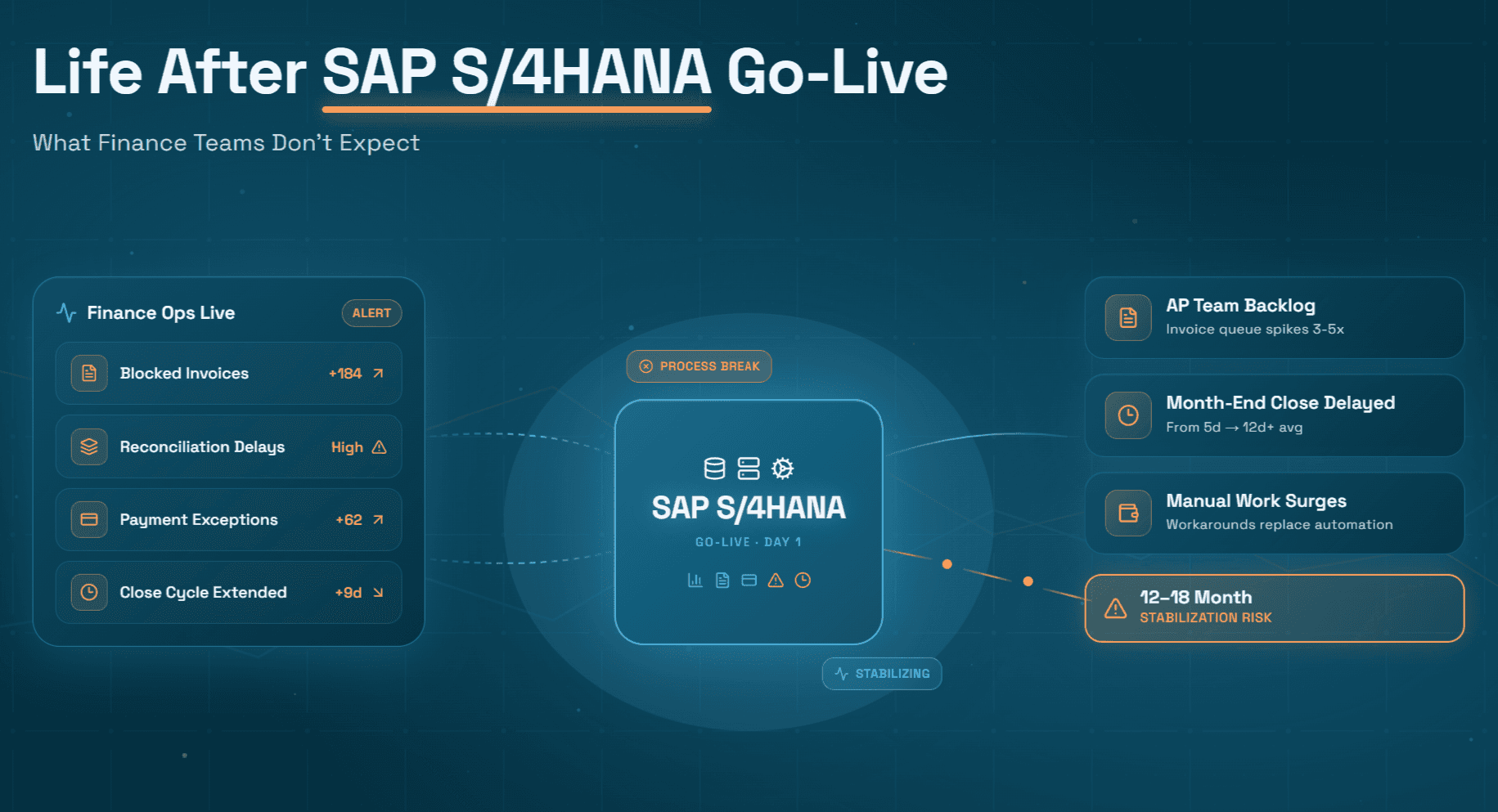
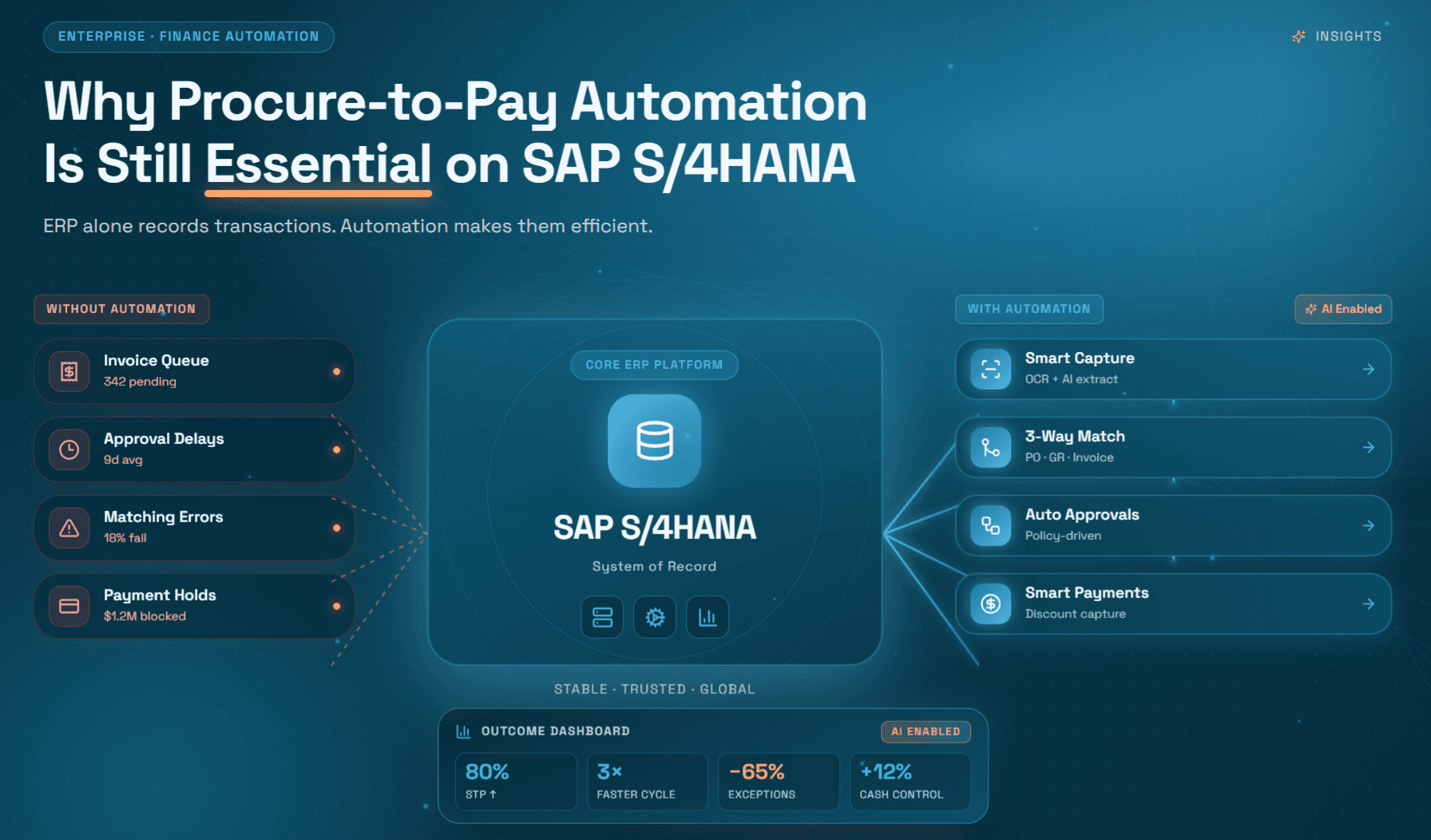
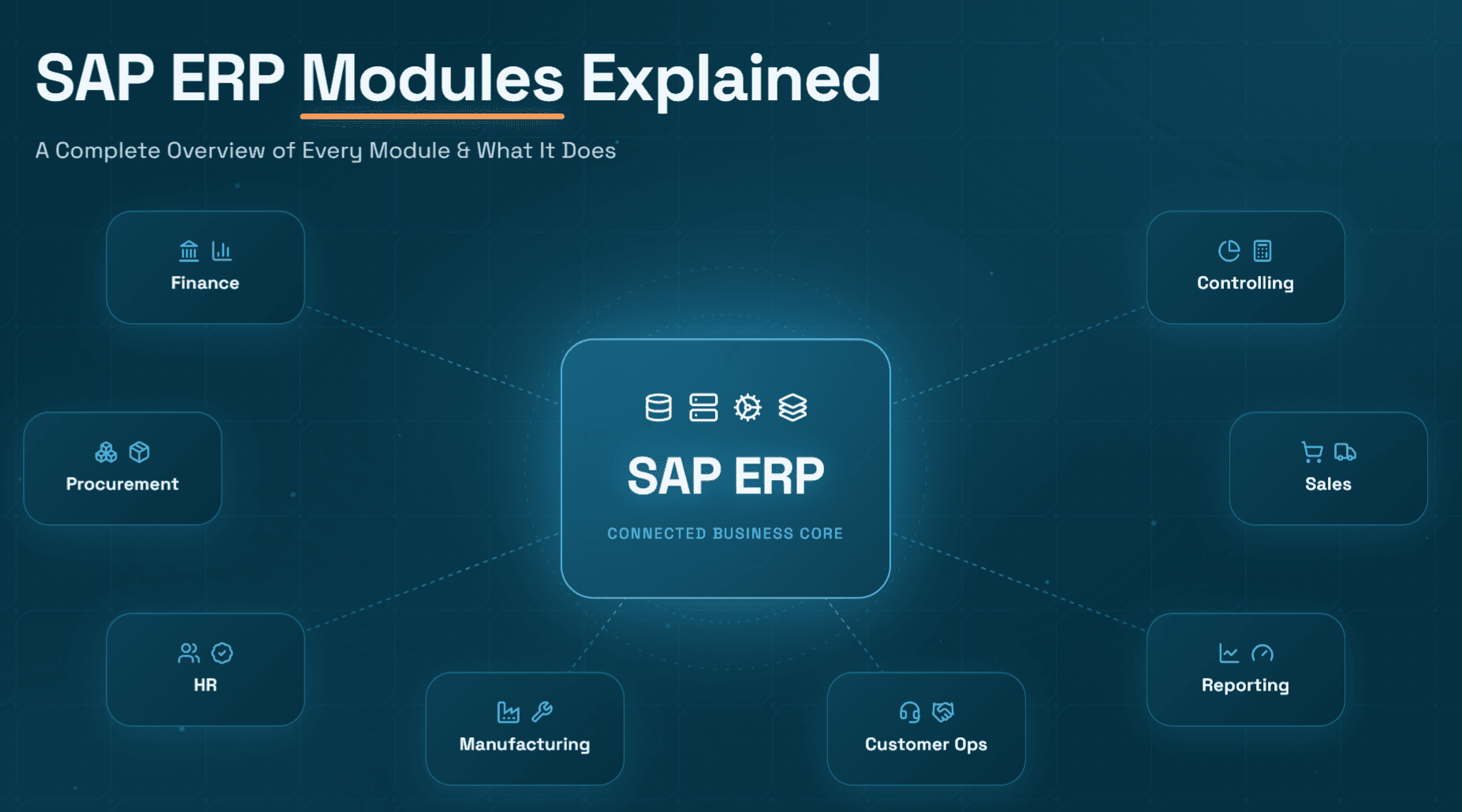
SAP ERP Modules Explained: A Complete Overview of Every Module & What It Does
A complete guide to SAP modules and how they work together across the business
What Is SAP ERP?
SAP (Systems, Applications, and Products in Data Processing) ERP is one of the world's most widely deployed enterprise resource planning platforms. It integrates core business processes like finance, procurement, manufacturing, sales, HR, and more, into a single, unified system.
With over 400,000 customers across 180 countries, SAP ERP is the backbone of global enterprises. Whether you're in manufacturing, retail, healthcare, or financial services, SAP ERP software modules form the operational infrastructure that keeps the business running.
SAP ERP Modules Overview: The Full Picture
Below is the master SAP ERP modules list, organized by functional area. Use this as your reference map.
Module Code | Full Name | Business Function | Typical Users |
FI | Financial Accounting | GL, AR, AP, Asset Accounting | Finance, Accounting |
CO | Controlling | Cost centers, profit centers, internal orders | FP&A, Controllers |
MM | Materials Management | Procurement, inventory, invoice verification | Procurement, Operations |
SD | Sales & Distribution | Order management, billing, delivery | Sales, Revenue Operations |
PP | Production Planning | Manufacturing, MRP, work orders | Supply Chain, Manufacturing |
HCM | Human Capital Mgmt | Payroll, org management, talent, time | HR, Payroll |
PM | Plant Maintenance | Equipment, preventive maintenance | Facilities, Operations |
QM | Quality Management | Inspections, certifications, defect tracking | Quality, Compliance |
PS | Project System | Project planning, budgeting, WBS | PMO, Finance |
SCM | Supply Chain Management | Demand planning, logistics, warehousing | Supply Chain |
CRM | Customer Relationship Management | Customer data, sales pipeline, service | Sales, CX |
SRM | Supplier Relationship Management | Supplier onboarding, contracts, performance | Procurement |
WM / EWM | Warehouse Management | Bins, picking, goods movement | Warehouse, Operations |
TM | Transportation Management | Freight, carrier management, route planning | Logistics |
BW / BI | Business Warehouse / BI | Reporting, analytics, data warehouse | Analysts, Finance |
SAP FI and CO - Financial Accounting & Controlling
These are the two most critical SAP ERP modules for any finance team. Together, FI and CO form the financial backbone of the entire SAP ecosystem.
SAP FI - Financial Accounting
SAP FI is responsible for external-facing financial reporting. It captures every financial transaction that hits the general ledger.
Sub-Module | What It Handles |
General Ledger (GL) | Chart of accounts, journal entries, period-end close |
Accounts Payable (AP) | Vendor invoices, payment runs, aging analysis |
Accounts Receivable (AR) | Customer invoicing, collections, cash application |
Asset Accounting (AA) | Fixed assets, depreciation, impairment |
Bank Accounting | Bank reconciliation, electronic bank statements |
Travel Management | Expense reports, mileage, per diem |
Why it matters: SAP FI is the system of record for financial compliance. Every purchase order, invoice, payment, and asset transaction flows through here. Errors in FI propagate across the entire enterprise. See best practices for GL posting to keep your ledger clean.
SAP CO – Controlling
While FI faces outward (statutory reporting), CO faces inward (management accounting). CO answers the question: "Where is our money actually going?"
• Cost Center Accounting (CCA): Tracks costs by department or business unit
• Profit Center Accounting (PCA): Measures profitability by product line or region
• Internal Orders: Tracks spending on specific projects or initiatives
• Product Costing: Calculates cost of goods manufactured
• Profitability Analysis (CO-PA): Margin analysis by customer, product, channel
SAP MM – Materials Management P2P Core
SAP MM is the engine behind the Procure-to-Pay (P2P) process. It covers everything from when a purchase need is identified to when a vendor is paid. For a deep dive, see the complete guide to transforming your procurement process.
MM Function | What Happens | Key Transaction |
Purchase Requisition | Internal request to buy goods/services | ME51N |
Purchase Order | Formal order sent to vendor | ME21N |
Goods Receipt | Recording delivery of goods | MIGO |
Invoice Verification | 3-way match: PO + GR + Invoice | MIRO |
Inventory Management | Stock tracking, transfers, adjustments | MB1A/MB1B |
Vendor Master Data | Supplier information management | MK01 |
P2P Pain Point: SAP MM handles the framework, but manual invoice processing within MM remains one of the top sources of operational cost, with error rates of 3–5% and processing costs of $15–$40 per invoice. This is precisely where AI automation delivers its highest ROI. See how AI solves 3-way matching.
SAP SD – Sales & Distribution O2C Core
SAP SD powers the Order-to-Cash (O2C) cycle. It starts when a customer places an order and ends when cash hits your bank account.
SD Component | Business Activity |
Sales Order Management | Customer PO intake, pricing, availability check |
Delivery Processing | Picking, packing, goods issue |
Billing & Invoicing | Customer invoice generation, credit/debit memos |
Pricing & Conditions | Discounts, surcharges, taxes, freight |
Credit Management | Customer credit limits, risk exposure |
Returns & Complaints | RMA processing, quality complaints |
SAP SD integrates tightly with FI (for AR postings), MM (for inventory), and PP (for availability). A delay anywhere in this chain directly delays cash collection, making O2C automation critical for working capital management. Learn about mastering the accounts payable workflow as a complement to O2C operations.
SAP PP – Production Planning
SAP PP is built for manufacturing organizations. It handles everything from demand forecasting to shop floor execution.
• Bill of Materials (BOM): Defines what components go into a finished product
• Routing: Defines manufacturing steps, work centers, and time
• Material Requirements Planning (MRP): Calculates what to buy/produce and when
• Production Orders: Authorizes and tracks manufacturing execution
• Capacity Planning: Matches demand to available production capacity
• Shop Floor Control: Real-time tracking of in-progress orders
Integration point: SAP PP feeds directly into MM (material consumption), CO (cost collection on production orders), and SD (ATP confirmation for sales orders). See how Hyperbots supports manufacturing AP automation in these environments.
SAP HCM – Human Capital Management
SAP HCM (also known as SAP HR) manages the entire employee lifecycle, from hire to retirement.
HCM Sub-Module | Function |
Organizational Management | Org charts, reporting lines, position management |
Personnel Administration | Employee master data, contracts, personal info |
Payroll | Gross-to-net payroll, tax calculations, compliance |
Time Management | Time recording, absence management, scheduling |
Talent Management | Recruitment, performance, succession, learning |
Benefits Administration | Health plans, retirement, leave entitlements |
SAP PM, QM & PS – Maintenance, Quality & Projects
SAP PM – Plant Maintenance
Manages all maintenance activities for physical assets, buildings, machinery, vehicles, and infrastructure.
• Preventive maintenance scheduling and work order management
• Equipment master data and functional location hierarchy
• Breakdown maintenance and corrective work tracking
• Integration with MM for spare parts and CO for cost allocation
SAP QM – Quality Management
Embeds quality checks into procurement, production, and delivery processes.
• Inspection lots at goods receipt, during production, and before delivery
• Defect recording, root cause analysis, and corrective actions (CAPA)
• Quality certificates and vendor quality performance tracking
• Integration with GRC for regulatory compliance (FDA, ISO)
SAP PS – Project System
Designed for organizations that run complex, multi-phase projects like construction, R&D, IT, consulting.
• Work Breakdown Structure (WBS) for project decomposition
• Network activities and Gantt chart scheduling
• Project budgeting, cost planning, and actual vs. plan reporting
• Revenue recognition and milestone billing
SAP SCM, CRM & SRM – Extended Enterprise Modules
SAP SCM – Supply Chain Management
SAP SCM (now largely embedded in SAP S/4HANA or delivered via SAP IBP) manages the end-to-end supply network.
SCM Capability | What It Does |
Demand Planning | Statistical forecasting, consensus planning |
Supply Network Planning | Multi-site inventory and capacity optimization |
Transportation Mgmt | Carrier selection, freight cost, route optimization |
Extended Warehouse Mgmt | Bin management, slotting, goods flow optimization |
SAP CRM – Customer Relationship Management
SAP CRM (or SAP C/4HANA in the cloud era) manages customer-facing processes.
• 360° customer view: contact history, transactions, service cases
• Marketing campaign management and lead qualification
• Service desk, SLA tracking, and field service management
• Integration with SD for seamless order processing
SAP SRM – Supplier Relationship Management
SAP SRM (now SAP Ariba in the cloud) manages the supplier side of the equation. For a step-by-step breakdown, see the SAP and Ariba purchase order process.
• Supplier onboarding, qualification, and scorecards
• Contract lifecycle management: creation, approval, compliance
• Self-service procurement and catalog management
• Spend analytics and supplier risk management
SAP S/4HANA – The Next-Generation Platform
SAP S/4HANA is the modern, in-memory ERP platform that replaces legacy SAP ECC. It re-architects the SAP ERP modules list on a single data model with real-time processing.
Feature | SAP ECC (Legacy) | SAP S/4HANA (Modern) |
Database | Any (Oracle, SQL Server, DB2) | SAP HANA only (in-memory) |
Data Model | Highly normalized, many tables | Simplified (ACDOCA universal journal) |
Real-time Analytics | Requires BW/BI extraction | Embedded analytics, live data |
Fiori UX | Limited | Full Fiori 2.0/3.0 UX |
Machine Learning | None | Embedded AI/ML (SAP BTP) |
Deployment | On-premise only | Cloud, on-premise, hybrid |
Migration note: SAP ECC mainstream maintenance ends in 2027. Most enterprises are either mid-migration or planning their S/4HANA move. AI co-pilots like Hyperbots are ECC and S/4HANA compatible, delivering value regardless of where you are on your SAP journey. See the full ERP implementation guide for 2025.
Where P2P and O2C Live Inside SAP ERP
Two of the most operationally intensive processes, Procure-to-Pay (P2P) and Order-to-Cash (O2C), span multiple SAP modules. Understanding this is critical for automation planning. Explore the full evolution of the P2P process for historical context.
Procure-to-Pay (P2P) in SAP
P2P Stage | SAP Module | What Happens |
Need Identification | MM / SRM | Purchase requisition created |
Sourcing | SRM / MM | RFQ, vendor selection, PO creation |
Goods/Service Receipt | MM | GR posted, inventory updated |
Invoice Receipt & Verification | MM / FI-AP | 3-way match, exceptions flagged |
Payment | FI-AP | Payment run, remittance, bank clearing |
Accruals | FI / CO | Month-end accruals for uninvoiced GR |
Order-to-Cash (O2C) in SAP
O2C Stage | SAP Module | What Happens |
Customer Order | SD | Sales order created, credit check |
Fulfillment | SD / MM / PP | Picking, packing, goods issue |
Invoicing | SD / FI-AR | Customer invoice posted to AR |
Collections | FI-AR | Dunning, dispute management, follow-up |
Cash Application | FI-AR | Payments matched to open invoices |
Reporting | FI / CO / BW | DSO, aging, cash forecast |
How Hyperbots AI Co-Pilots Transform SAP ERP Operations
SAP ERP provides the framework. But within that framework, operations teams still spend enormous time on repetitive, rules-based work. Hyperbots has built the most comprehensive suite of AI co-pilots specifically designed to automate the highest-cost workflows inside SAP ERP, delivering up to 80% reduction in operational costs for P2P and O2C processes.
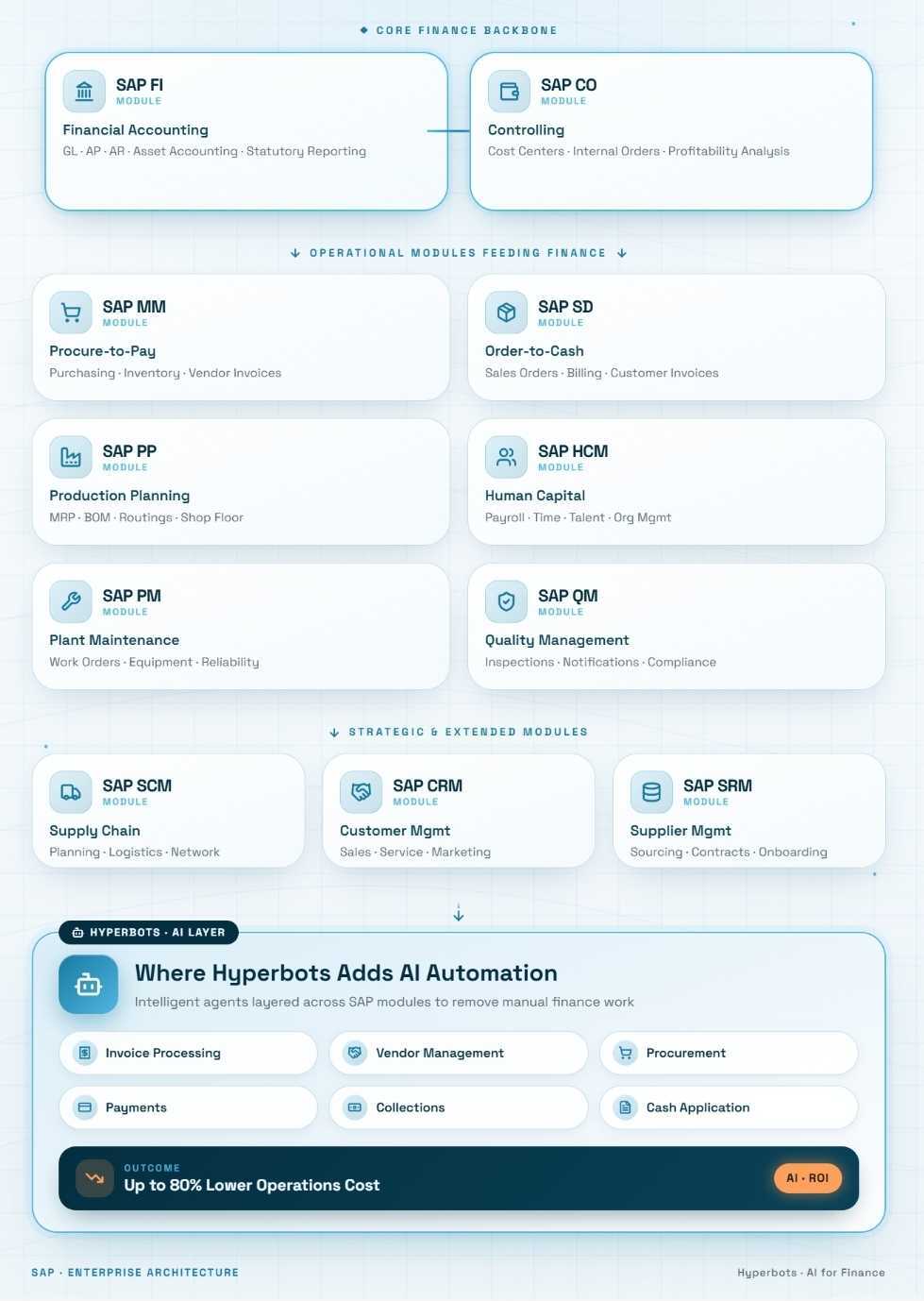
Why Hyperbots? Unlike generic RPA bots that break with every SAP update, Hyperbots co-pilots are AI-native. They understand context, handle exceptions intelligently, and continuously improve with every transaction they process. See the platform overview.
Procure-to-Pay (P2P) Co-Pilots
Manual invoice processing is the single biggest cost driver in P2P, costing $15–$40 per invoice, with 3–5% error rates. Hyperbots' Invoice Processing Co-Pilot eliminates this overhead entirely.
• Ingests invoices from any format (PDF, email, EDI, scanned paper) with near-100% accuracy. See how AI invoice processing works
• Performs intelligent 3-way match (PO, GR, Invoice) inside SAP MM and FI-AP, flagging only genuine exceptions for human review
• Handles complex invoice scenarios: PO line-item variances, quantity differences, price deviations, and partial deliveries
• Routes exceptions intelligently based on configurable business rules with full audit trails for SOX compliance
The benefit: Teams that previously processed 500 invoices/day manually now handle 5,000+ with the same headcount. See how Extreme Reach hit 80% straight-through processing with 99.8% accuracy.
Vendor master data in SAP is notoriously difficult to keep clean. Duplicate vendors, outdated banking details, and incomplete records cause payment failures and compliance risks.
• Automates vendor onboarding workflows by collecting W-9s, banking info, insurance certificates, and compliance documents
• Continuously monitors vendor master for duplicates, inconsistencies, and risky changes (e.g., sudden bank account updates)
• Validates vendors against sanctions lists (OFAC, EU, UN) and adverse media in real time
• Manages vendor communication and follow-up, reducing procurement team workload by 60–70%
The benefit: One Fortune 500 customer reduced vendor onboarding time from 14 days to under 48 hours. Read more on vendor onboarding challenges and the advantages of AI.
Maverick spending, delayed approvals, and manual PO creation are silent drains on every procurement organization. See how the PR-to-PO cycle can be compressed from 3 days to 4 hours.
• Converts purchase requisitions to POs automatically for pre-approved vendors and catalog items — eliminating manual SAP ME21N transactions
• Applies intelligent spend controls, routing non-catalog spend for approval and flagging off-contract purchases
• Monitors open POs for delivery delays and proactively alerts procurement teams and vendors
• Provides real-time spend analytics by category, vendor, cost center, and entity
The benefit: Procurement cycle time drops by 50–65%. Maverick spend is reduced by 80%, directly impacting negotiated savings realization.
Tax compliance on vendor invoices is a growing risk area. See how a CFO cut $200K in tax leakage using Hyperbots.
• Validates sales tax on every inbound invoice against jurisdiction-specific rules, automatically detecting overcharges, missing exemptions, and incorrect tax codes
• Integrates with SAP FI tax configuration and external tax engines (Vertex, Avalara)
• Identifies recoverable tax credits and flags them for finance review
• Maintains a real-time audit log of all tax decisions for regulatory examination readiness
Payment runs in SAP FI-AP are manual, high-risk processes. Missed early payment discounts, duplicate payments, and bank detail fraud collectively cost organizations millions annually.
• Automates SAP F110 payment run preparation, checking for duplicates, bank detail changes, and payment block flags before execution
• Dynamically captures early payment discounts. Learn how to leverage AI to capture missed early payment discounts
• Validates every payment against the vendor master to catch fraudulent bank account changes (Business Email Compromise protection)
• Generates payment remittances and handles reconciliation automatically
The benefit: Early payment discount capture alone can generate 1–2% of total AP spend as direct income. Fraud prevention protects against losses that average $130,000+ per BEC incident.
Month-end accruals are a painful, manual process. The Accruals Co-Pilot automates this entirely. See how Hyperbots' agentic AI transforms accruals.
• Automatically identifies goods and services received but not yet invoiced (GR/IR imbalances) and calculates the required accrual amount
• Posts accrual journals directly into SAP FI with proper cost object allocation (cost center, WBS, internal order)
• Reverses accruals automatically in the following period when actual invoices arrive
• Provides real-time accrual dashboards for controllers and FP&A teams
The benefit: Month-end close timelines shrink by 2–4 days. Accrual accuracy improves from ~80% to 97%+.
Order-to-Cash (O2C) Co-Pilots
Chasing overdue invoices is one of the most resource-intensive tasks in any AR department. The Collections Co-Pilot transforms collections from a reactive, manual process into a proactive, AI-driven workflow.
• Automatically segments customers by risk, prioritizing collections effort on highest-value, highest-risk accounts using predictive scoring
• Generates and sends personalized dunning communications (email, portal, SMS) at optimal times
• Logs all customer interactions, disputes, and promises-to-pay directly in SAP FI-AR
• Escalates unresolved disputes to the right team members with full context and history
The benefit: DSO (Days Sales Outstanding) reduces by 40% days on average. AR teams redirect 50%+ of their time from transactional follow-up to strategic relationship management.
Matching incoming payments to open invoices in SAP FI-AR is deceptively complex. The Cash Application Co-Pilot solves this at scale.
• Reads remittance data from any source (email, bank portals, EDI 820, customer portals) and matches to SAP AR open items with 95%+ auto-match rates
• Handles partial payments, deductions, and short pays intelligently
• Reduces unapplied cash to near zero
• Posts matched payments directly into SAP FI-AR, eliminating manual F-28/F-32 transactions
The benefit: With 95%+ auto-match rates, a team that previously spent 8 hours/day on cash application now spends under 1 hour managing exceptions.
Hyperbots-Led ROI: Tangible & Intangible Gains
Hyperbots' AI co-pilots deliver measurable impact across P2P and O2C. Use the Hyperbots ROI calculators to model the value for your organization.
P2P ROI Metrics
• 80% Straight-through processing
• 10% reduction in cash flow
• 99.8% accuracy in invoice extraction
• 5-minute PR creation
• 80% Reduction in PO creation and dispatch time
• Less than 5% variance in accrued vs. actual costs
O2C ROI Metrics
• 70% Cost reduction in Collections
• 40% reduction in DSO
• 80% reduction in reconciliation costs
• 10% Unapplied cash
Intangible Benefits
Benefit | Business Impact |
Audit readiness | Every transaction has a full AI-generated audit trail - SOX, GAAP compliant |
Talent retention | Finance teams freed from repetitive work report higher job satisfaction |
Vendor relationships | On-time payments and transparent communication improve supplier trust |
Customer satisfaction | Faster dispute resolution and proactive collections improve NPS |
Scalability | Handle 10x transaction volume with no incremental headcount, critical for M&A growth |
Risk reduction | Real-time fraud detection, sanctions screening, and tax compliance reduce enterprise risk |
Hyperbots Platform Capabilities
Hyperbots isn't just a collection of point-solution bots. It's a unified AI operations platform built on top of SAP ERP. Explore all Hyperbots integrations including SAP, NetSuite, QuickBooks, and more.
Platform Capability | What It Means for You |
Native SAP Integration | Deep API and BAPI integration with SAP ECC and S/4HANA; no middleware, no brittle screen-scraping |
Multi-entity & Multi-currency | Handles complex org structures: intercompany, multi-currency, and multi-chart-of-accounts scenarios |
Configurable Business Rules | Business users, not IT, configure approval thresholds, routing logic, and exception handling |
Real-time Dashboards | Live KPI monitoring for AP aging, AR aging, DSO, invoice cycle time, match rates, and accrual status |
AI That Learns | Co-pilots improve with every transaction; auto-match rates and extraction accuracy increase over time |
Security & Compliance | SOC 2 Type II certified, GDPR compliant, with role-based access mirroring SAP authorization objects |
Rapid Deployment | Go-live in 3–4 weeks, not 3–9 month ERP implementations. Value delivered within the first quarter. |
Human-in-the-Loop | Designed for collaboration: AI handles volume, humans handle judgment. Clear escalation paths always. |
Ready to Cut Your SAP Operations Costs by 80%? Hyperbots AI co-pilots are live in production SAP environments today, processing millions of invoices, matching cash, and automating collections. Request a Demo or start a free trial to see the platform in action.
Frequently Asked Questions (FAQs)
Q1. What are the core SAP ERP modules every company uses?
The universal foundation is FI (Financial Accounting) and CO (Controlling), every SAP implementation includes these. Beyond that, MM (Materials Management) is nearly universal for any company that buys goods or services, and SD (Sales & Distribution) is standard for any company that sells. HCM covers HR and payroll. The additional modules (PP, PM, QM, PS) are deployed based on industry and business model.
Q2. What is the difference between SAP ECC and SAP S/4HANA?
SAP ECC (ERP Central Component) is the legacy platform that most enterprises have run for 15–20 years. SAP S/4HANA is its modern replacement, built on the in-memory HANA database, with a simplified data model, embedded real-time analytics, and a modern Fiori UX. SAP ECC mainstream maintenance ends in 2027 (with extended maintenance to 2030), making S/4HANA migration a near-term priority.
Q3. How many SAP ERP modules are there?
SAP's full portfolio includes over 25 functional modules. In SAP S/4HANA, many are now integrated into the core system. See the best ERP systems scorecard for 2025 for a broader market comparison.
Q4. What SAP modules are involved in Procure-to-Pay?
P2P spans MM (purchase requisitions, purchase orders, goods receipt, invoice verification) and FI-AP (payment processing, vendor accounting). SRM/Ariba handles upstream sourcing and contract management. CO captures costs from purchase orders against cost centers or projects. Read the complete procure-to-pay process guide for a step-by-step walkthrough.
Q5. What SAP modules are involved in Order-to-Cash?
O2C primarily spans SD (sales orders, delivery, billing) and FI-AR (customer invoicing, collections, cash application). MM is involved for goods issue, PP for availability-to-promise, and CO/BW for revenue and margin reporting.
Q6. Can AI co-pilots work with SAP ECC, or only S/4HANA?
Hyperbots AI co-pilots work with both SAP ECC and SAP S/4HANA. They integrate via SAP's standard APIs and BAPIs, meaning you don't need to complete your S/4HANA migration before realizing the benefits of AI automation. Learn how pre-trained AI co-pilots transformed finance in days, not months.
Q7. What is the SAP MM transaction code for invoice verification?
The primary transaction for invoice verification in SAP MM is MIRO (Logistics Invoice Verification). For subsequent debit/credit, MR8M is used. FI-AP uses FB60 for direct vendor invoice entry and F-43 for manual document posting. Hyperbots' Invoice Processing Co-Pilot automates the data entry and 3-way match that precedes these transactions. See the complete AI invoice processing software guide for more.