Why Procure-to-Pay Automation Is Still Essential on SAP S/4HANA
Why a modern ERP foundation still needs intelligent automation to optimize procurement workflows
SAP S/4HANA Does a Lot, But Not Everything
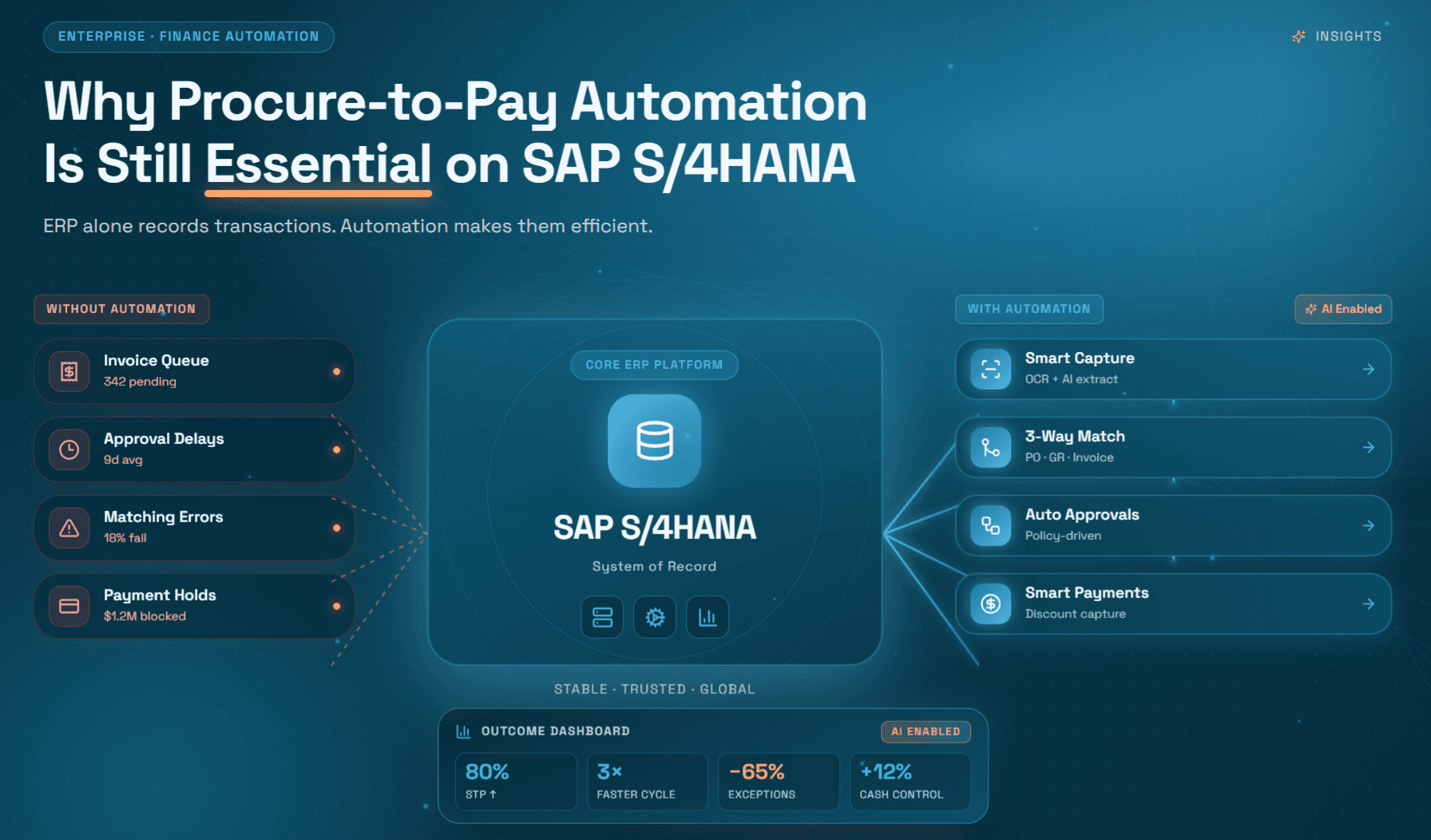
SAP S/4HANA is one of the world's most powerful ERP platforms. It handles financial accounting, procurement, materials management, and much more across thousands of global enterprises. For any CFO or finance leader, it is the backbone of operations.
But here is a question that comes up time and again at CFO roundtables and finance leadership events: "We have SAP. Why do our AP teams still spend hours on manual invoice processing?"
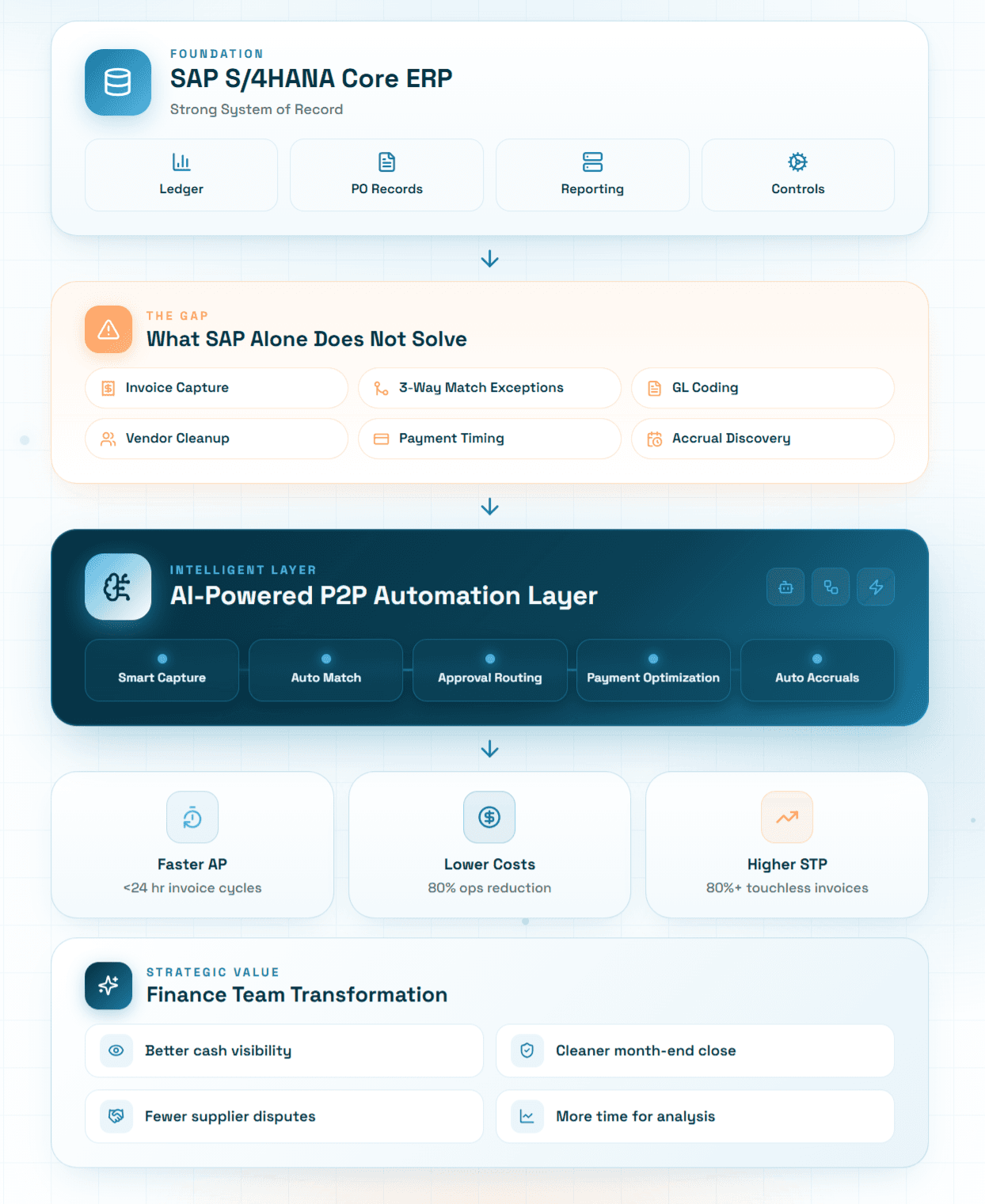
The honest answer is that SAP S/4HANA was built to record, structure, and manage business data, not to intelligently automate the end-to-end procure-to-pay (P2P) process. There is a meaningful difference between having an ERP and having true P2P automation. Understanding that gap is the first step to closing it.
This article explains why P2P automation remains critically important even on SAP S/4HANA, what the real operational gaps are, and how modern AI-powered solutions are helping finance teams achieve what SAP alone cannot.
What Is Procure-to-Pay Automation – And Why Does It Matter?
The procure-to-pay process covers everything from the moment an employee raises a purchase request to the moment a supplier receives payment. Every step in between, vendor onboarding, PO creation, invoice receipt, 3-way matching, GL coding, approval routing, and payment execution, is part of P2P.
P2P Stage | What Happens | Common Pain Point |
Purchase Requisition | Employee requests goods/services | Manual forms, slow approvals |
Purchase Order | Finance creates and dispatches PO | Errors, rework, delays |
Vendor Onboarding | Supplier data validated and set up | Slow, compliance gaps |
Invoice Receipt | Invoice captured from email/portal | Manual entry, missed invoices |
3-Way Matching | PO, GRN, and invoice reconciled | Exceptions pile up |
GL Coding | Expenses coded to correct accounts | Miscoding, audit risk |
Approval Workflow | Invoice routed for sign-off | Bottlenecks, lost invoices |
Payment | Supplier paid on correct terms | Late payments, missed discounts |
Accruals | Unbilled liabilities captured at period end | Manual, error-prone |
When any of these stages breaks down, the entire chain slows. Suppliers get frustrated. Finance teams scramble at month-end. Errors creep into financial reports. And cash flow suffers because early payment discounts are missed while late payment penalties accumulate.
True P2P automation means each of these stages is handled with minimal human intervention, intelligently, accurately, and in real time.
What SAP S/4HANA Gives You – And What It Does Not
SAP S/4HANA is exceptional at what it was designed for. It provides a structured data model, a unified ledger, deep procurement modules (MM, FI, SRM), and real-time reporting through SAP HANA's in-memory database. That is genuinely valuable.
What SAP S/4HANA Does Well | Where It Falls Short |
Centralized financial ledger | Invoice extraction and capture from unstructured documents |
Structured PO and GR management | Intelligent exception handling and resolution |
Role-based approval configuration | Autonomous GL coding based on context |
Vendor master data storage | Proactive fraud and anomaly detection |
Financial reporting and analytics | Automated accrual discovery for unbilled liabilities |
Compliance and audit structure | AI-driven payment timing optimization |
Integration with other SAP modules | Straight-through processing without manual touchpoints |
SAP S/4HANA requires clean, structured data to function well. But in real finance operations, invoices arrive as PDFs with inconsistent layouts. Vendors send invoices with mismatched PO numbers. Tax rates vary by state. Accruals need to be estimated for services received but not yet billed.
These are exactly the problems that SAP alone does not solve and they are the problems that keep AP teams working nights at month-end.
As one well-known benchmark puts it, the cost of processing a purchase order manually can be anywhere from $50 to $500 per PO depending on organization size and complexity. Across thousands of POs annually, that adds up fast.
The Real Cost of P2P Gaps in SAP Environments
The most common belief in organizations using SAP is: "We have an ERP, so we are automated." This is a costly misconception.
Here is what finance teams in SAP environments routinely experience without additional P2P automation:
Operational Costs
AP staff spend 60–70% of their time on manual data entry and exception handling
Invoice processing cycle times average 10–14 days in manual environments versus under 24 hours with invoice automation
3-way matching failures create backlogs that cascade into payment delays
Financial Costs
Missed early payment discounts, typically 1–2% of invoice value, go uncaptured due to slow processing
Duplicate payments and overpayments caused by manual entry errors
Tax leakage from incorrect GL coding or missed sales tax validation
Late payment penalties that erode vendor relationships
Strategic Costs
Finance leaders lack real-time visibility into committed spend and cash flow
Month-end close takes longer because accruals are calculated manually
Audit preparation is slow because audit trails are scattered across emails, spreadsheets, and SAP screens
None of these problems go away just because you are on SAP S/4HANA. They require a dedicated layer of intelligent automation on top.
Key Components of Effective P2P Automation on SAP S/4HANA
For P2P automation to deliver real value in a SAP environment, it needs to cover each stage of the cycle comprehensively. Here is what best-in-class automation looks like across the P2P chain.
1. Intelligent Invoice Capture and Processing
The entry point for AP automation is invoice capture. Invoices arrive from dozens of sources like email, vendor portals, EDI feeds, scanned documents, in hundreds of different layouts.
Effective invoice automation must:
Extract data accurately from any invoice format without templates
Validate extracted fields against PO data in SAP
Detect duplicates before they enter the approval queue
Auto-code GL accounts based on line-item context and historical patterns
Route exceptions intelligently rather than dumping them in a manual queue
The difference between basic OCR and true AI-native invoice automation is significant. OCR reads text. AI understands context, it knows that "professional services rendered per SOW-2024-Q3" belongs in a specific GL account, even if it has never seen that exact phrasing before.
2. Automated 3-Way Matching
3-way matching, reconciling the purchase order, goods receipt note (GRN), and vendor invoice, is where most AP exceptions are born. Quantity discrepancies, price variances, and missing GRNs all trigger manual reviews.
Best-in-class automation handles tolerance-based matching, flags only genuine exceptions for human review, and resolves routine variances autonomously. This is what drives straight-through processing (STP) rates above 80%.
3. Procurement and PO Automation
The purchase order process upstream of invoicing deserves equal attention. When purchase requisitions are manually created, delayed in approval, or dispatched to vendors without confirmation tracking, the downstream invoice process inherits all those errors.
Purchase order automation should cover:
Step | What Automation Delivers |
PR creation | Auto-fill from email, forms, or catalog data |
Policy validation | Instant check against spend policies and budgets |
PO generation | Automatic creation and dispatch after approval |
3-way match setup | PO data synchronized with invoice matching engine |
PO closure | Automated closure after GRN and payment confirmation |
4. Vendor Management
Poor vendor data quality is one of the most overlooked causes of invoice exceptions. When vendor master data in SAP contains errors, wrong bank details, stale addresses, outdated tax IDs, every downstream process suffers.
Vendor onboarding automation with AI-driven identity verification, document collection, and compliance checks reduces these errors at the source.
5. Sales Tax Verification
For US-based businesses, sales and use tax compliance on vendor invoices is a persistent risk. Tax rates vary by state, product category, and ship-to address. Incorrect tax on invoices, whether overcharged or undercharged, creates audit exposure.
Automated tax verification cross-checks each invoice line item against applicable jurisdiction rules before payment is approved.
6. Payment Optimization
Not all invoices should be paid at the same time. Early payment discounts are worth capturing. Strategic late payments can preserve cash in tight periods. And vendor payment term rationalization can unlock significant working capital benefits across a large supplier base.
AI-driven payment automation recommends optimal payment timing for each invoice based on cash position, vendor relationship, discount availability, and contractual terms.
7. Automated Accruals
Month-end accruals are one of the most labor-intensive processes in any finance team. Identifying unbilled liabilities, estimating amounts, posting journal entries, and reversing them the following period, all of this is typically done manually.
Automated accruals discovery engines can identify goods received but not invoiced, services rendered under open contracts, and recurring expenses without POs, then post and reverse accruals automatically with full audit trails.
How Hyperbots AI Co-Pilots Transform P2P on SAP S/4HANA
This is where the 20% of this article dedicated to Hyperbots becomes relevant because Hyperbots has been built specifically to close the P2P automation gaps described above, on top of SAP S/4HANA and other leading ERP platforms.
Hyperbots provides a suite of AI co-pilots that together cover the entire P2P cycle. Unlike rule-based automation tools, these co-pilots use AI reasoning to handle exceptions, learn from feedback, and improve accuracy over time. The result is up to 80% reduction in operational costs and 99.8% invoice processing accuracy.
Here is how each co-pilot maps to the P2P gaps identified above:
P2P Gap | Hyperbots Co-Pilot | Key Outcome |
Manual invoice capture and coding | 80%+ STP, 99.8% accuracy | |
PO creation and approval delays | PR-to-PO in 4 hours vs. 3 days | |
Vendor data errors and onboarding | Automated onboarding and verification | |
Sales tax errors and compliance | Real-time tax validation per line item | |
Suboptimal payment timing | Automated discount capture and cash optimization | |
Manual month-end accruals | Automated discovery, booking, and reversal |
What Makes These Co-Pilots Different From Basic Automation
They are pre-trained on finance data. Unlike generic AI tools, Hyperbots co-pilots come trained on finance-specific document patterns, GL coding conventions, and procurement policies. This means organizations go live in days, not months.
They reason, not just follow rules. When an invoice arrives with an unusual line-item description, a rules-based system creates an exception. Hyperbots' AI interprets the context, consults GL coding history and policy, and assigns the correct code autonomously.
They are ERP-native. Hyperbots integrates deeply with SAP S/4HANA's data model, posting directly into SAP's GL, AP, and procurement modules without rekeying or manual exports.
They operate 24/7. Invoices submitted at 11pm on a Friday are processed, matched, and routed for approval before Monday morning, no human in the loop required unless a genuine exception arises.
They provide full explainability. Every AI decision, every GL code assigned, every match accepted or rejected, every payment recommendation made, is logged with a human-readable explanation. This makes audits dramatically easier and gives CFOs confidence in the AI's decisions.
Hyperbots Platform Capabilities Creating Transformational Impact
Beyond individual co-pilots, the Hyperbots platform itself delivers capabilities that compound the benefits:
Platform Capability | What It Means in Practice |
Unlimited user licensing | Every team member, AP clerk, procurement manager, CFO, gets access without per-seat cost pressure |
Multi-entity support | A holding company with 10 subsidiaries can run one platform with entity-specific policies and ledgers |
Self-learning AI | Accuracy improves over time as the AI learns from each correction and approval |
Human-in-the-loop design | Genuine exceptions are surfaced to the right person instantly, not lost in inboxes |
Company-specific policy configuration | Approval thresholds, matching tolerances, and payment rules reflect your internal controls |
Ready-to-deploy models | Finance-specific pre-training means go-live in days with high initial accuracy |
Hyperbots ROI – Tangible and Intangible
Tangible ROI Improvements in Procure-to-Pay with Hyperbots
Metric | Before Hyperbots (Industry Average) | With Hyperbots |
Invoice Processing Time | 8–11 days per invoice cycle | < 1 minute for automated invoices |
Straight-Through Processing (STP) Rate | 20–45% of invoices touchless | 80%+ STP |
Invoice Data Extraction Accuracy | 85–90% average OCR accuracy | 99.8% accuracy |
AP Processing Cost per Invoice | $10–$15 per invoice | 80% reduction in processing cost |
Duplicate Payments | Common manual control issue | Zero duplicate payments |
Payment-to-Invoice Matching | Manual spot checks / partial controls | 100% payment-invoice matching before release |
Cash Outflow Efficiency | Passive payment runs; missed discounts | 10% reduction in cash outflow through optimized timing |
PR-to-PO Cycle Time | 2–3 business days | 4 hours |
Sales Tax Validation | Manual sample review / reactive audits | 100% automated tax verification |
Tax Error / Discrepancy Rate | 2–5% invoice exception rates common | <0.2% discrepancy rate |
Month-End AP Reconciliation Effort | Multi-day manual cleanup | Automated validations + dramatically fewer exceptions |
Vendor Onboarding Data Accuracy | Manual entry errors / duplicate vendors | AI validation, duplicate detection, clean vendor master |
Fraud / Payment Risk | Reactive controls after setup | AI bank validation + anomaly detection before payment |
Team Productivity | Heavy data entry workload | Staff redeployed to analytics / exception handling |
Implementation Time to Value | 3–9 months typical finance automation | 3-4 weeks due to pre-built connectors with common ERPs |
Intangible benefits:
Finance teams shift from transactional processing to strategic analysis
CFOs gain real-time visibility into committed spend and cash position
Vendor relationships improve through faster, more predictable payment cycles
Month-end close accelerates because accruals are automated and audit trails are complete
Fraud risk decreases through continuous anomaly detection across the AP portfolio
A real-world example: Extreme Reach (XR) achieved 80% straight-through processing with 99.8% accuracy and zero manual touch-ups after deploying Hyperbots' invoice automation.
Industry Applications
Hyperbots' P2P automation has been specifically designed to serve the needs of different industries, not just generic finance teams:
Manufacturing: High-volume PO matching against goods receipts, multi-site procurement, and MRP-linked PO automation
Professional Services: Time-and-material invoice matching, project-level GL coding, and accrual management for billable engagements
Retail: High-frequency vendor invoices, multi-jurisdiction sales tax compliance, and vendor portal management at scale
The Hyperbots industries overview provides more detail on sector-specific configurations.
Common Misconceptions About P2P Automation on SAP
"SAP Ariba covers this." SAP Ariba handles strategic sourcing and supplier collaboration well. But it does not provide AI-native invoice automation, autonomous GL coding, or intelligent accruals discovery. Ariba and an AI co-pilot layer serve different functions.
"Our ERP upgrade will fix the manual processes." Moving from SAP ECC to S/4HANA improves the underlying data model but does not change how invoices are captured, matched, or coded. The manual processes migrate with the data.
"Our team manages fine with the current process." When you ask AP teams what "managing fine" actually involves, the answer is usually: extended hours at month-end, a backlog of invoices in a shared inbox, and a spreadsheet tracking exceptions. That is not management, that is cost that does not appear on any budget line.
Implementation Considerations – What to Look for in a P2P Automation Partner
If you are evaluating P2P automation for your SAP S/4HANA environment, here are the criteria that separate capable solutions from ones that will require months of configuration and ongoing maintenance:
Evaluation Criterion | Why It Matters |
Pre-trained AI models | Faster time to value; less need for internal data science resources |
Deep SAP integration | GL posting, matching, and PO sync must be native, not via middleware workarounds |
Configurability without coding | Finance teams should own policy configuration, not IT departments |
Explainable AI decisions | Every coding and matching decision must be audit-ready |
Straight-through processing rate | The real measure of automation quality; target 80%+ |
Accuracy benchmark | Aim for 99%+ extraction accuracy; anything lower creates downstream rework |
Implementation timeline | Best-in-class solutions go live in days to weeks, not quarters |
The Gap Between Having SAP and Having True P2P Automation
SAP S/4HANA is an extraordinary platform. But it was designed to manage structured business processes, not to intelligently automate the messy, document-heavy, judgment-intensive work that happens in every AP and procurement team every day.
The finance teams that are pulling ahead are not the ones with the most sophisticated ERP configuration. They are the ones that have added an intelligent automation layer, one that captures invoices without templates, codes GL accounts without human input, matches POs autonomously, manages vendor relationships proactively, and closes the books faster because accruals no longer require a spreadsheet army.
P2P automation is not a nice-to-have on SAP S/4HANA. It is the difference between an ERP investment that delivers its full potential and one that still has a team of AP clerks manually keying in invoices on a Friday afternoon.
For finance leaders ready to explore what this looks like in their SAP environment, Hyperbots offers a free trial and personalized demo to walk through specific use cases and ROI scenarios.
FAQs – P2P Automation on SAP S/4HANA
Q1: Does P2P automation replace SAP S/4HANA? No. P2P automation works alongside SAP as a complementary layer. SAP remains the system of record; the automation layer handles intelligent document processing, decision-making, and workflow execution before and after data enters SAP.
Q2: How long does it take to implement P2P automation on SAP?
With pre-trained AI solutions like Hyperbots, finance teams can go live within days to a few weeks for core invoice processing. More complex configurations involving multi-entity setups or full P2P co-pilot deployment typically take 4–8 weeks.
Q3: What is straight-through processing (STP) and why does it matter?
STP refers to the percentage of invoices that are processed, matched, approved, and posted without any human intervention. A higher STP rate means less manual work, faster cycle times, and lower cost per invoice. World-class STP is considered 80% or above.
Q4: Can P2P automation handle complex invoice types like multi-page, multi-currency, or service invoices?
Yes. AI-native systems process multi-page invoices, handle multi-currency transactions, and apply matching strategies for open-ended service invoices differently from goods POs because the matching logic for a time-and-material invoice is fundamentally different from a product delivery.
Q5: What happens to exceptions, does automation remove human judgment entirely?
No, and it should not. Best-in-class P2P automation handles routine transactions autonomously while surfacing genuine exceptions, real discrepancies, policy violations, fraud signals to the right human for decision-making. This is the human-in-the-loop model: AI handles the volume, humans handle the judgment calls.
Q6: How does AP automation reduce fraud risk?
Fraud and anomaly detection in AI-powered AP automation works by continuously analyzing invoice patterns, vendor behavior, and payment instructions for signals that fall outside normal parameters like duplicate invoices with slight variations, mismatched vendor bank details, or unusually rounded amounts. These are flagged before payment, not discovered in an audit months later.
Q7: Is P2P automation only for large enterprises?
No. While large enterprises benefit from the scale of automation, mid-market companies often see even faster ROI because the ratio of manual work to transaction volume is higher. Many solutions, including Hyperbots, offer unlimited user licensing that makes enterprise-grade automation accessible regardless of team size.