ERP for Manufacturing: What It Is, What It Does, and Why Finance Teams Need More From It
Learn how manufacturing ERP systems handle procurement, inventory, and finance, and where AI fills critical gaps in invoice processing, GRNI, and automation.
If you work in manufacturing, run a manufacturing business, manage its finances, or are simply trying to understand how these companies keep their operations and money in order, this blog is for you. You do not need to be a finance expert or a technology specialist to follow it. Whether you are a plant manager wondering why invoices take so long to get paid, a CFO trying to close the books faster, an operations head dealing with procurement delays, or someone evaluating software for a manufacturing company, you will find something useful here.
This blog covers what an ERP actually is and why manufacturing needs one, what a manufacturing ERP has to handle that other industries do not, where most ERP implementations still leave large gaps, and what those gaps cost in real terms. It also covers how AI is closing those gaps today, and what to look for if you are choosing or upgrading your systems. By the end, you will have a clear, honest picture of where manufacturing finance works well, where it breaks down, and what the path forward looks like.
What Is an ERP, and Why Does Manufacturing Need One?
Every manufacturer runs on two parallel tracks. One track is physical: raw materials come in, production turns them into finished goods, and those goods ship out to customers. The other track is financial: every movement on the physical track generates a transaction that has to be recorded, approved, matched, and reported.
An ERP, or Enterprise Resource Planning system, is the software that connects both tracks in one place. It is the central system where purchasing, production, inventory, finance, and fulfilment all live together. Without it, each department runs on its own spreadsheets and systems, and nobody has a complete or reliable picture of what is happening across the business.
For manufacturers specifically, the ERP is not just a finance tool. It is the operating backbone. It manages material requirements planning so production does not run out of parts. It tracks inventory across plants and warehouses. It matches incoming invoices to purchase orders and goods receipts. It records costs at every stage of production so the finance team knows what it actually costs to make each product.
The reason manufacturers need a dedicated ERP, rather than a generic accounting system, is that manufacturing operations produce a level of financial and operational complexity that generic tools simply cannot handle. Multi-plant operations, multi-tier supply chains, bills of materials, production work orders, goods receipts, and intercompany transactions all need to be connected. An ERP is what makes that connection possible.
What a Manufacturing ERP Actually Has to Handle
Let us be specific about what manufacturing puts on the finance function that other industries do not.
Multi-plant, multi-entity invoices. A manufacturer with three production sites receives invoices from the same supplier addressed to different plants, charged to different cost centers, and needing to be posted to different legal entities in the ERP. Routing these manually is slow and produces posting errors that distort inventory values and cost-of-goods calculations.
Bills of materials and production costing. Every finished product has a bill of materials, which is a list of the raw materials and components that go into making it. When production runs, the ERP needs to record which materials were consumed, in what quantities, at what cost. If this data is inaccurate, the cost of goods sold is inaccurate, and so is the gross margin.
Goods Received Not Invoiced (GRNI). In manufacturing, materials arrive at the plant before the supplier sends an invoice. This creates a financial liability that needs to be recorded as an accrual. Getting GRNI accruals right every month is one of the hardest and most time-consuming tasks in manufacturing finance, and when it goes wrong, it creates material errors in the income statement.
MRO and indirect spend. Manufacturers buy not just production materials but also maintenance, repair, and operations items: spare parts, lubricants, tools, consumables. This spending is often off-contract, frequently undocumented with proper purchase orders, and difficult to track. It represents a significant source of uncontrolled spend in most manufacturing businesses.
Purchase order complexity. A single production run can require purchase orders across dozens of suppliers, with line-level pricing, quantity breaks, freight charges, and surcharges all on the same document. Matching the supplier invoice to the purchase order and goods receipt at line level is not something basic AP tools handle reliably.
Collections and cash flow. Manufacturers sell to distributors, retailers, and OEMs on credit terms. Managing which invoices are overdue, prioritising collections, and getting cash applied to the right customer accounts accurately is as important to a manufacturer's financial health as paying suppliers correctly.
The Manufacturing Finance Process: From Purchase to Payment
Here is how finance flows through a manufacturing operation, from the moment a purchase order is raised to the moment the books are closed:
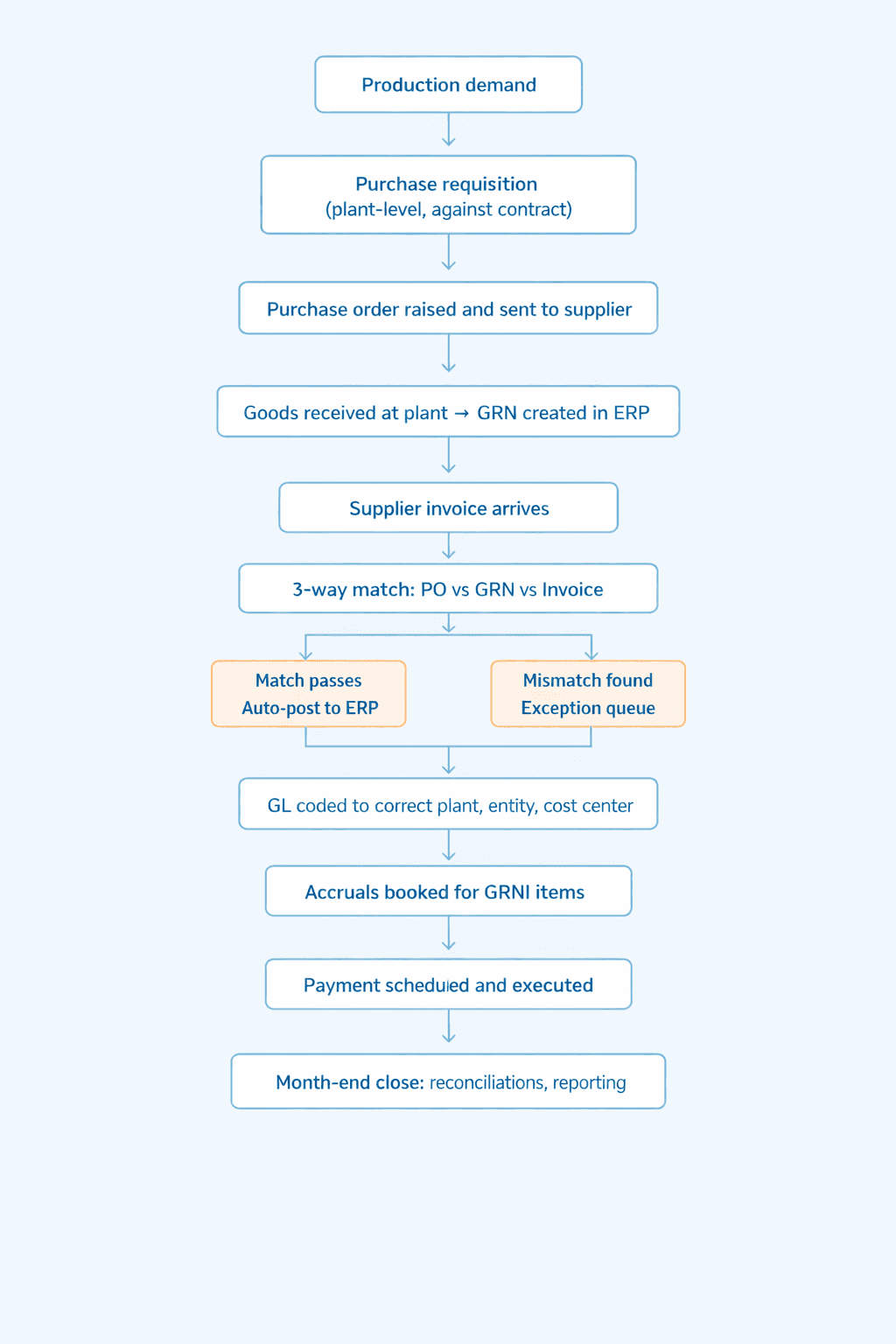
Every step in this flow has the potential for error, delay, and cost when it is handled manually. The more plants, the more suppliers, the more purchase orders, the bigger those costs become.
Where ERP Systems Fall Short in Manufacturing
ERP systems were built to record transactions. They were not built to process them intelligently. That distinction matters enormously in a manufacturing environment.
Invoice entry is still largely manual. Even in companies with a well-configured ERP, invoices arrive by email, PDF, and portal in formats the ERP cannot read directly. Someone has to enter the data, or a basic OCR tool has to be configured for each supplier's format. Errors creep in at this stage constantly, and those errors cause downstream mismatches that take hours to resolve.
3-way matching fails on complex invoices. Manufacturing invoices often include partial deliveries, freight and handling surcharges, quantity variances from what was ordered, and pricing adjustments tied to commodity indices. Standard ERP matching rules, which work on exact-match logic, generate large volumes of exceptions for every one of these scenarios. Those exceptions pile up in a queue that someone has to work through manually.
GRNI accruals are guesswork. Because the ERP records the goods receipt but the invoice has not arrived, the finance team has to estimate what is owed at period end. In a manufacturing business with hundreds of open purchase orders, those estimates are often wrong. The result is a financial close that requires significant post-period adjustments.
Procurement compliance breaks down at the plant level. Plant managers and procurement teams at individual facilities routinely bypass formal purchasing processes when they need materials quickly. This creates off-contract spend, duplicate purchase orders, and invoices that arrive with no corresponding PO in the ERP. Generic ERP workflows are too rigid to catch these problems at the point they happen.
Collections and cash application are afterthoughts. Most manufacturing ERP implementations focus heavily on the procurement and production side. The order-to-cash process, managing customer invoices, chasing overdue accounts, and applying incoming payments correctly, is frequently handled with basic functionality that does not account for the complexity of partial payments, disputed invoices, and remittances that cover multiple invoices at once.
Understanding which ERP platforms manufacturers are choosing today, and how buyer expectations are shifting toward AI-readiness, is covered in depth in the 2026 guide to ERP market share and buyer trends.
Manual Finance in Manufacturing vs What AI Makes Possible
When manufacturing finance runs manually, the problems compound with every plant, every supplier, and every purchase order added to the operation. Invoices pile up unmatched. GRNI estimates drift from actuals. Procurement teams bypass controls. Collections teams work through ageing reports with no context. The table below shows where most manufacturing finance teams sit today and what a better baseline looks like.
Process | Manual Approach | With AI Automation |
Invoice entry and matching | Manual data entry; basic OCR for some suppliers; exceptions handled by staff | AI reads any format, matches at line level, routes automatically |
GRNI accruals | Manual estimates at period end; often materially off | Booked automatically from goods receipt data |
Procurement compliance | Policies enforced inconsistently; off-contract spend discovered after the fact | Policies enforced at the point a purchase request is raised |
Collections | Manual prioritisation; generic payment reminders | Context-driven prioritisation; automated follow-up |
Cash application | Manual matching of payments to invoices; large unapplied balances | Automated matching including partial and bulk remittances |
Month-end close | Time-intensive; dependent on manual reconciliation | Faster and more predictable with automated accruals and reconciliations |
How Hyperbots Solves the Problems ERP Leaves Behind
Hyperbots is a finance-trained AI platform built specifically to run on top of manufacturing ERPs. It does not replace the ERP. It handles the work that the ERP cannot: reading complex invoices intelligently, making matching decisions, booking accurate accruals, managing procurement compliance at the plant level, and getting collections and cash application right.
The key word is finance-trained. Hyperbots has been pre-trained on manufacturing-specific financial documents: multi-plant invoices, partial deliveries, freight and surcharge structures, bill of materials costing, and GRNI scenarios. It understands the terminology and the transaction patterns that appear in real manufacturing environments. A generic AI tool trained on standard accounting data does not.
Here is what Hyperbots delivers in manufacturing deployments, based on verified performance data:
Process Area | With Hyperbots AI |
Invoice extraction accuracy | 99.8% accuracy |
Invoices processed without human involvement | Up to 80% straight-through processing |
Invoice processing cost | 80% cost reduction |
Time from production demand to approved PO | Under 5 minutes |
PO creation and dispatch time | 80% faster |
GRNI accruals vs. actual at period end | Less than 5% variance |
Cash flow from better accruals | 10% improvement in cash flow |
Reconciliation processing cost | 80% cost reduction |
Unapplied cash from customer payments | 90% automatically matched |
Days Sales Outstanding | 40% reduction in DSO |
Collections cost | 70% cost reduction |
Time to go live | Under 1 month |
Everything is connected to the manufacturing finance automation platform through pre-built ERP connectors that read and write data in real time. There is no custom integration project. The co-pilots connect to the ERP, learn the plant-level policies, and start processing within one month of kickoff.
Invoice Processing. The Invoice Processing Co-Pilot reads invoices in any format at 99.8% accuracy. It performs true 2-way and 3-way matching at line level, handling partial deliveries, freight surcharges, and pricing variances without false exceptions. Each invoice is routed to the correct plant, legal entity, and cost center automatically. Up to 80% move through the full cycle without anyone touching them.
Procurement. The Procurement Co-Pilot enforces plant-level purchasing policies before a PO is created. Requests take under 5 minutes from submission to approval. PO creation and dispatch is 80% faster. Off-contract and duplicate spend is prevented at source. For more on what purchase order automation looks like in a manufacturing environment, the detail is covered in depth.
Accruals. The Accruals Co-Pilot solves GRNI automatically. It reads goods receipt data, identifies unbilled items, books the accrual, and manages the reversal in the following period. Variance between accrued and actual costs stays under 5%. Cash flow improves by 10%. Month-end close becomes a predictable process rather than a scramble.
Payments. The Payments Co-Pilot ensures maintenance vendors and materials suppliers are paid on time. Late payments to critical maintenance suppliers are one of the hidden causes of unplanned production downtime. Automated scheduling with built-in approval controls prevents it.
Collections and Cash Application. The Collections Co-Pilot prioritises overdue accounts using shipment and dispute context, cutting DSO by 40% and collections cost by 70%. The Cash Application Co-Pilot matches incoming payments automatically, including partial and bulk remittances. Ninety percent of unapplied cash is cleared automatically.
Sales Tax Verification. The Sales Tax Verification Co-Pilot applies the correct tax rules at the transaction level by jurisdiction, product type, and usage, preventing overpayment and producing audit-ready documentation.
Vendor Management. The Vendor Management Co-Pilot keeps supplier records deduplicated and validated across all plants, preventing fraudulent vendors and maintaining accurate payment terms. AI's role in catching financial fraud and anomalies at the vendor level matters particularly in multi-plant environments. How these capabilities connect across ERP modules end to end covers the full picture.
What to Ask Before Choosing an ERP or Adding an AI Layer
Whether you are selecting an ERP for the first time or evaluating what to add on top of an existing one, these are the questions that matter most:
Does it handle plant-level purchase order complexity? Line-level matching with freight, surcharges, partial deliveries, and multi-entity routing needs to work without generating large exception volumes. Ask the vendor to show this on invoices that look like yours.
How does it manage GRNI? The ERP or automation layer should identify unbilled liabilities automatically from goods receipt data and book the accrual without manual intervention at period end.
What does procurement compliance look like at the plant level? Plant-level policies need to be enforced at the point a purchase request is raised, not discovered in an audit later.
Does it cover both P2P and O2C? An automation tool that only covers AP misses half the problem. Both procure-to-pay and order-to-cash need to work well.
How quickly does it go live? A credible AI layer with pre-built ERP connectors should be up and running within a month.
The Bottom Line
Manufacturing finance is complicated because manufacturing itself is complicated. Multi-plant operations, complex purchase orders, goods receipts that arrive before invoices, and customers who pay on their own schedules all create a financial environment that standard ERP functionality was not designed to handle without significant manual work sitting around it.
The finance teams managing this well are not hiring more AP clerks or building more complex spreadsheets. They are using an AI layer that understands manufacturing-specific transaction patterns and handles the volume automatically. The ERP records the result. The AI makes sure the right result gets there.
Hyperbots' co-pilots for manufacturing finance go live within one month, process invoices at 99.8% accuracy, keep GRNI accruals within 5% of actual, and cut DSO by 40%. Request a demo.
FAQs
What is ERP in manufacturing?
An ERP in manufacturing is the central software system that connects purchasing, production, inventory, finance, and fulfilment. It manages material requirements planning, tracks costs through production, processes supplier invoices, and produces the financial records that the business runs on.
What is GRNI and why is it a problem at period end?
GRNI stands for Goods Received Not Invoiced. It is the liability created when materials have been delivered to the plant but the supplier has not yet sent an invoice. Estimating this accurately at month end is difficult when done manually, and errors produce inaccurate financial statements. AI-powered accruals automation solves this by booking GRNI entries directly from goods receipt data, keeping variance under 5%.
What is 3-way matching and why does it break down in manufacturing?
3-way matching compares the supplier invoice, the purchase order, and the goods receipt to confirm that what was ordered, received, and billed all align. In manufacturing, partial deliveries, freight charges, quantity variances, and pricing adjustments regularly cause mismatches that standard ERP matching rules treat as exceptions requiring manual review. AI matching handles these scenarios intelligently rather than flagging them all as errors.
How long does it take to add AI automation on top of an existing manufacturing ERP?
With Hyperbots, the go-live timeline is within one month. Pre-built connectors and pre-trained models eliminate the need for custom integration work or a lengthy configuration project.