How to Keep SAP S/4HANA Clean While Scaling Finance Operations
Scaling finance without adding complexity, technical debt, or upgrade risk
Finance leaders who have lived through an SAP S/4HANA migration know the feeling: the system goes live lean, well-structured, and optimised. Then six months pass. A new country rolls in. An acquisition closes. Three more approvals get bolted into the workflow engine. The workarounds start accumulating, custom objects multiply, and before long the system you just spent eighteen months cleaning up starts to look uncomfortably like the legacy landscape you left behind.
Keeping SAP S/4HANA clean while simultaneously scaling finance operations is one of the defining architectural and governance challenges of the 2020s for enterprise finance teams. It is not a one-time project outcome; it is an operating discipline. Done well, it means faster upgrades, lower total cost of ownership, and a finance function that can absorb growth without proportional headcount or risk growth. Done poorly, it means re-platforming anxiety every two or three years.
This guide covers the structural principles, governance practices, and technology choices that let you preserve your clean core while your finance operations grow in volume, complexity, and geography and it includes the role that modern AI co-pilots now play in removing the organisational pressure that historically pushed teams toward customisation in the first place.
What "Clean Core" Actually Means in SAP S/4HANA
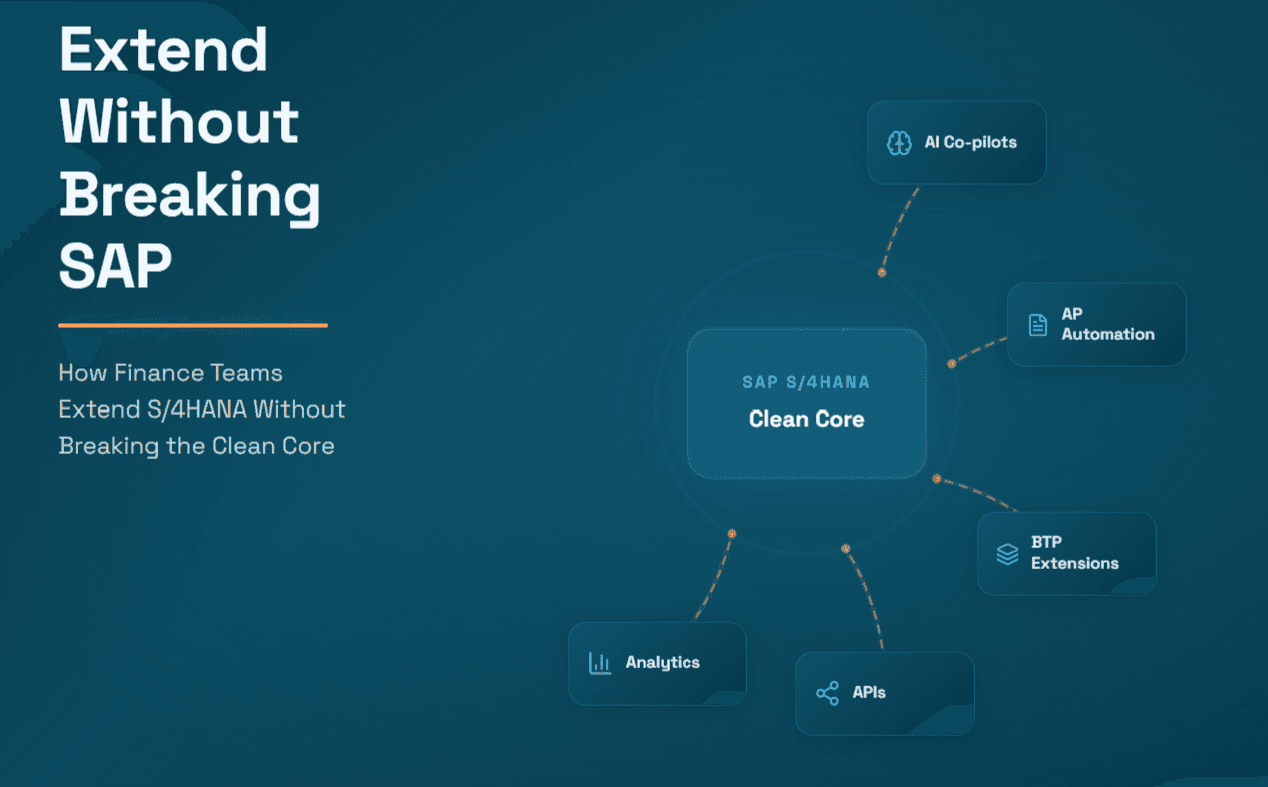
The phrase "clean core" gets used loosely. In SAP's own architecture guidance, a clean core means keeping the S/4HANA application layer as close to standard as possible, avoiding modifications to SAP-delivered objects, minimising custom ABAP in the core, and pushing extensibility outward to the SAP Business Technology Platform (BTP) or to third-party integration layers.
But from a finance operations perspective, clean core means something broader and more practical:
Standardised processes mapped to SAP best-practice. Your procure-to-pay flow, your period-end close, your payment run, these run on standard SAP objects, not on custom Z-programs that only two people in the organisation understand.
Data model integrity. Your chart of accounts, cost centre hierarchies, and GL structures follow a consistent logic that aligns with how S/4HANA stores and reports financial data natively. Understanding GL coding within the Chart of Accounts and why it matters structurally is a prerequisite for maintaining this integrity at scale.
Upgrade safety. When SAP releases a new feature pack or the next major release of S/4HANA, your upgrade path is predictable and not blocked by hundreds of custom objects that need regression-tested one by one.
Integration clarity. Connections to adjacent systems, HRMS, CRM, banks, tax engines, AP automation, happen through documented, versioned APIs rather than point-to-point custom interfaces hidden in the middleware layer.
Each of these dimensions degrades independently and often silently. A finance team might maintain a pristine ABAP layer while accumulating twenty years of chart-of-accounts entropy. A technology team might achieve upgrade safety at the infrastructure level while the integration layer turns into a spider's web of undocumented connections. A real clean core requires all four to be managed simultaneously.
Why Finance Scaling Puts Clean Core Under Pressure
Volume Growth Forces Process Workarounds
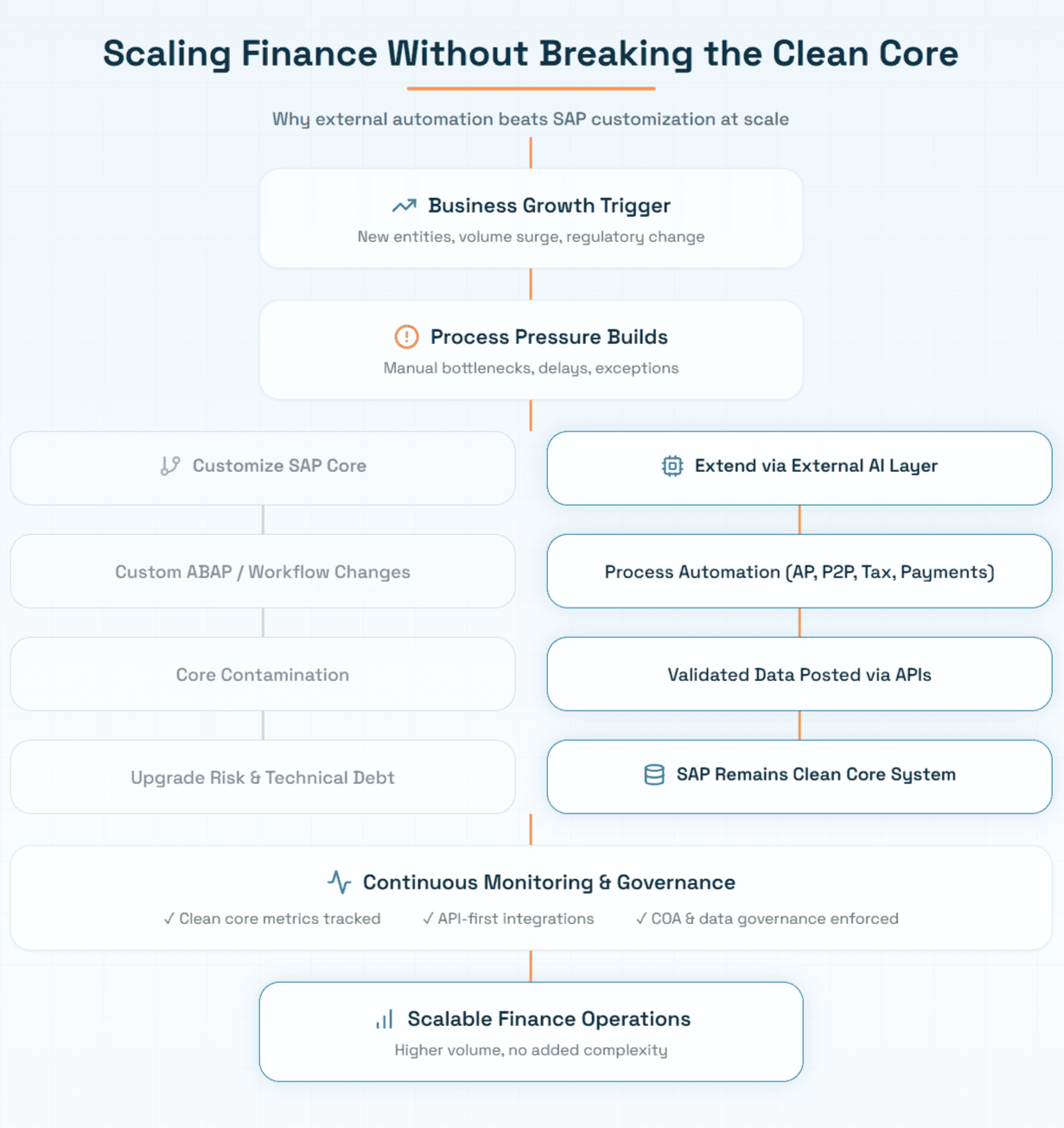
When invoice volumes double or procurement request volumes triple, the manual steps embedded in even a well-designed SAP workflow become bottlenecks. Finance teams under pressure find workarounds, a shared inbox here, an Excel staging file there, a custom approval notification built outside the system. Each workaround is a piece of technical debt and a deviation from the standard process. Over time, these accumulate into informal process variants that are invisible to the system but very visible in your audit results and your month-end close duration.
The right answer is to eliminate the manual bottleneck rather than route around it. But that requires automation tooling that integrates cleanly with S/4HANA at the data layer, not custom code that embeds itself into the core. Understanding the evolution of the P2P process helps contextualise why so many organisations still carry accumulated complexity from earlier automation generations that were not built with clean core in mind.
Organisational Expansion Creates Configuration Sprawl
Adding a new legal entity, subsidiary, or country to SAP S/4HANA is a configuration exercise, not a coding exercise, if the original design was done correctly. In practice, every new entity comes with local requirements: country-specific tax rules, local chart-of-accounts variations, different approval authority matrices, currency handling nuances. Without disciplined governance, each new entity brings a small set of customisations and exceptions that compound across the organisation.
The differences in Chart of Accounts structure across ERPs and across entities within the same ERP are a leading source of this configuration sprawl. Multi-entity finance teams need a COA governance framework that allows local legal requirements without fragmenting the global reporting structure.
Regulatory Change Requires Rapid Adaptation
Sales and use tax rules, e-invoicing mandates, transfer pricing documentation requirements, and financial reporting standards change constantly. Without a clean core, adapting to regulatory change means testing against a tangle of custom objects before you can even assess whether the standard SAP update handles the requirement. With a clean core, SAP's own compliance updates often solve the problem without additional development.
This is one of the least-discussed but highest-value arguments for clean core strategy: regulatory agility. The organisations that fell behind on IFRS 16, on US e-invoicing pilots, or on VAT digitalisation programs were frequently not behind because they lacked awareness, they were behind because their system was too customised to absorb the SAP standard update cleanly.
The Six Pillars of a Durable Clean Core Strategy
1. Extensibility-First Design
SAP's extensibility model on S/4HANA allows additional logic and custom fields to be added via the ABAP RESTful Application Programming Model (RAP) and BTP side-by-side extensions without modifying SAP-delivered objects. This architecture distinction is critical. Side-by-side extensions run independently of the SAP core, survive upgrades without regression, and can be retired without touching the underlying process.
Finance teams should treat every customisation request as a question: can this be achieved in a side-by-side extension? If yes, that is the required path. If not, then the process definition needs to change. This cultural shift is harder than the technical one.
2. Process Standardisation Before Configuration
The sequence matters. Organisations that start with process design, mapping their intended procure-to-pay, invoice-to-pay, or record-to-report flow against SAP best-practice and then configure the system to match, produce cleaner implementations than those that start with the existing process and configure SAP to mirror it.
The purchase order creation process is a good example. SAP's standard PO lifecycle, PR creation, validation, approval, PO dispatch, goods receipt, 3-way match, payment, is well-designed and covers the vast majority of procurement scenarios. Organisations that accept this standard flow and adapt their internal process to match it end up with simpler, more maintainable implementations than those that bend SAP to match a legacy process.
3. Data Governance as a First-Class Discipline
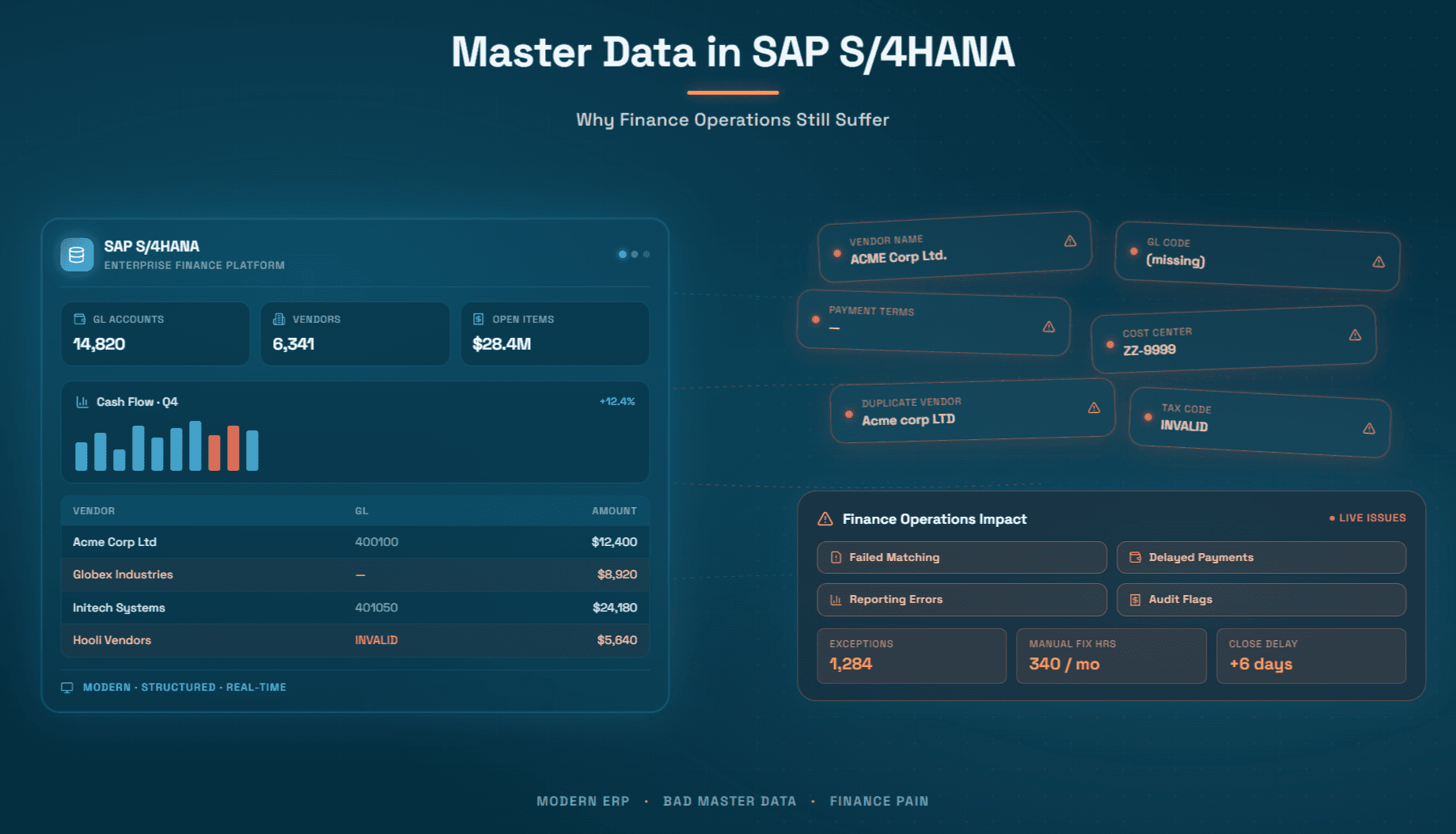
The most common form of technical debt in mature SAP environments is data model degradation, redundant GL codes, inconsistent vendor master records, duplicate cost centres, misaligned chart-of-accounts hierarchies. This debt does not show up in code, so it often escapes the scrutiny applied to ABAP development. But its effects are equally damaging: incorrect financial reporting, failed automated matching, compliance exposure.
Redundant and duplicate GL codes in the Chart of Accounts are a documented and widespread problem in enterprise ERP environments. Establishing a data governance function, with ownership of the COA, vendor master, and cost centre hierarchy, is as important to clean core preservation as any technical architecture decision. Similarly, managing and scaling the COA in QuickBooks Online illustrates how these challenges are not unique to large ERPs; they appear at every scale, and the governance discipline must match the scale of the organisation.
4. Integration Architecture That Respects the Core
Every interface between SAP S/4HANA and an external system is a potential source of core contamination if designed poorly. Custom BAPIs, direct database reads via RFC, or non-standard IDOc extensions create hidden dependencies that break silently during upgrades.
The clean answer is API-first integration, connecting to S/4HANA via its published OData or REST APIs, using SAP Integration Suite (formerly CPI) as the middleware layer, and documenting every interface in a formal integration catalogue. When an external system needs to send data into SAP, an invoice from an AP automation platform, a payment confirmation from a bank, it should do so through a standard interface, not a custom inbound program.
This is particularly important for accounts payable automation systems and AI invoice processing software, which by definition must write data back into SAP. Choosing a platform that connects via SAP's standard interfaces, rather than one that requires custom ABAP to post transactions, is an explicit clean core decision.
5. Upgrade Safety as a Release Gate
Every change to the SAP environment (configuration, extension, integration) should be evaluated against a single question before release: does this change make our next upgrade harder? This sounds obvious, but in practice it requires a formal gate in the change management process.
SAP has formalised this through its Upgrade Readiness Assessment tooling and the SAP Clean Core Compliance Check. Finance and technology leaders should run these assessments not just before upgrades but as a regular health metric, perhaps quarterly, so that technical debt accumulation is visible before it becomes a migration blocker.
6. Continuous Monitoring, Not Point-in-Time Audits
Clean core is not a state you achieve at go-live and then maintain passively. It degrades continuously under the pressure of business change. The organisations that sustain clean core over multi-year horizons treat it as an operational metric, something measured, trended, and reported to leadership alongside operational KPIs.
Metrics to track include: the number of modified SAP objects (target: zero in core), the number of custom Z-programs active in production, the age and business justification of each custom interface, and the COA change frequency and approval rate. Anomalies in these metrics are early warning signals of core degradation, not post-mortems after the damage is done.
Upgrade Safety – The Practical Discipline
Upgrade safety is the most tangible downstream benefit of clean core discipline, and it is also the one most likely to be sacrificed when short-term operational pressure builds. Understanding how upgrade safety erodes and how to protect it, deserves dedicated attention.
What Breaks Upgrade Safety
The primary culprits are well-documented: modifications to SAP-delivered objects (the classic "M" modifications in the modification log), custom ABAP programs that call internal SAP APIs not exposed in the public interface, and integrations that depend on SAP's internal database structures rather than its published service layer. Each of these creates a dependency on SAP's internal implementation, which changes between releases.
Secondary culprits are less obvious: over-configured approval workflows that create circular dependency risks, chart-of-accounts structures that map poorly to SAP's Financial Statement Version tooling, and vendor master configurations that deviate from SAP's published data model recommendations. These do not break technically on upgrade, but they create remediation work after upgrade because the new release's standard features do not work correctly against the non-standard configuration.
Protecting Upgrade Safety Without Constraining the Business
The tension finance leaders feel is real: the business needs the system to do something it does not do today, and the path of least resistance is a custom development. Upgrade safety requires resisting that path but resistance without an alternative just creates a governance conflict.
The sustainable model is to channel customisation demand toward the extensibility layer and toward third-party automation tooling that connects cleanly. If the business needs sophisticated early payment discount optimization, AI-driven capture of missed early payment discounts is a better architectural answer than building custom payment run logic inside SAP. If the business needs intelligent GL coding, a purpose-built AI co-pilot that connects via SAP's standard posting interfaces is a better answer than modifying the FI posting program.
COA Design and GL Coding – The Silent Clean Core Threat
Of all the dimensions of clean core, the chart of accounts and GL coding structure receive the least attention and cause some of the most persistent problems. A poorly designed COA does not trigger a system error. It just silently degrades financial reporting quality, makes automated matching harder, and creates compliance exposure that only surfaces during audits.
Best practices for GL posting in a clean SAP environment require more than technical accuracy, they require a COA design that supports both the granularity needed for operational decision-making and the consolidation needed for statutory reporting. The interrelationships and dependencies between GL codes in ERP systems compound this challenge: a poorly coded invoice does not just produce an incorrect line item; it can cascade into incorrect tax postings, incorrect accrual calculations, and incorrect management reporting.
Ensuring accurate GL coding of expenses is therefore both a data quality initiative and a clean core initiative. When GL coding is done correctly and consistently, SAP's standard reporting tools, standard consolidation functions, and standard audit trail capabilities work as designed. When it is not, teams build custom reports and custom extracts to compensate which then become part of the technical debt landscape.
AI-powered GL coding tools that learn from historical posting patterns and apply consistent coding logic without human intervention are now available and represent one of the highest-ROI applications of AI in the SAP finance environment. They do not modify SAP; they enhance the data quality of what goes into SAP, which is precisely the clean-core-compatible architectural pattern.
Scaling P2P on SAP S/4HANA Without Contaminating the Core
The procure-to-pay process is the highest-volume, most exception-prone process in most SAP finance environments, and therefore the area where clean core is most frequently compromised. Purchase order process automation from intake to 3-way match represents the full scope of what needs to happen cleanly and at scale.
The Automation Layer Above SAP
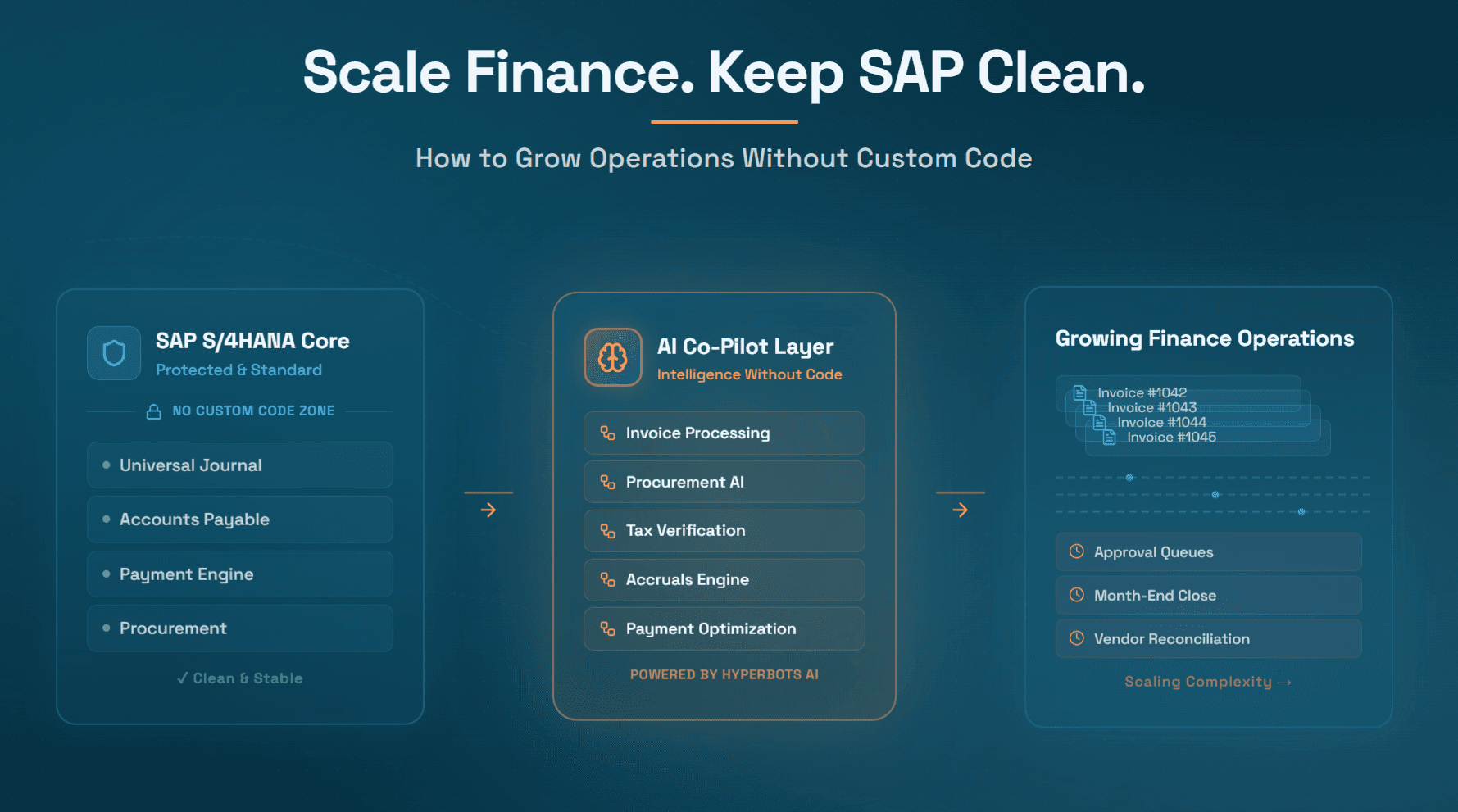
The architectural principle is clear: automation tooling should sit above SAP, not inside it. An AP automation platform should receive invoices, extract data, validate against SAP master data, perform matching, apply GL coding, and then post into SAP through standard interfaces. It should not modify SAP's invoice processing programs. It should not require custom tables to store its working data. And it should not require a custom UI embedded in SAP to operate.
This is a non-trivial selection criterion when evaluating AP automation vendors. Many legacy platforms were built in an era when direct SAP integration required custom development, and they carry that legacy architecture forward. Modern AI-native platforms are built around SAP's standard service layer from the ground up, they are architecturally clean core compatible.
The same principle applies to procurement automation. AI agents for purchase order automation that operate as a layer above SAP, reading from and writing to SAP through standard APIs, can deliver the intelligent automation that prevents the manual workarounds without introducing custom code.
3-Way Matching at Scale
Solving 3-way matching of invoices with AI is one of the most impactful automation opportunities in SAP environments. The standard SAP 3-way match process, reconciling the purchase order, goods receipt, and vendor invoice, is well-designed but requires clean data in all three documents to work without exception. At scale, data quality issues multiply: vendor invoices with non-standard formats, GRNs posted late, PO quantities that differ from invoice quantities by tolerance amounts. Each exception requires manual review.
AI-powered matching that can handle tolerance-based decisions, learn vendor-specific invoice patterns, and resolve common exceptions without human intervention dramatically reduces the manual review burden without modifying SAP's matching logic. The AI operates on the data before it reaches SAP's matching engine, improving the hit rate of the standard process rather than replacing it.
Multi-Agent AI and the Future of Finance Process Automation on SAP
The most significant architectural development in enterprise finance automation is the emergence of multi-agent AI systems such as networks of specialised AI agents that collaborate to handle end-to-end finance processes. Multi-agent collaboration in finance and accounting represents a fundamental shift from the single-function automation tools of the previous decade.
In a multi-agent architecture, each agent handles a specific function: one agent captures and extracts invoice data, another validates it against SAP master data, another performs GL coding, another executes the 3-way match, another makes the payment recommendation. These agents communicate with each other and with SAP through structured interfaces, escalating only genuine exceptions to human review.
This architecture is profoundly compatible with clean core strategy. The intelligence and decision logic lives in the AI layer, not in SAP. SAP receives clean, validated, coded transactions through its standard interfaces. The result is that SAP stays simple, a system of record with clean data and standard processes, while the complexity of real-world finance operations (variable invoice formats, exception management, multi-entity tax rules, early payment optimization) is handled in the AI layer above it.
ERP Integration Architecture for AI-Powered Finance Tools
For finance leaders evaluating AI automation platforms, the integration architecture question is not optional. It is a clean core decision with consequences that extend years beyond the initial deployment. Integrating purchase order automation with ERP systems requires careful consideration of how data flows between the automation platform and SAP, and what residue that integration leaves in the core.
The questions to ask any automation vendor:
Does the platform connect via SAP's published OData or REST services, or does it require custom ABAP? Does it store working data in SAP custom tables, or in its own data layer? Does it require a SAP transport to install anything in the production system? What happens to the integration during a SAP release upgrade? Does the vendor maintain upgrade compatibility, or does the customer carry that burden?
A clean core-compatible integration leaves nothing in the SAP core that is not part of SAP's standard delivery. The automation platform is an adjacent system that communicates with SAP through documented, versioned interfaces. This is both the architecturally correct approach and the approach that maximises the long-term value of the SAP investment.
Hyperbots AI Co-Pilots: Transformational Finance Automation Built for Clean Core Compatibility
With 80% of this discussion grounded in the architectural and operational principles of clean core strategy, this section addresses the technology layer that finance teams are increasingly deploying to put those principles into practice at scale.
Hyperbots is an AI co-pilot platform purpose-built for finance and accounting automation. Its architecture is AI-native which means the intelligence is in the AI layer, not embedded in ERP code and it connects to SAP S/4HANA and other ERP systems through standard published interfaces. This design is not incidental; it is the product of deliberate clean core-compatible architecture. The platform delivers up to 80% reduction in operational costs across finance workflows, with documented accuracy rates of 99.8% in invoice processing.
Procure-to-Pay Co-Pilots
Invoice Processing Co-Pilot. Hyperbots' Invoice Processing Co-Pilot handles the complete invoice lifecycle from receipt to GL posting. Invoices arrive through any channel like email, portal, EDI, scan and the co-pilot extracts all relevant fields without templates, using AI trained on finance-specific document patterns. It validates extracted data against SAP master data in real time, performs 2-way or 3-way matching according to configurable tolerance rules, applies GL coding based on historical patterns and policy rules, and posts clean transactions into SAP through standard interfaces.
The benefit to finance operations is measurable and immediate: straight-through processing rates of 80% or more mean that the majority of invoices flow from receipt to GL posting without a human touch. Exception handling is handled intelligently as the co-pilot resolves common exceptions autonomously and escalates genuine anomalies to reviewers with full context. Teams that previously employed large AP processing teams find that headcount can be redeployed to higher-value analysis and vendor relationship management. Extreme Reach achieved 80% straight-through processing and 99.8% accuracy deploying Hyperbots in their AP environment.
Procurement Co-Pilot. The Procurement Co-Pilot automates the end-to-end requisition-to-PO workflow. Purchase requests arrive from any source like email, form, existing system and the co-pilot extracts the request details, validates them against budget controls and procurement policies, routes for approval based on configurable rules, generates the purchase order, and dispatches it to the vendor. The PR-to-PO cycle that typically takes three days compresses to four hours. More importantly, it happens consistently, with full audit trail and policy compliance, without any custom workflow code in SAP.
Vendor Management Co-Pilot. Vendor onboarding is a persistent source of manual work and compliance risk. The Vendor Management Co-Pilot automates the collection and validation of vendor master data, performs identity verification, manages portal communication, and maintains ongoing vendor compliance monitoring. Vendors interact through a self-service portal; the co-pilot handles the data validation and SAP master data updates through standard interfaces. The result is faster onboarding, lower fraud risk, and cleaner vendor master data which directly supports matching accuracy and payment integrity.
Sales Tax Verification Co-Pilot. Incorrect sales and use tax on vendor invoices creates both overpayment leakage and compliance exposure. The Sales Tax Verification Co-Pilot validates tax on every invoice line item, checking jurisdiction rules, tax category classification, origin and destination addresses, and economic nexus thresholds, before the invoice posts to SAP. One CFO deployment identified and eliminated $200,000 in annual tax leakage through this automated verification. The co-pilot integrates with tax dictionaries for multi-jurisdiction accuracy and produces audit-ready documentation for every tax decision.
Payments Co-Pilot. The Payments Co-Pilot optimises the payment execution layer, recommending early payment discount capture, managing strategic late payment decisions based on cash position and vendor relationship data, processing ACH and check payments, and performing bank reconciliation. Payment decisions that were previously made based on available cash without systematic discount analysis are now made with AI-driven recommendations that maximise working capital efficiency while protecting vendor relationships.
Accruals Co-Pilot. Month-end accruals are one of the highest-effort, highest-error-rate processes in SAP finance environments. The Accruals Co-Pilot discovers accrual candidates such as goods received but not invoiced, services rendered but not billed, recurring expenses without POs, automatically and calculates accrual amounts, books journal entries into SAP, and reverses them in the following period. The period-end close accelerates materially, and the risk of missed or misstated accruals declines substantially.
Order-to-Cash Co-Pilots
Collections Co-Pilot. The Collections Co-Pilot automates AR collections workflows, identifying overdue balances, prioritising follow-up based on customer relationship and payment history, generating and sending collection communications, and tracking dispute resolution. Teams that previously managed collections through manual spreadsheet tracking and unstructured email find that the co-pilot systematises the process while preserving the relationship nuance that effective collections requires.
Cash Application Co-Pilot. Matching incoming payments to open invoices is deceptively complex, remittance advice formats vary, partial payments require decision logic, and misapplied cash creates downstream reconciliation problems. The Cash Application Co-Pilot handles this matching automatically, applying AI to resolve ambiguous remittance data and post clean clearing entries to SAP. Cash application that previously consumed a material portion of the AR team's capacity becomes largely autonomous.
Platform Capabilities Creating Transformational Impact
Hyperbots' platform capabilities extend beyond individual co-pilot functions to deliver system-level benefits:
Unlimited-user licensing means there is no per-seat cost barrier to deploying AI automation across the entire finance organisation. Finance teams that would otherwise limit access to avoid licence costs can deploy co-pilots to every accountant, controller, and AP processor who benefits from AI assistance.
Pre-trained, finance-specific AI models mean deployment timelines are measured in days, not months. Unlike generic AI platforms that require extensive training on company-specific data before achieving usable accuracy, Hyperbots' models arrive pre-trained on finance document patterns and achieve high accuracy from day one.
Self-learning AI means accuracy improves continuously. As the co-pilots process more transactions and receive feedback on exceptions, they refine their extraction, coding, and decision models. The 99.8% accuracy figure is not a static benchmark, it represents the performance level that organisations reach and then maintain as volume scales.
Human-in-the-loop oversight is built into every workflow. Exceptions that the AI cannot resolve with confidence are escalated to human reviewers with full context, the extracted data, the matched documents, the reason for escalation, and suggested resolution paths. The human decision is then fed back into the AI model. This architecture means that edge cases improve the system rather than defeating it.
24/7 operation means finance processes run continuously without the staffing cost of shift coverage. Invoice processing does not pause overnight. Payment recommendations are available at any hour. Period-end accrual discovery runs when it is needed, not when a team member is available.
Comprehensive audit trails for every AI decision mean that the documentation requirements of finance compliance, SOX, internal audit, external audit, tax authority review, are met automatically. Every GL coding decision, every matching decision, every payment recommendation is logged with the reasoning behind it and the human approvals obtained.
Hyperbots serves manufacturing companies, retail organisations, and professional services firms, with industry-specific configurations that reflect sector-specific AP patterns, procurement workflows, and compliance requirements. The manufacturing industry page details how Hyperbots handles the PO-heavy, multi-site procurement complexity characteristic of manufacturing environments. The industry overview covers the full range of supported sectors.
ROI Improvements Across P2P and O2C
The ROI case for Hyperbots deployment is grounded in both tangible and intangible benefits:
Tangible P2P benefits include: 80% reduction in invoice processing cost per invoice; 80% straight-through processing rate eliminating the majority of manual touches; 99.8% accuracy reducing error-driven rework; PR-to-PO cycle compression from 3 days to 4 hours; early payment discount capture rates increasing materially when the payment co-pilot systematically identifies and acts on discount opportunities; and tax leakage elimination through automated sales tax verification.
Tangible O2C benefits include: AR days outstanding reduction through systematic collections follow-up; cash application auto-match rates above 90% reducing manual matching effort; and dispute resolution cycle time reduction through structured workflow management.
Intangible benefits are equally significant: clean SAP data resulting from AI-validated inputs improves financial reporting accuracy; audit readiness improves through comprehensive logging; finance team capacity is freed from transaction processing for strategic analysis; and, directly relevant to this article's central topic, the pressure to customise SAP is reduced because the AI co-pilot layer handles the process complexity that would otherwise drive bespoke development.
Finance leaders can explore the ROI calculators for invoice processing, procurement, payments, accruals, collections, cash application, and vendor management to model organisation-specific returns.
Governance Model for Sustained Clean Core in a Scaling Finance Organisation
The technology choices described above create the conditions for clean core sustainability. But technology alone does not maintain a clean core, governance does. The organisations that sustain clean core over five-year and ten-year horizons have institutionalised specific governance practices.
A Clean Core Office or Centre of Excellence. Assign explicit ownership of clean core metrics to a team, typically sitting at the intersection of Finance, IT, and the SAP competence function. This team reviews every change request against clean core criteria before it enters development, tracks clean core metrics quarterly, and owns the relationship with SAP on upgrade readiness.
Process change before system change. Every request to modify SAP should first be evaluated as a process change opportunity. Can the business requirement be met by changing the process rather than the system? Frequently the answer is yes, and the process change is often an improvement over the workaround the system change would have enabled.
Architecture Review Board with clean core authority. System changes and new integrations should require ARB review, with explicit clean core compliance as a gate criterion. The ARB should have authority to reject changes that would compromise upgrade safety, even when the business case for the change is compelling.
Vendor selection criteria that include clean core compatibility. Every technology vendor connecting to SAP S/4HANA should be evaluated on clean core criteria: API-first integration, no SAP core modifications, documented upgrade compatibility. This criterion should carry material weight in vendor selection decisions.
Clean Core Is a Strategic Posture, Not a One-Time Achievement
Keeping SAP S/4HANA clean while scaling finance operations requires treating clean core as an operating discipline rather than a project deliverable. The pressures that drive core contamination, volume growth, organisational expansion, regulatory change, short-term operational urgency, are permanent features of a scaling enterprise. The governance structures, architectural choices, and technology layers that resist those pressures need to be equally permanent.
The emergence of AI-native finance automation platforms that connect to SAP through standard interfaces, rather than embedding complexity into the core, represents a structural shift in the economics of clean core maintenance. The choice is no longer between operational capability and clean core compliance. Modern AI co-pilot platforms like Hyperbots deliver the operational capability, 80% cost reduction, 99.8% accuracy, 80% straight-through processing, without the SAP core modifications that previous-generation tools required.
Finance leaders who invest in clean core governance today are building the upgrade safety and architectural flexibility that will compound in value over every subsequent SAP release cycle. And they are creating the conditions for AI-powered finance operations where the intelligence layer above SAP grows in capability over time while the SAP core remains clean, maintainable, and ready for whatever SAP's product roadmap delivers next.
To explore how Hyperbots AI co-pilots can extend your SAP S/4HANA capabilities without compromising your clean core, visit the Hyperbots platform overview or request a personalised demonstration.
Frequently Asked Questions (FAQs)
What is the difference between clean core and a vanilla SAP implementation?
A vanilla implementation means using SAP with no customisation at all which is impractical for most real-world organisations. Clean core is a more nuanced standard: it allows extensibility and configuration, but requires that extensions sit outside the core application layer. The goal is upgrade safety and maintainability, not configuration minimalism.
Q1. How do we evaluate whether our current SAP S/4HANA environment is clean?
SAP provides the Clean Core Compliance Check within its SAP Signavio and SAP LeanIX tooling. This identifies modified SAP objects, custom ABAP programs, non-standard interfaces, and configuration deviations. Running this assessment is the starting point for any clean core improvement programme.
Q2. Does adopting AI co-pilots for AP automation require SAP customisation?
It depends on the platform. Modern AI-native platforms like Hyperbots connect to SAP through standard published interfaces like OData, REST, or standard IDOc and do not require custom ABAP or SAP core modifications. Legacy AP automation platforms may have been built with custom SAP integration and require evaluation against clean core criteria.
Q3. How does clean core strategy interact with SAP's RISE with SAP programme?
RISE with SAP, SAP's cloud ERP offering, comes with SAP's own clean core requirements as a condition of the managed service. Organisations migrating to RISE with SAP will be required to remove core modifications as part of the migration. Building clean core discipline now, before a RISE migration, reduces the remediation scope and therefore the migration cost.
Q4. How quickly can AI co-pilots be deployed on top of an existing SAP S/4HANA environment?
With pre-trained, AI-native platforms like Hyperbots, go-live timelines are measured in days for initial deployment. Full production deployment across all co-pilots typically takes weeks rather than the months required by traditional automation implementations. The pre-trained models eliminate the data accumulation period that generic AI tools require before reaching usable accuracy.
Q5. What does 99.8% invoice processing accuracy mean in practice?
At 99.8% accuracy, roughly 2 invoices in 1,000 require human correction. For an organisation processing 10,000 invoices per month, that means approximately 20 manual reviews rather than the hundreds or thousands that a manual or lower-accuracy automated process would generate. The downstream effect is a dramatically smaller AP team requirement and materially lower error-driven rework costs.
Q6. How does Hyperbots handle multi-entity SAP environments?
Hyperbots supports multi-entity finance operations natively, with separate ledgers, tax rules, approval workflows, and reporting structures for each entity. This is particularly relevant for organisations scaling through acquisition or geographic expansion, new entities can be onboarded to the co-pilot layer without modifying SAP configuration for existing entities.
Q7. Is AI-powered finance automation suitable for mid-market SAP users as well as large enterprises?
Yes. Hyperbots' unlimited-user licensing model and rapid deployment timelines make AI co-pilot automation accessible to mid-market organisations that do not have large SAP competence teams or long implementation capacity. The pre-trained models reduce the data volume requirement that has historically made AI unsuitable for smaller deployments.