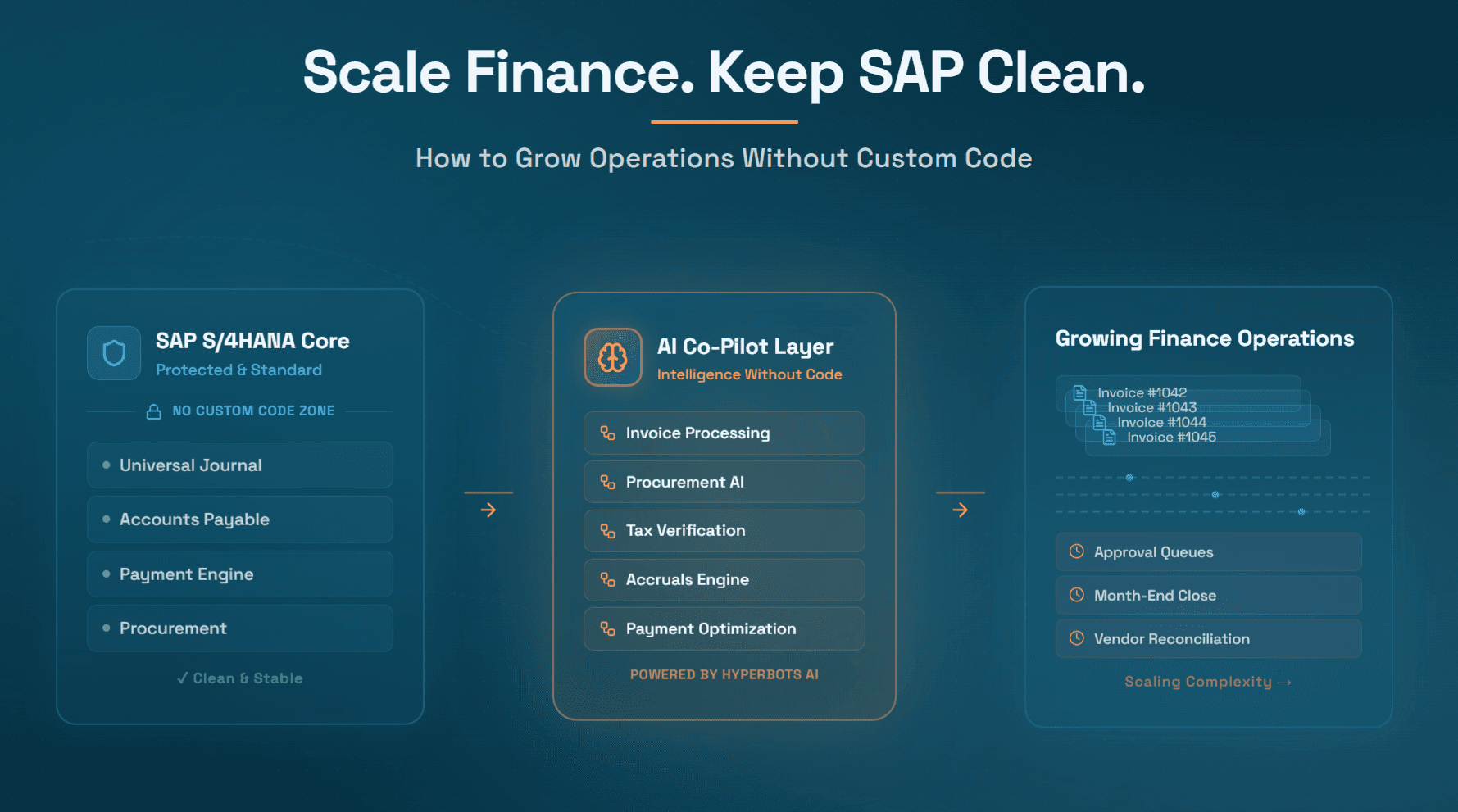
How Finance Teams Extend SAP S/4HANA Without Breaking the Clean Core
How finance teams add intelligence and automation without introducing technical debt
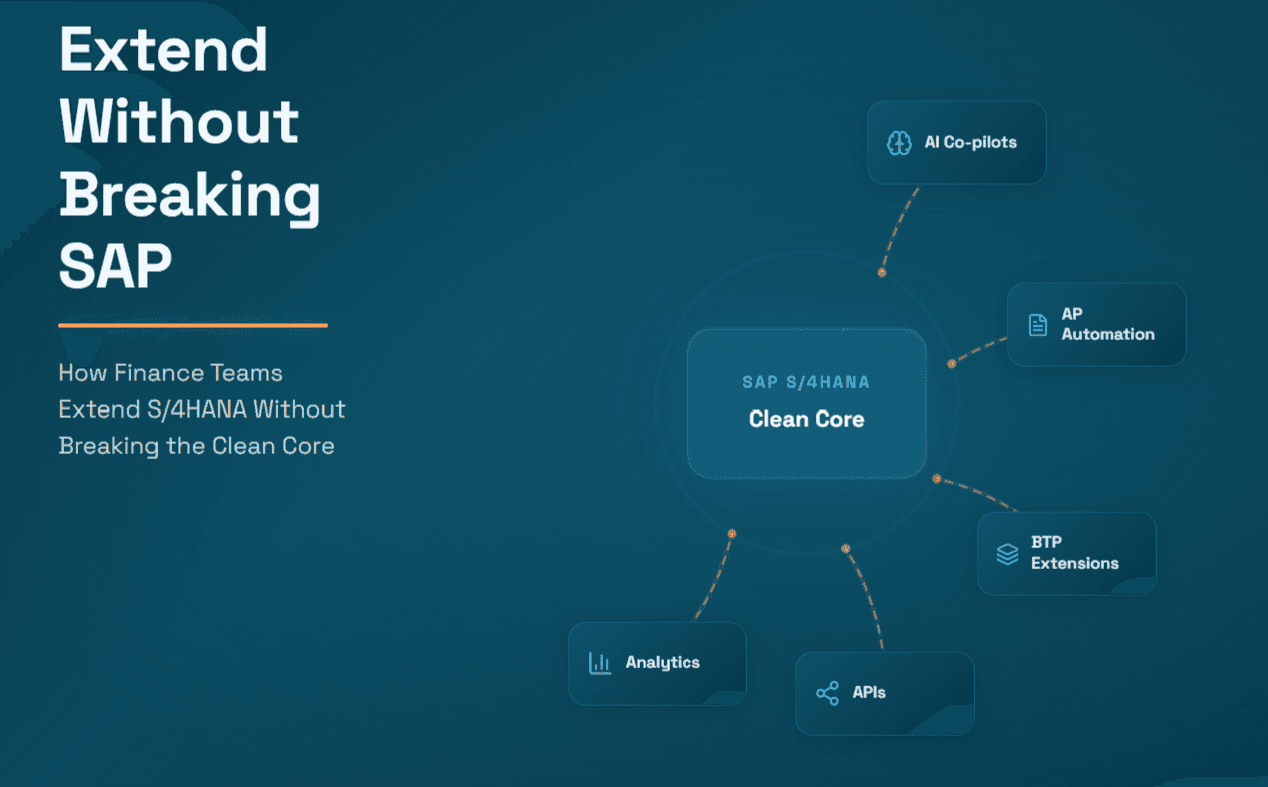
SAP S/4HANA represents one of the most significant ERP modernization investments a company can make. For finance teams, it is the system of record, the authoritative source of truth for general ledger, accounts payable, procurement, accruals, and financial close. But the promise of a unified, cloud-ready ERP comes with a constraint that CFOs, controllers, and IT leaders must take seriously: the imperative to preserve the clean core.
The clean core principle holds that customizations, business logic, and process-specific extensions should live outside the SAP kernel, not embedded in it. In practice, this means that any intelligent automation a finance team wants to layer onto S/4HANA, smarter invoice processing, AI-assisted procurement, real-time tax verification, must be built or acquired through external platforms that integrate cleanly without modifying standard SAP objects.
This guide explores what the clean core principle means for finance operations, why it matters so much in the S/4HANA era, and how modern AI platforms are enabling finance teams to extend their capabilities dramatically through external platforms without a single line of custom code touching the SAP core.
What Is the SAP Clean Core and Why Does It Matter for Finance?
The term "clean core" has become one of the most discussed, and the most misunderstood, concepts in enterprise technology. At its simplest, a clean core SAP implementation means an instance of S/4HANA that:
Contains no modifications to standard SAP code objects (Z-objects replaced with SAP standard)
Has no custom ABAP code embedded in the core application layer
Uses only SAP-approved extension mechanisms (BAdIs, Business Events, Side-by-Side Extensions)
Can accept SAP upgrades and releases without regression testing of hundreds of custom objects
Maintains full SAP support eligibility
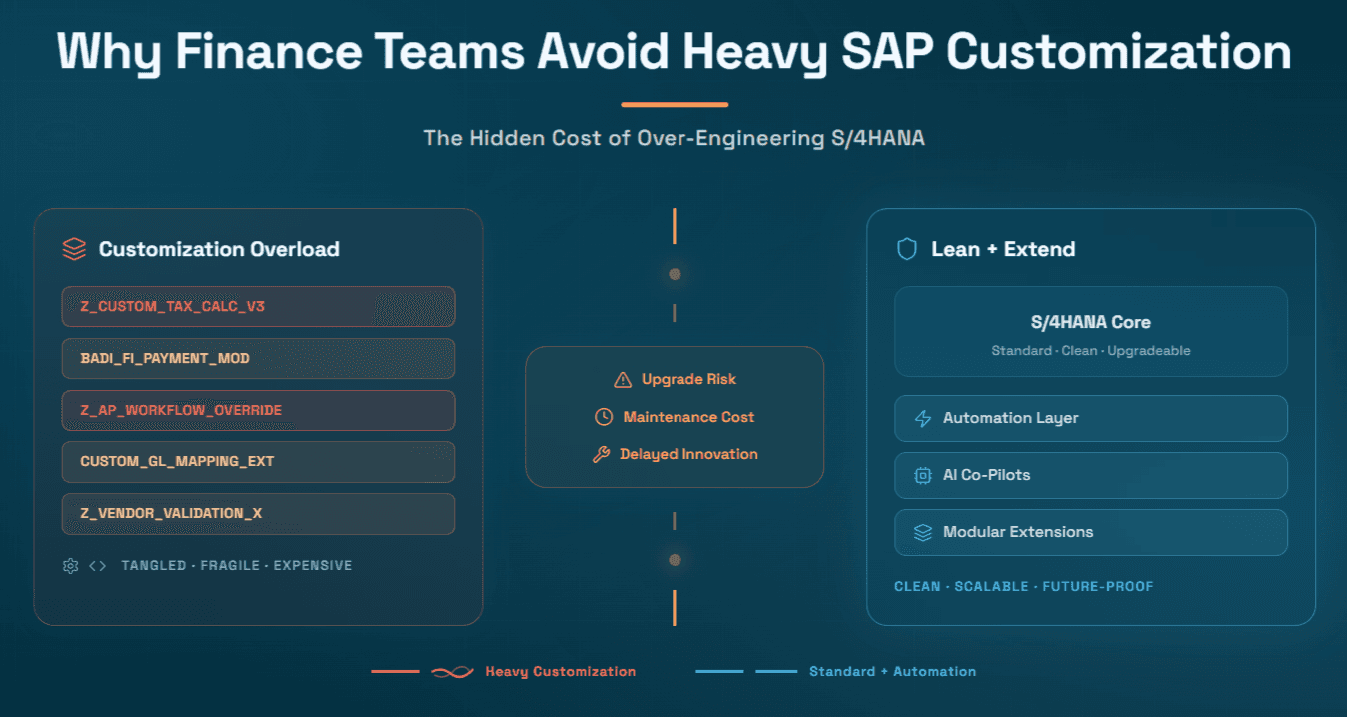
For finance teams, the implications are deeply practical. Historically, SAP implementations accumulated years of custom development, bespoke approval workflows, modified document processing routines, patched tax logic, custom GL coding rules. Each one was created with good intentions, but together they formed a brittle web of dependencies that made every upgrade expensive, every new release risky, and every audit cycle more complex.
SAP's move to S/4HANA and RISE with SAP is explicitly designed to break this cycle. The clean core isn't just an architectural preference, it is increasingly a commercial obligation. As organizations move to public cloud deployments of S/4HANA, SAP enforces constraints that make heavy customization structurally impossible. Modifications must go through external platforms or SAP's own extensibility tools.
SAP's own data suggests that Clean Core adoption can deliver 20–30% faster upgrades and meaningfully lower technical debt over time. For finance leaders managing tight operations budgets, that number matters.
But there is a paradox here. Finance teams are also under more pressure than ever to automate, to accelerate close cycles, to eliminate manual intervention in invoice processing and procurement, and to meet increasingly complex compliance obligations. The clean core principle says "don't customize the core." Finance operations reality says "we need much more intelligence than standard SAP provides."
The resolution to this paradox is the rise of finance-specialized external platforms, purpose-built AI and automation layers that integrate with S/4HANA through supported APIs, connect to the ERP's data model without modifying it, and deliver the process intelligence that SAP's standard functionality alone cannot provide.
The Architecture of Clean Core Extension – How External Platforms Connect to S/4HANA
Before evaluating any external platform for finance automation, it is essential to understand the approved architecture patterns for extending S/4HANA without touching the clean core. SAP has defined a clear extensibility model that distinguishes between what belongs inside S/4HANA and what belongs outside it.
Side-by-Side Extension Model
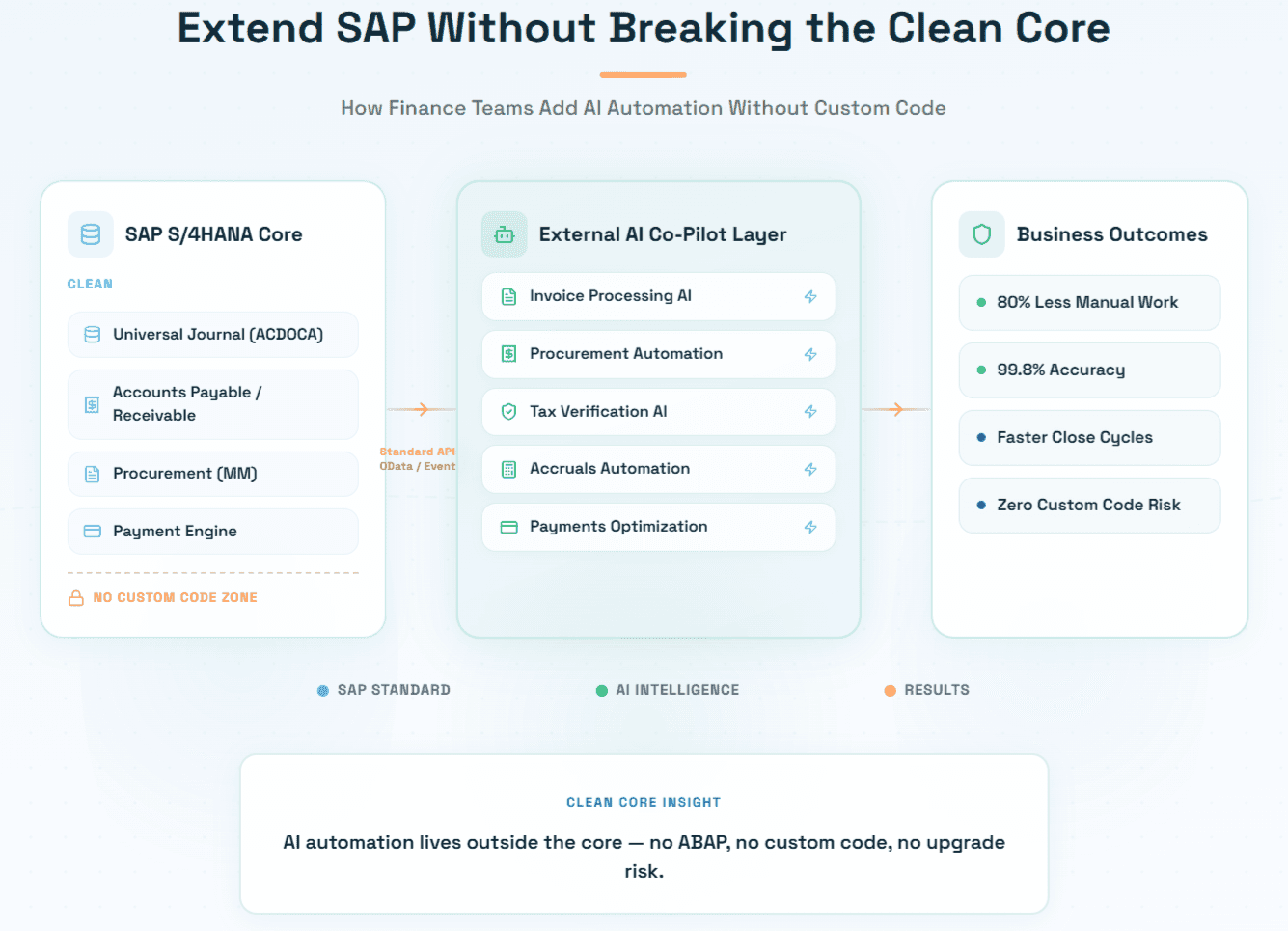
The most important pattern for finance automation is the side-by-side extension. In this model, a separate application, hosted on SAP BTP (Business Technology Platform) or any external cloud, communicates with S/4HANA exclusively through published APIs, OData services, and Business Events. The extension application has its own data store, its own processing logic, and its own user interface. It reads from and writes to S/4HANA through approved integration channels only.
For accounts payable, this means an external invoice processing platform can receive invoice data, validate it, apply matching logic, and post the validated result back to S/4HANA's FI module through standard document posting APIs without embedding any custom ABAP in the invoice processing pipeline.
For procurement, an external platform can create purchase requisitions, manage approval workflows, generate purchase orders, and dispatch them to vendors, posting the completed PO back to SAP MM through standard interfaces.
Event-Driven Integration
S/4HANA's Business Event Handling framework allows external platforms to subscribe to events triggered inside SAP (a goods receipt posted, a payment run initiated, a vendor master changed) and react accordingly. This is particularly valuable for AI-driven platforms that need to operate continuously, processing documents as they arrive rather than polling in batch cycles.
BTP Integration Suite
For organizations committed to the SAP ecosystem, SAP BTP Integration Suite provides a managed middleware layer that handles connectivity, transformation, and routing between S/4HANA and external platforms. Even without BTP, however, modern external platforms provide their own pre-built connectors to S/4HANA that bypass the need for custom integration development.
The key principle across all these patterns is the same: the intelligence, the business logic, the AI models, and the workflow configurations live entirely outside S/4HANA. SAP remains the clean system of record. The external platform provides the process automation layer that SAP's standard functionality doesn't and was never intended to supply.
Why Standard SAP Finance Functionality Leaves Gaps That External Platforms Must Fill
It is important to be precise about this: SAP S/4HANA is an extraordinary piece of enterprise software. Its financial management capabilities, from universal journal accounting to real-time asset accounting to predictive accounting, are genuinely best-in-class. But SAP was not designed to be, and should not be evaluated as, an end-to-end AI-powered process automation engine for the specific, highly contextual tasks that finance operations teams perform daily.
Consider the following scenarios, each of which represents a gap that emerges in virtually every S/4HANA implementation:
Invoice Processing Intelligence
SAP Intelligent Document Processing (IDP) has improved considerably, but it relies on template-based extraction models that struggle with the extraordinary diversity of real-world vendor invoice formats. A global company receiving invoices in dozens of formats, languages, and currencies needs extraction accuracy well above what template-based approaches deliver. The cost of a 2% error rate, at scale, is substantial, manual review queues, delayed payments, missed discounts, duplicate payment risk, and strained vendor relationships.
GL Coding Consistency
SAP's account determination rules can automate GL coding for standard purchase categories, but they break down in edge cases: invoices without PO references, service invoices with ambiguous cost center allocation, multi-line invoices spanning multiple GL accounts. Finance teams end up with a coding exception queue that requires skilled accountants to resolve manually, every month, every close cycle.
3-Way Matching at Scale
SAP's standard matching functionality supports 2-way and 3-way matching, but tolerance management, exception routing, and the handling of partial deliveries or services-rendered invoices requires configuration sophistication that most implementations approximate rather than fully automate. The result is a pool of invoices that require human intervention despite having all the data needed for automated resolution.
Accruals Discovery
Month-end accruals remain one of the most labor-intensive processes in finance. SAP does not automatically identify unbilled liabilities such as goods received but not yet invoiced, services rendered under recurring contracts, purchase orders partially fulfilled. Finance teams must query this information manually, build accrual workbooks, and post journal entries. This is time-consuming, error-prone, and difficult to audit.
Sales Tax Verification
For US-based AP operations, verifying that vendors have charged correct sales and use tax on every invoice requires cross-referencing the invoice's line items, origin and destination addresses, applicable jurisdiction rules, and the company's exemption status. SAP's tax determination can handle certain scenarios automatically, but it does not perform real-time AI-driven verification of vendor-charged taxes at the line-item level.
These are not criticisms of SAP, they are accurate descriptions of the boundary between what a transactional ERP system is designed to do and what specialized AI automation platforms are designed to do. The right architectural response is not to customize SAP to fill these gaps (that violates the clean core) but to deploy purpose-built external platforms that are specifically trained and configured to address them.
Key Functional Areas Where External Platforms Transform Finance on SAP
When finance teams map their process bottlenecks against the clean core constraint, they typically identify five to seven areas where external platforms deliver the most measurable impact. Understanding each area helps prioritize the deployment roadmap.
Procure-to-Pay Automation
The procure-to-pay process is a sequence of handoffs from purchase requisition through PO creation, goods receipt, invoice receipt, matching, approval, and payment and each handoff is a potential delay or error point. In a clean core S/4HANA environment, every stage of this sequence can be handled by specialized external platforms that post their output into SAP's standard document structures: MM purchase orders, FI vendor invoices, payment runs.
The benefit of automating P2P end-to-end on top of S/4HANA, rather than inside it, is that each stage can incorporate AI reasoning specific to that stage: policy-aware PR validation, intelligent vendor selection for PO creation, AI-driven 3-way matching, and payment optimization logic that evaluates early payment discount capture against the cash position.
Invoice Processing Automation
AI invoice processing is the highest-volume, highest-frequency task in most AP departments. An external platform that achieves 99%+ accuracy in extracting invoice data, classifying line items, assigning GL codes, performing matching, and routing exceptions can transform what is currently a heavily manual process into a largely autonomous one, while posting only validated, approved payables data into SAP.
The straight-through processing rate, the percentage of invoices that flow from receipt to posting with zero human intervention, is the critical KPI. Organizations that achieve 80%+ STP rates effectively eliminate the majority of their AP headcount cost while improving accuracy and vendor satisfaction simultaneously.
Procurement and Requisition Management
Purchase order automation, from intake of purchase requests to validated, dispatched POs, is an area where SAP's standard functionality handles the transactional mechanics but not the intelligence layer. An external platform can validate PRs against budgets and policies, auto-generate PO text and terms from vendor master data, route approvals based on configurable thresholds, and dispatch completed POs to vendors with the final PO document posted back into SAP MM.
This is particularly valuable for manufacturing organizations where procurement volumes are high, multi-site purchasing is common, and tight integration between purchase orders and production planning is essential.
Accruals Automation
Automating the accruals process in a clean core environment means deploying a platform that can query SAP's open purchase order and goods receipt data, identify accrual candidates using AI, calculate accrual amounts, generate journal entries in SAP-compatible format, and post them through standard accounting interfaces with full audit trail and automatic reversal configuration.
This removes the single most labor-intensive element of month-end close from the finance team's workload without requiring any modification to SAP's financial accounting core.
Vendor Management and Compliance
Vendor onboarding and management requires collecting, validating, and maintaining vendor master data that must ultimately reside in SAP's vendor master. An external platform can manage the full onboarding workflow, identity verification, bank detail validation, tax document collection, compliance screening and sync validated vendor records into SAP's BP (Business Partner) master data structure.
Sales Tax Verification
For US AP operations, sales tax verification requires AI-driven validation of vendor-charged taxes at the line-item level which is something that standard SAP tax determination does not perform on inbound invoices. An external platform can integrate tax jurisdiction data, validate tax categories for each line item, flag mismatches, and produce audit-ready documentation.
Payment Optimization
The payment decision process, determining whether to pay early for a discount, on due date, or late based on cash position and vendor relationship strategy, is a high-value area where AI can substantially outperform rule-based SAP payment programs. An external platform can analyze the full payables portfolio, model cash flow impact, flag early discount opportunities, and feed optimized payment batches back to SAP's payment run.
Integration Architecture Best Practices for Clean Core Compliance
Deploying external platforms to extend S/4HANA finance capabilities requires careful attention to integration design. The following principles reflect the practices of leading finance transformation projects.
Prefer Standard APIs Over Point-to-Point Custom Connections
S/4HANA exposes a rich set of OData and REST APIs for document creation, master data synchronization, and workflow triggering. Any external platform should connect exclusively through these published interfaces. Custom RFC calls, BAPI wrappers, or direct database access all introduce coupling that violates clean core principles and creates upgrade risk.
Maintain SAP as the Single System of Record
The external platform should be the system of process intelligence and workflow, but SAP should remain the system of record for all financial transactions. This means that every validated invoice, purchase order, payment, and journal entry generated by an external platform must be posted into SAP, not stored only in the external system. The external platform is a processor; SAP is the ledger.
Use Event Subscriptions for Real-Time Synchronization
Batch-based integration creates latency and complexity. Where SAP's Business Event framework supports it, external platforms should subscribe to real-time events (goods receipt posted, vendor invoice created, payment cleared) to keep process state synchronized without polling.
Implement Comprehensive Audit Trails in the External Platform
Because the external platform is performing process automation steps that are not natively visible in SAP's document flow, it must maintain its own comprehensive audit trail that documents every AI decision, every human approval, and every data transformation. This is essential for SOX compliance, external audit, and internal control testing.
Validate Integration in a Non-Production Environment First
Clean core compliance means that integration testing can be performed in a sandbox S/4HANA environment because the integration touches only standard interfaces that behave identically across environments. This is one of the genuine operational benefits of the clean core approach: integration validation is faster and lower-risk when no custom code is involved.
The Policy-Driven AI Advantage for Finance on SAP
One of the most important, and least discussed, dimensions of external platform selection for finance automation is the role of policy-driven AI. The most effective external platforms for SAP are not those that apply generic machine learning to invoice data or procurement requests. They are those that allow finance teams to configure company-specific rules, approval thresholds, GL coding logic, tax treatment preferences, and vendor-specific matching tolerances and then apply AI reasoning to enforce those policies automatically.
This matters because finance operations are not generic. A manufacturing company's three-way matching tolerance for raw material invoices is different from a professional services firm's matching logic for consultancy invoices. A CFO who wants to capture all early payment discounts above 1.5% net 30 needs a payment platform that understands that policy and applies it across thousands of invoices, not a rule engine that fires on a fixed schedule regardless of cash position.
Policy-driven AI is the architectural principle that makes this possible. The AI model provides the general capability, document understanding, pattern recognition, anomaly detection, decision reasoning. Company-specific policies provide the context that transforms general capability into specific, reliable automation.
This also has clean core implications. Policy-driven external platforms can be reconfigured as company policies change without modifying the SAP core and without rebuilding the platform. Policy changes are configuration changes, not development projects.
How Hyperbots Extends SAP S/4HANA Without Touching the Clean Core
Hyperbots is purpose-built to extend SAP S/4HANA and other leading ERPs through a clean, API-first integration architecture that connects to the ERP's standard interfaces without modifying any core objects. Every AI co-pilot in the Hyperbots suite operates as an external platform: receiving data from SAP, applying AI intelligence, and posting validated results back through standard SAP document interfaces.
This architecture means that deploying Hyperbots on a RISE with SAP or cloud S/4HANA instance requires no ABAP development, no modification of standard SAP objects, and no impact on SAP's clean core assessment. Finance teams gain advanced AI automation capabilities while remaining fully upgrade-eligible and SAP-supported.
The Hyperbots platform delivers AI co-pilots across the full spectrum of finance operations, with documented results of 80% reduction in operations costs, 99.8% invoice processing accuracy, and 80%+ straight-through processing rates. For manufacturing companies and organizations across all industries, these results represent transformational impact.
The Hyperbots P2P Co-Pilot Suite
Invoice Processing Co-Pilot
The Invoice Processing Co-Pilot addresses the highest-volume task in any AP operation. It ingests invoices from any channel such as email, vendor portals, EDI, scanned documents and applies AI-native extraction that does not rely on templates. This is not OCR with rules layered on top; it is a purpose-trained finance AI that understands invoice structure, identifies line items, validates totals, and assigns GL codes based on both the invoice content and the company's configured coding policies.
The practical benefit is that finance teams stop spending their time on data entry and exception resolution. A team that previously spent 60% of its hours manually processing invoices can redirect that capacity toward vendor relationship management, payment strategy, and financial analysis. The XR (Extreme Reach) case study demonstrates 80% straight-through processing and 99.8% accuracy in a production deployment, results that validate the platform's readiness for enterprise-scale finance operations.
Vendor Management Co-Pilot
Vendor onboarding is one of the most compliance-sensitive processes in finance. Errors in the vendor master, incorrect bank details, unverified identity, missing W-9 or tax documentation, create fraud exposure, payment failures, and audit risk. The Vendor Management Co-Pilot automates the full onboarding workflow: collecting required documents through a self-service vendor portal, performing identity verification, validating bank account details, screening against compliance lists, and syncing the verified vendor record into SAP's Business Partner master.
For finance teams managing hundreds of vendor onboardings annually, this means onboarding cycle times measured in hours rather than weeks, with a fully auditable compliance record for every vendor in the system.
Procurement Co-Pilot
The Procurement Co-Pilot automates the full PR-to-PO cycle. Purchase requests, whether submitted through the Hyperbots interface, extracted from email, or integrated from upstream systems, are validated against budgets and procurement policies, routed through configurable approval workflows, converted to POs with AI-populated vendor and pricing data, and dispatched to vendors. Completed POs post back into SAP MM through standard interfaces.
The business impact is compressed cycle times. The PR-to-PO case study documents a reduction from a 3-day cycle to 4 hours, a transformation that directly reduces the cost of procurement operations while improving visibility and compliance.
Sales Tax Verification Co-Pilot
The Sales Tax Verification Co-Pilot performs real-time AI-driven validation of vendor-charged sales and use taxes on every invoice. It extracts line-item details, validates origin and destination addresses, classifies tax categories, checks against jurisdiction rules, and flags mismatches for review. The CFO tax leakage case study documents $200,000 in annual tax leakage eliminated through automated verification, a direct financial benefit that many organizations never previously quantified because manual verification was too resource-intensive to perform consistently.
Payments Co-Pilot
The Payments Co-Pilot brings AI-driven intelligence to payment timing and method decisions across the full AP portfolio. It evaluates early payment discount opportunities, models the cash flow impact of payment timing decisions, recommends optimal payment schedules, and executes approved payment batches through SAP's standard payment run interfaces. For organizations with significant invoice volumes, the captured discounts and optimized payment timing generate substantial working capital benefits that far exceed the platform cost.
Accruals Co-Pilot
The Accruals Co-Pilot transforms month-end close by automating the discovery, calculation, booking, and reversal of accrual entries. It queries SAP's open PO and GRN data to identify goods received but not invoiced, identifies recurring service obligations without POs, calculates accrual amounts, generates journal entries, and posts them through SAP's standard FI interfaces with automatic reversal entries configured for the following period. The result is a month-end close process where accruals require a fraction of the hours they previously consumed, with a fully auditable record of every entry.
The Hyperbots O2C Co-Pilot Suite
Collections Co-Pilot
The Collections Co-Pilot brings AI-driven automation to accounts receivable collections. It monitors outstanding invoices, prioritizes collection actions based on customer payment history and risk scoring, generates and dispatches collection communications, and escalates aging receivables through configurable workflows. The practical benefit is a reduction in days sales outstanding (DSO) and a dramatic reduction in the manual effort finance teams currently spend on collections follow-up.
Cash Application Co-Pilot
The Cash Application Co-Pilot automates the matching of incoming payments to open invoices in SAP. It handles the full complexity of real-world cash application, partial payments, multi-invoice remittances, payments with deductions, and payments without remittance advice, using AI to determine the most probable match and posting the result into SAP's AR module. Finance teams that previously spent days on manual cash application each month can redeploy that effort entirely.
Platform Capabilities Creating Transformational Impact
The Hyperbots platform delivers these co-pilots through a set of cross-cutting capabilities that multiply their individual impact:
AI-Native Architecture: Every co-pilot is built on AI reasoning, not rule-based automation. This means that when an invoice arrives in an unexpected format, or a vendor changes their invoice template, or a new GL account needs to be coded, the platform adapts, it doesn't break.
Pre-Trained Finance Models: Hyperbots' AI models are pre-trained on finance-specific data, meaning they deploy with high baseline accuracy from day one rather than requiring months of training on company-specific data. Organizations go live in days, not months.
Unlimited User Licensing: The unlimited-user model means that all finance team members, AP processors, procurement specialists, controllers, and CFOs, can access the platform without per-seat cost constraints that typically limit adoption.
Self-Learning: The platform's self-learning capability means that every exception resolved by a human reviewer improves the model's future performance. Accuracy increases over time without requiring manual retraining.
24/7 Operations: Finance doesn't stop at 5pm. Hyperbots operates continuously, processing invoices and updating procurement statuses around the clock without human supervision.
Comprehensive Audit Trails: Every AI decision, every approval, and every document transformation is logged with full explainability, supporting SOX compliance, external audit, and internal control review.
Multi-Entity Support: For organizations with multiple subsidiaries, legal entities, or geographic operations, Hyperbots supports separate policies, ledgers, tax rules, and approval workflows within a single deployment.
ERP Integration Depth: Pre-built connectors for SAP, Oracle NetSuite, Microsoft Dynamics, Sage, QuickBooks, and others mean that integration is configuration, not development, preserving the clean core across all supported ERP systems.
ROI Improvements — Tangible and Intangible Benefits
The ROI case for AI-driven finance automation on top of SAP S/4HANA is well-documented, but it is important to distinguish between the tangible financial metrics and the intangible operational benefits that collectively justify the investment.
Tangible P2P ROI
80% reduction in invoice processing labor costs through straight-through processing
99.8% invoice accuracy rate, eliminating duplicate payments and GL coding errors that average 1–2% of AP spend at organizations without automation
$200,000+ annual tax leakage recovery through systematic sales tax verification
1–3% of invoice value captured through AI-optimized early payment discount management
Purchase order cycle time reduced from days to hours, compressing procurement lead times and improving budget visibility
Month-end close accelerated by 2–3 days through automated accruals discovery and posting
Tangible O2C ROI
Measurable reduction in DSO through AI-prioritized collections workflows
Reduction in unapplied cash and suspense account balances through automated cash application
Lower credit risk through AI-driven customer payment behavior scoring
Intangible Benefits
The intangible benefits are often as strategically significant as the direct cost savings:
Finance teams redirected from transactional processing to strategic analysis and business partnering
Audit readiness improved through comprehensive, AI-generated audit trails on every financial transaction
Vendor relationship quality improved through faster payment processing and proactive communication
Fraud risk reduced through systematic anomaly detection and duplicate payment prevention
CFO confidence in financial data quality increased through systematic validation at every process stage
Scalability due to the ability to grow invoice and PO volumes without proportional headcount growth
The ROI on AI-led automation in finance compounds over time as the platform's self-learning capability improves accuracy, as more processes are automated, and as the team's capacity for higher-value work grows.
Industry-Specific Considerations for Finance Automation on SAP
Finance automation requirements vary significantly by industry, and the external platforms that extend SAP most effectively are those configured for industry-specific processes.
Manufacturing
Manufacturing finance teams face the highest procurement volumes, the most complex 3-way matching requirements, and the tightest integration between procurement and production planning. The manufacturing industry page details how Hyperbots addresses manufacturing-specific AP, procurement, and accruals automation, including MRP-connected PO generation, multi-site procurement workflows, and inventory-integrated invoice matching.
Professional Services
Professional services firms, consulting, IT services, legal, have a distinct P2P profile dominated by services invoices, time-and-material billing, and complex project-based GL coding. ERP for professional services requires external platforms that handle services-specific matching strategies: validating hours billed against purchase order terms, coding expenses to project codes, and managing subcontractor invoice compliance.
Retail and Distribution
Retail finance teams face high-volume supplier invoice processing, complex vendor rebate calculations, and multi-jurisdiction sales tax compliance. The combination of the Invoice Processing Co-Pilot and Sales Tax Verification Co-Pilot addresses the two highest-cost manual processes in retail AP.
Healthcare
Healthcare procurement is distinguished by strict compliance requirements, multi-vendor contract structures, and the need for automated PO management across medical supply categories. Healthcare purchase order automation details how automated PO management reduces compliance risk and procurement cycle times in this sector.
Common Questions About Clean Core Extension – FAQ
Q1: Does connecting an external platform to SAP S/4HANA violate the clean core?
No, provided the integration uses only SAP's published APIs, OData services, and Business Events. External platforms that connect through these standard interfaces do not modify any SAP core objects and are fully compatible with clean core principles. SAP's own extensibility documentation explicitly endorses side-by-side extensions as the recommended pattern for adding process intelligence to S/4HANA.
Q2: How do external AI platforms handle SAP upgrades?
Because the external platform connects only through SAP's standard API layer, SAP upgrades do not break the integration. The SAP APIs used for document posting, master data synchronization, and event subscription are stable across releases. This is precisely the operational benefit of the clean core approach, the external platform's integration is upgrade-safe by design.
Q3: What happens to data ownership when an external platform processes SAP financial data?
Financial data processed by the external platform should be governed by a clear data processing agreement. The system of record remains SAP, all validated transactions are posted back to the ERP. The external platform processes data to generate intelligence; it does not replace SAP as the authoritative ledger.
Q4: How long does it take to deploy an external AI finance platform on SAP?
Pre-trained platforms with pre-built SAP connectors can be deployed in days to weeks for core processes, compared to months for custom development. Hyperbots' pre-trained models and ERP-specific connectors are specifically designed to reduce time-to-value without requiring extensive data training periods.
Q5: Can an external platform handle multi-entity SAP environments?
Yes, modern external platforms are designed for multi-entity deployments, with separate policy configurations, GL coding rules, tax treatment logic, and approval workflows for each entity. All entities can be managed within a single platform deployment.
Q6: How does AI-driven GL coding maintain accuracy as the chart of accounts evolves?
GL coding accuracy in AI-driven platforms is maintained through a combination of policy configuration and self-learning. When account structures change, policy configurations are updated, and the platform's learning loop ensures that new patterns are incorporated as they emerge in actual transaction data.
Q7: Is policy-driven AI better than rule-based automation for SAP finance?
For complex, contextual finance processes, yes policy-driven AI is significantly better. Rule-based automation handles predictable, structured scenarios well but breaks on edge cases, format variations, and policy changes. AI-driven platforms that incorporate policy context can handle the same edge cases by reasoning about them in light of the configured policies rather than failing when an expected rule pattern isn't matched. This is the difference between rules and reasoning.
Selecting an External Platform for SAP Finance Automation – Evaluation Criteria
For finance leaders evaluating external platforms to extend their S/4HANA investment, the following criteria should anchor the selection process:
ERP Integration Depth
The platform must connect to SAP through standard APIs, not custom BAPI wrappers or direct database queries. Verify that the vendor's SAP connector uses published OData or REST services for all read and write operations. Ask specifically how the platform handles SAP upgrade cycles and what API versioning strategy it maintains.
Pre-Training on Finance Data
Generic AI models applied to invoice processing or GL coding require extensive training periods before they reach acceptable accuracy. Finance-specific pre-trained models arrive with meaningful baseline accuracy on day one. Evaluate accuracy benchmarks, specifically, what STP rate and accuracy rate does the platform achieve on the first week of production data?
Policy Configuration Flexibility
The platform must allow granular configuration of company-specific policies: approval thresholds, GL coding rules, matching tolerances, tax treatment preferences, vendor-specific logic. Evaluate whether policy changes require development work or configuration changes through an administrative interface.
Audit Trail Completeness
Every AI decision must be logged with a human-readable explanation. Evaluate the audit trail specifically for SOX control testing, can an external auditor trace every invoice posting back to the AI decision and human approval that preceded it?
Total Cost of Ownership
Per-user licensing models create adoption constraints that limit the platform's impact. Evaluate whether the platform's licensing model allows unlimited user access and this is particularly important for organizations where procurement and AP processes involve many stakeholders across the business.
Implementation Timeline
Time-to-value matters. An external platform that requires 12 months of implementation before delivering value is not preferable to a 6-week deployment that reaches 80% STP in production. Evaluate not just the implementation timeline but the expected accuracy trajectory in the first 90 days.
Conclusion: Clean Core and AI Automation Are Complementary, Not Competing
The clean core principle and the ambition for advanced finance automation are not in tension, they are naturally complementary. The clean core approach creates exactly the conditions that allow external platforms to thrive: a stable, API-accessible ERP core that can receive the output of intelligent automation without being distorted by the automation logic itself.
Finance teams that embrace this architecture, maintaining SAP S/4HANA as a clean system of record while deploying purpose-built AI platforms for invoice processing, procurement, accruals, vendor management, sales tax verification, payments, collections, and cash application, are achieving results that would be structurally impossible inside a heavily customized ERP.
The evidence from real-world deployments is compelling: 80% reductions in operations costs, 99.8% invoice accuracy, procurement cycles compressed from days to hours, and month-end close accelerated by multiple days. These are not theoretical projections, they are production results from organizations that chose to extend their ERP the right way.
For CFOs and finance leaders navigating the S/4HANA journey, the question is no longer whether to adopt AI-driven finance automation. It is which external platforms to deploy, how to sequence the rollout, and how to build the organizational capability to capture the full value of the investment.
The path to transformational finance operations runs through the clean core, not around it.
Explore Hyperbots' full suite of AI co-pilots for finance automation at hyperbots.com. Calculate your potential ROI using the Hyperbots ROI calculators or request a personalized demo to see the platform in action in your ERP environment.