Why Finance Teams Avoid Heavy Customization in SAP S/4HANA
The hidden cost of custom code—and why standardization plus AI delivers better finance outcomes
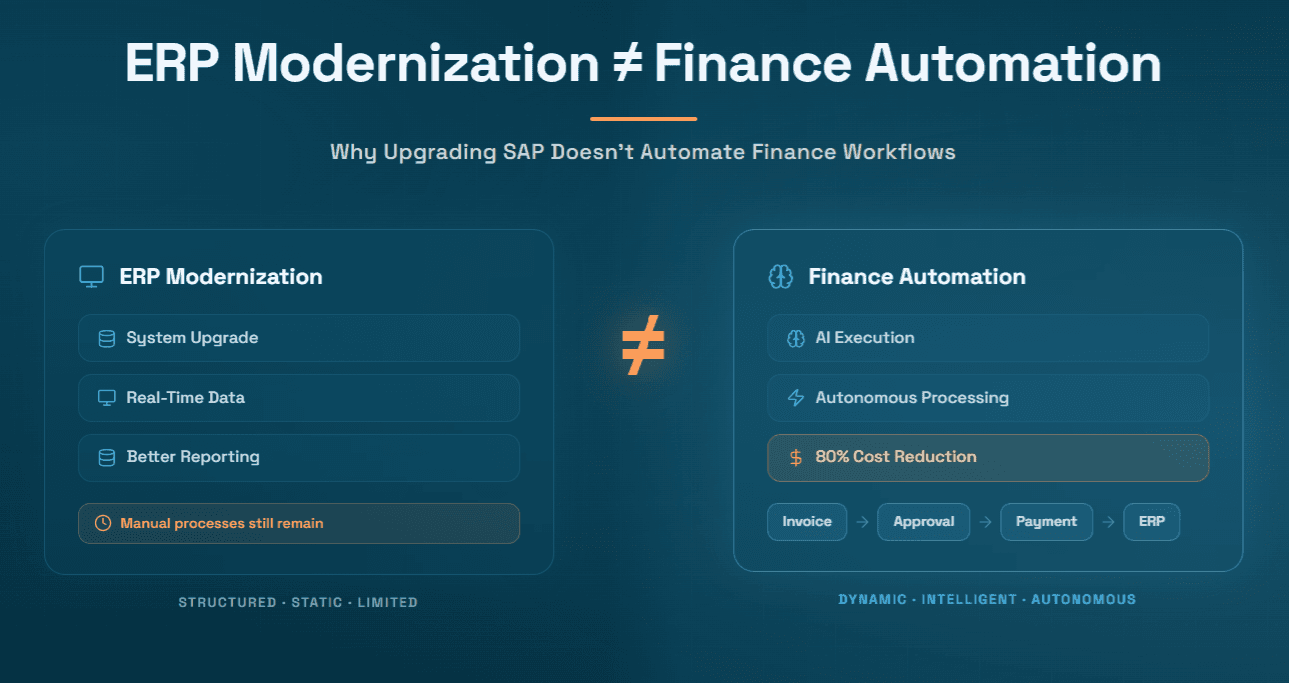
SAP S/4HANA is one of the most powerful ERP platforms available to enterprise finance teams today. Its architecture, built on the in-memory HANA database, with a redesigned data model and embedded analytics represents a generational leap from SAP ECC. Yet despite its sophistication, finance teams across industries are arriving at the same uncomfortable conclusion: heavy customization of SAP S/4HANA is a trap.
This post explores why reliance on custom code and bespoke enhancements in SAP S/4HANA creates long-term risk, operational drag, and financial exposure and what modern finance leaders are doing instead to unlock genuine transformation.
The Legacy of SAP Customization: How Finance Teams Got Here
Before SAP S/4HANA, most large enterprises ran SAP ECC, a system that was intentionally designed with customization in mind. The ABAP programming layer, modification keys, and user exits gave IT teams extraordinary latitude to build bespoke functionality for virtually every finance process.
For years, this felt like a strength. Procurement teams wanted custom approval workflows. AP departments needed bespoke matching rules. Revenue teams demanded specialized GL posting logic. Each of these needs was met with a new Z-program, a BAdi implementation, or an enhancement spot and consultants billed millions of dollars delivering exactly what each organization asked for.
By the time organizations began their journey to SAP S/4HANA, they were carrying extraordinary technical debt. Studies from SAP and its major implementation partners consistently show that mid-to-large enterprises running SAP ECC have accumulated thousands of custom objects. Some large organizations have documented over 50,000 custom ABAP programs, reports, function modules, and enhancements. Many of these have undocumented dependencies, unknown authors, and no regression test coverage.
This legacy of customization is not a sign of sophistication, it is a sign of accumulated compromise.
What Is Custom Code in SAP S/4HANA?
To understand why this matters, it helps to be precise about what "custom code" actually means in the SAP context.
In SAP, custom code refers to any ABAP (Advanced Business Application Programming) development that is not delivered by SAP as standard functionality. This includes:
Z-programs and Z-reports: Custom ABAP reports, batch jobs, or executables that finance teams run to extract, transform, or display data
Y/Z function modules: Reusable code blocks built by internal developers or consultants
Modifications to standard SAP objects: Direct changes to SAP-delivered code, which SAP explicitly discourages
User exits and BAdi implementations: Extension points in SAP's standard code where custom logic can be injected
Implicit enhancements: Code injected into standard SAP programs at designated enhancement spots
Custom tables (Z-tables): Database tables created outside SAP's standard data model to store additional configuration or transactional data
Workflow customizations: Custom SAP Business Workflow definitions that govern approval routing, notifications, and exception handling
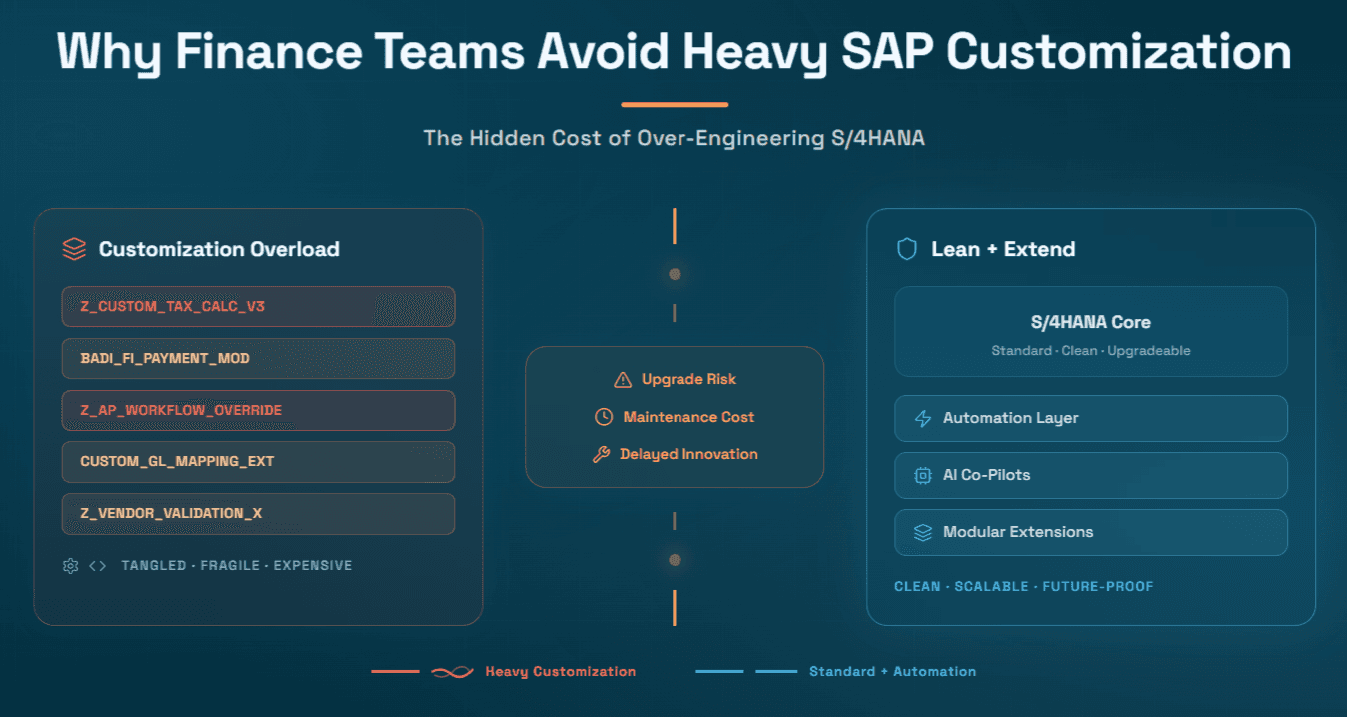
Enhancements are a related but slightly narrower concept. SAP provides designated enhancement frameworks, including Business Add-Ins (BAdIs), enhancement spots, and the Business Technology Platform (BTP) extension model, that allow customers to extend functionality without directly modifying SAP source code. When used correctly, enhancements are less risky than modifications. But even well-architected enhancements create maintenance obligations, upgrade risk, and long-term complexity.
The line between enhancement and modification is often blurry in practice. Finance teams that request a "small change" to standard AP processing logic frequently end up with a series of nested enhancements that interact in unpredictable ways, especially after system upgrades.
Why SAP S/4HANA Makes the Customization Problem Worse
The shift from ECC to S/4HANA introduced a redesigned architecture that makes legacy customization approaches particularly hazardous.
The simplified data model
SAP S/4HANA's most fundamental architectural change is the elimination of aggregate tables. In ECC, tables like BSEG (accounting document segment), BSAK, BSIK, BSAD, and BSID were physically separate and commonly accessed by custom Z-reports directly. In S/4HANA, these tables are replaced with the Universal Journal (ACDOCA), a single, wide line-item table that consolidates all financial postings.
Custom code that directly reads ECC aggregation tables will fail or return incorrect results in S/4HANA. Organizations with thousands of custom ABAP reports face enormous remediation efforts before go-live, often discovering that many of their custom reports duplicate functionality that SAP now delivers natively.
The new user experience and Fiori apps
SAP S/4HANA is designed around SAP Fiori, a browser-based UX framework that replaces SAPGUI for most end-user activities. Custom SAPGUI transactions developed for ECC have no direct equivalent in Fiori. Finance teams that invested heavily in custom SAPGUI screens, enhanced transaction layouts, or bespoke ALV reports must either rebuild these for Fiori, maintain parallel access to SAPGUI (a technical debt of its own), or abandon the custom functionality entirely.
Continuous cloud releases
Organizations running SAP S/4HANA Cloud (Public Edition) receive automatic quarterly updates from SAP. This is one of the platform's major selling points, it ensures customers are always on current functionality, receive security patches automatically, and benefit from ongoing innovation. But it creates a fundamental incompatibility with custom code and enhancements. Code that works correctly after one release may break silently after the next. The more custom code a finance team carries, the more regression testing each release demands.
Even customers on S/4HANA Private Cloud or on-premise deployments face this challenge during annual support packs and feature pack upgrades. SAP's own tooling, the Custom Code Migration App and ABAP Test Cockpit, helps identify affected objects, but the remediation work remains substantial.
Embedded analytics and CDS views
S/4HANA's embedded analytics rely on Core Data Services (CDS) views, a layer of virtual data models built on HANA that provide real-time reporting without data replication. Custom Z-reports that replicate this functionality are not just redundant, they create performance overhead, consume HANA resources, and produce potentially inconsistent results that undermine trust in financial data.
The Real Cost of Custom Code in Finance Operations
The decision to build custom code or complex enhancements in SAP S/4HANA is rarely made with full visibility into its total cost. Individual requests are evaluated on their apparent business value without accounting for the long-term obligations they create.
Upgrade cost amplification
Every SAP upgrade project, whether a support pack, an enhancement package, or a major version migration, requires all custom objects to be tested and, in many cases, remediated. SAP's standard guidance is that custom code should be reviewed and validated for each upgrade. In large organizations, this testing effort can consume a significant portion of the total upgrade budget.
Research from major SAP implementation firms consistently shows that organizations with high volumes of custom code face upgrade costs two to four times higher than organizations that have maintained standard configurations. This is not a one-time cost, it recurs with every upgrade cycle.
Consultant dependency
Custom code written by external ABAP developers creates a knowledge dependency. When that developer or consulting firm is no longer engaged, the organization may find that no one fully understands why specific logic was implemented, what business rules it encodes, or what breaks if it is removed. Finance teams that have experienced the departure of a key ABAP resource frequently describe discovering custom code that no one on the current team can explain or safely modify.
Testing burden
Standard SAP processes benefit from SAP's extensive testing and quality assurance. Custom code has no such safety net. Every change to the system, including patches, configuration changes, and integration updates, potentially affects custom code in ways that only regression testing can detect. As the volume of custom code grows, so does the test matrix, making the organization progressively slower to respond to change.
Compliance and audit risk
Auditors examining financial processes in SAP are increasingly sophisticated about custom code risk. Custom logic in payment processing, GL posting, or tax calculation represents a potential control gap, a place where standard SAP controls have been bypassed or modified. Demonstrating the integrity of custom code to external auditors requires documentation, change management records, and access controls that many finance organizations struggle to provide. Learn how AI improves auditability in the age of AI.
Performance degradation
Custom code that directly reads database tables, bypasses SAP's buffering mechanisms, or runs inefficient queries can impose significant performance overhead on HANA, a database specifically designed for in-memory columnar processing. Finance teams that invested in S/4HANA expecting dramatic performance improvements are sometimes disappointed to find that custom code is bottlenecking the very processes they were hoping to accelerate.
Why Finance Teams Are Specifically Vulnerable
Not all SAP modules are equally affected by customization risk, but finance is particularly exposed and for identifiable reasons.
Process complexity and regulatory variation
Finance processes are inherently complex. Tax rules, intercompany accounting, payment terms, and approval thresholds vary by entity, jurisdiction, and vendor relationship. In the past, this complexity was often handled by encoding business rules directly into custom ABAP programs. The result was that critical financial controls existed only inside custom code, invisible to standard SAP configuration, undocumented in any process specification, and fragile in the face of regulatory change.
Volume and velocity demands
Accounts payable teams processing thousands of invoices per day have historically used custom batch programs to handle volume at scale. These programs often embed matching logic, GL coding rules, and payment scheduling logic that was written years ago to solve a specific operational problem. As business rules change, these programs accumulate layers of conditional logic that become progressively harder to maintain, test, or audit. See how AI solves the 3-way matching challenge.
Organizational politics
Finance departments have significant organizational influence, and finance leaders have historically been effective at getting custom development prioritized. When a CFO requests a specific report format, a controller wants a custom approval workflow, or a treasury team needs a bespoke payment file format, the SAP development backlog tends to move quickly. Over years, this pattern results in a customization landscape that reflects the organizational chart more than it reflects best-practice process design. Read about the CFO's evolution in the age of AI.
Integration complexity
SAP S/4HANA rarely operates in isolation. Finance teams use it alongside procurement platforms, banking portals, tax engines, expense management systems, and treasury platforms. Integrations between these systems frequently rely on custom BAPIs, IDocs, or RFC function modules that carry the same maintenance and upgrade risks as any other custom code.
The SAP Clean Core Strategy – What It Means for Finance
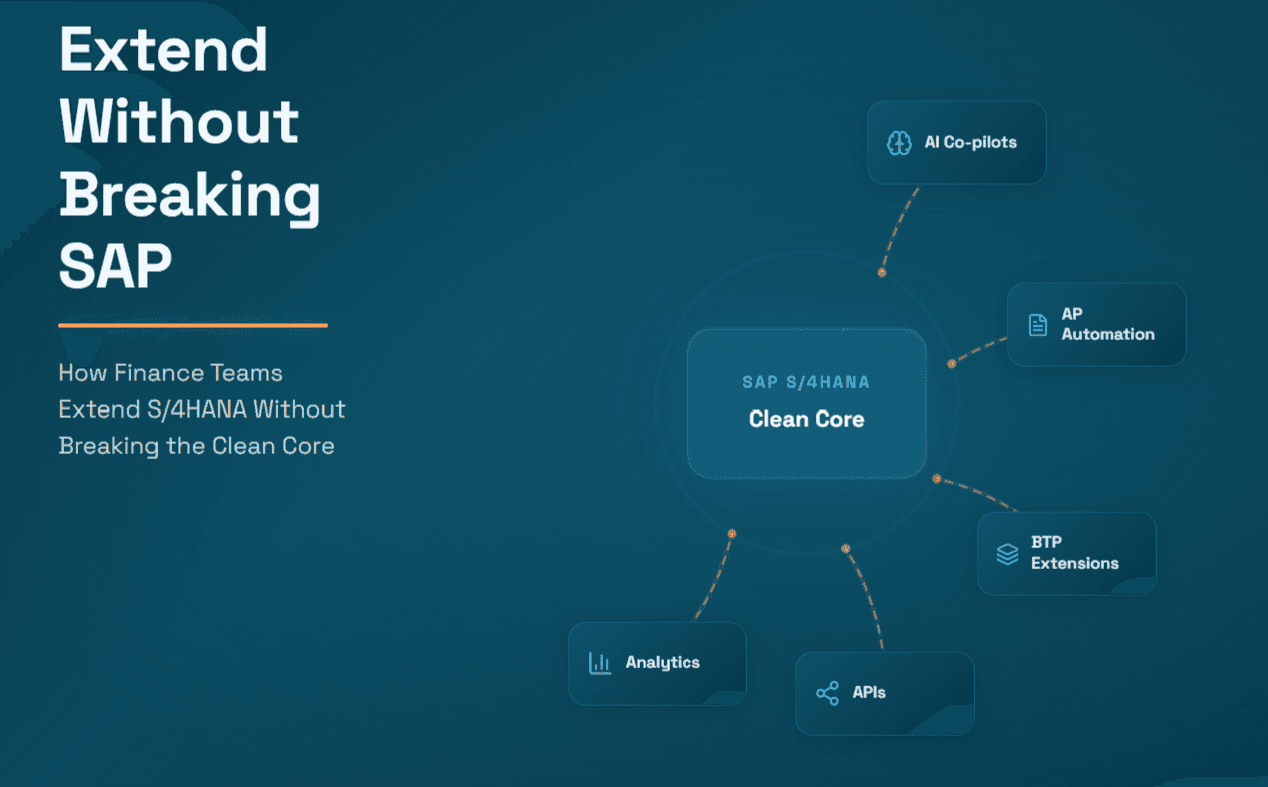
SAP has articulated its response to the customization problem through the "Clean Core" strategy. The principle is straightforward: keep the SAP core clean, meaning uncustomized and tightly aligned with SAP's standard delivered functionality and extend the system using officially supported extension mechanisms that operate outside the core.
SAP's Clean Core framework recommends:
Avoiding modifications to SAP-delivered code entirely
Using BTP (Business Technology Platform) for extensions that require custom logic, running them as side-by-side applications rather than in-system customizations
Adopting SAP's standard processes wherever possible, adapting business processes to fit SAP rather than adapting SAP to fit legacy business processes
Leveraging SAP's API layer for integrations rather than direct database access or RFC calls
Using SAP's Extensibility Explorer to identify officially supported extension points that are upgrade-stable
For finance teams, Clean Core has significant implications. It means that the long-standing practice of building custom code inside SAP to handle edge cases, reporting requirements, or process variations is no longer the recommended approach, even by SAP itself.
The challenge is that many organizations have invested years and significant budgets in exactly the customization landscape that Clean Core is designed to eliminate. The path to a clean core is not a configuration change, it is a transformation project.
Common Finance Customizations That Create Risk
Understanding which specific customizations create the most risk helps finance leaders make informed decisions about where to focus remediation efforts.
Custom invoice processing logic
AP teams commonly build custom programs to handle invoice exceptions, splitting lines, applying tolerance rules, routing non-PO invoices, or enriching GL coding based on vendor master data. This logic encodes institutional knowledge that is not visible in SAP configuration. When key personnel leave or when the system is upgraded, this logic becomes a black box. Understand how AI transforms invoice processing.
Custom payment programs
SAP's standard payment program (F110) is highly configurable, but many organizations have built custom variants or enhancement-based modifications to handle specific bank formats, payment approval workflows, or dynamic discount capture logic. These modifications are particularly high-risk because errors in payment processing have immediate financial consequences and create fraud exposure.
Custom GL posting rules
Custom substitution and validation rules in FI-GL are common and often poorly documented. Finance teams add them to handle specific accounting scenarios without full consideration of their interaction effects. When financial reporting produces unexpected results, tracing the cause through layers of custom substitutions can take days of consultant time.
Custom reporting and analytics
Arguably the largest category of custom code in SAP finance environments is reporting. Organizations have built hundreds of custom ALV reports, SAP Query variants, and bespoke BEx queries over decades. Many of these reports duplicate functionality that S/4HANA now delivers natively through embedded analytics, Fiori apps, and CDS views. The challenge is that finance users have come to rely on specific report layouts, column arrangements, and filter defaults, making rationalization politically difficult even when it is technically straightforward. Read about GL coding best practices.
Custom approval workflows
Approval routing for invoices, payment runs, and purchase orders is frequently handled through custom SAP Business Workflow definitions or, in more recent implementations, through custom-coded Flexible Workflow variants. These workflows encode approval policies that should ideally live in configurable business rules, not hard-coded in ABAP.
What Happens When You Ignore Customization Risk
The consequences of ignoring customization risk in SAP S/4HANA are not hypothetical, they manifest in predictable ways across organizations that delay addressing their custom code debt.
Migration failures and delays
SAP S/4HANA migration projects fail most commonly not because of data migration challenges or training issues, but because of the underestimated scope of custom code remediation. Organizations that complete a thorough custom code impact analysis before committing to a go-live date consistently experience better project outcomes than those that defer this analysis.
Permanent parallel operations
Some organizations that complete an S/4HANA migration find themselves running custom legacy programs in parallel because they cannot confidently decommission them without understanding all their dependencies. This defeats a core purpose of the migration and maintains the same operational and audit risk.
Frozen functionality
Organizations with high custom code volumes often find that their SAP system effectively becomes frozen, unable to adopt new SAP functionality, apply meaningful configuration changes, or integrate new tools because the risk of disrupting interdependent custom code is too high. Finance teams in this situation lose the competitive advantage that a modern ERP should provide.
Audit findings
Regulators and external auditors increasingly focus on IT general controls, including the change management and access controls around custom code. Organizations that cannot demonstrate appropriate segregation of duties in ABAP development, comprehensive change records for custom objects, or regression testing evidence for finance-critical custom programs face audit findings that require remediation and sometimes restatement of financial controls representations. Explore AI automation and audit ease.
The Alternative – Configuration Over Customization
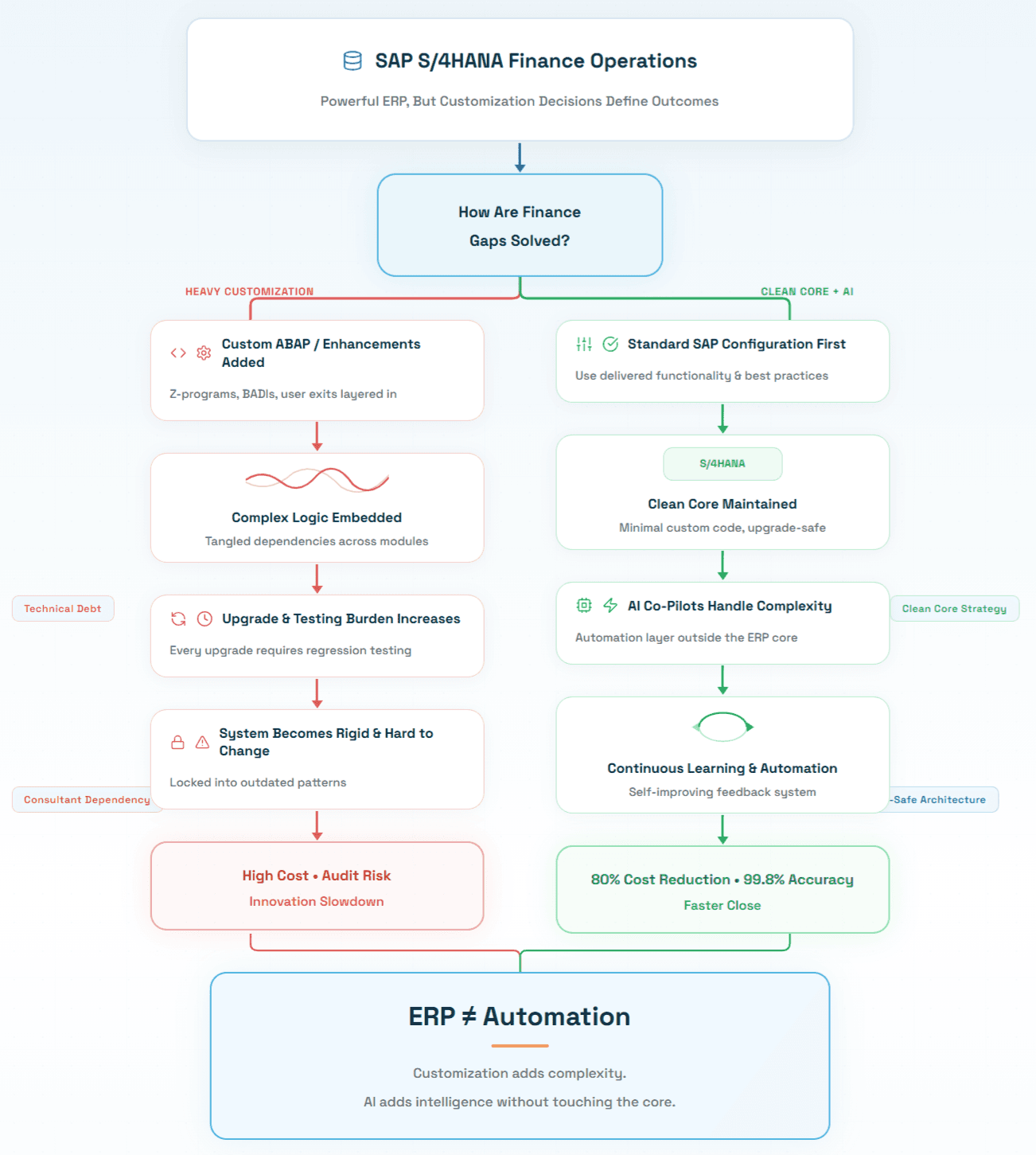
The most effective response to customization risk is not to abandon SAP S/4HANA, but to adopt a fundamentally different philosophy: solve business problems through configuration, process redesign, and intelligent add-on tools, not through custom code.
SAP S/4HANA's configuration framework is extensive. Most finance processes can be accommodated through:
Flexible workflow configuration in the SAP Fiori-based Manage Workflows app
Business rules configuration for tolerance levels, matching thresholds, and approval routing
Substitution and validation rules configured through the standard FI configuration menu
SAP BTP extensions for scenarios that genuinely require custom logic, implemented outside the core
Pre-configured industry solutions from SAP partners that deliver specific functionality without requiring custom ABAP
The discipline of "configuration first" requires finance teams to distinguish between genuine business requirements and organizational preferences. Many customization requests reflect a preference for familiar process flows rather than a genuine business requirement that standard SAP cannot meet. Understand how ERP and AI work together.
Where AI Co-Pilots Are Changing the Equation
Beyond the choice between custom code and standard configuration, a new category of solution is fundamentally changing how finance teams approach process automation in and around SAP: AI co-pilots.
AI co-pilots for finance are pre-trained, purpose-built intelligent automation tools that operate alongside ERP systems, integrating deeply with SAP S/4HANA through standard APIs and certified connectors, but running their intelligence layer outside the ERP core. This architecture is precisely aligned with SAP's Clean Core philosophy: the SAP core remains untouched, while sophisticated automation runs in a separate, upgradeable layer.
The emergence of AI co-pilots addresses the root cause of most customization requests. Finance teams historically built custom code because standard SAP could not handle the cognitive complexity of real-world finance processes, the variability in invoice formats, the nuance of GL coding decisions, the judgment required to handle exceptions, the policy-specific rules around approval routing. AI co-pilots handle this cognitive complexity without requiring any modification to SAP's core.
This is the key insight: the need for custom code was never really about SAP's lack of configuration options. It was about the absence of intelligence. SAP can be configured to route a standard invoice. It cannot, without custom code, learn from thousands of past GL coding decisions to predict the correct account for a new vendor invoice type. AI can. Read how AI is transforming purchase order processing.
How Hyperbots AI Co-Pilots Deliver What Custom Code Was Trying to Achieve
This is where Hyperbots enters the picture and the contrast with custom code approaches is stark.
Hyperbots is a purpose-built AI co-pilot platform for finance and accounting operations. Its co-pilots are pre-trained on finance-specific data and processes, integrate with SAP S/4HANA and other major ERPs through certified connectors, and operate entirely outside the ERP core, delivering the intelligence that finance teams previously tried to encode in custom ABAP.
Crucially, Hyperbots reduces operations costs by 80% while achieving 99.8% invoice processing accuracy and 80%+ straight-through processing (STP) rates. These are not aspirational metrics, they are documented outcomes from real customer deployments, including Extreme Reach, which achieved 80% STP and 99.8% accuracy with zero manual touch-ups.
What makes Hyperbots genuinely differentiated from legacy automation tools and from custom code approaches is its multi-agent AI architecture. Rather than applying a single automation rule to a process, Hyperbots deploys networks of specialized AI agents that each handle a component of the workflow such as extraction, validation, matching, GL coding, approval routing, exception handling, posting and collaboration in real time. This is the agentic AI revolution in practice.
Invoice Processing Co-Pilot
Finance teams built custom SAP code for invoice processing because standard SAP could not handle the variability of real-world invoices with different formats, missing fields, ambiguous line items, inconsistent tax treatment. The Hyperbots Invoice Processing Co-Pilot eliminates this problem without any customization.
The co-pilot captures invoices from any source like email, vendor portals, EDI, scanned documents and applies AI-native extraction that achieves near-perfect accuracy without template dependency. Unlike OCR-based tools that fail when vendors change their invoice format, Hyperbots' AI understands invoice semantics, not just layout. It then validates against PO data and goods receipts, applies configurable 2-way and 3-way matching, performs AI-driven GL coding based on historical patterns and policy rules, routes exceptions intelligently, and posts directly to SAP, all with comprehensive audit trails. The measurable business outcome: AP teams processing the same invoice volume with dramatically fewer FTEs, and month-end close cycles that are shorter and more accurate.
Vendor Management Co-Pilot
Custom code for vendor onboarding and master data management was a common SAP finance customization, typically because standard SAP's vendor onboarding workflow was too rigid for complex supplier relationships. The Hyperbots Vendor Management Co-Pilot replaces this entirely. It automates vendor onboarding with AI-driven identity verification, provides a self-service vendor portal for document submission and communication, and enforces compliance checks without any custom ABAP. The practical benefit: vendor onboarding that previously took days now completes in hours, with higher data quality and full audit trail. Learn more about vendor onboarding challenges and AI advantages.
Procurement Co-Pilot
Purchase requisition and PO processing is one of the most heavily customized areas of SAP finance. Procurement teams routinely build custom approval workflows, custom PR validation rules, and custom PO templates because standard SAP configuration does not accommodate their specific organizational policies. Hyperbots' Procurement Co-Pilot delivers all of this through configurable AI, automated PR field population, policy-based validation, intelligent GL coding at the requisition stage, configurable multi-level approval routing, automated PO generation and dispatch, and PO closure management. The result: the PR-to-PO cycle compresses from 3 days to 4 hours, without a single line of custom ABAP.
Payments Co-Pilot
Payment processing has historically been one of the riskiest areas for custom code in SAP. Organizations build custom payment programs to handle specific bank formats, dynamic discount capture, or approval workflows that differ from SAP's standard F110. These custom programs carry enormous audit and fraud risk. Hyperbots' Payments Co-Pilot replaces this approach with AI-driven payment recommendations, configurable approval workflows, multi-method payment processing (ACH, check, virtual card), automated bank reconciliation, fraud detection, and automated remittance advice, all operating outside the SAP core. Understand how Hyperbots transforms the P2P process.
Sales Tax Verification Co-Pilot
Sales and use tax determination is a domain where finance teams have historically relied on custom SAP code or standalone tax engines with complex integrations. Errors cost real money as demonstrated by one CFO who eliminated $200,000 in tax leakage using Hyperbots. The Sales Tax Verification Co-Pilot automates line-item tax validation, jurisdiction determination using origin and destination addresses, tax category classification, nexus threshold monitoring, and mismatch detection, all without custom ABAP.
Accruals Co-Pilot
Period-end accruals are labor-intensive, error-prone, and frequently handled through a combination of custom SAP programs and manual spreadsheets. The Hyperbots Accruals Co-Pilot automates accrual discovery, identifying goods received but not invoiced, services rendered but not billed, and recurring expenses without POs, books accrual journal entries directly in SAP, and manages automated reversals in the subsequent period. Read how this transforms the accruals process.
Collections Co-Pilot and Cash Application Co-Pilot
On the order-to-cash side, Hyperbots extends the same AI-first philosophy. The Collections Co-Pilot automates overdue account monitoring, dunning communications, and escalation workflows, replacing custom AR aging reports and manual follow-up processes. The Cash Application Co-Pilot matches incoming payments to open invoices with AI-driven accuracy, handling remittance data in any format and resolving exceptions autonomously. Together, these co-pilots compress DSO (Days Sales Outstanding) and reduce the manual effort that AR teams have historically managed through custom SAP reports and manual spreadsheets.
Hyperbots Platform Capabilities: Transformational Impact Beyond Individual Co-Pilots
What sets Hyperbots apart from point solutions is its platform architecture, which creates compound value across the entire finance operation.
Unlimited-user licensing: Unlike traditional software that charges per seat, creating pressure to limit access and driving shadow processes, Hyperbots offers unlimited-user access under a single license. This means every stakeholder in the approval chain, every business unit requestor, and every finance reviewer can participate in automated workflows without license cost escalation.
Pre-trained, ready-to-deploy models: Hyperbots co-pilots are pre-trained on finance-specific data and go live in days, not months. This is fundamentally different from custom ABAP development, which requires months of requirements gathering, development, testing, and training before delivering value. Read how pre-trained AI co-pilots transformed finance in days.
Self-learning AI: The platform continuously improves through feedback loops, learning from exception resolutions, GL coding corrections, and approval decisions to become more accurate over time. Custom code does not learn, it degrades as business conditions change.
Company-specific policy configuration: Hyperbots is configurable to company-specific policies, approval thresholds, matching tolerances, GL coding rules, payment terms without any custom code. This is the configuration-over-customization philosophy in practice.
Explainable AI and audit trails: Every decision made by a Hyperbots AI agent is logged with full explainability, why it made a particular GL coding choice, why it flagged an invoice as a duplicate, why it recommended an early payment. This is the transparency advantage that custom code fundamentally cannot provide.
24/7 operations: Hyperbots runs 24/7 without downtime, processing invoices, booking accruals, and managing vendor communications around the clock. Custom ABAP batch jobs run on schedules; AI co-pilots process continuously.
Human-in-the-loop design: For exceptions that require human judgment, Hyperbots provides structured human-in-the-loop workflows, presenting exceptions with full context, AI recommendations, and one-click resolution. This is superior to the email-based exception handling that most custom SAP workflows fall back on.
Hyperbots ROI – Tangible and Intangible Outcomes
P2P (Procure-to-Pay) outcomes:
80% reduction in manual invoice processing effort
99.8% invoice extraction and GL coding accuracy
80%+ straight-through processing rate for invoices
PR-to-PO cycle reduced from 3 days to 4 hours
$200,000+ in annual tax leakage elimination (documented CFO case study)
Vendor onboarding time reduced from days to hours
Payment discount capture rates significantly improved through AI-driven timing recommendations
Fraud risk reduced through automated duplicate detection and anomaly identification
O2C (Order-to-Cash) outcomes:
Significant reduction in DSO through automated collections follow-up
Cash application accuracy approaching 100% for standard remittance formats
AR team effort dramatically reduced on routine matching and application tasks
Improved customer communication consistency through automated dunning workflows
Intangible outcomes:
Finance teams redirected from manual processing to analysis and strategic support
Month-end close cycles shortened through automated accruals
Audit readiness improved through comprehensive, explainable audit trails
IT team freed from custom ABAP maintenance obligations
ERP upgrade projects simplified by the absence of custom code dependencies
Industry Applications – Hyperbots Across Sectors
The benefits of AI co-pilots over custom code are amplified in industries with complex procurement and AP environments.
Manufacturing: Manufacturing companies face high-volume PO-matched invoicing, multi-site procurement, and complex 3-way matching requirements. These are exactly the scenarios where custom SAP code has historically been most prevalent and where Hyperbots delivers the greatest relief. Learn why manufacturing teams choose Hyperbots over legacy AP automation.
Professional Services: Project-based businesses face time-and-material invoice matching challenges and complex revenue accrual requirements. Hyperbots' Accruals Co-Pilot and Invoice Processing Co-Pilot handle these without custom code.
Retail: High-volume, multi-location retail procurement requires robust PO matching and vendor management at scale which are capabilities that Hyperbots delivers through its Procurement and Invoice Processing co-pilots. See why retail leaders choose Hyperbots.
Healthcare: Healthcare procurement involves complex regulatory compliance, medical supply matching, and formulary controls, areas where custom code has historically proliferated. Explore how healthcare organizations use automated POs.
The Path Forward for Finance Teams
The case against heavy customization in SAP S/4HANA is compelling and supported by both technical reality and strategic direction from SAP itself. Custom code and complex enhancements create upgrade risk, audit exposure, consultant dependency, and a frozen system that cannot adopt new capabilities.
The alternative is not to accept process compromise. It is to recognize that the intelligence finance teams that were trying to encode in custom ABAP can now be delivered by AI more accurately, more maintainably, and with full explainability.
Hyperbots represents the convergence of these trends: a platform purpose-built to handle the cognitive complexity of real-world finance operations, integrated with SAP and other ERPs through clean APIs, configured rather than coded, and continuously improving through AI. For finance teams running SAP S/4HANA, Hyperbots is not just an alternative to custom code, it is the reason custom code is no longer necessary.
Request a demo to see how Hyperbots AI co-pilots can replace your custom code dependencies with intelligent automation that delivers measurable, auditable, and upgrade-proof outcomes.
Frequently Asked Questions
Q1: Is it ever appropriate to use custom code in SAP S/4HANA?
There are legitimate scenarios for custom development in SAP S/4HANA, particularly for highly industry-specific requirements that SAP does not address through its standard industry solutions, or for integrations with proprietary systems where no standard API exists. SAP's recommendation in these cases is to use BTP-side extensions rather than in-system ABAP modifications. The key principle is that any custom development should be an exception, not a default approach, and should be documented, tested, and governed accordingly.
Q2: What is the difference between customization and configuration in SAP?
Configuration refers to adjusting SAP's behavior through standard IMG (Implementation Guide) settings, things like defining company codes, chart of accounts, payment terms, and approval thresholds. Customization refers to building custom code or enhancements that extend or modify SAP's delivered functionality beyond what configuration supports. Configuration carries no upgrade risk; customization carries significant upgrade risk.
Q3: How does SAP's Clean Core strategy affect existing custom code?
SAP's Clean Core strategy does not force organizations to immediately eliminate existing custom code, but it strongly influences the direction of SAP S/4HANA Cloud and the platform's long-term roadmap. Organizations on S/4HANA Cloud Public Edition face the most immediate pressure, as SAP applies automatic updates that may break custom code. Organizations on Private Cloud or on-premise have more flexibility, but SAP's tools and support resources are increasingly oriented toward Clean Core architectures.
Q4: Can AI co-pilots replace the need for custom code in SAP finance?
For the vast majority of finance process customizations, invoice processing, GL coding, approval routing, payment scheduling, accruals, vendor onboarding, AI co-pilots like Hyperbots can replace custom code entirely, while delivering superior accuracy, auditability, and maintainability. There will remain edge cases requiring genuine custom development, but these are far fewer than most organizations assume.
Q5: How does Hyperbots integrate with SAP S/4HANA without requiring custom code?
Hyperbots integrates with SAP S/4HANA through standard SAP APIs, certified connectors, and pre-built data model mappings. The platform's Data Model Designer enables out-of-the-box ERP mapping without custom ABAP. Read how Hyperbots accelerates ERP onboarding.
Q6: What ROI can finance teams expect from replacing custom code with AI co-pilots?
ROI varies by organization size and process complexity, but documented Hyperbots outcomes include 80% reduction in manual processing effort, 99.8% invoice accuracy, and documented tax leakage elimination exceeding $200,000 annually. Use Hyperbots' ROI calculators to model expected returns for your specific operation. Also read about ROI on AI-led automation in finance.
Q7: Is Hyperbots only for large enterprises using SAP?
Hyperbots co-pilots integrate with a broad range of ERP platforms beyond SAP including Oracle NetSuite, Microsoft Dynamics, QuickBooks, Sage, and others. The platform is designed for mid-market and enterprise organizations across all industries.