Purchase Requisition Software: Complete Guide to Automation & AI Solutions [2026]
Discover how AI-powered purchase requisition software transforms procurement workflows, eliminates bottlenecks, and delivers 80% cost savings through intelligent automation.

Executive Summary
Purchase requisition software has evolved from basic approval tools into intelligent automation platforms that fundamentally reshape procurement operations. Organizations still relying on manual requisition processes face cycle times exceeding 7-10 days, error rates above 15%, and operational costs that drain 3-5% of total procurement spend. Modern purchase requisition software addresses these challenges by automating request intake, accelerating approvals, enforcing policy compliance, and providing real-time spend visibility.
This comprehensive guide explores the purchase requisition software landscape, from fundamental capabilities to cutting-edge AI applications. You'll discover automation strategies that reduce processing times, learn how generative AI transforms requisition workflows, and understand implementation best practices. Most importantly, we examine how Hyperbots' AI Co-pilot suite delivers transformational results—including 80% operational cost reduction—positioning it as the definitive solution for modern finance teams seeking procurement excellence.
Whether you're evaluating purchase requisition automation for the first time or upgrading legacy systems, this guide provides the strategic framework and tactical insights needed to drive measurable business impact.
Introduction: The Evolution of Purchase Requisition Management
The procurement function stands at an inflection point. Finance leaders at mid-sized and enterprise organizations face mounting pressure to control costs, ensure compliance, and accelerate transaction velocity—all while operating with constrained resources. Purchase requisitions represent the critical first step in this journey, yet they remain frustratingly manual in most organizations.
Recent Gartner research reveals that finance teams spend 40-60% of their time on transactional processing rather than strategic activities. Manual purchase requisition handling exemplifies this problem: employees submit requests through disconnected channels, approvers face cluttered inboxes, finance teams chase missing information, and the resulting delays frustrate everyone involved.
The cost implications extend beyond wasted labor. Organizations without proper purchase requisition software experience maverick spending, duplicate orders, policy violations, and limited spend visibility. A typical mid-sized company processing 5,000 requisitions annually may spend $75-125 per transaction when factoring in labor, errors, and delays—representing $375,000-$625,000 in annual costs for requisition management alone.
Digital transformation offers a compelling alternative. Modern purchase requisition software automates routine tasks, applies intelligent validation, and accelerates approvals—reducing cycle times from days to hours while cutting processing costs by 60-80%. The most advanced platforms leverage artificial intelligence to deliver autonomous processing capabilities that fundamentally redefine what's possible in procurement operations.
Understanding these solutions requires examining their core capabilities, business benefits, and transformational potential through AI integration.
What is Purchase Requisition Software?
Core Definition & Purpose
Purchase requisition software is a specialized application that digitizes, automates, and manages the process of requesting goods or services for organizational use. It serves as the gateway to procurement, capturing employee needs, routing requests through appropriate approval channels, validating policy compliance, and ultimately generating purchase orders for vendor fulfillment.
At its essence, this software transforms informal requests—whether submitted via email, spreadsheet, or verbal communication—into structured, trackable, and auditable transactions. It establishes a single system of record for all purchasing intentions, ensuring nothing falls through the cracks while maintaining complete transparency across the requisition-to-payment lifecycle.
The fundamental purpose extends beyond simple digitization. It enforces spending controls before commitments are made, routes requests to appropriate decision-makers based on configurable business rules, maintains audit trails for compliance requirements, and provides finance teams with forward-looking spend visibility that enables proactive budget management. For comprehensive details, explore this guide on what is purchase requisition software: benefits, features, and ROI.
Modern purchase requisition software operates as part of the broader procure-to-pay ecosystem, integrating seamlessly with ERP systems, procurement platforms, vendor management tools, and accounts payable solutions to create end-to-end workflow continuity.
Key Components
Effective purchase requisition software comprises several interconnected components that work together to streamline the request-to-approval process:
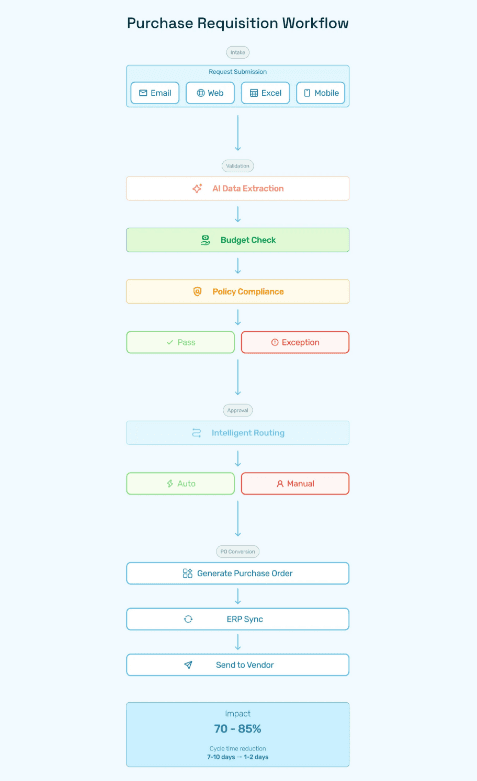
Request Intake Systems capture requisition information through multiple channels including web forms, mobile applications, email, Excel uploads, and API integrations. Advanced solutions employ intelligent data extraction to parse unstructured requests and populate requisition fields automatically.
Approval Workflows route requests to appropriate stakeholders based on configurable rules considering factors like amount thresholds, department, commodity category, and vendor selection. These workflows support serial approvals, parallel reviews, delegation during absences, and automatic escalation for overdue items.
Budget Validation checks requests against available funds in real-time, preventing over-commitment before obligations are created. Integration with financial planning systems ensures requisitions align with approved budgets and spending authorities.
Policy Enforcement applies organizational purchasing rules automatically, flagging non-compliant requests for review. This includes preferred vendor requirements, competitive bidding thresholds, contract compliance, and purchasing authority limits.
PO Generation converts approved requisitions into purchase orders with minimal manual intervention, maintaining data continuity and reducing re-keying errors. Integration with vendor management systems ensures accurate supplier information and terms flow through seamlessly.
Traditional vs. Modern Solutions
The evolution from traditional to modern purchase requisition software reflects broader technology shifts and changing business expectations.
Traditional solutions—many built 10-20 years ago—rely on rigid workflow engines, require extensive IT involvement for configuration changes, offer limited integration capabilities, and provide basic reporting functionality. These systems typically operate as standalone modules, forcing users to toggle between multiple applications to complete procurement tasks. User experiences often feel dated, with cumbersome interfaces that require extensive training.
Modern cloud-based purchase requisition software reimagines these capabilities. These platforms offer intuitive, consumer-grade interfaces that minimize training requirements. They provide flexible workflow configuration through low-code or no-code tools, enabling business users to adapt processes without IT dependency. Pre-built connectors facilitate integration with dozens of ERP, accounting, and procurement systems. Advanced analytics deliver actionable insights through interactive dashboards and automated alerting.
The most transformational advancement comes through artificial intelligence integration. AI-powered purchase requisition software employs machine learning for intelligent data extraction, natural language processing for conversational request submission, predictive analytics for spend forecasting, and autonomous decision-making for routine approvals. These capabilities don't just digitize manual processes—they fundamentally reimagine how requisitions work, delivering speed and accuracy that human-only processes cannot match.
Benefits of Purchase Requisition Software
Operational Efficiency
Purchase requisition software delivers dramatic operational improvements that directly impact bottom-line performance. Organizations implementing modern solutions typically achieve 70-85% reduction in requisition cycle times, shrinking the journey from initial request to approved purchase order from 7-10 days to under 24 hours for routine purchases.
This acceleration stems from multiple factors: automated request routing eliminates delays caused by approver unavailability or inbox overload; real-time budget validation prevents time-consuming back-and-forth communications; intelligent exception handling focuses human attention only on truly complex decisions; and parallel approval processing enables multiple stakeholders to review simultaneously rather than sequentially.
Error elimination represents another significant benefit. Manual requisition processing suffers from data entry mistakes, missing information, incorrect coding, and mismatched approvals. These errors cascade through the procurement process, causing purchase order corrections, invoice disputes, and delayed payments. Automated purchase requisition systems reduce error rates by 90-95% through structured data capture, mandatory field validation, and automated policy checks.
Labor efficiency improvements prove equally compelling. Finance teams report saving 60-75% of time previously spent chasing requisition status, correcting errors, and manually routing approvals. This productivity gain frees skilled professionals to focus on strategic activities like vendor negotiations, contract optimization, and spend analysis rather than transactional processing.
Financial Control & Visibility
Perhaps no benefit resonates more strongly with CFOs than enhanced financial control and forward-looking spend visibility. Traditional requisition processes create a blind spot in financial planning—requests submitted today may not surface as commitments until purchase orders are issued days or weeks later, leaving finance teams with incomplete views of upcoming expenditures.
Purchase requisition software illuminates this blind spot by capturing spending intentions at the earliest possible stage. Real-time dashboards show pending requests by category, department, and vendor—enabling proactive budget management rather than reactive responses to overspending. Finance leaders can spot emerging trends, identify budget pressures before they become crises, and make informed decisions about resource allocation.
Budget compliance improves dramatically when requisition software enforces controls before commitments are made. Hard stops prevent requests that exceed available funds, while configurable approval escalations route exception requests to appropriate authority levels. Organizations typically see budget variance rates improve by 40-60% within the first year of implementation.
Audit trail capabilities address compliance and control requirements that regulatory frameworks and internal policies demand. Every requisition maintains a complete history showing who requested what, when, which approvers reviewed it, what changes occurred, and why. This documentation proves invaluable during internal audits, external examinations, and dispute resolution.
Strategic Advantages
Beyond operational and financial benefits, purchase requisition software enables strategic capabilities that create lasting competitive advantages.
Data-driven decision making becomes possible when requisition data is captured consistently and analyzed comprehensively. Spend analytics reveal patterns like: which departments consistently request similar items from different vendors, suggesting consolidation opportunities; recurring requisitions that indicate candidates for automated replenishment; price variations across similar purchases that point to negotiation opportunities; and seasonal trends that inform procurement planning.
Vendor relationship optimization improves when requisition data flows seamlessly to procurement teams. Understanding upcoming demand enables better planning of vendor communications, more effective negotiation leverage through volume commitments, and stronger partnerships built on transparency and reliability.
Policy enforcement shifts from reactive policing to proactive guidance. Rather than discovering policy violations after the fact, requisition software prevents non-compliant requests from progressing. This might include steering employees toward preferred vendors, enforcing competitive bidding thresholds, ensuring contract compliance, or requiring appropriate documentation before approval.
These benefits compound over time as organizations refine their processes, expand automation coverage, and leverage advanced capabilities like AI-powered insights and predictive analytics.
Essential Features of Purchase Requisition Software
Request Management
Comprehensive request management capabilities form the foundation of effective purchase requisition software. The best solutions support multi-channel intake, recognizing that employees submit requests through various means depending on their roles and preferences.
Web-based forms provide structured input for users comfortable with digital interfaces, guiding them through required fields while offering contextual help and smart defaults. Mobile applications extend access to field personnel and executives who need to submit or approve requests while away from their desks. Email intake accommodates users who prefer familiar communication tools—advanced systems use AI to parse email requests and extract relevant details automatically.
Excel upload functionality addresses bulk requisition scenarios where multiple items need to be requested simultaneously. Rather than manually entering dozens of line items, users can upload spreadsheets that the system validates and converts into properly formatted requisitions. Learn more about automating requisitions with email and Excel through practical playbooks. This capability proves particularly valuable during budget planning cycles or project kickoffs when numerous purchases need to be authorized together.
Smart cataloging enhances user experience by enabling requesters to search for commonly purchased items, view specifications and pricing, and add them to requisitions with minimal data entry. Integration with contract pricing ensures employees see accurate costs and select from approved vendors automatically.
Template functionality accelerates recurring requisitions by allowing users to save frequently requested item combinations and reuse them with minor modifications. A department that orders the same monthly supplies can complete their requisition in seconds rather than minutes.
Approval Automation
Approval automation represents the most impactful feature of purchase requisition software, transforming what was historically a bottleneck into a streamlined, rapid process.
Modern systems enable business users to configure approval rules through intuitive interfaces without programming knowledge. Workflow engines support sophisticated logic including amount-based routing, department-specific approvers, commodity category specialists, and vendor relationship managers. Multiple conditions can be combined to create precise routing rules that reflect organizational decision-making structures. Organizations can leverage Power Automate workflows for requisition approvals with templates and rules to accelerate implementation.
Parallel approval processing allows multiple stakeholders to review requisitions simultaneously when their input is independent. For example, a large capital equipment purchase might require concurrent review by the requesting department manager, facilities team, finance controller, and IT security—rather than routing sequentially through each approver and extending cycle time unnecessarily.
Delegation capabilities ensure approvals don't stall during vacations or unexpected absences. Approvers can designate alternates who receive routing during specified periods, maintaining workflow continuity. Automatic escalation rules further prevent bottlenecks by forwarding overdue approvals to supervisors or alternate approvers after defined time periods.
Mobile approval functionality recognizes that decision-makers aren't always at their desks. Push notifications alert approvers to pending requests, while mobile interfaces enable review and approval with comprehensive context including requisition details, budget impact, and policy compliance status—all from smartphones or tablets.
Conditional approval paths handle exceptions gracefully. When requisitions fall outside normal parameters—exceeding budget, selecting non-preferred vendors, or lacking required documentation—workflows can route to specialized reviewers while allowing standard requests to flow through rapidly.
Integration Capabilities
Purchase requisition software delivers maximum value when deeply integrated with surrounding systems rather than operating as an isolated tool. Robust integration capabilities ensure data flows seamlessly across the procure-to-pay landscape without manual intervention or data re-entry.
ERP synchronization forms the most critical integration point. Seamless connectivity with ERP systems ensures requisitions reflect current budget balances, approved requisitions generate purchase orders in the ERP automatically, and status updates flow bi-directionally. Leading solutions offer pre-built connectors for major ERP platforms including SAP, Oracle, NetSuite, Microsoft Dynamics, and Workday—minimizing implementation time and technical complexity. Understanding automated purchase requisition management system architecture and integrations helps organizations plan effective deployments.
API connectivity enables custom integrations with proprietary systems, niche applications, or industry-specific platforms. Modern RESTful APIs allow IT teams to build connections that match exact business requirements, whether integrating with vendor management systems, contract repositories, project management tools, or business intelligence platforms.
Master data synchronization maintains consistency across systems. Vendor records, GL accounts, cost centers, and item catalogs stay current through automated data exchanges, preventing the errors and confusion that arise when different systems contain conflicting information.
Single sign-on (SSO) integration through SAML or OAuth protocols provides secure, frictionless access. Employees authenticate once through their corporate identity provider and gain access to purchase requisition software without separate credentials—improving security while enhancing user experience.
Notification integrations with collaboration platforms like Microsoft Teams, Slack, or email ensure stakeholders receive timely alerts about pending approvals, status changes, or exception conditions without constantly checking the requisition system.
Security & Access Control
Enterprise-grade security and sophisticated access controls protect sensitive procurement data while enabling appropriate transparency.
Modern solutions employ multiple security layers including encryption at rest and in transit, regular security audits, penetration testing, and compliance certifications like SOC 2, ISO 27001, and GDPR. Cloud-based solutions benefit from enterprise security infrastructure that exceeds what most organizations can implement independently. For detailed information on security features, review this guide to online purchase requisition software accessibility, security, and SSO for modern finance.
Role-based access control (RBAC) ensures users see only information relevant to their responsibilities. Requesters access their own requisitions and approved item catalogs. Approvers view pending requests requiring their review. Finance teams see comprehensive dashboards and analytics. Administrators configure system settings and workflows. This granular control prevents unauthorized data access while maintaining operational efficiency.
Audit logging captures every system interaction including user logins, requisition submissions, approval decisions, workflow configuration changes, and data exports. These immutable logs support compliance requirements, forensic investigations, and process improvement initiatives.
Data residency controls address regulatory requirements by allowing organizations to specify where their data is stored geographically. This proves particularly important for multinational companies navigating varying data sovereignty regulations.
Field-level security can mask sensitive information like pricing or vendor details from users who don't require this visibility, while still enabling them to perform their roles effectively.
Types of Purchase Requisition Software
Cloud-Based Solutions
Cloud-based purchase requisition software has become the dominant deployment model, offering compelling advantages over traditional on-premises installations. These Software-as-a-Service (SaaS) platforms run entirely in vendor-managed cloud infrastructure, eliminating hardware investments, reducing IT overhead, and accelerating time-to-value.
Accessibility represents a primary cloud advantage—users access the system from anywhere with internet connectivity, supporting remote work, mobile approval, and global operations. Automatic updates ensure organizations always run current versions with latest features and security patches, without disruptive upgrade projects.
Scalability allows organizations to expand user counts, process volumes, and feature adoption without infrastructure investments. Companies can start with core capabilities and add advanced modules as needs evolve, paying only for what they use. This flexibility particularly benefits growing organizations whose requirements change rapidly.
Subscription pricing models convert large capital expenditures into predictable operational expenses, improving cash flow and simplifying budgeting. Total cost of ownership typically runs 40-60% lower than on-premises alternatives when factoring in hardware, IT labor, and ongoing maintenance.
Leading cloud platforms offer 99.9% uptime guarantees backed by redundant infrastructure, disaster recovery capabilities, and 24/7 monitoring—reliability levels that exceed what most organizations achieve with on-premises systems.
Open-Source Options
Open-source purchase requisition software appeals to organizations with specific technical requirements, limited budgets, or preferences for transparent, customizable code. These solutions provide free access to base functionality while requiring organizations to manage implementation, hosting, and ongoing maintenance. Learn about free and open-source purchase requisition software pros, cons, and fit to evaluate this option thoroughly.
Advantages include zero licensing costs, complete code transparency enabling unlimited customization, freedom from vendor lock-in, and active community support for popular projects. Organizations with strong technical capabilities can mold open-source platforms to exact requirements without compromise.
However, significant challenges temper this appeal. Implementation requires substantial technical expertise including development skills, infrastructure knowledge, and security understanding. Total cost of ownership—while excluding license fees—includes hosting infrastructure, technical personnel, security maintenance, and feature development. These costs often equal or exceed commercial solutions when fully accounted for.
Open-source projects vary widely in maturity, documentation quality, and community activity. Some offer robust capabilities comparable to commercial alternatives. Others provide only basic functionality requiring extensive development to meet enterprise needs. Long-term viability depends on continued community engagement, which can be unpredictable.
Open-source purchase requisition software works well for technology-oriented organizations with internal development teams, specific customization requirements that commercial solutions cannot address, or philosophical preferences for open platforms. Most mid-sized and enterprise organizations find commercial cloud solutions offer better value when considering total costs and capabilities.
Custom-Built Applications
Some organizations choose to build custom purchase requisition applications using low-code platforms like Microsoft Power Automate, internal development resources, or consulting partners. This approach offers maximum flexibility and perfect alignment with unique business processes. For those considering this path, follow this comprehensive guide to building a purchase requisition app with Power Automate.
Low-code platforms democratize application development by enabling business analysts and power users to create functional workflows using visual tools rather than programming. Power Automate, Salesforce Flow, and similar platforms provide templates, connectors, and drag-and-drop interfaces that accelerate development while maintaining professional capabilities.
Custom development makes sense when organization-specific requirements cannot be addressed through commercial software configuration, when deep integration with proprietary systems is essential, or when existing low-code platform investments and skills make custom development economically attractive.
Critical considerations include the full lifecycle cost of maintaining custom applications including updates, enhancements, user support, and security management. Custom solutions lack the continuous innovation that commercial vendors provide through regular feature releases. Organizational dependency on specific individuals who understand the custom codebase creates risk when those people leave.
Most organizations benefit from commercial purchase requisition software that offers robust configuration capabilities rather than pursuing custom development. The market has matured sufficiently that commercial solutions address the vast majority of requirements through standard features and configuration options.
Enterprise Suites vs. Point Solutions
Organizations face strategic choices between comprehensive enterprise suites that bundle purchase requisition software with broader procure-to-pay functionality versus specialized point solutions focused exclusively on requisition management.
Enterprise suites from ERP vendors or procurement platform providers offer integrated data models, consistent user experiences, simplified vendor management, and unified reporting across requisition, purchasing, receiving, and payment processes. Single-vendor relationships reduce complexity and simplify accountability.
However, suite approaches can involve compromises where individual modules lack depth compared to specialized alternatives. Implementation complexity increases when deploying multiple modules simultaneously. Organizations may pay for bundled functionality they don't need. Innovation pace sometimes lags specialized vendors who focus exclusively on specific domains.
Point solutions deliver best-in-class capabilities within their specific focus areas, faster innovation cycles, and greater flexibility to select preferred solutions for each process area. Organizations can implement quickly without disrupting existing systems and expand integration over time.
The optimal approach depends on existing technology landscapes, procurement process maturity, IT resources, and strategic objectives. Organizations with limited ERP procurement capabilities often benefit from point solutions that integrate with financial systems. Those with comprehensive ERP investments may prefer native or tightly coupled modules that maintain data consistency.
Purchase Requisition Automation: End-to-End Guide
Automation Fundamentals
Purchase requisition automation represents a comprehensive approach to eliminating manual tasks, accelerating cycle times, and improving accuracy across the request-to-purchase-order journey. Successful automation requires understanding which processes benefit most from automation, how to sequence implementation for maximum impact, and what supporting capabilities must be in place. Discover comprehensive strategies in this guide on how to automate purchase requisitions end-to-end.
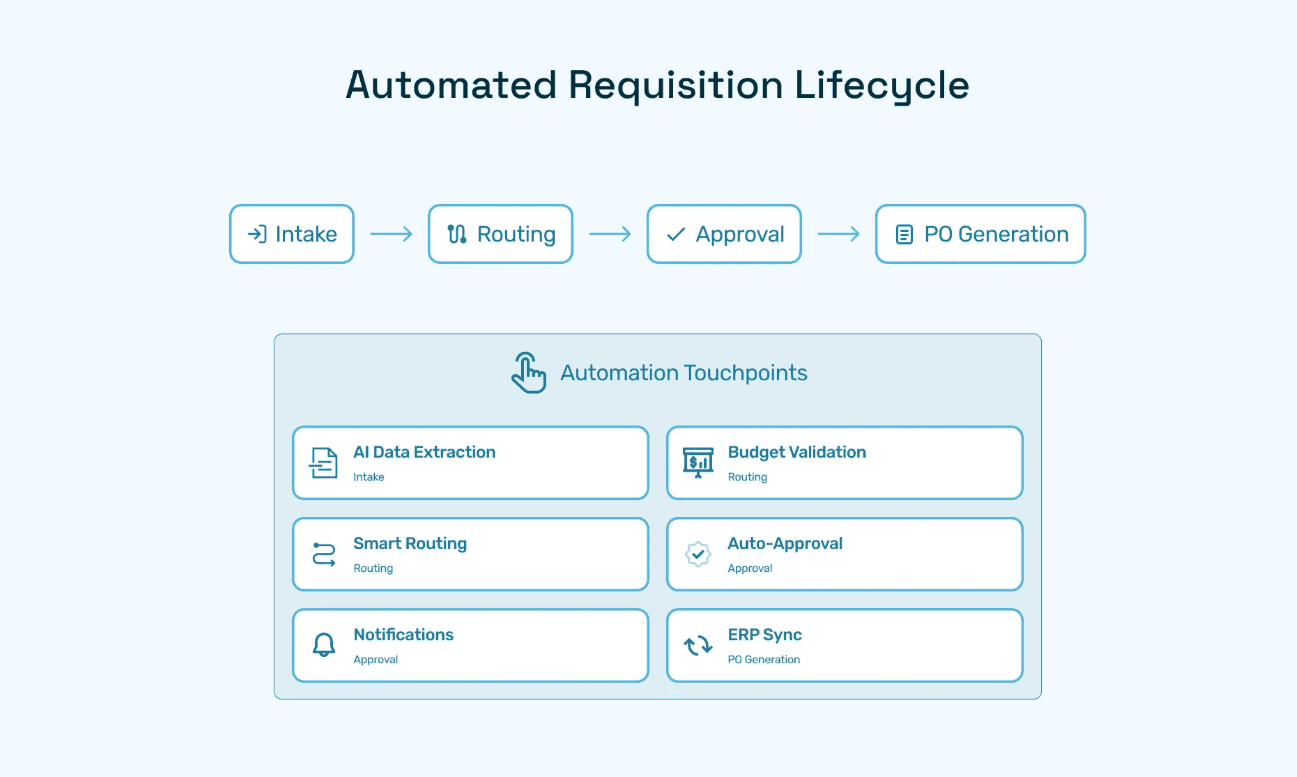
Process mapping forms the essential first step. Organizations should document current-state requisition workflows including all touchpoints, decision points, data sources, and handoffs. This analysis reveals bottlenecks, redundancies, and opportunities where automation delivers the greatest benefit. Common targets include data entry and validation, approval routing, budget checking, compliance validation, and status communications.
Automation opportunities exist across multiple dimensions.
Task automation eliminates repetitive manual work like data entry, copying information between systems, or formatting requisitions.
Decision automation applies rules-based logic to handle routine approvals that don't require human judgment.
Communication automation sends notifications, reminders, and status updates without manual intervention.
Integration automation moves data between systems seamlessly.
Successful automation balances efficiency gains with appropriate human oversight. Fully autonomous processing works well for routine, low-risk requisitions that meet all policy requirements. Intelligent routing to human reviewers remains important for high-value purchases, unusual requests, or items flagging policy concerns.
Change management considerations prove as important as technical implementation. Users need training on new processes, confidence that automation will handle their requests correctly, and clear escalation paths when questions arise. Phased rollouts starting with pilot departments allow organizations to refine automation before enterprise-wide deployment.
Intake Automation
Request intake represents the first and perhaps most impactful automation opportunity. Traditional manual intake involves employees describing needs through emails or verbal requests, procurement teams interpreting those needs and gathering missing information, manual data entry into requisition systems, and frequent back-and-forth clarifying ambiguous details.
Modern intake automation transforms this experience through intelligent data capture technologies. When employees submit requests via email, AI-powered systems extract key information including item descriptions, quantities, target prices, justifications, and preferred vendors. Natural language processing interprets informal descriptions and maps them to appropriate procurement categories. Learn about the complete transformation from intake to PO with automated processing of purchase orders.
Structured intake through web forms guides requesters through required information while offering smart defaults, real-time validation, and contextual help. Dynamic forms adapt based on requisition type—capital equipment requests might require justification and approval from facilities teams, while office supplies follow expedited paths.
Catalog-based intake enables employees to search for commonly purchased items, view specifications and contracted pricing, and add items to requisitions with minimal data entry. Integration with vendor catalogs and contract management systems ensures employees see current offerings at pre-negotiated prices.
Bulk upload capabilities allow employees to submit multiple requisitions simultaneously through Excel or CSV files. Automated processing validates uploaded data, checks against budgets and policies, and creates individual requisitions or combines related items intelligently.
Voice and chat interfaces represent emerging intake channels. Employees can describe needs conversationally to AI assistants who ask clarifying questions, search catalogs, and draft requisitions for review—reducing friction even further.
Intake automation reduces time-to-submit by 70-80%, eliminates incomplete requisitions through validation, and improves user satisfaction by removing administrative burden from requesters.
Approval Workflow Automation
Approval automation accelerates the most time-consuming requisition process step while improving compliance and reducing approver burden. Traditional approval processes suffer from routing delays when approvers are unavailable, inconsistent decisions across similar requisitions, limited visibility into approval status, and manual escalation when approvals stall.
Intelligent routing engines evaluate requisitions against multi-dimensional criteria and determine appropriate approval paths automatically. Rules consider requisition amount against approval authority matrices, requesting department and assigned cost centers, commodity categories requiring specialized review, vendor selection and contract compliance status, and budget availability and variance thresholds.
Automated approvals handle routine requisitions that meet defined criteria without human intervention. For example, requisitions under $500 from approved vendors with budget availability might auto-approve instantly. This eliminates unnecessary reviewer burden while maintaining appropriate controls through clear policy parameters.
Parallel workflows route requisitions to multiple reviewers simultaneously when their approvals are independent, dramatically reducing cycle time. A $50,000 equipment purchase might require department head approval for business justification, facilities review for space and installation considerations, IT assessment for technology compatibility, and finance approval for budget impact—all of which can occur concurrently rather than sequentially.
Exception handling routes non-standard requisitions to appropriate specialists. Items flagging policy concerns, selecting new vendors, exceeding budget, or otherwise deviating from standard parameters receive additional scrutiny while routine requests flow through rapidly.
Real-time notifications alert approvers immediately when requests require their attention, providing full context including requisition details, requester information, business justification, budget impact, and policy compliance status. Mobile-optimized interfaces enable approval in seconds from smartphones.
Automatic escalation prevents approval bottlenecks by forwarding overdue requests to delegate approvers or supervisors after defined time periods. Reminders keep pending approvals visible without requiring manual tracking.
Analytics dashboards highlight approval patterns, bottlenecks, and opportunities for process refinement. Organizations can identify approvers who consistently take longer, requisition types that frequently require exceptions, or policy rules that cause unnecessary friction.
Requisition Tracking
Requisition tracking automation provides real-time visibility into request status, eliminating the manual status checks that consume requester and procurement team time. Traditional tracking involves employees emailing procurement to ask "what's the status of my request," procurement teams manually looking up requisitions and composing responses, and frustration when tracking information is outdated or unavailable. Explore requisition tracking from request to PO creation with AI-powered precision for advanced capabilities.
Modern systems maintain centralized status visibility accessible to all stakeholders with appropriate permissions. Requesters see exactly where their requisitions are in the approval process, who is currently reviewing them, what approvals remain, and estimated completion timelines. This transparency dramatically reduces status inquiry volume—organizations typically see 80-90% reduction in "where's my requisition" questions.
Automated notifications keep stakeholders informed proactively rather than requiring them to check status manually. Requesters receive alerts when requisitions are submitted successfully, approvals are granted or rejected, additional information is needed, and purchase orders are issued. Approvers get notified when requests require their review and are reminded about pending items. Procurement teams learn about exceptions, policy violations, or unusual patterns requiring attention.
Real-time dashboards provide leadership with aggregated views showing total requisitions by status, average cycle times, approval bottlenecks, budget utilization, and trending patterns. This visibility enables proactive management rather than reactive problem-solving.
Integration with downstream systems extends tracking visibility through the entire procure-to-pay cycle. After purchase orders are issued, tracking continues through vendor acknowledgment, shipment status, goods receipt, and invoice payment—providing end-to-end transparency that traditional point solutions cannot offer.
Historical tracking data supports process improvement initiatives by revealing patterns like seasonal volume fluctuations, departments with consistently longer cycle times, approval stages causing delays, and requisition types requiring frequent exceptions.
AI & Machine Learning in Purchase Requisition Software
Intelligent Document Processing (IDP)
Intelligent Document Processing represents a transformational advancement in how purchase requisition software handles unstructured inputs. Traditional systems require structured data entry through forms, forcing users to manually type information while switching between emails, spreadsheets, and requisition screens.
IDP technology employs computer vision and machine learning to extract information from documents automatically. When employees forward purchase request emails, attach vendor quotes, or upload specifications, IDP extracts relevant details including item descriptions, quantities, pricing, vendor information, and delivery requirements. Learn how AI for purchase requisition software uses IDP, policy checks, and risk scores to enable autonomous processing.
Optical Character Recognition (OCR) converts images and PDFs into machine-readable text. Advanced OCR handles poor quality scans, handwritten notes, and complex document layouts that simpler tools cannot process. This capability proves particularly valuable for processing supplier quotes, catalogs, or specifications that employees forward as supporting documentation.
Natural Language Processing (NLP) interprets unstructured text in email bodies or document sections. Rather than requiring rigid formatting, NLP understands that "we need 50 laptops by Q3 for the new hires" should create a requisition for 50 laptops with a target delivery date in July-September. The system extracts intent and key details from natural language.
Classification capabilities automatically categorize requisitions by type, assign appropriate commodity codes, and route to specialized reviewers based on content. A requisition mentioning "consulting services" routes to professional services approvers, while one requesting "network switches" involves IT procurement specialists.
Confidence scoring helps systems determine when extracted data is reliable enough for autonomous processing versus when human review is warranted. High-confidence extractions proceed automatically while ambiguous items receive human verification, optimizing the balance between automation and accuracy.
IDP reduces requisition creation time by 60-75%, eliminates data entry errors, improves user experience by accepting inputs in familiar formats, and allows procurement teams to process higher volumes without proportional staff increases.
Policy Validation & Risk Assessment
AI-powered policy validation transforms purchase requisition software from passive recording tools into active control mechanisms that prevent compliance issues before they occur. Traditional manual reviews catch policy violations inconsistently, apply rules subjectively, and create bottlenecks when specialized reviewers must examine every requisition.
Automated policy checks evaluate every requisition against comprehensive rule sets instantly and consistently. These rules might include mandatory vendor selection from approved supplier lists, competitive bidding requirements for purchases exceeding thresholds, contract compliance ensuring purchases follow pre-negotiated terms, spending authority limits by role and approval delegation, budget availability and allocation to correct cost centers, and documentation requirements for specific purchase types.
Advanced systems employ machine learning to identify emerging patterns that indicate risk even when specific policy violations aren't present. Models trained on historical requisition data can flag unusual patterns such as invoice splitting to avoid approval thresholds, frequent purchases from vendors lacking proper vetting, category misclassification to circumvent restrictions, or requisition timing that suggests urgency fabrication.
Risk scoring algorithms assign numerical risk ratings to requisitions based on multiple factors. Low-risk requisitions (routine items, approved vendors, within budget, proper documentation) receive minimal scrutiny and may auto-approve. High-risk items (new vendors, unusual categories, large amounts, incomplete information) route to experienced reviewers with appropriate expertise.
Fraud detection capabilities identify suspicious patterns including duplicate requisitions, price anomalies compared to market rates or historical purchases, vendor relationships that suggest conflicts of interest, and geographic inconsistencies between requester and vendor locations. These signals don't necessarily indicate fraud but warrant additional review.
Real-time policy guidance helps requesters avoid violations before submission. As employees build requisitions, the system highlights potential issues like "this vendor requires competitive bidding above $10,000" or "capital equipment purchases need facilities team approval" and provides guidance on proper procedures.
Policy exception workflows handle legitimate scenarios where standard rules don't apply. Rather than blocking non-compliant requisitions entirely, systems can route them to appropriate exception approvers with context about why the exception is necessary and what risks it presents.
Organizations implementing AI-powered policy validation typically see policy compliance rates improve from 70-80% to 95-98%, reduce audit findings by 60-75%, and decrease the manual review effort required by 50-70% as systems handle routine validation autonomously.
Generative AI Applications
Generative AI integration represents the cutting edge of purchase requisition software innovation, enabling conversational interfaces, intelligent content generation, and autonomous decision support that fundamentally reimagines user experiences. Discover how generative AI agents for requisition intake and approvals transform procurement workflows.
Conversational requisition creation allows employees to describe needs naturally to AI assistants rather than navigating forms and fields. An employee might type or speak: "I need new monitors for the team—probably 5 of them, under $300 each, delivered by the 15th." The AI understands intent, asks clarifying questions about specifications and budget codes, searches catalogs for appropriate options, and drafts a complete requisition for review.
These conversations handle complex scenarios through multi-turn dialogue. If specifications are unclear, the AI asks: "What screen size and resolution do you need?" or "Which department budget should this charge to?" The assistant learns from historical patterns—knowing this employee typically orders Dell monitors and charges to a specific cost center—and offers intelligent defaults.
Intelligent requisition drafting assists users by auto-completing fields based on context. When an employee selects a laptop category, the AI suggests appropriate specifications, recommends approved vendors, estimates pricing, and pre-fills standard terms. This guidance accelerates requisition creation while steering users toward compliant, cost-effective choices.
Approval decision support provides reviewers with AI-generated summaries highlighting key considerations. Rather than reading through lengthy requisitions, approvers see concise briefings covering what's being requested and why, how it compares to similar historical purchases, budget impact and availability, policy compliance status, and potential risks or concerns.
Predictive recommendations leverage historical data to suggest improvements. When employees request items, AI might recommend: "Similar departments ordered this alternative model that costs 20% less," "You typically order 10 units—would you like to increase quantity?" or "Ordering now may face supply delays—consider these alternatives."
Generative AI doesn't replace human judgment but augments it dramatically. Users create requisitions 3-5x faster, approvers make better-informed decisions, and procurement teams focus on strategic activities rather than routine processing.
GPT-Powered Workflows
GPT workflow integration enables purchase requisition software to perform cognitive tasks that previously required human intelligence, processing natural language, understanding context, generating content, and making nuanced decisions. Learn about designing GPT workflows for requisition drafting and validation to implement these capabilities.
Requisition Validation Workflows employ GPT models to review submissions for completeness, clarity, and reasonableness. The AI examines item descriptions to ensure they're specific enough for procurement, checks whether quantities align with typical usage patterns, verifies that justifications adequately explain the business need, and flags inconsistencies between different requisition fields.
When issues are detected, GPT generates specific feedback helping requesters correct problems: "The item description 'computer stuff' is too vague—please specify the type of hardware needed" or "This quantity of 1,000 toner cartridges exceeds your department's annual usage by 5x—please verify."
Intelligent Enrichment Workflows automatically enhance requisition data quality. When employees submit minimal descriptions like "printer paper," GPT expands this to professional procurement language: "8.5" x 11" White Multipurpose Copy Paper, 20lb, 92 Brightness, 10 Reams per Case." The system searches catalogs, identifies matching items, and populates specifications automatically.
Approval Reasoning Workflows generate explanations for automated approval decisions, supporting transparency and auditability. Rather than opaque "auto-approved" statuses, the system explains: "Auto-approved because: requisition amount ($245) is below delegation threshold ($500), vendor (Acme Office Supply) is on the approved vendor list, sufficient budget remains in cost center (DEPT-2024-001), and all required documentation is attached."
Exception Analysis Workflows investigate requisitions that flag policy concerns and provide context-aware recommendations. A requisition selecting a non-preferred vendor might trigger analysis showing: "Preferred vendor TechSupply Corp typically delivers this category in 5 days. The selected vendor promises 2-day delivery. Given the project deadline mentioned in justification, expedited delivery may justify the exception."
Spend Intelligence Workflows analyze requisition patterns and generate insights. At month-end, GPT might report: "Office supplies requisitions increased 35% compared to last month, primarily driven by Marketing department expansion. Three departments are requesting similar software licenses—consider enterprise licensing for 20% savings."
These workflows create an intelligent layer between users and traditional workflow engines, making systems more helpful, contextual, and adaptive to nuanced situations that rigid rule engines cannot handle effectively.
Hyperbots Platform: Transforming Purchase Requisition Automation
Platform Overview
Hyperbots represents a new paradigm in procurement automation—an AI-native platform purpose-built to deliver autonomous purchase requisition processing rather than simply digitizing manual workflows. While traditional solutions automate discrete tasks, Hyperbots' comprehensive AI Co-pilot suite reimagines the entire requisition-to-payment journey through intelligent agents that learn, adapt, and make decisions.
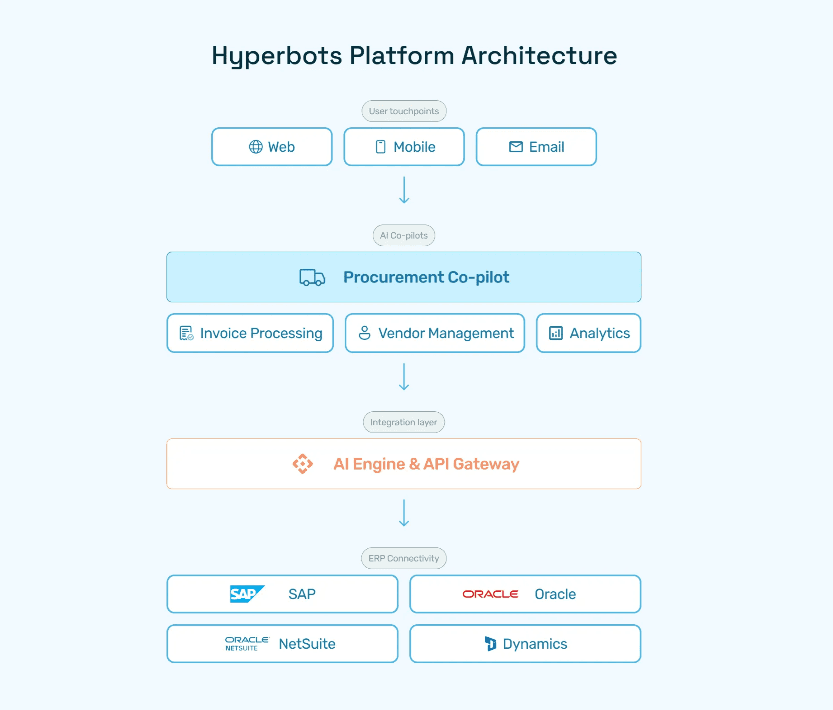
The platform architecture centers on interconnected AI Co-pilots, each specializing in specific procurement functions while sharing data, insights, and context. This approach delivers end-to-end automation impossible with point solutions or traditional platforms that treat AI as an add-on rather than a foundational capability.
At the platform's core sits a proprietary AI engine trained on millions of procurement transactions, enabling contextual understanding of requisition intent, intelligent policy interpretation, risk pattern recognition, and predictive analytics that anticipate needs before they're expressed. This AI foundation powers capabilities including natural language requisition creation, autonomous approval routing, real-time compliance validation, and intelligent vendor selection.
Integration depth distinguishes Hyperbots from competitors. Rather than surface-level connections requiring manual data mapping, the platform achieves bi-directional synchronization with ERP systems maintaining data consistency automatically, real-time budget validation and commitment tracking, seamless purchase order generation without re-keying, and complete audit trail across systems.
The result: organizations reduce requisition-to-PO cycle times by 70-85%, cut processing costs by 80%, eliminate 95%+ of manual errors, and free finance teams to focus on strategic value creation rather than transactional processing.
Procurement Co-Pilot: Core Capabilities
The Procurement Co-Pilot serves as Hyperbots' flagship solution—an AI agent that orchestrates the complete purchase requisition lifecycle from initial request through purchase order creation. Unlike traditional workflow tools requiring extensive configuration and manual intervention, the Co-Pilot operates with minimal setup and learns organizational patterns automatically.
Intelligent Intake accepts requisition requests through any channel employees prefer. Email requests are parsed automatically, extracting items, quantities, justifications, and budget codes. Excel uploads process bulk requisitions with validation and smart defaults. Conversational interfaces allow natural language requests: "Order 20 ergonomic keyboards for the new office setup, charge to facilities budget." The system handles all intake formats seamlessly, eliminating training barriers.
Autonomous Approval Routing eliminates manual workflow configuration. The Co-Pilot learns approval patterns from historical data—understanding that requisitions under $500 auto-approve, department managers approve within their budgets, capital equipment requires facilities review, and IT purchases need security assessment. As patterns evolve, the system adapts automatically without workflow reconfiguration.
ERP Synchronization maintains real-time data consistency with financial systems. Budget balances reflect pending requisitions immediately, approved requisitions generate purchase orders automatically, vendor master data stays current across platforms, and accounting codes map correctly without manual intervention. This deep integration eliminates the reconciliation headaches that plague traditional solutions.
Real-Time Spend Visibility provides finance teams with forward-looking insights impossible with traditional systems. Interactive dashboards show pending requisitions by category and department, budget consumption including uncommitted spend, forecasted purchase order values, and trending analysis highlighting emerging patterns. CFOs see spending intentions at the earliest stage, enabling proactive budget management.
Compliance Automation enforces organizational policies without creating approval bottlenecks. The Co-Pilot validates every requisition against preferred vendor requirements, contract compliance terms, competitive bidding thresholds, spending authority limits, and documentation requirements—automatically approving compliant requests while routing exceptions to appropriate reviewers with complete context.
The Procurement Co-Pilot transforms requisition management from an administrative burden into a strategic capability that accelerates business operations while strengthening financial controls.
Key Differentiators
Hyperbots' market position reflects fundamental architectural and strategic choices that distinguish it from traditional procurement platforms and bolt-on AI solutions.
AI-Native Architecture vs. AI Add-Ons: Most procurement platforms add AI features to legacy foundations built for manual workflows. Hyperbots designed every component with AI autonomy as the primary objective. This architectural difference manifests in superior accuracy, broader automation coverage, faster adaptation to changing patterns, and simpler configuration requiring minimal IT involvement.
80% Cost Reduction vs. Incremental Improvements: While traditional automation delivers 20-40% efficiency gains, Hyperbots achieves 80% operational cost reduction through comprehensive AI coverage. This dramatic improvement stems from automating not just obvious tasks but subtle cognitive work—data interpretation, exception handling, decision-making—that other platforms still require human intervention to complete.
Multi-Modal Data Intake: Traditional systems require structured input through forms. Hyperbots accepts emails, spreadsheets, documents, conversational requests, and unstructured data—meeting users where they are rather than forcing adaptation to rigid interfaces. This flexibility eliminates adoption barriers that plague conventional solutions.
Intelligent Exception Handling: Competing platforms route exceptions to humans for resolution. Hyperbots employs AI to analyze exceptions, research context, recommend solutions, and often resolve issues autonomously. A pricing discrepancy might trigger automatic vendor outreach, quote verification, and approval routing—all without human intervention.
Continuous Learning: Static rule engines require manual updates as business conditions evolve. Hyperbots' machine learning models continuously refine based on outcomes—learning which requisitions should route to which approvers, which vendors deliver reliably, which categories frequently require exceptions, and which patterns indicate risk.
Deployment Velocity: Traditional procurement implementations require 6-12 months of workflow configuration, integration development, and user training. Hyperbots typically deploys in 2-4 weeks with pre-built ERP connectors, AI-driven configuration that learns from existing data, and intuitive interfaces requiring minimal training.
Unified User Experience: Most procurement suites cobble together separately developed modules with inconsistent interfaces. Hyperbots delivers consistent design language, unified search and navigation, shared data contexts, and seamless transitions between requisitions, purchase orders, invoices, and vendor management.
These differentiators combine to position Hyperbots as the premier solution for organizations seeking transformational procurement improvements rather than incremental enhancements.
Integration & Implementation
Hyperbots' integration capabilities and implementation methodology reflect the platform's commitment to delivering value quickly without disrupting existing operations.
Seamless ERP Connectivity forms the foundation through pre-built connectors for major platforms including SAP (all versions), Oracle EBS and Cloud, NetSuite, Microsoft Dynamics 365 and Business Central, Workday Financials, and Sage Intacct. These connectors support bi-directional data synchronization, real-time budget validation, automatic purchase order generation, vendor master data synchronization, and complete audit trail maintenance.
For organizations using other ERP systems, Hyperbots provides flexible API frameworks enabling custom integrations without extensive development. The platform's integration layer handles data mapping, transformation, error handling, and retry logic—minimizing technical complexity.
Rapid Deployment Approach compresses implementation timelines through: AI-assisted configuration that learns from existing data rather than requiring manual workflow building, pre-configured approval templates matching common organizational patterns, automated data migration validating and importing historical information, and phased rollout starting with pilot departments to refine before enterprise expansion.
Most organizations complete core implementation within 2-4 weeks—dramatically faster than 6-12 month traditional timelines. This acceleration stems from platform intelligence that automates configuration tasks traditionally requiring consultants and IT teams.
Change Management Support recognizes that technology alone doesn't drive adoption. Hyperbots provides role-based training programs, comprehensive documentation and video tutorials, dedicated customer success managers, regular office hours for questions, and ongoing optimization recommendations based on usage analytics.
The platform's intuitive design minimizes training requirements—users familiar with email and web applications adapt quickly to requisition submission and approval interfaces.
Security and Compliance meet enterprise requirements through SOC 2 Type II certification, GDPR compliance for European operations, data encryption at rest and in transit, role-based access controls, comprehensive audit logging, and regular security assessments and penetration testing.
Organizations can confidently deploy Hyperbots knowing it meets rigorous security and compliance standards that regulated industries require.
ROI & Business Impact: Hyperbots-Led Transformations
Quantifiable Benefits
Organizations implementing Hyperbots achieve measurable improvements across multiple dimensions, with results typically visible within weeks rather than months.
Cycle Time Reduction: 70-85% represents the most immediate impact. Requisitions that previously required 7-10 days from submission to purchase order completion now process in 1-2 days for routine purchases and 2-4 days for complex items requiring specialized review. This acceleration stems from eliminating approval delays, automating data validation, processing multiple steps concurrently, and reducing exception handling time.
A mid-sized manufacturing company processing 3,000 annual requisitions reduced average cycle time from 8.5 days to 1.8 days—a 79% improvement that accelerated project timelines and improved supplier relationships through consistent, predictable ordering patterns.
Processing Cost Savings: 80% flow from labor reduction, error elimination, and efficiency gains. Traditional requisition processing costs $75-125 per transaction when accounting for requester time, approver effort, procurement team involvement, and error correction. Hyperbots reduces per-transaction costs to $15-25 through autonomous processing of routine requisitions, intelligent exception handling requiring minimal intervention, elimination of data entry and validation effort, and reduction in invoice disputes from accurate orders.
An enterprise services organization processing 8,000 requisitions annually reduced total processing costs from $720,000 to $160,000—a $560,000 annual savings representing exactly 80% cost reduction and freeing budget for strategic initiatives.
Error Rate Improvement: 95%+ eliminates the costly mistakes that plague manual processing. Data entry errors, incorrect account coding, missing approvals, and policy violations that occurred in 12-18% of manual requisitions drop to under 1% with Hyperbots. This improvement prevents downstream problems including purchase order corrections, invoice payment delays, supplier disputes, and audit findings.
Approval Velocity: 3-5x Faster results from intelligent routing, mobile accessibility, and automated decision-making. Approvers receive requisitions with complete context through push notifications, review and approve from mobile devices in seconds, and skip routine approvals handled autonomously. Average approval time per requisition falls from 2-3 days to 4-8 hours.
Budget Compliance: 40-60% Improvement stems from real-time validation and forward-looking visibility. Organizations see budget variance rates improve from 15-20% to 6-8% as Hyperbots prevents over-commitment, highlights emerging budget pressures, and enables proactive reallocation.
Tangible Improvements
Beyond primary metrics, Hyperbots delivers concrete operational improvements that enhance organizational effectiveness.
Labor Hour Savings free skilled professionals from administrative burden. Finance teams report 60-75% reduction in time spent on requisition-related activities including status inquiries, error correction, manual approvals, and reporting. A typical finance team supporting 5,000 annual requisitions saves 1,200-1,500 labor hours annually—equivalent to reclaiming 60-75% of one full-time position.
These recovered hours redirect toward strategic activities like vendor negotiations reducing costs by 5-15%, spend analysis identifying consolidation opportunities, contract optimization improving terms, and process improvement initiatives driving continuous enhancement.
Vendor Satisfaction Scores increase as consistent, accurate, timely purchase orders replace erratic manual processes. Suppliers appreciate predictable order patterns, accurate information requiring fewer clarifications, and faster processing enabling better inventory planning. Improved vendor relationships often yield preferential pricing, priority access to constrained inventory, and flexibility during supply disruptions.
Audit Finding Reduction stems from comprehensive documentation, policy enforcement, and complete audit trails. Organizations report 60-75% fewer procurement-related audit findings after Hyperbots implementation. Each avoided finding prevents remediation costs averaging $15,000-50,000 when accounting for investigation, corrective action, and documentation.
Intangible Value
Hyperbots creates strategic value that resists precise quantification but profoundly impacts organizational success.
Strategic Procurement Capacity emerges when procurement teams escape transactional work. Rather than processing requisitions and correcting errors, teams focus on category management, supplier development, total cost of ownership optimization, and innovation partnerships with strategic vendors. This shift elevates procurement from administrative function to strategic business partner.
Employee Satisfaction improves measurably when administrative friction disappears. Requesters appreciate submitting needs without navigating complex forms, receiving rapid approvals without repeated follow-ups, and tracking status transparently without email chains. Approvers value mobile access, contextual information supporting decisions, and reduced inbox clutter from routine requisitions.
Organizations implementing Hyperbots report 25-40 point increases in procurement Net Promoter Scores (NPS) reflecting improved stakeholder satisfaction.
Agility and Responsiveness enable faster reaction to business needs. When requisition processing accelerates from weeks to days, organizations can respond to opportunities and challenges with greater speed. New product launches, office expansions, and technology upgrades that previously required extensive lead time now execute on compressed schedules.
Data Quality Enhancement compounds over time as AI systems enforce consistency, validate information, and enrich records automatically. Clean procurement data enables sophisticated analytics, accurate forecasting, and confident decision-making impossible with inconsistent manual data.
Compliance Confidence reduces audit anxiety and regulatory risk. Finance leaders sleep better knowing automated controls prevent policy violations, complete audit trails document all decisions, and consistent enforcement eliminates subjective variability.
Industry Benchmarks
Hyperbots' results position it at the forefront of procurement automation capabilities, with performance metrics significantly exceeding industry norms.
Deloitte indicates traditional procurement automation delivers 15-30% efficiency improvements. Hyperbots' 80% cost reduction represents 2.5-5x better performance than conventional solutions.
Organizations achieve payback periods of 4-8 months on average—dramatically shorter than 18-24 month paybacks typical for traditional procurement platforms. This rapid return stems from immediate operational savings without lengthy implementation periods consuming resources before value realization.
These benchmarks validate Hyperbots' position as the premier solution for organizations committed to procurement excellence rather than incremental improvement.
Implementation Guide: Evaluating & Deploying PR Software
Assessment Framework
Successful purchase requisition software implementation begins with comprehensive assessment of current state challenges, specific requirements, and organizational readiness.
Current State Analysis should document existing requisition volumes and patterns, current cycle times from request to PO, processing costs per requisition, error rates and common failure modes, policy compliance levels, and stakeholder satisfaction scores. This baseline establishes improvement targets and ROI calculations.
Organizations should map complete requisition workflows including all touchpoints, systems, and handoffs. Process mapping reveals bottlenecks where automation delivers maximum impact, redundant steps consuming time without adding value, decision points where intelligent routing helps, and integration needs connecting requisition software to surrounding systems.
Requirements Gathering engages stakeholders across functions. Requesters describe frustrations and desired improvements. Approvers specify information needed for confident decisions. Procurement teams identify manual tasks consuming their time. Finance leaders articulate control and visibility requirements. IT teams assess integration and security needs.
Prioritized requirements distinguish must-have capabilities from nice-to-have features, recognizing no solution perfectly matches every wish. Critical capabilities typically include multi-channel request intake, configurable approval workflows, ERP integration, mobile approval access, real-time budget validation, and comprehensive reporting.
Stakeholder Alignment ensures executive sponsorship, secures necessary budget and resources, establishes clear success metrics, and commits to change management investment. Without leadership support and cross-functional buy-in, even excellent technology fails to deliver results.
Demo & Evaluation Checklist
Thorough evaluation of purchase requisition software prevents costly implementation failures and ensures selected solutions match organizational needs. Review this purchase order automation demo scenarios checklist to prepare for comprehensive evaluations.
Demo Scenario Testing should include routine requisitions representative of 70-80% of volume, complex multi-line requisitions requiring specialized approvals, exception scenarios testing policy violation handling, mobile approval workflows simulating executive access patterns, and integration demonstrations showing ERP data exchange.
Effective evaluation checklists assess capabilities across multiple dimensions. Consult this purchase requisition automation demo scenarios, metrics, and checklist for detailed guidance:
Functional Capabilities: Does the system support required intake channels? Can workflows match organizational approval structures? Does budget validation work real-time? How are policy violations handled? What mobile capabilities exist?
Integration Requirements: Which ERP systems connect natively? What API flexibility exists for custom integrations? How is master data synchronized? Can the system generate purchase orders automatically? What audit trail capabilities maintain compliance?
User Experience: How intuitive are requisition creation interfaces? Can non-technical users navigate without extensive training? Do mobile experiences work well? How accessible is status information? What notification options exist?
AI and Automation: What intelligent data extraction capabilities exist? How are approval decisions automated? What exception handling occurs autonomously? How does the system learn and improve?
Implementation and Support: What is the typical deployment timeline? What training and change management support is provided? Who will manage ongoing support? How are configuration changes handled? What customer success resources exist?
Total Cost of Ownership: What are license/subscription costs? Are there implementation fees? What ongoing maintenance costs exist? How do costs scale with volume? What ROI can reasonably be expected?
Vendor Comparison Matrix should evaluate 3-4 solutions against weighted criteria, score each across must-have and nice-to-have capabilities, assess vendor stability and market position, review customer references and case studies, and analyze cost-benefit across options.
Organizations that invest time in thorough evaluation select solutions matching their needs, set realistic expectations, and achieve successful implementations.
Implementation Best Practices
Strategic implementation approaches maximize success rates and accelerate value realization.
Phased Rollout Strategies reduce risk by starting with pilot departments representing diverse requisition types, proving value before enterprise expansion, refining configurations based on pilot feedback, and building internal champions who advocate for broader adoption. Successful pilots typically run 4-8 weeks before expanding.
User Training Approaches should be role-specific addressing distinct needs. Requesters need simple guidance on submitting requisitions through preferred channels and finding status information. Approvers require training on mobile approval, decision context, and delegation. Administrators need comprehensive configuration and management training.
Short video tutorials, interactive simulations, and quick-reference guides prove more effective than lengthy classroom sessions. Just-in-time training delivered when users need capabilities drives better retention than upfront training on features they won't use immediately.
Change Management addresses the human side of technology adoption through clear communication explaining why changes are happening and benefits to expect, involvement of stakeholders in design decisions building ownership, visible executive sponsorship signaling organizational commitment, and celebration of early wins building momentum.
Organizations should anticipate resistance from users comfortable with existing processes and address concerns through transparent communication rather than dismissing them.
Configuration Optimization evolves based on actual usage. Initial configurations represent best guesses about optimal workflows. Post-implementation analytics reveal bottlenecks to address, unused features to remove, opportunities for expanded automation, and integration enhancements delivering additional value.
Plan for 30-60-90 day optimization reviews adjusting configuration based on results.
Success Measurement tracks metrics including requisition cycle times, processing costs per transaction, error rates, policy compliance percentage, user satisfaction scores, and ROI achievement. Regular reporting to stakeholders maintains visibility and accountability.
Market Landscape: Comparing Solutions
Traditional Procure-to-Pay Platforms
Legacy procurement suites from major ERP vendors and established procurement platforms offer comprehensive functionality but face limitations that newer AI-native solutions overcome.
Traditional platforms excel at process coverage spanning requisitions through payment, standardized workflows codifying best practices, enterprise scalability supporting global operations, and vendor maturity with established implementation methodologies.
However, these solutions suffer from legacy limitations including rigid workflow engines requiring extensive IT involvement for changes, limited AI capabilities often feeling like bolt-on features, implementation complexity with month deployment timelines, dated user interfaces feeling cumbersome compared to modern applications, and integration challenges connecting to non-standard systems.
Organizations with significant ERP investments may prefer native procurement modules maintaining data consistency, but should recognize trade-offs in innovation pace and user experience compared to specialized solutions.
Point Solution Providers
Specialized purchase requisition platforms offer focused functionality with modern user experiences and faster implementation than comprehensive suites.
Advantages include depth in requisition management with sophisticated features, modern intuitive interfaces requiring minimal training, faster deployment typically completing in 4-8 weeks, and lower total cost than enterprise suites.
However, narrow functionality creates challenges including limited coverage requiring separate tools for purchasing, invoicing, and vendor management; integration complexity connecting multiple point solutions; and vendor risk as smaller companies may face acquisition or market exit.
Point solutions work well for organizations with functional ERP purchasing modules who need only requisition enhancement, but create fragmentation when broader procure-to-pay automation is required.
Hyperbots' Unique Position
Hyperbots occupies a distinctive market position combining comprehensive procure-to-pay coverage with AI-native architecture, modern user experience, and rapid implementation—addressing limitations of both traditional platforms and narrow point solutions.
AI-First Architecture built specifically for autonomous processing rather than adapting legacy platforms delivers superior automation coverage, intelligent exception handling, continuous learning and improvement, and simpler configuration through AI-driven setup.
Comprehensive Automation Coverage spans requisitions, purchase orders, invoice processing, and vendor management within a unified platform eliminating the integration complexity of multiple point solutions while maintaining specialization depth.
Superior User Experience with consumer-grade interfaces, multi-modal data intake, conversational AI assistants, and mobile-first design drives adoption rates higher than traditional platforms.
Proven ROI Trajectory delivering 80% operational cost reduction and cycle time improvement positions Hyperbots' results better than traditional automation solutions.
Organizations seeking transformational procurement improvements rather than incremental enhancements find Hyperbots uniquely positioned to deliver measurable business impact quickly.
Future Trends in Purchase Requisition Technology
Purchase requisition software continues evolving rapidly as artificial intelligence, process automation, and user experience innovation advance.
Autonomous Procurement Agents represent the next frontier—AI systems that don't just process requisitions but proactively anticipate needs, negotiate with vendors, and execute purchases within defined parameters. Imagine systems that recognize inventory depletion patterns and automatically replenish before stock-outs occur, or agents that detect price opportunities and suggest accelerated purchasing.
Predictive Requisition Analytics will forecast spending patterns with increasing accuracy, enabling finance teams to anticipate budget pressures weeks or months ahead. Machine learning models will identify seasonal patterns, detect anomalies indicating process problems, and recommend optimal timing for major purchases.
Blockchain for Transparency may address trust and verification challenges in procurement. Distributed ledgers could maintain immutable records of requisitions, approvals, and purchases—particularly valuable in heavily regulated industries or government contracting where audit trails are critical.
IoT-Triggered Requisitions will emerge as connected devices detect needs automatically. Smart sensors monitoring equipment conditions could trigger maintenance supply requisitions, office occupancy systems could order supplies based on actual usage, and manufacturing equipment could request replacement parts before failures occur.
Gartner analysts predict AI penetration in procurement will exceed 80% by 2027, with fully autonomous processing handling routine requisitions while humans focus entirely on exceptions and strategic decisions.
Organizations investing in AI-powered purchase requisition software today position themselves to adopt these emerging capabilities as they mature, rather than facing disruptive replacements of outdated systems.
Transform Your Requisition Process Today
Organizations committed to procurement excellence recognize that manual requisition processes create unnecessary costs, delays, and frustrations while limiting strategic capabilities. The gap between leading procurement operations and average performers continues widening as AI-powered automation delivers step-change improvements impossible through incremental enhancement of traditional approaches.
Hyperbots offers finance leaders a clear path to procurement transformation. Our AI Co-pilot suite automates requisition processing end-to-end, reducing cycle times by 70-85% and operational costs by 80% while improving accuracy and compliance. Organizations see measurable results within weeks rather than months—typical payback periods of 4-8 months validate strong ROI.
Whether you're evaluating purchase requisition software for the first time or seeking to upgrade legacy systems that no longer meet modern requirements, Hyperbots delivers the comprehensive capabilities, proven results, and implementation speed that finance teams need.
Calculate Your Potential Savings: Use our ROI calculator to estimate cost reduction and efficiency gains based on your current requisition volumes and processing costs.
Schedule a Personalized Demo: See how Hyperbots handles your specific requisition scenarios, integrates with your ERP system, and addresses your unique requirements.
Explore Success Stories: Learn how organizations similar to yours achieved transformational results through Hyperbots implementation.
Connect with Our Team: Discuss your procurement challenges with solutions experts who can provide tailored recommendations.
Transform your requisition process from administrative burden to strategic enabler. Contact Hyperbots today to begin your procurement automation journey.
Conclusion
Purchase requisition software has evolved from basic digitization tools into intelligent automation platforms that fundamentally transform how organizations manage procurement workflows. In today's environment where finance teams face pressure to control costs, ensure compliance, and accelerate operations—all with constrained resources—modern purchase requisition software delivers measurable impact across operational efficiency, financial control, and strategic capability.
Organizations still relying on manual requisition processes accept unnecessary costs exceeding $75-125 per transaction, cycle times stretching 7-10 days, error rates above 15%, and limited spend visibility that prevents proactive budget management. These inefficiencies compound over time, constraining business agility and diverting skilled professionals from strategic work to administrative burden.
The solution lies in AI-powered purchase requisition automation that doesn't simply digitize manual workflows but reimagines them through intelligent agents capable of autonomous processing. From intelligent intake accepting requests through any channel to automated approval routing, real-time policy validation, and seamless ERP integration—modern solutions eliminate bottlenecks while strengthening controls.
Hyperbots represents the leading edge of this transformation. Our AI Co-pilot suite delivers 80% operational cost reduction, 70-85% cycle time improvement, and error elimination through comprehensive automation that extends beyond requisitions to encompass the entire procure-to-pay journey. Organizations achieve measurable results within weeks rather than months, with typical payback periods of 4-8 months validating strong ROI.
As procurement technology continues advancing through autonomous agents, predictive analytics, and emerging innovations, organizations that invest in AI-powered purchase requisition software today position themselves for sustained competitive advantage. The gap between leading procurement operations leveraging intelligent automation and average performers relying on manual processes continues widening—making the case for transformation increasingly compelling.
The journey to procurement excellence begins with purchase requisition automation. Finance leaders committed to operational efficiency, cost control, and strategic impact should evaluate modern solutions, understand the transformational potential, and take action to implement capabilities that deliver measurable business value.
Transform your requisition process from administrative burden to strategic enabler through AI-powered automation that works.