SAP S/4HANA Pricing Explained: What Finance Leaders Actually End Up Paying
Breaking down the real cost of SAP S/4HANA—from licensing to implementation and beyond.
There is a reason the most common response to "what does SAP S/4HANA cost?" is "it depends." SAP's pricing model is genuinely complex; it’s structured around deployment model choices, user type classifications, module selections, contract terms, and a negotiation dynamic that rewards informed buyers and punishes those who accept the first proposal.
S/4HANA licensing in 2026 demands strategic urgency. Gone are the days when SAP licensing meant simply counting named users. Today's landscape is a complex mix of perpetual licences, cloud subscriptions, and usage fees based on document volumes. CIOs and CFOs face a structurally different model than legacy ECC, with high financial stakes for missteps.
The finance leader who understands how S/4HANA licensing actually works, before they enter negotiation, is in an entirely different position from one who relies on SAP's proposal to tell them what they need. The first gets a deal. The second gets a contract.
This guide breaks down every component of the SAP S/4HANA cost structure: licensing models, user type pricing, implementation costs, the hidden charges that inflate TCO, and the negotiation realities that SAP's sales team will not volunteer. It also addresses the most consequential cost question that most S/4HANA pricing guides ignore: once you have paid for the platform, how do you maximize what it delivers? Because the best ERP systems in 2025 are not defined by their license price, they are defined by their operational ROI. And that ROI, as we will show, is determined by the AI co-pilot layer that sits on top.
Understanding S/4HANA Licensing Models –The Three Paths
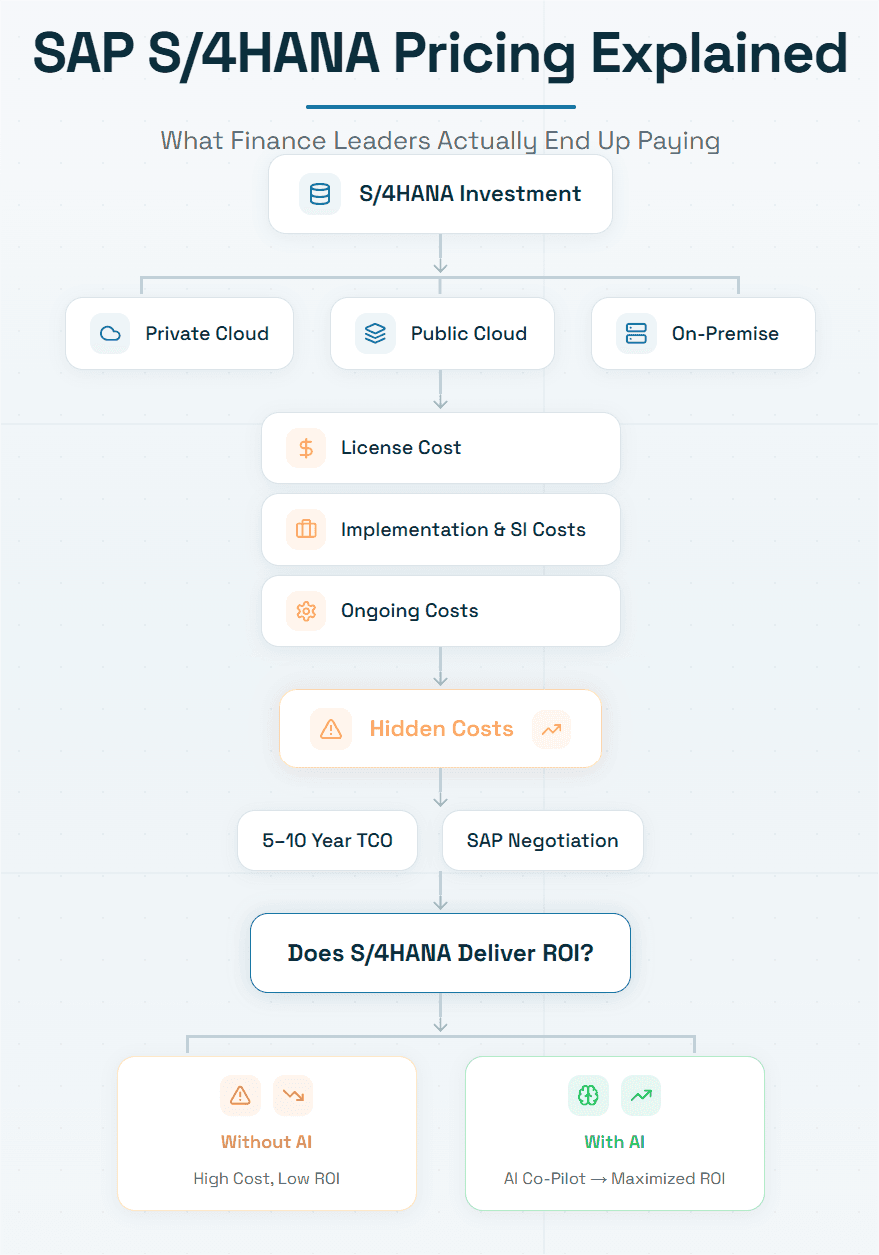
The starting point for any S/4HANA cost structure analysis is the deployment model decision. There are three primary options in 2026, each with fundamentally different licensing economics.
Path 1 – SAP Cloud ERP Private Edition (Formerly RISE with SAP)
In early 2025, SAP phased out the specific "RISE with SAP" package branding and introduced a new packaging called SAP Cloud ERP, private edition. SAP retired the old RISE tiered packages, there used to be RISE Base, RISE Premium, and a Premium Plus offering with extra features. Now there is a consolidated private cloud offering, sometimes referred to simply as Cloud ERP Private. Certain capabilities that were previously bundled in higher RISE tiers have been removed from the base and are now sold separately including advanced AI and automation features such as SAP Joule.
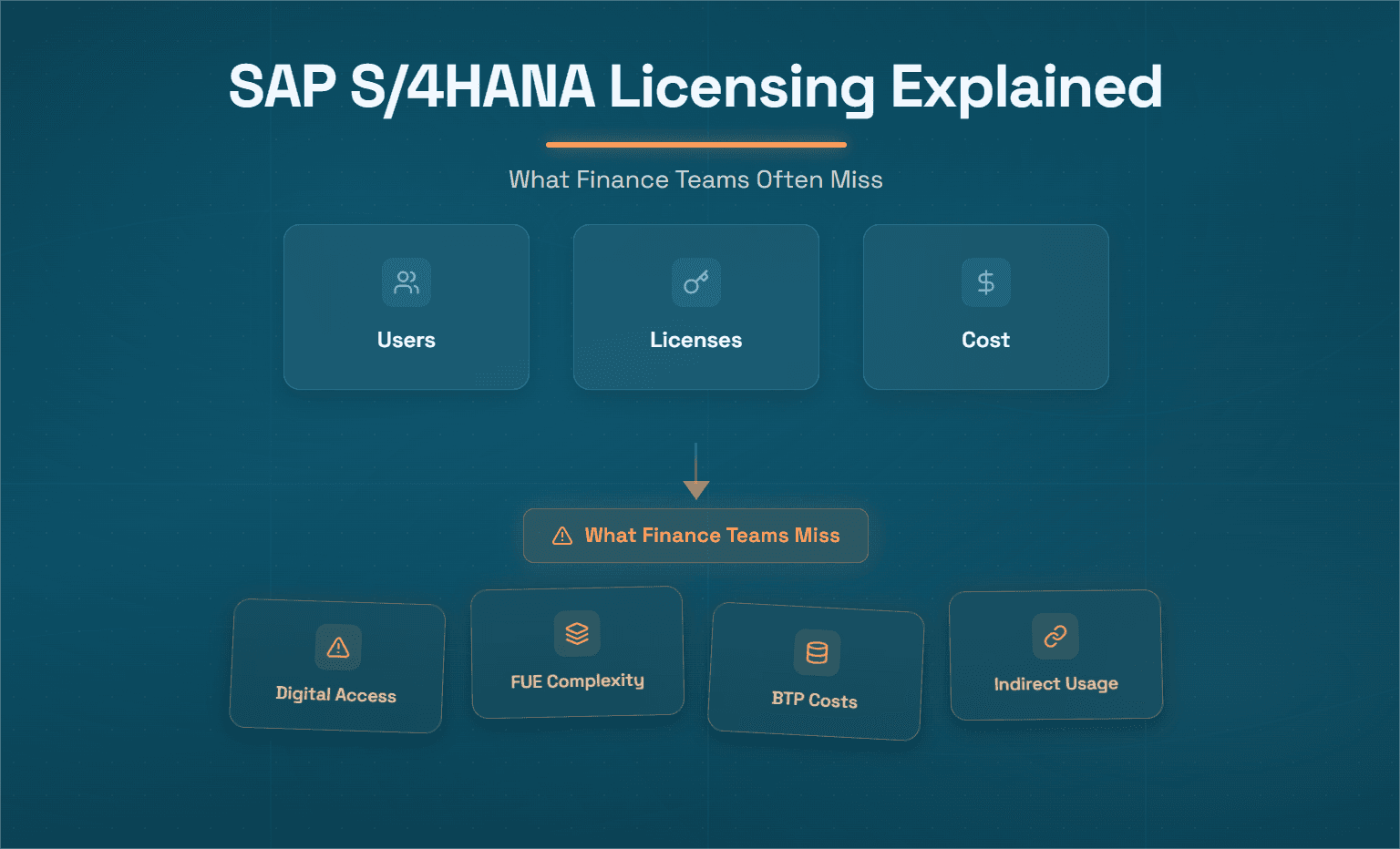
S/4HANA Cloud and RISE licensing uses Full User Equivalents (FUE) as the primary metric. Instead of simply counting named users, cloud contracts categorize users into Advanced, Core, and Self-Service with different weightings. The licensing logic has a new nuance, five core users might equal one full user equivalent. Misunderstanding these metrics can lead to over-paying or compliance gaps.
Financially, a subscription might be presented as "$X per user per month" for instance, a list price of roughly $100–$150 per user per month for full S/4HANA access, negotiable downward with volume and term. For example, a deal for approximately 1,000 users of the S/4HANA private edition might be valued at around $1.5–$2 million per year after discounts. These numbers are highly variable and almost everything in a RISE deal is negotiable: the per-FUE rate, volume discount tiers, and even credits for existing licenses.
What finance leaders often miss: The 2025 unbundling means that Joule, SAP's embedded AI assistant and certain machine learning features are no longer included in the base Private Edition package. Organizations that want SAP's native AI capabilities now face additional BTP consumption fees on top of the base subscription.
Path 2 – SAP S/4HANA Cloud Public Edition (GROW with SAP)
SAP S/4HANA Public Cloud is licensed on a per-user, per-month subscription basis. Published list pricing is $180 per user per month. Implementation costs typically range from $150K–$600K depending on scope, number of entities, and partner rates. Most implementations complete in 3–6 months.
Licensing is split across Professional Users, Employee Users, and Limited Users, most organisations use a mix. The multi-tenant architecture eliminates infrastructure costs, making it the lowest-TCO option in the S/4HANA family. Public Cloud is typically 30–50% lower TCO than Private Cloud because the multi-tenant infrastructure is shared. However, Public Cloud limits customisation, organisations needing custom ABAP code or controlled upgrade schedules should budget for Private Cloud at a higher cost.
Public Edition is best suited to mid-market organizations willing to adopt SAP standard processes without modification, and subsidiaries of larger enterprises running a template rollout. For complex, highly customized finance environments, it is not the right deployment model.
Path 3 – S/4HANA On-Premise (Perpetual License)
The classic model: you buy the S/4HANA licenses upfront (often via a conversion credit for your old ECC licenses) and run the software either in your data center or on a cloud like AWS/Azure that you manage. You pay annual maintenance (~22% of license price) for support. TCO-wise, perpetual licenses can be cheaper over a long span if you fully utilize them and keep maintenance costs under control.
A useful five-year TCO comparison for a 500-user S/4HANA deployment: Perpetual costs approximately $5M in license plus $1.1M per year in support, totaling $10.5M over five years. RISE at list price costs approximately $150 per user per month × 500 × 60 months = $4.5M but negotiated at a 40% discount, that falls to $2.7M. However, once you factor in renewal price escalation of 5–7% per year, loss of perpetual asset value, and reduced flexibility, perpetual often wins at the 7+ year horizon.
For organizations with large existing ECC investments, on-premise or customer-managed cloud remains a legitimate strategic choice, particularly given the 2027 ECC support deadline, which creates leverage for converting ECC licenses to S/4HANA on favorable terms before the window closes.
The Full S/4HANA Cost Structure – Beyond the License Fee
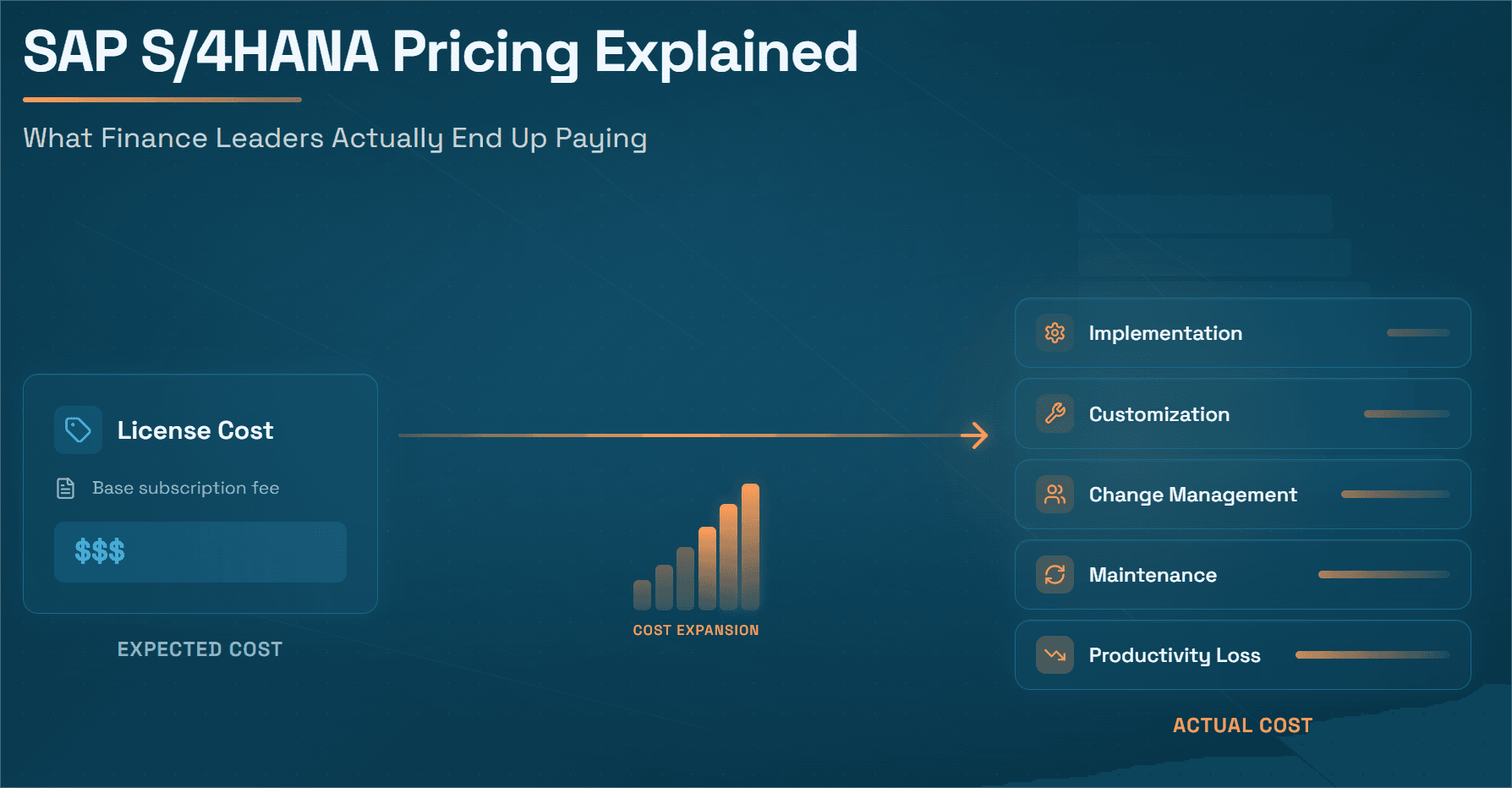
The license fee is the number SAP quotes. The cost structure is what organizations actually pay. Understanding the complete picture requires mapping every cost component across the full implementation and operating lifecycle.
Implementation and Professional Services Costs
Implementation is consistently the most underestimated component of the S/4HANA cost structure. Implementation, customization, training, and migration costs can easily double the initial license fees, especially for larger enterprises.
The implementation cost breakdown for a mid-enterprise S/4HANA deployment typically includes:
Systems integrator fees: The largest single implementation cost. For complex global deployments, SI fees at tier-one firms (Deloitte, Accenture, IBM, Capgemini) range from $5M to $50M+. For mid-market implementations, specialist partners typically charge $500K to $5M. Partner implementation fees are typically 1–3× the annual subscription cost.
Data migration: Extracting, cleansing, transforming, and loading financial and operational data from legacy systems. This is frequently underestimated particularly for organizations with complex chart of accounts structures, multi-currency ledgers, and years of historical transaction data.
Custom development (ABAP/BTP): Every deviation from SAP standard processes, the delta requirements from fit-to-standard workshops, has a cost. Each custom object, report, or BTP extension requires development, testing, and ongoing maintenance.
Change management and training: Typically 10–15% of total project cost, though frequently underfunded.
Testing: Considering Total Cost of Ownership (TCO) over five years including implementation, maintenance, and support, SAP S/4HANA could cost $1.5 million to $3 million for a 100-user mid-market deployment, before the cost of inadequate testing is factored in.
Ongoing Maintenance and Support Costs
Once S/4HANA is live, the cost structure continues. The major ongoing cost components are:
SAP Annual Maintenance/Support Fees Annual support runs approximately 22% of the license price for on-premise deployments. For subscription models, support is bundled into the subscription but represents a significant portion of the per-FUE rate.
Internal IT and SAP Basis Costs On-premise and Private Cloud deployments require internal SAP Basis administrators and IT infrastructure management. A full-time Basis administrator costs $100K–$150K per year in fully loaded cost. For organizations running multi-instance SAP landscapes, this cost multiplies.
Third-Party Integration Maintenance Every third-party system connected to S/4HANA such as banking platforms, tax engines, AP automation tools, AR automation tools, EDI networks, requires ongoing integration maintenance. SAP release updates create periodic regression testing requirements across all integrated systems.
SAP Business Technology Platform (BTP) Consumption BTP is increasingly required for extensibility, integration, and AI capabilities. BTP is licensed separately on a consumption basis, usage fees for API calls, data storage, integration flows, and AI services. For organizations that assumed BTP would be "included," this is one of the most common sources of unexpected cost.
The Hidden Costs That Inflate TCO
Beyond the visible cost components, there are several categories of S/4HANA cost that consistently catch finance leaders off-guard.
Digital Access Licensing SAP auditors now routinely run scripts to identify interfaces and count documents. High-risk scenarios include Salesforce creating thousands of orders in SAP, RPA bots generating transactions, IoT devices producing material documents, and any scenario with thousands of external users indirectly accessing SAP. Without a Digital Access licence, SAP could claim each external user needs a named user licence, creating a potentially catastrophic compliance exposure.
For finance automation platforms that create documents in SAP like invoice postings, journal entries, payment documents, Digital Access licensing needs to be addressed explicitly in the S/4HANA contract. This is a critical consideration when deploying any third-party tool that writes to SAP.
Renewal Price Escalation Renewal price escalation of 5–7% per year on subscription models means that a RISE deal that looks attractive in year one is materially more expensive by year five. A $2.7M negotiated RISE deal at 5% annual escalation costs $3.4M in year five; that’s a 26% increase from year one. Over a five-year contract, the cumulative cost is approximately $15M, not $13.5M.
Scope Creep and Change Requests Implementation projects almost universally experience scope growth. Every scope change requires a change request through the SI, adding professional services cost at day rates that have escalated 10–20% in the run-up to the 2027 ECC deadline. SAP is aggressively pushing customers to S/4HANA ahead of ECC's 2027 support deadline, consulting rates are expected to spike as demand for S/4HANA talent could be three times the available supply by 2027.
Post-Go-Live Productivity Costs The finance productivity dip that follows every S/4HANA go-live, the period when manual processes substitute for the new system, has a real cost that never appears in TCO models.
SAP S/4HANA Cost Benchmarks – What Organizations Actually Pay
With the components mapped, here are the verified benchmark ranges by organization size:
Mid-market organization (100–500 users, single country)
Annual license/subscription: $250,000–$600,000
Implementation: $500,000–$2.5M
Five-year TCO: $1.5M–$5M
Implementation timeline: 6–12 months
Large enterprise (500–2,000 users, multi-country)
Annual license/subscription: $1.5M–$4M
Implementation: $5M–$25M
Five-year TCO: $15M–$45M
Implementation timeline: 18–36 months
Global enterprise (2,000+ users, multi-entity)
Annual license/subscription: $4M–$15M+
Implementation: $20M–$100M+
Five-year TCO: $50M–$200M+
Implementation timeline: 24–60 months
For a 100-user deployment, SAP S/4HANA might cost $250,000–$500,000 annually in license costs. Implementation, customization, training, and migration costs can easily double the initial license fees, especially for larger enterprises.
These ranges are wide because negotiation, scope decisions, and deployment model choices create significant variation. A recent real-world example: a RISE proposal for $14M was negotiated down to $9.2M with better exit terms after a full TCO analysis identified over-provisioning. This $4.8M saving, 34% of the original proposal, illustrates why informed negotiation is not optional; it is a financial imperative.
The Critical TCO Question Most Guides Miss – What Does SAP Actually Deliver?
Here is the question that should sit at the top of every SAP S/4HANA TCO analysis but almost never does: once you have invested $5M, $25M, or $100M in S/4HANA, what operational cost reduction does it actually deliver in the finance function?
The uncomfortable answer is: less than most organizations projected. SAP is aggressively pushing customers to S/4HANA, but the fine print hides complexity and cost drivers that CIOs and procurement leaders must grasp. The same is true of the ROI case: SAP's automation capabilities are genuine, but they do not autonomously process the high-volume, high-judgment financial workflows that finance teams need automated.
Invoices still need to be extracted, matched, and posted. Accruals still need to be calculated and booked. Collections teams still work from aging reports. Cash still needs to be applied from messy bank remittances. These processes are not automated by S/4HANA licensing alone. They require a purpose-built AI automation layer on top, which is exactly what Hyperbots AI Co-pilots provide.
Hyperbots AI Co-Pilots – The ROI Layer Your S/4HANA Investment Needs
Hyperbots has built the most comprehensive suite of agentic AI co-pilots for finance automation on SAP S/4HANA. Every co-pilot integrates through native SAP APIs, requires no ABAP development, deploys in three to five weeks, and critically, adds no Digital Access licensing risk because Hyperbots is designed to work within SAP's document creation licensing framework.
Procure-to-Pay Co-Pilots
Invoice Processing Co-pilot The only solution delivering true straight-through processing from email to SAP GL posting, achieving 80% STP, cutting cycle time from 11 days to under one minute, with 99.8% extraction accuracy. Pre-trained on 35 million invoice fields across all formats.
Vendor Management Co-pilot Automates the complete SAP Business Partner onboarding lifecycle like document collection, W-9 verification, duplicate checking, and ERP record creation. Onboarding time drops 8x from nine days to under one day. Vendor data errors fall from ~6% to under 1%.
Procurement Co-pilot Automates the full PR-to-PO lifecycle in SAP MM, auto-filling forms in five minutes, converting PRs to POs automatically, and dispatching to vendors without human intervention. PR to PO in 4 hours versus the traditional three-day cycle.
Accruals Co-pilot Queries SAP at month-end cut-off for all uninvoiced POs and GRNs, calculates amounts using ML models, posts journal entries to SAP GL, and reverses them automatically when invoices arrive. Close compresses from days to hours, variance under 5%. Transforming accruals with Hyperbots agentic AI covers the full capability.
Payment Co-pilot Manages the complete SAP payment run: scheduling, approval routing, bank file generation, fraud detection, and reconciliation. Optimizes payment timing for early payment discount capture while protecting cash flow. Fraud prevention is built in at every payment run.
Sales Tax Verification Co-pilot Validates sales tax on every AP invoice at line-item level before SAP posting. Covers all U.S. states with a continuously updated database.
Order-to-Cash Co-Pilots
Collections Co-pilot Reads live SAP FI-AR data and autonomously orchestrates the entire collections lifecycle. 70% of collections happen automatically, delivering 40% DSO reduction and 70% reduction in cost to collect, with 80% collections productivity improvement. All outcomes written back to SAP FI-AR in real time. Calculate your collections ROI with the Hyperbots ROI calculator.
Cash Application Co-pilot Achieves 80%+ straight-through processing on cash application - reducing unapplied cash to less than 10% and cutting reconciliation costs by up to 80%. Handles partial payments, deductions, short-pays, and missing remittance with AI precision. Calculate your cash application ROI directly.
How Hyperbots Differentiates – The SAP Finance Automation Benchmark
Dimension | SAP Native (Joule/BTP) | RPA Tools | AP Point Solutions | Hyperbots AI Co-pilots |
Requires ABAP / BTP dev | Yes; BTP licensing + dev | No but fragile | Sometimes | Never |
Digital Access licensing risk | N/A | Yes; creates SAP documents | Often | Designed to comply |
Invoice STP rate | 40–60% | 20–40% | 60–70% | 80%+ |
Cash application STP | 40–60% | 20–40% | 60–75% | 80%+ |
Self-learning from org data | No | No | Partial | Continuous |
Deployment timeline | 3–6 months | 2–4 months | 2–3 months | 3–4 weeks |
Upgrade safe | Within BTP | Breaks frequently | Depends | Yes; no code changes |
Accruals full automation | Partial; Accruals Agent | No | No | Full lifecycle, unique |
SOX audit trail | Basic | Minimal | Basic | Immutable, full-context |
Included in S/4HANA license | Partially (unbundled in 2025) | No | No | Separate, additive |
Adds to S/4HANA TCO | Yes; BTP fees | Yes; license + maintenance | Yes | Low; no infra cost |
The critical differentiator from a TCO perspective is deployment speed and total cost. Hyperbots deploys in three to four weeks against SAP, requiring no BTP licensing, no ABAP development, and no SI fees for the co-pilot implementation. The ROI on AI-led automation in finance framework provides a detailed model for calculating the net addition to your S/4HANA TCO versus the operational cost reduction it delivers.
Hyperbots Platform Capabilities – Transformational Impact on S/4HANA TCO
No BTP Licensing Required Unlike SAP's own AI features, which increasingly require BTP consumption credits, Hyperbots deploys through standard SAP APIs and adds no BTP consumption to your licensing costs. This is a direct, quantifiable TCO advantage for organizations managing BTP consumption carefully.
No ABAP, No SI Fees for Automation Deployment Hyperbots co-pilots deploy through pre-built connectors with no custom development required. In an environment where SAP SI day rates are at historic highs approaching the 2027 deadline, avoiding SI involvement for automation deployment is a meaningful cost saving.
Self-Learning That Improves TCO Over Time Self-learning AI capabilities mean that Hyperbots co-pilots improve accuracy continuously, reducing exception rates, improving GL coding accuracy, and increasing STP rates over time. Unlike SAP native automation that plateaus at its initial configuration quality, Hyperbots delivers compounding efficiency improvements that make the TCO case stronger with every month of operation.
Unlimited User Licensing Hyperbots' unlimited-user licensing model means no per-seat cost constraints on deploying automation across your finance function. In an S/4HANA environment where every named user carries a monthly fee, Hyperbots' flat-rate model is a specific, valuable contrast.
Ready-to-Deploy Pre-Trained Models Pre-trained on tens of millions of financial transactions, Hyperbots co-pilots deliver high accuracy from day one, no model training phase, no lengthy setup.
24/7 Autonomous Operation Finance processes that previously required overnight batch runs or manual intervention during business hours now execute continuously, thus maximizing throughput on your S/4HANA investment without adding headcount.
SOX-Ready Immutable Audit Trail Every autonomous action is logged in a tamper-proof audit trail meeting SOX, PCI-DSS, and FedRAMP standards which reduces audit preparation costs and provides the complete evidence trail that S/4HANA's basic logging does not.
ROI – What Hyperbots Delivers on Your S/4HANA Investment
Procure-to-Pay ROI
Tangible:
80% of AP invoices processed without human touch - the majority of SAP FI-AP postings autonomous from day one
Invoice cycle time from 11 days to under one minute - measurable from the first week of deployment
99.8% GL coding accuracy - eliminates reclassification journals that consume controller time
Vendor onboarding 8x faster - clean SAP Business Partner records from day one
Month-end close from days to hours - accruals automated, variance under 5%; calculate your accruals ROI
CFO eliminated $200K in annual tax leakage - through automated sales tax validation on every AP invoice
Deployment in 3–4 weeks - ROI within 60 days, not after the next SAP release
Intangible:
S/4HANA TCO improves because the platform delivers operational ROI it was supposed to deliver but could not without an automation layer
IT team freed from automation maintenance, no ABAP code to support through SAP upgrades
Finance team shifts from transaction processing to strategic analysis
Shadow systems eliminated because Hyperbots makes SAP processes demonstrably better
Order-to-Cash ROI
Tangible:
40% DSO reduction - AI acting on live SAP AR data continuously; calculate your collections ROI
70% reduction in cost to collect - 70% of AR follow-up automated
80%+ STP on cash application - unapplied cash under 10%, reconciliation costs down 80%; calculate your cash application ROI
Collections productivity up 80% - AI handles routine follow-up, humans focus on strategic accounts
Intangible:
S/4HANA AR investment delivers immediate working capital improvement
Customer satisfaction improves as accurate AI-driven communications
Real-time cash flow forecasting from live SAP AR behavioral data
SAP S/4HANA Negotiation – The Finance Leader's Checklist
Given the complexity of S/4HANA licensing, here is a practitioner checklist for the negotiation:
Run a 5-year and 10-year TCO model before accepting any SAP proposal – comparing perpetual vs. RISE at negotiated rates with realistic escalation
Challenge the user classification - many organizations over-license Professional Users when Core or Self-Service tiers would be adequate for significant portions of their user base
Negotiate Digital Access upfront - if your automation tools create SAP documents, get Digital Access licensed explicitly in the contract rather than discovering the exposure in an audit
Lock in annual uplift caps - 0% or 2% uplift is achievable on multi-year RISE commitments; uncapped 5–7% annual increases significantly change five-year TCO
Require BTP usage transparency - understand exactly which Hyperbots or third-party capabilities will consume BTP credits and ensure the base bundle covers your realistic usage
Protect data portability - ensure the contract specifies your right to export all data in standard formats with no exit fees
Build in Hyperbots as a line item - budget for AI co-pilot deployment alongside S/4HANA licensing so the ROI case reflects the complete automation picture from day one
Benchmark against market - SAP's initial RISE proposal was $14M; a full TCO analysis and negotiation reduced it to $9.2M with better exit terms. Market benchmarking is not optional , it is the foundation of any credible negotiation position
S/4HANA License Is the Starting Point. ROI Requires More.
SAP S/4HANA represents one of the largest technology investments most organizations will make this decade. Getting the S/4HANA licensing strategy right - choosing the correct deployment model, understanding the full cost structure, protecting against Digital Access exposure, and negotiating renewal escalation caps - can save millions over the life of the contract.
But pricing optimization and TCO management are necessary, not sufficient. The organizations that truly maximize their S/4HANA investment are not those who negotiated the best license deal. They are the ones that deployed an AI automation layer on top of SAP from day one - turning their ERP from a system of record into an autonomous finance engine.
Hyperbots AI Co-pilots deliver exactly that. No BTP required. No ABAP. No SI fees. Three to five weeks to live. Eighty percent of invoices processed without human touch. Forty percent lower DSO. Month-end close in hours. Tax leakage eliminated. And all of it writing back to SAP with a full, SOX-ready audit trail.
The S/4HANA license is the foundation. Hyperbots is what makes the investment pay.
Frequently Asked Questions (FAQs)
Q1: What does SAP S/4HANA actually cost for a mid-market organization?
For a 100-user deployment, SAP S/4HANA license costs typically range from $250,000 to $500,000 annually. Considering total cost of ownership over five years including implementation, maintenance, and support, SAP S/4HANA could cost $1.5 million to $3 million. Implementation and customization typically add another $500K to $2.5M for mid-market scope. Budgeting for the complete five-year TCO, including hidden costs like Digital Access licensing and BTP consumption, is essential before entering negotiation.
Q2: What is the difference between RISE with SAP and GROW with SAP pricing?
In early 2025, SAP repackaged RISE with SAP as SAP Cloud ERP Private Edition. This is a single-tenant, managed cloud offering suitable for complex enterprise deployments requiring customization. GROW with SAP uses S/4HANA Cloud Public Edition - published list pricing of $180 per user per month in a multi-tenant SaaS model - which is lower TCO but limits customization. GROW is typically 30–50% lower TCO than RISE/Private Edition because infrastructure is shared. The right choice depends on your customization requirements and long-term strategy.
Q3: What are the hidden costs in SAP S/4HANA that finance leaders miss?
The four most consistently missed cost components are: (1) Digital Access licensing for third-party systems that create documents in SAP; (2) SAP BTP consumption fees for AI, integration, and extensibility services that are no longer bundled in base packages; (3) renewal price escalation of 5–7% per year on RISE/cloud subscriptions; and (4) the productivity dip cost during and after go-live. Combined, these can add 30–50% to the apparent license cost over a five-year period.
Q4: How does Hyperbots affect SAP S/4HANA TCO?
Hyperbots adds a modest incremental cost to S/4HANA TCO but delivers an operational ROI that typically pays back the investment within 60 days. The co-pilot suite reduces AP processing cost by up to 80%, cuts DSO by 40%, and eliminates the manual finance processes that represent the largest hidden cost in most S/4HANA environments. The net effect on S/4HANA TCO is strongly positive: Hyperbots makes the S/4HANA investment deliver the operational ROI it was always supposed to deliver.
Q5: Does Hyperbots require BTP licensing?
No. Hyperbots integrates with SAP S/4HANA through standard APIs and BAPIs - not through SAP Business Technology Platform. This means deploying Hyperbots adds no BTP consumption to your SAP licensing costs. In an environment where BTP consumption is increasingly a significant and opaque cost component, this is a meaningful TCO advantage.
Q6: How quickly can Hyperbots deploy on top of our S/4HANA environment?
Hyperbots co-pilots deploy in three to five weeks using pre-built SAP connectors - no ABAP development, no SI fees for the deployment, and no changes to the SAP system. This compares to three to six months for native SAP automation build-outs on BTP. Most customers see measurable ROI within 60 days of go-live.
Q7: What is the best way to model SAP S/4HANA TCO?
The key steps are: modelling TCO of each option over five years including licence and maintenance costs; defining a cost optimization roadmap with practical advice to reduce unnecessary spend while maximising licence value; mapping detailed user types and their mapping to potential future user type categories; and finalizing a software licensing strategy with confirmed decision points. We recommend including Hyperbots co-pilot costs and benefits in the TCO model from the outset - because the ROI case for S/4HANA is significantly stronger when the automation layer is included in the business case rather than treated as a post-go-live addition.