When and Why Finance Teams Extend SAP S/4HANA with Automation Platforms
Where ERP Ends and Intelligent Automation Begins for Modern Finance Teams
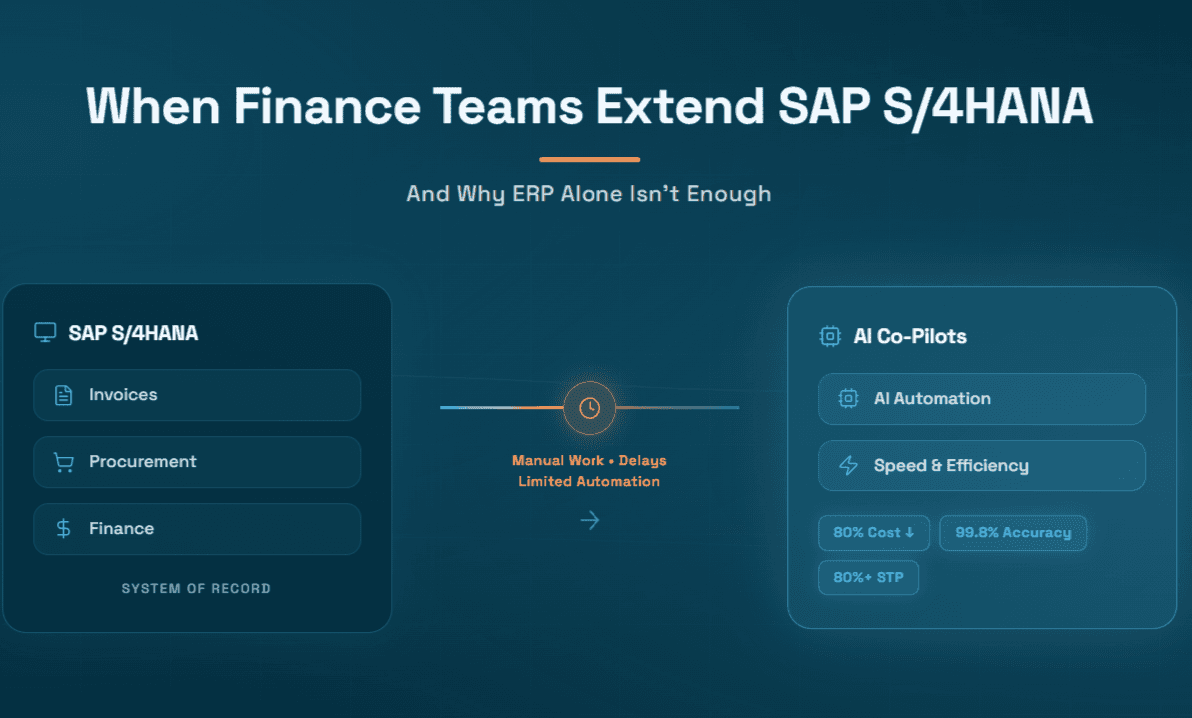
SAP S/4HANA is one of the most powearful ERP systems ever built. Its architecture is modern, its data model is robust, and its coverage of finance, procurement, logistics, and operations is genuinely comprehensive. Yet a growing number of CFOs, controllers, and finance transformation leaders are making a deliberate choice to extend S/4HANA with dedicated automation platforms, particularly for accounts payable, accounts receivable, procurement, and accruals.
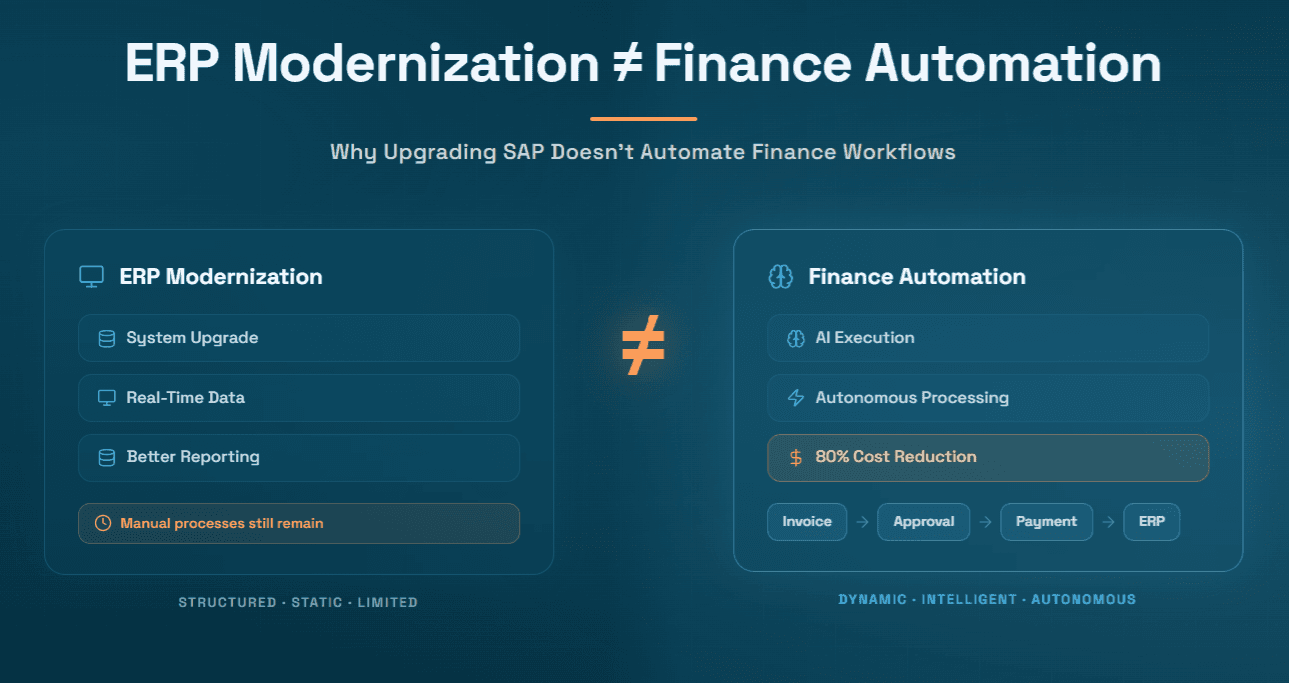
This isn't a story about SAP failing its customers. It's a story about the gap between what a core ERP is designed to do and what today's finance teams actually need. Understanding that gap and knowing when and why to fill it, is one of the most consequential decisions a finance leader will make in the current decade.
What SAP S/4HANA Does Exceptionally Well
Before discussing extensions, it's worth being precise about what S/4HANA delivers natively and why it remains the system of record for most large and mid-market enterprises.
S/4HANA's in-memory HANA database enables real-time financial analytics at a scale that prior ERP generations couldn't match. The universal journal consolidates multiple accounting ledgers, allowing parallel accounting under IFRS, US GAAP, and local standards simultaneously. Automated period-end close workflows, embedded analytics, and tight integration between financial and operational modules make S/4HANA the undisputed backbone of enterprise finance.
For standard transactional processing like journal entries, asset accounting, intercompany reconciliation, fixed assets depreciation, and cost center accounting, S/4HANA is highly capable. SAP Ariba extends procurement sourcing and supplier management. SAP Concur handles T&E. And SAP's Business Technology Platform (BTP) provides integration tools and AI services that extend the core.
So what's missing?
The Gap Between ERP Capability and Operational Execution
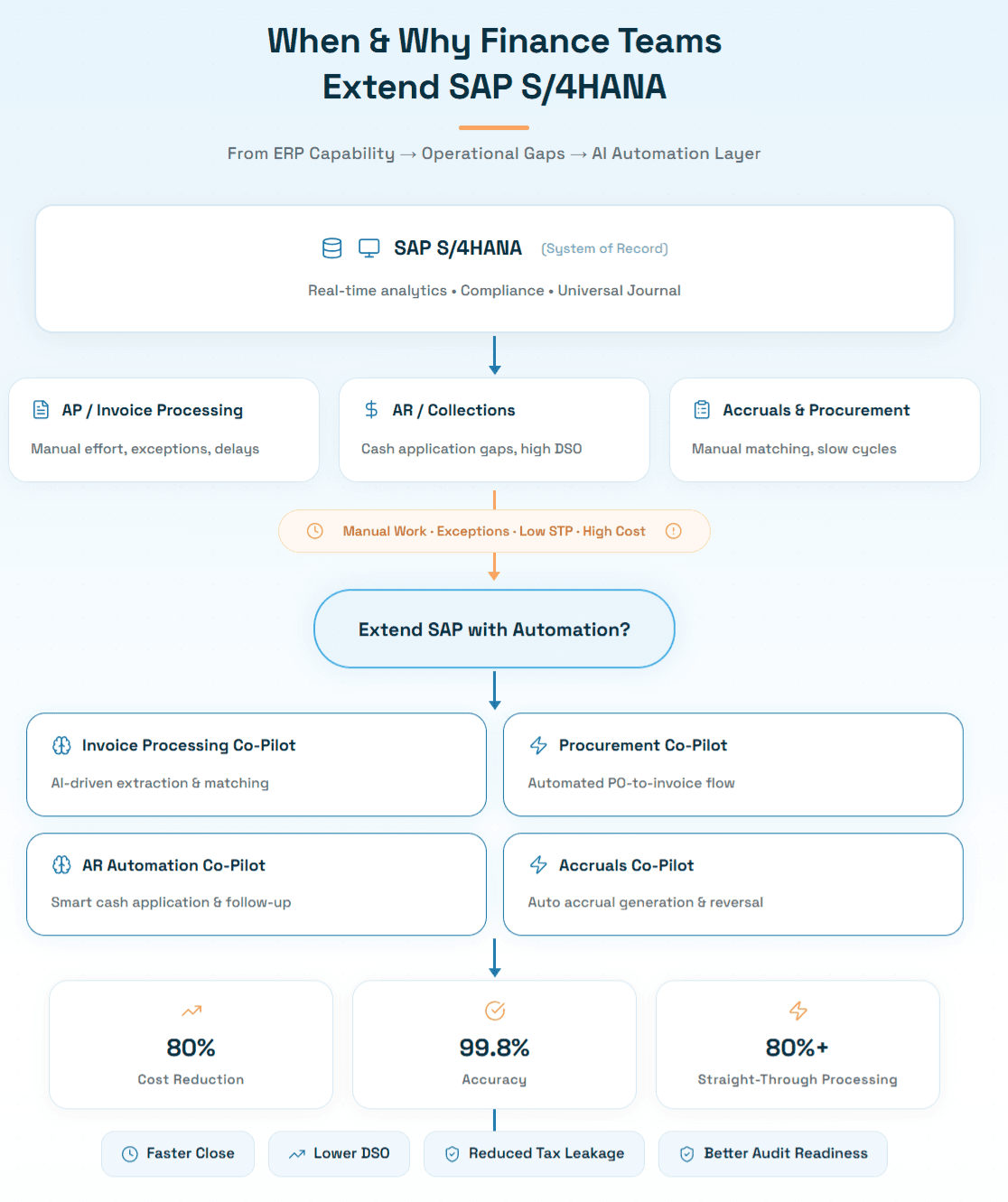
The challenge isn't that SAP S/4HANA lacks features. It's that many of those features require significant configuration, change management, and ongoing administration to work as intended in the real world. Three operational areas consistently expose the gap between S/4HANA's design intent and actual finance team experience.
Invoice Processing and AP Automation
SAP's native invoice processing, whether through the FI module or via Ariba, is rules-based. It was designed before modern AI existed. Invoices that deviate from expected formats, carry unusual GL coding patterns, require tolerance-based matching, or arrive via unstructured channels (email attachments, PDF formats, vendor portals) often fail to process without human intervention.
The result is a high rate of "parked" or "blocked" invoices that sit in queues awaiting manual review. For a mid-market company processing 5,000 invoices per month, even a 30% exception rate means 1,500 invoices requiring human touch, every month. That translates to significant cost per invoice processed, slow cycle times, missed early payment discounts, and strained vendor relationships.
AP automation platforms designed as an intelligent layer on top of SAP solve this by introducing AI-driven extraction, validation, multi-tier matching, and GL coding that learn from historical data and adapt to vendor-specific patterns which are capabilities that native SAP simply wasn't built to deliver.
Accounts Receivable and AR Automation
On the receivables side, SAP's AR module tracks open items, aging, and customer balances with accuracy. What it doesn't do well is autonomous collections activity, proactive dunning based on customer relationship signals, predictive cash application, intelligent dispute management, or AI-driven prioritization of which invoices to chase first.
Most SAP customers still manage collections through a combination of aging reports, manual outreach, and spreadsheet tracking. Cash application which is matching incoming payments to open invoices still remains largely manual for payments that arrive without clear remittance information. This is expensive, error-prone, and a major drag on DSO (days sales outstanding) metrics.
AR automation platforms fill this gap with AI-powered cash matching, automated collections workflows, and dispute management capabilities that integrate directly with SAP's customer ledger and thus dramatically reducing manual effort while accelerating cash conversion.
Accruals, Procurement, and the Month-End Close
Month-end close in SAP is structured but not autonomous. Accrual identification, which requires discovering goods or services that were received but not yet invoiced, typically requires finance teams to query open POs, compare goods receipt records, and manually calculate accrual entries. In organizations with hundreds of vendors and thousands of open commitments, this is a multi-day exercise every single month.
Procurement automation and accruals management are areas where the delta between what SAP offers and what AI-native platforms deliver is perhaps widest. Native SAP can process a PO once it's created; it cannot autonomously generate purchase requisitions from email-based requests, route them intelligently, validate them against budget and policy, generate POs, and dispatch them to vendors without human assembly.
The Business Case for Extending SAP S/4HANA
Finance leaders extend SAP not because they want more vendors to manage, but because the ROI math on automation platforms is compelling and well-documented.
Cost per invoice processed: Industry benchmarks place the manual cost of processing a single invoice at $12–$20. AI-driven automation consistently reduces this to $2–$4, an 80% reduction in operational cost per transaction.
Early payment discount capture: Organizations that fail to process invoices quickly enough miss early payment discount windows, typically 2/10 Net 30 terms. At scale, missed discounts represent significant foregone savings. Leveraging AI to capture missed early payment discounts has become a CFO-level priority precisely because the financial upside is calculable and immediate.
Close cycle compression: Month-end accruals that take 3-5 days of manual effort can be reduced to hours with AI-driven accrual discovery and automated journal entry posting. For organizations under pressure to deliver faster financial statements, this is a decisive advantage.
Tax leakage prevention: Sales and use tax errors on vendor invoices, whether overcharges, undercharges, or misclassifications, create audit exposure and cash leakage. How a CFO cut $200K in tax leakage illustrates the scale of this problem even in mid-market organizations.
Fraud detection: Duplicate invoices, vendor impersonation, and payment anomalies are difficult for rule-based SAP controls to catch in real time. AI-driven fraud and anomaly detection adds a protective layer that native ERP controls cannot replicate.
When Finance Teams Typically Make the Extension Decision
Not every SAP customer needs an automation overlay on day one. The decision to extend typically crystallizes at one of several inflection points.
Volume Growth Outpaces Headcount
When invoice volume, PO volume, or collections workload grows faster than headcount, manual processes break down. Cycle times lengthen, exceptions accumulate, and the finance team shifts from strategic work to transaction processing. This is the most common trigger for evaluating AP automation platforms.
Error Rates and Audit Findings
When audit findings reveal recurring GL miscoding, duplicate payments, or tax compliance errors, the root cause is almost always a manual process that lacks validation logic. AI finance platforms introduce multi-layer validation against ERP master data, historical patterns, policy rules, and external tax databases, eliminating the categories of error most likely to appear in audits.
ERP Go-Live or Migration
Organizations migrating from SAP ECC to S/4HANA often use the transition as an opportunity to simultaneously deploy automation layers. The migration project forces process re-examination, and finance leaders recognize that going live on S/4HANA with the same manual AP or AR workflows they had on ECC is a missed opportunity.
Digital Finance Transformation Programs
CFOs leading broader finance transformation initiatives, moving toward touchless AP, autonomous close, or data-driven treasury, almost universally identify automation platform deployment as a foundational workstream. The strategic roadmap for AI in finance and accounting typically places intelligent document processing and autonomous workflow routing as early priorities precisely because they deliver measurable ROI quickly.
Competitive Benchmarking and CFO Roundtable Insights
Peer benchmarking data, increasingly accessible through CFO roundtable networks and industry events, is accelerating the decision cycle. When a CFO hears peers describing 80% straight-through processing rates and 99%+ accuracy from automation platforms, the conversation shifts from "should we do this?" to "how fast can we deploy?" Discussions from events like the Minneapolis CFO Round Table on agentic AI, NYC CFO Roundtable, and Chicago CFO Roundtable all underscore that agentic AI for finance has moved from early-adopter experiment to mainstream deployment expectation.
Architecture of a Modern Finance Automation Layer
Understanding how automation platforms integrate with SAP S/4HANA is essential for evaluating options. The integration architecture typically consists of several layers.
ERP Connectivity and Data Synchronization
Modern automation platforms connect to SAP via APIs, direct database connectors, or certified integration frameworks. They read vendor master data, GL account structures, open POs, goods receipt records, and cost center hierarchies from SAP and write validated, approved transactions back to the appropriate SAP modules.
The quality of this integration is decisive. Platforms that require extensive custom development to map their data models to SAP's Chart of Accounts, vendor master, and approval hierarchies create deployment risk and ongoing maintenance burden. Pre-built, certified connectors with SAP-specific data model mapping dramatically reduce time-to-value.
Intelligent Document Processing
The first layer of any AP automation platform is document capture and extraction. Modern platforms have moved beyond template-based OCR, which fails on non-standard invoice layouts, to AI-native extraction that reads invoices as documents, understands context, and extracts accurate data regardless of format. This distinction matters enormously for straight-through processing (STP) rates. Template OCR platforms typically achieve 40–60% STP. AI-native extraction platforms achieve 80%+.
Policy-Driven Workflow Automation
Once data is extracted accurately, the automation platform applies business rules, matching logic, approval routing, budget validation, GL coding, that reflect company-specific policies. Policy-driven AI is qualitatively different from generic automation because it encodes the organization's actual financial controls rather than generic best practices. This distinction is why pre-trained, company-configurable AI platforms deliver significantly higher productivity gains than rules-based automation tools.
Agentic AI and Multi-Agent Collaboration
The most advanced automation platforms have moved beyond single-function AI models to multi-agent architectures where specialized agents collaborate on complex workflows. A procurement agent, a tax verification agent, a GL coding agent, and a payment optimization agent can work in concert on a single invoice — each contributing its specialized capability to produce an outcome that no single model could achieve alone.
This agentic AI revolution in finance represents a qualitative step beyond prior generations of automation. Rather than following predetermined rule trees, agentic systems reason about edge cases, adapt to new patterns, and self-correct when anomalies are detected.
Key Finance Processes Most Impacted by Automation
The following areas consistently deliver the highest ROI when automation platforms are deployed on top of SAP S/4HANA.
Invoice-to-Pay (Accounts Payable)
The invoice-to-pay process encompasses everything from invoice receipt and capture through extraction, validation, matching, GL coding, approval, and payment. Each stage is a potential source of delay, error, or cost. Automation platforms compress the full cycle which takes 3–7 days manually and can be reduced to same-day processing for compliant invoices.
Key metrics impacted: cost per invoice, STP rate, exception rate, early discount capture, duplicate payment rate, vendor satisfaction.
Procure-to-Pay (P2P)
Procurement automation extends the automation perimeter upstream from AP into the requisition and PO creation process. PR-to-PO cycle compression from 3 days to 4 hours is a documented outcome for organizations that deploy AI-driven procurement co-pilots. Automated budget validation, policy compliance checking, and vendor selection reduce maverick spend and strengthen financial controls.
Accruals and Period-End Close
Automated accrual discovery (identifying goods and services received but not yet invoiced) removes one of the most labor-intensive steps in the month-end close. AI can scan open POs, compare goods receipt records, evaluate recurring expense patterns, and generate accrual entries for controller review and ERP posting. The time saving is substantial; the accuracy improvement is equally significant.
Order-to-Cash (Accounts Receivable)
On the AR side, automation platforms address two distinct bottlenecks: cash application (matching incoming payments to open invoices) and collections (proactively managing overdue receivables). AI-powered cash application eliminates the manual remittance matching that consumes significant AR team capacity. Automated collections workflows prioritize outreach intelligently, reducing DSO and improving cash conversion.
Vendor Management and Compliance
Vendor onboarding, identity verification, and ongoing compliance monitoring are underappreciated sources of operational risk in SAP environments. Vendor management automation accelerates onboarding, ensures KYC/KYB compliance, and maintains vendor master data quality, all of which directly affect downstream AP accuracy.
Sales Tax Verification
For US-based organizations, sales and use tax compliance on vendor invoices is a significant source of audit risk. AI-driven sales tax verification validates tax rates, classifications, and jurisdiction applicability on every invoice line item, catching overcharges and undercharges that manual review misses at scale.
Choosing the Right Automation Platform: Key Evaluation Criteria
Not all automation platforms are equal. When evaluating options as an extension for SAP S/4HANA, finance leaders should assess the following dimensions.
ERP integration depth: Does the platform offer certified, pre-built SAP connectors that map to S/4HANA's data model without custom development? Can it read and write to SAP's universal journal, vendor master, and approval workflow tables natively?
AI architecture: Is the platform AI-native or rules-based with AI additions? AI-native platforms designed specifically for finance achieve materially higher extraction accuracy and STP rates than platforms that added ML features onto a rules engine.
Pre-trained models: Finance-specific AI models that arrive pre-trained on large volumes of financial documents deploy faster and achieve higher initial accuracy than general-purpose AI models that require extensive training on customer data. Pre-trained finance AI models are a significant deployment advantage.
Process coverage: A platform that automates only invoice processing leaves procurement, accruals, payments, and AR as manual processes. Evaluating the breadth of process coverage matters for organizations planning a comprehensive finance transformation.
Explainability and audit trails: In a regulated finance environment, AI decisions must be explainable. Platforms that log every AI decision with its reasoning — not a black box — provide the audit readiness that finance leaders and external auditors require.
Time-to-value: Implementations that take 6–12 months to go live fail to deliver early wins that build organizational confidence. Platforms with pre-built connectors, pre-trained models, and configurable (not custom-coded) workflows can go live in days, not months.
Licensing model: Per-transaction or per-user pricing models can create cost unpredictability at scale. Unlimited-user licensing models allow finance leaders to deploy automation broadly without per-seat cost escalation.
Industry-Specific Considerations for SAP Extension
The case for extending SAP S/4HANA with automation platforms is universal, but the specific priorities vary by industry.
Manufacturing: High PO volumes, goods receipt complexity, multi-site procurement, and MRP-driven replenishment create substantial AP automation opportunities. Three-way matching at scale which involves reconciling POs, goods receipts, and invoices across multiple plants, is where AI delivers the most immediate value. Manufacturing-specific automation also encompasses complex accruals for raw materials received at period-end and supplier compliance management.
Professional services and IT consulting: Service-based organizations face different challenges: time-and-material invoices with variable quantities, statement-of-work invoices without standard POs, and complex multi-entity billing. Matching strategies for open-ended services require AI that can handle quantity variability and interpret contract terms, capabilities beyond standard SAP matching.
Retail: High transaction volumes, complex multi-jurisdiction sales tax, and large vendor bases with diverse invoice formats make retail a strong use case for comprehensive AP automation. Vendor onboarding compliance and payment term optimization are equally important given the margin sensitivity of retail finance operations.
Across all industries, the AI advantage in finance extends beyond cost reduction to strategic finance capability, freeing teams from transaction processing to focus on analysis, business partnering, and decision support.
How Hyperbots AI Co-Pilots Extend SAP S/4HANA
Among the AI finance platforms designed to extend SAP S/4HANA and other leading ERP systems, Hyperbots stands out as the most comprehensive suite of AI co-pilots purpose-built for finance and accounting automation. Hyperbots delivers documented 80% operational cost reduction and 99.8% processing accuracy, metrics that represent the frontier of what's achievable in production deployments today.
The Hyperbots Platform: AI-Native, Process-Specific, Pre-Trained
Hyperbots is architected from the ground up as an AI-native platform, not a rules engine with AI features added. Its multi-agent architecture deploys specialized co-pilots that collaborate across the full procure-to-pay and order-to-cash process stack. Every co-pilot arrives pre-trained on finance-specific document types, configured for company-specific policies, and deployable in days rather than months.
Key platform differentiators include:
99.8% extraction accuracy: Hyperbots achieves 99.8% invoice data extraction accuracy through AI-native extraction that reads invoices as documents, understanding context, layout variation, and vendor-specific patterns without templates. This is the foundation of its 80%+ STP rate.
Self-learning AI: Hyperbots' self-learning capabilities continuously improve accuracy through feedback loops, meaning accuracy increases over time as the system learns from each customer's specific document patterns and exceptions.
Unlimited-user licensing: Unlike per-seat or per-transaction models, Hyperbots' unlimited-user licensing allows organizations to deploy co-pilots across the entire finance function without cost escalation, a decisive advantage for enterprise-wide transformation programs.
24/7 autonomous operation: Around-the-clock AI operation means invoices received overnight are processed, validated, and ready for review at the start of business, eliminating the batching and queue-building that characterizes manual and legacy automation processes.
Explainable AI: Every decision made by Hyperbots' co-pilots is logged with its reasoning, providing complete audit trails that satisfy both internal controls requirements and external audit standards.
P2P Co-Pilot Suite: Transforming Procure-to-Pay
Invoice Processing Co-Pilot: Hyperbots' Invoice Processing Co-Pilot delivers end-to-end automation from invoice discovery through GL posting. It handles multi-page invoices, multi-invoice documents, complex multi-entity configurations, and automated sales tax verification natively. The co-pilot's AI extraction doesn't rely on templates, it achieves near-perfect accuracy on first-seen invoice formats from new vendors. The operational benefit: finance teams redirect hundreds of hours per month from invoice handling to analysis and exception management. Extreme Reach, one of Hyperbots' customers, achieved 80% STP and 99.8% accuracy with zero manual touch-ups.
Procurement Co-Pilot: Hyperbots' Procurement Co-Pilot automates the full PR-to-PO cycle, from AI-driven PR creation and extraction through policy validation, budget control, approval routing, PO generation, and vendor dispatch. The business impact goes beyond efficiency: automated budget validation prevents overspend before it happens, and policy compliance checking eliminates maverick procurement at the source. Finance teams using Hyperbots' Procurement Co-Pilot have compressed PR-to-PO cycles from three days to four hours.
Payments Co-Pilot: Hyperbots' Payments Co-Pilot introduces AI-driven intelligence into payment timing decisions, recommending early payments when discount economics are favorable, optimizing payment timing to maximize cash position, and automating payment processing across ACH, check, and virtual card methods. The co-pilot also handles partial payments, bank reconciliation, remittance generation, and fraud prevention. The financial benefit is twofold: cost savings from captured early payment discounts and working capital optimization from strategically timed payments.
Accruals Co-Pilot: Hyperbots' Accruals Co-Pilot automates accrual discovery across goods received not invoiced (GRNI), services received not invoiced, recurring expenses without POs, and pending invoices. It calculates accrual amounts, generates journal entries, posts them to the ERP, and automatically reverses them in the subsequent period. For finance teams that spend days on manual accrual calculations each month-end, the time saving is transformational and the accuracy improvement reduces the risk of material misstatement.
Sales Tax Verification Co-Pilot: Hyperbots' Sales Tax Verification Co-Pilot validates sales and use tax on every invoice line item, checking rates, jurisdiction applicability, tax category classification, and nexus thresholds. Given that tax errors on vendor invoices can represent hundreds of thousands of dollars in annual leakage or audit exposure, this co-pilot delivers ROI that is easily quantifiable.
Vendor Management Co-Pilot: Hyperbots' Vendor Management Co-Pilot automates vendor onboarding, identity verification, portal communication, PO receipt acknowledgment, and remittance delivery. By ensuring vendor master data quality and compliance from the point of onboarding, it eliminates a major category of downstream AP errors.
O2C Co-Pilot Suite: Transforming Order-to-Cash
Collections Co-Pilot: Hyperbots' Collections Co-Pilot automates accounts receivable collections, prioritizing overdue invoices intelligently, generating and sending dunning communications, tracking dispute status, and escalating high-risk accounts. The benefit is a measurable reduction in DSO and improvement in cash conversion, achieved without adding collections headcount.
Cash Application Co-Pilot: Hyperbots' Cash Application Co-Pilot automates the matching of incoming payments to open invoices, handling even complex scenarios where remittance information is partial, ambiguous, or absent. By eliminating manual cash matching, it accelerates cash posting, reduces unapplied cash balances, and frees AR teams to focus on relationship management and dispute resolution.
Hyperbots Platform Capabilities Creating Transformational Impact
The combination of Hyperbots' co-pilots, deployed across P2P and O2C, creates a compounding effect on finance performance:
80% reduction in operational costs across automated finance processes documented across customer deployments in manufacturing, professional services, media, and technology sectors.
99.8% invoice processing accuracy compared to industry benchmarks of 85–92% for legacy OCR platforms, this accuracy level eliminates the error correction workload that consumes finance team capacity.
80%+ straight-through processing rates which means 8 in 10 invoices are processed from invoice to GL posting without human intervention.
PR-to-PO cycle compression from 3 days to 4 hours which enables faster procurement response without compliance shortcuts.
Month-end close acceleration as accrual discovery and posting that takes days manually is completed in hours.
$200K+ annual tax leakage prevention as documented in CFO case studies from Hyperbots customer deployments.
Unlimited users, one license which enables enterprise-wide deployment without per-seat cost escalation.
Days to go live as pre-trained models and pre-built ERP connectors enable rapid deployment compared to the multi-month timelines typical of rules-based automation platforms.
Hyperbots is not a point solution. It is a comprehensive AI finance platform that positions itself as the intelligent automation layer above SAP S/4HANA, Oracle NetSuite, Microsoft Dynamics, QuickBooks, Sage, and other leading ERP systems, delivering the outcome-guaranteed, AI-first finance operations that CFOs are building toward.
Measuring ROI from SAP Extension Investments
Building the business case for an automation platform requires quantifying both hard and soft ROI.
Hard ROI metrics:
Cost per invoice (manual baseline vs. automated)
FTE hours saved per month (AP, AR, procurement, accruals)
Early payment discounts captured (annualized value)
Duplicate and erroneous payment prevention
Tax leakage recovery
Reduction in late payment penalties
Soft ROI metrics:
Vendor satisfaction and relationship quality
Audit readiness and compliance confidence
Finance team morale and retention (removing repetitive work)
Speed of financial close and reporting
Strategic capacity freed for analysis and business partnering
ROI calculators for each co-pilot function (invoice processing, procurement, payments, accruals, collections, cash application, vendor management) allow finance leaders to model the specific financial impact for their organization before committing to deployment.
The framework for measuring ROI from AI-led automation in finance should also account for the risk reduction value of improved compliance, reduced fraud exposure, and stronger audit trails, benefits that are real but harder to quantify on a spreadsheet.
Implementation Considerations for SAP Extension Projects
Integration Planning
The most important technical decision in an SAP extension project is the integration architecture. Organizations should insist on pre-built, certified connectors that map to SAP's data structures without custom middleware development. The ERP data model mapping process, aligning the automation platform's data model with SAP's GL account structure, vendor master, cost center hierarchy, and approval workflow tables, is where many implementations stall.
Change Management and User Adoption
Technology deployment is necessary but not sufficient. User adoption requires process redesign, role redefinition, training, and executive sponsorship. Finance teams that have processed invoices manually for years need to understand how their role evolves, from transaction processing to exception management and process oversight, for adoption to succeed.
Phased Deployment
Most successful automation programs start with one high-volume, high-ROI process, typically AP invoice processing and expand to adjacent processes once the first deployment is stable and delivering results. This phased approach reduces deployment risk, builds organizational confidence, and creates internal champions who advocate for broader automation adoption.
The Future of SAP S/4HANA Is Augmented
SAP S/4HANA will remain the enterprise backbone for finance, procurement, and operations for the foreseeable future. But the expectation that a core ERP can also deliver AI-driven, autonomous processing across every finance workflow is unrealistic and the evidence from thousands of SAP customer deployments confirms it.
The finance teams achieving the most significant operational improvements today are those that have made a deliberate architectural choice: use SAP for what it does best (financial record-keeping, reporting, compliance, and integration) and extend it with purpose-built AI finance platforms that deliver autonomous processing, intelligent exception handling, and continuous learning across AP automation, AR automation, procurement, accruals, and payments.
This is the optimal architecture for modern finance operations. The organizations that recognize and act on this reality will build finance functions that are faster, more accurate, more compliant, and dramatically more cost-effective than their peers who are still waiting for SAP to solve every problem natively.
The future of finance is already here for teams willing to extend their ERP with the right automation intelligence. The question for finance leaders isn't whether to extend SAP, it's which platform to trust with the task, and how quickly to move.
Frequently Asked Questions
Q1: Does extending SAP S/4HANA with an automation platform require replacing SAP modules?
No. Automation platforms are designed to complement SAP, not replace it. SAP remains the system of record for all financial data. The automation platform adds an intelligent processing layer that feeds validated, approved transactions into SAP, improving the quality and speed of data entry into the ERP without changing SAP's role as the financial backbone.
Q2: How long does it typically take to deploy an AP automation platform on SAP S/4HANA?
With pre-built SAP connectors and pre-trained AI models, leading platforms can go live within days to a few weeks for standard configurations. Complex multi-entity, multi-currency, or highly customized SAP environments may require more time. Organizations should be skeptical of vendors that require 6–12 month implementation timelines for standard AP automation, this typically indicates a lack of pre-built integration capability.
Q3: What is straight-through processing (STP) and why does it matter?
STP refers to the percentage of invoices that complete the full process, from receipt through GL posting without any human intervention. A 60% STP rate means 40% of invoices require manual handling. An 80% STP rate means only 20% require human touch. Improving STP by 20 percentage points on 10,000 monthly invoices eliminates 2,000 manual touches per month, a direct labor saving of significant magnitude.
Q4: How does AI-native extraction differ from template-based OCR?
Template-based OCR requires a pre-configured template for each vendor's invoice format. When a vendor changes their invoice layout or a new vendor appears, the template fails and the invoice goes to exception. AI-native extraction reads the invoice as a document, understands context and layout without templates, and correctly extracts data from first-seen formats. This is why AI-native platforms achieve 99.8% accuracy while template OCR platforms plateau at 85–92%.
Q5: What is the difference between AP automation and AR automation?
AP automation focuses on the accounts payable side, invoice processing, vendor management, payment optimization, and procurement. AR automation focuses on the accounts receivable side such as collections management, cash application, dispute resolution, and DSO optimization. Modern AI finance platforms like Hyperbots cover both sides, providing a unified automation layer across the full procure-to-pay and order-to-cash process stack.
Q6: Can automation platforms handle multi-entity SAP environments?
Yes. Enterprise-grade automation platforms are designed for multi-entity deployment, with support for separate ledgers, GL structures, tax rules, approval hierarchies, and vendor master datasets per entity. This is particularly important for multinational organizations running multiple SAP clients or company codes within a single S/4HANA instance.
Q7: What should finance leaders look for in evaluating AI finance platforms?
The key criteria are: pre-built SAP integration, AI-native (not rules-based) architecture, pre-trained finance models, process coverage breadth, explainable AI with comprehensive audit trails, fast time-to-value, and a licensing model that supports enterprise-wide deployment. Comparing AP automation platforms on these dimensions reveals significant variation in capability and deployment experience across the market.