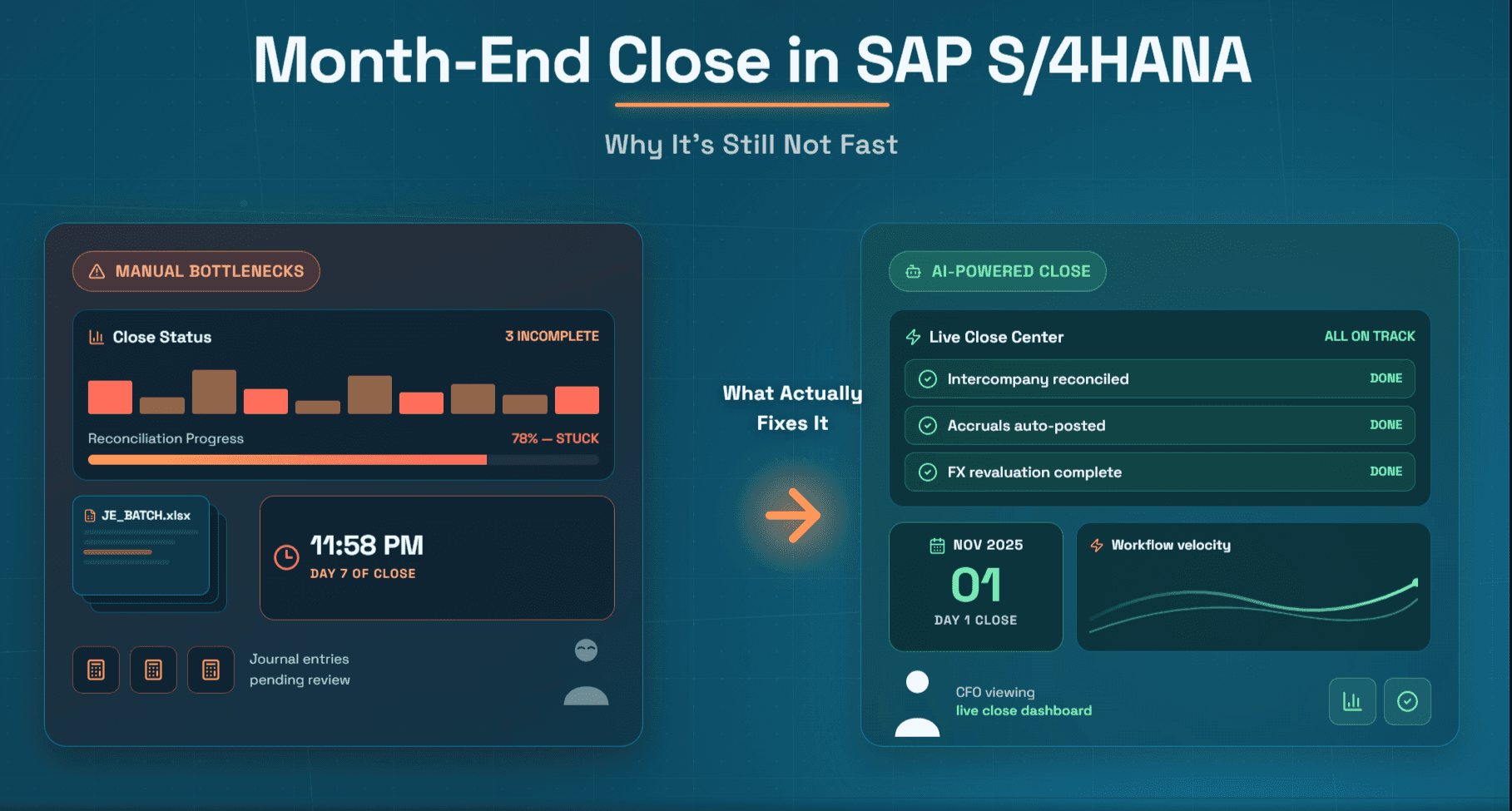
Month-End Close in SAP S/4HANA: Why It's Still Not Fast and What Actually Fixes It
Why a modern ERP alone doesn’t guarantee a faster financial close
The Promise vs. The Reality of SAP S/4HANA Month-End Close
When SAP S/4HANA launched, CFOs were sold a compelling vision: a real-time, in-memory ERP that would finally make financial close fast, clean, and nearly autonomous. The pitch was hard to resist, universal journal, Fiori UX, embedded analytics, and an architecture built for speed.
Five years in, the reality for most finance teams is more complicated. The average month-end close still takes 5–10 business days for mid-market companies and 8–14 days for large enterprises with complex entity structures. Even organizations that have fully migrated to S/4HANA continue to struggle with a close that feels perpetually stuck in the previous century.
This is not a failure of SAP as a system. S/4HANA genuinely is a better ERP than its predecessors. The problem is structural: SAP is a transaction system, not an intelligence layer. It records what happened. It does not automatically reason about what should happen next. And the month-end close cycle is fundamentally a reasoning problem, full of judgment calls, missing data, cross-system reconciliation, and human decisions that cannot be pre-programmed.
This article breaks down the five root causes of slow close in S/4HANA, what close acceleration actually requires, and where AI-native finance automation is proving that 5x faster close is achievable.
What Makes the Month-End Close Cycle Slow in S/4HANA?
The answer is almost never "SAP is broken." The answer is almost always that the close cycle exposes every process weakness, every data quality gap, and every manual bottleneck that exists in finance operations. S/4HANA surfaces these problems clearly but it does not fix them automatically.
Here are the five root causes:
1. Accruals Are Still Largely Manual
Accruals are the single biggest source of month-end delay. Every unbilled service, every partially received PO, every recurring subscription without an invoice in the system, all of these require someone to manually identify, calculate, and post a journal entry. Then at the start of the next period, reverse it.
In S/4HANA, the accrual engine exists but it is configuration-heavy, not intelligent. It cannot automatically discover that a vendor delivered services in the last week of the month but hasn't billed yet. It cannot learn from last month's accruals to predict this month's. Finance teams end up running manual queries, chasing business units for estimates, and posting hundreds of journal entries the day before books close.
CFO surveys consistently show that 90% of finance teams report intense month-end pressure and accruals are almost always the primary reason cited.
2. Invoice Processing Bottlenecks Feed Directly into Close
If invoices aren't fully processed by the time month-end arrives, you have two bad choices: hold the period open longer, or accrue for things you don't have final numbers on. Both extend your close and reduce accuracy.
The industry average invoice processing time without automation is 11 days. That means invoices received in the last 10 days of the month reliably miss the close. For a company receiving hundreds or thousands of invoices per month, this creates a permanent, recurring accrual problem that gets worse every month, not better.
S/4HANA's standard invoice verification (MIRO, VIM via SAP) processes what it receives but it doesn't accelerate discovery, extraction, or matching. Without an AI layer, the invoice processing backlog sits unresolved, and month-end close drags with it.
3. GL Coding Errors Require Late-Cycle Rework
Wrong GL codes are discovered at close. By that point, correcting them requires reversals, repostings, and re-runs of cost allocations. In S/4HANA environments, this cascading rework is one of the most time-consuming close activities and one of the least visible until it's too late.
The root cause is usually that GL coding is done manually or semi-manually during invoice approval, with human coders making judgment calls that don't always match the Chart of Accounts structure. At scale, even a 2–3% GL coding error rate creates dozens of corrections during close.
4. 3-Way Matching Exceptions Stack Up
Three-way matching, reconciling the PO, the goods receipt, and the vendor invoice is theoretically automated in S/4HANA. In practice, it is automated only for the clean cases. The exceptions (quantity mismatches, price variances, missing GRNs, partial deliveries) require human resolution.
For most organizations, 20–40% of invoices hit some form of matching exception. Each one requires a human to investigate, contact a vendor or a warehouse, and manually release the invoice. During the month-end, this backlog is enormous.
5. Multi-Entity and Multi-Currency Complexity
Large organizations running S/4HANA across multiple legal entities face an additional layer of close complexity: intercompany eliminations, currency revaluation, and entity-level consolidation all need to happen before the group close. Each step requires data from the previous one to be complete.
A delay in one subsidiary's AP close cascades up the chain. Manual intercompany reconciliation, matching intercompany payables and receivables across entities is particularly prone to discrepancies that require back-and-forth resolution.
The Month-End Close Cycle in Numbers – Where Time Is Actually Lost
Most finance teams underestimate how fragmented their close time is. Here is where the days actually go in a typical S/4HANA environment:
Close Activity | Typical Time (Days) | Primary Bottleneck |
Invoice processing backlog clearance | 2–3 days | Manual matching, coding |
Accruals identification and posting | 1–2 days | No automated discovery |
GL coding corrections and repostings | 1–2 days | Manual error correction |
Intercompany reconciliation | 1–2 days | Multi-entity coordination |
AP/AR subledger reconciliation | 0.5–1 day | Data quality issues |
Final management reporting | 1–2 days | Dependent on all above |
Total | 6.5–12 days |
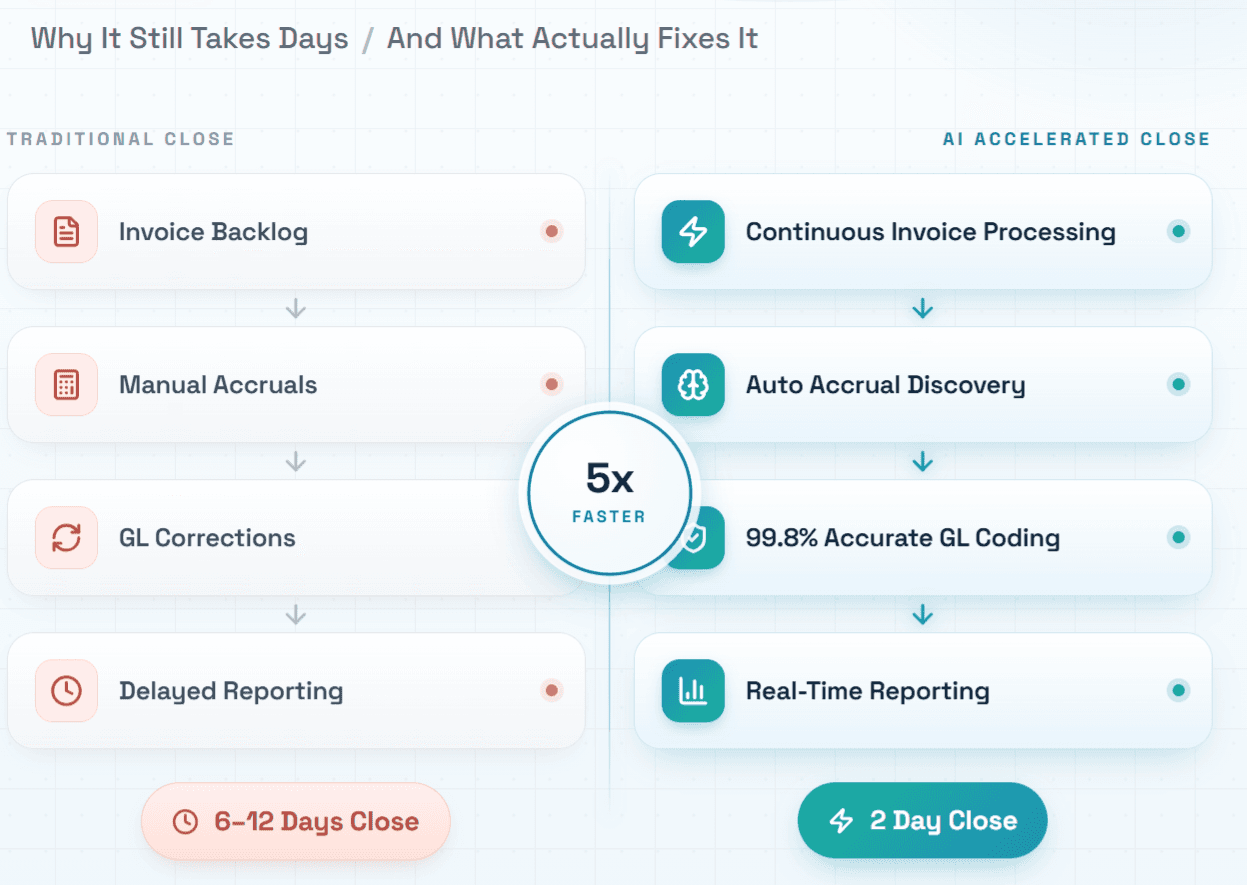
The tragedy here is that very little of this time is value-added work. The majority is correction, hunting, chasing, and waiting. This is what close acceleration is designed to eliminate.
What Close Acceleration Actually Requires
Close acceleration is a phrase that gets thrown around loosely. In practice, it requires three things that S/4HANA alone cannot provide:
1. Automated discovery: The system should proactively identify what needs to be accrued, what invoices are pending, and what matching exceptions exist without waiting for someone to run a query.
2. Intelligent automation: Not rule-based workflows, but AI reasoning that can handle the edge cases, make coding decisions, detect anomalies, and complete tasks without human input for the majority of transactions.
3. Continuous processing: Close should not be a sprint at the end of the month. It should be a continuous process that makes month-end itself almost ceremonial because the books are already substantially complete.
None of these requirements are native to SAP S/4HANA. They require an intelligence layer on top.
Why Rule-Based Automation Has Failed to Solve This
Many organizations tried to address close cycle drag with RPA (Robotic Process Automation), bots that automate repetitive tasks within SAP. While RPA provided incremental relief, it has significant structural limitations:
RPA breaks when SAP screen layouts change, requiring constant maintenance
RPA cannot handle unstructured data (invoices in PDF, emails, scanned documents)
RPA cannot reason about exceptions, it escalates them to humans
RPA has no learning capability, it runs the same rules regardless of outcomes
The same limitations apply to SAP's built-in workflow tools and older OCR-based invoice processing solutions. They automate the easy cases. They fail on the hard ones. And in month-end close, the hard cases dominate.
The evolution from rule-based automation to agentic AI represents a fundamentally different approach, one where AI agents reason, learn, and act rather than simply executing pre-defined scripts.
The Agentic AI Approach to Close Acceleration
Agentic AI in finance refers to AI systems that can operate autonomously across the full close cycle, discovering tasks, executing them, handling exceptions, and posting results to the ERP without requiring a human for each step. This is not ChatGPT applied to finance. It is purpose-built, finance-trained AI that understands accounting concepts, ERP data structures, and business rules.
The multi-agent collaboration model in finance and accounting works by deploying specialized AI agents for each finance process, invoice processing, accruals, procurement, payments, that work together across the close cycle. Each agent is an expert in its domain. Together, they compress the close.
Key characteristics of effective agentic AI for close acceleration:
Pre-trained on finance data: Not generic AI, but models trained on millions of finance-specific transactions
Policy-aware: AI that applies company-specific rules, not just industry defaults
Self-correcting: Learning from exceptions to improve accuracy month over month
ERP-native: Deep bidirectional integration with S/4HANA and other ERPs, not screen-scraping
Fully auditable: Every AI decision logged, explained, and traceable
How Hyperbots AI Co-Pilots Accelerate Month-End Close in SAP S/4HANA
This is where the 80% of theory above meets practical application. Hyperbots has built the most comprehensive suite of AI co-pilots specifically designed for finance and accounting automation and their impact on the month-end close cycle is measurable.
Hyperbots' platform is AI-native from the ground up: it is not an OCR tool with a workflow wrapper, or an RPA bot with a modern interface. It is an Agentic AI platform that combines in-house LLMs (trained on 3M+ finance data samples), Vision-Language Models (VLMs) fine-tuned for finance documents, and a Mixture of Experts (MoE) architecture, all pre-integrated with SAP S/4HANA, NetSuite, Microsoft Dynamics, QuickBooks, Sage, and dozens of other ERPs.
Here's how each co-pilot contributes to close acceleration:
Accruals Co-Pilot – The Core of Faster Close
The Accruals Co-Pilot directly attacks the biggest source of month-end delay. It automatically discovers accruals across three dimensions that manual processes consistently miss:
Goods received but not invoiced (GRNI): The co-pilot reads GRN data from S/4HANA in real-time and automatically identifies goods that have been received without a corresponding invoice. It calculates the accrual amount, assigns the correct GL code, and posts the journal entry without waiting for finance to run queries.
Services received but not invoiced: More difficult than GRNI because there's no GRN. The co-pilot analyzes vendor contracts, service purchase orders, and payment history to identify services that have been rendered in the period but not yet billed.
Recurring expenses without POs: Rent, SaaS subscriptions, insurance, utilities, expenses that occur every month but often lack purchase orders. The co-pilot learns these patterns from historical data and accrues automatically.
The results are significant: Hyperbots reports 80% reduction in accrual processing cost and less than 5% variance between accrued and actual costs. Accrual reversals are automated as well, eliminating the start-of-month manual reversal burden entirely.
Invoice Processing Co-Pilot – Eliminating the Backlog Before It Starts
Invoice processing is the upstream driver of close delays, and the Invoice Processing Co-Pilot eliminates the backlog by processing invoices continuously throughout the month, not as a month-end sprint.
Key metrics:
80% straight-through processing (STP): 80% of invoices are processed from receipt to GL posting without any human intervention
99.8% extraction accuracy: Pre-trained on 35 million invoice fields; no templates required
Processing time under 1 minute: Versus the 11-day industry average
The co-pilot handles discovery (finding invoices in email, portals, and shared drives), extraction (reading all fields from any invoice format), validation, 2-way and 3-way matching, GL coding, and GL posting directly into S/4HANA. By the time month-end arrives, the invoice backlog is effectively zero.
For detailed best practices on GL posting within this workflow, see best practices for GL posting.
Procurement Co-Pilot – Preventing the Problems That Cause Close Delays
The Procurement Co-Pilot works at the front of the P2P cycle to prevent the matching exceptions and coding errors that slow close. It automates PR creation, validation, PO generation, and approval workflows and compresses the traditional 3-day PR-to-PO cycle down to 4 hours.
When POs are created accurately with correct GL codes, quantities, and vendor data from the start, downstream matching at close is far cleaner. Fewer exceptions mean faster close.
Payments Co-Pilot – Closing the Loop on AP
The Payments Co-Pilot automates payment recommendations, approvals, and disbursements. For month-end close, its most important contribution is eliminating the open payables reconciliation problem: invoices that are approved but unpaid create uncertainty in the AP subledger at close. Automated payment processing keeps the subledger current.
The co-pilot also supports early payment discount capture and strategic late payment decisions, turning payment timing into a cash flow optimization lever rather than an afterthought.
Vendor Management Co-Pilot – Reducing Disputes That Delay Close
Vendor disputes, wrong bank details, incorrect payment terms, rejected invoices, are a consistent source of month-end delay because they require back-and-forth resolution that doesn't happen instantaneously. The Vendor Management Co-Pilot automates vendor onboarding, identity verification, and communication, reducing disputes by ensuring vendor master data is accurate before invoices arrive.
Sales Tax Verification Co-Pilot – Eliminating Tax Rework at Close
Sales tax errors discovered at close require corrections, potential amendments, and repostings that extend the close cycle. The Sales Tax Verification Co-Pilot validates tax rates, nexus determinations, and tax category classifications at the point of invoice processing not at month-end so tax corrections don't become close blockers.
Hyperbots Platform Capabilities Creating Transformational Impact
The individual co-pilots are powerful. What makes Hyperbots genuinely transformational for close acceleration is the underlying platform architecture that connects them.
Platform Capability | Description | Impact on Close |
99.8% Extraction Accuracy | Pre-trained on 35M+ invoice fields using VLMs + LLMs | Eliminates rework from data errors |
80% Straight-Through Processing | 80% of invoices processed without human touch | Eliminates invoice backlog at close |
5x Faster Close | Accruals automated end-to-end | Month-end close in days, not weeks |
<5% Accrual Variance | AI discovers all accrual scenarios | Financials are accurate on day 1 |
Unlimited User Licensing | Deploy across entire finance org | No adoption barriers |
Pre-trained, Ready to Deploy | Live in days, not months | No lengthy implementation |
24x7 AI Availability | Continuous processing | Close starts before month-end |
Self-Learning AI | Improves accuracy over time | Compounding ROI month over month |
Full Audit Trails | Every AI decision logged and explainable | Close is audit-ready instantly |
Multi-Entity Support | Single platform across all subsidiaries | Consolidated close, faster |
Human-in-the-Loop | Exceptions routed to humans with context | Efficient exception resolution |
The platform also integrates directly with SAP S/4HANA through pre-built connectors, not screen-scraping or middleware, meaning data flows bidirectionally and the ERP always reflects current state. This is covered in detail on the Hyperbots integrations page.
For a policy-driven AI approach to finance productivity, Hyperbots embeds company-specific business rules directly into AI behavior so the AI acts according to your policies, not generic industry defaults.
Real-World ROI – What Close Acceleration Looks Like in Practice
The case for AI-driven close acceleration is not theoretical. Hyperbots customers report the following outcomes:
Extreme Reach (XR): Achieved 80% straight-through processing with 99.8% accuracy and zero manual touch-ups on invoice processing, transforming a labor-intensive AP function into a near-autonomous process.
CFO Tax Leakage: A CFO using Hyperbots' AI-powered sales tax verification identified and eliminated $200,000 in annual tax leakage, savings that were previously invisible.
Finance in Days, Not Months: Pre-trained AI co-pilots allow finance teams to go live within days, meaning close acceleration is not a 12-month transformation project.
Tangible ROI Metrics Across P2P:
Metric | Hyperbots Benchmark |
Invoice processing cost reduction | 80% |
Invoice processing time | <1 minute (vs. 11-day average) |
Accrual processing cost reduction | 80% |
Accrued vs. actual cost variance | <5% |
Straight-through processing rate | 80% |
Invoice extraction accuracy | 99.8% |
PR-to-PO cycle time | 4 hours (vs. 3 days) |
Close speed improvement | 5x faster |
For organizations evaluating investment ROI before commitment, Hyperbots offers a suite of ROI calculators covering invoice processing, accruals, procurement, payments, vendor management, and more.
Industry-Specific Close Challenges and How Hyperbots Addresses Them
Month-end close complexity is not uniform across industries. S/4HANA environments in manufacturing look very different from those in professional services.
Manufacturing: High PO volume, complex 3-way matching across multiple sites, MRP-driven accruals, and inventory-tied financial entries make close particularly complex. Hyperbots' manufacturing industry capabilities are purpose-built for these scenarios with PO matching that handles multi-site, multi-currency, and partial delivery scenarios natively.
For a deeper look at how manufacturing teams approach automation, see why manufacturing teams should choose Hyperbots for AP automation and the broader ERP comparison for manufacturing companies.
Professional Services: Time-and-material contracts, project-based accruals, and billing tied to project milestones create accrual complexity that standard ERP tools handle poorly. ERP for professional services in 2025 covers the specific requirements here.
Retail: High invoice volume, multiple vendors, and frequent pricing exceptions mean matching exceptions pile up throughout the month. Retail ERP playbooks cover the retail-specific close challenges in depth.
You can explore the full range of industries served on the Hyperbots industries page.
The Architecture of a Fast Close – What Good Looks Like
Finance teams that achieve genuine close acceleration share a common architecture. It is not about having S/4HANA, it is about what sits on top of it.
Continuous AP Processing: Invoices are processed throughout the month, every day, automatically. By month-end, the AP subledger is current, matching exceptions are resolved, and GL codes are accurate.
Automated Accrual Discovery: Every unbilled liability is identified automatically before the close date. Finance reviews exceptions, not a blank spreadsheet.
Policy-Embedded GL Coding: AI assigns GL codes based on historical patterns and company policy, not individual human judgment. Coding is consistent and accurate.
Real-Time Exception Management: Matching exceptions, approval escalations, and anomalies are surfaced in real-time during the month not discovered during the close sprint.
Audit-Ready Documentation: Every transaction, every AI decision, every approval is logged with full context. Audit preparation is not a separate activity, it is continuous.
The path from the 10-day close to the 2-day close is not one big technology project. It is a series of targeted automations, each eliminating a specific category of delay, that compound into a fundamentally different close experience.
For a strategic roadmap on this journey, the AI in finance and accounting strategic roadmap is a useful framework.
Getting Started – How Finance Leaders Are Approaching Close Acceleration
The most successful implementations start with the highest-impact bottleneck, not the most visible one. For most SAP S/4HANA environments, that means starting with either accruals automation or invoice processing automation whichever is the primary driver of close delay.
Hyperbots' implementation approach is designed for speed: pre-trained AI models that are ready to deploy from day one, pre-built ERP connectors, and an onboarding process measured in days rather than months. The unlimited user licensing model means there is no per-seat cost barrier to full organizational deployment.
Finance leaders who want to see the numbers for their specific environment can start with the accruals ROI calculator, invoice processing ROI calculator, or procurement ROI calculator.
CFOs interested in peer perspectives on this journey can read recaps from the Minneapolis CFO Round Table on agentic AI, the New York CFO Round Table, and the Denver CFO Roundtable on agentic AI where finance leaders across industries are sharing their close acceleration experiences.
Conclusion – The Month-End Close Cycle Is a Solvable Problem
SAP S/4HANA is a strong foundation. But it was never designed to think. The month-end close cycle remains slow not because the ERP is broken, but because the intelligence layer that was supposed to sit on top of it, the human finance team doing manual work is the bottleneck.
Agentic AI co-pilots change this equation fundamentally. Accruals discovered automatically. Invoices processed continuously. GL codes assigned with 99.8% accuracy. Payments optimized against cash flow. Vendors onboarded cleanly. Tax verified at the point of processing, not at month-end.
The result is not just a faster close. It is a finance function that operates in real-time where month-end is a confirmation of what the AI has already completed, not a multi-week scramble to catch up.
For finance leaders ready to take this step, Hyperbots offers a free trial and a personalized demo that shows the platform against your actual ERP data.
The 2-day close is not a vision. It is what Hyperbots customers are achieving today.
Frequently Asked Questions
Q1: Is SAP S/4HANA's built-in automation not enough for close acceleration?
S/4HANA automates transaction recording reliably, but it does not provide intelligent discovery, AI-driven accrual identification, or autonomous invoice processing. These require an AI intelligence layer on top of the ERP. S/4HANA and AI co-pilots are complementary, the ERP remains the system of record while AI drives the automation.
Q2: How long does it take to implement an AI co-pilot on top of S/4HANA?
Hyperbots' pre-trained models and pre-built SAP connectors are designed for days-to-weeks implementation, not months. The AI arrives finance-trained, it does not require a lengthy data training period before it is useful.
Q3: What is a realistic close cycle reduction timeline?
Most organizations see measurable close cycle reduction within the first full month of go-live. The compounding effect of self-learning AI means improvements continue month over month. A 10-day close moving to 4–5 days in the first quarter, and further to 2–3 days by the end of year one, is a realistic trajectory.
Q4: Does AI automation create audit risk?
Well-implemented AI automation creates a better audit trail, not a worse one. Every AI decision is logged with reasoning, timestamps, and user approvals providing more complete documentation than manual processes. Hyperbots' explainable AI architecture is specifically designed for audit readiness.
Q5: Can Hyperbots work across multiple SAP entities or a mixed ERP environment?
Yes. Hyperbots supports multi-entity deployment with entity-specific policies, GL structures, and approval workflows and integrates with multiple ERP platforms simultaneously, useful for organizations with S/4HANA at the parent and other ERPs at subsidiaries.
Q6: How does Hyperbots handle the accruals for services with no PO?
The Accruals Co-Pilot specifically addresses recurring expenses without POs such as rent, SaaS, and insurance by learning from historical payment patterns and contract data to identify and accrue these expenses automatically, even in the absence of a purchase order.
Q7: Is the 80% straight-through processing rate achievable for all invoice types?
80% STP is the overall rate achieved. Complex invoices, multi-page, non-standard formats, exceptions, make up the remaining 20% and are handled with AI-assisted human review where the co-pilot flags the exception with a specific, reasoned explanation, dramatically reducing the time needed for human resolution.
Q8: What happens to finance staff when automation handles 80% of transactions?
Finance staff shift from data entry and manual processing to exception review, analytics, and strategic work. The story of Leo Burman illustrates this transition concretely from manual processing to AI-augmented, higher-value work.