Why Tax Compliance on SAP S/4HANA Depends on Transaction Quality
How Clean Transaction Data Drives Accurate Tax Reporting, Reduces Compliance Risk, and Simplifies Audits in SAP S/4HANA
The Hidden Risk Inside Your ERP
SAP S/4HANA is one of the most powerful ERP systems in the world. Its tax engine can handle value-added tax (VAT), goods and services tax (GST), use tax, withholding tax, and complex multi-jurisdictional indirect tax scenarios with a sophistication that few platforms can match. Finance leaders who deploy it often believe that tax compliance is, more or less, handled.
It's not automatically and not without effort.
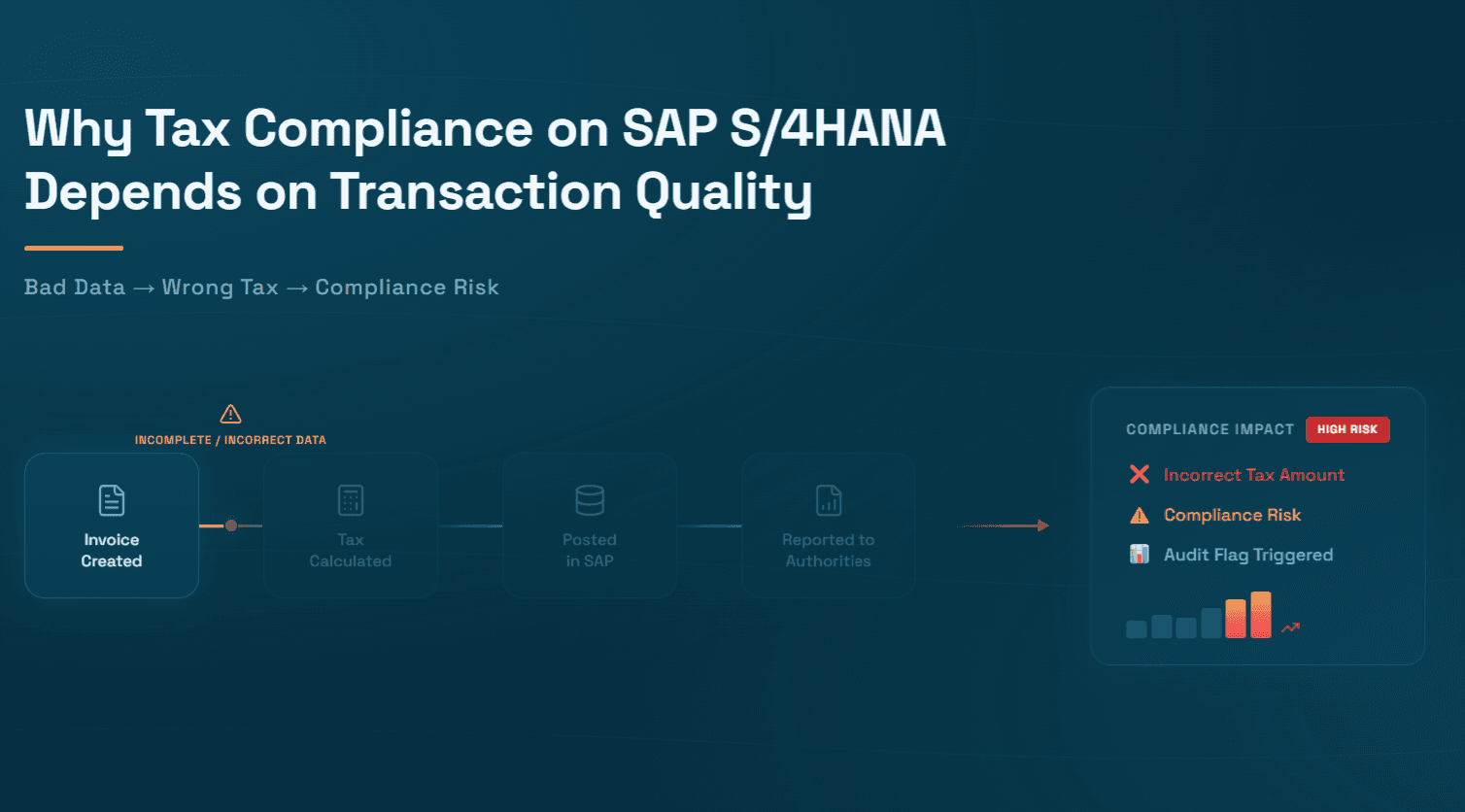
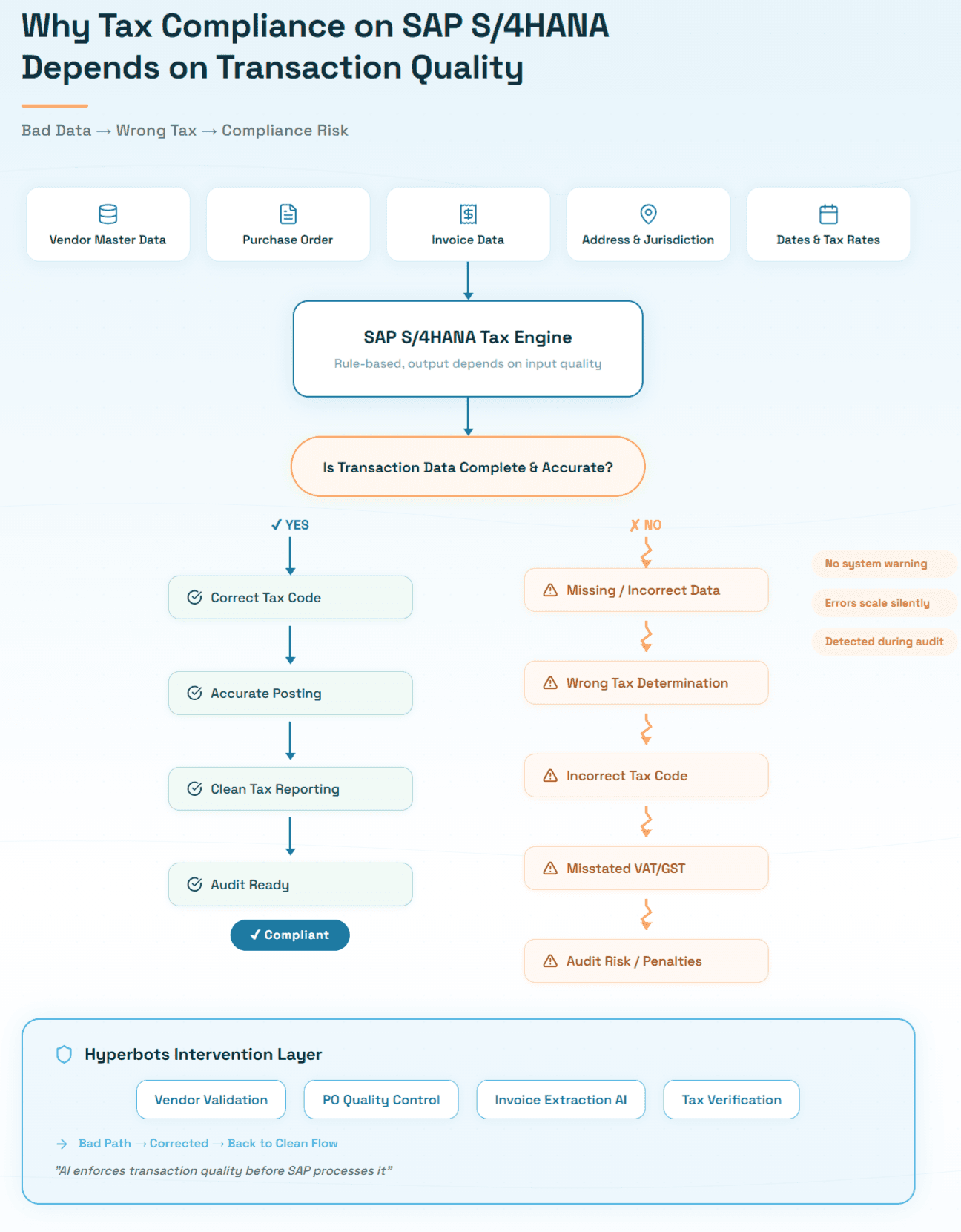
Here is the uncomfortable truth about SAP S/4HANA and indirect tax accuracy: the tax engine is only as reliable as the transaction data that feeds it. Every VAT or GST determination, every tax code assignment, every inter-company posting, and every vendor invoice that flows through the system is subject to the quality of the data entered upstream. When that data is incomplete, ambiguous, or inconsistent, the tax engine makes incorrect determinations, silently, at scale, and often invisibly until an auditor arrives.
This blog explores why transaction quality is the foundational variable in SAP S/4HANA tax compliance, where the failure points are, how they manifest as VAT and GST errors, and what organizations can do to engineer quality at the source rather than clean up after the fact.
What "Transaction Quality" Actually Means in an SAP S/4HANA Context
Transaction quality is not just a concept from data governance. In the context of SAP S/4HANA and indirect tax, it refers to a specific set of data attributes that must be accurate, complete, and consistent on every business document that triggers a tax event.
These attributes include:
The tax classification of the material or service being procured or sold. SAP uses material master data and service classifications to determine whether a line item is taxable, exempt, zero-rated, or subject to reduced rates under VAT or GST rules. If the classification is missing or wrong, the tax code assigned will be wrong.
The tax classification of the vendor or customer business partner. SAP's Business Partner master contains tax-relevant fields including the tax number, the jurisdiction code, and the tax indicator that tells the system whether the counterparty is a registered taxable entity, a non-resident, or an entity entitled to specific tax treatment. Errors here cascade into every transaction with that vendor.
The plant and delivering plant on a purchase order or sales order. In VAT and GST systems, the place of supply rules are often location-dependent. SAP uses the plant assignment to derive the tax jurisdiction. If the plant is incorrectly entered or if a drop-ship scenario means the delivering plant differs from the receiving plant, the jurisdiction determination fails.
The document date and posting date. Tax rates change. Jurisdictions update their rules. The correct tax rate on a transaction depends on when it occurred, not when it was entered into the system. Backlogs in invoice processing frequently result in documents posted with incorrect dates, triggering the wrong tax rate.
The purchase order line item completeness. Three-way matching, the reconciliation of a purchase order, a goods receipt, and a vendor invoice, is the bedrock of AP compliance in SAP. When PO line items are incomplete, when quantities or unit prices are missing, or when goods receipt documents are not posted promptly, the match fails and the invoice either sits in exception or is force-posted with incorrect tax.
These are not edge cases. In most mid-market and enterprise SAP environments, data quality problems of this kind affect a meaningful proportion of transactions. The volume of manual intervention required to correct them is what drives up processing costs, extends cycle times, and creates the audit exposure that CFOs dread.
How VAT and GST Errors Originate in the Transaction Layer
The Vendor Master Problem
Every vendor invoice that enters SAP carries with it an assumption: that the vendor master record from which tax-relevant fields are read is accurate and up to date. In practice, vendor master data is one of the most poorly maintained areas of SAP installations.
A vendor may change their registered VAT or GST number. They may restructure their legal entity, changing their tax registration status. They may begin supplying from a different country or state, altering the applicable tax jurisdiction. If the vendor master is not updated to reflect these changes, every subsequent invoice processed against that vendor will carry incorrect tax data.
The problem compounds when organizations have multiple SAP clients, when they have grown through acquisition and brought in vendor records from legacy systems, or when procurement teams create new vendor records without following a standardized master data governance process. It is not unusual to find the same vendor represented multiple times in SAP with different tax classifications across records and for invoices to be routed to different records depending on who in the procurement team created the purchase order.
Understanding how Hyperbots handles vendor onboarding and master data accuracy offers a window into how AI-native systems address this upstream problem systematically.
The Purchase Order Completeness Problem
Purchase orders in SAP are the anchor document for indirect tax in procurement. The PO carries the tax code, the cost object, the plant, and the material or service classification. When an invoice arrives and matches cleanly to a PO, SAP has everything it needs to post correctly. When the PO is incomplete, incorrect, or absent, the downstream tax determination becomes manual.
The challenge is that PO completeness is a function of how purchase requisitions are created, approved, and converted to POs. In organizations where this process is still largely manual, where procurement teams are working from email requests, Excel trackers, and informal approvals, the rate of PO exceptions is high.
The relationship between purchase requisition quality and downstream PO accuracy is a well-documented problem in procurement operations. Every gap in the PR-to-PO handoff is a potential tax error waiting to be discovered.
The Invoice Data Extraction Problem
When a vendor invoice arrives whether by email, EDI, vendor portal, or paper scan, its data must be extracted and matched to the PO and goods receipt before SAP can post it. The quality of that extraction determines whether the tax fields populate correctly.
Traditional OCR-based extraction systems, which remain common in SAP environments, fail with non-standard invoice layouts. They miss line-item detail. They confuse the bill-to address with the ship-to address, which is critical for jurisdiction determination under destination-based VAT and GST rules. They fail to extract tax registration numbers from international invoices, leaving the vendor tax classification field blank.
When these fields are blank or wrong at the point of invoice receipt, one of two things happens: either the invoice goes into an exception queue where a human must correct it manually (slow, expensive, error-prone), or it is force-posted with default tax codes that may not be correct (fast, cheap, and quietly building audit risk).
How AI approaches invoice data extraction differently from legacy OCR is increasingly the conversation finance leaders are having when they examine their tax exception rates.
The Specific Ways Poor Transaction Quality Breaks SAP S/4HANA Tax
Incorrect Tax Code Assignment
SAP determines tax codes through a combination of the tax classification on the material or service, the tax classification on the business partner, and the tax procedure assigned to the company code. When any of these inputs is wrong, the tax code assigned to the document is wrong.
In a VAT environment, this might mean a standard-rated supply is posted as zero-rated. In a GST environment, it might mean an exempt supply is taxed. In a use tax environment, it might mean a taxable purchase is posted without use tax self-assessment, creating a liability that the company is technically obligated to remit but has not captured.
None of these errors generate a system-level warning in SAP. The document posts. The G/L entries are created. The tax return is prepared from those entries. The error propagates into the return and, potentially, into a tax assessment by the relevant authority.
Jurisdictional Misassignment
VAT and GST are inherently territorial. The rules that apply to a transaction depend on where it is deemed to have taken place, which depends on the nature of the supply, the location of the buyer and seller, and, in many GST regimes, whether the supply is B2B or B2C.
SAP handles jurisdictional determination through a combination of plant codes, tax jurisdiction codes, and, in more complex scenarios, the tax determination rules configured in the tax procedure. This configuration requires careful, ongoing maintenance. When a business opens a new location, changes its supply chain, or begins selling in a new jurisdiction, the SAP tax configuration must be updated to reflect the new reality.
In the absence of that maintenance, SAP will continue applying the old rules. Invoices for supplies that should attract the new jurisdiction's tax rate will continue to be posted at the old rate. The discrepancy accumulates until a compliance review or tax audit surfaces it.
The problem is particularly acute for multi-destination shipments, where a single invoice may need to be split across jurisdictions with different tax treatments.
Address Validation Failures
In destination-based tax systems, which includes the GST regimes of most major economies and the VAT regimes of the EU for cross-border B2C supplies, the tax rate applicable to a transaction depends on the delivery address. If the delivery address on a purchase order or sales order is incorrect, the jurisdiction assigned to that transaction is incorrect, and the tax rate is incorrect.
Address errors in SAP are common. They arise from manual data entry, from the use of shorthand or abbreviations, from postal code errors, and from the failure to update addresses when vendors or customers relocate. In high-volume transactional environments, even a small percentage of address errors translates to a significant volume of incorrectly taxed transactions.
Why address accuracy on invoices and POs matters for tax compliance is a topic that often doesn't receive the attention it deserves until an audit reveals the scale of the problem.
Date-Related Rate Errors
Tax rates change. Governments adjust VAT and GST rates as part of budget measures, economic stimulus programs, or legislative reform. When rates change, SAP's tax condition records must be updated to apply the new rates from the effective date.
The risk arises in two directions. First, if condition records are not updated promptly, transactions after the rate change date continue to be posted at the old rate. Second, if backdated invoices are processed, (which is common in high-volume AP environments where processing backlogs exist) they must be checked against the rate applicable on the transaction date, not the posting date.
How transaction dates affect sales tax computation is directly relevant to this challenge, and the same principles apply to VAT and GST in SAP environments.
The Audit and Compliance Consequences of Tax Errors in SAP
The Scale of Hidden Risk
Tax authorities in most major jurisdictions now have data analytics capabilities that allow them to identify anomalies in taxpayer data at scale. Electronic audit files, SAP's own SAF-T (Standard Audit File for Tax) format is a good example, give authorities direct access to transaction-level data. Statistical outliers in tax rates, unusual patterns in exempt supplies, or inconsistencies between reported output tax and input tax claims are all detectable through automated analysis.
When an authority identifies an anomaly and opens an inquiry, the burden is on the taxpayer to demonstrate that each transaction was correctly taxed. In an SAP environment where tax errors originate from data quality problems rather than deliberate evasion, the documentation trail can be difficult to reconstruct. SAP's audit trails show what was posted and when, but they do not always clearly show why a particular tax code was applied or whether the underlying master data was correct at the time of posting.
The Cost of After-the-Fact Correction
Organizations that discover significant tax errors in SAP after the fact face a challenging remediation path. The correction typically requires reverse and re-post entries on the affected documents, amended returns to the relevant tax authority, and, in many cases, interest and penalties on the underpaid or overpaid amounts.
Beyond the direct financial cost, there is the operational cost of the remediation effort itself. Finance teams may need to review thousands of transactions, engage external tax advisors, and invest significant time in correspondence with tax authorities. The indirect cost of this work frequently exceeds the direct tax liability.
How a CFO eliminated $200,000 in tax leakage using Hyperbots is an example of what the cost of undetected tax errors looks like in practice and what is recoverable when the right controls are in place.
The Role of Explainability in Tax Audits
One of the less-discussed aspects of tax compliance in SAP environments is the importance of being able to explain, to an auditor, why a particular tax determination was made on a particular transaction. SAP's standard transaction logs record what happened, but explaining why requires access to the master data and configuration that was in place at the time.
This explainability gap is one of the reasons that AI-driven finance automation platforms, which maintain detailed decision logs for every action taken, are becoming attractive to tax and finance leaders. When an auditor asks why invoice number 12345678 was posted with a zero-rate VAT code rather than the standard rate, the ability to produce a clear, timestamped record of the data that drove that decision and the rule that was applied is a significant compliance asset.
Engineering Transaction Quality for Indirect Tax Accuracy
The Vendor Onboarding Checkpoint
The most effective point at which to intervene in the transaction quality problem is at vendor onboarding, before any transactions are processed. A vendor onboarding process that validates tax registration numbers against official registries, verifies business addresses, confirms entity type and tax status, and populates SAP vendor master fields in a standardized, governance-controlled way eliminates a large proportion of downstream tax errors.
This is not a new insight. What is new is the feasibility of doing this at scale and with a level of automation that makes it operationally sustainable. Manual vendor onboarding processes, which require AP or procurement teams to chase vendors for documents and manually key data into SAP, are too slow and too error-prone to serve as a reliable quality gate.
The challenges in vendor onboarding and how AI addresses them covers this territory in detail.
The Purchase Order as a Tax Control Point
The PO should be treated as a tax control document, not just a procurement instrument. This means that every PO must carry a validated tax code, a correct plant assignment, an accurate delivering plant where applicable, and correctly classified line items. It means that PO approval workflows must include a tax validation step, not just a budget approval step.
Automating PO creation and validation so that the PR-to-PO conversion populates tax-relevant fields from validated master data rather than relying on manual entry, substantially reducing the error rate. Purchase order automation and the role of policy-driven AI shows how automation that embeds tax policy into PO creation workflows produces measurable accuracy improvements.
For a full picture of how automation transforms the PR-to-PO process end to end, the guide on PR to PO in 4 hours is instructive.
Invoice Receipt and Matching as a Tax Verification Layer
The invoice receipt and three-way matching process is not only a financial control; it is also a tax verification layer. When an invoice is received, its tax fields, the tax amount charged, the tax code indicated, the vendor's tax registration number, the delivery address, should be validated against the expected values derived from the PO and goods receipt.
Mismatches between the tax on the invoice and the expected tax should generate exceptions that are routed for review, not silently resolved through default postings. How AI solves the challenges of three-way matching addresses this directly.
The connection between GL coding accuracy and financial reporting quality is also relevant here because incorrect tax codes translate directly into incorrect GL entries and therefore into inaccurate tax accounts on the balance sheet and P&L.
Real-Time Sales Tax Verification on Invoice Lines
For organizations operating in the US, where sales and use tax rules vary by state, county, and even city, the verification of tax on vendor invoices is a specific and complex challenge. SAP can handle US tax determination through integration with third-party tax engines, but this integration is only as good as the address and product classification data that feeds it.
An AI-driven sales tax verification layer that operates at the line-item level and hence validating the taxability of each product or service, confirming the jurisdiction based on origin and destination addresses, checking the vendor's tax registration, and flagging mismatches for review which provides a systematic quality gate that SAP's native configuration alone cannot deliver.
For an understanding of how overcharged and undercharged tax scenarios are handled in practice, handling overcharged sales tax invoices and handling tax liability for undercharged sales tax invoices provide useful operational detail.
The Systemic Challenge: Why SAP Configuration Alone Is Not Enough
Many SAP implementations approach tax compliance primarily as a configuration problem. The logic is understandable: if the tax procedure is correctly configured, if the condition records are correct, and if the tax codes are correctly defined, the system should handle tax determination correctly.
This is true as far as it goes. The problem is that configuration addresses the rule set, not the data quality. A perfectly configured SAP tax procedure will produce incorrect results when fed incorrect transaction data. The configuration cannot compensate for a vendor master that has the wrong tax classification, a PO that was created without a validated plant assignment, or an invoice where the delivery address has been entered incorrectly.
This is why the organizations that achieve the highest levels of indirect tax accuracy in SAP are not necessarily those with the most sophisticated tax configurations. They are the ones that have invested in data quality controls upstream of the tax determination engine—controls on vendor master data, controls on PO creation, controls on invoice receipt and extraction, and controls on address validation.
The differences in Chart of Accounts and GL coding across ERP platforms including SAP illustrates how the structural choices made in SAP setup ripple through every downstream financial and tax process.
GL coding in SAP's Chart of Accounts and the coding scheme in SAP Costpoint are also relevant to understanding how tax accounts are structured and maintained.
Hyperbots AI Co-Pilots: Closing the Transaction Quality Gap in SAP S/4HANA
This is where Hyperbots becomes directly relevant to the tax compliance challenge described above. Hyperbots is a suite of AI co-pilots built specifically for finance and accounting automation, designed to operate as an intelligent layer on top of ERP systems including SAP S/4HANA. Rather than replacing the ERP, Hyperbots AI co-pilots enforce data quality, automate validation, and ensure that the transaction data entering SAP is accurate enough for the tax engine to work correctly.
The suite reduces operational costs by up to 80% and achieves 99.8% accuracy in invoice processing, not by working around SAP's tax engine, but by ensuring that the data feeding it is trustworthy.
The Invoice Processing Co-Pilot
The Invoice Processing Co-Pilot is the front line of transaction quality control for AP-driven tax compliance. It addresses the core problem that traditional OCR and manual processes cannot: extracting complete, accurate, tax-relevant data from vendor invoices at scale.
Unlike template-based OCR systems that fail on non-standard layouts, Hyperbots uses AI-native extraction that works on any invoice format without requiring template setup. It extracts not just header fields but line-item detail including tax amounts, tax registration numbers, unit prices, quantities, and delivery addresses and validates each field against the PO, the vendor master, and company tax policy before passing the document to SAP.
The practical impact is significant. When invoice data arrives in SAP already validated with correct tax codes confirmed, addresses verified, and line items matched, the SAP tax engine has the clean inputs it needs to make correct determinations. Exception rates fall. Manual review queues shrink. The audit trail for every tax determination is clear and complete.
Hyperbots achieves 80% or higher straight-through processing, meaning the vast majority of invoices pass from receipt to SAP posting without human intervention. This is the operational foundation that makes tax compliance scalable.
The Sales Tax Verification Co-Pilot
The Sales Tax Verification Co-Pilot is purpose-built for the specific challenge of US sales and use tax verification on vendor invoices. It operates at the line-item level, validating the taxability of each product or service, confirming the applicable jurisdiction from origin and destination addresses, checking the vendor's tax registration status, and comparing the tax charged on the invoice against the expected tax.
When a mismatch is detected such as an overcharge, an undercharge, an incorrect rate, or a tax applied to an exempt item, the co-pilot flags it for review with a clear explanation of why the discrepancy exists. This prevents both overpayment (where the company pays tax it should not have been charged) and under-self-assessment (where the company fails to accrue use tax on untaxed purchases that are taxable in the destination jurisdiction).
The co-pilot integrates with tax dictionaries for standardized classification across jurisdictions, handles multi-destination shipments, and maintains comprehensive audit trails for every tax verification decision.
For organizations that have experienced tax leakage, the kind of overcharged sales tax that CFOs typically discover only at audit, this co-pilot is the systematic solution. It turns what was previously an episodic, audit-driven problem into a continuous, automated control.
The Vendor Management Co-Pilot
The Vendor Management Co-Pilot addresses the vendor master data quality problem at its source. It automates vendor onboarding with AI-driven identity verification, tax registration number validation, address verification, and structured population of vendor master fields in SAP.
When a new vendor is onboarded through Hyperbots, their tax classification, jurisdiction, and registration data are verified before they ever appear in the SAP vendor master. When an existing vendor updates their information, a new bank account, a new tax registration, a change of address, the co-pilot manages the update workflow with appropriate approval controls and audit documentation.
The benefit for tax compliance is direct: every transaction processed against a Hyperbots-managed vendor record starts from a foundation of validated tax data. The most common source of cascading tax errors in SAP is incorrect vendor master data.
The Procurement Co-Pilot
The Procurement Co-Pilot ensures that purchase orders enter SAP with the tax-relevant fields correctly populated from the start. It automates the PR-to-PO conversion with AI-assisted GL coding, tax code validation, plant assignment verification, and budget control checks, all before the PO is dispatched to the vendor.
The significance of this for tax compliance is that a correctly formed PO is the precondition for correct invoice matching and correct tax determination at the point of invoice processing. When POs are created with validated tax codes and correct plant assignments, the three-way match succeeds cleanly and the tax posting reflects the intended treatment.
Redefining procurement with Hyperbots PR-PO Co-Pilot covers the operational transformation in detail.
The Payments Co-Pilot
The Payments Co-Pilot manages payment execution with fraud prevention, anomaly detection, and GL posting automation. From a tax compliance perspective, its relevance is in ensuring that payments are made against correctly posted invoices and that payment timing decisions, including early payment discounts and strategic late payments, are made with full visibility into the financial implications.
The co-pilot also handles automated remittance advice to vendors, which is a communication control that helps prevent disputes and discrepancies that might otherwise result in corrected invoices being processed and creating additional tax complexity.
The Accruals Co-Pilot
The Accruals Co-Pilot is relevant to tax compliance in a specific but important way: it ensures that period-end accruals for received-but-not-invoiced goods and services are correctly calculated, correctly coded to GL accounts with the appropriate tax treatment, and posted and reversed in the correct accounting periods.
In VAT and GST environments, the timing of tax recognition is important. A supply that has been received and for which an accrual has been posted may or may not generate a recoverable input tax claim, depending on jurisdiction rules about the timing of VAT/GST recovery. Incorrect accrual treatment can result in input tax claims being submitted in the wrong period or not at all.
Hyperbots Platform Capabilities Creating Transformational Impact
What distinguishes Hyperbots from point solutions and legacy automation platforms is not any single co-pilot in isolation, but the integrated nature of the platform and the architectural principles that underpin it.
Hyperbots is AI-native, not rule-based. This means that its co-pilots reason about transactions rather than applying brittle if-then rules that fail on exceptions. When an invoice presents an unusual tax scenario, a partial return, a mixed supply with different tax treatments on different lines, a cross-border service with complex place-of-supply implications, the AI applies judgment based on policy configuration and historical patterns rather than failing to an exception queue.
Hyperbots is pre-trained on finance and accounting data. This is a critical differentiator. Generic large language models and general-purpose AI platforms lack the domain-specific training on financial documents, tax classifications, GL coding conventions, and ERP data structures that are necessary to operate accurately in a finance context. What is missing from financial AI training data articulates this distinction clearly. Hyperbots' pre-trained models are ready to deploy from day one with high accuracy, without the lengthy training period that custom-built solutions require.
Hyperbots is self-learning. Feedback from human reviewers when an exception is resolved, when a tax code is corrected, when a vendor master update is approved is used to continuously improve the models. Accuracy improves over time without requiring manual rule updates.
Hyperbots provides comprehensive audit trails for every decision. Every action taken by a Hyperbots co-pilot like every tax code assigned, every validation check performed, every exception flagged is logged with a timestamp and a reason code. This audit documentation is not an afterthought; it is built into the platform architecture. Empowering CFOs to enhance auditability in the age of AI covers why this matters for tax compliance specifically.
Hyperbots uses an unlimited-user licensing model. Unlike per-user pricing models that create incentives to restrict access to the automation platform, Hyperbots' unlimited-user model allows organizations to deploy co-pilots across all users without incremental cost. This matters for tax compliance because tax validation should not be a privilege reserved for senior AP staff, it should be embedded in every workflow for every user.
ROI of Hyperbots AI Co-Pilots in P2P and O2C
The financial case for addressing transaction quality through AI co-pilots is quantifiable and significant.
In procure-to-pay, Hyperbots customers have documented 80% productivity improvements in invoice processing and 99.8% accuracy in data extraction and tax determination. Extreme Reach's achievement of 80% straight-through processing with 99.8% accuracy is one of the most detailed public case studies of what this looks like in practice. The cost per invoice processed falls dramatically when manual review is required on fewer than 20% of documents. The indirect tax accuracy improvements eliminate the leakage that would otherwise show up as audit adjustments.
The $200,000 in tax leakage that one CFO recovered using Hyperbots is one data point. The broader picture is that organizations processing high volumes of vendor invoices are typically leaving meaningful amounts of incorrectly taxed transactions undetected every year, either overpaying tax that should not have been charged, or under-remitting tax that was due. Both forms of error have direct financial consequences. ROI on AI-led automation in finance provides a framework for calculating the full value.
In order-to-cash, the Collections Co-Pilot and Cash Application Co-Pilot reduce the days outstanding on receivables and accelerate cash matching, which has indirect tax benefits: when invoices are paid and matched more quickly, the tax periods close more cleanly, reducing the volume of open items that must be managed through accruals and reconciliations.
Hyperbots’ Collections Co-Pilot delivers up to 40% reduction in DSO, 70% reduction in cost to collect, and 80% improvement in collections productivity, driven by AI-led prioritization, automated dunning, and autonomous follow-ups.
At the same time, the Cash Application Co-Pilot reduces unapplied cash to below 10%, and lowers reconciliation costs by up to 80%, with 99.8% matching accuracy across fragmented remittance data.
The combined effect is not just faster cash realization but structurally cleaner financial periods: fewer unmatched receipts, lower reconciliation effort, reduced carry-forward of tax-relevant open items, and significantly tighter period-end close.
Pre-trained AI co-pilots also reduce the time to go live from months to days, which means organizations can realize these benefits without the lengthy implementation cycles that have historically made enterprise finance transformation so expensive.
How Hyperbots Differentiates From Other Software in the Market
The AP automation and tax compliance software market is crowded. Platforms like Tipalti, Ramp, and various ERP-native tools all claim to address invoice processing and tax compliance. The differentiators that matter for SAP S/4HANA tax accuracy specifically are:
ERP integration depth. Hyperbots integrates at the data model level with SAP and other major ERPs, not through superficial API connections that only exchange summary data. Faster onboarding with Hyperbots ERP integration explains the pre-built connector approach. This depth means that Hyperbots co-pilots can read and write the specific SAP fields like tax codes, jurisdiction codes, material classifications that drive indirect tax accuracy.
Line-item extraction accuracy. Many platforms extract header-level data from invoices and rely on the PO for line-item detail. This is insufficient for tax compliance, where line-item tax treatment may vary across a single invoice. Hyperbots extracts and validates at the line-item level, which is the granularity that indirect tax accuracy requires.
Sales tax verification as a native co-pilot. Most AP automation platforms treat tax verification as a bolt-on integration to a third-party tax engine. Hyperbots includes a purpose-built Sales Tax Verification Co-Pilot that operates at the line-item level with AI-driven classification, jurisdiction determination, and mismatch detection.
Self-correcting AI versus human-in-the-loop. Competitors like Tipalti route exceptions to human reviewers as the primary exception management mechanism. Hyperbots' self-correcting AI resolves the majority of exceptions autonomously, learning from the resolution to improve future accuracy. Why accuracy matters more than speed in invoice automation and the comparison of Hyperbots vs. Tipalti on accuracy and STP make this case in quantitative terms.
Explainability. Hyperbots' AI provides reasons for every decision, which is essential for tax audit defense. The transparency gap between Hyperbots' explainable AI and black-box alternatives illustrates why this matters in practice.
Transaction Quality Is Tax Strategy
The organizations that achieve durable indirect tax accuracy on SAP S/4HANA are not the ones that have invested most heavily in tax configuration or tax advisory services. They are the ones that have recognized that tax compliance is, at its core, a data quality problem and that the solution lies upstream, in the quality of the transactions that feed the tax engine.
Vendor master data that is validated at onboarding. Purchase orders that are complete and correctly coded before they are dispatched. Invoice data that is extracted at the line-item level and verified against jurisdiction rules before it reaches SAP. These are the controls that make VAT, GST, and indirect tax accuracy achievable at scale.
Hyperbots AI co-pilots are built to enforce exactly these controls, at the data volumes that modern enterprises require, with the accuracy that tax compliance demands. The combination of the Invoice Processing Co-Pilot, the Sales Tax Verification Co-Pilot, the Vendor Management Co-Pilot, the Procurement Co-Pilot, the Payments Co-Pilot, and the Accruals Co-Pilot creates an end-to-end data quality layer that transforms how SAP S/4HANA handles tax, not by changing the ERP, but by ensuring the ERP receives the quality of data it needs to perform correctly.
For finance leaders who are serious about indirect tax accuracy, the conversation cannot stop at SAP configuration. It must extend to the entire transaction lifecycle that precedes tax determination. That is where the real opportunity lies and where AI co-pilots like Hyperbots are delivering measurable, auditable results.
To see how Hyperbots AI co-pilots can improve indirect tax accuracy in your SAP environment, visit hyperbots.com/request-demo or explore the ROI calculators for your specific use case.
Frequently Asked Questions
Q1: Does SAP S/4HANA automatically ensure VAT and GST compliance?
No. SAP S/4HANA's tax engine is a powerful rule-based system, but it determines tax based on the data it receives from transaction documents, master data, and configuration. If any of those inputs are incorrect like wrong tax classification on a vendor, incorrect plant assignment on a PO, wrong delivery address on an invoice, the tax determination will be incorrect. SAP cannot compensate for poor data quality.
Q2: What is the most common cause of indirect tax errors in SAP?
Vendor master data quality is consistently the most common root cause. When vendor tax classifications, tax registration numbers, or addresses are incorrect in the SAP vendor master, every transaction with that vendor is potentially misstated from a tax perspective. The second most common cause is incomplete or incorrectly formed purchase orders that prevent clean three-way matching.
Q3: How does AI improve indirect tax accuracy in SAP environments?
AI improves indirect tax accuracy by enforcing data quality upstream of SAP's tax engine. This means AI-driven vendor onboarding that validates tax data before it enters the vendor master, AI-driven invoice extraction that captures complete line-item and address data from any invoice format, and AI-driven sales tax verification that checks every line item against jurisdiction rules before posting. When the inputs to SAP's tax engine are clean and complete, the tax engine performs correctly.
Q4: What is the difference between sales tax verification and use tax self-assessment in the context of SAP?
Sales tax verification addresses the question of whether a vendor has charged the correct amount of tax on an invoice. Use tax self-assessment addresses the question of whether a purchase that was not taxed by the vendor should nonetheless attract a use tax liability in the buyer's jurisdiction. Both require the same underlying data quality which includes accurate product classification, correct addresses, verified vendor tax registration status and both are addressable through AI-driven verification at the invoice receipt stage.
Q5: How does Hyperbots integrate with SAP S/4HANA?
Hyperbots connects to SAP S/4HANA through pre-built ERP connectors that integrate at the data model level. This means co-pilots can read PO data, vendor master records, and GL coding structures directly from SAP, and post validated invoices, accruals, and payment instructions back into SAP with full field mapping. The integration does not require custom development for standard SAP configurations.
Q6: Can Hyperbots be deployed on top of an existing SAP implementation without disruption?
Yes. Hyperbots is designed to operate as an overlay on existing ERP implementations. It does not require changes to SAP configuration or custom ABAP development. The pre-built connectors and pre-trained models allow organizations to go live within days rather than months, with immediate accuracy improvements from the first transactions processed.
Q7: How does Hyperbots help with VAT/GST compliance specifically?
Hyperbots contributes to VAT and GST compliance through several mechanisms: validating vendor tax registration numbers against registries before they are used in SAP, ensuring delivery address accuracy for destination-based tax determination, verifying that line-item tax codes match expected treatments based on product classification and jurisdiction, and maintaining comprehensive audit trails that can be produced in response to tax authority inquiries. The Sales Tax Verification Co-Pilot is specifically designed for US sales and use tax, but the broader data quality controls benefit VAT and GST compliance in all jurisdictions.
Q8: What ROI can finance teams expect from deploying Hyperbots?
Hyperbots customers have documented 80% reductions in manual processing effort and 99.8% invoice accuracy. In tax-specific terms, the elimination of incorrectly taxed transactions prevents both direct financial losses (overpaid tax, under-remitted tax liabilities) and indirect costs (audit remediation, interest, and penalties). ROI calculators for each Hyperbots co-pilot are available at hyperbots.com/roi-calculators.